❌

Normal view

  • ✇Porter & Co
  • These Bonds Can Outrun Inflation
    TIPS are securities that offer long-term protection from inflation. They generate low guaranteed returns if held to maturity – and their market value can swing significantly. Today, Andy Lipman explains why he believes they are best…
     

These Bonds Can Outrun Inflation

17 October 2026 at 09:39
TIPS are securities that offer long-term protection from inflation. They generate low guaranteed returns if held to maturity – and their market value can swing significantly. Today, Andy Lipman explains why he believes they are best…
  • ✇Armstrong Economics
  • The Political Confrontation Martin Armstrong
    QUESTION: So, if the Democrats take the House and possibly the Senate, and if I remember correctly, Biden didn’t sign that act saying the president cannot withdraw from NATO? Does that mean the Democrats can force us into World War III to protect Zelensky? HJ ANSWER: Yes and No. In 2024, Biden signed Section 1250A  into law, which prohibits the President from unilaterally withdrawing the United States from NATO. The 2024 National Defense Authorization Act (NDAA) included it, and it is codified
     

The Political Confrontation

16 October 2026 at 21:09

Party Politics

QUESTION: So, if the Democrats take the House and possibly the Senate, and if I remember correctly, Biden didn’t sign that act saying the president cannot withdraw from NATO? Does that mean the Democrats can force us into World War III to protect Zelensky?

HJ

ANSWER: Yes and No. In 2024, Biden signed Section 1250A  into law, which prohibits the President from unilaterally withdrawing the United States from NATO. The 2024 National Defense Authorization Act (NDAA) included it, and it is codified at 22 U.S.C. § 1928f.

The law explicitly prohibits the President from suspending, terminating, denouncing, or withdrawing from the North Atlantic Treaty except by one of two methods:

Advice and consent of the Senate, with two-thirds of Senators present concurring, or
An Act of Congress.

It also bars the use of any federal funds to support a NATO withdrawal without meeting those requirements. This was supported by the Neocon then Sen. Marco Rubio (now Secretary of State) and Sen. Tim Kaine.

The law sets up a potential legal clash. The executive branch’s Office of Legal Counsel (OLC) issued a 2020 opinion arguing that treaty withdrawal is an exclusive presidential power that Congress cannot constitutionally constrain. If a President attempted to withdraw without congressional approval, the matter would end up in court unless you had a Democrat as president.

However, the practical effect is that any President would need at least 14 Democratic Senators (assuming all Republicans voted to withdraw) to reach the two-thirds threshold required by the law. Section 1928f is titled “Limitation on withdrawal from the North Atlantic Treaty Organization.” Its sole purpose is to prevent the President from unilaterally withdrawing the United States from NATO without congressional approval.

While I believe it is unconstitutional, the real tension would be the Democrats would shut down all funds until he sent Americans to due for the ethnic cleansing of Zelensky. Anyway you slice this, we are in for a chaotic 2 years into 2028 and the American people, and the world, will wonder if the United States is even salvageable.

  • ✇Armstrong Economics
  • Market Talk – October 16, 2026 Martin Armstrong
    ASIA: The major Asian stock markets had a green day today: • NIKKEI 225 increased 898.34 points or 1.39% to 65,324.29 • Shanghai increased 8.808 points or 0.24% to 3,716.284 • Hang Seng increased 124.11 points or 0.52% to 24,186.83 • ASX 200 increased 87.00 points or 1.00% to 8,806.70 • SENSEX increased 413.66 points or 0.56% to 74,729.27 • Nifty50 increased 148.80 points or 0.65% to 23,146.15 The major Asian currency markets had a mixed day today: • AUDUSD increased 0.0018 or 0.26% to 0.69
     

Market Talk – October 16, 2026

16 October 2026 at 13:34

Market Talk 2017

ASIA:
The major Asian stock markets had a green day today:
• NIKKEI 225 increased 898.34 points or 1.39% to 65,324.29
• Shanghai increased 8.808 points or 0.24% to 3,716.284
• Hang Seng increased 124.11 points or 0.52% to 24,186.83
• ASX 200 increased 87.00 points or 1.00% to 8,806.70
• SENSEX increased 413.66 points or 0.56% to 74,729.27
• Nifty50 increased 148.80 points or 0.65% to 23,146.15
The major Asian currency markets had a mixed day today:
• AUDUSD increased 0.0018 or 0.26% to 0.69390
• NZDUSD increased 0.00235 or 0.42% to 0.56465
• USDJPY increased 0.032 or 0.02% to 158.030
• USDCNY decreased 0.00328 or -0.05% to 6.68615
The above data was collected around 14:07 EST.
Precious Metals:
•  Gold decreased 7.8 USD/t oz. or -0.19% to 4,163.26
•  Silver decreased 0.389 USD/t. oz. or -0.68% to 57.017
The above data was collected around 14:12 EST.
EUROPE/EMEA:
The major Europe stock markets had a green day today:
•  CAC 40 increased 22.00 points or 0.28% to 7,956.70
•  FTSE 100 increased 41.55 points or 0.38% to 10,881.90
•  DAX 30 increased 239.99 points or 0.95% to 25,622.61
The major Europe currency markets had a mixed day today:
• EURUSD increased 0.00089 or 0.08% to 1.12291
• GBPUSD increased 0.00403 or 0.30% to 1.33156
• USDCHF decreased 0.00231 or -0.28% to 0.82445
The above data was collected around 14:19 EST.

AMERICAS:

US Markets:

  • DJIA declined by 175.28 points (0.34%) to 52,002.41
  • S&P 500 declined by 84.62 points (1.09%) to 7,659.44
  • NASDAQ declined by 572.99 points (2.15%) to 26,140.034
  • Russell 2000 declined by 45.9 points (1.66%) to 2,721.37

Canada:

  • TSX Composite advanced by 39.45 points (0.11%) to 36,176.55
  • TSX 60 advanced by 3.81 points (0.18%) to 2,142.72

Brazil:

  • Bovespa advanced by 1,106.07 points (0.54%) to 205,430.33
ENERGY:
The oil markets had a mixed day today:
•  Crude Oil increased 3.319 USD/BBL or 3.39% to 101.289
•  Brent increased 3.507 USD/BBL or 3.31% to 109.427
•  Natural gas decreased 0.1255 USD/MMBtu or -3.88% to 3.1105
•  Gasoline increased 0.0476 USD/GAL 1.50% to 3.2278
•  Heating oil increased 0.032 USD/GAL or 0.66% to 4.8776
The above data was collected around 14:22 EST.
•  Top commodity gainers: Crude Oil (3.39%), Brent (3.31%), Silicon (2.65%) and Coffee (3.47%)
•  Top commodity losers: Natural Gas (-3.88%), Lithium (-2.16%), Cocoa (-2.59%) and Wheat (-1.61%)
The above data was collected around 14:47 EST.
BONDS:
Japan 2.9330% (+0.49bp), US 2’s 4.75% (+0.008%), US 10’s 5.1110% (+3.7bps); US 30’s 5.44 (+0.035%), Bunds 3.4564% (+4.89bp), France 4.7860% (-0.55bp), Italy 4.5100% (+2.28bp), Turkey 32.81% (-5bp), Greece 4.3220% (+5.1bp), Portugal 3.9000% (+1.91bp); Spain 4.053% (+2.5bp) and UK Gilts 5.4049% (+4.18bp)
The above data was collected around 14:52 EST.
  • ✇Market Wise
  • How to trade AI stocks from here Brian Hunt
    Today’s issue in preview: How to get paid again and again by owning the world’s best businesses How to trade AI stocks from here This bull market in energy is generating huge winners. Here are four good ways to invest. Learn our Top Themes to buy now How to trade AI stocks from here Credit: KanawatTH The giant AI infrastructure boom has its believers and its doubters. And they can disagree on many things. But they can all agree that no matter if this trend is going to move higher or
     

How to trade AI stocks from here

16 October 2026 at 12:00

Today’s issue in preview:

  • How to get paid again and again by owning the world’s best businesses

  • How to trade AI stocks from here

  • This bull market in energy is generating huge winners. Here are four good ways to invest.

  • Learn our Top Themes to buy now


How to trade AI stocks from here

Image

Credit: KanawatTH

The giant AI infrastructure boom has its believers and its doubters. And they can disagree on many things.

But they can all agree that no matter if this trend is going to move higher or lower from here, it’s going to do so quickly… and with plenty of volatility.

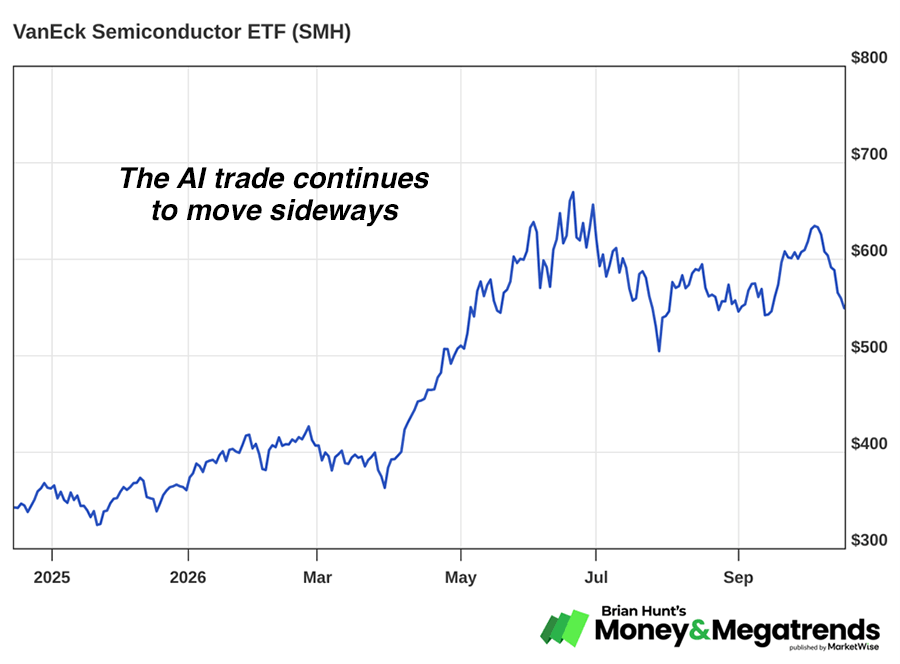
Case in point: After ripping higher in September, most of this megatrend’s key stocks and ETFs have suffered steep declines over the past week. This rapid series of up-and-down moves has left the larger trend back to trading in a directionless, sideways market… or “becalmed,” like a sailboat on a windless sea.

In other words, the “world’s most important trend” is back in a holding pattern. Here’s what it means for your portfolio…

Over the past three months, we’ve published a special series of research notes analyzing the AI infrastructure trend.

The status of this critical trend has become one of the great sagas of the business and investment world… a source of intense disagreement among industry bulls and bears. It’s a trend whose outcome could have large effects on your portfolio.

Given AI’s enormous promise, large tech firms such as Alphabet (GOOG), Amazon (AMZN), and Microsoft (MSFT) have invested over $1 trillion in AI infrastructure. They are on pace to invest over $700 billion this year alone and more than $3 trillion after that.

Both the scale and the velocity of this investment boom are unprecedented. It is the largest collective investment effort in history.

Big Tech’s historic investment boom has made the entire “AI infrastructure” trend responsible for a large share of America’s GDP growth and stock market returns over the past two years. It has also drawn the skeptical scrutiny of many widely followed investment analysts who claim the trend is a bubble… one that will soon explode and cause tremendous damage to stock prices and the global economy.

If this hugely consequential trend isn’t the most important trend in the stock market, then it is certainly in the top three.

I believe the AI infrastructure trend has years to run. I believe the world’s smartest, most connected tech insiders who know the true state of bleeding-edge AI development and have real-time stats on AI investment ROI, such as Elon Musk, Jensen Huang (Nvidia), Satya Nadella (Microsoft) and Andy Jassy (Amazon), perhaps maybe… just might… know far more about AI and their businesses than outsiders know about it.

As much press as AI gets, let’s remember that less than 1% of the global population pays for top-tier AI programs. And I estimate less than 10% of large companies believe AI has made a meaningful impact on their businesses.

This revolutionary technology hasn’t yet proliferated, achieved mass adoption, or had mass impact. However, the Agent Supernova is coming.

Regular readers know I care a lot more about what the market thinks of any stock, trend or theme than what any one person thinks of it, including me. You can be bullish or bearish on a trend all you like, but if that trend is moving strongly against you, then your idea isn’t worth much in my book.

One of the best ways to gauge what the market thinks of AI infrastructure is analyzing the VanEck Semiconductor ETF (SMH).

This fund is full of key semiconductor firms whose fortunes rise and fall with AI infrastructure spending trends. Major holdings include Nvidia (NVDA), Taiwan Semiconductor (TSM), AMD (AMD), Texas Instruments (TXN), ASML Holdings (ASML) and Micron (MU).

As you can see in the two-year chart below, SMH enjoyed a gigantic run from June 2025 to June 2026. The fund gained 176%. Since June 2026, however, the fund has corrected and moved in a volatile, sideways pattern. The fund attempted a breakout in late Sept/early Oct, but huge selling pressure over the past week has sent it back into its sideways base. Back to a trendless state.

I’ll keep you updated on the world’s most important trend. It won’t be long before we get meaningful price action that provides more direction for trading the semis and AI as a megatrend.

Image

Recommended Link:

The #1 Stock Picker Who Called AMD Is Going Public With His Next Big Idea

Ad Image

TipRanks once named Luke Lango the #1 stock picker out of 15,000. He recommended AMD back when Wall Street dismissed it as a gaming company – before it soared as much as 26,797%. Now Luke’s found what he believes could be the most lucrative move of Elon Musk’s career – along with the $15 stock at the center of it all. Click here for the full story.

How to get paid again and again by owning the world’s best businesses

Image

Credit: Liudmila Chernetska

This week, the stock market sent us a subtle but important message…

It says that if you don’t want to deal with the complexity and volatility of investing in rapidly evolving technologies like AI, consider focusing on the simplicity of just getting paid.

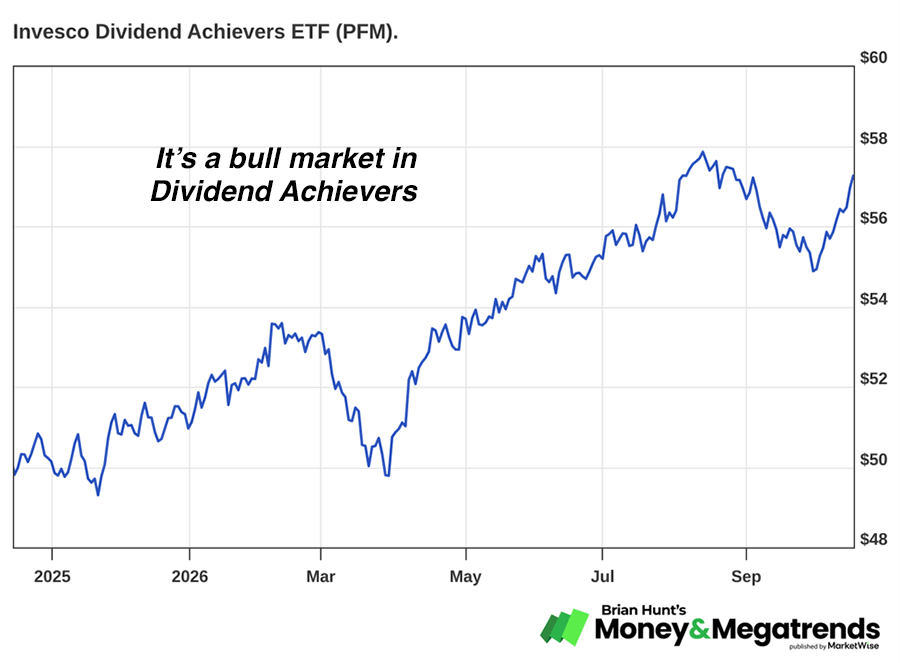
Focus on the strategy employed by investment funds like the Invesco Dividend Achievers ETF (PFM).

PFM is a unique fund that invests exclusively in high-quality dividend-paying stocks. A dividend is a payment a company makes to its shareholders, typically distributed from its profits. Dividends are typically paid by companies on the larger, more stable side of the stock market spectrum.

In the world of dividend payers, there is an elite class of firms that have raised their dividends for 10 consecutive years. These elite, high-quality firms are called Dividend Achievers. Only the strongest, most durable companies can qualify for membership in this club.

Some legendarily great businesses that are members of the exclusive Dividend Achievers club include Johnson & Johnson (JNJ), PepsiCo (PEP), 3M (MMM), Wal-Mart (WMT), Visa (V), Procter & Gamble (PG), Coca-Cola (KO), Chevron (CVX), and ExxonMobil (XOM).

Some of these firms have increased their dividends not for “just” 10 years in a row, but 30, 40, and even 50+ years in a row (and are called “Dividend Aristocrats”).

These businesses have paid and increased their dividends through recessions, bear markets, and a global pandemic. In terms of consistency, these firms rank just behind the rising sun. PFM is a fund designed specifically to own such firms.

Over the past week, many high-profile technology stocks, such as Lumentum (LITE), Dell Technologies (DELL), and Applied Materials (AMAT), have suffered large short-term sell-offs. Each firm is down more than 15% over the past five trading sessions.

Meanwhile, PFM has climbed by 2% over the same period. It’s something of a “port in the storm.” As you can see in the one-year chart below, the fund is enjoying a strong uptrend and is near its all-time high.

We are wildly bullish on the power of technology to create greater prosperity, longer lifespans, and large investment returns. However, we understand that “going big” into technology investments isn’t for everyone. And of course, it’s smart to have a diversified portfolio.

If you’re of the same mind, it’s good to know that investing in stable compounders and insisting on “getting paid” is still working well.

Image


This bull market in energy is generating huge winners. Here are four good ways to invest.

Image

Credit: Stock87

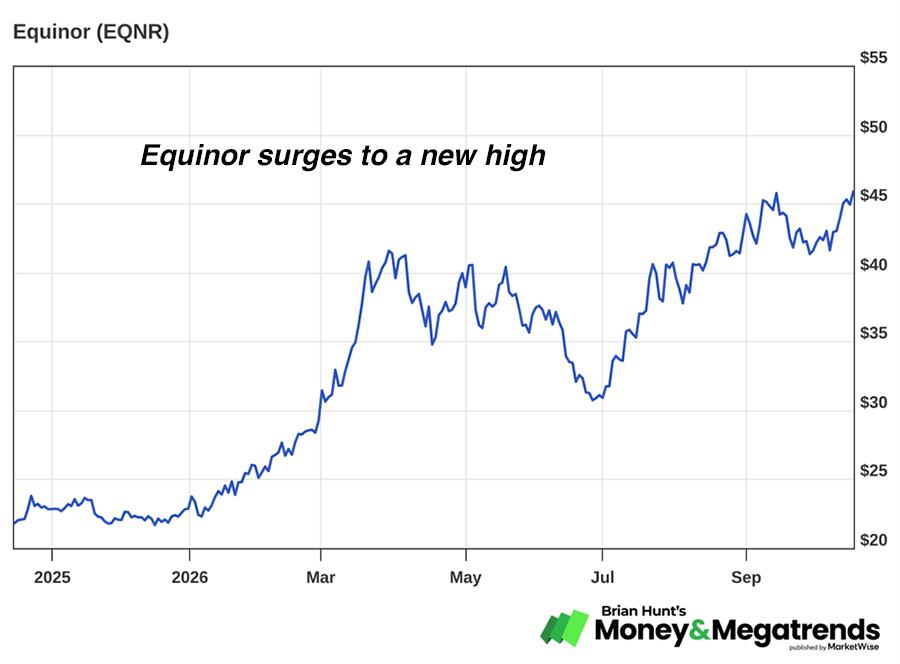
This morning, the stock prices of Canadian oil giants Suncor Energy (SU) and Canadian Natural Resources (CNQ) reached new all-time highs. Shares of Norwegian oil and gas giant Equinor (EQNR) did the same.

This price action tells us that it’s still a bull market in “non-Middle Eastern” oil supplies… and that our September 2025 recommendation to get long oil stocks was very well timed.

Last September, I made the case for going long the emerging uptrend in oil and gas stocks: As the global economy grows, oil demand will remain solid. However, importantly, U.S. shale oil production growth appears to be peaking.

Flatlining supply from this region would remove a critical and reliable source of production growth that has been in place for more than a decade. Plus, oil was very cheap relative to gold and other assets, indicating good value.

With all that in mind, we’ve written frequently and bullishly about owning Suncor, ExxonMobil (XOM), the diversified State Street Energy Select Sector SPDR Fund (XLE), and oilfield service stocks like those in the SPDR S&P Oil & Gas Equipment & Services ETF (XES). The oil sector has been one of the true market leaders over the past year. Both XOM and XLE recently reached new all-time highs.

When I recommended oil and started trading it from the long side, I did not factor in the potential bullish driver of the Iran War. That’s been a “bonus” driver of gains in oil stocks. Sometimes, the dice rolls in your favor.

Although positive news related to the Iran War could emerge at any time and trigger a short-term correction in oil and oil stocks, the long-term picture remains bullish. I see three reasons why this is the case.

One: Critical oil infrastructure in the Middle East has been damaged. Oil flows will not return to pre-war levels for possibly over a year. This supports oil prices north of $80 per barrel, which in turn supports strong cash flows for oil and gas firms.

Two: Most countries maintain substantial above-ground “buffer” supplies of oil and refined petroleum products in the event of market disruptions such as the Iran War. Over the past six months, much of these buffer supplies have been depleted to compensate for the loss of Middle Eastern flows. They must be replenished.

The coming restocking of buffer supplies will support oil prices north of $80 per barrel… which, again, supports large cash flows for oil and gas firms.

Three: Although oil stocks have enjoyed a large run since our September call, they aren’t up much over the past ten years. Adjusted for dollar debasement over the past decade, key oil and gas ETFs are down significantly. This is not an aging bull market that has attracted too many fans and too much capital. It is the opposite of that.

I’ve been especially bullish on companies with all or most of their assets in safe, reliable “not Middle Eastern” asset bases such as Canada, Brazil, and Norway (where Equinor is a major player).

As I’ve covered over the past five months, for many countries and businesses, the Iran War is a powerful reminder: If your survival or smooth operation depends on uninterrupted resource flows from the Middle East, you are in a dangerous, vulnerable position.

No politician, CEO, or major shareholder wants their business to be in that position. No citizen wants their country to be in that position. Many powerful and influential people are realizing this is a big risk that must be mitigated if humanly possible. Executives and politicians will get fired for not addressing it effectively.

This means building and buying as many forms of “not Middle Eastern” and “non-Russian” resource supply chains as possible economically… like those from safe, resource-rich Canada, Norway, and Brazil. With today’s new highs for Suncor, Canadian Natural Resources, and Equinor in mind, I repeat my big picture takeaway: It’s a bull market in safe, reliable oil supplies… so stay long Canada and Norway.

Image


Market Notes

  • Our recommendation to own healthcare stocks continues to pay off. The Health Care Select Sector Fund (XLV) reached a new one-year high today.

  • Software leaders Atlassian (TEAM), Veeva Systems (VEEV), DocuSign (DOCU), Freshworks (FRSH) and Paylocity (PCTY) hit new one-year highs today.

  • Our January 28th recommendation to own the AI application layer is paying off. Zeta Global Holdings (ZETA) just hit a new yearly high. It is up 88% since our initial recommendation.

  • Payment giants Visa (V) and Mastercard (MA) hit new one-year highs today. These are positive economic signals.

  • E-commerce giant eBay (EBAY) hit a new one-year high today.

Regards,

Brian Hunt signature

Brian Hunt signature

Brian Hunt
Editor, Money & Megatrends


An urgent message from our colleagues:

FCC Rule Change Could Fast-Track New Elon Device

Image

New FCC Rule Change Could Make It Easier to Launch Elon’s Next Big Project. See why this new FCC rule change could be the most important evidence for Elon’s newest tech.

Click here.


The post How to trade AI stocks from here appeared first on MarketWise.

  • ✇Schiff Sovereign
  • A good week to be on a government payroll Schiff Sovereign
    It was a good week to be on a government payroll and a bad one to be paying for it. Here are a few of the most absurd stories from the last several days in case you missed them. Too tired to go to work? The Australian government has your back! Michele Duffy, 63, advises students at Victoria University in Melbourne. She asked to work from home two days a week to cut the “physical fatigue” of commuting. She has no medical condition precluding her from going to work in person; she just doesn’t feel
     

A good week to be on a government payroll

16 October 2026 at 10:33

It was a good week to be on a government payroll and a bad one to be paying for it. Here are a few of the most absurd stories from the last several days in case you missed them.

Too tired to go to work? The Australian government has your back!

Michele Duffy, 63, advises students at Victoria University in Melbourne. She asked to work from home two days a week to cut the “physical fatigue” of commuting. She has no medical condition precluding her from going to work in person; she just doesn’t feel like it.

Her employer, the university, disagreed. Her job is dealing with students face to face, and somebody has to be at the desk when they walk in.

Finally Ms. Duffy’s manager offered that she could work from home one day per week, on Fridays, the quietest day.

That wasn’t good enough for Duffy. So she took the university to the Fair Work Commission, Australia’s workplace tribunal. Since 2023, the tribunal can overrule employers who turn down such flexible-work requests.

The tribunal agreed the university was within its rights to refuse Duffy’s request… but then ordered them to comply regardless.

“I do not consider that it was necessary for Ms. Duffy to establish that there was a medical reason [for her to stay home],” the commissioner of the tribunal wrote.

The next logical step in this slippery slope is employees who can demand to be paid when they don’t feel like working at all!

One man, five government salaries, and nobody noticed for three years

Speaking of shamming at work, Kashim Chowdhury, 55, went on trial in London this week, accused of holding five full-time government jobs at once.

Over three years, prosecutors say, he worked his way through eight employers in a chain of overlapping government jobs, among them an east London council, the Home Office, the environment department, the UK Health Security Agency and the Department of Health.

All of these were work-from-home jobs; the man claimed he needed to work from home to look after his sick mother.

At the peak, in 2023, he was drawing five full-time salaries at the same time.

His managers rated his work “largely ineffective” and “exceptionally poor”. Yet he was never fired and the paychecks kept coming.

Apparently it’s perfectly acceptable to be exceptionally poor at your job if you work for the British government.

The only reason he finally got caught is because a government data-matching exercise called the National Fraud Initiative flagged his name… not because any of his managers did the obviously right thing and fired him.

Clearly if one man could hold five of those jobs at once, do all of them badly, and go three years without anyone noticing, then none of those jobs needed doing in the first place.

Update: California’s bullet train money went to a tiki bar

If Britain looks bad for paying the same guy to do multiple jobs, California really raises the bar of incompetence and largess.

I recently went through where the first $15 billion of money for California’s non-existent bullet train went. What I couldn’t work out was why nobody had audited any of it. The inspector general, whose job that is, said his office was half-staffed. Now he has found the time to read the consultants’ expense claims.

On September 15 he reported that four consulting firms, the accounting firm KPMG among them, had billed about $600,000 in travel that state rules or their own contracts didn’t allow. That was more than half of everything he looked at. The claims included first-class flights and car rides to a night club until 2:30 in the morning, a cigar lounge in Washington, DC, a tiki bar and an escape room.

One legal consultant billed for about 30 trips between Denver and Sacramento in a year: $40,800 in travel costs, plus $86,500 in billable hours for the time he spent getting there. That is roughly $4,000 a trip before he did any legal work.

Voters approved this train in 2008 for $33 billion, with service by 2020. The current estimate is that it will cost up to $231 billion and be finished by 2040.

$26,450 per student, and 62% of them still can’t do math

And while we’re talking about California, the state released its annual test results on Thursday under the headline “New Statewide Data Shows Continued Progress for California Students.”

Progress??? Their own report shows only 49% of students met the state’s basic English standard, and just 38% met the math standard. Both are still below 2019. Among low-income students, 61% fell short in English and 73% in math.

Governor Gavin Newsom’s statement called the results “important evidence that our sustained investments are making a difference.”

Here are the investments, according to the Legislative Analyst’s Office, the legislature’s nonpartisan budget staff: about $143 billion on K-12 schools in the year these tests were taken, roughly $26,450 per student.

The state’s answer is to spend 7% more this year, about $28,250 per student.

It’s a great plan! When has spending more money ever failed to produce solid results in California?

Source

  • ✇Armstrong Economics
  • Prepare for Nuclear War – There is No Choice Martin Armstrong
    The Neocons have won. They have successfully shifted the blame for the Ukraine war entirely onto Russia, and 99% of media coverage now frames the invasion as completely unprovoked. Their hatred of Trump is so intense that they feel compelled to oppose him on principle, regardless of what he does. Now they are cheering Zelensky on to destroy every refinery in Russia, as if this will somehow win the day, lead to Russia’s collapse, and let them dance on Russian graves. Nowhere in the press is ther
     

Prepare for Nuclear War – There is No Choice

16 October 2026 at 09:49

Sun Trump is Disgrace

The Neocons have won. They have successfully shifted the blame for the Ukraine war entirely onto Russia, and 99% of media coverage now frames the invasion as completely unprovoked. Their hatred of Trump is so intense that they feel compelled to oppose him on principle, regardless of what he does. Now they are cheering Zelensky on to destroy every refinery in Russia, as if this will somehow win the day, lead to Russia’s collapse, and let them dance on Russian graves. Nowhere in the press is there anyone with more than two brain cells to rub together. Like neocons everywhere, they seem incapable of asking what comes next. It’s the same pattern as Netanyahu’s approach: kill the Ayatollah on day one and declare victory. Or Iraq: kill Saddam and declare victory—while ignoring that he was the one keeping all the warring factions from slaughtering each other.

Wheat Havest Diesel

A global famine would require a catastrophic disruption to the production and distribution of food. The war in Ukraine has already threatened food security, and its escalation increases that risk into 2028.

Zelensky and the neocons seek to destroy all Russian refineries, assuming this would cause a catastrophic domestic fuel shortage that cripples Russia’s military logistics, agriculture (fuel for tractors and transport), and economy. They ignore the fact that global oil prices would likely spike to $200 a barrel by 2028, with diesel soaring to $10 or more. This would contribute to general inflation, including food prices, and also impede their own military operations.

Russia would struggle to harvest and transport its own grain without fuel, terminating its exports and risking famine—especially in the Middle East, where Iran is 100% dependent on Russian grain supplies. This would put upward pressure on global grain prices, but it would also expand the war, as other countries would then be positioned to attack the EU as well. This risks a worldwide famine. The idea that other producers could theoretically increase output and that markets would adjust—albeit painfully—still requires diesel.

While the destruction of Russian refineries would be a dramatic escalation with serious global economic consequences, the neocons directing this madman Zelensky never once address the question of what comes next.

Then there is the matter of Russian fertilizer exports. Russia is the world’s largest exporter of mineral fertilizers. Disruptions to these exports raise costs for farmers globally, potentially reducing crop yields and pushing the world toward famine. In theory, fertilizers are produced by a separate industry. However, without diesel, Russian exports would come to a halt.

Russia and Ukraine are major global breadbaskets, accounting for a huge share of global wheat, corn, and sunflower oil exports. The actual threat to global food security comes from Ukraine’s attacks on Russian ports and Russia’s retaliation against Ukrainian ports, shipping lanes, and agricultural infrastructure—which directly block the shipment of grain from both sources to countries that need it.

Zelensky is not carrying out this war to retain the Donbas, which is occupied by ethnic Russians whose language and religion he has outlawed—a fact the press refuses to report, given his former neo-Nazi affiliations. This is the neocon dream of conquering and destroying Russia once and for all. It has never been about democracy or any other propaganda. The Minsk Agreement was meant to allow the Donbas to vote, which Zelensky refuses to honor. He has suspended all elections because he knows they would not benefit Ukraine and he would be voted out in a second. Even 10% of the population has fled Ukraine.


A few months ago, Zelensky ordered a direct strike on a Russian Ministry of Defense. This is like a direct attack on the Pentagon. Zelensky is deliberately trying to provoke Russia into attacking anything in NATO to start World War III where he has urged NATO to make a pre-emptive attack on Moscow with nuclear weapons. This is the Neo-Nazi speaking.

CIA protected Ukrainian Nazi Bandara

We have switched sides and are now supporting the ethnic cleansing of a modern-day Adolf Hitler. The CIA protects the Ukrainian neo-Nazis because they always intended to use them to destroy Russia. This is ethnic cleansing, orchestrated by the neocons, and they will destroy Western society in the process—for they have not won a single war since World War II. These are the statements coming from major Ukrainian figures, and they make clear that this has always been about the destruction of Russia, not the Donbas.

Oleksiy Danilov, Secretary of Ukraine’s National Security and Defense Council, stated in December 2022 that “everything will blaze and burn until all of Moscow burns.” Robert Brovdi (“Magyar”), Commander of Ukraine’s Unmanned Systems Forces, wrote “Moscow will fall” while reporting on strikes against Russian energy infrastructure. Mykola Kokhanivsky, leader of the Ukrainian Nationalist Organization (OUH), promised to “destroy Russia,” stating “Russia must be destroyed. Carthage must fall.” It’s worth noting that Yulia Tymoshenko, former Prime Minister of Ukraine, also made statements about “destroying Moscow” and “wiping it off the map.”

The We’re Next Argument

Grey Sir Edward

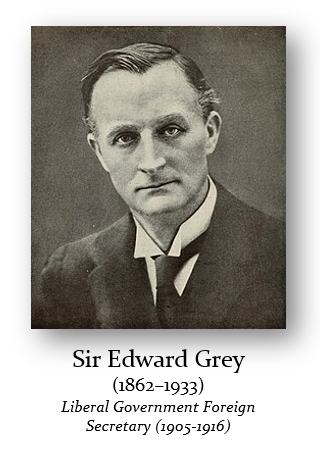
The most famous example is Britain’s entry into World War I. Britain had a treaty (the Treaty of London, 1839) guaranteeing Belgium’s neutrality. When Germany invaded Belgium in August 1914, Britain declared war. The British politician most closely associated with the argument that Britain had to enter World War I to prevent itself from being “next” was Sir Edward Grey, the Foreign Secretary. His argument “We’re Next” logic was most famously laid out in his speech to the House of Commons on August 3, 1914, constructed on the idea that Britain could not stand aside while France was crushed. The logic was strategic: if Germany defeated France and dominated the Continent, Britain would be left isolated and vulnerable.

UKDebt MA2011

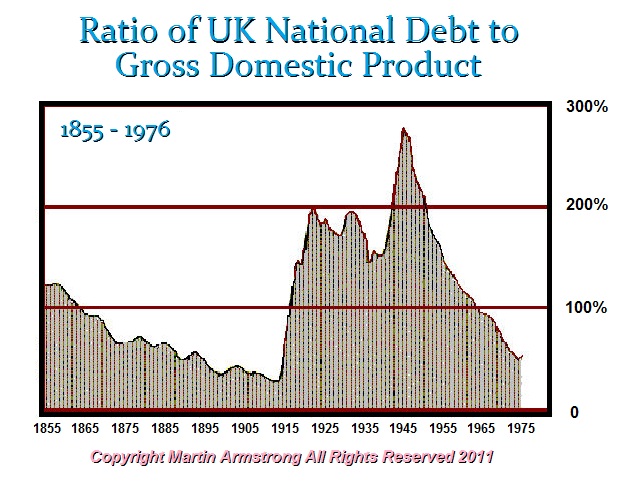
Grey’s warmongering succeeded in reducing the British economy and shifting financial capital from London to New York. He sent UK debt to 200% of GDP. Wars seem to always be promoted by the left—perhaps they think they are the hand of God, empowered to smite the opposition. Grey was the left, and he entered the war just as WWI, WWII, Vietnam, and Korea were all advocated by Democrats, who now want to double the money sent to Zelensky to smite Russia.

However, the deeper strategic reasoning was explicitly about the fear of being next. Britain’s leaders argued that if Germany conquered Belgium and the French coast, it would dominate the English Channel and threaten Britain directly. The German invasion of Belgium was not just a violation of a treaty—it was a strategic move that, if successful, would leave Britain isolated and vulnerable. This is a case where the “we’re next” logic was central to the decision, even if the public justification focused on the treaty.

Formal Summit Portrait with National Flags

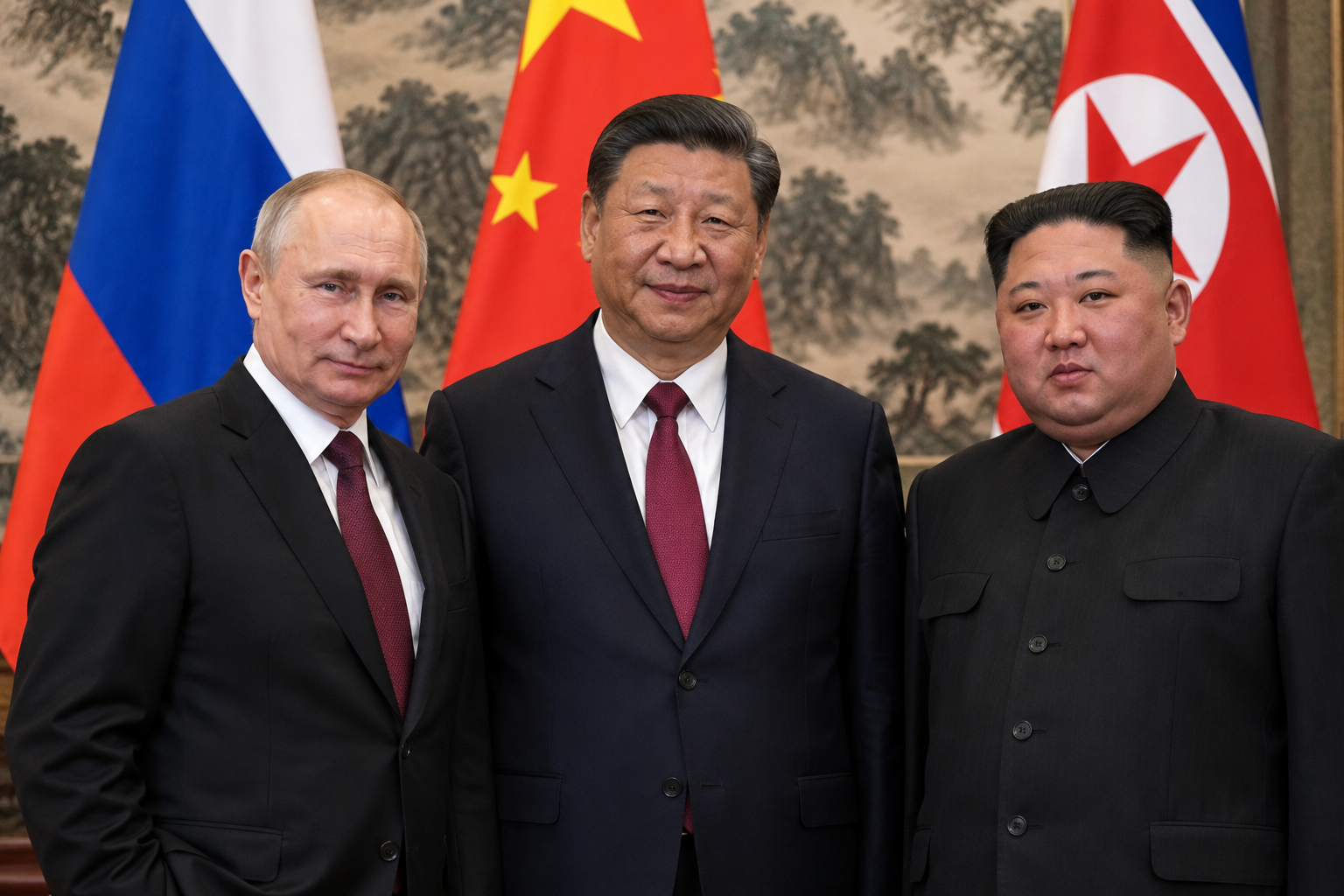
China & North Korea Will Join Russia Fearing They TOO Will Be NEXT

I have repeatedly warned that history demonstrates a recurring pattern: when a nation confronts a serious domestic crisis, its political leaders often seek an EXTERNAL ENEMY to divert public attention from their own failures. This is nothing new. It is a pattern that has unfolded throughout history, from ancient empires to modern nation-states.

We are heading into what I have warned will be a serious global economic decline extending into 2028. The danger is that economic instability will increasingly feed geopolitical confrontation as governments seek someone else to blame for their own mismanagement.

The problem with these warmongering Neocons is that they NEVER anticipate the consequences of their actions. They view the world through the narrow lens of military confrontation, assuming that sanctions, threats, and regime change will somehow produce the political outcomes they desire. They fail to understand that every action produces a reaction, often with consequences they never imagined. Even elements within the Democratic Party appear increasingly willing to embrace confrontation under the banner of defending democracy and claiming the moral high ground. Yet moral declarations do not prevent wars. They can just as easily become the justification for escalating conflicts beyond anyone’s control.

China presents a particularly dangerous dimension to this developing crisis. China is confronting serious structural economic problems, including its prolonged property-market downturn, heavily indebted local governments, weak household confidence, demographic decline, and growing dependence on manufacturing and exports to sustain economic activity. However, economic weakness and a direct political threat to Xi Jinping are two entirely different questions.

The real issue for Xi is not simply whether economic growth slows. It is whether prolonged economic deterioration begins undermining CONFIDENCE within the Communist Party itself, particularly among provincial officials, influential business leaders, and the military establishment. That is where economic problems can eventually become political problems.

Nevertheless, dissatisfaction with economic performance does not automatically mean Xi faces an imminent leadership challenge. China’s political structure is fundamentally different from Western electoral systems, and Xi has consolidated considerable authority over the party, the government, and the military.

The greater danger is how Beijing might respond if economic pressure intensifies while Washington and Europe simultaneously escalate their confrontation with China. This is where the Neocons fail to understand the dynamics of international capital flows, confidence, and geopolitical alliances.

These Neocons assume that increasing pressure on Russia, China, Iran, and North Korea will somehow force each country to submit independently. What they fail to consider is that their policies may instead encourage these nations to cooperate more closely against a common external threat.

China does not need to agree with every Russian policy to recognize that weakening Moscow could eventually leave Beijing more exposed to American strategic pressure. Likewise, Russia has an incentive to strengthen its relationship with China as Western sanctions and military confrontation continue.

North Korea faces a similar calculation. Its leadership has every incentive to strengthen relationships that provide economic support, military cooperation, and protection against international isolation.

This does not mean these countries form a unified alliance with identical interests. They do not. But common external pressure can create cooperation among governments that would otherwise have significant disagreements. That is precisely how geopolitical confrontation spreads through contagion.

The more Washington and European leaders attempt to isolate their adversaries simultaneously, the greater the incentive for those adversaries to coordinate their responses.

Meanwhile, European governments face their own economic difficulties, fiscal pressures, and political instability. Yet influential voices continue advocating military escalation as though economic resources were unlimited and public confidence could never collapse.

The greatest danger is that political leaders will turn an economic crisis into a military crisis in their desperate attempt to retain power and avoid responsibility.

This is why I have consistently warned that you cannot analyze war independently of economics. War, capital flows, sovereign debt, political confidence, and economic decline are interconnected. They are not isolated events.

As we move toward 2028, the critical question will not merely be whether China experiences an economic slowdown or whether Xi Jinping faces domestic dissatisfaction.

The question is whether mounting economic pressure, combined with increasingly aggressive Western foreign policy, creates the incentive for China, Russia, and North Korea to deepen their strategic cooperation.

History warns that when governments begin losing CONFIDENCE at home, they often seek confrontation abroad. The tragedy is that those who start these confrontations rarely understand how they will end.

“We’re Next” Argument Has Existed for Millennium

Ionian Revolt_ Burning Harbor Battle


When Athens and Eretria sent ships to aid the Ionian Revolt in 498BC, they were not acting from pure altruism. There was the assumption that Persia would march on Greece immediately. This was a diagnosis of geostrategic realities and future issues. Athens’ decision was a “preemptive strike” to check Persian expansionism, which is precisely what Zelensky is demanding that NATO conduct. The Athenians had already clashed with Persia indirectly when they had refused to give earth and water to Persian envoys, and Persia was harboring the exiled Athenian tyrant Hippias, who wanted Persian help to regain power. Supporting the revolt was a way to weaken a hostile empire before it could act on those tensions.

This is the sequence that Athens feared when it aided the Ionian Revolt in 498BC. The revolt itself was crushed by 493BC, and Darius I  of Persian then turned his attention to mainland Greece, partly to punish Athens and Eretria for their support of the Ionians, and partly to expand Persian control into the Aegean. So the Athenian “we might be next” calculation proved correct, though the invasion came about a decade after they withdrew from Ionia, not immediately. Supporting the Ionian Greeks in Turkey also declared that Athens was the enemy of Persia much as the US support Britain that dragged the US into WWI and WWII.

First Invasion (492–490BC) of Persian into Greece came one year later after the Ionian Revolt was crushed.
A Persian expedition under Mardonius crossed into Thrace and Macedonia, but a storm destroyed much of the fleet and the campaign was abandoned.

A second force under Datis and Artaphernes crossed the Aegean in 490BC, captured Eretria, and landed at Marathon in Attica. The Athenians, with only a small contingent of Plataeans, defeated the Persians at the Battle of Marathon. The Persians withdrew.

Spartan Shield Wall at Thermopylae

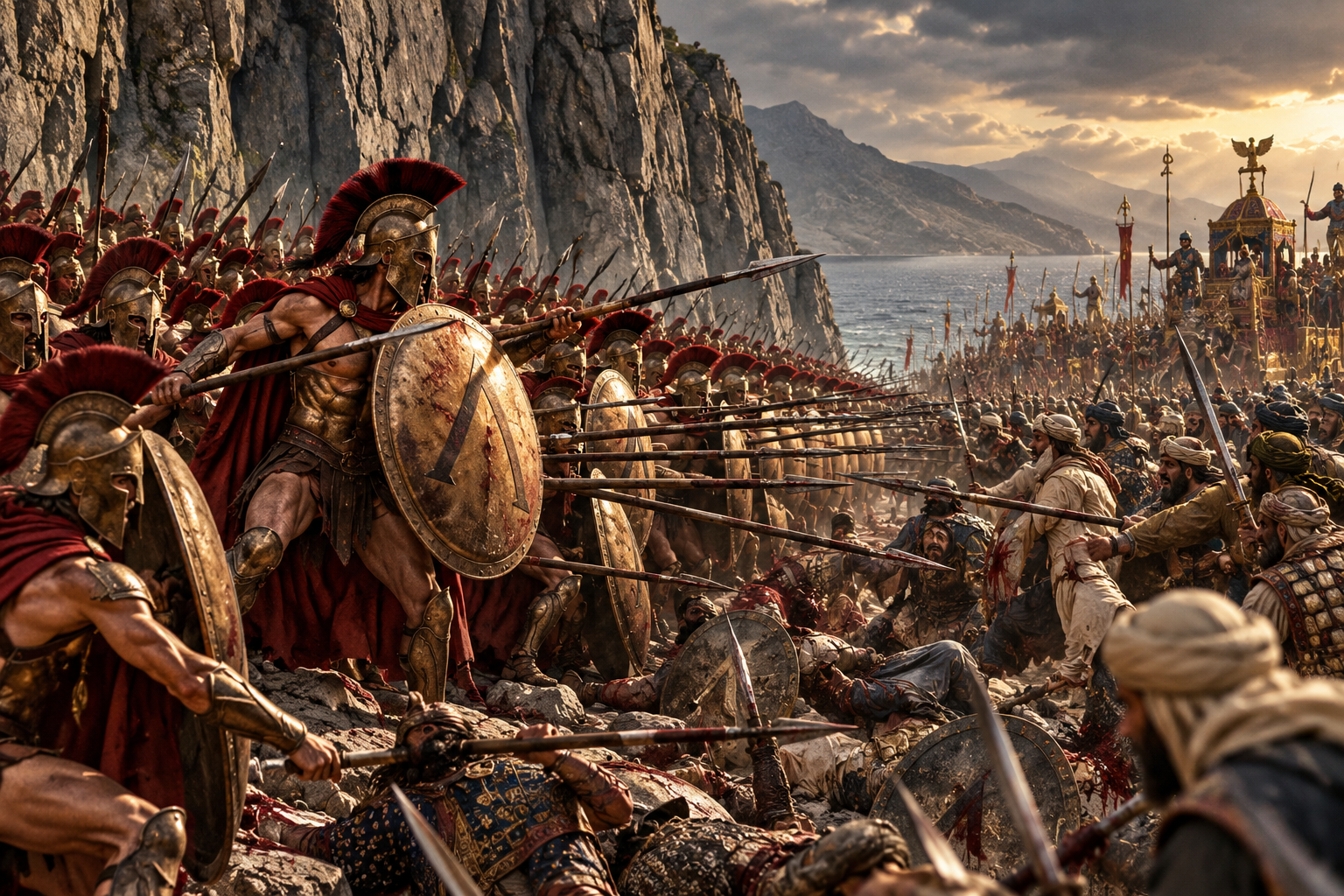
A Second Invasion (480–479BC) was the much larger invasion, personally led by King Xerxes I. The Persians crossed the Hellespont on a pontoon bridge and marched south. They were delayed by the Greeks at Thermopylae (the famous stand of Leonidas and the 300 Spartans) and defeated at sea at Salamis, which forced Xerxes to retreat.

The Persian commander Mardonius remained in Greece with a land army. The Greeks decisively defeated him at the Battle of Plataea in 479BC, and a simultaneous Greek naval victory at Mycale effectively ended the invasion.

Alexander the Great Battle Issus Darius III

When all was said and done, Persia funded Sparta to defeat Athens in 404BC. That was a ancient cold war of the Greeks vs Persians. This was followed by Alexander the Great conquering the Persian Empire (the Achaemenid Empire) in a remarkably short campaign, spanning roughly 334–330BC.

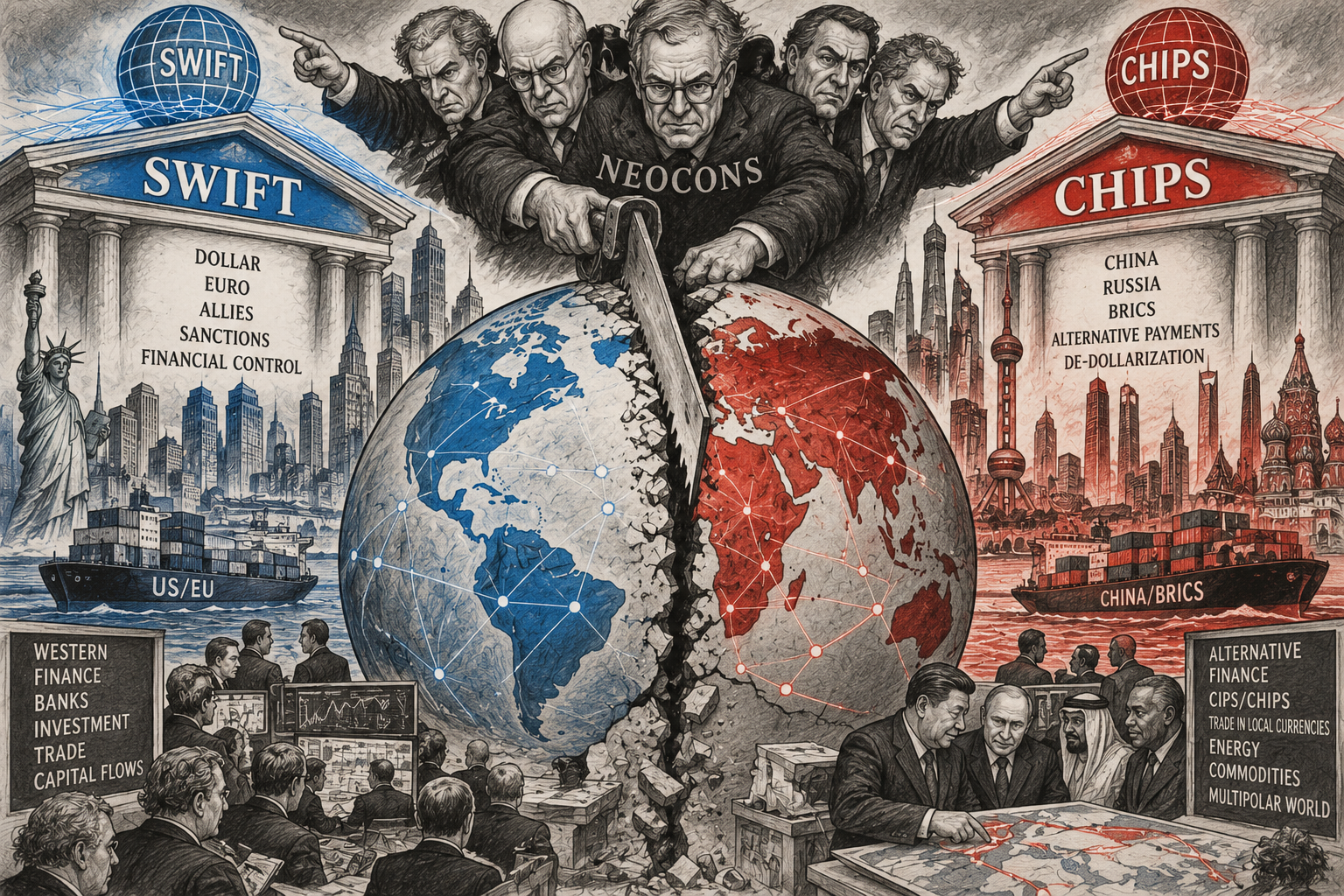
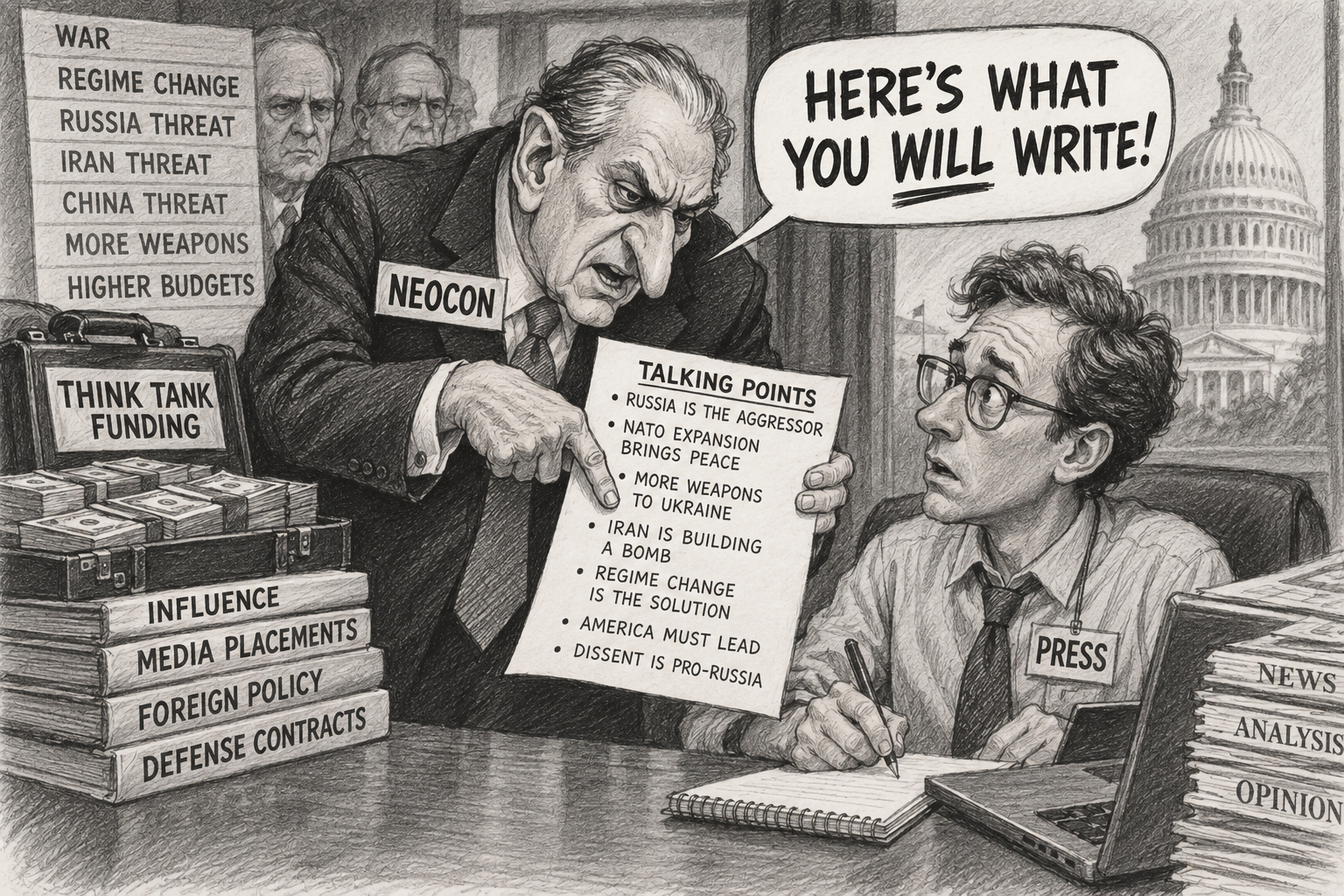
Divided World_ Neocons Split Global Finance Neocon Controls the Talking Points

The Neocons have already destroyed the world economy and they control the press that only calls Trump insane and advocates WWIII with Russia to support Zelensky.

Reagan in quest of peace

Neocons Defeated the Peace Dividend

There was an expectation of a “peace dividend,” and the decision to keep NATO was the result of a deliberate strategic choice driven by several key figures who argued that the end of the Cold War did not mean the end of security risks. The Neocons transformed their hatred and opposition to Communism into racism and even argued that President Reagan should not meet with Gorbachev saying “you can never trust a Russia.” The Neocons at every stage of the last nearly 40 years have done nothing but promote war. With the Democrats taking at least the House and possibly the Senate because Trump will not admit a mistake and throw Netanyahu under the bus, the Neocons are just days away from realizing their dream – World War III.

Boris_Johnson_We_are_in_a_proxy_war_against_Russia_

London Destroyed

Boris may be delighted to think of all the millions of pounds he has been paid as “donations” from the military industrial complex and speaker fees promoting war with Russia, but (1) he will not have a place left to spend it, and (2) the British pound will no longer exist anyway.

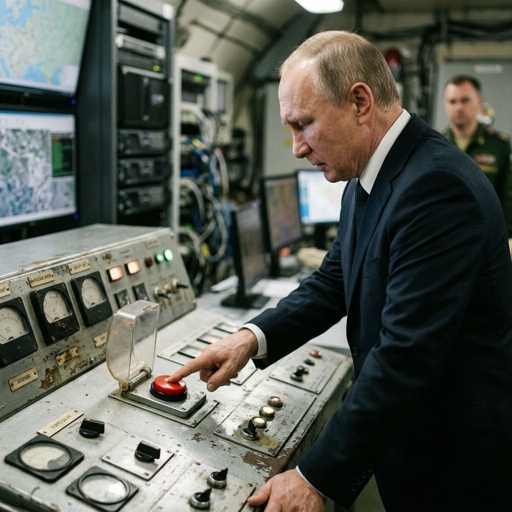
Putin Pushing the Red Button for Nuclear War

All of this nonsense that Putin would never resort to nuclear war because he knows it would push back on him is absurd. When you have NATO and their mouth piece Zelensky with Boris Johnson and Kallas all advocating the total destruction and break up of Russia, that is a death sentence and he would have no choice but at the very least to take them with him. This will bring China, North Korea, Iran, and Russia all together.

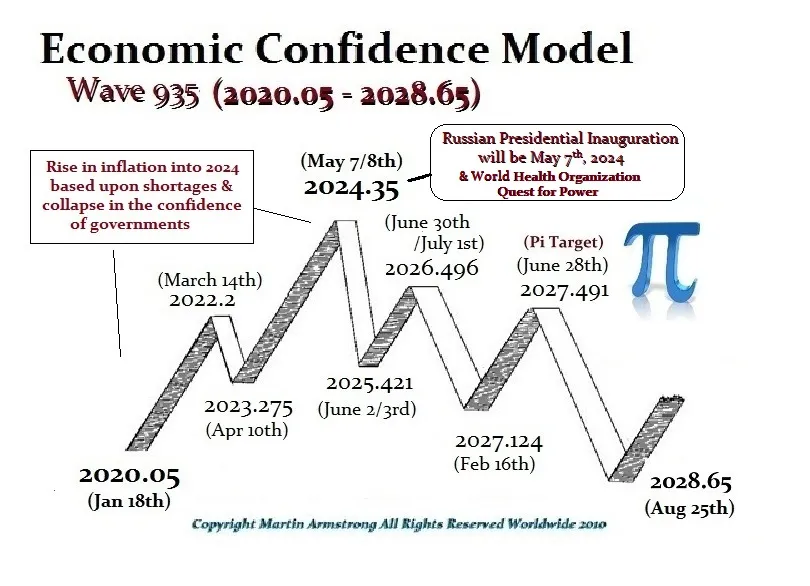
ECM Wave 2020 2028 Pi

With the Democrats cheering Zelensky incapable of ever looking at what comes next, as I have said many times, I have tried so hard to defeat my own computer, but I am the one who always loses. I have even offered to fly to DC to meet with Trump to explain what is at stake. He MUST throw Netanyahu under the bus. He needs also to establish an external enemy and state what will happen by supporting Zelensky – WWIII with China and North Korea joining Russia. Dropping the mother of all bombs on Iran is bullshit. This is like the Epstein nonsense focusing on who went to his island rather than who was paying Epstein for this honey trap and what was the blackmail for? A power play that inevitably comes back to war?

We are on our own. Government is hopeless – It Has Been Usurped By Neocons

  • ✇Curzio Research
  • How to find bargains—and avoid losers—in a selloff Curzio Research

    In today's volatile environment, we're seeing strong companies pull back sharply alongside weaker ones. That creates opportunity… but also risk. Let's take a look at how to spot a true bargain during the selloff… and what to steer clear of. The post How to find bargains—and avoid losers—in a selloff appeared first on Curzio Research.
     

How to find bargains—and avoid losers—in a selloff

15 October 2026 at 22:00

In today's volatile environment, we're seeing strong companies pull back sharply alongside weaker ones. That creates opportunity… but also risk. Let's take a look at how to spot a true bargain during the selloff… and what to steer clear of.

The post How to find bargains—and avoid losers—in a selloff appeared first on Curzio Research.

  • ✇Armstrong Economics
  • Iran’s Oil Exports Have Collapsed to ZERO Martin Armstrong
    Iran’s oil industry has been brought to a standstill, and the economic consequences are becoming impossible to ignore. Iran’s seaborne crude oil exports collapsed from a 14-day average of 230,000 barrels per day at the beginning of September to ZERO, remaining there into October. This is an extraordinary development for a country that depends upon petroleum revenues to finance its government, support its currency, and obtain the foreign exchange necessary to purchase imports. Washington has spe
     

Iran’s Oil Exports Have Collapsed to ZERO

15 October 2026 at 21:05

An Overview of Iran's Energy Industry and Infrastructure - Energy News, Top  Headlines, Commentaries, Features & Events - EnergyNow.com

Iran’s oil industry has been brought to a standstill, and the economic consequences are becoming impossible to ignore. Iran’s seaborne crude oil exports collapsed from a 14-day average of 230,000 barrels per day at the beginning of September to ZERO, remaining there into October. This is an extraordinary development for a country that depends upon petroleum revenues to finance its government, support its currency, and obtain the foreign exchange necessary to purchase imports. Washington has spent decades attempting to cripple Iran’s economy through sanctions, but the naval blockade has accomplished something far more devastating in a matter of weeks.

Claire Jungman, Vortexa’s director of maritime risk and intelligence, stated, “The blockade is doing what years of sanctions never managed.” There are now an estimated 83 million barrels of Iranian crude sitting aboard tankers, including 43 million barrels trapped west of the Strait of Hormuz. Iran has the oil, it has potential buyers, and it has enormous financial obligations, but it cannot freely deliver its product and collect the revenue. Liquefied petroleum gas exports have also collapsed by 48% from the previous month, reaching their lowest level since at least January 2023. The government is being deprived of its principal source of hard currency while the costs of maintaining the state and its military continue.

This is precisely what I have explained regarding the sovereign debt crisis throughout the Middle East. These governments built their budgets around petroleum revenues, and when that income disappears, the financial structure begins to unravel. They cannot simply replace billions in lost export earnings by increasing taxes on a population that is already struggling. Government employees still expect to be paid, military expenditures continue, imports must be financed, and outstanding obligations do not disappear because the oil tankers cannot leave port. The longer this blockade continues, the more difficult it becomes for Tehran to maintain the financial machinery upon which the government depends.

Iran’s currency has already been devastated. The rial has lost approximately 35% of its value against the dollar since July, while annual inflation reached 73.6% in September. Imagine living under a government where the purchasing power of your savings is being destroyed at that pace while the country loses access to its most important source of foreign exchange. Imported goods become more expensive, businesses struggle to obtain necessary supplies, and the average family pays the price for decisions made by politicians who never seem to suffer the same consequences as the people they govern.

The economic contraction is equally alarming. The International Monetary Fund now projects Iran’s economy will shrink 7.6% in 2026, while Iranian government figures show GDP contracted approximately 10% during the spring compared with a year earlier. Industrial production, trade, and household consumption are all suffering. A country cannot lose its export revenue, experience a currency collapse, and maintain normal economic activity simply because its leaders insist they remain financially secure. The government may be able to survive politically for some time, but the private economy is being systematically deprived of the capital necessary to function.

China’s position is particularly important because Beijing has been one of the principal destinations for Iranian petroleum. Vortexa reports that China’s demand for Iranian crude has weakened as Russian oil has filled part of the gap. This illustrates how international capital and trade flows adjust regardless of the political arrangements governments believe they have established. Russia benefits from replacing Iranian supplies, while Tehran loses both revenue and bargaining power. Russia now accounts for 80% of the high-risk petroleum exports tracked by Vortexa among Iran, Russia, and Venezuela. Moscow may be politically aligned with Tehran, but that does not mean Russian producers will voluntarily surrender their own market share to rescue Iran’s finances.

Washington may believe that eliminating Iran’s oil revenue will force Tehran to negotiate, but economic warfare carries consequences well beyond the intended target. Iran still possesses the ability to threaten shipping through the Strait of Hormuz, one of the most strategically important energy corridors in the world. The more desperate its financial position becomes, the greater the incentive for its leadership to use whatever leverage remains. A blockade intended to weaken one country can therefore create disruptions throughout the region, raising transportation costs, insurance premiums, and energy prices for nations that have nothing to do with the original dispute.

We are already witnessing the inflationary consequences of this conflict. American gasoline prices surged 9.1% in September, and the energy component of the Consumer Price Index increased 5.2% in a single month. The same government attempting to deprive Iran of petroleum revenue must now confront the consequences of higher energy costs at home. Energy enters virtually every stage of production and distribution, so the disruption does not end at the gasoline pump. It works its way into transportation, agriculture, manufacturing, and ultimately the cost of living for ordinary households.

The global economy is interconnected, whether politicians wish to acknowledge it or not. Iran loses its oil revenue, Russia captures additional market share, China adjusts its purchases, and Western consumers confront higher energy costs. Every government involved believes it can manipulate the outcome through sanctions, blockades, or military pressure. But international commerce does not operate according to political wishes, and the economic damage rarely remains confined to the country originally targeted.


  • ✇Armstrong Economics
  • America May Need a Wall Along the Canadian Border Martin Armstrong
    Canada has apparently learned absolutely NOTHING from the immigration disaster under Justin Trudeau. Prime Minister Mark Carney is already discussing increasing immigration again, and now India’s High Commissioner to Canada, Dinesh K. Patnaik, has suggested that Canada’s economic ambitions could require another 15 million workers over the next decade. Canada has a population of approximately 42 million people. We are talking about a number equivalent to more than one-third of the country’s exis
     

America May Need a Wall Along the Canadian Border

15 October 2026 at 21:02

America's borders, porous from the start - The Boston Globe

Canada has apparently learned absolutely NOTHING from the immigration disaster under Justin Trudeau. Prime Minister Mark Carney is already discussing increasing immigration again, and now India’s High Commissioner to Canada, Dinesh K. Patnaik, has suggested that Canada’s economic ambitions could require another 15 million workers over the next decade. Canada has a population of approximately 42 million people. We are talking about a number equivalent to more than one-third of the country’s existing population, yet these people discuss such enormous demographic changes as though they were simply adding employees to a corporate payroll. Nobody seems particularly concerned about where these millions of people would live, how much infrastructure would cost, or whether the Canadian economy could actually support such an expansion.

Carney has indicated Canada will eventually resume increasing immigration after the government supposedly brought the previous surge under control. Trudeau had already opened the floodgates, allowing Canada’s population to increase by approximately 1.27 million people in 2023 alone, with international migration accounting for nearly 98% of that growth. Canada admitted nearly 484,000 permanent residents in 2024, and the government is still targeting another 380,000 in 2026. Ottawa is officially reducing temporary admissions, but Carney is already talking about when population growth should accelerate again. They have barely begun cleaning up the mess before discussing another expansion.

Canada has been suffering from a housing affordability crisis, overcrowded public services, and an economy where population growth has not translated into comparable improvements in living standards. The politicians look at GDP and celebrate whenever they can make the total number larger. Add another million consumers and naturally total economic activity can increase. That does not mean the average Canadian has become wealthier. GDP per capita matters because it measures economic output relative to the population. Importing more people does absolutely NOTHING to improve living standards if housing, productivity, wages, and infrastructure cannot keep pace.

Now we have India’s representative discussing 15 million additional workers to support Carney’s proposed investment ambitions. Patnaik was discussing a potential labor requirement, not an immigration agreement committing Canada to admit 15 million Indians. Nevertheless, the sheer scale of the suggestion exposes how these governments approach economic policy. Instead of asking how to improve productivity, encourage investment in machinery, or make it possible for existing citizens to afford families, they continually return to expanding the labor supply. Businesses may welcome a larger pool of workers, particularly when it reduces pressure to increase wages, but the public is left competing for housing and services that governments have failed to expand.

Canada’s fertility rate has fallen to approximately 1.25 children per woman, and politicians present immigration as the only practical solution to an aging population. Perhaps they should ask WHY young Canadians are increasingly unable to afford children. Housing has become outrageously expensive, taxation consumes an enormous portion of income, and the cost of raising a family continues climbing. The government then points to declining birth rates as justification for bringing in more workers without addressing the economic conditions discouraging family formation in the first place. This is the mentality of politicians who treat human beings as entries on an economic spreadsheet.

America should be paying close attention because Canada shares the longest international land border in the world with the United States, stretching approximately 5,525 miles when Alaska is included. We have spent years arguing about securing the southern border while treating the northern border as though geography somehow guarantees security. It does not. If Ottawa pursues immigration policies that overwhelm its ability to screen arrivals or enforce visa rules, Washington cannot simply assume that none of those consequences will reach American territory. The United States has every right to secure its northern border, increase enforcement where necessary, and insist that Canada maintain credible immigration and security controls. A wall along sensitive stretches may eventually become part of that discussion, although no physical barrier could reasonably replace enforcement across the entire frontier.

There is also a growing political divide between Washington and Ottawa. Carney is pursuing closer economic relationships with India, China, and the European Union while attempting to reduce Canada’s dependence on the United States. Canada is entitled to determine its own trade relationships, but Washington is equally entitled to determine who enters American territory. Immigration policies have consequences beyond national borders, particularly when two countries are so closely integrated economically and geographically. American taxpayers should not be expected to absorb the consequences of decisions made in Ottawa.

What makes this particularly absurd is that Canada possesses enormous natural resources, agricultural capacity, energy reserves, and opportunities for industrial development. Its problem is hardly a shortage of land or natural wealth. The political establishment has created an economy increasingly dependent upon government spending, expensive housing, and population expansion rather than productivity and investment. Instead of developing the resources already available and making life affordable for existing citizens, the solution being discussed is to bring in millions more people and hope the economy somehow catches up.

The Canadian people deserve a government that measures success by their standard of living rather than the number of people politicians can add to the population. Immigration can contribute to economic growth when it is properly managed and supported by productive investment, but there is a limit to what housing, infrastructure, and public services can absorb within a given period. Trudeau ignored those constraints, and Carney appears eager to revisit the same policies before the damage has been repaired. If Ottawa refuses to recognize those limits, Washington will have to take its northern border far more seriously. America cannot control Canada’s immigration policy, but it certainly can control its own border.

  • ✇Armstrong Economics
  • COMMENTS FROM READERS & US Separation Martin Armstrong
      JEB: “I don’t know of any other president in my lifetime that had so much momentum behind them that they could’ve really made serious change. But I also never saw a president sell America out to Israel so blatantly.” BD: “Trump built a durable coalition that would have ruled for 25 years. No other Republican could have done it. Then we did a regime change war in the Middle East” GLEN: “I’m telling you, the turnout models being used by GOP pollsters are wrong.  A bunch of Republicans that nobo
     

COMMENTS FROM READERS & US Separation

15 October 2026 at 21:01

Interview


JEB: “I don’t know of any other president in my lifetime that had so much momentum behind them that they could’ve really made serious change. But I also never saw a president sell America out to Israel so blatantly.”

BD: “Trump built a durable coalition that would have ruled for 25 years. No other Republican could have done it. Then we did a regime change war in the Middle East”

GLEN: “I’m telling you, the turnout models being used by GOP pollsters are wrong.  A bunch of Republicans that nobody thought would lose are going to find themselves very negatively surprised in a few weeks. It may be a “historic precedent that is rarely defied” but I can tell you what is unprecedented ,… it’s the seething anger we Republican voters have for Trump and the feckless, self-serving worms in Congress. We know how disastrous it will be if the lunatic left gain back control, but our anger is so great that many of us have a burn it all down mentality. The rot in our government is so gargantuan that is has become unsustainable. Everyone is bought off and utterly corrupt…. The left, the right, the degenerate Corp media, all of our institutions. Those of us who don’t have our heads up our asses know that we are in very perilous times.”

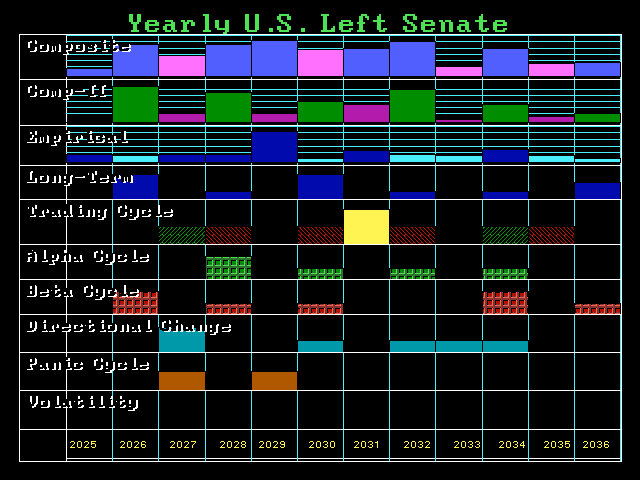
Democrates Senate 2026

We have a Panic Cycle in 2027 in the Senate for the Democrats. I suspect we will have a surprising midterm. Netanyahu has so screwed the United States all for his personal vendetta with Iran. I suspect the progressives will go crazy and the people have to learn the hard way, for history suggests that is the only way human ever learns. Anyone who thinks voting in the Democrats will change anything for the better know nothing. The Democrats will so screw up the economy with their hatred of the rich that the migration from Blue States to the Red will accelerate.

Material Jeaousy LEFT Socialist

People like Elizabeth Warren, a diehard communist for the rest of society her excluded will seriously destroy CONFIDENCE in the economy and investment fulfilling our model into a steep recession into 2028. Mandami will succeed in reducing NYC into a wasteland just as the city of Detroit cause every auto manufacturer to flee. Without CONFIDENCE in the future, capital will contract and NOT invest. No matter what you say, they refuse to listen. They are no different than a guy with a gun robbing passers by because they have more than them.

Marx ten commandments socialism

What they preach is forbidden in the Ten Commandments showing that this is the evil dark side of humanity that always destroys civilization. It has been taking place for thousands of years. This is what is REQUIRED to get to 2032 that will finally convince the average American that the system is broke and neither side is even capable of fixing anything because they are too busy playing the game.

The Great Migration Blue to Red

I have personally met many families who fled to Florida because their children were getting suicidal under the lockdowns and school closing during COVID. The data points to a few key drivers, though the reasons are complex and personal:

Cost of Living and Affordability: This is often cited as a primary factor. High housing costs in states like California and New York are pushing residents to seek more affordable areas .

Family and Quality of Life: Wanting to be closer to family has been the top reason for interstate moves for several years. Other common motivations include retirement and a desire for a different pace of life .

Taxes and Policy: Some analyses, particularly from conservative-leaning think tanks, argue that lower taxes and less regulation in red states are significant draws . However, this remains a subject of debate; for instance, one analysis found that most people leaving Massachusetts earned under $200,000, suggesting affordability concerns outweighed tax policy for many

COVID lockdowns

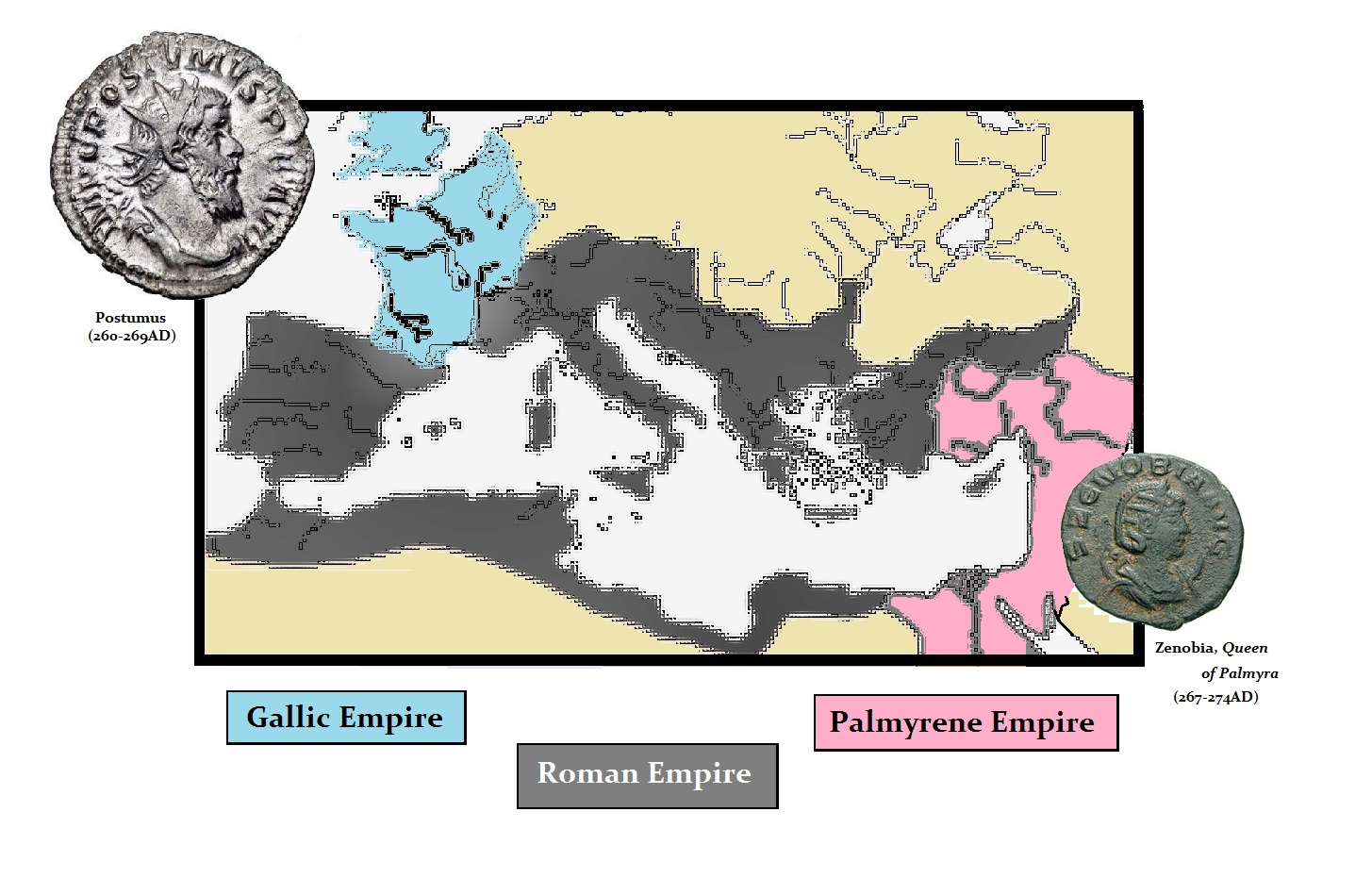
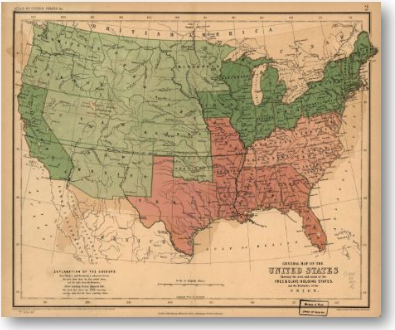
Empires 3rdCentury Rome MapUS Civil War 1 MAP

There is no doubt that the a major Democratic victory will spark the Separatist Movement for people are starting to see that this two party system is hopelessly corrupt and incompetent of running the country. We will see the US break apart precisely as the Roman Empire split into three for the very same reasons –

IT’S ECONOMY STUPID!!!!

  • ✇Armstrong Economics
  • Diesel & Democrats Martin Armstrong
    COMMENT: Marty, Socrates is simply unbelievable. When everyone assumed a deal would be reached and Trump was trying to strong-arm Zelensky, Socrates still predicted rising diesel prices. Today, after saying Kyiv would no longer comply with US President Donald Trump’s demand that it not strike Russian oil refineries, Zelensky turned to his European lapdogs. Socrates sees through everything. I don’t know how you ever managed this. Z REPLY: I have said, even I cannot beat Socrates. It is an objec
     

Diesel & Democrats

15 October 2026 at 18:20

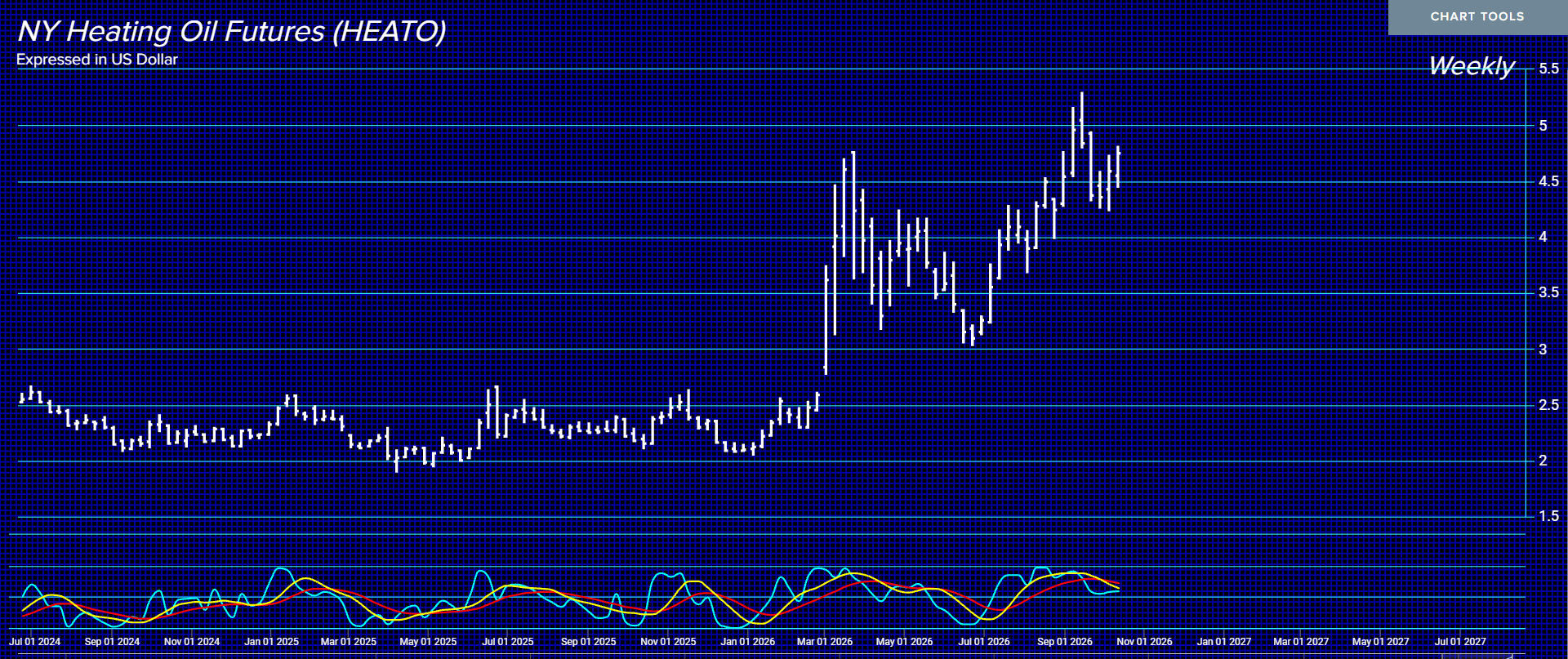
HeatingOil W Tech 10 15 26

COMMENT: Marty, Socrates is simply unbelievable. When everyone assumed a deal would be reached and Trump was trying to strong-arm Zelensky, Socrates still predicted rising diesel prices. Today, after saying Kyiv would no longer comply with US President Donald Trump’s demand that it not strike Russian oil refineries, Zelensky turned to his European lapdogs. Socrates sees through everything. I don’t know how you ever managed this.

Z

Tax Robbery

REPLY: I have said, even I cannot beat Socrates. It is an objective observer of the world. It is not partisan, and it is not opinion. We all have an opinion. That doesn’t lead to accurate forecasts. There is still the risk of this week forming a temp high with a 2 to 3 week retest of support. The major risks will be in the 1st quarter next year. The Democrats want to have Zelensky trillions as Elizabeth Waren shakes everyone upside down to get every last dime.

Based on polling data, the vast majority of Democrats support continued or increased military aid to Ukraine, but there is no polling data showing that a majority of Democrats specifically want to fund strikes on all Russian refineries with no regard to what they will do to creating a famine. They insisted on lockdowns for COVID with also no regard for its economic impact.

Democrats are overwhelmingly in favor of supporting Ukraine militarily. 53% of Democrats want to increase military aid to Ukraine, while 19% want to maintain current levels. Only 9% want to decrease or stop aid. There is a Congressional Ukraine Caucus, which includes Democrats, that has pushed back against any restrictions that would limit Ukraine’s ability to to wage World War II in its quest to destroy Russia. They are yelling on Capitol Hill screaming that any restrictions is putting civilians at risk are “unacceptable.” Of course, the do not care about how many Ukrainian ethnic Russian they kill in revenge.

If Democrats retake the House in November, impeachment is “essentially guaranteed” according to Republican leaders like Speaker Mike Johnson and Rep. Jim Jordan. We have a Panic Cycle in the Senate for 2027 and that does NOT look good. Democrats need only a simple majority to pass articles of impeachment, and many in the progressive wing, such as Reps. Alexandria Ocasio-Cortez and Ro Khanna, are already vocal supporters .

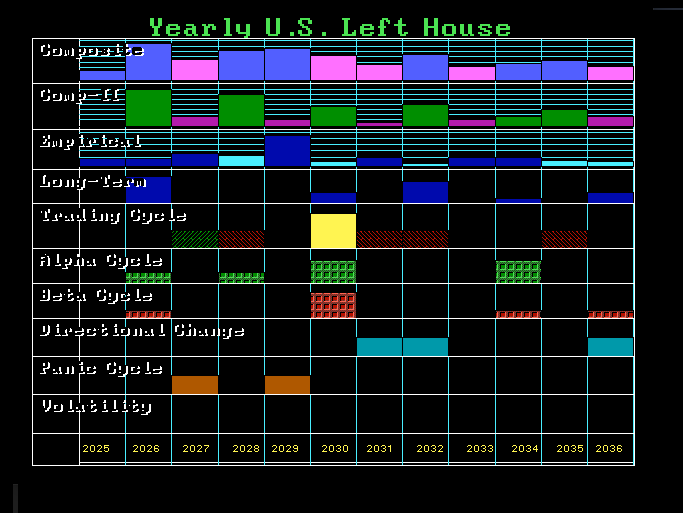
Democrates HOUSE 2026

As you can see, we also have a Panic Cycle in 2027 for the Democrats in the House AND Senate. This is not good. This will be waging war against anything Trump does and they will seriously disrupt the country, the government, and geopolitics. Trump’s refusal to throw Netanyahu under the bus will seriously undermine his legacy no matter what he names after himself.

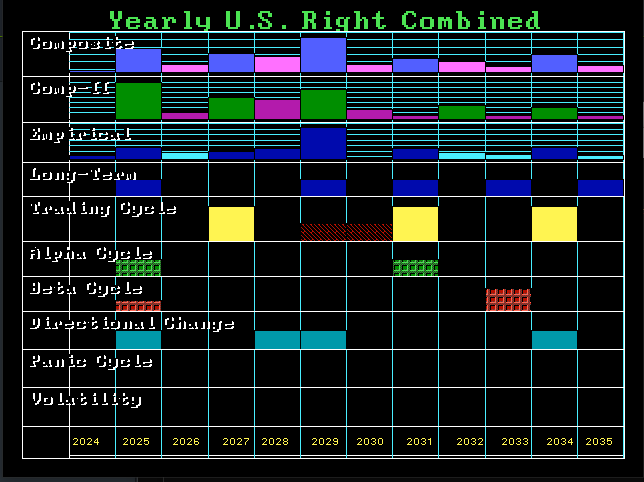
Right Combined Array 2024

The peak for the Republicans was 2025. That was the turning point and a Directional Change. Welcome to 2032.

You may need to buy a bigger bed to hide under especially going into 2028/2029.

  • ✇Armstrong Economics
  • Market Talk – October 15, 2026 Martin Armstrong
    ASIA: The major Asian stock markets had a mixed day today: • NIKKEI 225 decreased 3,318.34 points or -4.90% to 64,425.95 • Shanghai decreased 59.751 points or -1.59% to 3,707.476 • Hang Seng decreased 251.45 points or -1.03% to 24,062.72 • ASX 200 decreased 8.20 points or -0.09% to 8,719.70 • SENSEX increased 1,533.72 points or 2.11% to 74,315.61 • Nifty50 increased 374.65 points or 1.66% to 22,997.35 The major Asian currency markets had a mixed day today: • AUDUSD decreased 0.00583 or -0.8
     

Market Talk – October 15, 2026

15 October 2026 at 13:16

Market Talk 2017

ASIA:
The major Asian stock markets had a mixed day today:
• NIKKEI 225 decreased 3,318.34 points or -4.90% to 64,425.95
• Shanghai decreased 59.751 points or -1.59% to 3,707.476
• Hang Seng decreased 251.45 points or -1.03% to 24,062.72
• ASX 200 decreased 8.20 points or -0.09% to 8,719.70
• SENSEX increased 1,533.72 points or 2.11% to 74,315.61
• Nifty50 increased 374.65 points or 1.66% to 22,997.35
The major Asian currency markets had a mixed day today:
• AUDUSD decreased 0.00583 or -0.84% to 0.69135
• NZDUSD increased 0.0017 or 0.30% to 0.56095
• USDJPY decreased 0.126 or -0.08% to 158.199
• USDCNY decreased 0.00525 or -0.08% to 6.69080
The above data was collected around 13:10 EST.
Precious Metals:
•  Gold increased 43.86 USD/t oz. or 1.07% to 4,149.43
•  Silver increased 1.381 USD/t. oz. or 2.48% to 56.980
The above data was collected around 13:28 EST.
EUROPE/EMEA:
The major Europe stock markets had a green day today:
•  CAC 40 increased 61.59 points or 0.78% to 7,934.70
•  FTSE 100 increased 115.49 points or 1.08% to 10,840.35
•  DAX 30 increased 84.01 points or 0.33% to 25,382.62
The major Europe currency markets had a mixed day today:
• EURUSD increased 0.00607 or 0.54% to 1.12173
• GBPUSD increased 0.00813 or 0.62% to 1.32746
• USDCHF decreased 0.00769 or -0.92% to 0.82725
The above data was collected around 14:00 EST.

AMERICAS:

US Markets:

  • DJIA advanced by 556.21 points (1.08%) to 52,177.69
  • S&P 500 advanced by 25.12 points (0.33%) to 7,744.06
  • NASDAQ advanced by 20.16 points (0.08%) to 26,713.026
  • Russell 2000 advanced by 37.46 points (1.37%) to 2,766.995

Canada:

  • TSX Composite advanced by 552.12 points (1.55%) to 36,136.58
  • TSX 60 advanced by 30.48 points (1.45%) to 2,138.83

Brazil:

  • Bovespa declined by 2,338.23 points (1.13%) to 204,167.75
ENERGY:
The oil markets had a mixed day today:
•  Crude Oil increased 2.837 USD/BBL or 2.98% to 97.927
•  Brent decreased 0.117 USD/BBL or -0.11% to 105.944
•  Natural gas increased 0.0206 USD/MMBtu or 0.64% to 3.2186
•  Gasoline decreased 0.0789 USD/GAL -2.42% to 3.1806
•  Heating oil decreased 0.0691 USD/GAL or -1.40% to 4.8583
The above data was collected around 14:03 EST.
•  Top commodity gainers: Crude Oil (2.98%), Silver (2.48%), Cheese (2.45%) and Palladium (3.28%)
•  Top commodity losers: Methanol (-8.12%), Lithium (-3.56%), Palm Oil (-2.21%) and Gasoline (-2.42%)
The above data was collected around 14:10 EST.
BONDS:
Japan 2.9280% (-7.43bp), US 2’s 4.76% (-0.051%), US 10’s 5.0970% (-8.9bps); US 30’s 5.43 (-0.099%), Bunds 3.4105% (-5.61bp), France 4.7920% (-9.22bp), Italy 4.4890% (-7.15bp), Turkey 32.86% (+6bp), Greece 4.2840% (-11.19bp), Portugal 3.8840% (-6.96bp); Spain 4.016% (-7.7bp) and UK Gilts 5.3734% (-2.88bp)
The above data was collected around 14:30 EST.
  • ✇Market Wise
  • Three ways to invest in Elon Musk’s next big move Brian Hunt
    Today’s issue in preview: Three ways to invest in Elon Musk’s next big move The longevity gold rush has a clear winner. How to invest. These stocks are quietly crushing the rest of the market. Are you profiting? Learn Our Top Themes to Buy Now These stocks are quietly crushing the rest of the market. Are you profiting? Credit: Ridofranz To help us track and trade the world’s strongest business and technology trends, our Global Trend Tracker monitors over 170 industry groups, over 30
     

Three ways to invest in Elon Musk’s next big move

15 October 2026 at 12:00

Today’s issue in preview:

  • Three ways to invest in Elon Musk’s next big move

  • The longevity gold rush has a clear winner. How to invest.

  • These stocks are quietly crushing the rest of the market. Are you profiting?

  • Learn Our Top Themes to Buy Now


These stocks are quietly crushing the rest of the market. Are you profiting?

Image

Credit: Ridofranz

To help us track and trade the world’s strongest business and technology trends, our Global Trend Tracker monitors over 170 industry groups, over 30 proprietary thematic indexes, over 70 ETFs, and over 3,500 public stocks.

This trend-tracking system serves as our “all-seeing eye” – an early-detection system that continuously monitors money flows and shifts in the market climate.

It is designed to identify powerful trends very early in their lifespans, giving us the opportunity to capitalize on them before they become popular investment themes. A business, product, or technology trend can barely twitch without being picked up by our Global Trend Tracker.

This week, our tracker emphatically states that in a market where many important sectors are trading weakly – including defense stocks, small caps, homebuilders, and banking stocks – the healthcare sector is displaying terrific “relative strength.”

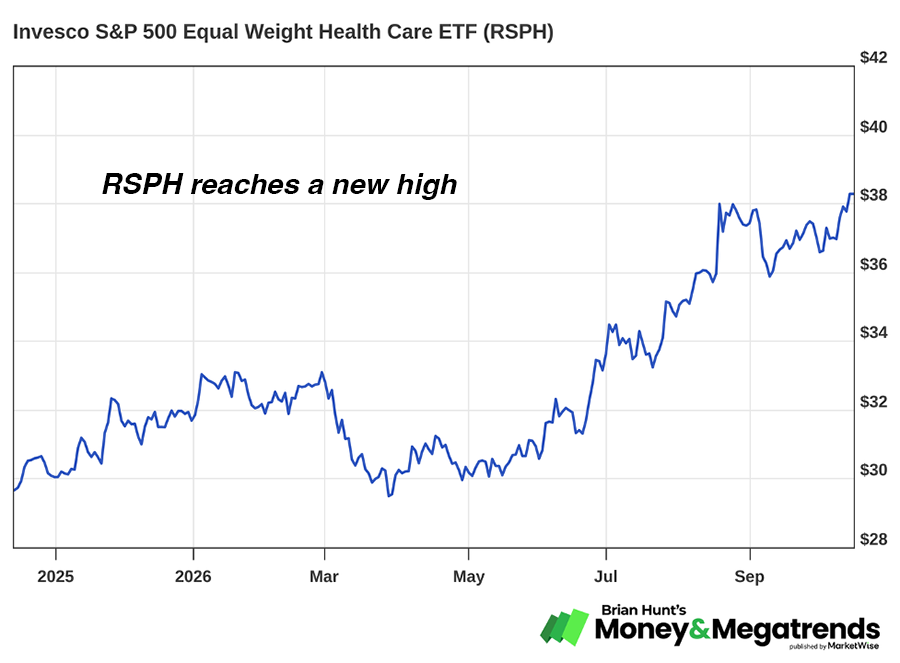
For example, while many sectors are down significantly over the past month, the Invesco S&P 500 Equal Weight Health Care ETF (RSPH) just reached a new one-year high.

This fund is an equal-weighted, diversified basket of large health care firms such as Illumina (ILMN, genomic sequencing), Revvity (RVTY, life sciences), Intuitive Surgical (ISRG, surgical robotics), Biogen (BIIB, biotech), ResMed (RMD, sleep devices), and Pfizer (PFE, pharma). The fund is up 29% over the past year and is one of the few equity ETFs outside of the oil and gas complex to reach a new one-year high this week.

Avid Money & Megatrends readers know that “Boomer healthcare” is one of our highest-conviction long-term investment megatrends. We don’t know of another investment research publication that has written more bullishly, more often about this booming industry than we have.

Over the past year, we have published more than two dozen pieces on opportunities in drug development, biotechnology, senior living facilities, genomics, cardiology, diagnostics, and more.

Our bullish stance has produced a parade of home runs, with the healthcare industry dominating the stock market’s list of new highs over the past year.

Healthcare stocks are generating extraordinary returns because they are benefiting from several megatrends simultaneously…

One is demographics. More than 10,000 Americans reach retirement age every day. The U.S. population aged 80 and older is projected to roughly double, from 14.7 million in 2025 to 29.4 million by 2045.

This is the enormous Baby Boom generation entering the phase of life where health care and longevity spending skyrocket. For many boomers, a typical month involves going to see at least one doctor to have something looked at, removed, or treated.

This means many health care businesses are experiencing huge demand now – and will for at least the next decade.

Two is exponential technological progress. Thanks to major advancements in genomic sequencing, AI-powered analytics, imaging technology, and preventative treatment, healthcare is becoming much better and more personalized. This is driving strong demand for all kinds of new tests, tools, and treatments.

After all, when a useful and important service you buy gets much better, you typically buy more of it

Investing in many healthcare businesses over the next decade will be investing with a gale-force tailwind at your back. If you’re a parent and worried about your child getting a job, just point them to the booming healthcare industry.

The new high in RSPH serves as a reminder: The giant business, tech, and demographic trends that shape our world tend to play out in five or more years, not five months. This means the stock market trends they manifest play out over the same time periods. With this trend truism in mind, I once again remind you that if you like money, keep it invested in healthcare.

Image

Recommended Link:

My Nearly $20 Million ‘Bar Tab’ With Stansberry Research

Ad Image

I’m an ordinary guy – a financial newsletter reader like you. But a few years ago, I landed in an extraordinary position: unmasking a priceless secret from inside Stansberry Research, unfiltered, on camera. In the years since, my ongoing efforts have COST Stansberry nearly $20 million and counting – money that has stayed in readers’ bank accounts instead. Today, I’m speaking out one FINAL time.

The longevity gold rush has a clear winner. How to invest.

Image

Credit: svetikd

As with any large part of our economy, the booming healthcare sector (see above) comprises many smaller “sub-industries” that often perform much better or much worse than the broader sector.

Currently, one prominent member of the “doing better” category is the business of selling GLP-1 drugs.

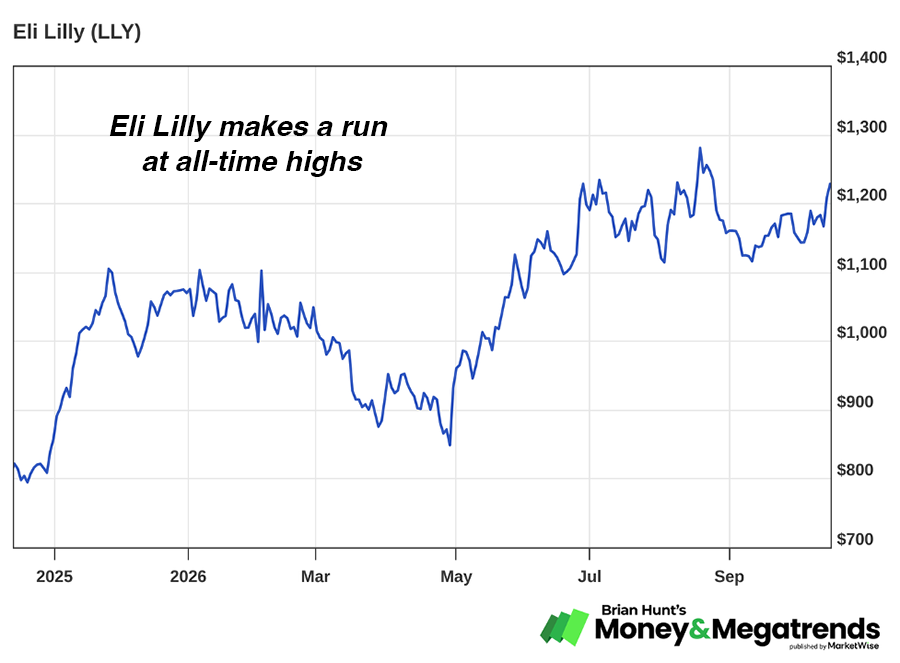
As evidence, we cite the surging revenues and strong stock trend of one of our top healthcare “picks to click,” Eli Lilly (LLY).

Back in June, I detailed how drug giant Eli Lilly is uniquely positioned to benefit from soaring health care and longevity spending.

Data from the Federal Reserve shows that between 15 million and 20 million baby boomers are millionaires. More than 1 million boomers are worth more than $10 million. As mentioned above, the U.S. population aged 80 and older is projected to roughly double, from 14.7 million in 2025 to 29.4 million by 2045.

This is the largest group of wealthy people in history. It includes many motivated, older, wealthy people who can spend big on longevity.

One of the leaders of this investment trend – you could even call it the poster child – is drug giant Eli Lilly.

Lilly is the world’s largest seller of glucagon-like peptide-1 (GLP-1) medications. GLP-1 drugs mimic a natural gut hormone. They control blood sugar by stimulating insulin release, thereby slowing digestion and reducing appetite.

Over the past 5 years, this class of medications has exploded in popularity. A representative of healthcare giant IQVIA says GLP-1 therapies for weight loss generated $55 billion in sales over the past 12 months, which is up from $2 billion in 2022.

Many people who take GLP-1 drugs see drastic weight loss in less than six months… which should extend their lives.

Studies indicate that GLP-1 drugs may also lower cholesterol, slow cancer growth, and reduce the risk of cardiac disease. They are also prescribed to treat sleep apnea, which is a pervasive problem whose effective treatment should extend many lives.

In other words, GLP-1s are believed to be the closest thing to “miracle longevity drugs” that we currently have.

As a result, Eli Lilly’s sales are skyrocketing. The company recently reported quarterly sales growth of 48%. The results were driven by a 91% jump in demand for Lilly’s weight-loss drug, Mounjaro.

Soaring GLP-1 revenues are driving strong returns for Lilly shareholders. The stock has returned 49.7% over the past year… and is currently making a run to eclipse its all-time high reached in August. The Boomer health care theme continues.

Image


Three ways to invest in Elon Musk’s next big move

Image

Credit: Walter Cicchetti

Last week, shares of America’s three biggest telecommunication firms took one of their worst beatings in decades, thanks to Elon Musk’s SpaceX (SPCX).

Verizon (VZ), AT&T (T), and T-Mobile (TMUS) all dropped between 9% and 13%, wiping roughly $45 billion off their collective market value.

The trigger?

SPCX announced it was acquiring a nationwide spectrum license to become a major mobile carrier in the U.S. It’s paying about $8 billion for up to 14 megahertz of low-band airwaves. In other words, it is buying the legal rights to transmit wireless signals over specific radio frequencies.

Musk called it a “very big deal.” It potentially puts SpaceX on a collision course with Verizon, AT&T, and T-Mobile.

For years, Starlink has been considered a backup phone service… one that kicked in when you lost signal on a hiking trail or a rural highway. Not anymore. Investors now see a fourth national carrier coming to take customers from the incumbents.

And SPCX isn’t starting from zero. An estimated 13.5 million people already pay for Starlink internet, including about 4.1 million in the U.S. Those are likely easier wins: customers who already trust the brand and pay a monthly bill. Bundling a phone plan for those customers is the next logical step.

Obviously, there’s a long way to go to disrupt incumbents like Verizon, which has about 147 million wireless connections. But in a market estimated at $600 billion annually, even a few percentage points of customers switching to Starlink each year would be worth a lot.

In any case, the threat of SPCX disruption is likely still years away. The spectrum deal still needs approval from the Federal Communications Commission. SPCX’s next-generation direct-to-phone satellites won’t start launching until the second half of 2027. And it takes years for people to upgrade their phones and decide to switch away from their current provider.

But in the background, while all of this plays out, the demand for hardware to build this network will arrive long before the first customers sign up.

As a result, the “picks and shovels” suppliers behind Starlink are already seeing orders.

When a company with SPCX’s scale and speed decides to build, its suppliers feel it first. That’s where you want to be positioned as an investor.

Compelling investment candidates inside this long-term trend include:

Filtronic (FTC.L) is a roughly $800 million UK-listed company that builds the powerful amplifiers Starlink uses to transmit enormous amounts of data between satellites and ground stations. SpaceX is its largest customer, accounting for 68% of annual revenue, and holds warrants to acquire up to 15% of Filtronic’s shares. On Oct. 1, Filtronic announced its largest-ever SpaceX order: $68.1 million for advanced amplifiers, with deliveries expected primarily in fiscal 2028.

As SpaceX launches thousands of additional satellites and pursues millions of mobile phone customers, its network will need to handle vastly more data traffic. That should drive growing demand for Filtronic’s specialized amplifiers, making this sub-$1 billion company an intriguing way to invest in the satellite communications boom.

STMicroelectronics (STM) is a roughly $42 billion semiconductor giant that has spent a decade co-designing custom chips with SpaceX. Its advanced BiCMOS technology is a critical component of Starlink’s satellite dishes, and the company has reached a remarkable delivery rate of more than 5 million chips per day.

STM also supplies chips used aboard Starlink satellites and in ground infrastructure. Now SpaceX plans to expand into traditional mobile phone service, potentially installing small cellular base stations alongside its existing Starlink dishes. This could create another enormous market for advanced communications chips. STM expects to generate more than $3 billion in cumulative space-related revenue between 2026 and 2028, making it one of the clearest publicly traded beneficiaries of the satellite communications boom.

MACOM Technology Solutions (MTSI) is a $22 billion semiconductor company that makes the powerful radio-frequency chips satellite communications networks depend on.

Its specialty includes amplifiers that boost weak radio signals, allowing enormous amounts of data to travel between space and the ground. These chips are critical components of phased-array antennas, which use hundreds or thousands of tiny antenna elements working together to electronically steer signals.

In June, MACOM introduced new amplifier technology specifically designed for satellites that communicate directly with ordinary smartphones. That’s important because SpaceX plans to deploy up to 15,000 next-generation direct-to-phone satellites, each of which requires sophisticated communications hardware.

MACOM hasn’t been confirmed as a direct SpaceX supplier, but its technology positions it to benefit from the enormous satellite communications boom SpaceX is helping create.

Whether Starlink Mobile becomes America’s fourth major carrier in three years or ten, the hardware must be built first. STM, MTSI, and FTC all stand to benefit from the boom in satellite-based communications that SpaceX is leading.

Image


Market Notes

  • The Boomer health care megatrend continues to generate winners: Pharma giant Pfizer (PFE) reached a new one-year high today.

  • Worries over mid-term elections and potential changes in defense spending helped send military firms Aerovironment (AVAV) and Kratos Defense (KTOS) to new one-year lows today.

  • Quantum computing stocks Rigetti Computing (RGTI) and D-Wave Quantum (QBTS) reached new one-year lows today.

  • Uranium miners Denison Mines (DNN) and Uranium Energy Corp (UEC) reached a new one-year low today.

  • Air taxi firms Joby Aviation (JOBY) and Archer Aviation (ACHR) reached new one-year lows today.

  • Nuclear energy technology firms Oklo (OKLO) and NuScale Power (SMR) reached new one-year lows today.

Regards,

Brian Hunt signature

Brian Hunt signature

Brian Hunt
Editor, Money & Megatrends


An urgent message from our colleagues:

Free AI Demo – 10X Your Money

Image

Keith Kaplan, one of America’s top AI experts, leads a firm that spent $17 million building some of the most advanced AI models around. Today, he’s agreed to publicly demo a brand-new breakthrough, which he says could help you make more than 10X your money.

Join Keith here for the demo.

The post Three ways to invest in Elon Musk’s next big move appeared first on MarketWise.

❌