❌

Normal view

  • ✇Market Wise
  • The 15 Best Cybersecurity Stocks to Buy Whether AI Booms or Busts Jonathan Rose
    Everyone is trying to figure out how to own artificial intelligence without owning the froth. After a two-year sprint in chips and data-center names, “How do I hedge the AI bubble?” has become one of the most asked questions in investing. I spent 28 years on the trading floors at the CBOE and CME before building Masters in Trading, and one lesson from the pits never changes: when everyone crowds the same trade, you look for the adjacent one nobody’s fighting over. Right now, that trade is cyb
     

The 15 Best Cybersecurity Stocks to Buy Whether AI Booms or Busts

15 September 2026 at 07:55

Everyone is trying to figure out how to own artificial intelligence without owning the froth. After a two-year sprint in chips and data-center names, “How do I hedge the AI bubble?” has become one of the most asked questions in investing.

I spent 28 years on the trading floors at the CBOE and CME before building Masters in Trading, and one lesson from the pits never changes: when everyone crowds the same trade, you look for the adjacent one nobody’s fighting over. Right now, that trade is cybersecurity stocks.

Here’s the logic, and it isn’t complicated. AI is a double-edged sword. The same technology racing through corporate America is also arming attackers, enabling faster, cheaper, autonomous attacks at a scale we’ve never seen. That means security stops being a “nice-to-have” line item and becomes a bill companies cannot stop paying. Cyber vendors get paid whether AI succeeds spectacularly or blows up in someone’s face. Both outcomes create threats. Both require defense.

We got a live preview of this rotation on Monday, September 14, the day the chip names sold off on fresh AI-risk warnings — with Nvidia down nearly 3% and the VanEck Semiconductor ETF (SMH) off 4.4% — the pure-play cybersecurity names had their best session in years. CrowdStrike hit a record high. Zscaler and SentinelOne jumped double digits. The market wasn’t fleeing AI. It was repricing who benefits from it.

Below are the 15 best cybersecurity stocks to buy now, each positioned to ride that shift and grouped by the role it plays in a portfolio.

How Big Is the Cybersecurity Market in 2026?

Before we look at the names, consider these numbers — because the size of this market is the whole thesis.

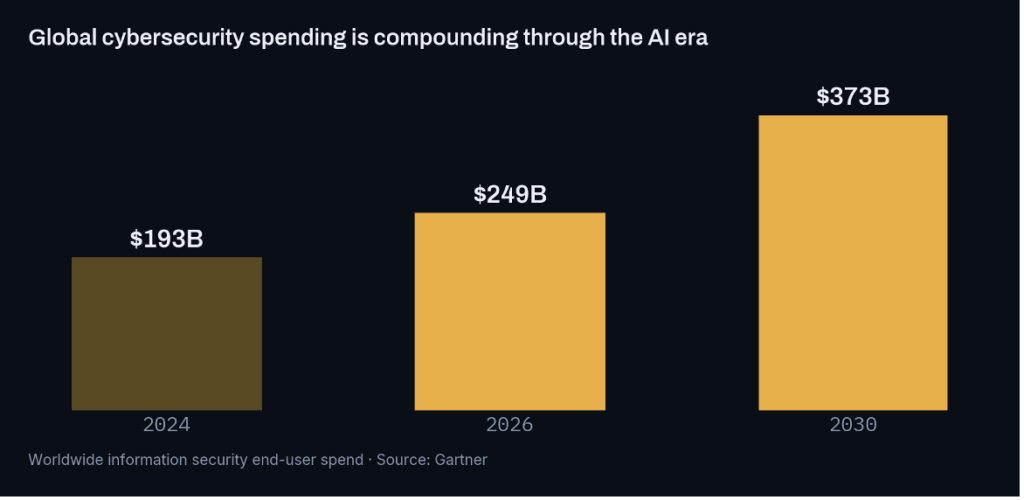
Gartner projects global information security spending will hit roughly $249 billion in 2026, up nearly 13% year over year, on track for about $373 billion by 2030. That’s up from just $193 billion in 2024 — a ~29% jump in two years, at a time when most enterprise software budgets are getting squeezed.

Global information security spending, 2024–2030. Source: Gartner.

Add in security services, and Cybersecurity Ventures pegs the broader market above $520 billion. A Morgan Stanley survey of CIOs found cybersecurity budgets are expected to grow roughly 50% faster than overall software spending.

The fastest-growing slice of the entire market is a category that barely existed 18 months ago: “securing AI” — projected to overtake endpoint protection as the single largest security category by 2029.

Translation: this isn’t a headline-of-the-week trade. It’s a multi-year, structurally funded spending supercycle. Now onto the stocks.

Want to see how I’m trading this theme in real time? I break down setups like these — with live entries, exits, and risk levels — every weekday at 11 a.m. ET on MiT Live.

A watchlist of cyber security companies

 The 15 Best Cybersecurity Stocks at a Glance

StockWhat it doesEst. rev. growthValuationAnalyst view
CrowdStrike (CRWD)Endpoint / XDR~26%PremiumStrong Buy
Palo Alto (PANW)Platform / identity~25%Above avg.Buy
Fortinet (FTNT)Network / firewall~20%ValueBuy / Hold
Zscaler (ZS)Zero Trust / SASE~24%ModerateBuy
Microsoft (MSFT)Bundled security giantDiversifiedModerateStrong Buy
SentinelOne (S)AI-native endpoint~23%ValueBuy
Okta (OKTA)Identity & access~11%ValueModerate Buy
Rubrik (RBRK)Cyber resilience~48%ModerateBuy
Cloudflare (NET)Edge / AI infra~36%PremiumHold / Buy
Check Point (CHKP)Firewall / SASE~7%ValueHold
Qualys (QLYS)Vuln. mgmt.~9%ModerateHold
Varonis (VRNS)Data security / DSPM~9%*ModerateBuy
Tenable (TENB)Exposure mgmt.~11%ValueBuy
Rapid7 (RPD)Vuln. mgmt. / SecOps~flatValueHold
Gen Digital (GEN)Consumer security~4%ValueHold
Figures are approximate, based on the most recent quarterly reports as of September 2026; *Varonis total revenue grew ~9% but its SaaS ARR is growing far faster (~60%+) through its subscription transition. Valuation reflects EV/revenue relative to the ~25x sector median.

The Rose Take: Where I Would (and Wouldn’t) Put New Money

After 28 years reading order flow, I’ve learned the best company and the best stock aren’t always the same thing. Here’s how I’d rank them:

  • Best business, hands down — CrowdStrike (CRWD). Nothing else in the group has its brand, retention, or platform breadth. The only knock is the price: it’s trading near Wall Street’s most bullish targets, so you’re buying perfection.
  • My No. 1 pick for new money — Palo Alto (PANW). It has the scale of CrowdStrike, faster-improving platform economics, a brand-new identity engine from the CyberArk deal, and it still trades at a discount to CRWD. It’s the best risk-adjusted way to own the theme.
  • Boldest high-upside bet — SentinelOne (S). The cheapest of the leaders, growing more than 20%, with real takeover optionality. If it keeps closing the gap with CrowdStrike, it has the most torque on the list.
  • Handle with care — Cloudflare (NET) and CrowdStrike (CRWD). Two of the best stories in tech, at two of the richest multiples. I’d rather wait for a pullback than chase them here.
  • The one I wouldn’t chase — Rapid7 (RPD). Revenue is essentially flat. It’s a turnaround-and-takeover bet, not a growth story — treat it that way.

The Blue-Chip Generals: Best Cybersecurity Stocks for Core Exposure

Large-cap, profitable platforms. They offer core exposure to the theme , and they’re the names institutions buy first.

1. CrowdStrike (CRWD)

The category gold standard. Its Falcon platform is the purest expression of the “AI threat means more security spend” trade, and management now openly calls the company “AI security infrastructure.” Net new annual recurring revenue grew more than 50% year over year in its most recent quarter, its new AI-detection product is scaling fast, and gross retention sits near 97% — a sign customers simply don’t leave. The catch: it’s the most expensive name in the group, and after a 4-for-1 split this summer, it’s already trading near Wall Street’s most bullish price targets. You’re paying up for the best.

2. Palo Alto Networks (PANW)

The consolidation play. While rivals sell point products, Palo Alto is pitching enterprises on running their entire security stack through one vendor — and it’s working, with next-generation security ARR above $9 billion and growing north of 30%. Its roughly $25 billion acquisition of CyberArk, which closed earlier this year, bolts on a dedicated identity pillar right as AI agents make machine identity a top priority. The catch: growth is decelerating off a huge base, and the stock has already had a monster year.

3. Fortinet (FTNT)

The value general. Fortinet owns better than half the global firewall market, differentiates with its own custom silicon, and — critically — is consistently profitable. It typically screens as the cheapest of the mega-cap pure plays, which makes it the “sleep at night” name in the group. The catch: it carries more hardware exposure than the pure cloud names, so its growth is steadier but slower.

4. Zscaler (ZS)

The zero-trust leader. Zscaler replaced the old perimeter-firewall model with cloud-native traffic inspection, and it’s leaning hard into securing agentic AI as its next growth leg, with ARR growing around 25% to nearly $4 billion. It often trades at a meaningful discount to CrowdStrike on forward earnings. The catch: the market punishes any hint of a growth slowdown here — recent guidance wobbles have triggered sharp drops.

5. Microsoft (MSFT)

The elephant nobody counts as a “cyber stock.” Microsoft has quietly built a security business worth roughly $37 billion — larger than CrowdStrike, Palo Alto, and Zscaler combined — and bundles it into enterprise agreements customers already sign. You won’t get pure-play torque, but you get the most defensible distribution in the entire industry with a fraction of the single-name risk. The catch: security is a rounding error in Microsoft’s overall story, so it won’t move the stock on its own.

The High-Growth Disruptors: AI Cybersecurity Stocks With the Most Upside

More torque, more risk. These are the challengers and turnarounds with the most upside if they execute.

6. SentinelOne (S)

The direct CrowdStrike challenger. Its AI-native Singularity platform and Purple AI tools are built exactly for the autonomous-threat era, ARR has crossed $1 billion, and it’s the cheapest of the leaders on a price-to-sales basis — trading around 3.5x forward revenue versus far richer peers. It’s also a perennial takeover candidate. That combination gives it the most torque on the list. The catch: it’s still proving durable profitability and faces the risk of being out-muscled by the platform giants.

7. Okta (OKTA)

The identity turnaround. Identity is the front door to every network — and with AI agents multiplying, every one of them needs an identity to manage. Okta is the leader in that lane and has been climbing steadily back after years in the wilderness. The catch: the platform giants are bundling identity too, so Okta has to keep proving it’s the better standalone tool.

8. Rubrik (RBRK)

The “after the breach” play. While most names focus on preventing attacks, Rubrik focuses on cyber resilience — clean, fast recovery after ransomware hits. That’s a fundamentally different exposure, and a critical one, since no defense is perfect. It’s been one of the stronger performers among the newer public names. The catch: it’s a younger, higher-volatility stock still scaling toward consistent profitability.

9. Cloudflare (NET)

The AI-infrastructure hybrid. Cloudflare isn’t a pure cybersecurity play — it sits at the intersection of edge computing, AI infrastructure, and security, growing revenue nearly 30%. For investors who want the AI build-out and the security angle in one ticker, it’s a rare two-for-one. The catch: that breadth means it competes on multiple fronts, and it trades at a premium valuation.

The Under-the-Radar Value & Niche Cybersecurity Stocks

Cheaper, specialized, less-crowded corners of the space — where the asymmetric setups often hide.

10. Check Point Software (CHKP)

The steady compounder. Check Point rarely grabs headlines, but it delivers consistent margins and cash flow while quietly building out its cloud and zero-trust offerings. It’s the low-drama way to own the theme.

11. Qualys (QLYS)

The profitable niche leader in cloud-based vulnerability scanning and compliance — the unglamorous plumbing that every regulated enterprise has to buy.

12. Varonis (VRNS)

A direct “securing AI” play hiding in plain sight. Varonis discovers, classifies, and monitors sensitive data and catches insider threats — exactly the problem that explodes when companies point AI models at their internal data. Its shift to a SaaS model is gaining traction.

13. Tenable (TENB)

The exposure-management specialist. Tenable helps organizations find what’s actually exploitable before attackers do — a discipline that only grows in importance as AI accelerates vulnerability discovery on the offensive side.

14. Rapid7 (RPD)

The small-cap wildcard. Same vulnerability-management and security-operations lane as the bigger names, but at a fraction of the market cap — which means more torque on any sector re-rating, and more risk if execution slips.

15. Gen Digital (GEN)

The consumer angle. The owner of Norton and Avast is the steadier, income-oriented way to play cybersecurity — protecting individuals rather than enterprises, with a profile closer to a cash-flow compounder than a hyper-growth bet.

Bonus: 3 Cybersecurity ETFs for One-Click Exposure

Not sure which horse to back? Own the whole field. These three ETFs give you diversified exposure without single-name blowup risk:

  • First Trust NASDAQ Cybersecurity ETF (CIBR) — the largest and most liquid, weighted toward Palo Alto, CrowdStrike, and Fortinet. It’s pulled in roughly $1.5 billion of net inflows over the past year, so it’s where sector money shows up first.
  • Amplify Cybersecurity ETF (HACK) — the original cyber ETF, with a similar large-cap tilt.
  • Global X Cybersecurity ETF (BUG) — a cleaner pure-play tilt with less legacy-tech overlap.

The Bottom Line on the Cybersecurity Play

Cybersecurity is one of the only enterprise budgets still expanding through an uncertain economy — and AI is pouring fuel on it from both sides. That’s the definition of a durable trade.

A few rules to play it well. Treat the tiers as roles, not rankings — the generals for core exposure, the disruptors for torque, the niche names for less-crowded setups, and the ETFs when you’d rather own the theme than pick a winner. Watch net new ARR at every earnings report; it’s the one number that separates a real spending shift from a headline pop. And remember that after a big move like Monday’s, headlines fade but bookings don’t — the names that hold their gains are the ones with the recurring revenue to back it up.

The AI era needs defending. These are the companies getting paid to do it.

Editor’s Note: What ever happened to the AI stock boom? Even AI darlings like Nvidia have essentially gone nowhere since summer 2025. Our friend and colleague at InvestorPlace, Louis Navellier, may have the answer. According to Louis, the AI industry is quietly “staging” ahead of the next great AI breakthrough… a new class of AI he calls “Superintelligence… but better.” How will it trigger a $100 trillion reset of the AI markets. How will the launch of this tech send some stocks to zero, and others soaring? And why does Louis say: Don’t buy or sell an AI stock in 2026 until you see what’s coming next? Go here for the full story (and Louis’ #1 pick).  

Cybersecurity Stocks FAQ

What is the best cybersecurity stock to buy in 2026?

There’s no single answer for every investor, but the strongest candidates are CrowdStrike for quality, Palo Alto for the best balance of growth and value, and SentinelOne for the most upside if you can stomach the risk. Match the name to your risk tolerance, not the other way around.

Are cybersecurity stocks a good hedge against an AI bubble?

They’re one of the more logical ways to stay exposed to AI without betting purely on the chip and data-center trade. Security spending is largely non-discretionary and rises whether AI adoption succeeds or produces new threats — so the group can hold up even if AI enthusiasm cools.

What is the best cybersecurity ETF?

The First Trust NASDAQ Cybersecurity ETF (CIBR) is the largest and most liquid, making it the default choice for diversified exposure. Amplify’s HACK and Global X’s BUG are smaller alternatives with slightly different holdings.

How is AI changing the cybersecurity industry?

AI is arming attackers with faster, cheaper, autonomous attacks — and forcing defenders to buy AI-powered tools to keep up. Gartner now tracks “securing AI” as its fastest-growing category, projected to become the single largest area of security spending by 2029.

CrowdStrike vs. Palo Alto — which is the better stock?

CrowdStrike is the higher-quality, faster-compounding business; Palo Alto is the broader platform at a more reasonable valuation. For new money at current prices, Palo Alto arguably offers the better risk-reward — but both belong on a serious watchlist.

Trade This Theme With Me – Live, Every Morning

A watchlist is a starting point. Turning it into actual trades — knowing when to get in, where to set risk, and when to walk away — is the hard part, and it’s what I do out loud every single day.

Join me on MiT Live, weekdays at 11 a.m. ET. I go live to break down the market’s biggest themes and the specific setups I’m watching in real time — cybersecurity, AI, and wherever the money is rotating next. It’s free, it’s unscripted, and it’s where lists like this one turn into real trade plans. Drawing on 28 years as a CBOE and CME floor trader, I’ll show you exactly how I’m thinking through these moves as they happen.

Watch live at youtube.com/@LiveOptionsWithJR — hit subscribe and set a reminder so you never miss the 11 a.m. open.

About the author

Jonathan Rose is a 28-year veteran trader who spent his career as a market maker on the Chicago Board Options Exchange (CBOE) and a floor trader at the CME and CBOT. He is the founder of Masters in Trading, where he teaches options and shares live trades and market themes every weekday at 11 a.m. ET on MiT Live. His focus is helping everyday investors think about risk and opportunity the way professional traders do.

The post The 15 Best Cybersecurity Stocks to Buy Whether AI Booms or Busts appeared first on MarketWise.


  • ✇Market Wise
  • You’re crazy if you think AI development will slow down. Stay bullish. Brian Hunt
    Today’s issue in preview: You’re crazy if you think AI development will slow down. Stay bullish. How to profit from the surge in “AI is dangerous” concerns Donald Trump turned these stocks into money machines Learn our Top Themes to buy now You’re crazy if you think AI development will slow down. Stay bullish Credit: Just_Super To slow down or not to slow down? Over the past week, this has become the biggest unanswered question in the entire investment world. The answer could have la
     

You’re crazy if you think AI development will slow down. Stay bullish.

14 September 2026 at 12:00

Today’s issue in preview:

  • You’re crazy if you think AI development will slow down. Stay bullish.

  • How to profit from the surge in “AI is dangerous” concerns

  • Donald Trump turned these stocks into money machines

  • Learn our Top Themes to buy now


You’re crazy if you think AI development will slow down. Stay bullish

Image

Credit: Just_Super

To slow down or not to slow down?

Over the past week, this has become the biggest unanswered question in the entire investment world. The answer could have large effects on your portfolio.

Many AI insiders are seeing the blistering pace of AI advancement and saying it should be slowed. They say a slower rate of progress would give technologists more time to build safeguards such as restricting what AI agents can do, limiting what data they can access, and thorough testing to gauge their capabilities. Over the past week, this subject has exploded across mainstream media and social media alike.

However, some “AI maximalists” say slowing down development would cede America’s AI lead to China. They also say some AI leaders, such as Anthropic’s Dario Amodei, are not 100% sincere in their calls for oversight.

Dario’s critics say he is advocating regulation not out of altruism, but to kneecap competitors through new rules and laws. They say Anthropic has reached a rarified level of AI capability and wants to “pull up the ladder” to prevent other firms from reaching its level.

Sincere or not, the “deceleration” calls from Dario and other AI insiders are producing losses in many AI-related stocks today. Investors are worried that slowing the pace of AI development will ultimately depress the revenues and profits of companies that manufacture critical AI data center hardware, such as semiconductors, data networking equipment, and cooling systems.

We believe all this fuss is overblown relative to both current and future reality.

The development of a revolutionary technology like AI, which is extraordinarily valuable from both commercial and geopolitical standpoints, is a relentless force that works 24 hours a day, 365 days a year. It does not take holidays. It does not sleep. It can be temporarily slowed a little but not stopped. And development of this revolutionary technology is global.

American tech executives and politicians can regulate domestic AI development, but they cannot regulate its development in China, Russia, India, or dozens of other countries. They cannot effectively regulate open-source AI all over the world.

Heavily regulating U.S. firms OpenAI and Anthropic (called “Frontier Labs”) would be like slowing down traffic in one lane of a six-lane highway. Everybody is still getting to their destinations. The prize of advanced AI is so large that it will be pursued, no matter what.

Plus, consider the U.S. government’s position. It rightly sees itself in a massive geopolitical and economic “great power” competition with China. AI supremacy is hugely value in this competition. It would be lunacy to slow AI development to the point that we essentially hand China a big victory. Governments are among the dumbest entities on the planet, but they aren’t that dumb.

Given all this, we believe the current fuss over AI development will prove to be a tiny speed bump on the long road of breakneck AI advancement and proliferation.

During times like this, it is important to keep the big-picture view in mind. Keep AI’s potential TAM – or Total Addressable Market – in mind.

And let’s ask ourselves, “How big is the market for super intelligence?”

How much demand is there globally for instant access to super genius doctors, super genius lawyers, super genius software developers, super genius financial advisors, super genius engineers, super genius marketers, super genius accountants, and so on?

When entrepreneurs and business executives try to generate interest in their companies, they often cite the size of their TAM.

When it comes to TAM, bigger is better. A typical investor gets more excited about investing in a company with a $200 billion TAM than one with a $5 billion TAM.

You’re going to serve the $250+ billion U.S. beverage market? Great. Big TAM.

You’re going to serve the Asian grocery market in Burlington, Vermont? Not so great. Small TAM.

So, what is the TAM for super intelligence, aka AI?

Since a large portion of the $126 trillion annual global GDP consists of paying lots of money to elite lawyers, consultants, executives, project managers, doctors, software engineers, financial advisors, accountants, and business analysts, I’m comfortable saying the TAM for super intelligence over the next decade is north of $100 trillion.

We are talking about a colossal TAM.

We’re talking about a technology that will yield many of the largest financial “jackpots” in the history of capitalism… while bestowing some governments with awesome geopolitical power.

For practical purposes, we can say the demand for superintelligence is so vast that it is essentially infinite.

This is what the world’s smartest, most informed, and wealthiest technologists know… which is why they are in a great race to build the world’s most useful AI infrastructure and programs. It’s why they are conducting the largest collective investment effort in history.

When you boil away all the fluff, bluster, and extraneous details from the AI discussion, what we are left with is the core, foundational issue…

A world of advanced AI is a world of abundant, ubiquitous superintelligence. Since applied intelligence is the engine of innovation and human progress, the demand – the TAM – for superintelligence across all industries and countries is essentially infinite.

Ownership of the world’s most useful, most valuable AI programs and applications will be among the greatest financial prizes in all recorded history. They will be among the greatest prizes of government in all recorded history.

The current fuss over the speed of AI development will not prevent people all over the world from reaching for these prizes. The historic level of AI infrastructure spending will continue… and will generate significant financial opportunities along the way.

Recommended Link:

Move your money OUT of SpaceX (and into this stock) by Sept. 29th

Ad Image

Elon Musk has gone “all in” on Texas, home of SpaceX. But Texas just froze ALL new AI data center buildouts. The reason? Data center demand in Texas has soared from 48 gigawatts to 474 gigawatts… since 2023, according to Reuters. But according to 60-year Wall Street legend Marc Chaikin, one company has the solution. Its “micro cluster” technology will consume an estimated 99% less electricity and water. And it’ll come online as soon as Sept. 29th. When it does, it’ll make current data centers obsolete when it comes to major AI breakthroughs – including Elon’s Grok. Go here for the company name and ticker – and Marc’s full prediction – free.

How to profit from the surge in “AI is dangerous” concerns

Image

Credit: imaginima

Part of the current fuss over AI development (detailed above) stems from recent and former Anthropic employees airing concerns that AI “could kill us all.”

They have shared precious few details on exactly how AI would do that, but presumably, they have some movie scenarios in mind, such as a “bad” AI taking over nuclear missile launches, developing a killer virus, or taking over transportation systems and causing catastrophic accidents.

Whatever the vector is, the public is now sufficiently spooked over AI. Political leaders are spooked over AI. And business leaders are spooked over AI.

This is all bullish for the cybersecurity business.

And it should continue to make our AI cybersecurity call a winner.

Back in March, we detailed how the “Agent Supernova” was set to create huge amounts of new cybersecurity threats across banking, transportation, healthcare, manufacturing, and corporate secrets.

Agent Supernova is our name for the megatrend of AI-powered “agents” working throughout the global economy.

Years of development have made AI advanced enough to perform many everyday tasks people do now… and the list keeps growing. Over the next 12–24 months, AI agents will help manage factories, perform financial analysis, manage inventories, write software, design websites, create legal documents… and thousands of other tasks.

Within two years, the number of AI agents operating in the American economy isn’t poised to increase by 10X… or 50X… or even 1,000X. Try at least 10,000X.

This is the coming Agent Supernova: agents working with people, agents working with other agents, agents running businesses, and negotiating with other agents.

The Agent Supernova is about to introduce billions of “AI workers” into our economy with very little day‑to‑day human oversight. The business and investment implications are huge. It will transform many businesses and industries, end many as we know them, and create entirely new ones.

In our original research note, we detailed how this megatrend would also create huge amounts of new cybersecurity risks. If we’re going to have millions of AI agents performing billions of daily tasks in health care, education, energy, transportation, manufacturing, and technology, then we’re going to have billions of points of cybercrime vulnerability. And remember, crooks get to use AI too.

If agents can roam the web, communicate for you, log in to your apps, move money, and modify data at machine speed, then a compromised agent can do the same damage just as fast – now with far less human oversight to catch mistakes or intrusions. We stated this is why well-positioned cybersecurity companies are poised to enjoy years of booming business.

At the time, we highlighted CrowdStrike (CRWD), Palo Alto Networks (PANW), Zscaler (ZS), SailPoint (SAIL), and Radware (RDWR) as “picks to click” in this trend. This basket is up an average of 58% in six months.

At the time of our note, cybersecurity stocks – a special type of software stock – had suffered a sharp decline due to investor concerns that AI would disrupt software.

Soon after our note, cybersecurity stocks staged a huge rebound as investors began to believe AI wouldn’t disrupt the business as much as they had thought. This rally has sent leaders CrowdStrike and Palo Alto up more than 100% from their bottoms. This sector’s big drop and subsequent huge rise have given rollercoasters a run for their money.

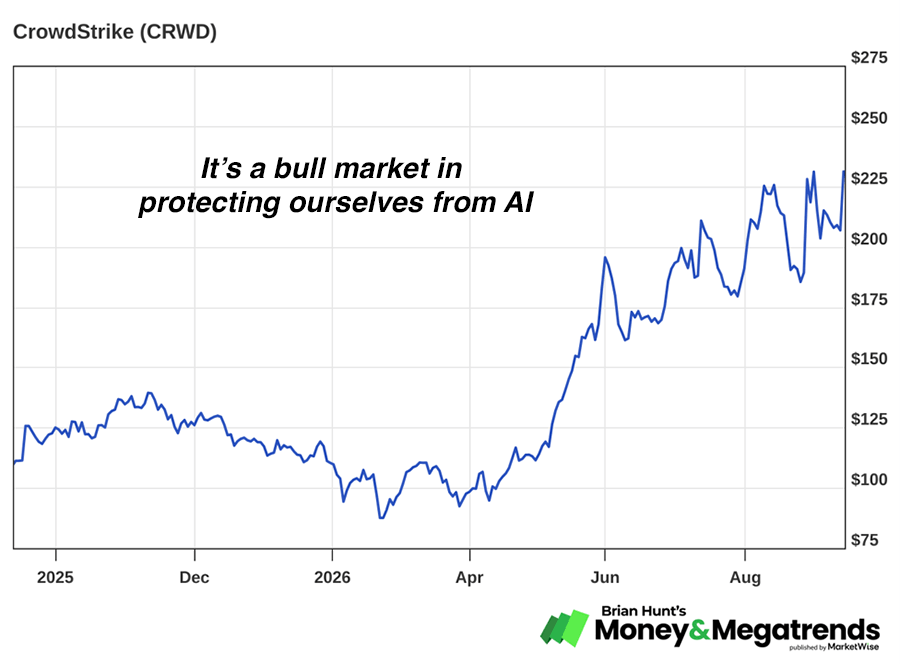
AI is the most exciting and potentially transformational technology of our time. The high-profile concerns aired by AI insiders over the past week are an indication that it’s also probably the most dangerous. That is driving a bull market in cybersecurity stocks. Given the fuss of the past week, it’s no coincidence cybersecurity leader CrowdStrike jumped 12% this morning to reach a new all-time high.

Image


Donald Trump turned these stocks into money machines

Image

Credit: dan_prat

Over the past 12 months, the mainstream media has had a heyday reporting on conflicts between President Donald Trump and Canadian Prime Minister Mark Carney.

Unfortunately, Canadians have been subjected to Trump’s frequent taunting and trade war tariffs. More than a few Canadians have recently used four-letter words to refer to Trump.

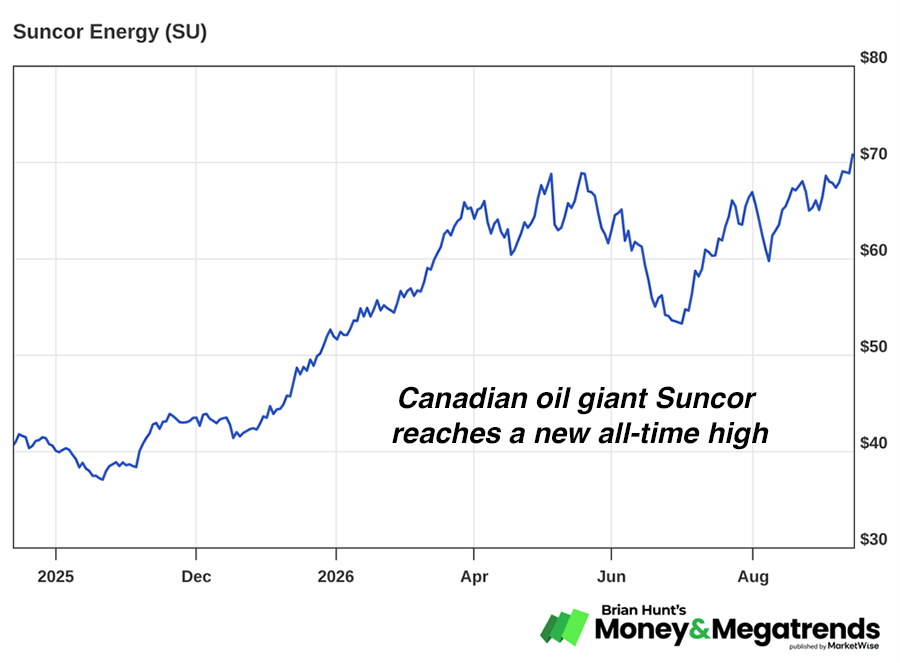
However, shareholders of Canada’s “national champion” oil and gas firms should consider sending Trump a nice thank you gift. His war in Iran is generating extraordinary returns for companies such as Suncor Energy (SU), Cenovus Energy (CVE), and Canadian Natural Resources (CNQ).

All three firms are benefitting from soaring oil prices. All three are enjoying booming revenues and profits. All three recently registered all-time highs. The Iran War is a substantial driver of it all.

Money & Megatrends readers in good standing are familiar with our bullish stance on Canada. It’s been one of our highest-conviction themes over the past year. We’ve published over a dozen research notes on the idea.

Over the past 12 months, I’ve made the case that we are in a favorable environment for critical resources… one in which many individual resource sectors will generate strong returns.

Critical resources are the building blocks of the economy. Think raw materials like crude oil, natural gas, iron ore, copper, uranium, corn, and cotton.

Even today’s high-tech world of AI, apps, email, and Zoom calls is built on a “low-tech” foundation of steel, concrete, copper, lumber, and aluminum. Every day, our cars, trucks, and airplanes consume millions of barrels of fuel. Our lights turn on because we burn coal and natural gas.

Mining, extracting, planting, harvesting, processing, refining, and transporting critical resources is a multi-trillion-dollar business that affects every area of your life.

During this time, I’ve frequently highlighted Canada as an excellent place for investment capital. Canada is the second-largest country in the world by total area, after Russia.

This means there’s plenty of area to hold big oil and natural gas deposits… huge tracts of timberland… giant mineral deposits… and enormous farms. Canada is a major player in oil and natural gas production, ranking in the world’s top five producers for both. It’s also a world leader in the production of fertilizer, uranium, aluminum, wheat, gold, lumber, and platinum.

Canada’s massive resource endowment also makes it a beneficiary of the war in Iran and its consequences.

As I’ve covered this year, for many countries and businesses, the Iran War is a powerful reminder: If your survival or smooth operation depends on uninterrupted resource flows from the often-unstable Middle East, you are in a dangerous, vulnerable position.

No politician, CEO, or major shareholder wants their business to be in that position. No citizen wants their country to be in that position. Many powerful and influential people are realizing this is a big risk that must be mitigated if humanly possible. Executives and politicians will get fired for not addressing it effectively.

This means building and buying as many forms of “not Middle Eastern” resource supply chains as possible economically… like those from safe, resource-rich Canada. I can state with confidence that no caribou will ever strap on an explosive vest and attack a local oil refinery… and no grizzly bear will send a kamikaze drone flying into a natural gas pipeline.

But don’t take my word on this trend. Take the market’s word.

It enthusiastically supports owning high-quality Canadian resource assets.

Canadian Natural Resources, Cenovus Energy, and Suncor Energy are essentially “national champions” of Canada. Together, they produce a huge portion of the country’s oil and gas. Much of this production comes from the country’s vast oil sands deposits. And together, their market values are soaring. Their stocks have gained 73%, 108%, and 75%, respectively, over the past 12 months. A large portion of these gains are attributable to the Iran War and its uplifting of global oil prices.

Canadian stocks had strong tailwinds before the Iran War. They will have even stronger tailwinds after it. We are still bullish on Canada.

Image


Market Notes

  • Our recommendation to get long oil and gas stocks continues to pay off. Oil giants Chevron (CVX), ConocoPhillips (COP), Permian Resources (PR) and Shell (SHEL) hit new highs today.

  • LNG shipping leaders are hitting new highs. Frontline (FRO), Teekay Tankers (TNK), Dorian LPG (LPG) and Nordic American Tankers (NAT) just hit a new highs.

  • Cruise line giants Norwegian Cruise Line Holdings (NCLH) and Carnival Corp (CCL) reached new one-year lows today.

  • The high-profile eVOTL firm Joby Aviation (JOBY) reached a one-year low today.

Regards,

Brian Hunt signature

Brian Hunt signature

Brian Hunt
Editor, Money & Megatrends


An urgent message from our colleagues:

I paid $5,000 to hear Elon say this

Image

I recently paid $5,000 to be in a room with Elon Musk in Los Angeles. What he’s launching right now could be his biggest move yet (and make you more money than anything he’s done so far). If you buy just one stock in 2026, I urge you to make it the one I’m giving away for free:

Get the ticker & full details here.

The post You’re crazy if you think AI development will slow down. Stay bullish. appeared first on MarketWise.

❌