❌

Normal view

  • ✇Market Wise
  • Oracle Earnings: Watch Out for Massive OpenAI Risk Despite Blowout First Quarter James Royal
    Key Points Oracle reported strong results in its fiscal first quarter, with sales and adjusted earnings per share soaring 30%, while AI cloud revenue surged 121%. Oracle delivered 850 megawatts of data-center capacity during the quarter and boosted its remaining performance obligations, a measure of future contract revenue, to $664 billion. Oracle’s success is so closely tied to contracted revenue from OpenAI that investors can’t afford to ignore the risk, especially as OpenA
     

Oracle Earnings: Watch Out for Massive OpenAI Risk Despite Blowout First Quarter

11 September 2026 at 11:10

Key Points

  • Oracle reported strong results in its fiscal first quarter, with sales and adjusted earnings per share soaring 30%, while AI cloud revenue surged 121%.
  • Oracle delivered 850 megawatts of data-center capacity during the quarter and boosted its remaining performance obligations, a measure of future contract revenue, to $664 billion.
  • Oracle’s success is so closely tied to contracted revenue from OpenAI that investors can’t afford to ignore the risk, especially as OpenAI’s fundamentals and business environment worsen.

Oracle (ORCL) reported strong results in its fiscal first quarter on Thursday, with earnings blowing past analysts’ expectations. Total revenue climbed 30% year over year, to $19.3 billion, while adjusted earnings per share grew 30% to $1.92, topping the Bloomberg analyst consensus of $1.75 per share.

All eyes should be on Oracle’s artificial-intelligence (“AI”) infrastructure business, since that’s where the company has staked its future growth. This Cloud Infra unit, as Oracle calls it, saw sales surge 121% to $7.4 billion in the quarter, above the analyst consensus of $7.19 billion.

Oracle noted that it delivered 850 megawatts of data-center capacity in the quarter. This allows the company to start generating revenue from the additional capacity.

Oracle signed $30 billion in AI cloud contracts in the quarter, bringing its remaining performance obligations (“RPO”) to $664 billion. The RPO is future contract revenue that Oracle expects to earn from its data-center tenants. This includes, most importantly, OpenAI, which represents about half of Oracle’s RPO, including a $300 billion deal between the two companies.

Management projected that the second quarter of fiscal 2027 would look similar to, or maybe better than, this quarter: sales up 30% to 34% and adjusted earnings per share of $1.85 to $1.93. That level of earnings per share represents growth of 21% to 25% – down from the first quarter.

Management stood firm on its prior sales expectations of $90 billion for the year, but raised earnings-per-share guidance from $8.05 to $8.10. It also stuck to its capital spending expectations of $90 billion to $95 billion for this year, a level that’s already strained its finances.

Oracle is spending aggressively to build out its data-center network, so its first-quarter earnings translated into negative $5 billion in free cash flow. The company has borrowed a staggering amount to fund the build-out – sporting $130 billion in notes payable and other borrowing, as of May – and completed a $20 billion equity offering in the quarter to raise non-debt financing.

The concern is significant enough that the company is telling investors that its new RPO contracts do not create the need for an incremental capital raise.

Oracle CFO Hilary Maxson detailed on the earnings call that the “vast majority of those new contracts were via prepay or bring your own hardware or similar mechanic,” and that the RPO wouldn’t hit revenue or capital expenditures until fiscal 2028 (which begins in June 2027) or beyond.

Oracle’s quarterly results may calm the nerves of some investors for now, but the company will need to show that its key data-center tenant can pay its bills. At this point, that’s not certain.

Oracle’s Future Is Linked to OpenAI’s Success

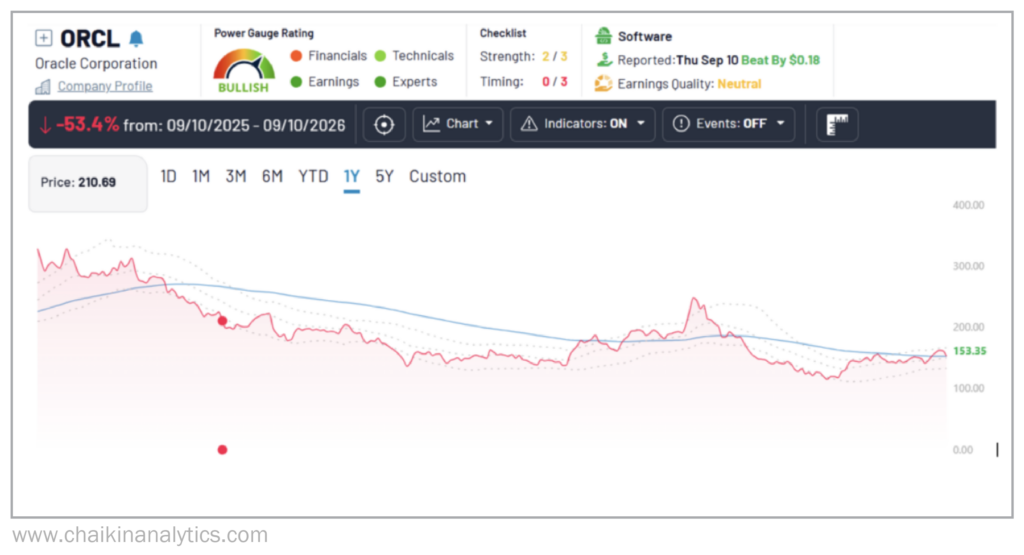
Oracle stock has been on a roller coaster over the past year as investors try to decide whether the company will be one of the biggest beneficiaries of AI… or one of the biggest losers. Big tech companies have hitched their AI fortunes to two money-losing firms: OpenAI and Anthropic.

Oracle Chaikin Graph

Some investors are betting big that Oracle will plummet – a 50% drawdown is well possible, after similar downdrafts in the past year – and the cost to insure Oracle’s debt against default has soared during that time.

The key risk is OpenAI, given its large share of Oracle’s RPO and OpenAI’s continuing losses. OpenAI is a linchpin in the AI industry, with future spending commitments to major players, including Cerebras Systems (CBRS), CoreWeave (CRWV), and Oracle. So, it’s crucial to the AI industry and Oracle that OpenAI stays solvent and continues to spend. If not, a range of AI-related stocks may go to zero if the bubble pops.

OpenAI Continues to Burn Billions in Cash

However, OpenAI is unprofitable, and it’s not clear whether it can ever turn a profit. OpenAI lost $20.9 billion on an operating basis in 2025, followed by a $9.3 billion loss in the first quarter and a further $12.3 billion loss, including stock compensation, in the second quarter.

The business environment continues to worsen for OpenAI, too. The company’s sales grew just 18% quarter over quarter, while Anthropic more than doubled its revenue in the same period.

Meanwhile, Chinese AI models are taking significant share from American models, including OpenAI. They’re offering good enough performance at substantially lower prices, so software developers are turning to these low-cost providers to build their models.

As if that wasn’t enough, token prices continue to plummet, reducing the revenue OpenAI can generate. Silicon Data’s LLM Token Expenditure Index shows token pricing cut in half from the end of May to late August, from $2 per million tokens to just $1.02.

With poor and worsening economics, OpenAI will need to raise at least tens of billions of dollars soon to stay afloat. So, in effect, Oracle’s success – some analysts say survival – depends on whether investors will keep funding OpenAI indefinitely.

Oracle’s own shakier financial status is shown by the fact that S&P Global Ratings downgraded the company’s debt by a notch to BBB-, just one level above “junk.” As mentioned, the cost to insure Oracle’s debt against default has sharply risen over the past year.

All of that is tied to OpenAI in some way or another.

So, while Oracle’s own first-quarter results look excellent on the surface, its key customer is showing severe problems. If not fixed, it’s only a matter of time before they become Oracle’s problems, too.

Regards,

James Royal, PhD

Editor’s Note: Whitney Tilson — the hedge fund manager CNBC called “The Prophet” — says America has reached its “Ripping Point.” The old financial order is being torn apart, and he believes most investors have no idea what’s coming in the next six months. He’s named the stocks he thinks will be destroyed in the chaos — and the ones he believes will soar. Watch his free presentation while it’s still available.

The post Oracle Earnings: Watch Out for Massive OpenAI Risk Despite Blowout First Quarter appeared first on MarketWise.

  • ✇Market Wise
  • SB Energy IPO: This Hidden Detail Is a Major Warning About the AI Bubble James Royal
    Key Points SB Energy has announced plans to go public, but AI investors should be wary, as the company had to give away billions of dollars in value to secure OpenAI as a tenant. SB Energy issued warrants now worth $5.5 billion to OpenAI as part of a deal to land the AI lab as a tenant at data centers it’s developing in Milam County, Texas. A poorly capitalized SB Energy, with little history of developing data centers, is paying an AI lab with a history of rising losses to oc
     

SB Energy IPO: This Hidden Detail Is a Major Warning About the AI Bubble

10 September 2026 at 13:10

Key Points

  • SB Energy has announced plans to go public, but AI investors should be wary, as the company had to give away billions of dollars in value to secure OpenAI as a tenant.
  • SB Energy issued warrants now worth $5.5 billion to OpenAI as part of a deal to land the AI lab as a tenant at data centers it’s developing in Milam County, Texas.
  • A poorly capitalized SB Energy, with little history of developing data centers, is paying an AI lab with a history of rising losses to occupy its massive but not-yet-built facility.

SB Energy (SBE) is planning to go public, but details in its recently filed S-1 initial public offering (“IPO”) prospectus should give artificial intelligence (“AI”) investors a wake-up call. The data-center developer had to give away billions of dollars in value to secure OpenAI as a tenant at to-be-constructed facilities, according to SB Energy’s prospectus.

SB Energy’s move suggests demand for AI data centers may not be nearly as robust as AI bulls suggest, especially as OpenAI seems to lose more money each quarter.

Let’s dig into the details to understand what SB Energy did and why.

In January, SB Energy issued warrants to OpenAI as part of a deal to land the AI lab as a tenant at data centers it’s developing in Milam County, Texas. As of the prospectus date, OpenAI owns 3.99 million warrants, valued at $5.5 billion on June 30, and they expire in 2036.

Warrants are a kind of financial derivative that entitle the owner to buy a security from the issuer at a specified price until the expiration date. In this case, OpenAI can buy up to 3.99 million shares at $0.01 per share if and when each of the eight warrant tranches vests.

One tranche has already vested when the two companies signed a lease for 800 megawatts at SB Energy’s Milam County facility. A second tranche will vest if SB Energy prices an initial public offering (“IPO”). The firms have agreed to a cashless exercise of these vested warrants, so that OpenAI simply receives the value of the warrants as shares of SB Energy stock without having to put up any money of its own – a valuable point for OpenAI, since it’s burning cash.

Six further tranches vest under other conditions, including five that vest as SB Energy’s market capitalization hits milestones from $80 billion to $200 billion.

Why would SB Energy just give away warrants that were worth more than $3.6 billion at the time of issuance – and now valued at $5.5 billion?

SB Energy Just Gave Away Billions to OpenAI

As part of its IPO, SB Energy is looking to raise between $5 billion and $7 billion with an initial market cap of $50 billion. But the firm has a history of losses, and almost all of its handful of data centers are yet to be constructed. In the first six months of 2026, SB Energy reported sales of $138.7 million and losses of $3.2 billion, mostly due to changes in the warrants’ value.

So, enticing OpenAI to sign a lease with billions in warrants gets SB Energy in the game quickly with a tenant that has billions in financing. With a signed contract in hand for a future data center, SB Energy can go to a lender and access financing on more agreeable terms (or at all). That’s how neoclouds such as CoreWeave (CRWV) have been playing the game, too.

Subsequently, SB Energy announced it will build another massive data center to be leased by OpenAI, an 8.0-gigawatt facility known as the PORTS-Pike Technology Campus in Pike County, Ohio. Nvidia (NVDA) stepped in to backstop up to $105 billion for the facility’s first 4.25 gigawatts and has an option to backstop the remaining portion of the build-out. Operation will begin in phases in 2028.

But step back for a moment and consider what SB Energy’s financing move really does. If the AI market is really as hot as bulls say it is, why does a developer need to pay a prospective tenant? Shouldn’t AI labs – which are unable to keep up with demand, the story goes – be clamoring for a data-center deal, so that a supplier such as SB Energy doesn’t need to pay its tenants?

What we’re seeing is relatively little demand for AI data centers that isn’t driven by the two major labs, OpenAI and Anthropic. The two most lavishly funded labs are running around signing massive deals, such as with Oracle (ORCL), which is building data centers for OpenAI. The AI lab owes around half of Oracle’s $638 billion in remaining performance obligations as rent.

OpenAI has $1.4 trillion in spending commitments, and Anthropic inked $517 billion in compute deals in just 11 months. That’s translating into a huge share of AI revenue for the hyperscalers: 70% of Microsoft’s (MSFT) revenue in its latest fiscal year, per Bloomberg estimates. Analyst Ed Zitron pegs OpenAI and Anthropic’s sales at a similar level to Google and Amazon (AMZN).

In short, a poorly capitalized SB Energy with little history in developing data centers is paying an AI lab with a history of rising operating losses to occupy its massive but not-yet-built facility.

That sounds like a recipe for trouble.

SB Energy’s IPO Timeline: Will It Race to Go Public?

SB Energy is relying on the weakest major player among AI labs, OpenAI. It’s on the hook to spend $1.4 trillion and generated a $12.3 billion loss in the second quarter, after a $9.3 billion loss in the first quarter. It will keep burning money and may be structurally unprofitable.

While OpenAI raised $122 billion earlier this year in a huge funding round, it’s going to need to raise cash again soon – and not just a little. And it has a few ways to lose in the fundraising process and really just one way to win. It needs to raise at least tens of billions of dollars at a higher valuation than it received in its latest funding round in March, $852 billion.

It loses if it can’t raise enough money, the valuation does not rise enough, or – horror! – the valuation actually falls. Given that OpenAI postponed an IPO over concerns it would not reach a $1 trillion valuation, the potential upside here may be limited.

If OpenAI can’t get a fundraising round that sustains investors’ optimism about AI as a business, it will be felt across the industry. As a result, SB Energy may be racing to the IPO window in the next few weeks to get ahead of this possibility. But even if SB Energy does complete its offering, it will still be almost wholly reliant on OpenAI to survive.

Regards,

James Royal, PhD

Editor’s Note: A highly secure site in West Texas now houses an emerging potential $10 trillion technology backed by Elon Musk and Sam Altman. This breakthrough could completely replace our need for foreign oil – and send one small group of stocks soaring in the process. Click here to learn how you can invest in Elon’s next $10 trillion move.

The post SB Energy IPO: This Hidden Detail Is a Major Warning About the AI Bubble appeared first on MarketWise.

  • ✇Market Wise
  • SB Energy IPO: Plenty of Risk for This AI Data-Center Stock, But Is There Any Return? James Royal
    Key Points SB Energy is planning an IPO, with the developer of AI data centers and power projects looking to raise $5 billion to $7 billion at an estimated market cap of more than $50 billion. The AI infrastructure firm is backed by some of the sector’s biggest investors, including SoftBank, OpenAI, Nvidia, and OpenAI CEO Sam Altman personally. SB Energy’s heavy reliance on OpenAI means the company is exposed not only to risks in its own business but also to risks facing Open
     

SB Energy IPO: Plenty of Risk for This AI Data-Center Stock, But Is There Any Return?

4 September 2026 at 13:23

Key Points

  • SB Energy is planning an IPO, with the developer of AI data centers and power projects looking to raise $5 billion to $7 billion at an estimated market cap of more than $50 billion.
  • The AI infrastructure firm is backed by some of the sector’s biggest investors, including SoftBank, OpenAI, Nvidia, and OpenAI CEO Sam Altman personally.
  • SB Energy’s heavy reliance on OpenAI means the company is exposed not only to risks in its own business but also to risks facing OpenAI.

SB Energy (SBE) announced on September 1 that it has filed for an initial public offering (“IPO”). Although the company hasn’t provided a listing date, reports say it could begin trading as soon as this month. The developer of artificial intelligence (“AI”) data centers and power projects is looking to raise between $5 billion and $7 billion.

With an estimated market capitalization of more than $50 billion, the offering would put SB Energy among the largest IPOs ever, even if its market cap looks modest in an IPO year with big names such as SpaceX (SPCX) and the upcoming Anthropic debut.

The AI infrastructure company is backed by some of the biggest investors in the sector, including SoftBank (SFTBY) – where the “SB” in the company’s name comes from – as well as OpenAI and Nvidia. OpenAI CEO Sam Altman is also a personal investor in SB Energy.

Despite these big names, SB Energy plans to conduct its IPO with a history of losses and with almost all of its data-center facilities yet to be constructed. Meanwhile, many established, cash-flowing data-center companies are planning IPOs that may hit the market in weeks.

In the six months ending in June 2026, SB Energy reported sales of just $138.7 million, with most of that coming from changes in the value of financial instruments (i.e., not customer purchases). Similarly, while it reported a loss of $3.2 billion over the same period, all but $45 million of that loss was non-cash expenses for stock compensation or losses on financial instruments.

These results show that SB Energy doesn’t have many assets producing cash flow right now.

In fact, it has no operational data centers at the moment, but it does have:

  • 8.8 gigawatts of data centers contracted or under construction
  • 5.5 gigawatts of power projects contracted, under construction, or operating

With the contracts it has signed for services at these facilities, SB Energy has a $439 billion sales backlog.

The details matter a lot here. Of its 8.8 gigawatts of data-center capacity, just 0.8 gigawatts are actually under construction now, and it could take 24 to 36 months to bring new capacity online. As SB Energy says in its prospectus: “No data center capacity is currently in operation.”

So, investors in SB Energy must be comfortable with a company that will need to ramp up over time. For example, Nvidia (NVDA) has committed to invest $1.5 billion at the stock’s IPO price in a private placement. SB Energy has also issued financial derivatives known as warrants to key tenant OpenAI, valued at $5.5 billion. These gain in value if SB Energy stock rises.

Even if you are bullish on AI, the data-center developer presents some serious risks, and the prospectus takes pains to show how much SB Energy relies on OpenAI for its future success.

SB Energy’s Biggest Risk Is OpenAI

SB Energy is tied at the hip to OpenAI, with the AI lab committing to be a significant tenant at SB’s upcoming data centers. But given its relationship with OpenAI, it’s more than just that, as SB Energy explains in its prospectus:

We are substantially dependent on OpenAI as a tenant and strategic partner, and any adverse change in its financial condition or willingness to perform its contractual obligations could materially and adversely affect our business.

Contracts with OpenAI, as well as controlling shareholder SoftBank, “constitute a significant portion of our near-term data center revenue,” according to SB Energy.

Beyond the issue of OpenAI being a key customer, both OpenAI and SoftBank are strategic partners, too, creating a conflict of interest that could affect regular shareholders.

The prospectus explains one of the potential concerns here:

For example, our board of directors’ willingness or ability to enforce lease obligations or pursue remedies against a tenant that is simultaneously our controlling shareholder (or a significant investor with board designation rights) may be constrained in ways that would not apply with respect to an unaffiliated tenant.

While the company has taken steps to mitigate these conflicts of interest, they’re inherent in this structure.

Because of key tenant OpenAI’s history of operating losses and its own history of losses, SB Energy has done what many AI firms have done to get access to financing… turn to Nvidia.

The world’s most valuable company has been backstopping many AI deals of late, becoming a “central bank of AI,” to get data-center projects off the ground when they might not have moved forward otherwise.

In a recently announced 10-gigawatt facility in Ohio, for example, Nvidia is providing financial guarantees that let SB Energy secure financing on better terms. SB Energy is leasing the facility to OpenAI, and given OpenAI’s losses, it might not have been able to do the deal. The first phase of the deal won’t even begin until 2028, and then only at 8% of the facility’s capacity.

The size of this project shows that the AI build-out is more than a chip supply issue. Access to critical financing and electrical power are both huge advantages in the AI race.

So, OpenAI is an essential partner in SB Energy’s success as an investment.

OpenAI Is Key to the AI Boom Not Busting

Since SB Energy relies so heavily on OpenAI, its continued existence depends on OpenAI’s survival. And it’s not just SB Energy that’s propped up in some way or another by OpenAI. Because of the dense interconnection among a relatively few AI companies, OpenAI is existentially critical to AI as an industry and to many, though not all, companies in the sector.

While OpenAI is a high-profile company, its viability is anything but a given. It’s burning tons of cash each quarter and may never become profitable. It recorded an operating loss of $20.9 billion in 2025, for example. Then in the first quarter, OpenAI recorded a $9.3 billion loss, followed by a $12.3 billion loss in the second quarter, when including stock compensation.

Because it’s losing money on such a massive scale, OpenAI must repeatedly access the capital markets, despite a $122 billion fundraising round in March. For now, CEO Sam Altman has put off a potential IPO to 2027 because he can’t get a $1 trillion valuation for the stock.

OpenAI’s survival matters to the industry because it’s tightly connected to so many other players. For example, OpenAI has committed to spending hundreds of billions of dollars with Oracle (ORCL), and if it can’t fulfill its contract, Oracle shares could plummet. A similar situation exists with neocloud provider CoreWeave (CRWV), where a large portion of its future revenue depends on OpenAI’s existence.

If OpenAI begins having difficulty raising money, it could ripple across the sector, making it increasingly difficult for any AI project to raise funding. For a firm like SB Energy that has yet to bring a data center online, such a “confidence event” could stop it cold.

So, investing in SB Energy at this stage of the AI build-out is a wager that AI funding can continue on trend for at least a couple of years until it can get a functional data center powered up. Given the shaky state of AI financing, it’s not a sure thing by any stretch, and it could be why SB Energy is rushing to get its IPO across the finish line, even without an operational data center.

That’s not the kind of favorable risk-reward setup that tends to work out well very often.

Regards,

James Royal, PhD

Editor’s Note: The three most successful tech billionaires in history are now backing a new use for AI that could dwarf anything we’ve seen before. And Nature says this tech is so revolutionary, it could add $367 trillion to the economy – the equivalent of $1 million per American. Click here to see the stocks that could soar as this new type of AI goes online nationwide.

The post SB Energy IPO: Plenty of Risk for This AI Data-Center Stock, But Is There Any Return? appeared first on MarketWise.

  • ✇Market Wise
  • 7 Best ETFs to Hedge Against an AI Bubble James Royal
    Key Points With the stock market near all-time highs and many investors worried about an AI bubble, it may be time to consider ETFs that can help hedge AI exposure. If the AI bubble bursts, it could lead to a recession accompanied by falling stock prices and declining GDP. ETFs that may be best positioned to weather an AI-bubble burst include funds investing in REITs, utilities, and fixed-income securities. The artificial intelligence (“AI”) trade has had a good run ov
     

7 Best ETFs to Hedge Against an AI Bubble

3 September 2026 at 10:18

Key Points

  • With the stock market near all-time highs and many investors worried about an AI bubble, it may be time to consider ETFs that can help hedge AI exposure.
  • If the AI bubble bursts, it could lead to a recession accompanied by falling stock prices and declining GDP.
  • ETFs that may be best positioned to weather an AI-bubble burst include funds investing in REITs, utilities, and fixed-income securities.

The artificial intelligence (“AI”) trade has had a good run over the past few years, with key tech stocks such as Nvidia (NVDA), Microsoft (MSFT), and Alphabet (GOOGL) posting strong returns. But with the stock market near all-time highs and growing fears of an AI bubble, some investors may want investments that can hedge their portfolio if AI stocks plunge.

The best exchange-traded funds (“ETFs”) to hedge an AI bubble may offer better relative returns than plummeting AI stocks and may offer absolute positive returns, at least in some cases. An ETF hedge may help you conserve cash for later when it’s time to invest more aggressively.

If the AI bubble bursts, it’s likely to lead to a recession with falling stock prices, declining GDP, and rising unemployment. In response, the Federal Reserve is likely to lower short-term interest rates to stimulate economic activity, including increasing business investment and spending.

So, the ETFs that may help investors ride out a bubble are those that typically benefit when the Fed lowers rates and investors suddenly begin looking for safer assets. These sectors include real estate investment trusts (“REITs”), utilities, preferred stocks, and bonds, among others. These kinds of investments typically pay out substantial cash, making them typical “turn to” investments for investors in tougher times.

These sectors benefit from lower rates in a few ways:

  • For REITs and utilities, which use a lot of debt financing in their operations, the cost of debt is a key input in their cost structure. Lower interest rates make them more profitable.
  • Lower rates also increase the value of these firms’ assets. When rates fall, real estate tends to become more valuable, and the value of cash-flowing investments rises.
  • Cash-flowing investments such as REITs, utilities, preferred stocks, and bonds become more attractive as prevailing rates fall. That is, a security paying a 5% yield when rates are 3.5% becomes more attractive and valuable when rates drop to 1%, for example.

So, income-producing securities may hold up better in a downturn than the average stock, and they’ll pay cash while you wait, helping you amass cash for a later upswing in the market.

Best ETFs for an AI Downturn

The ETFs below include investments in REITs, utilities, preferred stocks, and U.S. Treasury bills. These sectors haven’t shown uniformly strong results over the past few years, as higher interest rates have hit some hard. So, lower rates in a recession should really boost these areas.

Still, each fund pays out substantial cash, which can help you weather a market downturn.

Funds consisting of preferred stocks offer high yields and the potential for major capital gains, at the cost of some downside risk. One fund below consisting of U.S. Treasury bills offers about as safe a short-term investment as you can find, giving you strong “optionality” when a down market eventually turns and it’s time to get back to investing in Big Tech stocks.

That’s generally the strategy here: Aim for lower but safer returns, so you can conserve capital in a down market, and then trade from these funds to higher-potential ones as the market turns.

More aggressive investors could consider some of the best dividend ETFs for strong returns.

Fund (ticker)Dividend yieldFive-year average annual return10-year average annual return
Vanguard Real Estate Index Fund ETF (VNQ)3.6%1.1%4.9%
Schwab U.S. REIT ETF (SCHH)3.3%1.9%3.7%
Virtus Reaves Utilities Fund (UTES)1.6%12.7%11.8%
State Street Utilities Select Sector SPDR Fund (XLU)2.9%7.3%9.1%
iShares Preferred and Income Securities ETF (PFF)6.3%0.5%2.9%
InfraCap REIT Preferred ETF (PFFR)8.3%0.8N/A
iShares 0-3 Month Treasury Bond ETF (SGOV)3.5%3.7%N/A
Source: Data from Morningstar, as of Sept. 2, 2026

1. Vanguard Real Estate Index Fund ETF (VNQ)

This Vanguard fund tracks the MSCI U.S. Investable Market Real Estate 25/50 Index, which includes REITs. REITs pay sizable dividends in exchange for not being taxed at the corporate level, and they have a strong, long-term track record.

The fund holds 140 positions, providing strong diversification across the sector, with the largest companies having the heaviest weightings in the index fund. The fund’s expense ratio of 0.13% is low, charging just $13 annually for every $10,000 invested.

Assets under management: $73.1 billion

Expense ratio: 0.13%

Top holdings: Welltower (WELL), Prologis (PLD), Equinix (EQIX), American Tower (AMT), Simon Property Group (SPG)

2. Schwab U.S. REIT ETF (SCHH)

This Schwab fund tracks the Dow Jones Equity All REIT Capped Index and holds more than 120 REITs, offering strong diversification across the sector’s largest stocks. Key sub-sectors here include telecom towers, data centers, and traditional retail.

The 0.07% expense ratio is nearly as cheap as a fund can be, and the fund pays a solid 3.3% yield, giving investors plenty of cash as they wait for the market to settle down.

Assets under management: $11.2 billion

Expense ratio: 0.07%

Top holdings: Welltower, Prologis, Simon Property Group, Digital Realty Trust (DLR), Equinix

3. Virtus Reaves Utilities Fund (UTES)

This actively managed fund was featured in our list of the best AI energy funds for its outstanding performance, with returns that far outpaced its rivals over time. While it and other utilities stocks are AI plays, they also offer the kind of “slow and rising” demand typical of low-risk stocks.

The fund’s expense ratio is on the higher side compared with similar passively managed funds, since it is an active fund. However, that has translated into its outperformance. Although it has the lowest dividend yield on our list, it has the highest average annual returns.

Assets under management: $1.2 billion

Expense ratio: 0.49%

Top holdings: Constellation Energy (CEG), Talen Energy (TLN), Vistra (VST), Xcel Energy (XEL), CenterPoint Energy (CNP)

4. State Street Utilities Select Sector SPDR Fund (XLU)

This passively managed fund tracks the Utilities Select Sector Index, which includes the key publicly traded utilities. The fund holds more than 30 stocks, and the slow-and-steady nature of utilities – with their high dividend payouts – makes them attractive as buy-and-hold investments.

The fund’s expense ratio of just 0.08% is low, costing investors just $8 annually for every $10,000 invested. The fund’s average annual returns have been solid over time.

Assets under management: $22.1 billion

Expense ratio: 0.08%

Top holdings: NextEra Energy (NEE), Southern (SO), Duke Energy (DUK), Constellation Energy, American Electric Power (AEP)

5. iShares Preferred and Income Securities ETF (PFF)

This iShares fund invests in preferred stocks and other income securities, allowing it to make an attractive payout. Its investments will tend to do well when prevailing interest rates are falling, meaning that a Fed rate cut or a series of them could help turbocharge the investment book.

The key advantage of this fund is its meaty monthly yield, which is likely to be the main driver of returns over time. In other words, while the fund may get a nice capital gain if prevailing rates move lower, its main source of return will be that dividend payout.

Assets under management: $12.8 billion

Expense ratio: 0.45%

Top holdings: NextEra Energy Units (2029), NextEra Energy Units (2027), Southern Units (2028), BrightSpring Health Services Units, NextEra Energy Units (2029)

6. InfraCap REIT Preferred ETF (PFFR)

This InfraCap fund is a much smaller player than the others on the list, but its portfolio of preferred stocks puts its yield at the top. Preferred stock acts much like a bond rather than a stock, with the payout being the key source of the investment’s return over time. Still, the fund may perform well if prevailing rates fall, making it more attractive.

Preferred stocks act much like high-yield bonds (formerly known as junk bonds), though their long-term record is fine. So, expect this fund to fluctuate with interest-rate changes even as the monthly payouts keep coming.

Assets under management: $120 million

Expense ratio: 0.45%

Top holdings: UMH Properties Series D (UMH-D), Digital Realty Trust Series L (DLR-L), Hudson Pacific Properties Series C (HPP-C), Pebblebrook Hotel Trust Series G (PEB-G), Vornado Realty Trust Series M (VNO-M)

7. iShares 0-3 Month Treasury Bond ETF (SGOV)

This fund doesn’t have a 10-year track record yet, but even in its short lifetime it has become quite popular. The fund holds only short-term Treasury bills, so it quickly reflects changes in the Fed funds rate. The short duration of its holdings means that it’s not subject to much interest rate risk (i.e., its value won’t change much in response to changes in prevailing rates).

The fund pays a monthly dividend at effectively the short-term Fed funds rate, so it’s a low-risk place to stash cash for short periods while you wait for the market to turn around. It’s the ultimate safe-haven trade for those who want to be sure their cash is there when they need it.

Assets under management: $104.9 billion

Expense ratio: 0.09%

Top holdings: U.S. Treasury bills

Regards,

James Royal, PhD

Editor’s Note: Whitney Tilson — the hedge fund manager CNBC called “The Prophet” — says America has reached its “Ripping Point.” The old financial order is being torn apart, and he believes most investors have no idea what’s coming in the next six months. He’s named the stocks he thinks will be destroyed in the chaos — and the ones he believes will soar. Watch his free presentation while it’s still available. 

The post 7 Best ETFs to Hedge Against an AI Bubble appeared first on MarketWise.

  • ✇Market Wise
  • Strategy’s Latest Bitcoin Buys Look Quite Puzzling – Here’s Why It’s a Worrisome Sign James Royal
    Key Points Strategy resumed buying bitcoin, acquiring more than 4,600 coins during the final week of August for nearly $370 million, even as its stock traded at only a modest premium to its holdings. The company is already underwater on some of those purchases after buying near recent highs and issuing stock at only a small premium to its bitcoin holdings. Strategy continues repurchasing shares of its STRC preferred stock as it works toward becoming something like a “central
     

Strategy’s Latest Bitcoin Buys Look Quite Puzzling – Here’s Why It’s a Worrisome Sign

2 September 2026 at 12:12

Key Points

  • Strategy resumed buying bitcoin, acquiring more than 4,600 coins during the final week of August for nearly $370 million, even as its stock traded at only a modest premium to its holdings.
  • The company is already underwater on some of those purchases after buying near recent highs and issuing stock at only a small premium to its bitcoin holdings.
  • Strategy continues repurchasing shares of its STRC preferred stock as it works toward becoming something like a “central bank of bitcoin.”

Strategy (MSTR), the world’s largest bitcoin treasury firm, scooped up 4,603 bitcoins in the last full week of August for a total price of $369.7 million. That’s an average cost of $80,318, which is right around the cryptocurrency’s recent peak.

Generally, Strategy uses arbitrage to make low-risk money when buying or selling bitcoins. If its common stock is trading for substantially more than the value of its bitcoin holdings, it can make financial sense for Strategy to issue common stock to buy more bitcoins.

Voila! – More bitcoins per common share, all at relatively low risk.

That’s what Strategy did with last week’s purchases, too. It sold 4.53 million shares of common stock, raising $602.8 million. It then spent nearly $370 million to buy those 4,603 bitcoins. It also spent $151.8 million on repurchasing its STRC preferred stock, saving it that security’s 12% coupon and following major repurchase activity in prior weeks.

What about the remaining $80 million or so from that cash raise?

A total of $50.7 million was used to pay out the dividend on the STRC preferred stock, while $30 million was stashed away in Strategy’s cash reserve for increased liquidity.

What’s puzzling is why Strategy acted at all, given the relatively low premium placed on its stock.

The stock was not trading at a substantial premium, particularly after an extended period of malaise in the bitcoin market. On Monday, Strategy marked its stock at 1.09 times its bitcoin holdings, so the stock was trading at just a 9% premium to its holdings. That figure dropped to just 1.05 times on Tuesday.

The 9% premium is quite small compared with what Strategy stock had fetched in bitcoin’s go-go years, but such a modest premium may be all that’s available to the company in this slow period.

But the thin arbitrage margin is worrisome in a fast-moving market like bitcoin. Strategy did not buy before the latest run, as bitcoin rose from $63,000 to $78,000 – up more than 20% – in a week or so. Instead, it bought more coins near the recent top around $80,000.

Now, with bitcoin a few thousand dollars off that purchase price, Strategy is quickly underwater on those buys. Such a thin premium on its stock gives the company much less room for error when trading the world’s largest cryptocurrency in the short term.

It shows the challenges Strategy faces in a slow bitcoin market, even as it has significantly altered how it manages its balance sheet and investments to meet them. With bitcoin down significantly from its all-time highs, Strategy’s executive chair Michael Saylor has been forced to rework how the firm can effectively raise funds to keep its bitcoin buying binge on track and protect its future.

Strategy Is Becoming the ‘Central Bank of Bitcoin’

At the center of these moves is what Strategy’s executive chair, Michael Saylor, is calling his digital credit plan. This plan reworks how Strategy manages its balance sheet, focusing its fundraising on the company’s STRC variable-rate preferred stock to increase the number of bitcoins per share of common stock.

Its digital credit plan turns Strategy into something like a “central bank of bitcoin,” meaning it manages its debt financing like how a central bank manages the money supply.

At the center of this fundraising process is the company’s preferred series STRC. It’s already the world’s largest preferred stock, according to Saylor, and by managing it carefully, Strategy can lower its financing costs.

“We expect to keep laser focus on it,” said Saylor in Strategy’s latest earnings call. “We’re going to do everything we can to make it the most appealing credit in the entire digital credit space.”

For example, Strategy can adjust STRC’s dividend payout, currently a 12% coupon, and the stock price by issuing or repurchasing shares when they’re priced favorably. If Strategy can develop a reputation as a solid counterparty, it may be able to lower that dividend over time.

This move is just one part of the company’s tool chest when it comes to managing its finances:

  • Strategy can repurchase its preferred shares if the price falls too far, or it can issue them to raise funds if the price hits a favorable level, say its par value of $100 or above.
  • Strategy can raise the yield on its preferred to raise the stock’s price, as it did recently, if it wants to raise cash or if it wants to boost its bitcoin holdings, for example.
  • A larger issuance of STRC preferred stock creates more market liquidity, which may help reduce the preferred’s cost and make it seem like a more reliable investment.

In short, Strategy will adjust its actions in three asset markets – bitcoin, common stock, and preferred stock – so that it will raise its bitcoins per common share.

In the past few weeks, Strategy has been working to push up the price of its STRC preferreds, a move that should ultimately let Strategy issue them without suffering a discount. Its recent repurchase of nearly $152 million in STRC also keeps buying pressure up on that security, and it has nearly $365 million in repurchase authorization, giving it more dry powder.

Despite the strong bounce back in STRC, it’s not quite yet at its par value of $100 per share. The preferred stock bottomed around $71 per share and has since moved to around $97.

Saylor’s plan to keep the preferred near par may create unintended consequences, though. For example, if Strategy always keeps a floor under STRC, it may encourage investors to use the preferred as a source of cash, potentially draining the company’s coffers if it’s not careful.

Strategy’s new digital credit plan means it will need a longer-term approach to managing its assets and liabilities, which runs counter to short-term trading.

Do Bitcoin and Strategy Protect Against a Market Meltdown?

Bitcoin has bounced back over the past few weeks, moving from the low $60,000s to its recent peak above $80,000. One driver of this move is growing anxiety about massive U.S. debt and deficits, as well as the related issue of the dollar’s purchasing power.

While this “dollar debasement trade” may work as a short-term move for bitcoin traders, it’s apt to be a poor trade for those who think bitcoin will protect their money during tough times.

First, bitcoin and other cryptocurrencies trade like “risk” assets such as tech stocks or even more speculative, profit-less investments. So, it will trade largely in line with these riskier investments, though often with more exaggerated moves – that is, higher highs and lower lows.

These exaggerated movements make sense when you understand that bitcoin is backed only by traders’ sentiment and isn’t directly usable for goods and services (except the illegal kinds). Since it’s based solely on sentiment, bitcoin can fluctuate wildly as sentiment swings from fear to greed.

Second, because bitcoin is based on nothing but traders’ confidence or belief that they can sell it for more to the next trader, its price will evaporate if and when traders lose confidence in it. The market’s confidence is inherently unstable and can disappear at any moment for a variety of reasons, including if someone discovers a new way to hack the crypto.

Strategy combines this lack of intrinsic value with leverage in the form of its bonds and preferred stock, meaning its stock will be even more volatile than bitcoin itself. It’s taking steps to be able to control this inherently volatile situation more effectively so that it can keep buying bitcoins when prices are down and ensure the entire company doesn’t blow up in a downturn.

Another time may come when bitcoin is down so far from its peak that the market just capitulates, as it did in 2022. In that scenario, Strategy will need the capital to buy bitcoin after the plunge, but whether it ends up being the final death knell for the world’s biggest crypto, and therefore Strategy, will play out in time.

Regards

James Royal, PhD

Editor’s Note: One group of Americans is quietly building extraordinary wealth right now, while another is falling further behind with every passing month. Whitney Tilson — the hedge fund legend CNBC called “The Prophet” — says we’ve hit the “Ripping Point,” and the split is accelerating fast. He’s sharing what he believes everyone needs to do immediately (including two free stock picks) in this urgent free presentation.

The post Strategy’s Latest Bitcoin Buys Look Quite Puzzling – Here’s Why It’s a Worrisome Sign appeared first on MarketWise.

  • ✇Market Wise
  • Nvidia’s Blockbuster Earnings: Here’s the Biggest Risk the AI Chipmaker Faces, Even as Sales Soar James Royal
    Key Points Nvidia reported eye-popping second-quarter results, with sales surging 106% to $96.2 billion and operating earnings climbing 124% to $63.7 billion. Despite the standout performance, Nvidia is losing some key levers for boosting profitability, including its ability to rapidly expand margins as it has in years past. Nvidia’s current valuation depends on the AI build-out continuing to grow, even as more companies are forced to borrow heavily to keep buying its chips.
     

Nvidia’s Blockbuster Earnings: Here’s the Biggest Risk the AI Chipmaker Faces, Even as Sales Soar

27 August 2026 at 10:41

Key Points

  • Nvidia reported eye-popping second-quarter results, with sales surging 106% to $96.2 billion and operating earnings climbing 124% to $63.7 billion.
  • Despite the standout performance, Nvidia is losing some key levers for boosting profitability, including its ability to rapidly expand margins as it has in years past.
  • Nvidia’s current valuation depends on the AI build-out continuing to grow, even as more companies are forced to borrow heavily to keep buying its chips.

Nvidia (NVDA) reported strong earnings on Wednesday. In its latest quarter, the artificial intelligence (“AI”) chipmaker grew sales an astonishing 106% year over year to $96.2 billion, while operating income surged 124% to $63.7 billion.

Nvidia puts up numbers each quarter that seem impossible to fathom. And the fact that a $5 trillion company can grow this much is something special.

While any company would love numbers like that, investors are always looking ahead, and some believe things can’t get any rosier for Nvidia than what they’re seeing now. That’s a big reason why we’ve seen the stock plateau in recent months.

The upshot is that Nvidia is losing some levers that have kept its massive profit machine growing at the pace it has sustained over the past few years. At the same time, its willingness to finance massive projects is swelling its own balance sheet, even as hyperscalers are borrowing billions to buy its chips – both of which call into question the ongoing sustainability of Nvidia’s tremendous sales growth.

For example, even as sales have exploded higher, Nvidia’s gross margin has seemed to top out.

Period2022202320242025Q1 2026Q2 2026
Sales$27 billion$60.9 billion$130.5 billion$215.9 billion$81.6 billion$96.2 billion
Gross margin56.9%72.7%75%71.1%74.9%75%
Operating margin15.7%54.1%62.4%60.4%65.6%66.2%
Source: Macrotrends and Nvidia’s 2026 releases

Gross margin appears stuck at 75% and seemingly unable to expand above that level. So, future profit growth will rely primarily on sales growth, without the added lift of gross margin expansion.

Nvidia has already warned that surging memory costs are hitting margins, likely pushing them to 71% to 72% in the fourth quarter. Next year, however, they should bounce back to margins of 72% to 73%. This sensitivity to change shows how tough it will be for Nvidia to exceed its historic 75% level.

It’s a similar – but slightly different – situation with operating margins, which continue to grow from already phenomenal levels, albeit more slowly than before. If sales keep growing and Nvidia keeps a hold on costs, it will likely still be able to wring a few more points of operating margin. But the days of 8.1 year-over-year percentage-point gains Nvidia saw in 2024 are gone.

Nvidia’s bleeding-edge products keep it in the lead for now. Still, everyone wants a piece of these fat margins, from established players such as Broadcom (AVGO) to upstarts such as Cerebras Systems (CBRS), which makes wafer-scale chips for AI data centers.

None of this suggests that the near future won’t get better for Nvidia, but the ability for it to get much better has been diminished, since margins can’t expand at yesteryear’s levels anymore. But this is only one part of the concerns suggesting that Nvidia must use new levers, such as more aggressive financing, to keep its sales growth on track.

(Looking for a step-by-step plan to help you use AI in your own investing? Here’s how the N.E.W. System works.)

Nvidia Is Aggressively Financing the AI Boom, Which Comes With Higher Risks

Borrowing behind the AI build-out has surged, especially in 2026. Hyperscalers such as Amazon (AMZN), Microsoft (MSFT), Alphabet (GOOGL), and Meta Platforms (META) have spent nearly all their 2026 cash flow on capital expenditures, most of it on the AI build-out.

To keep that build-out on pace, these hyperscalers have each started borrowing tens of billions of dollars in the past year. With hyperscalers’ AI spending projected to top $1 trillion in 2027 – well beyond their estimated cash flow – they’ll need to borrow even more money.

While that increased financing means the spending spree for Nvidia’s chips won’t keep growing forever, the chipmaker has begun offering more short-term financing on its own balance sheet.

That is, Nvidia is offering more generous payment terms to larger customers, giving these more important clients up to a year to pay. CFO Colette Kress said about 25% of Nvidia’s 2027 sales could be to AI labs (such as OpenAI) where Nvidia is using its own balance sheet.

You can see this change in a metric called accounts receivable, which has soared in recent years, as Nvidia finances more sales, typically for short periods. The average is around 60 days, or about two months. While the figure dipped in the first quarter (not necessarily a bad thing), it rebounded hard in the second quarter, though only to its historical levels.

Period2022202320242025Q1 2026Q2 2026
Receivables$3.8 billion$10 billion$23.1 billion$38.5 billion$40.7 billion$63.1 billion
Sales$27 billion$60.9 billion$130.5 billion$215.9 billion$81.6 billion$96.2 billion
Days sales outstanding51.859.964.56544.959.9
Source: Macrotrends and Nvidia’s 2026 releases

To judge these receivables, analysts look at days sales outstanding (“DSO”), which is the ratio of accounts receivable to a quarter’s average daily sales. DSO shows whether a company may be expanding credit to less worthy customers to keep its sales growth continuing.

This trend isn’t worrisome yet, but it’s worth watching as Nvidia expands its financing, especially to clients with major financing issues such as OpenAI, which is hemorrhaging billions in cash each quarter. Of course, it’s not just OpenAI that could hurt Nvidia, but even established players that rely on OpenAI remaining solvent to continue moving billions in AI spending through the system.

After such a consistent trend for years, a sudden rise in DSO may offer investors an early read on how the business is going. Nvidia is already warning investors that the number should rise – and it’s a sign that it must move more of this financing to its own balance sheet to keep sales rising. If credit problems arise, they will likely appear in rising days sales outstanding figures.

That puts greater credit risk on Nvidia, drawing it even closer to less well-financed players.

More broadly, you can see Nvidia rushing to keep its sales growth on track, as it becomes the “central bank of AI.” It has lined up a $250 billion backstop for OpenAI to construct a massive data center as well as a $350 billion financing arrangement for the facility’s chips.

Nvidia also announced an incomplete $500 billion deal with major investors before it had been finalized. In the end, it’s less a deal than a memorandum of understanding – “a deal to do a deal” – despite the breathless media headlines making it seem like the terms were in place.

Despite this quarter’s excellent numbers, Nvidia is pushing hard to line up financing for its customers and keep all its plates spinning. With each passing quarter, the growth will become harder to sustain, so watch for a rise in DSO as an early warning sign of trouble.

Nvidia’s Stock Looks Undervalued, But Is It Really?

On the surface, Nvidia looks cheap for a company growing at such a brisk pace. In May, various analysts raised stock price targets based on Nvidia’s rising earnings for 2026 and 2027, due to surging AI investment.

For example, Wells Fargo raised its price target from $265 per share to $315 on earnings estimates of $8.45 per share this year and $11.95 per share for calendar year 2027. This level of explosive growth implies a price of less than 19 times next year’s earnings at a share price around $220.

This price-to-earnings (P/E) ratio is well below the stock’s 32 times earnings over the past three years, says Wells Fargo.

In absolute terms, this forward P/E ratio looks quite reasonable for such high growth. But it assumes that growth will continue, even as Nvidia desperately works to provide financing for its clients. Some of Nvidia’s levers for growing profits are becoming less powerful, too.

So this assumption of growth will look fine until one day it suddenly won’t.

It’s less a question of “if” than “when” the Nvidia juggernaut can no longer sustain the high expectations it’s setting now.

Arguably, the world’s most-watched company is trading for what looks like a value. If you believe in the wisdom of the market, you want to be quite sure why it’s putting the company – and many high-growth AI plays – in the bargain bin. They may not be as undervalued as they appear.

Regards,

James Royal, PhD

Editor’s Note: Whitney Tilson — the hedge fund manager CNBC called “The Prophet” — says America has reached its “Ripping Point.” The old financial order is being torn apart, and he believes most investors have no idea what’s coming in the next six months. He’s named the stocks he thinks will be destroyed in the chaos — and the ones he believes will soar. Watch his free presentation while it’s still available.

The post Nvidia’s Blockbuster Earnings: Here’s the Biggest Risk the AI Chipmaker Faces, Even as Sales Soar appeared first on MarketWise.

  • ✇Market Wise
  • SpaceX Is Planning a $100 Billion Louisiana Spaceport – But AI Is the Real Must-Win James Royal
    Key Points SpaceX is planning to build a $100 billion spaceport on the Louisiana coast as it works to increase its launch cadence and accelerate revenue growth. While SpaceX has touted 10,000 annual flights within five years, the company is on track for fewer than 200 flights this year, while Starship development continues to face delays. CEO Elon Musk says SpaceX can reach $1 trillion in sales by 2030, but those projections appear wildly unrealistic based on the company’s cu
     

SpaceX Is Planning a $100 Billion Louisiana Spaceport – But AI Is the Real Must-Win

26 August 2026 at 07:07

Key Points

  • SpaceX is planning to build a $100 billion spaceport on the Louisiana coast as it works to increase its launch cadence and accelerate revenue growth.
  • While SpaceX has touted 10,000 annual flights within five years, the company is on track for fewer than 200 flights this year, while Starship development continues to face delays.
  • CEO Elon Musk says SpaceX can reach $1 trillion in sales by 2030, but those projections appear wildly unrealistic based on the company’s current trajectory.

SpaceX (SPCX) announced on Tuesday that it plans to open a $100 billion spaceport on the Louisiana coast. It’s a huge investment from a company that has offered up ambitious plans, such as going to Mars.

The new facility will be larger than the company’s three existing launch sites, and will include five launch pads, a mission-control unit, offices, a propellant factory, and power plants. SpaceX plans to begin construction in 2027, with the first launch scheduled three years from now.

The Louisiana launch site and SpaceX’s other sites would allow the company to increase its launch cadence, targeting 10,000 flights annually within five years across its various ships.

Such a goal remains ambitious. SpaceX just completed its 100th launch of Falcon 9 in 2026 on August 25. The workhorse rocket flew 165 missions during 2025. Those rockets have been carrying the company’s Starlink satellites, which provide global telecommunications services.

SpaceX also says thousands of those projected flights each year would involve its Starship rocket, which features reusable components that can drastically cut launch costs, “making rocket launches as routine as airplane travel.” Starship is still in its testing phase, however, and it hasn’t reached the high altitude that’s needed to launch some satellites.

Starship is key to SpaceX’s plans for orbital artificial intelligence (“AI”) data centers, putting these facilities in space. Recently, however, the company has pushed back timelines for upcoming Starship launches.

Despite these concerns, SpaceX CEO Elon Musk recently announced on social-media platform X that “SpaceX, in partnership with Nvidia, has designed a space-optimized Vera Rubin NVL72 system for launch to orbit in Q4 next year, with significant scale in 2028.”

That’s a notable speed-up of the timeline for these satellites, which had been scheduled to launch in 2028.

It’s a ton of moving parts for SpaceX before it can really get orbital AI moving, though investors looking to bet on Musk may want to keep an eye on the “Bank of Elon” hidden inside the firm.

Rockets may get a lot of SpaceX’s headlines, but the company highlights AI as its biggest future value driver.

Musk Touts $1 Trillion in Revenue in 2031 or Sooner

While the rocket business and new Louisiana spaceport may be stepping stones to deploying AI, the AI business is the whole ball game at SpaceX. That’s exactly what SpaceX’s prospectus tells you, with more than 90% of what it considers the “largest actionable total addressable market in human history” of $28.5 trillion expected from its proposed AI businesses.

Management pegs the rocket business at just 1.2% of the company’s total opportunity set. That means SpaceX’s valuation lives and dies on AI, and it is the only way for SpaceX to achieve the $1 trillion in revenue Musk has projected.

He has even sped up the timeline for this milestone in the latest earnings call:

It’s probably also worth mentioning that our internal projections for reaching $1 trillion in revenue, not [annual recurring revenue], but revenue, have moved up from 2031 to 2030. Prior to the [initial public offering (“IPO”)], the financial projections we had were reaching $1 trillion in revenue in 2031. We now expect that to be in 2030. There’s a non-zero chance of that being in 2029.

That’s just not going to happen, and it’s another example of Musk making a promise – here a “projection” rather than a promise – that simply cannot be fulfilled. Such a milestone would see SpaceX vastly surpass the 2026 sales of giants such as Amazon (AMZN) and Walmart (WMT). In effect, that means multiplying SpaceX’s annual sales by more than 20 times in four years.

Don’t count on it, despite Musk’s promises of launching rockets at scale in 2028 (which itself is likely another “overpromise, underdeliver” statement).

SpaceX’s IPO prospectus tells you exactly why it’s not going to happen on this timeline:

[M]any of our initiatives described above under “Our Growth Strategies,” including those to develop orbital AI compute at scale, manufacture AI chips at scale, establish a lunar economy, transport humans and cargo to the Moon and Mars, and develop human augmentation systems, involve significant technical complexity, unproven technologies or technologies that do not exist, and such initiatives may not achieve commercial viability….As a result, the timeline for certain of our initiatives involving unproven or new innovations, including our goal of deploying 100 gigawatts of annual compute power to orbit, the establishment of a lunar economy and interplanetary industrialization, and the launch cadence required to achieve these goals may be difficult or impossible to determine.

The realization of these plans is so far out that Musk and the company couldn’t even give a credible timeline three months ago – when it came time to put things in a written legal document that must offer a much more sober analysis of the issue or suffer potentially serious penalties.

So, Musk says one thing when it comes time to make legal statements but plays a different tune when he’s making projections during conference calls or on X.

SpaceX Stock Still Faces Huge Share ‘Overhang’

SpaceX stock has rebounded well from its recent low, as investors sold the stock mercilessly amid waves of lockup expirations from the company’s IPO. Just weeks after the stock debuted, it declined by more than half from its all-time high of $225 per share.

With worries about this “share overhang” having abated – though they are not eliminated – SpaceX stock has gotten its head above the $135 IPO price.

The lockups prevent SpaceX insiders from selling their shares, but SpaceX has already cleared two of those lockup expirations, and a few more remain in the coming months:

  • August 6, 2026: Two days after SpaceX’s second-quarter earnings were reported, about 20% of eligible shares were available to be sold.
  • August 21, 2026: About 7% of shares became eligible for trading.
  • September 10, 2026: About 7% of shares will become eligible for trading.
  • September 25, 2026: About 7% of shares will become eligible for trading.
  • October 10, 2026: About 7% of shares will become eligible for trading.
  • October 25, 2026: About 7% of shares will become eligible for trading.

With just 5% or so of the total shares outstanding issued in the IPO, that first expiration unlocked nearly four times as many shares for sale. Now, about 28% of shares are due to be unlocked for sale over the next two months.

For now, the stock has found its footing, with a relatively lower percentage of shares newly available for trading through October (28% soon-to-be available shares versus about 32% now). The negative expectations from the share overhang should subside even further.

That’s why I believe the stock has further upside during the next few months and could climb back to $165 again, as I outlined. The stock was trading at that level just weeks ago.

This catalyst looks like the next best opportunity for short-term traders to make money on the stock. Long-term fundamental investors still see a stock that’s massively overvalued, run by a CEO with a history of broken promises. So, the stock will stay up only as long as the market wants to believe Musk’s hype in the face of a different reality.

Regards,

James Royal, PhD

Editor’s Note: Elon Musk revived the electric car, pioneered reusable rockets, and beamed down internet to the four corners of the Earth. But his new initiative – “XPANSE” – could be bolder… more transformative… and far more lucrative than all of these innovations combined. And, like Tesla and SpaceX, it could make early investors incredibly wealthy. Click here for the details… 

The post SpaceX Is Planning a $100 Billion Louisiana Spaceport – But AI Is the Real Must-Win appeared first on MarketWise.

  • ✇Market Wise
  • Best Index Funds: Top Funds For the S&P 500, Nasdaq, and Dow Jones James Royal
    Key Points The best index funds let investors earn attractive returns from major indexes such as the S&P 500, Nasdaq-100, and Dow Jones Industrial Average with little effort. Index funds provide diversification and reduce the risks of investing in individual stocks, but their broad exposure also means some individual stocks can dramatically outperform them. Investors who successfully identify and invest in outperforming stocks have the potential to generate returns well a
     

Best Index Funds: Top Funds For the S&P 500, Nasdaq, and Dow Jones

25 August 2026 at 07:29

Key Points

  • The best index funds let investors earn attractive returns from major indexes such as the S&P 500, Nasdaq-100, and Dow Jones Industrial Average with little effort.
  • Index funds provide diversification and reduce the risks of investing in individual stocks, but their broad exposure also means some individual stocks can dramatically outperform them.
  • Investors who successfully identify and invest in outperforming stocks have the potential to generate returns well above the average returns offered by index funds.

Index funds can be a great way to invest in the stock market, and the best index funds allow you to earn attractive returns. The largest and most popular index funds track major stock indexes such as the Standard & Poor’s 500 (“S&P 500”) and the Nasdaq 100 Index.

The S&P 500, Nasdaq 100, and Dow Jones Industrial Average are stock indexes that include America’s largest publicly traded companies and come with a strong long-term track record. The funds based on these stock indexes deliver nearly the same return as the indexes themselves. So, they’re an attractive way to achieve the index’s return with minimal analysis and work.

Top index funds also typically charge low expense ratios, the annual cost of the fund as a percentage of your investment. Top funds might charge $2 to $3 annually for every $10,000 invested in a fund, so you’re not paying a lot for the fund’s advantages. Index funds can charge low fees because they’re passively managed, meaning that they simply replicate the stocks in the index rather than paying analysts to actively find and invest in stocks.

Here are the best index funds for the major indexes, including both exchange-traded funds (“ETFs”) and mutual funds.

(Looking for a step-by-step plan to help you use AI in your own investing? Here’s how the N.E.W. System works.)

Top S&P 500 Index Funds in 2026

Fund (ticker)Five-year annual returnsExpense ratioMinimum investment
Fidelity ZERO Large Cap Index (FNILX)12.9%0%None
Vanguard S&P 500 ETF (VOO)13.1%0.03%None
SPDR S&P 500 ETF Trust (SPY)13.1%0.095%None
iShares Core S&P 500 ETF (IVV)13.1%0.03%None
Schwab S&P 500 Index Fund (SWPPX)13.1%0.02%None
Vanguard 500 Index Fund Admiral Shares (VFIAX)13.1%0.04%$3,000
Fidelity 500 Index Fund (FXAIX)13.2%0.015%None
Source: Returns from Morningstar, as of Aug. 24, 2026

These funds track the S&P 500, which includes around 500 of the largest stocks traded on American exchanges, such as Nvidia (NVDA) and Apple (AAPL). So, it shouldn’t be surprising that these funds have basically the same average annual return of 13.1% over the previous five years. Therefore, the key differentiator here is the fund’s expense ratio, which ranges from 0% to 0.095%.

While ETFs are usually available to buy and sell wherever you can trade stocks, not all brokerages give you access to the entire mutual fund universe. Mutual funds often charge a minimum initial investment, too.

Three of these S&P 500 funds are ETFs, while four are mutual funds. Just one fund – the Vanguard mutual fund – charges a minimum investment, while its counterpart – the Vanguard S&P 500 ETF – charges a lower expense ratio and does not have a minimum investment. So, it makes sense to buy the Vanguard ETF or another lower-cost ETF unless you can’t access them.

Some of these funds also appear on this year’s list of the best ETFs.

Top Nasdaq Funds in 2026

Fund (ticker)5-year annual returnsExpense ratioMinimum investment
Invesco QQQ Trust (QQQ)14.9%0.18%None
Invesco Nasdaq 100 ETF (QQQM)14.9%0.15%None
Victory Nasdaq-100 Index Fund   (USNQX)14.6%0.42%$3,000
Fidelity Nasdaq Composite Index ETF (ONEQ)13.3%0.21%None
Source: Returns from Morningstar, as of Aug. 24, 2026

These funds track the Nasdaq, with three following the Nasdaq 100, which includes the 100 largest non-financial firms on that exchange. The other fund tracks the Nasdaq Composite, which measures the performance of all stocks trading on that Nasdaq exchange, including Microsoft (MSFT) and Amazon (AMZN).

While the Invesco QQQ Trust has long been the most popular ETF, the recently introduced Invesco Nasdaq 100 ETF has delivered the same performance at a lower expense ratio.

Meanwhile, the Victory Nasdaq-100 index fund is a mutual fund tracking the Nasdaq 100 and requires a $3,000 minimum investment. The Fidelity fund here tracks the Nasdaq Composite rather than the Nasdaq 100, giving it broader exposure and less concentration in the largest tech stocks.

The Nasdaq Exchange includes the world’s largest tech companies, such as the recently debuted SpaceX (SPCX). (CEO Elon Musk is working on a way to disrupt the global financial system, here’s how.)

Top Dow Jones Industrials Funds in 2026

Fund (ticker)Five-year annual returnsExpense ratioMinimum investment
SPDR Dow Jones Industrial Average ETF Trust (DIA)10.6%0.16%None
Invesco Dow Jones Industrial Average Dividend ETF (DJD)11.9%0.07%None
Source: Returns from Morningstar, as of Aug. 24, 2026

Fewer funds track the Dow Jones Industrial Average and its 30 stocks, including Goldman Sachs (GS) and Caterpillar (CAT). The SPDR Dow Jones Industrial Average ETF is the key name to watch here. Meanwhile, the Invesco ETF here focuses only on dividend-paying stocks in the Dow Jones Industrials.

Investors looking for more dividend-paying investments should review the best dividend ETFs.

Which Index Fund Is Best for You?

In general, if you’re searching for an index fund for a major index such as the S&P 500 or Nasdaq 100, you have several fund choices. Since funds tracking the same index deliver very similar performance, the best pick is often the one with the lowest expense ratio.

Any of the funds on these lists are cheap or reasonably priced. The S&P 500 funds here offer the lowest expense ratios overall, but even funds in other categories are still fairly priced.

If you go with the Fidelity ZERO fund above, which charges no expense ratio, it’s important to know it does so by avoiding the S&P branding and the related fees. The fund still tracks the index, but Fidelity can’t market it as an S&P 500 fund.

In general, unless you need to buy a mutual fund – say, you’re investing in a retirement account – an ETF is often the better choice. They tend to have a lower expense ratio and don’t require a minimum initial investment, unlike mutual funds. Plus, they trade throughout the market day, unlike mutual funds, which are priced and traded only at the end of the day.

As mentioned above, not all mutual funds are available at all brokers. For example, the Fidelity fund with no expense ratio is not available at many brokers. However, any of the ETFs above should be available at any broker that offers stock trading.

Reasons to Invest in an Index Fund

The key advantage of an index fund is that investors can earn strong returns without spending much time or energy analyzing stocks.

Investors in an S&P 500 Index fund get exposure to the 500 or so stocks in that index, and the funds closely track the index’s performance, which has been about 10% over long periods and even more recently. Each share of the index fund lets investors own a small slice of all the companies in the index, and it charges one low management fee that is deducted seamlessly from the account.

Index funds offer immediate diversification, lowering the risk of investing in an individual stock. Diversification is the idea that your money is spread out across many different investments, so that the performance of one stock doesn’t hurt your overall performance too much.

Of course, there’s a flip side to diversification, too. An index fund’s performance is just the weighted average performance of all the stocks in it. So, it’s necessarily an average. In other words, some stocks will perform much better than the average.

If you can find outperforming stocks, your overall return can do drastically better than an index fund’s average. So, it can be worth your time and money to search out high-flying stocks.

Regards,

James Royal, PhD

Editor’s Note: Whitney Tilson called the rise of Apple, Amazon, and Netflix… as well as the collapse of dozens of companies that went bankrupt. Now the former $200M hedge fund firm manager is stepping forward with what he calls the most important financial warning of his 30-year career. He’s sharing two free stock recommendations  (one to buy, one to sell immediately) along with details of a new proprietary system fueling his predictions. See it all in his free presentation.

The post Best Index Funds: Top Funds For the S&P 500, Nasdaq, and Dow Jones appeared first on MarketWise.

  • ✇Market Wise
  • Anthropic in Talks to Buy Decart AI in Push to $2 Trillion IPO While Financials Remain Murky James Royal
    Key Points Anthropic is reportedly in talks to acquire Decart AI, an AI optimization and world model company, for an estimated $6 billion as it looks to reduce operating costs and improve efficiency. The potential deal comes as Anthropic prepares for an IPO that its investors argue could value the company at $2 trillion or more, potentially making it the largest public-market debut ever. Anthropic’s investors are working to build excitement around the IPO before the company’s
     

Anthropic in Talks to Buy Decart AI in Push to $2 Trillion IPO While Financials Remain Murky

20 August 2026 at 07:01

Key Points

  • Anthropic is reportedly in talks to acquire Decart AI, an AI optimization and world model company, for an estimated $6 billion as it looks to reduce operating costs and improve efficiency.
  • The potential deal comes as Anthropic prepares for an IPO that its investors argue could value the company at $2 trillion or more, potentially making it the largest public-market debut ever.
  • Anthropic’s investors are working to build excitement around the IPO before the company’s financials become public, which could reveal substantial losses.

Anthropic is on the verge of acquiring Decart AI, a company that increases the efficiency of artificial intelligence (“AI”) chips, as Anthropic seeks to lower operating costs in a brutally competitive market. Anthropic is racing toward what its investors insist will be a $2 trillion initial public offering (“IPO”), and the company needs a compelling story showing how it can get on a path to profitability.

The deal would be worth about $6 billion, according to Bloomberg, making it the AI lab’s largest acquisition ever. Decart provides optimization software that helps squeeze more performance from chips, lowering the cost of training AI models. The startup also builds “world models,” a kind of simulation that mimics the real world and helps AI models navigate it effectively.

Besides the potential to lower costs, the acquisition of Decart could allow Anthropic to serve more users on existing hardware. That may prove useful as AI labs say they’re capacity-constrained by the fast-rising demand for services and the relatively slow build-out of AI data centers.

Anthropic and its key American rival, OpenAI, face rapidly increasing cost pressures, as low-cost Chinese AI model companies such as DeepSeek and Moonshot churn out high-quality models that may cost just 5% to 10% of what their American rivals charge. As a result, Chinese models have been rapidly growing their market share.

OpenAI has responded by slashing prices on one of its newest AI models by up to 80%, a move that threatens to heat up a simmering price war in the industry. OpenAI’s move shows AI labs lack pricing power and threatens the company’s ability to ever go public.

Anthropic feels the price pressure as well. As the AI industry’s dynamics rapidly shift and costs become ever more important, Anthropic is rushing its IPO across the finish line. Reports suggest that the company is still targeting an October debut, and it has been touting its sales growth in recent months to keep investors warm for the offering.

Media Pumping Anthropic $2 Trillion IPO Rumor

Have you ever gone to a restaurant and paid for a meal before you even knew what you’re being served? Of course not, but that’s what a few investors are doing for the Anthropic IPO, trying to attach a $2 trillion price tag to the offering before the public knows what they’re getting.

Unfortunately, the Financial Times is helping them do it. The pink paper quoted a half-dozen Anthropic investors who said the AI lab could hit a $2 trillion valuation for an IPO. That would make Anthropic the largest IPO of all time, surpassing SpaceX’s (SPCX) recent public offering.

Sharp investors should be highly dubious and consider this primarily as an approach to pump the stock of an upcoming IPO:

Anthropic’s backers say booming demand for the lab’s advanced AI models and tools justifies their lofty expectations. Investors expect the Claude maker’s annualised revenue to be between US$100 billion and US$120 billion by the end of 2026 — using the start-up’s preferred measure, which infers full-year sales from recent performance — up by more than 10 times over the course of 2026.

Incredibly, the Financial Times goes on to quote one investor who posits a $3 trillion valuation on Anthropic.

Let’s unpack some of what’s happening here.

  • The $2 trillion IPO valuation is insiders’ price target. Insiders are trying to normalize a $2 trillion figure for the investing public, so it looks reasonable. A $3 trillion valuation, also tossed around, helps make $2 trillion look less extreme.
  • The public is being fed this info by highly interested insiders.This valuation data is being fed to the media by insiders who have an investment interest of millions to billions in an Anthropic IPO, so they want to use the largest number possible.
  • No detailed financial information is public yet. Anthropic’s financial info remains high-level in this FT article, so the public can’t clearly know what it would get for $2 trillion. How much money is Anthropic losing, and what is its trend toward profitability?
  • Annualized revenue is not defined. While insiders provide a target for annualized revenue, the formula isn’t clearly defined. A guess might be that it’s 12 times the last month’s revenue, but that is not really clear. This lack of clarity works well for those who want the investing public to be ready to buy the IPO stock at any price.
  • Annualized revenue is not revenue.Annualizing revenue is a forecast of what revenue would look like over the course of a year. So it’s not a statement of realized revenue, as the figures on financial statements filed by publicly traded companies are. For a high-growth company, annualized revenue will generally look much higher than actual revenue.

In short, the Financial Times is offering readers the best possible image of Anthropic – full of make-up, doused with perfume, and with a photo filter on. The point of this kind of “media plant” is to get the investing public excited about AI as “the wave of the future,” so that it uncritically buys whatever the big investors are selling BEFORE they see the financials.

And if OpenAI’s financials are anything to go by, Anthropic could be burning cash at a fearsome rate.

Billionaire Elon Musk used a similar strategy with the SpaceX IPO. Musk publicized a $1.5 trillion IPO figure in late 2025 and early 2026 before detailed financials were made public – indeed before even filing the IPO paperwork. The pre-IPO figure rose to $1.75 trillion, and company officials even briefly worked $2 trillion into the conversation before the IPO.

While SpaceX went up briefly in the wake of the IPO, it has been mostly down since then. The pre-IPO jawboning helped the company price the stock at a massive overvaluation.

So, investors should carefully review Anthropic’s financials when they’re released to see what they’d be getting for their money. Insiders are using the media to normalize a huge valuation before the public is forced to see Anthropic’s actual – quite likely terrible – financial figures.

Regards,

James Royal, PhD

Editor’s Note: Could a major AI company’s “silent IPO” end up overshadowing both SpaceX and Anthropic?  

According to Marc Chaikin — the 60-year Wall street legend who called Nvidia before it shot up 45,000% — a tech firm that been called “the unseen winner of the AI race” could soon break itself up into three separate companies.  

If it does, the next Netflix… the next Tesla… and the next Amazon are all poised to spin off just from this one stock. That means, if you simply make one trade today, you could could automatically get your hands on shares of all these potential spinoff IPOs with no more work on your part. 

Click to see how you can get in on this “silent IPO” before it’s too late… 

The post Anthropic in Talks to Buy Decart AI in Push to $2 Trillion IPO While Financials Remain Murky appeared first on MarketWise.

Despite CoreWeave’s Recent Rebound, Here’s How the Neocloud Stock Could Go to Zero if the AI Bubble Pops

18 August 2026 at 15:28

Key Points

  • CoreWeave has rebounded about 54% from its one-month low, fueled partly by stunning sales growth despite the company’s continued lack of profitability.
  • While revenue grew 112% in the second quarter, CoreWeave’s net profit margin worsened year over year as soaring interest expenses consumed much of the incremental gains.
  • A broad range of insiders have aggressively sold hundreds of millions of dollars worth of shares, raising a major warning sign for investors.

Neocloud stock CoreWeave (CRWV) has sharply risen by about 54% from its one-month low of $60.55, making now a good time for investors to consider heading to the sidelines after the latest rally.

The artificial-intelligence (“AI”) data-center company is both debt-heavy and relies on continual financing to stay afloat. Worse, the people who know the company best – executives and other insiders – have been unloading the stock as fast as they can.

In short, if the AI bubble bursts, there are reasons to think that CoreWeave could go to zero.

If you look at the surface of CoreWeave’s results, you might think that nothing’s the matter. In fact, the company’s rapidly increasing sales in recent quarters would seem to nullify any bearish fears. But a closer look shows why I said CoreWeave is one of five AI stocks that could go bust.

PeriodSales growthOperating marginInterest expenseNet margin
Q1 2025/2026112%-2.7%/-6.9%$264/$536*-32.1%/-35.5%
Q2 2025/2026112%1.6% / -1.9%$267/$640*-23.9%/-24.3%
* Figures in millions of dollars

On the top line, CoreWeave grew sales 112% year over year in both the first and second quarters of 2026. For any normal company, such rapid sales growth would quickly translate into much higher operating margins, but the improvement has been less obvious here.

We didn’t see higher operating margins in the first quarter, as they fell from negative 2.7% last year to negative 6.9% in the first quarter of this year. Second-quarter operating margin also fell, from 1.6% last year to negative 1.9% this year. However, operating margin improved sequentially from the first quarter to the second quarter, so it’s important to see whether this trend continues.

While operating margin is a key financial factor, CoreWeave’s heavy use of leverage makes the net margin especially important. Despite CoreWeave’s stellar sales growth, it’s taking on significant interest expense to finance that growth. As a result, net margin is not improving much, especially in the second quarter.

For example, CoreWeave paid $267 million in interest expense during the second quarter a year ago. In the second quarter this year, interest costs ballooned to $640 million. So, despite CoreWeave’s 112% sales growth, net margin actually worsened year over year, from negative 23.9% to negative 24.3%.

While CoreWeave reports those fast-growing sales figures in its press releases, it leaves out the fast-growing liabilities that finance them. To see that, you need to turn to Form 10-Q, where you can see just how much the company relies on liabilities.

Of the company’s $77.1 billion in assets as of June 30, 2026, about $72 billion are financed by liabilities. That leaves a meager $5 billion in shareholders’ equity supporting that pile of assets. In other words, CoreWeave is massively leveraged. If the value of those assets is written down by 6.5% or more, the company will have zero or negative shareholders’ equity.

Zero or negative shareholders’ equity might be fine for a company that has a strong history of turning a profit, but that’s not CoreWeave. It must keep financing its assets and paying interest.

With the company’s market capitalization of about $51.4 billion, investors are willing to pay about 9.1 times the book value of the company. Put another way, the market is saying the company’s assets are 9.1 times as valuable as their book value.

Despite huge growth, this valuation doesn’t make sense given the lack of profitability.

CoreWeave Insiders Are Selling Aggressively

But this analysis is not the only thing telling you CoreWeave’s valuation doesn’t add up. Key company insiders have been telling you all year that CoreWeave is overvalued, selling hundreds of millions of dollars in stock as fast as they can. The company’s recent addition to the Nasdaq 100 Index gave the stock another boost that insiders could sell into.

Before we run through some numbers, CoreWeave bulls will point out (rightly) that insiders may sell for many reasons. They sell to diversify their own portfolios, because they need cash elsewhere, and because they’re raising money to pay taxes on stock grants. At the same time, they typically buy only when they believe the stock is poised to go up.

Or as the old investment saying goes, “insiders sell for many reasons, but they buy for only one.”

But you rarely see the depth and breadth of selling that’s evident at CoreWeave. It’s the kind of thing that you should be terrified of if you own the stock. Insiders have been selling at a furious pace since August 2025 – when the company’s lockup on insider selling expired as part of its initial public offering. They’ve been selling every month since then, too. Plus, there has not been a single insider buy over that time, according to MarketBeat.

Let’s look at selling from the company’s CEO, Michael Intrator, over the past few months.

InsiderJuly (Sales/$)June (Sales/$)May (Sales/$)
CEO Michael Intrator7 sales / $75.4 million10 sales / $174.5 million9 sales / $136.2 million
Source: MarketBeat

Intrator sold shares in seven separate batches in July for a total of $75.4 million, according to MarketBeat. That followed 10 sales for $174.5 million in June and nine sales for $136.2 million in May.

The CEO’s sales pattern goes back to August 2025.

But it’s not just the CEO selling shares. Rather, it’s a “Who’s Who” of CoreWeave that has been getting rid of shares at a brisk pace:

  • Brannin McBee, chief development officer
  • Nitin Agrawal, CFO
  • Kristen McVeety, general counsel
  • Brian Venturo, co-founder, director
  • Jack Cogen, director
  • Chen Goldberg, senior vice president of engineering
  • Jeff Baker, chief accounting officer
  • Sachin Jain, COO
  • Karen Boone, director

The amounts of stock they’ve sold differ, of course, from relatively small sales of a few shares to gargantuan amounts, such as the $49.4 million from Brannin McBee in September 2025 or the $105.3 million from Jack Cogen that same month.

All those sales and literally zero insider buys. Nothing is illegal, but as an investor (or potential investor) in CoreWeave, it’s an unambiguous signal that’s quite valuable.

Insiders selling CoreWeave stock this aggressively tells you almost everything you need to know about it as an investment. Tack on a business that can’t even budge its net profit margin despite 112% sales growth, and you have a stock that could plummet if the AI bubble bursts.

Regards,

James Royal, PhD

Editor’s Note: Whitney Tilson — the hedge fund manager CNBC called “The Prophet” — says America has reached its “Ripping Point.” The old financial order is being torn apart, and he believes most investors have no idea what’s coming in the next six months. He’s named the stocks he thinks will be destroyed in the chaos — and the ones he believes will soar. Watch his free presentation while it’s still available.

The post Despite CoreWeave’s Recent Rebound, Here’s How the Neocloud Stock Could Go to Zero if the AI Bubble Pops appeared first on MarketWise.

  • ✇Market Wise
  • 11 Best Dividend Stocks for 2026: High Yields and High Growth James Royal
    Key Points The best dividend stocks can build long-term wealth while generating a growing stream of income that investors can use however they choose. These top stocks offer current dividend yields of up to 5.9% and have increased their payouts by nearly 20% annually over the past five years. The strongest dividend stocks are backed by durable businesses that can keep raising payouts for decades while also delivering capital gains. The best dividend stocks offer solid
     

11 Best Dividend Stocks for 2026: High Yields and High Growth

17 August 2026 at 12:43

Key Points

  • The best dividend stocks can build long-term wealth while generating a growing stream of income that investors can use however they choose.
  • These top stocks offer current dividend yields of up to 5.9% and have increased their payouts by nearly 20% annually over the past five years.
  • The strongest dividend stocks are backed by durable businesses that can keep raising payouts for decades while also delivering capital gains.

The best dividend stocks offer solid payouts that investors can rely on for years. They help investors build wealth over time, offer a growing dividend, and are backed by the safety of a company with a solid track record. With a sizable portion of their returns paid out in cash, these top stocks are a great choice for retirees or anyone seeking income.

Top dividend stocks can offer investors the following benefits:

  • Strong, long-term returns, with attractive capital gains and not just a high payout
  • A high dividend, with yields higher than 2%, much greater than the S&P 500’s yield
  • A growing dividend, with a payout that grows at least at the target rate of inflation
  • A solid business, a larger company that has survived and thrived, often for decades
  • Lower volatility, meaning the stock fluctuates less than the average stock

The best dividend stocks give you the chance to build wealth while offering a growing stream of dividends for decades, giving you the cash to spend however you like. Certain investors prefer dividend stocks with high yields and some growth over time, while others prefer a lower yield today but higher growth potential over time.

This list of 11 dividend stocks offers options for both approaches.

Best Dividend Stocks: How They Compare

Stock (Ticker)Dividend yieldFive-year annualized dividend growthFive-year annualized return
Verizon Communications (VZ)5.9%2.0%2.0%
Edison International (EIX)5.0%5.7%8.6%
Kimco Realty (KIM)4.4%8.6%5.7%
Fidelity National Financial (FNF)4.3%8.4%4.5%
Lamar Advertising (LAMR)4.1%19.9%10.9%
Paychex (PAYX)3.8%11.9%4.2%
CareTrust REIT (CTRE)3.7%6.0%15.0%
Public Storage (PSA)3.7%8.5%4.7%
NextEra Energy (NEE)2.9%10.7%2.8%
McDonald’s (MCD)2.7%7.3%5.0%
Coca-Cola (KO)2.4%4.5%11.1%
Data: Charles Schwab, Morningstar, as of August 14, 2026

Some of these stocks are also included in MarketWise’s list of best retirement stocks for 2026.

1. Verizon Communications (VZ)

Everyone knows Verizon as one of the major U.S. telecom players, but maybe less well known is that it pays a massive dividend of nearly 6%. The trade-off for that high current yield is slow dividend growth, but investors can decide for themselves how they want to play the dividend game. The stock has not had a great five-year run, but its higher current yield gives investors plenty of reason to stick around and wait for the stock to catch a bid.

Market cap: $201 billion

Dividend yield: 5.9%

2. Edison International (EIX)

Electrical utilities can be great dividend picks because they enjoy stable, growing demand for their key product. They also tend to increase prices year after year, and their stock tends to be relatively stable because of these advantages. For California-based Edison, that has resulted in an attractive dividend and a history of raising it quickly.

Market cap: $27 billion

Dividend yield: 5.0%

3. Kimco Realty (KIM)

Kimco Realty is a real estate investment trust (“REIT”) that owns grocery-anchored shopping centers and mixed-use properties in major metro areas. Kimco’s “must-visit” properties generate reliable rents that grow over time, and as a REIT, it must pay out most of its income as dividends.

The company’s meaty current yield doesn’t come at the expense of strong dividend growth over the past five years either.

Market cap: $16 billion

Dividend yield: 4.4%

4. Fidelity National Financial (FNF)

Fidelity National Financial may not be a familiar name for many investors, but if you’ve ever bought or sold a house, there’s a good chance you’ve used the company for its title insurance. It’s the leading player in this oligopolistic industry, and it has delivered excellent returns over time, even if the past five years have been ho-hum.

It offers a high current yield, and management hasn’t been stingy about increasing the payout over the past half-decade, giving investors reason to hold the stock for a while.

Market cap: $13 billion

Dividend yield: 4.3%

5. Lamar Advertising (LAMR)

It seems like artificial intelligence (“AI”) or tech is disrupting nearly every business these days, so it’s refreshing when you find a business such as Lamar’s – billboard advertising – that seems largely unaffected. The company has some 360,000 billboards in the U.S. and Canada that advertise local and national brands to travelers.

The company has grown its meaty dividend nearly 20% annually over the past five years, on the way to putting up nearly 11% annualized returns.

Market cap: $16 billion

Dividend yield: 4.1%

6. Paychex (PAYX)

Paychex offers human resources management and payroll processing for small- and medium-sized businesses, among other related services. It has delivered tremendous returns for investors over time, even if the past five years have been a bit mediocre.

But that may be just a brief pause before another period of exceptional performance. Today’s investors can lock in a strong dividend and look for signs that management will raise that payout aggressively moving forward.

Market cap: $43 billion

Dividend yield: 3.8%

7. CareTrust REIT (CTRE)

CareTrust may not be a household name like others on this list, but it has delivered solid returns to investors, with a high yield and a growing payout over time.

As a REIT, it must make sizable dividend payments, and its business of leasing out healthcare facilities on long-term leases with annual rent escalators ensures the stable revenue that’s a prerequisite for a top dividend stock.

Market cap: $9 billion

Dividend yield: 3.7%

8. Public Storage (PSA)

Public Storage is the behemoth in the self-storage space. As a real estate investment trust, it has to pay out most of its income as dividends. It offers a high current yield that has grown at a brisk 8.5% annually over the past five years, meaning you’re getting the best of both worlds.

The REIT has redesigned its executive incentive system to help drive stock outperformance, a move that should help keep the dividend AND share price growing.

Market cap: $61 billion

Dividend yield: 3.7%

9. NextEra Energy (NEE)

NextEra is one of the largest North American electric utilities, with about 80 gigawatts of generation and storage capacity. NextEra is almost the definition of a “must-have” asset, with a product that will always be in demand, even while offering strong upside as AI-driven power demand pushes prices higher.

The stock’s above-average dividend has been growing quickly over the past half-decade, and recent price weakness may be a long-term opportunity.

Market cap: $179 billion

Dividend yield: 2.9%

10. McDonald’s (MCD)

McDonald’s may be famous for its Big Mac, but the firm makes much of its money from franchise fees and leasing out the real estate that sits beneath its thousands of restaurants.

As one of the most popular consumer businesses, the Golden Arches has shown notable durability, helping drive a solid dividend that’s grown at a fast 7.3% over the past five years.

Market cap: $193 billion

Dividend yield: 2.7%

11. Coca-Cola (KO)

While everyone knows the company’s namesake drink, Coca-Cola is a drink distributor that can deliver whatever consumers want – sodas, water, sports drinks, and juices. Coca-Cola has proven that it can thrive over decades, while increasing its dividend for 64 straight years.

Although its yield is on the lower side of our list, it has grown at a reasonable 4.5% annualized clip, while the stock has returned about 11% annually on average over the past five years.

Market cap: $377 billion

Dividend yield: 2.4%

Another Top Dividend Stock to Consider for Retirement Investors

The best dividend stocks offer strong returns over time that investors can rely on year after year, and Wall Street veteran Whitney Tilson has spent decades hunting for a business so durable that an investor could build an entire retirement portfolio around it.

Now, he says he has found a business that could deliver even bigger, more durable returns than the legendary business of Berkshire Hathaway and keep delivering for decades.

Whitney calls it “America’s Greatest Retirement Stock.”

Most investors have never heard of this company, and it only has around 100 employees. The company doesn’t exactly sit in a major metropolitan area either, doing business on a stretch of West Texas and New Mexico bigger than the size of Rhode Island.

That might make you think of oil, but this company doesn’t drill wells and doesn’t own a data center or generate any power. Instead, it owns the ground beneath one of the largest industrial build-outs in modern American history.

And every single time someone wants to use that ground, this company collects a payment.

Whitney recently took a helicopter out to see it for himself… Click here to watch his exclusive investigation.

Regards,

James Royal, PhD

The post 11 Best Dividend Stocks for 2026: High Yields and High Growth appeared first on MarketWise.

Tesla-SpaceX Merger: Here’s How Elon Musk’s Big Potential Payday Could Lead to an Overpay for Investors

13 August 2026 at 11:08

Key Points

  • SpaceX and Tesla appear increasingly likely to merge in the near term as Elon Musk continues to highlight collaboration between the two companies on key projects.
  • Musk’s involvement in both companies creates a potential conflict of interest, raising concerns that he could prioritize the interests of one company over the other.
  • Musk could receive a significant payday if Tesla is acquired at a high valuation, suggesting SpaceX stock could potentially be used to purchase Tesla at a substantial premium.

It is looking increasingly likely that SpaceX (SPCX) will acquire carmaker Tesla (TSLA), with even SpaceX and Tesla CEO Elon Musk not denying the possibility. While the move could make some sense for operational and business reasons, Musk’s insatiable ego is the driving factor.

But as pessimistic as I was about the rationale for the merger, I still failed to account for a key reason for Musk to merge the two firms: He stands to earn megabucks in performance bonuses from Tesla as part of the $1 trillion compensation package he signed with the carmaker last year.

For investors in Tesla and SpaceX, the ultimate question is really: Will SpaceX vastly overpay for Tesla, hurting SpaceX investors for the benefit of Tesla investors? Or will SpaceX offer a fair price for Tesla, thereby reducing the stock price of the massively inflated Tesla and benefiting SpaceX investors?

The best prediction is probably to look at Musk’s compensation package and determine the circumstances in which he benefits most.

Here’s How Elon Musk Benefits in a SpaceX-Tesla Merger

Musk benefits in the event of a takeover of Tesla, due to his 2025 CEO Performance Award Agreement with Tesla. The agreement laid out 12 different awards that Musk could earn for achieving various operational goals, such as delivering 20 million Tesla vehicles, or by market capitalization goals such as Tesla being valued at $2 trillion or $2.5 trillion, for example.

For each of the 12 levels, Musk could earn more than 35.3 million shares of Tesla, which are currently worth about $11.5 billion at a stock price of $326.

But achieving the operational goals is not necessary in the event of a change of control, such as if SpaceX acquires Tesla. In this case, all that needs to happen is for Tesla’s market cap to exceed one or more of the thresholds for Musk to achieve at least some of the shares.

At a share price of $500 – where Tesla’s market cap is about $2 trillion – each 35.3-million-share tranche is worth nearly $18 billion. So, the bigger the size of the deal, the larger his payday could become, as he earns more shares at a higher valuation.

Because Musk owns supervoting stock in SpaceX that gives him effective control of the company, he has a strong ability to decide whether SpaceX acquires Tesla and at what price. So, he has both the incentive to overpay for Tesla and the means to make a merger occur.

Given his strong voting position in SpaceX, he can even overpay for Tesla using SpaceX stock while still maintaining effective control of the newly merged firm, as a Wall Street Journal article shows. Even if SpaceX pays at the top of the compensation range for Tesla – a whopping $8.5 trillion – Musk would still hold control of the merged company, with about 56% of the vote.

At that level, he’d add more than $800 billion to his personal wealth, soaking SpaceX investors by massively overpaying for Tesla stock. Again, there’s that conflict of interest.

This level of self-dealing – It may all be too much for even the most ardent Musk fans, despite all the opportunity inside the company: rocket ships, Starlink satellites, Optimus robots, Terafab, as well as the hidden financial business inside SpaceX.

Tesla Explores Divesting Its China Business

A SpaceX-Tesla merger might require Tesla to separate its Chinese business in some form, and Tesla has been exploring that possibility, according to the Wall Street Journal. While Musk called the article “fake news,” a divestiture would prove problematic, given Tesla’s enormous valuation.

The concern here is that SpaceX is a significant defense contractor, with the federal government making up 20.9% of its 2025 sales. With SpaceX units such as top-secret satellites, the U.S. would want some separation between the company and China. At the same time, China would take a close look at a SpaceX merger if it led to a U.S. contractor controlling Tesla factories.

Tesla executives have been told to prepare for the Chinese unit to be hived off, whether that’s a spinoff, a sale, or even a closure. A sale or spinoff could prove particularly problematic because it would cause a standalone Chinese unit to be valued separately from Tesla as a whole.

A standalone valuation of the China unit will prove problematic because Tesla is so overvalued to start with. Tesla might actually be worth 80%, 90%, or maybe 95% less than today’s value, about $1.3 trillion, but Tesla enjoys a Musk premium, a price boost because Musk is at the helm.

But a strategic acquirer such as another car company will not purchase Tesla China at a price that’s 5 to 20 times higher than its actually worth, as the stock market is doing. So, a sale of the China unit at something near fair value necessarily means that the remaining non-China units are being priced by the market at an even more massive overvaluation, given their assets.

In this case, a SpaceX acquisition of Tesla near its current price implies a huge overpayment for the remaining Tesla assets. In other words, SpaceX investors get hosed, while Tesla investors enjoy a huge windfall by selling their overinflated assets – one reason Tesla is too risky to short.

A spinoff of Tesla China into a separate publicly traded company isn’t likely to solve the problem either. If the market is not willing to award the spinoff a Musk premium, it’s not going to fetch the kind of price that it’s currently doing inside Tesla today, where it’s likely 5 to 20 times overvalued. In this case, SpaceX would again vastly overpay for the remaining Tesla assets, soaking investors.

Given the huge difficulties created by Tesla’s overvaluation, the company has been exploring other ways of “firewalling” the Tesla China unit from the rest of the business.

Why SpaceX Is Likely to Acquire Tesla

Besides the personal payday for Musk, Musk may seek to combine SpaceX and Tesla for a variety of other reasons:

  • Musk has a history of merging companies to paper over bad news: Tesla bought the debt-laden SolarCity in 2016, of which Musk owned 20%. The move bailed out Musk’s personal investment in the renewable energy company, which his cousins managed.
  • A merger puts Musk in total control:Musk runs the whole ship at SpaceX through his supervoting stock, and a purchase of Tesla may mean that he can simply ignore investors who want to challenge his decisions or compensation, for instance.

Investors should expect to see more of Musk and his team laying the groundwork for a potential merger in the coming quarters, much as he did in the last earnings call:

Well, as you can tell from all the many collaborations on so many fronts with SpaceX, there’s more and more overlap, especially with Terafab, that’s really going to be a gigantic project. Obviously, we can’t talk about combining companies and that kind of thing on an earnings call. It’s got to be done with the appropriate process.

This kind of non-denial shows that Musk is likely to be actively pursuing a merger, and it’s only a matter of time before we get the details. As we’ve seen in Musk’s recent deals, he’s going to come out of it just fine. The real question is which investor group – SpaceX’s or Tesla’s – gets worked over harder. It looks like Musk’s money is riding on SpaceX to pay up for Tesla.

Regards,

James Royal, PhD

Editor’s Note: Elon Musk revived the electric car, pioneered reusable rockets, and beamed down internet to the four corners of the Earth. But his new initiative – “XPANSE” – could be bolder… more transformative… and far more lucrative than all of these innovations combined. And, like Tesla and SpaceX, it could make early investors incredibly wealthy. Click here for the details… 

The post Tesla-SpaceX Merger: Here’s How Elon Musk’s Big Potential Payday Could Lead to an Overpay for Investors appeared first on MarketWise.

  • ✇Market Wise
  • Strategy’s New Bitcoin-Backed ‘Digital Credit’ Plan: Does the Juiced Preferred Stock Have Upside? James Royal
    Key Points Strategy continues to deploy its recently announced “digital credit” plan, which manages the company’s STRC preferred stock and aims to improve its fundraising capabilities over time. The company continues to sell bitcoin and repurchase preferred stock, helping push the high-yielding shares closer to par, where Strategy may consider issuing more. By more actively managing its securities, Strategy aims to double its bitcoin per common share within seven years, with
     

Strategy’s New Bitcoin-Backed ‘Digital Credit’ Plan: Does the Juiced Preferred Stock Have Upside?

12 August 2026 at 08:39

Key Points

  • Strategy continues to deploy its recently announced “digital credit” plan, which manages the company’s STRC preferred stock and aims to improve its fundraising capabilities over time.
  • The company continues to sell bitcoin and repurchase preferred stock, helping push the high-yielding shares closer to par, where Strategy may consider issuing more.
  • By more actively managing its securities, Strategy aims to double its bitcoin per common share within seven years, with any increase in bitcoin’s price providing additional upside.

Strategy (MSTR) continues to sell bitcoins for cash, plowing the proceeds into shares of its own STRC Series A preferred stock, as part of the firm’s recently announced “digital credit” plan.

In the week ending August 9, Strategy made several key moves:

  • Sold common stock worth $653.1 million, at an average price of about $99.17.
  • Sold 1,690 bitcoins for $108.6 million, at an average price of $64,262.
  • Repurchased 1,152,020 shares of STRC Series A preferred stock for a total price of $108.6 million, or about $94.27 per share.

Strategy’s moves effectively exchanged its 1,690 bitcoins for more than 1.15 million shares of the preferred stock. The cash proceeds from the common stock went to the company’s USD Reserve, now at $4.65 billion, which backstops the payment of dividends and other interest.

After the sale, Strategy owns 840,447 bitcoins at an average purchase price of $75,385. It is the world’s largest bitcoin treasury firm, owning about 4% of the cryptocurrency’s total issuance.

The intent of the digital credit plan is to increase the number of bitcoins per common share by closely managing Strategy’s common stock, STRC preferred stock, and its bitcoin holdings. The recent sales bolster the firm’s balance sheet, raising investors’ confidence that Strategy can meet the payments on its preferred stock and other indebtedness without needing to raise cash in a fire sale, which might occur while bitcoin prices are low or at a similarly inopportune time.

Strategy’s focus on its STRC preferreds has worked out well for holders so far. The shares have bounced back significantly from a major June downdraft, after investors’ confidence was rattled. The digital credit plan may lead to further gains in the preferreds in the short term as well.

Strategy’s Digital Credit Plan: How it Works

Strategy’s recent portfolio moves are part of what executive chair Michael Saylor calls the company’s digital credit plan. This plan refocuses the company’s fundraising around its STRC Series A preferred stock, with Strategy managing its dividend yield and price, so that it can increase the number of bitcoins it owns per share of its common stock.

Saylor says that the STRC preferreds are already the “most liquid and largest preferred stock in the world.” By carefully managing the preferred, Strategy can raise cash more cheaply.

“We expect to keep laser focus on it,” said Saylor in the second-quarter earnings call. “We’re going to do everything we can to make it the most appealing credit in the entire digital credit space.”

This approach means that Strategy will keep a tight rein on its Series A preferreds so that they stay popular with investors while also offering a reliable source of funds for buying bitcoins.

In a real sense, then, Strategy is acting like a central bank of bitcoin, using some of the same tools as an actual central bank, such as adjusting interest rates and liquidity.

As I explained in this recent piece on Strategy’s new gambit, Strategy has the following tools:

  • Strategy can use dollars to repurchase preferreds if they drift too low, or it can issue them for more dollars if the price reaches a favorable range.
  • Strategy can adjust the yield on this preferred to raise its price, for example, if it wants to raise cash or if bitcoin is surging and its preferred stock enjoys investors’ confidence.
  • By creating a greater market for this preferred, Strategy creates more liquidity in the financial instrument itself, meaning it can more easily issue the preferred and likely lower the cost of funding over time as investors come to trust the stock.

So, Strategy will take advantage of pricing in each of its markets – bitcoins, common stock, and preferred stock – for the purpose of raising the number of bitcoins per common share. To do so, it has recently raised cash to strengthen its balance sheet, giving it a more defensive posture.

At the same time, it has the potential to go on offense when the time is right to buy bitcoins, ideally giving it more ability to accumulate bitcoins if the STRC preferred becomes highly trusted.

So, Strategy’s digital credit plan requires a longer-term approach to acquiring bitcoins rather than the short-term “squeeze” of the bitcoin market that some traders may have first envisioned.

Is There Upside in Strategy’s STRC Preferred Stock?

A key part of Strategy’s approach is ensuring that its STRC preferred stock trades close to its par value of $100. At this price, it will likely issue more shares to fund its bitcoin purchases. Strategy’s moves here may offer a short-term opportunity to profit for its preferred investors.

Strategy can help STRC reach its $100 reference price in a few ways, including maintaining investors’ confidence that it will reliably pay its high dividend, adjusting the dividend to attract investors, and buying back the preferred stock in order to push up its trading price.

In fact, Strategy has recently made all three of these moves:

  • Management’s focus on the preferred share price and a more resilient cash-heavy balance sheet have helped restore confidence in its preferred stock.
  • Strategy authorized a $1 billion buyback for the preferred series and has already begun deploying the cash.

The result? The STRC preferreds are up solidly from their 52-week low of $71.25 in June to around $95 today. Plus, there may be even more upside as the company looks to return the stock to par.

Saylor effectively promised to return the preferreds to par in this time frame, almost down to the day, in the company’s last earnings call, though without making any explicit promise to do so.

“When we came public with STRC, it took us about 70 trading days to reach par,” said Saylor. “Some people forget this, but when we did the IPO, we IPO’d at $90. It took us 70 days to get to par…. If we were to trace forward 70 trading days from when STRC fell out of our trading range, that would put us around September 8.”

Saylor noted on the call that if the $1 billion authorization doesn’t work,

We have ample additional capital in order to cure the dislocation. We’re currently in a discovery process to figure out how much capital will be required on our part in order to return STRC to par. We’re certain that we will return STRC to par.

So, expect further upside for the STRC preferred series for now. Then tack on that heavy dividend – which looks safe at least in the short term – while you wait for shares to move higher.

However, Strategy will have a tough balancing act down the road, since it will want to lower the shares’ steep 12% coupon. But if it lowers the payout, will the stock remain near par, or will Strategy be forced to buy back shares in order to keep the price in management’s target range of $99 to $100?

Strategy’s refined digital credit plan sees the company playing all sides of its markets to keep the number of bitcoins per common share rising over time. We’ll watch how well it does.

Regards,

James Royal, PhD

Editor’s Note: Every generation or so, the way money moves gets a fundamental upgrade. The people who see it coming have the chance to get extraordinarily wealthy. Everyone else watches from the sidelines. Luke Lango says that moment is here again, and Elon Musk is behind the upgrade in an amazing way. He’s revealing exactly what to buy, including one free pick, in this presentation.

The post Strategy’s New Bitcoin-Backed ‘Digital Credit’ Plan: Does the Juiced Preferred Stock Have Upside? appeared first on MarketWise.

  • ✇Market Wise
  • OpenAI IPO Delay: Just the Start? Price Cuts Hint It May Not Happen at All James Royal
    Key Points OpenAI is aiming for a $1 trillion IPO valuation, but AI’s increasingly poor economics and its own terrible financials mean that the OpenAI IPO delay may turn into no IPO at all. OpenAI is now severely marking down the price of its high-end AI models created just weeks before, suggesting it’s having significant trouble competing. With a price war, OpenAI is likely to be burning more cash at an even faster clip than before, meaning it will need to raise cash sooner
     

OpenAI IPO Delay: Just the Start? Price Cuts Hint It May Not Happen at All

11 August 2026 at 08:05

Key Points

  • OpenAI is aiming for a $1 trillion IPO valuation, but AI’s increasingly poor economics and its own terrible financials mean that the OpenAI IPO delay may turn into no IPO at all.
  • OpenAI is now severely marking down the price of its high-end AI models created just weeks before, suggesting it’s having significant trouble competing.
  • With a price war, OpenAI is likely to be burning more cash at an even faster clip than before, meaning it will need to raise cash sooner than some may have thought.

OpenAI CEO Sam Altman is aiming for a $1 trillion valuation for the initial public offering (“IPO”) of the artificial-intelligence (“AI”) model company. But the increasingly poor economics of AI and the company’s terrible financials mean that even an already delayed IPO may never arrive.

OpenAI is facing white-hot competition, with the company now severely marking down the price of high-end AI models created just weeks before. Altman and his public relations team tried to balance that news with the fact that OpenAI’s customers now comprise more than 1 billion users and more than two million businesses. Instead, investors need to pay attention to OpenAI’s lack of pricing power.

In late July, Altman announced the following price cuts on two recently adopted models and an upgrade on a third model.

AI modelFeaturePrice cut
GPT‑5.6 LunaFastest and most affordable model-80%
GPT‑5.6 TerraBalanced model for everyday work-20%
GPT‑5.6 SolNow offers Fast modeNone

As part of the announcement, OpenAI explained that GPT-5.6 had become more efficient to run, so the company said: “We’re passing those gains on to customers with lower prices…”

It’s a sales pitch that feels a lot like a seedy car salesman trying to “get you in a new car today.” But businesses aren’t usually trying to lower prices – their profit driver – unless they need to. And that’s even more true for a company’s latest and greatest models, as is the case at OpenAI.

That’s the tough situation OpenAI finds itself in today, as Chinese AI rivals such as Kimi K3 and DeepSeek models make heavy incursions into OpenAI’s user base. They’re releasing high-power AI models that do most of what OpenAI’s (and Anthropic’s) models do, but they charge a fraction of the price, sometimes just a few percentage points of what higher-end models charge.

It’s a price war that OpenAI simply can’t afford, one way or the other. OpenAI is already burning cash furiously and must be propped up by its customers. At the same time, it needs revenue to make good on an estimated $1.4 trillion in spending commitments in the coming years.

Either way, the company may well go broke. Many firms that are counting on it for revenue – Oracle (ORCL), Cerebras Systems (CBRS), and CoreWeave (CRWV) – may be badly hurt.

So, OpenAI must raise money to continue operating, but investors need to see a credible path to profitability before Altman’s IPO goal of $1 trillion can ever come to fruition. This impasse means that OpenAI has tentatively delayed its IPO until 2027, but it may be “delayed” permanently.

OpenAI’s Cash Burn Is Probably Getting Worse

The unprecedented scale of OpenAI’s ability to lose money is something to behold. OpenAI reported an operating loss of $20.9 billion in 2025 and estimates for the first quarter of 2026 peg its operating loss at a further $7 billion. At this rate, OpenAI could easily lose $30 billion in 2026 and possibly even $35 billion to $37 billion. We’ll have to wait for leaked financials for a better idea.

But a price war won’t likely improve profitability, even if it does increase sales for the moment.

In fact, we’re seeing OpenAI’s sales continue to soar, though the company’s executives provided only very high-level financials. CFO Sarah Friar told employees that OpenAI’s July annualized recurring revenue had exceeded the company’s total for the second quarter, according to CNBC.

While that feat may actually be less impressive than it sounds at first, it does indicate a ramp in sales at the end of the quarter. But it may well be one that the company can’t afford.

The interesting detail here is what leaders attributed the growth to: the company’s enterprise agent ChatGPT Work, its AI coding tool Codex, and its GPT-5.6 series of models.

That is, the same GPT model that OpenAI put on sale at a severe discount at the end of July.

For normal companies, sales growth translates into scaling profitability. In OpenAI’s case, higher sales translate into even greater losses, and we have plenty of signs that OpenAI is burning more cash than ever, as it’s forced to lower prices to keep getting business.

So, higher sales are not good news when you’re losing more money in absolute terms.

The inability to price AI models so that they’re profitable shows that AI models are mostly fungible. Businesses are shifting to the lowest-cost model to carry out their work, and some are reserving the high-cost models for their best and highest uses. But Chinese AI models have been showing that they, too, can move upmarket, leaving less room for OpenAI here, too.

For example, among AI startups using open-source software, about 80% are using Chinese AI models, according to Andreessen Horowitz.

While OpenAI struggles to get itself in shape for an IPO, China’s DeepSeek is planning its own public offering by the end of 2026 or early next year.

OpenAI’s Next Funding Round

All this means that OpenAI is likely to be burning even more cash at an even faster clip than before. The upshot then is that it will need to raise another funding round sooner than some may have thought. OpenAI last raised $122 billion in March, valuing the company at $852 billion.

OpenAI is under significant constraints, however. Venture-stage companies do not like to raise money at a lower valuation than the prior funding round. It indicates that something’s not right and dings the company’s reputation. That reputational worry is even greater in the field of AI, which is being hyped as much as any technology ever has been. If OpenAI can’t raise its valuation in the next funding round, it will look like there’s something wrong. (And there is…)

OpenAI needs to raise money at ever-higher valuations to keep the market’s confidence up and so that it can retain the potential to raise even more money in the future.

Of course, Altman wants to line up funding before he needs it, too. Increasingly larger losses in future quarters will hurt investors’ confidence to put up more cash. At the same time, ready cash that can subsidize its ongoing losses means OpenAI is not immediately subject to the market’s whims, giving Altman some maneuvering room if funding conditions tighten for a while.

Like the last funding round in March, OpenAI’s next round is likely to be funded by mega-cap companies that need the AI party to continue. Last time out, Amazon (AMZN), Nvidia (NVDA), and SoftBank (SFTBY) put up $110 billion of the $122 billion raised by OpenAI. Investors may need to raise cash from the debt markets themselves to plow into the money-losing OpenAI.

OpenAI is a linchpin in the AI economy, since it’s promised to spend literally more than $1 trillion across some of the biggest AI-related firms. If it’s unable to meet these commitments – and it must raise the cash to do so – the dominoes will begin to fall across the entire AI sector.

Confidence is key in these situations, and investors are already feeling skittish after a poor debut from SpaceX (SPCX) and massive declines in memory stocks such as Micron Technology (MU). The inability of OpenAI to raise at a higher valuation could be a sign that the Teflon stock market for AI stocks may be about to turn. So, keep a close eye on OpenAI’s ability to raise funding.

Regards,

James Royal, PhD

Editor’s Note: One company quietly beat Apple, Amazon, and the S&P 500 — combined. Over the long run it has returned more than 8,300%… enough to turn $10,000 into $830,000. Yet most investors have never heard of it. Former fund manager Whitney Tilson says right now it’s trading at a rare discount — and he’s revealing the name and ticker, free of charge. Click here for the details…

OpenAI IPO Delay FAQ

Why is OpenAI’s IPO delayed?

OpenAI has tentatively delayed its IPO until 2027. Sam Altman is holding out for a $1 trillion valuation, but investors need to see a credible path to profitability before that can happen, and OpenAI hasn’t demonstrated one.

When will OpenAI’s IPO happen?

OpenAI has tentatively set 2027 as its new timeline, after already delaying the offering once before. Given OpenAI’s mounting losses and the pricing pressure it’s facing from competitors, that date isn’t set in stone.

Could OpenAI’s IPO never happen at all?

It’s possible. OpenAI’s already-delayed IPO may never arrive at all, given the increasingly poor economics of AI and the company’s own terrible financials. What looks like a delay to 2027 could turn out to be permanent.

Why is OpenAI cutting the price of its AI models?

In late July, OpenAI cut prices on GPT-5.6 Luna by 80% and Terra by 20%, just weeks after launching them. OpenAI said it was passing along efficiency gains, but the cuts come as Chinese AI rivals like DeepSeek and Kimi K3 offer similar models for a fraction of the cost.

How much money is OpenAI losing?

OpenAI reported a $20.9 billion operating loss in 2025, with estimates putting its first-quarter 2026 loss at another $7 billion. At that pace, OpenAI could lose $30 billion to $37 billion in 2026.

How much has OpenAI raised in funding, and at what valuation?

OpenAI raised $122 billion in March at an $852 billion valuation, with Amazon, Nvidia, and SoftBank contributing $110 billion of that total. OpenAI will likely need to raise again soon, and doing so at a lower valuation than its last round would signal to the market that something is wrong.

Which stocks could be hurt if OpenAI’s IPO stalls or fails?

Companies that depend on OpenAI for revenue, including Oracle, Cerebras Systems, and CoreWeave, could be badly hurt. OpenAI has promised more than $1 trillion in spending commitments across the AI industry, and if it can’t raise the cash to meet them, the dominoes could begin to fall across the entire AI sector.

The post OpenAI IPO Delay: Just the Start? Price Cuts Hint It May Not Happen at All appeared first on MarketWise.

  • ✇Market Wise
  • 7 Top Tech ETFs to Invest in Semiconductor, AI, Software, and Space Stocks James Royal
    Key Points Major tech sectors including semiconductors, software, AI, and space are benefiting from the investment boom, and ETFs offer one of the simplest ways to gain exposure. Leading tech ETFs have delivered annualized returns ranging from roughly 30% to more than 50% over the past three years. While investors should not expect those outsized returns to continue indefinitely, tech ETFs remain a compelling long-term way to invest in high-growth companies. Major tech
     

7 Top Tech ETFs to Invest in Semiconductor, AI, Software, and Space Stocks

7 August 2026 at 10:44

Key Points

  • Major tech sectors including semiconductors, software, AI, and space are benefiting from the investment boom, and ETFs offer one of the simplest ways to gain exposure.
  • Leading tech ETFs have delivered annualized returns ranging from roughly 30% to more than 50% over the past three years.
  • While investors should not expect those outsized returns to continue indefinitely, tech ETFs remain a compelling long-term way to invest in high-growth companies.

Major technology sectors – semiconductors, software, and artificial intelligence (“AI”) – are some of the stock market’s hottest investments right now. With major tech companies investing in AI at record levels, many related stocks have surged to all-time highs over the past year.

For investors looking to ride this investment wave, it can be challenging to pick individual tech stocks. An easier way to get diversified exposure to these companies and find winners is to invest in some of the best tech exchange-traded funds (“ETFs”), often for a low cost.

The best tech ETFs in chips, software, and AI have returned 30%, 40%, and even 50% annually over the past three years – without investors needing to analyze and trade stocks.

While tech darlings such as Nvidia (NVDA) and Broadcom (AVGO) have raced higher for years, the big winners aren’t all trillion-dollar mega-cap stocks. In fact, even smaller chip companies and lesser-known software and AI companies can offer huge returns in the investment boom.

So, the best tech ETFs offer an accessible way for investors of all skill levels to invest in a portfolio of winning stocks across the semiconductor, software, space, and AI sectors.

Top Tech ETFs to Invest in for 2026

Fund (ticker)One-year returnThree-year annualized returnExpense ratio
VanEck Semiconductor ETF (SMH)99.0%55.3%0.35%
Invesco PHLX Semiconductor ETF (SOXQ)116.7%49.0%0.19%
State Street SPDR S&P Kensho Final Frontiers ETF (ROKT)69.8%40.2%0.45%
Franklin Intelligent Machines ETF (IQM)37.1%32.0%0.50%
Procure Space ETF (UFO)54.3%35.2%0.75%
Invesco AI and Next Gen Software ETF (IGPT)83.6%39.3%0.56%
Amplify Bloomberg AI Equal Weight ETF (AIVC)      99.5%44.0%0.59%
Source: Data from Morningstar as of August 6, 2026

How MarketWise Selected These Funds

MarketWise chose its best tech funds based on the following criteria:

  • Funds with exposure to the semiconductor, software, AI industries, and others
  • Funds with at least three years of strong returns
  • A reasonable expense ratio
  • No leveraged or inverse funds

1. VanEck Semiconductor ETF (SMH)

This fund tracks the MVIS U.S. Listed Semiconductor 25 Index, which includes 25 semiconductor production and equipment companies. This fund also makes our list of best semiconductor ETFs.

This VanEck fund is the market’s largest semiconductor-focused ETF, and it charges a fair 0.35% expense ratio. Its returns were notably strong over the past year and three years, and even its five-year returns bested the largest chip-focused funds, too.

Assets under management: $70.5 billion

Top holdings: Nvidia, Taiwan Semiconductor Manufacturing (TSM), Broadcom, Micron Technology (MU), Advanced Micro Devices (AMD)

2. Invesco PHLX Semiconductor ETF (SOXQ)

This passively managed Invesco fund tracks the PHLX Semiconductor Sector Index, which includes the 30 largest semiconductor companies listed on U.S. exchanges. The fund’s low expense ratio of 0.19% means that more money stays in your pocket rather than going to the fund manager.

This chip fund recorded the best one-year returns on our list as well as the second-best annualized returns here over the past three years. It’s a testament to the fact that you don’t need a high-cost fund to achieve attractive total returns.

Assets under management: $2.9 billion

Top holdings: Nvidia, Broadcom, Micron Technology, Applied Materials (AMAT), Marvell Technology (MRVL)

3. State Street SPDR S&P Kensho Final Frontiers ETF (ROKT)

This passive fund tracks the S&P Kensho Final Frontiers Index, which includes companies driving the exploration of space and the deep seas.

The fund has had a tremendous run over the past year and three years, and yet it still charges a not-too-costly expense ratio of 0.45%, putting it among the lower half of expense ratios on the list, despite those stellar returns. This State Street fund also ranks in our list of best space ETFs.

Assets under management: $209.2 million

Top holdings: Oceaneering International (OII), Ducommun (DCO), RTX (RTX), Forum Energy Technologies (FET), Heico (HEI)

4. Franklin Intelligent Machines ETF (IQM)

This Franklin actively managed fund invests in stocks that fit the theme of intelligent machines, where AI is driving the “transformation of products, software, systems and machinery as well as product design, manufacture, logistics, distribution and maintenance….,” according to the prospectus.

Despite being an actively managed fund, it doesn’t charge a steep expense ratio, at just 0.5%. And it has delivered some outstanding annual returns over the past year and three years.

Assets under management: $108.7 million

Top holdings: Nvidia, Taiwan Semiconductor Manufacturing, Celestica (CLS), Broadcom, SanDisk (SNDK)

5. Procure Space ETF (UFO)

This passively managed fund tracks the S-Network Space Index, which includes companies with a majority of their sales coming from space-related sectors, including satellite-based telecoms, space technology and hardware, as well as rocket and satellite manufacturing, among others. The fund’s above-average expense ratio of 0.75% has been worth the extra returns you’re getting, at least so far.

This fund’s portfolio is more tightly focused on telecom names such as Viasat and Sirius XM, as well as rocket companies such as SpaceX (SPCX) and Rocket Lab (RKLB). So, the fund may be a better pick for investors with that kind of investment angle on space.

Assets under management: $609.7 million

Top holdings: Viasat (VSAT), Sirius XM (SIRI), Trimble (TRMB), Garmin (GRMN), AST SpaceMobile (ASTS)

6. Invesco AI and Next Gen Software ETF (IGPT)

This passively managed Invesco ETF tracks the STOXX World AC NexGen Software Development Index, which includes “companies with significant exposure to technologies or products that contribute to future software development through direct revenue,” per the prospectus.

The fund’s one-year performance at more than 80% is nothing short of amazing, while its three-year annualized performance approaches 40% – all for a reasonable expense ratio.

Assets under management: $1.2 billion

Top holdings: Advanced Micro Devices, Alphabet (GOOGL), Nvidia, Meta Platforms (META), Micron Technology

7. Amplify Bloomberg AI Equal Weight ETF (AIVC)

This passively managed Amplify fund tracks the Bloomberg AI Value Chain Equal Weight Total Return Index, which includes cloud computing, semiconductor, and hardware companies that form the basis of AI technologies. The fund uses an equal-weight approach, where stocks have a broadly similar position size in the portfolio.

The fund’s price has effectively doubled over the past year, while its 44% annualized returns over the past three years would have generated some significant wealth. This fund’s returns have been among the best on this list of superstars, and it charges a not-too-high expense ratio.

Assets under management: $120.9 million

Top holdings: Alibaba (BABA), Atlassian (TEAM), Hewlett Packard Enterprise (HPE), Microsoft (MSFT), Snowflake (SNOW)

Are Tech Stocks a Good Long-Term Investment?

Tech stocks have long been among the market’s most popular investments. The best stocks offer scalability – that is, their profits can grow much faster than their sales. As they grow, their profits often soar as their operating margin improves.

Semiconductor stocks have performed very strongly in the past few years, as Big Tech companies, such as Microsoft and Alphabet, have poured money into AI investments. However, much of this high return has occurred in the past year, with two funds in the list up about 100% or more.

This level of performance will be hard-pressed to continue over time, even if semiconductors do post attractive long-term returns. It’s effectively impossible for a stock or fund to put up this level of return over extended periods. So, investors should expect returns to come back to more normal levels, say 20% annually over time. Even this more manageable level will build huge wealth over time.

For investors who like the prospects of the top tech stocks, it’s important to invest cautiously, especially after the phenomenal returns over the past year and three years. Take a long-term view on the market and invest regularly over time. Doing so helps reduce your risk of buying at a relatively high point, and it still can deliver attractive long-term returns.

Regards,

James Royal, PhD

Editor’s Note: One company quietly beat Apple, Amazon, and the S&P 500 — combined. Over the long run it has returned more than 8,300%… enough to turn $10,000 into $830,000. Yet most investors have never heard of it. Former fund manager Whitney Tilson says right now it’s trading at a rare discount — and he’s revealing the name and ticker, free of charge. Click here for the details…

The post 7 Top Tech ETFs to Invest in Semiconductor, AI, Software, and Space Stocks appeared first on MarketWise.

  • ✇Market Wise
  • Is the Fed About to Pop the AI Debt Bubble? James Royal
    Key Points The Federal Reserve is expected to raise short-term interest rates at least once this year, increasing pressure on the credit markets that help finance the AI boom. Even before any rate hikes, companies such as Amazon and Oracle are facing investor scrutiny over their rising AI spending and growing debt levels. Low-cost financing remains critical for cash-burning AI companies like OpenAI and Anthropic, which continue to rely heavily on outside capital to fund their
     

Is the Fed About to Pop the AI Debt Bubble?

5 August 2026 at 13:20

Key Points

  • The Federal Reserve is expected to raise short-term interest rates at least once this year, increasing pressure on the credit markets that help finance the AI boom.
  • Even before any rate hikes, companies such as Amazon and Oracle are facing investor scrutiny over their rising AI spending and growing debt levels.
  • Low-cost financing remains critical for cash-burning AI companies like OpenAI and Anthropic, which continue to rely heavily on outside capital to fund their growth.

Soaring prices for computer memory chips, skyrocketing debt at hyperscalers, and price wars have been worrisome for investors in the artificial intelligence (“AI”) trade. You can add the Federal Reserve to that growing list of concerns, as the U.S. central bank may raise interest rates at its next meeting in September.

The Fed is looking to reduce inflation, which has risen significantly from the bank’s long-term target of 2% in recent months. From a recent low of 2.4% in February, inflation rose to 4.2% in May but then dipped back down to 3.5%. Fed policymakers are waiting to see if inflation cools further or whether soaring energy prices will become more embedded in the economy.

The soaring inflation is due to President Trump’s tariffs as well as the effects of the Iran War, which has drastically cut the supply of oil coming from the Persian Gulf. Rising oil prices affect almost all sectors of the economy, which then raise their own prices to offset the impact.

Newly appointed Fed chair Kevin Warsh has talked a good game about getting inflation under control. But his reputation – a key reason that President Donald Trump appointed him – is as someone who would be more interested in keeping interest rates low.

Currently, there’s about a 60% chance that the Fed raises rates by 0.25 percentage points at its September meeting, according to the CME Group’s FedWatch. It also estimates the odds at more than 33% that the Fed will raise rates by 0.50 percentage points or more in total by its December meeting.

If the Fed raises short-term rates, it could put significant pressure on an increasingly tenuous funding environment for the AI industry. Rising rates would reduce the affordability of credit for funding the AI build-out. Higher rates translate into less money flowing through the industry, while AI firms desperately need adequate access to capital to continue.

But if the Fed sees inflation staying low, AI stocks may rebound hard from a ripping point. That’s why it’s important to keep a close eye on inflation and the Fed’s response to it.

AI Requires Massive Debt Financing

The AI build-out – the massive spending going into AI data centers, costly memory chips, and AI model training – can continue at its breakneck pace only as long as firms can borrow cheaply.

The biggest AI investors, including Amazon (AMZN), Microsoft (MSFT), Alphabet (GOOGL), Oracle (ORCL), and Meta Platforms (META), are borrowing hundreds of billions of dollars so that they can keep building the capabilities that they say will be needed in future years.

In total, the big four hyperscalers – everyone above but Oracle – are expected to spend some $725 billion this year. Many analysts expect this figure to top more than $1 trillion in 2027. They simply don’t have the cash flow to pay for this level of build-out without borrowing heavily.

In fact, the borrowing has already become so intense that investors are beginning to pull back somewhat. They’re requiring incrementally higher yields on debt being issued by even top-tier borrowers, such as the hyperscalers above, and showing less overall interest in buying bonds.

For example, last month, Amazon marketed $25 billion in bonds and had to raise the rates on its longest-duration notes. Plus, demand was not as robust as it had been. Orders came in at just 2.5 times the bonds being offered, compared with 3.2 times in a March debt offering.

In the case of Oracle, investors are becoming even more skittish about the company’s debt. The cost to insure the company’s bonds against default over the next five years, through derivatives known as credit default swaps, has risen aggressively since mid-2025 and keeps rising.

Oracle is already substantially indebted and will likely have to sell even more bonds to meet its investing commitments. S&P Global Ratings recently downgraded Oracle’s debt to one notch above “junk” status, and a further downgrade could raise its future cost of borrowing. This setup means that Oracle stock could fall another 50% after already being cut in half earlier this year.

Meanwhile, less well-heeled AI players such as CoreWeave (CRWV) are being forced to cough up junk bond-like yields for much more modest borrowings. It’s negotiating a bond at a rate 5.5 percentage points above the benchmark, or up to 1.25 percentage points above its initial talks. Already, that amounts to a yield of more than 9%. Firms needing to raise money could see their benchmark rate rise and therefore their actual rate, if the Fed decides to raise short-term rates.

So, if the Federal Reserve raises interest rates, it could rapidly put a damper on the fundraising that’s so critical to the AI build-out, even as investors are already questioning AI’s economics.

OpenAI, Anthropic Must Raise Money to Survive

The necessity of even the largest companies to raise money shows how much the AI build-out relies on affordable credit. This is something that will be felt the most by financially weaker players, names such as OpenAI and Anthropic, that need financing to survive. These companies are burning cash furiously – OpenAI recorded an operating loss of $20.9 billion in 2025 alone.

These AI modelers are effectively no longer being funded by the usual Silicon Valley venture capital investors. The same companies above that are funding them must raise money and so are subject to the same dynamics in the credit market as everyone else.

For example, in its March funding round, OpenAI raised $122 billion, but almost all of it ($110 billion) came from three investors:

  • Amazon: $50 billion
  • Nvidia (NVDA): $30 billion
  • SoftBank (SFTBY): $30 billion

If the Fed raises interest rates, it will reduce the capacity of large investors such as these and the hyperscalers to raise incremental capital, hurting their ability to fund OpenAI and Anthropic.

Perpetual money burners such as OpenAI MUST raise money to survive, since it cannot make money on its own. Given its estimated $1.4 trillion in spending commitments – money that’s spent all over the AI industry – OpenAI is essential to propping up the AI sector.

If companies find it increasingly less affordable to raise money – perhaps due to the Fed raising short-term rates – it has the potential to spiral out of control, popping the AI bubble. The road to bursting the AI bubble may run right through the Federal Reserve.

Regards,

James Royal, PhD

Editor’s Note: Whitney Tilson — the hedge fund manager CNBC called “The Prophet” — says America has reached its “Ripping Point.” The old financial order is being torn apart, and he believes most investors have no idea what’s coming in the next six months. He’s named the stocks he thinks will be destroyed in the chaos — and the ones he believes will soar. Watch his free presentation while it’s still available. 

The post Is the Fed About to Pop the AI Debt Bubble? appeared first on MarketWise.

❌