
 Login

Following The Smart Money In Q2
In today’s Sunday Stock Screen, we’re “Following The Smart Money” by looking closely at the 13F filings from Wall Street’s top money managers.
And in today’s Sunday Selection, we report on a dominant retail company whose margins are vanishing – the crowd sees deterioration, but the world’s top fund managers see an empire spending today’s profits to own the next decade
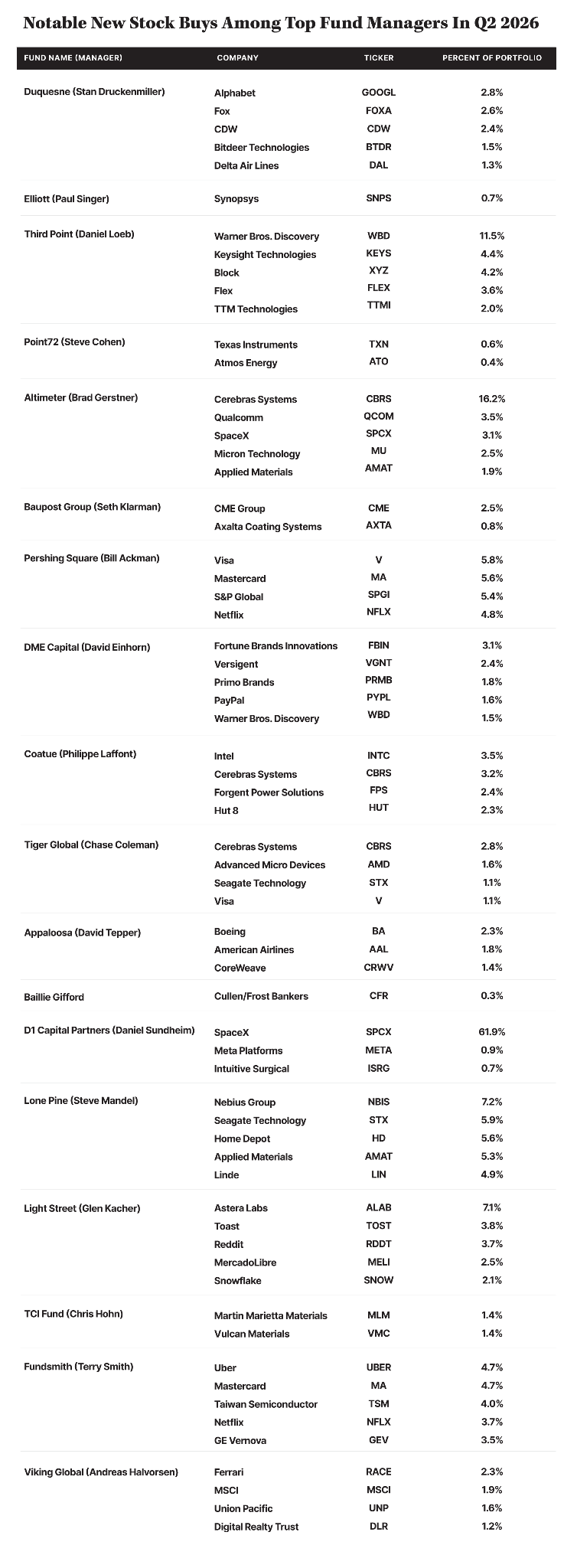
In the tables below, we show the latest (Q2 2026) new stock buys – as reported in their most recent 13F filings with the Securities And Exchange Commission – of some of our favorite fund managers. We also show what percentage each stock makes up within each fund’s investment portfolio.
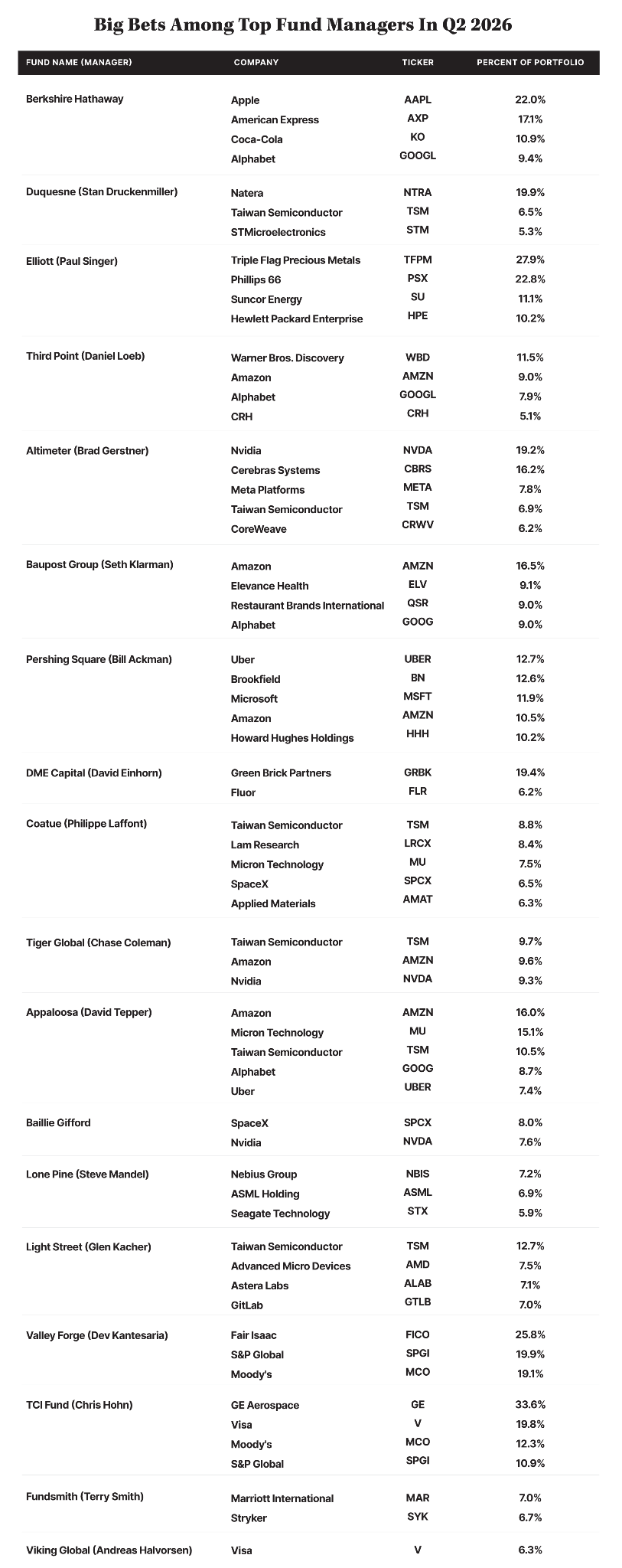
In addition to tracking new purchases, we pay attention to any “big bets” these asset managers make – comprising at least 5% of the portfolio.
 Edit Delete
(Several of the companies on the two lists above are also recommended stocks in Porter Stansberry’s Complete Investor… to learn more about joining Complete Investor – and find out which stock those are, and why we recommended them – go here.)
Highs And Lows
Each week, we also monitor any stocks in the market making a new 52-week high. We do this because any stock on its way to generating 2x, 3x, or 10x returns will spend a lot of time making 52-week highs along the way. Thus the new 52-week-high list provides an opportunity to flag these potential high performers before they really break out, with a particular emphasis on lower-profile, less widely-followed stocks that might have otherwise gone unnoticed.
Notable stocks making a new 52-week high this week:
-
Eli Lilly (LLY)
-
JP Morgan Chase (JPM)
-
Visa (V)
-
Johnson & Johnson (JNJ)
-
AbbVie (ABBV)
-
Coca-Cola (KO)
-
Merck (MRK)
-
Amgen (AMGN)
-
Thermo Fisher Scientific (TMO)
-
Charles Schwab (SCHW)
-
Union Pacific (UNP)
-
ConocoPhillips (COP)
-
Pfizer (PFE)
-
Vertex Pharmaceuticals (VRTX)
-
Bristol-Myers Squibb (BMY)
-
Airbnb (ABNB)
-
General Dynamics (GD)
-
Marathon Petroleum (MPC)
-
Valero Energy (VLO)
-
Phillips 66 (PSX)
-
3M Company (MMM)
-
Regeneron Pharmaceuticals (REGN)
How to Profit From”The SpaceX Supercycle”
Act Before August 26
According to legendary tech investor Jeff Brown…
Three words on page 37 of the SpaceX IPO filing…
Signal Musk is about to trigger a rare wealth supercycle…
And send billions into a sector nobody associates with tech.
Click Here Now To Watch His Urgent Strategy Session
Editor’s Note: Keep in mind, we only accept advertising from publishers we know to offer well-researched ideas vetted by a legal team, excellent customer service, and reasonable refund policies. Brownstone is one such partner. We do not, however, under any circumstances make any representations about their investment ideas or strategies, nor will we warrant them as equal to our own. We do recognize that the markets are tempestuous and, at times, ideas that we may not endorse prove valuable.
We also monitor stocks on the new 52-week-low list. In many cases, the names on this list are there for good reason – the market is often correctly pricing in their weak fundamentals. However, once in a while, a great business with excellent long-term prospects finds itself on this list due to a temporary setback. This can create the rare opportunity to buy top-shelf merchandise at bargain-basement prices.
Notable stocks making a new 52-week low last week:
-
AppLovin (APP)
-
CRH plc (CRH)
-
AutoZone (AZO)
-
Medline (MDLN)
-
Public Service Enterprise Group (PEG)
-
Kroger (KR)
-
Martin Marietta Materials (MLM)
-
FedEx Freight Holding (FDXF)
-
Rollins (ROL)
-
Lennox International (LII)
-
JBT Marel (JBTM)
-
Brookfield Business (BBUC)
-
Icahn Enterprises (IEP)
-
Liftoff Mobile (LFTO)
-
PagSeguro Digital (PAGS)
-
StoneCo (STNE)
Today’s Sunday Selection comes off one of our “Following The Smart Money” screens – and it is one of the most dominant online retailers in the world. Two weeks ago, it reported its fastest quarterly revenue growth in four years – crossing $10 billion for the first time in its history, up 50% year over year (“YOY”), while adding 18 million new customers in 12 months.
Yet the shares sit roughly 25% below their 52-week high as the market is fixated on margins. The company is in the middle of a deliberate investment cycle – spending today’s profits to extend its lead across an entire continent – and the market is punishing the stock for it. Yet the world’s top fund managers were buying while the market complained. We have seen this movie before, from this company: the last time it invested this heavily, the bears insisted it would never earn consistent profits, its margins went on to set record after record, and the stock compounded several times over for investors who bought at the trough.
We believe a similar moment is approaching, making this a strong candidate for the Complete Investor recommendation list.
Edit Delete (To become a Partner Pass member, contact our Customer Care team at 888-610-8895, internationally at +1 443-815-4447, or via email at support@porterandcompanyresearch.com.)
The company is MercadoLibre (Nasdaq: MELI) – the Amazon (AMZN), PayPal (PYPL), and Shopify (SHOP) of Latin America rolled into a single business. Calling MercadoLibre an online retailer understates it the way calling Amazon a bookstore did in 2005. Founded in Buenos Aires in 1999 and listed on Nasdaq since 2007, the company operates across 18 countries through three interlocking businesses.
The marketplace, MercadoLibre, is the dominant e-commerce platform in Latin America – roughly 35% share in Brazil (more than double Amazon), 68% in home-market Argentina, and a strong second position in Mexico. It served 89 million unique buyers last quarter, with gross merchandise volume (“GMV”) up 36% YOY on a currency-neutral basis, and generated $16.3 billion of revenue in 2025 – 56% of the total.
The fintech arm, Mercado Pago, began as a checkout tool and is now one of Latin America’s largest financial platforms – digital wallet, merchant acquiring, asset management, and, increasingly, credit. Total payment volume passed $100 billion last quarter, 88 million people use Pago monthly, and in Brazil it is the most-used wallet after the government’s own Pix system. This fintech arm generated $12.6 billion of revenue in 2025, or 44% of the total. Within it, credit revenue reached $5.9 billion, up 63% in a year, on a $16.4 billion loan book growing 75% with non-performing loans near historical lows and net interest margins widening.
The logistics network, Mercado Envios, is what makes the marketplace credible: fulfillment centers, more than 10,000 drop-off points, and the fastest delivery network in the region, moving roughly three-quarters of fast shipments within 48 hours. Unit shipping costs in Brazil fell 17% last year even as volumes surged – scale economics working as designed.
Each business feeds the others. Shoppers adopt the wallet, wallet users get offered credit, credit makes shoppers buy more, and sellers fund advertising to reach them. Users active in both commerce and fintech grew 37% last quarter – faster than either side alone – and management says these dual-ecosystem users are multiples more profitable than single-platform users. That is the MercadoLibre flywheel.
The flywheel has driven revenue nearly vertical: $15.1 billion in 2023, $20.8 billion in 2024, and $28.9 billion in 2025. The profit line tells a different story, and it is the part the market keeps focusing on. MercadoLibre runs in deliberate investment cycles. When management sees an opening, it spends through the income statement to seize it – growth accelerates and margins compress. Then the investments mature and the profits arrive.
The company has completed this loop once at full scale. From 2016 to 2019, it transformed from a high-margin marketplace into an integrated commerce, logistics, and payments ecosystem – and paid for it with profits. Operating margin went from 21.4% in 2016 to negative 6.7% in 2019 while bears insisted the company would never earn consistent profits. Then margins recovered to a record 14.6% – on revenue that had grown 10-fold from its 2018 level – and the market capitalization went from $13 billion at the end of 2018 to $84 billion by the end of 2020, a more than six-fold increase in two years.
Here is the detail that matters most for timing: the stock rose 92% in 2019 – nearly 3x the Nasdaq’s gain in a year when falling rates lifted everything. The market did not wait for the margin inflection to appear in the headlines. It re-rated the stock as soon as the evidence showed the spending was changing customer behavior and would eventually monetize. By the time reported margins recovered, the easy money had been made.
The 2021-2022 drawdown is the counterexample that sharpens the rule: margins improved steadily and the stock still fell more than 65% peak-to-trough as rising rates crushed growth multiples. The market prices the expected return on MercadoLibre’s investments – margins are one signal within that judgment, and often a lagging one.
Today’s cycle is the broadest yet, and the result is the paradox in last quarter’s report – revenue up 50%, operating margin down about 50% (at 6.7% versus 12.2% a year ago). And the early evidence looks like 2019: conversion, purchase frequency, retention, and category breadth are all rising.
What has not happened yet is the payoff. By our math, the realized incremental return on the roughly $9 billion to$13 billion deployed in this cycle so far is only about 2% to 3% – versus the mid-teens-to-30%-plus returns the prior cycles eventually earned. That gap is the current opportunity.
The segment data makes the strategy legible: Argentina is the fortress that funds the wars, Brazil is the battleground, Mexico is the contested frontier, and everything else is seed corn for the next cycle.
Argentina generated $6.0 billion of 2025 revenue (21% of the total), up 56%, and more than $2.5 billion of direct contribution profit – more than Brazil, on 40% of Brazil’s revenue. With 68% market share and a fintech-heavy mix, it is a monopoly tollbooth earning a contribution margin above 40%, with enormous macro torque as credit strengthens under Argentina’s normalization.
Brazil, at $15.2 billion of revenue (53%), up 33%, is where the money is going. Direct contribution profit fell from $2.3 billion to $2.1 billion in 2025 even as revenue grew by $3.8 billion – each incremental dollar of Brazil revenue arrived with slightly more than a dollar of direct costs attached. The engagement response has been immediate: items sold up 56% last quarter, items per buyer up 19%, and conversion up 1.1 points.
Mexico, at $6.5 billion of revenue (22%), up 39%, is the one major market where Amazon leads – roughly 40% to 30% share – and the capital allocation shows how seriously it believes in this opportunity. Mexico’s gross property and equipment now nearly equals Brazil’s on only 40% of the revenue, while the segment still earns an 18% contribution margin.
The remaining markets – Chile, Colombia, Peru, and Uruguay – produced $1.3 billion of revenue (4%), up 41%.
Three levers drive the next leg of growth. Credit is the largest and MercadoLibre is well positioned with years of granular purchase data no bank can see, formal credit penetration in Latin America still a fraction of developed-market levels, and mature non-card lending that is highly profitable today. Advertising is the highest-margin opportunity: Mercado Ads grew 62% last quarter and now exceeds 10% of Latin American digital advertising. And AI is quietly deflating the cost base: the majority of the company’s code is now AI-written, product development fell from 8.4% to 7.2% of revenue, and customer service headcount dropped from 10,000 to 7,000 while the business tripled.
The credit book is the real risk. This cycle is far more credit- and balance-sheet-intensive than 2016–2019, and credit metrics always look best right before they do not. Competition is intensifying, currency remains a permanent tax on reported results, and the valuation – nearly 50x trailing earnings – is cheap only against the stock’s own history. And unlike 2019, there is no help from lower rates – long yields are moving higher globally, so the re-rating must be carried by the operating evidence alone.
The stock sits roughly 25% below its June 2025 high while revenue grows 50%. And the multiple is measured against earnings the company is deliberately suppressing – so the 50x trailing earnings overstates what investors are paying for the underlying earning power. If revenue reaches $50 billion and margins recover merely to 10% to 12%, operating profit climbs toward $5 billion – meaning today’s roughly $95 billion market capitalization is paying about 20x that earning power, for a business still compounding revenue at more than 20% a year.
Management has spent 27 years proving it knows how to allocate capital across a reinvestment runway that is nowhere near exhausted. History says the stock will not wait for the evidence to be complete – which is what makes MercadoLibre a strong candidate for the Complete Investor recommendation list… but not yet.
Porter & Co.
Stevenson, Maryland
The post Following The Smart Money In Q2 appeared first on Porter & Co..
