❌

Normal view

  • ✇Market Wise
  • We’re revealing our top AI trade of the month… Brian Hunt
    Today’s issue in preview: We’re revealing our top AI trade of the month… This stock sector is starting to boom. We bet it has years to run. Are you on board One of our top thematic recommendations generates another huge winner Learn our Top Themes to buy now We’re revealing our top AI trade of the month… Credit: Ron and Patty Thomas Short-term traders take note: The utilities sector is oversold and due for a rebound. Back in April 2024, I sent a note to colleagues highlighting the em
     

We’re revealing our top AI trade of the month…

24 September 2026 at 12:00

Today’s issue in preview:

  • We’re revealing our top AI trade of the month…

  • This stock sector is starting to boom. We bet it has years to run. Are you on board

  • One of our top thematic recommendations generates another huge winner

  • Learn our Top Themes to buy now


We’re revealing our top AI trade of the month…

Image

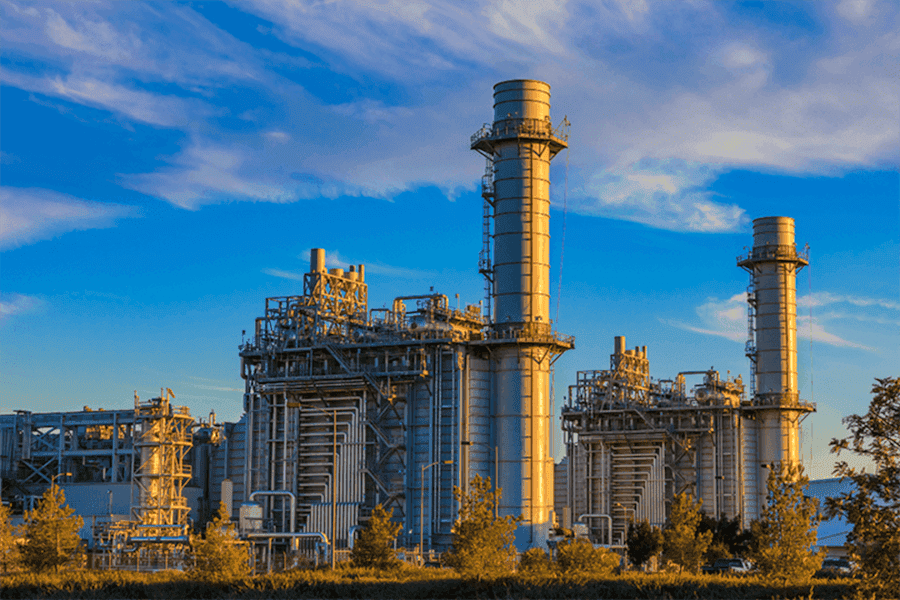
Credit: Ron and Patty Thomas

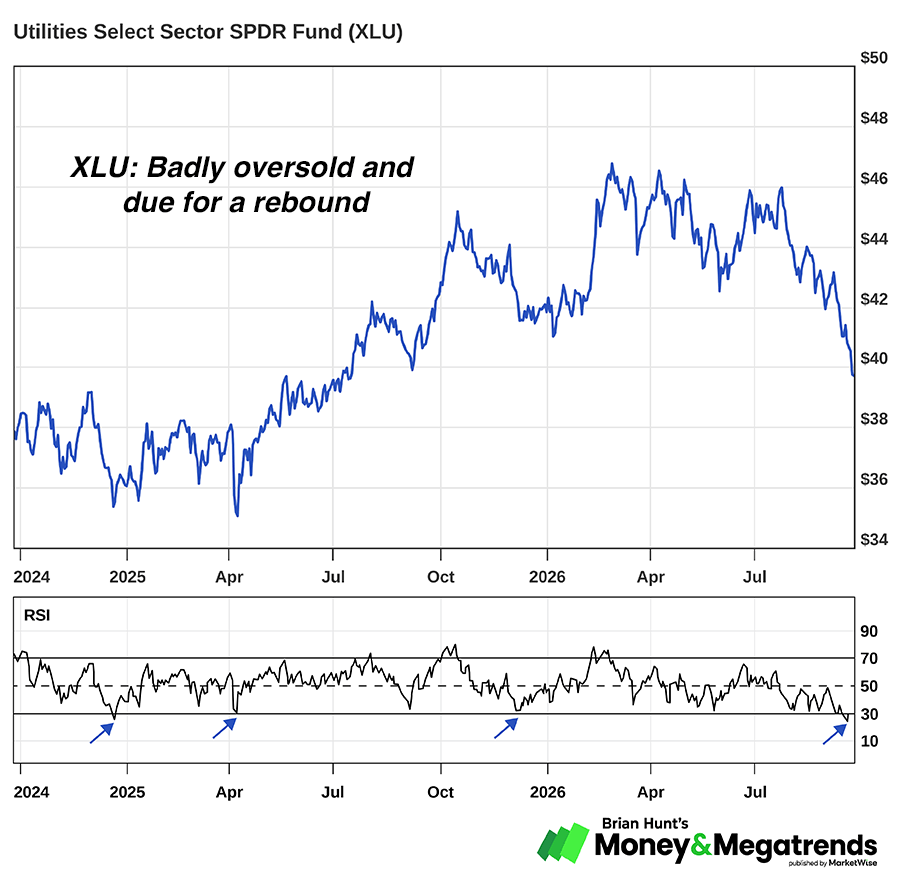
Short-term traders take note: The utilities sector is oversold and due for a rebound.

Back in April 2024, I sent a note to colleagues highlighting the emerging uptrend in utility stocks and the AI data center boom’s potential to increase electricity demand.

Utility stocks are shares of companies that generate, transmit, and distribute electricity. Most operate as regulated monopolies in specific regions, earning government-approved returns on their investments. They’re generally known for stable revenues and reliable dividends.

The bull case for these stocks going forward is simple: Given AI’s enormous promise, big tech firms Meta (META), Alphabet (GOOG), and Microsoft (MSFT) are racing to build the world’s best AI models and infrastructure. They’ve already spent more than a trillion dollars. This year, they are on pace to spend over $700 billion on AI infrastructure, with more than $4 trillion expected to follow.

All that AI infrastructure is poised to consume huge amounts of electricity. Goldman Sachs forecasts global power demand from data centers will climb 50% by 2027 and as much as 165% by the end of the decade. This demand is driving a big bull market in virtually every form of electric power production.

One of my recommended ways to invest in this megatrend is via electric power producers… aka “electric utilities.” When you invest in utilities, you are not risking your money by trying to pick the company that creates the best AI model or the best AI-powered fintech application.

Instead, you’re making the safe bet that every company and every individual using AI ends up buying some electricity to power it. It’s the old “selling picks and shovels to Gold Rush miners” strategy applied to AI.

From early 2024 to mid 2026, utility stocks – as represented by the State Street Utilities Select Sector SPDR ETF (XLU) – enjoyed a strong bull market. However, the sector has been hammered over the past two months by rising interest rates. XLU has dropped 13% over the past two months, a huge move for the utility sector.

Traditionally, utility stocks decline when interest rates rise because income-seeking investors may view rising bond yields as making bonds more attractive relative to dividend-paying utilities.

This big decline has made XLU deeply oversold and due for a rebound. To gauge the “oversold-ness,” of XLU, we can consult its Relative Strength Index (RSI).

RSI is an indicator that measures a stock’s short-term price momentum. It is represented on a 0 – 100 scale. Typically, an RSI reading below 30 indicates that a stock or ETF has suffered a deep sell-off and may be due for a rebound.

I like to think of the RSI as showing how a market swings like a pendulum. The market swings back and forth, back and forth, back and forth… with some swings anomalously large and extreme.

RSI is no infallible indicator. However, it can be a useful tool to spot good trade setups.

In the case of XLU’s trade setup, the sector’s fundamental drivers are strong. And the price is badly stretched to the downside. RSI has reached an extreme level that in the past has flashed near local bottoms. A rebound starting soon is likely.
Image

Recommended Link:

Trump to build “biggest data center on the planet”

Ad Image

America’s about to get its first national data center… Completely funded by taxpayer dollars. When it comes online just days from now… This device could change the history of Artificial Intelligence… And even human civilization. (It could also make early investors in this company very happy.) Louis Navellier believes it will secure America’s dominance over China in the AI arms race… While completely sidestepping the dangers of Artificial Superintelligence. Donald Trump committed $1 billion to support the stock behind the coming breakthrough right now… Ahead of a potential announcement from the company that could hit on or before Sept. 29th. Get all the details – down to the company name and ticker – here, in Louis’ brand-new presentation.

This stock sector is starting to boom. We bet it has years to run. Are you on board?
Image

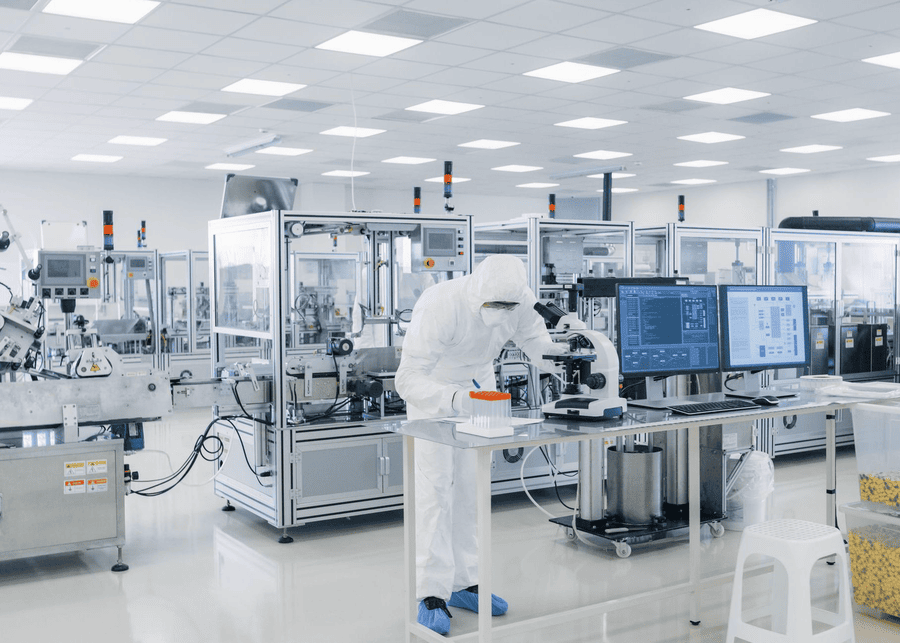
Credit: gorodenkoff

This morning, the benchmark S&P 500 declined 0.40% to trade back to its level in early August.

And one look at our Global Trend Tracker database shows most major U.S. sectors and themes are down on the day. Many are trading in sideways, directionless trends… much like “becalmed” sailboats on a windless sea.

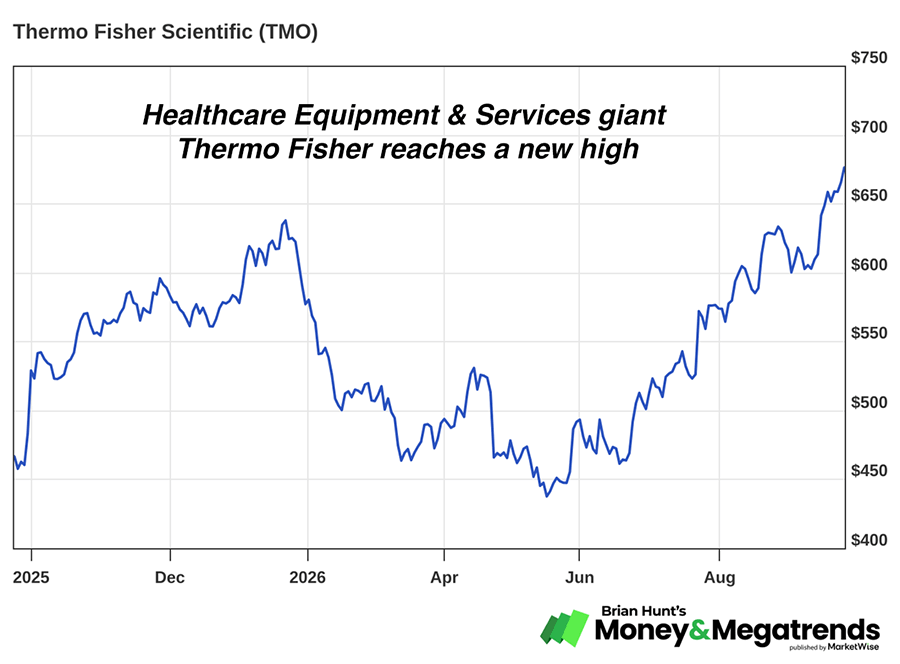
This pervasive lack of bullish momentum makes today’s continued strength and new highs in Healthcare Equipment & Services stocks such as Repligen (RGEN), Agilent (A), Thermo Fisher Scientific (TMO), Mettler Toledo (MTD), and Waters (WAT) more impressive.

We covered this industry yesterday because that’s where the money was flowing. It’s where the meaningful trend was. And we’re covering it again today because both of those conditions are in full force again.

This group of winners has many of the “who’s who” of the healthcare industry niche that sells laboratory equipment, drug manufacturing and testing equipment, and related services. They comprise a critical infrastructure layer that enables large drug firms such as Pfizer (PFE), Amgen (AMGN), Merck (MRK), and Eli Lilly (LLY) to test, develop, and manufacture drugs.

Avid Money & Megatrends readers know that “Boomer health care” is one of our highest-conviction long-term investment megatrends. We don’t know of another investment research publication that has written more bullishly, more often about this booming industry than we have.

Over the past year, we have published more than two dozen pieces on opportunities in drug development, biotechnology, senior living facilities, genomics, cardiology, diagnostics, and more.

Our bullish stance has produced a parade of home runs, with the healthcare industry dominating the stock market’s new highs list over the past year.

Healthcare stocks are generating extraordinary returns because they are benefiting from several megatrends simultaneously…

One is demographics. More than 10,000 Americans reach retirement age every day. The U.S. population aged 80 and older is projected to roughly double, from 14.7 million in 2025 to 29.4 million by 2045.

This is the enormous Baby Boom generation entering the phase of life where health care and longevity spending skyrocket. For many boomers, a typical month involves going to see at least one doctor to have something looked at, removed, or treated.

This means many health care businesses are experiencing huge demand now – and will for at least the next decade.

Two is exponential technological progress. Thanks to major advances in genomic sequencing, AI-powered analytics, imaging technology, and preventive treatments, healthcare is becoming much better and more personalized. This is driving strong demand for all kinds of new tests, tools, and treatments.

After all, when a useful and important service you buy gets much better, you typically buy more of it.

The fortunes of the equipment and services firms above are closely tied to the R&D and capital spending cycles of big drug firms like those listed above.

When drugmakers expand laboratory research, genomic analysis, testing programs, and manufacturing capacity, they require more analytical instruments, consumables and bioprocessing equipment – the “picks and shovels” supplied by companies like Agilent, Waters, and Thermo Fisher.

We believe the new highs reached by these firms are harbingers of a healthcare megatrend that will generate large returns over the coming years: That thanks to advanced genomic sequencing, AI-powered data analytics, and other bleeding edge innovations, the healthcare industry will move away from blunt “one size fits all” treatments and move to more “personalized” treatments that are tailored to an individual’s genetic makeup.

The Boomers are willing to spend trillions of dollars per year on such things.

This megatrend will drive strong drugmaker R&D spending and strong revenue growth for well-positioned “picks and shovels” firms above.

Also, consider that U.S. healthcare leaders and the U.S. government are very keen on increasing domestic drug manufacturing to reduce our reliance on foreign manufacturing.

The FDA says more than half of pharmaceuticals distributed in the U.S. are manufactured overseas, and only about 11% of active pharmaceutical ingredient manufacturers are U.S.-based.

Since 2025, pharmaceutical companies have announced hundreds of billions of dollars of U.S. manufacturing and R&D investment. CBRE tracked approximately $350 billion in announcements, although it estimates that roughly half of these were projects that had already been planned or begun – an important caveat when interpreting the headline.

Add these two trends – the personalized treatment revolution and the domestic drug manufacturing boom – and you get serious fundamental tailwinds that will continue driving the bull market in many areas of healthcare, especially the “picks and shovels” providers of drug development and manufacturing. We remain bullish on drug development and manufacturing infrastructure.
Image


One of our top thematic recommendations generates another huge winner

Image

Credit: gorodenkoff

It turns out, being bullish on the Healthcare Diagnostics theme was a heck of an idea.

The latest data point that makes this case?

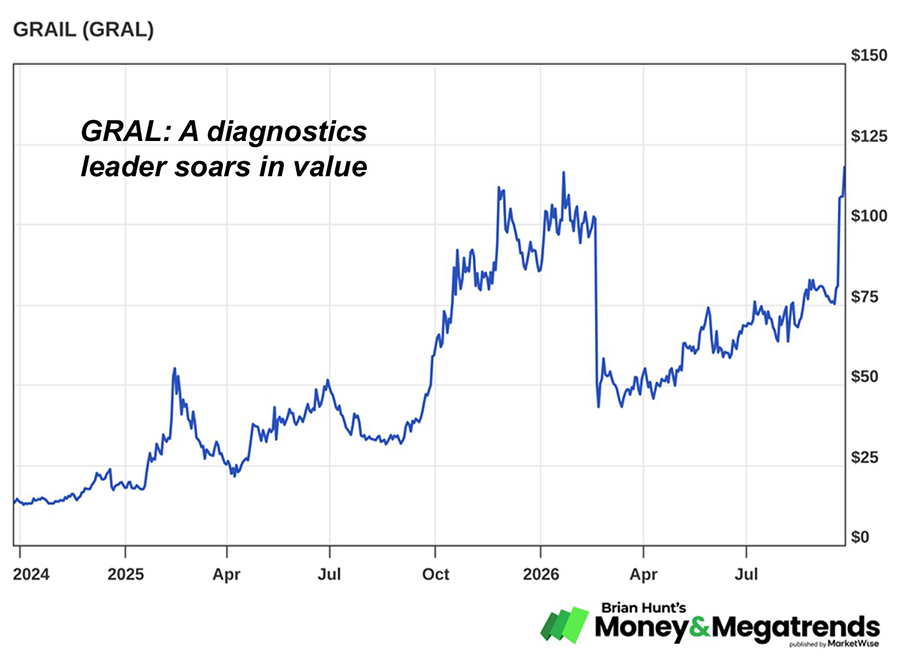
GRAIL (GRAL) – one of the world’s leading cancer diagnostics firms – just received a critical endorsement from an FDA advisory committee for its bleeding-edge Galleri cancer screening technology. The news has sent GRAL stock up 57% in the past eight trading sessions. Shares are up a massive 97% since our original bullish note on Healthcare Diagnostics, which featured GRAIL.

In the Healthcare Equipment & Services note above, we detailed why Boomer health care is one of our highest conviction long-term investment themes. Our bullishness has yielded many large winners over the past year.

In July, we narrowed our focus to the Healthcare Diagnostics theme.

Over the past 20 years, preventive healthcare diagnostics have improved dramatically due to advances in genomics, imaging technology, and data analytics. Genetic testing has become faster and less expensive, allowing earlier identification of disease risks. High-resolution imaging and improved laboratory testing can detect conditions such as cancer, heart disease, and diabetes at much earlier stages.

Wearable devices and remote monitoring tools continuously track vital signs and health trends, enabling early intervention. Electronic health records and artificial intelligence help clinicians identify risk patterns and personalize screening recommendations.

Together, these innovations are shifting healthcare from reactive illness care to predictive, preventive, and proactive disease management before serious symptoms develop. The shift from reactive treatment to early detection is still early, but the numbers already reflect its momentum.

The U.S. health care diagnostics market was valued at $35.7 billion in 2024 and is projected to reach nearly $60 billion by 2030, growing at an annual rate of over 9%. Globally, clinical diagnostics is on track to hit $170 billion by the end of the decade. North America commands nearly half of that market.

But those figures don’t fully account for how AI is about to revolutionize health care diagnostics, such as:

  • AI-powered imaging that detects inflammation in the coronary arteries before a heart attack.

  • Liquid biopsies that identify cancer DNA in a blood draw years before a tumor becomes visible.

  • Genetic testing that recommends food and supplement changes to treat illness before it even takes root.

The diagnostics market isn’t just growing. It’s being rebuilt from the ground up around a new clinical philosophy powered by blazing technological progress: detect early, intervene early, prevent the crisis entirely. This industry’s potential to drive growth, deliver societal benefits, and produce big stock market winners is massive.

In our June note, we detailed how GRAL’s flagship product, Galleri, is a multi-cancer early detection test that analyzes DNA fragments in a blood sample to identify cancer signals and predict where the cancer originated, potentially detecting more than 50 types of cancer, many of which lack routine screening methods. And as of today, this test’s potential has driven GRAL up 95% since our note.

We look at this major shift and confidently restate our original summary of Healthcare Diagnostics: Healthcare is undergoing a historic revolution. For generations, the system was built to treat the sick. It is now being rebuilt to detect and treat disease before it makes people sick.

The companies above are building the tools and equipment at the center of what may be the most durable growth theme in healthcare investing over the next decade. We recommend staying bullish on it and the stocks we have covered.
Image


Market Notes

  • Our recommendation to invest in the genomics megatrend continues to pay off. Sector leaders Natera (NTRA) and Illumina (ILMN) reached new all-time highs today.

  • Our July 31 call to buy Meta (META) remains a huge winner. The stock is up 42% since our note, thanks to the company’s successful new AI assistant Muse.

  • Nuclear power industry manufacturer BWXT Technologies (BWXT) just hit a new one-year low.

  • Cruise line giant Carnival Corp (CCL) reached a new one-year low today.

  • Casino giants Wynn Resorts (WYNN), Boyd Gaming (BYD), and Las Vegas Sands (LVS) reached new one-year lows today.

Regards,

Brian Hunt signature

Brian Hunt signature

Brian Hunt
Editor, Money & Megatrends


An urgent message from our colleagues:

Two Wall Street Veterans Warn: “Just days from now, the U.S. stock market will be rocked by a shocking October Surprise”

Image

In mere days, investors could wake up a market transformed by an extraordinary October Surprise. Both Louis Navellier and Marc Chaikin have independently come to the same conclusion: a midterm-election market event is about to strike, backed by a 92% historical precedent stretching back more than a century. On September 29, they’re holding an urgent market update to share the EXACT day they believe this event could begin shocking the market… the No. 1 move investors need to make beforehand… And FOUR free stock recommendations you can act on immediately.

Reserve your spot now.

The post We’re revealing our top AI trade of the month… appeared first on MarketWise.

  • ✇Curzio Research
  • Can inverse ETFs save you from a pullback? Frank Curzio
    Do inverse ETFs offer protection during a selloff? Plus, should you buy oil stocks now or wait for a pullback? … 2 power stocks to buy amid AI volatility… And a great trade setup in uranium. The post Can inverse ETFs save you from a pullback? appeared first on Curzio Research.
     

Can inverse ETFs save you from a pullback?

24 September 2026 at 10:55

Do inverse ETFs offer protection during a selloff? Plus, should you buy oil stocks now or wait for a pullback? … 2 power stocks to buy amid AI volatility… And a great trade setup in uranium.

The post Can inverse ETFs save you from a pullback? appeared first on Curzio Research.

  • ✇Curzio Research
  • The AI power gap Wall Street still hasn’t priced in Curzio Research
    Elon Musk says the AI race is accelerating beyond anyone’s control. But every competitor faces the same physical limit: electricity. PJM’s widening power shortfall shows why companies with secured grid capacity could become the next major AI trade. The post The AI power gap Wall Street still hasn’t priced in appeared first on Curzio Research.
     

The AI power gap Wall Street still hasn’t priced in

15 September 2026 at 22:00

Elon Musk says the AI race is accelerating beyond anyone’s control. But every competitor faces the same physical limit: electricity. PJM’s widening power shortfall shows why companies with secured grid capacity could become the next major AI trade.

The post The AI power gap Wall Street still hasn’t priced in appeared first on Curzio Research.

  • ✇Market Wise
  • SpaceX Wants to Build Natural Gas-Turbine Parts for AI Data Centers. Can Elon Musk Pull It Off? David Engle
    Key Points SpaceX wants to make its own gas-turbine blades and vanes to speed up AI data-center power deployment, but the project is still years away from production. The turbine-parts bottleneck is real, but SpaceX still needs permits, a foundry, and specialized talent to make its plan work. If successful, the project could make SpaceX a major turbine-parts supplier. But for now, it’s a high-risk, long-term bet. Elon Musk likes to move as quickly as possible. The Tesl
     

SpaceX Wants to Build Natural Gas-Turbine Parts for AI Data Centers. Can Elon Musk Pull It Off?

3 September 2026 at 09:00

Key Points

  • SpaceX wants to make its own gas-turbine blades and vanes to speed up AI data-center power deployment, but the project is still years away from production.
  • The turbine-parts bottleneck is real, but SpaceX still needs permits, a foundry, and specialized talent to make its plan work.
  • If successful, the project could make SpaceX a major turbine-parts supplier. But for now, it’s a high-risk, long-term bet.

Elon Musk likes to move as quickly as possible. The Tesla (TSLA) and SpaceX (SPCX) CEO has been known to occasionally bypass reality when it comes to his projects and businesses. Recently, Musk has become a major proponent of using natural gas turbines for the artificial-intelligence (“AI”) build-out.

All of that came into focus on August 29, when Musk announced that SpaceX will manufacture its own gas-turbine parts – specifically blades and vanes – to help speed up the process of getting natural gas turbines online to provide power for its data centers.

SpaceX and Tesla are each building 100GW/year of solar production capacity as fast as possible, but natural gas will still be needed to supplement and bootstrap solar for several years.

The limiting factor for nat gas turbine production is casting the blades & vanes. By doing…

— Elon Musk (@elonmusk) August 29, 2026

As you can see in Musk’s X post, he believes casting gas-turbine blades and vanes in-house will cut production time by up to 18 months and be a “profound game-changer” for SpaceX.

And he’s probably right. If SpaceX can actually expedite the process by up to 18 months, it will be a huge win for Musk and company. As he stated in his post, natural gas is still a critical energy source needed to supplement solar power.

But some questions remain unanswered:

  • How quickly can SpaceX get a gas-turbine parts-casting factory up and running?
  • Does Musk have a team capable of building these parts?
  • And assuming this all goes smoothly, how long will it take for SpaceX to produce these parts at scale?

Building Natural Gas-Turbine Parts Is the Next Phase of Musk’s ‘Dark Energy’ Plan

If you’re unfamiliar with the concept of “Dark Energy,” let me take you back to a June 5 article by my colleague Steven Longenecker.

In that piece, he wrote:

Elon Musk will be one of the world’s top buyers of gas turbines over the next few years…

SpaceX has committed to spending more than $2.8 billion on these turbines for its artificial intelligence (“AI”) build-out, the company recently revealed in its initial public offering (“IPO”) filing…

In March, SpaceX agreed to buy $805 million worth of turbines from an unnamed supplier, with deliveries running through 2029. Then in late April, the company struck a separate, still-pending deal for roughly $2 billion worth of mobile gas turbines and related equipment from another vendor.

Steven’s article continued:

And it confirms something my colleague Professor Joel Litman has been saying for months…

This kind of off-grid “Dark Energy” is the next stage of the AI boom. As I explained in our Dark Energy deep-dive last month:

Dark Energy is a clean, reliable power source. Specifically, it’s a class of natural-gas turbines… essentially a jet engine adapted into an electric generator. They start in minutes, run on natural gas instead of jet fuel, and can produce tens of megawatts of power per unit. Stack enough of them together, and you have a private power plant…

But until recently, no one was using them at scale to power the world’s most advanced AI labs. Now that they are, the suppliers building them are sold out for years.

Since then, SpaceX has also purchased APR Energy, a Jacksonville-based power company specializing in rapidly deployable, modular power generation.

I covered that transaction in a July 21 article, in which I wrote:

The deal, which is thought to be worth at least $1 billion, gives Musk what APR Energy’s website describes as “one of the world’s largest mobile gas turbine fleets,” with solutions that scale from 20 megawatts (“MW”) to 500 MW. APR Energy has delivered more than 50 terawatt-hours of power to more than 35 countries.

Most importantly, the company claims it can “deliver reliable energy in 30 to 90 days.”

And that’s exactly what Musk – and every other data-center operator and hyperscaler in the world – desperately wants and needs. Plenty of power… and fast.

Musk is clearly a big believer in the fast power that natural gas turbines can provide to SpaceX’s data centers. But, based on his recent X post, that power can’t be delivered fast enough. So, the next logical step after buying up natural gas turbines and then buying an energy company for its fleet of mobile gas turbines is to help build them yourself, right?

Regardless of how he procures the turbines, Musk is in the midst of taking Dark Energy to the next level.

The Texas Foundry Building the Natural Gas-Turbine Parts

Bastrop, Texas, a small town of roughly 14,000 residents located around 30 miles outside of Austin, was once known as a filming location for the iconic 1974 horror classic, The Texas Chain Saw Massacre. Today, it’s Elon Musk’s playground.

Along with Musk’s huge SpaceX Starlink factory, Bastrop will soon be home to the new foundry that will cast blades and vanes for natural gas turbines. Musk, through his recent dealings with gas-turbine production, learned that the primary bottleneck is the casting process.

TechCrunch, via the Information, explained why:

The blades inside a gas turbine’s hottest section run at temperatures around 3,000 to 3,600 degrees Fahrenheit, which is roughly 800 degrees hotter than the melting point of the very metal alloy they’re made from. That’s only possible because of the blades’ internal cooling channels and thermal-barrier coatings, plus the specific way each blade is cast. Just four companies worldwide have mastered the casting process well enough to produce them at industrial scale, and all of them are tapped out right now.

To repeat, only four companies on the planet know how to do this on a large scale. But they’re completely booked through 2029 and into 2030. And, as we’ve learned, patience is not a virtue of Musk’s. So, he’s opting to do it in-house rather than wait.

The problem is that the entire operation is obviously very complex and delicate.

As TechCrunch noted:

What makes the whole thing especially difficult is that each blade has to be cast as a single, unbroken crystal, grown slowly inside a vacuum furnace, without the microscopic seams that let ordinary cast metal crack under stress. It’s a tricky process even for the smaller blades used in jet engines; the blades in power-plant turbines are considerably larger, which makes producing them at that scale and without defects even harder.

Which takes us back to some of those unanswered questions I posed at the start of this article…

The answer to all three questions is, essentially, a giant shrug.

We do know that SpaceX bought roughly 830 acres of land in Bastrop between March and June. But that’s pretty much all we know. As of August, the state of Texas had no record of any environmental or building permits being filed by SpaceX for construction of the facility.

Let’s also not forget that these types of gas turbines release smog-forming compounds and dangerous chemicals like formaldehyde, as well as pollutants linked to asthma, respiratory disease, and certain cancers into the air. That’s why significant industrial air-quality permits are required before construction can even begin.

Those permits haven’t appeared yet.

The next part to consider, assuming permits are granted and foundry construction goes smoothly, is the time it takes to create the product.

Peter Perri III, an energy investor with more than 20 years of experience in building and financing power infrastructure, noted in an August 30 Substack post:

A vacuum casting foundry capable of single-crystal work is 18 to 24 months from groundbreaking to commissioning, and the job listings say they’re still hiring the people who will build it. Process development on single-crystal yield typically runs another two to three years.

At this point, no ground has been broken, and no team has been assembled. So, realistically, we’re probably looking at a minimum of five years before the foundry yields any product. History tells us that Musk won’t want to wait that long.

The Turbine-Blade and AI-Power Bottlenecks Are Real… But Is Musk’s Plan Realistic?

Global research company Gartner projects that the amount of energy consumed by data centers around the world will reach 565 terawatt-hours (“TWh”) by the end of this year. To put that into perspective, here are some fun facts about how much 565 TWh is worth in real-world contexts:

  • It’s nearly twice the annual energy consumption of the entire continent of Australia.
  • If the world’s data centers were one country, it would be one of the top 10 largest electricity-consuming countries on Earth.
  • It could fully charge every smartphone on the planet – around seven billion – every day for the next 40 years.

By 2030, that number will hit nearly 1,000 TWh, according to the International Energy Agency.

The current electrical-grid infrastructure simply can’t handle this type of load. Something needs to power the rapidly growing number of data centers, which shows no signs of tapering off anytime soon. This has hyperscalers like Amazon (AMZN), Meta Platforms (META), Alphabet (GOOGL), Microsoft (MSFT), OpenAI, and SpaceX looking for quick energy sources.

Most of those companies have already gone the renewable, clean-energy route, like solar and wind. But they’re all turning – or have already turned – to natural gas because it has typically been a faster way to get their data centers online.

But the AI-driven demand has overwhelmed the supply. GE Vernova (GEV), the world’s largest manufacturer of natural gas turbines, is effectively sold out of production capacity through 2030.

That’s the reason Musk turned to APR Energy and its fleet of mobile gas turbines. And that’s why he decided to build his own parts to break the bottleneck holding up gas-turbine production.

But can SpaceX pull this off? As I mentioned, there is no foundry yet… permits haven’t been secured, and ground hasn’t been broken. And no team of experts is in place to oversee and take part in the extremely complicated and sensitive process of casting turbine blades.

Could it theoretically happen? Sure. Musk has the financial means to make virtually anything happen. He should be able to lure top talent to Texas to participate in the project. Although, considering the recent news that SpaceX completely restructured its data-center team because of engineering and reliability concerns at its Mississippi and Tennessee factories, is there any guarantee that SpaceX will even be able to bring in the right people?

If SpaceX does pull this off, it will position the company as one of only five Western companies capable of this type of manufacturing. SpaceX would have every AI-infrastructure builder across the globe lining up for its turbine blades and vanes.

But the lack of any progress and the daunting production timelines for both foundry construction and large-scale production make this feel closer to fantasy than reality.

And, let’s face it, Musk has a long history of grandiose ideas and projects that sound amazing at conception but barely get off the ground. The fully self-driving Tesla car (on a large scale), the Hyperloop, the mass rollout of Tesla robotaxis, personal rocket-travel across Earth, the Tesla Roadster, the city on Mars… you get the idea.

The man is undeniably brilliant and has conceptualized some incredible technological breakthroughs. But he also owns a long list of broken promises. Time will tell which category the turbine-blade foundry in Texas falls into.

Regards,

David Engle

Editor’s Note: A new “dark energy” is being rolled out as we speak… It completely bypasses our need for foreign oil. And it’s not nuclear or solar or wind or anything you would expect.

This new potential $10 trillion technology is already seeing investment by early backers of Microsoft, Google, Amazon, and more… Most important, these dozens of billionaires can’t make this tech themselves. They have to go through obscure “supplier” companies.

And in the coming months, this new “dark energy” could send three little-known stocks soaring… while wiping out 10 of the most popular stocks on the market. Learn more about this dark energy opportunity by clicking right here.

The post SpaceX Wants to Build Natural Gas-Turbine Parts for AI Data Centers. Can Elon Musk Pull It Off? appeared first on MarketWise.

  • ✇Market Wise
  • Bitcoin Miners: A Surprising Winner From the Growing AI Data-Center Backlash Eric Wade
    Key Points Bitcoin miners are becoming valuable players in AI infrastructure because their existing power, land, and cooling assets can be repurposed for lucrative data centers. AI’s surging electricity demand is creating a tailwind for some miners, while flat mining difficulty and higher bitcoin prices could further boost profitability. The AI data-center backlash creates both opportunity and risk: slower development could limit mining competition but also delay miners’ own
     

Bitcoin Miners: A Surprising Winner From the Growing AI Data-Center Backlash

26 August 2026 at 10:01

Key Points

  • Bitcoin miners are becoming valuable players in AI infrastructure because their existing power, land, and cooling assets can be repurposed for lucrative data centers.
  • AI’s surging electricity demand is creating a tailwind for some miners, while flat mining difficulty and higher bitcoin prices could further boost profitability.
  • The AI data-center backlash creates both opportunity and risk: slower development could limit mining competition but also delay miners’ own AI infrastructure projects.

It seems like just about everyone is mad about AI data centers right now.

They’re thought of as big, loud nuisances… and it’s hard to find people who actually want them where they live.

At the same time, we’re using artificial intelligence (“AI”) more than ever for searches, coding, writing, problem-solving, and even just chatting. So, demand for data centers is real.

Nonetheless, the AI data-center backlash we’re seeing has become big enough to matter to investors. Towns are pushing back over water, power bills, tax breaks, noise, diesel generators, and the simple reality that nobody wants a windowless server farm dropped into their neighborhood.

That’s a problem for the AI trade because Nvidia (NVDA) stock may be a proxy for AI growth, but chips still need to be installed in hardware which needs to be deployed into buildings, powered by transformers, and receive municipal permits before they become revenue. Nvidia is the top bellwether for AI, but it still relies on data centers for a majority of its chip sales.

It’s also creating a strange side effect in bitcoin mining…

See, while investors have been staring at Nvidia, the bitcoin mining network has been doing something odd.

Crypto-tracking site CoinWarz put bitcoin difficulty at 125.81 trillion today. About a year ago, on August 24, 2025, according to Hashrate Index, the difficulty was at 129.70 trillion… then an all-time high.

In plain English, the work required to mine a block today is roughly the same as it was last summer. That gives miners more time to make a return on their hardware investments without having to upgrade.

So thank you, AI data centers. And thank you to everyone saying they don’t want one in their neighborhood. It’s helping make certain miners a lot of money.

Today, we’ll look further at how the AI-infrastructure build-out and rising bitcoin prices are setting up a profitable scenario in the mining space.

Why Steady Mining Difficulty Is Favorable in a Bitcoin Rally

Bitcoin mining difficulty is the network’s thermostat.

Every two weeks, bitcoin adjusts how hard miners must work to keep blocks arriving about every 10 minutes. When more machines mine for the same reward, bitcoin difficulty rises. Fewer machines, or machines pointed somewhere else, means difficulty stabilizes or falls.

For a miner, that math is brutal and simple. Revenue comes from the bitcoin price, block rewards, and transaction fees. Costs come from power, machines, debt, and maintenance. If bitcoin jumps while difficulty stays flat, the same machines earn more dollars without facing the usual penalty of a harder network.

That’s exactly why the recent bitcoin rally matters. Bitcoin gained 23% in a week– its biggest move since last year’s sell-off – after Treasury-bond buybacks pushed long yields lower, the dollar weakened, and a short squeeze forced buyers back into the market. ETF inflows are the next test, because forced buying burns out quickly, while institutional flows can keep a rally alive.

If bitcoin holds even part of that move higher, miners get operating leverage when the selling price rises, and the production hurdle does not.

AI Pivots Are the New Way Miners Capitulate

In previous bitcoin cycles, miner capitulation looked familiar. The price fell, inefficient miners shut off, mining rigs hit the secondary market, and the network waited for difficulty to adjust down.

This cycle has a different escape hatch. Miners don’t have to disappear. Some have become AI-infrastructure companies.

That sounds like a branding trick until you remember what miners can offer to the AI space: power access, land, cooling, substations, operating teams, and a tolerance for absurd capital intensity. Those are the main things that data-center developers are fighting to secure.

CoinDesk reported in March that public miners had announced more than $70 billion in AI and high-performance-computing (“HPC”) contracts. S&P Global listed Iren, Riot Platforms, Core Scientific, Hive Digital Technologies, Cipher Digital, and TeraWulf among the miners shifting capacity away from pure bitcoin mining, with analysts expecting HPC and AI to drive much of their growth in 2026.

That matters because every megawatt chasing AI is a megawatt that’s not automatically chasing the next bitcoin block. While the machines and customers are different, the scarce input is the same: energized infrastructure.

The result is a softer version of miner capitulation. Instead of “we shut off because bitcoin mining stopped being profitable,” the message becomes “we found a better-paying customer for this power.”

AI Data-Center Backlash Cuts Both Ways

Now for the catch…

The same local revolt slowing the data-center land rush and helping bitcoin miners also threatens the miners trying to become AI landlords.

Governors and lawmakers are moving to force data centers to pay for their own electricity supply, limit water use, disclose more about operations, and win local support, according to the Associated Press.

Microsoft (MSFT) is already working to unwind multimillion-dollar tax breaks on several Atlanta data-center projects as the politics get hotter.

So, the trade is not “buy every miner with AI in the press release.” Please don’t do that. That’s how people end up owning a construction project with a bitcoin ticker.

Look for mining stocks that already control power, have credible tenants, and can survive construction delays while still making money mining bitcoin if their AI customer takes longer than promised to come online.

Global asset manager VanEck has already warned that miners chasing AI face a roughly $50 billion near-term funding gap and that only about a quarter of leased AI and HPC capacity has been delivered so far.

That means there’s still a long way to go.

What Investors Should Watch Next

Chips are no longer the bottleneck in the AI trade. Power is. Permits are. Local sentiment is. The boring parts are now in charge.

For bitcoin miners, that means three numbers are worth watching…

  • Bitcoin difficulty: If difficulty stays near last year’s level while bitcoin holds its rally, miner margins improve without any miracle.
  • ETF inflows: A short squeeze can light the match (and it really, really did last week), but sustained inflows tell you whether serious capital is returning to bitcoin. They’ve been positive since August 17, which is good, but previous rallies have run for as long as seven months, so time will tell.
  • AI data-center approvals: Every delayed hyperscale project makes energized power more valuable. Some miners will monetize that value through AI contracts. Others will benefit because competitors will stop adding hash rate as aggressively.

That’s one thing many bitcoin investors are missing. While the AI data-center backlash is a risk to the AI build-out, it’s also putting a ceiling on one of bitcoin mining’s worst enemies: endless hash-rate growth.

If bitcoin’s price keeps firming while mining difficulty stays flat, it presents a solid opportunity for bitcoin mining stocks to profit from.

For once, the local zoning board is indirectly doing bitcoin miners a favor.

Good investing,

Eric Wade

Editor’s Note: Trillions of dollars — the largest flood of spending in U.S. history — are pouring into AI and energy. And one little-known company sits right in the path of it, collecting a toll on every dollar that flows past. It doesn’t make a single chip or pump a drop of oil. Whitney Tilson calls it “America’s Greatest Retirement Stock” right now — and today, it’s trading at a rare discount. He’s giving away the name for free. Click here…

The post Bitcoin Miners: A Surprising Winner From the Growing AI Data-Center Backlash appeared first on MarketWise.

  • ✇Curzio Research
  • Bitcoin miners just found a better business model Curzio Research
    Bitcoin miners built their businesses around cheap power and mining rigs. Now, many are realizing their power assets may be worth far more as AI data center infrastructure. Here's why the shift matters—and which names are profiting. The post Bitcoin miners just found a better business model appeared first on Curzio Research.
     

Bitcoin miners just found a better business model

23 August 2026 at 22:00

Bitcoin miners built their businesses around cheap power and mining rigs. Now, many are realizing their power assets may be worth far more as AI data center infrastructure. Here's why the shift matters—and which names are profiting.

The post Bitcoin miners just found a better business model appeared first on Curzio Research.

❌