❌

Normal view

Tesla-SpaceX Merger: Here’s How Elon Musk’s Big Potential Payday Could Lead to an Overpay for Investors

13 August 2026 at 11:08

Key Points

  • SpaceX and Tesla appear increasingly likely to merge in the near term as Elon Musk continues to highlight collaboration between the two companies on key projects.
  • Musk’s involvement in both companies creates a potential conflict of interest, raising concerns that he could prioritize the interests of one company over the other.
  • Musk could receive a significant payday if Tesla is acquired at a high valuation, suggesting SpaceX stock could potentially be used to purchase Tesla at a substantial premium.

It is looking increasingly likely that SpaceX (SPCX) will acquire carmaker Tesla (TSLA), with even SpaceX and Tesla CEO Elon Musk not denying the possibility. While the move could make some sense for operational and business reasons, Musk’s insatiable ego is the driving factor.

But as pessimistic as I was about the rationale for the merger, I still failed to account for a key reason for Musk to merge the two firms: He stands to earn megabucks in performance bonuses from Tesla as part of the $1 trillion compensation package he signed with the carmaker last year.

For investors in Tesla and SpaceX, the ultimate question is really: Will SpaceX vastly overpay for Tesla, hurting SpaceX investors for the benefit of Tesla investors? Or will SpaceX offer a fair price for Tesla, thereby reducing the stock price of the massively inflated Tesla and benefiting SpaceX investors?

The best prediction is probably to look at Musk’s compensation package and determine the circumstances in which he benefits most.

Here’s How Elon Musk Benefits in a SpaceX-Tesla Merger

Musk benefits in the event of a takeover of Tesla, due to his 2025 CEO Performance Award Agreement with Tesla. The agreement laid out 12 different awards that Musk could earn for achieving various operational goals, such as delivering 20 million Tesla vehicles, or by market capitalization goals such as Tesla being valued at $2 trillion or $2.5 trillion, for example.

For each of the 12 levels, Musk could earn more than 35.3 million shares of Tesla, which are currently worth about $11.5 billion at a stock price of $326.

But achieving the operational goals is not necessary in the event of a change of control, such as if SpaceX acquires Tesla. In this case, all that needs to happen is for Tesla’s market cap to exceed one or more of the thresholds for Musk to achieve at least some of the shares.

At a share price of $500 – where Tesla’s market cap is about $2 trillion – each 35.3-million-share tranche is worth nearly $18 billion. So, the bigger the size of the deal, the larger his payday could become, as he earns more shares at a higher valuation.

Because Musk owns supervoting stock in SpaceX that gives him effective control of the company, he has a strong ability to decide whether SpaceX acquires Tesla and at what price. So, he has both the incentive to overpay for Tesla and the means to make a merger occur.

Given his strong voting position in SpaceX, he can even overpay for Tesla using SpaceX stock while still maintaining effective control of the newly merged firm, as a Wall Street Journal article shows. Even if SpaceX pays at the top of the compensation range for Tesla – a whopping $8.5 trillion – Musk would still hold control of the merged company, with about 56% of the vote.

At that level, he’d add more than $800 billion to his personal wealth, soaking SpaceX investors by massively overpaying for Tesla stock. Again, there’s that conflict of interest.

This level of self-dealing – It may all be too much for even the most ardent Musk fans, despite all the opportunity inside the company: rocket ships, Starlink satellites, Optimus robots, Terafab, as well as the hidden financial business inside SpaceX.

Tesla Explores Divesting Its China Business

A SpaceX-Tesla merger might require Tesla to separate its Chinese business in some form, and Tesla has been exploring that possibility, according to the Wall Street Journal. While Musk called the article “fake news,” a divestiture would prove problematic, given Tesla’s enormous valuation.

The concern here is that SpaceX is a significant defense contractor, with the federal government making up 20.9% of its 2025 sales. With SpaceX units such as top-secret satellites, the U.S. would want some separation between the company and China. At the same time, China would take a close look at a SpaceX merger if it led to a U.S. contractor controlling Tesla factories.

Tesla executives have been told to prepare for the Chinese unit to be hived off, whether that’s a spinoff, a sale, or even a closure. A sale or spinoff could prove particularly problematic because it would cause a standalone Chinese unit to be valued separately from Tesla as a whole.

A standalone valuation of the China unit will prove problematic because Tesla is so overvalued to start with. Tesla might actually be worth 80%, 90%, or maybe 95% less than today’s value, about $1.3 trillion, but Tesla enjoys a Musk premium, a price boost because Musk is at the helm.

But a strategic acquirer such as another car company will not purchase Tesla China at a price that’s 5 to 20 times higher than its actually worth, as the stock market is doing. So, a sale of the China unit at something near fair value necessarily means that the remaining non-China units are being priced by the market at an even more massive overvaluation, given their assets.

In this case, a SpaceX acquisition of Tesla near its current price implies a huge overpayment for the remaining Tesla assets. In other words, SpaceX investors get hosed, while Tesla investors enjoy a huge windfall by selling their overinflated assets – one reason Tesla is too risky to short.

A spinoff of Tesla China into a separate publicly traded company isn’t likely to solve the problem either. If the market is not willing to award the spinoff a Musk premium, it’s not going to fetch the kind of price that it’s currently doing inside Tesla today, where it’s likely 5 to 20 times overvalued. In this case, SpaceX would again vastly overpay for the remaining Tesla assets, soaking investors.

Given the huge difficulties created by Tesla’s overvaluation, the company has been exploring other ways of “firewalling” the Tesla China unit from the rest of the business.

Why SpaceX Is Likely to Acquire Tesla

Besides the personal payday for Musk, Musk may seek to combine SpaceX and Tesla for a variety of other reasons:

  • Musk has a history of merging companies to paper over bad news: Tesla bought the debt-laden SolarCity in 2016, of which Musk owned 20%. The move bailed out Musk’s personal investment in the renewable energy company, which his cousins managed.
  • A merger puts Musk in total control:Musk runs the whole ship at SpaceX through his supervoting stock, and a purchase of Tesla may mean that he can simply ignore investors who want to challenge his decisions or compensation, for instance.

Investors should expect to see more of Musk and his team laying the groundwork for a potential merger in the coming quarters, much as he did in the last earnings call:

Well, as you can tell from all the many collaborations on so many fronts with SpaceX, there’s more and more overlap, especially with Terafab, that’s really going to be a gigantic project. Obviously, we can’t talk about combining companies and that kind of thing on an earnings call. It’s got to be done with the appropriate process.

This kind of non-denial shows that Musk is likely to be actively pursuing a merger, and it’s only a matter of time before we get the details. As we’ve seen in Musk’s recent deals, he’s going to come out of it just fine. The real question is which investor group – SpaceX’s or Tesla’s – gets worked over harder. It looks like Musk’s money is riding on SpaceX to pay up for Tesla.

Regards,

James Royal, PhD

Editor’s Note: Elon Musk revived the electric car, pioneered reusable rockets, and beamed down internet to the four corners of the Earth. But his new initiative – “XPANSE” – could be bolder… more transformative… and far more lucrative than all of these innovations combined. And, like Tesla and SpaceX, it could make early investors incredibly wealthy. Click here for the details… 

The post Tesla-SpaceX Merger: Here’s How Elon Musk’s Big Potential Payday Could Lead to an Overpay for Investors appeared first on MarketWise.
Bitdeer’s $4.7 Billion Data-Center Lease to Cloud Startup Tied to Anthropic AI Deal: Here’s Who Benefits

13 August 2026 at 07:59

Key Points

  • Bitdeer is making a major pivot from bitcoin mining to AI infrastructure, highlighted by a $4.7 billion, 16-year agreement with Volta Infrastructure to convert its Norwegian mining campus into four AI data halls serving Anthropic.
  • The deal gives Anthropic access to 133 megawatts of Norwegian hydropower and wind energy, computing capacity, and Nvidia’s next-generation Vera Rubin chips while reducing its dependence on Amazon.
  • The agreement could create new opportunities for AI infrastructure stocks, with Bitdeer, Nvidia, and Dell positioned to benefit while JPMorgan’s $1.3 billion credit backstop helps reduce the financial risk of the massive long-term lease.

In a somewhat hush-hush deal reported by Bloomberg on August 4, Anthropic signed a six-year, $10 billion agreement with Volta Infrastructure, a Singapore-based AI neocloud startup that, according to its website, “is the upstream enabling layer for AI infrastructure in high-growth markets,” which “control[s] the physical prerequisites that make hyperscale deployment possible.”

With this deal, Anthropic receives exclusive access to 133 gross megawatts (“MW”) of power capacity from Volta at Bitdeer Technologies’ (BTDR) Tydal data-center campus in Norway. This ensures Anthropic has plenty of Norwegian hydropower and wind energy to train its next-generation Claude AI models.

But the Anthropic news is only one layer of a much bigger deal between Bitdeer and Volta.

On August 4, Bitdeer signed a 16-year lease and services agreement with Volta worth roughly $4.7 billion in scheduled payments through its initial term. The deal could potentially reach a total of $8 billion through a one-time eight-year lease extension, per Bitdeer.

Bitdeer expects to deliver the 133 gross MW capacity through four data halls (which are secure areas housed inside data centers) split into two phases… The first is slated for completion by December 31 and the second by March 31, 2027.

The data halls – which are being converted from a bitcoin-mining campus – will be outfitted with PowerRack infrastructure from Dell Technologies (DELL) using Nvidia (NVDA) advanced Vera Rubin AI-accelerator chips.

It’s all a bit complicated, so here’s a quick recap of each deal:

The Volta-Bitdeer Deal: $4.7 Billion Over 16 Years, With a Path to $8 Billion

  • Volta and Bitdeer agreed to a 16-year physical infrastructure colocation lease and services agreement in which Volta pays $4.7 billion in total contracted revenue to Bitdeer, with options that could push the total value to $8 billion.
  • Bitdeer supplies 133 gross MW of renewable power to Volta through four data halls in Tydal, Norway.
  • Bitdeer takes on the physical conversion of the bitcoin-mining facilities into data-center structures and runs the operations (such as power management and cooling) for each facility.
  • Volta deploys Dell and Nvidia AI hardware within the facilities.

The Anthropic-Volta Deal: $10 Billion for Six Years of Tydal Capacity

  • Anthropic and Volta agreed to a six-year contract that involves Anthropic paying Volta $10 billion to secure direct cloud access to the computing capacity from the Tydal data centers, which it will use to train its Claude models.
  • Volta is effectively the neocloud layer between the physical site (owned by Bitdeer) and the data-center equipment from Dell and Nvidia, which Volta will install and manage.

These are important deals for a couple of reasons. For one, they demonstrate how AI companies are increasingly looking outside the box (in this case, to Norway) to secure the power they need to train and run their constantly evolving models.

The deals also illustrate the push that AI companies are making to use the newest generations of chips… in this case, Nvidia’s much-anticipated Vera Rubin architecture. They also show how traditional bitcoin-mining companies like Bitdeer are finding other revenue streams – in this case, converting its crypto sites into AI cloud data halls – during a time when the crypto market as a whole is trying to find its footing after losing roughly 50% of its value since its peak last October.

Investors noticed Bitdeer’s strategy shift after its deal with Volta (and Volta’s deal with Anthropic) and pushed the stock up as high as roughly 14%, to $12.93, during August 4 trading.

The JPMorgan $1.3 Billion Credit Backstop That Was Key to the Bitdeer-Volta Deal

Inconspicuously listed as the 10th bullet point, way down within Bitdeer’s August 4 press release announcing the deal with Volta, was this:

Institutional-grade Credit Support: Volta’s obligations are anticipated to be backed by Letters of Credit arranged by affiliates of J.P. Morgan and another top-tier global financial institution, totaling approximately $1.3 billion and subject to customary conditions.

This is critical. JPMorgan Chase’s (JPM) credit support was instrumental in facilitating the deal. And this $1.3 billion credit backstop essentially secures Volta’s payment obligations and helps protect Bitdeer against potential credit defaults by Volta, a company still in its infancy.

But it’s JPMorgan’s credit-decoupling structure that made it all possible. With JPMorgan and another top-tier bank putting together the $1.3 billion in letters of credit, Bitdeer didn’t have to underwrite a massive loan for a new startup (Volta) on an equally massive 16-year lease. Instead, it underwrote for two globally elite financial institutions.

Put simply, JPMorgan’s letters of credit “decoupled” Volta’s basically non-existent credit profile from the deal. This allowed Bitdeer to secure a major AI data-center lease without taking on Volta’s potential credit risk.

While this credit separation paved the way for Bitdeer’s pivot from crypto miner to high-margin data-center landlord, the fact remains that Bitdeer still needs up to $500 million to fund infrastructure costs and meet the aggressive deadlines. Bitdeer plans to finance through debt and a dilutive $1 billion stock offering.

Even as it flies somewhat under the radar, JPMorgan’s backing in this deal could very well represent a pivotal moment of the AI boom. By providing the $1.3 billion letters-of-credit backstop, JPMorgan told the world that Wall Street is ready to assume the risk inherent in brokering deals between startup AI companies and data-center operators.

In other words, AI-startup financing may have just transitioned from high-risk venture into institutional-grade backing.

This deal also opens the door for other bitcoin miners to pivot from volatile crypto mining toward AI infrastructure (as Bitdeer did) without taking on significant lending risks. And, of course, JPMorgan’s role in this deal encourages new AI startups to seek substantial data-center leases if they can secure bank-grade credit.

What This Deal Means for Bitdeer, Dell, Nvidia, and Anthropic

Besides providing the AI hardware and infrastructure for the data centers in Norway, Dell CEO Michael Dell and Nvidia backed Volta as it raised $300 million in venture funding, which valued the company at $2.4 billion. So, Dell and Nvidia are – literally – invested in Volta’s deal with Bitdeer.

But all parties involved stand to benefit. Here’s how.

Bitdeer (BTDR): $4.7 Billion Guaranteed, but a “Very Bearish” Rating

Bitdeer may gain the most from its deal with Volta, as the company almost instantly morphed from a struggling bitcoin-mining business into a landlord of four potentially high-margin AI data halls in Norway.

The company’s strategic decision to convert its energy-intensive bitcoin-mining campuses into data centers is already paying off, as the 16-year lease with Volta guarantees the company at least $4.7 billion – with the potential of that sum growing to $8 billion if the lease is extended.

Bitdeer could certainly use it. While its total revenue was strong during the second quarter of fiscal 2026 ($228.8 million, a year-over-year increase of 47%), the company suffered a year-over-year gross loss of $8.5 million and a net loss of $92.3 million – both significantly worse numbers than 2025’s, though improvements from the previous quarter. Additionally, its generally accepted accounting principles (“GAAP”) earnings per share (“EPS”) of negative $0.37 missed consensus expectations.

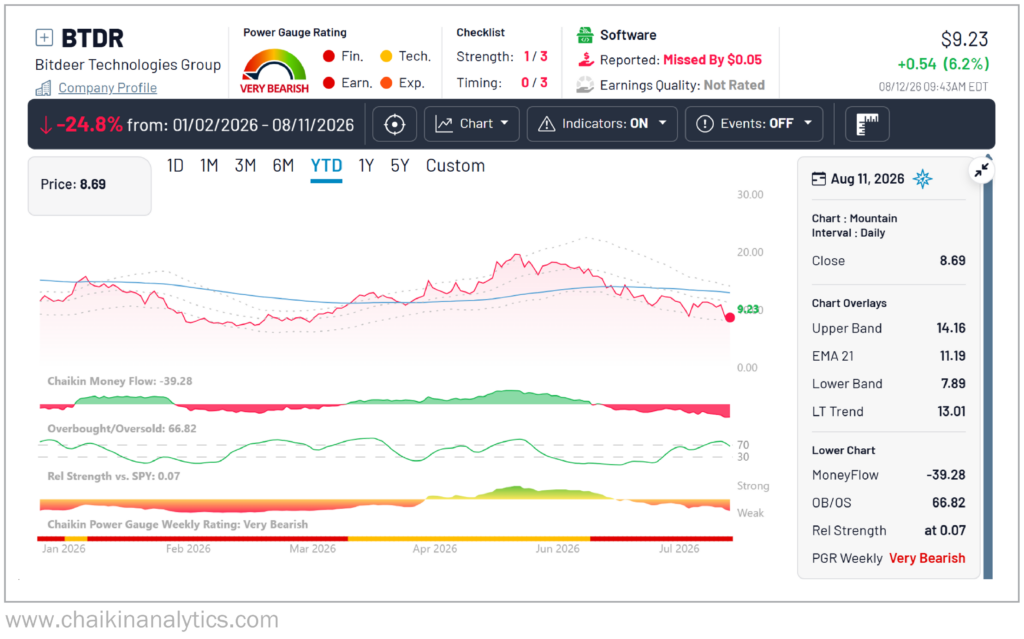
Bitdeer stock has been on a gradual downward slide since the start of the year, dropping nearly 25% as of August 11.

Bitdeer Chaikin Analytics Graph

Chaikin Analytics, the investment-research platform founded in 2009 by legendary 60-year Wall Street veteran Marc Chaikin, rates Bitdeer “very bearish” in its Chaikin Power Gauge, a 20-factor stock-rating system that scans more than 5,000 stocks and 2,300 exchange-traded funds (“ETFs”).

Bitdeer Power Gauge Rating of Very Bearish

Despite the bearishness, Bitdeer could rebound as it establishes itself more as a data-center landlord rather than a shaky crypto company.

Nvidia (NVDA): Backing the Customer That Buys Its Chips

It’s not as if the chip bellwether was relying on these Bitdeer/Volta/Anthropic deals to turn its fortunes around. It is, after all, the most valuable company in the world. But these types of deals certainly don’t hurt, especially as Nvidia rolls out its next-generation Vera Rubin AI architecture on a large scale.

The Bitdeer/Volta data-center campus is simply a showcase for Nvidia’s latest and greatest. But by backing – both financially and with its state-of-the-art technology – a specialized startup like Volta, Nvidia diversifies and expands its already sizeable footprint. And it will likely result in more startups lining up at Nvidia’s door, hoping for the same level of support.

Unsurprisingly, Nvidia gets a “very bullish” rating from the Chaikin Power Gauge.

Nvidia Power Gauge Rating of Very Bullish

Dell (DELL): PowerRack and Liquid Cooling Inside All Four Tydal Halls

Most people know Dell as a long-standing, successful, and reputable business within the consumer-computing industry. But the company has proven itself to be a major player in the AI world. These deals further solidify that sentiment.

The Bitdeer/Volta deal places Dell’s enterprise hardware, PowerRack server systems, and liquid cooling technology into the new data halls in Norway – another major milestone for Dell’s growing AI business.

And it’s that AI business that has pushed Dell stock up 245% since the start of 2026 (as of August 11) and prompted a “very bullish” Chaikin Power Gauge rating.

Dell Chaikin Graph

Anthropic: 133 MW and Less Reliance on Amazon

The Volta deal is huge for Anthropic on a couple of fronts. First and foremost, it gets 133 gross MW of power that it desperately needs to run the infrastructure that will train and deploy its next-generation Claude AI models and Claude Code.

Second, it secures this infrastructure using renewable, clean energy at a large scale. By tapping into Norway’s nearly carbon-free hydropower, Anthropic not only complies with strict European environmental regulations, but it also avoids the overly congested U.S. power grid and its yearslong connectivity wait times.

And this transaction also lessens Anthropic’s dependence on Amazon (AMZN), its main cloud provider. Expanding your supplier network, especially geographically, is never a bad idea in the AI world. Doing so will help Anthropic avoid bottlenecks, reduce geopolitical risk, and even improve performance.

The Risks: $500 Million Unfunded and a Chip That Just Started Shipping

While these agreements certainly have upsides for all involved parties, there are some risky elements… especially for Anthropic and Bitdeer.

Let’s start with Bitdeer. Per the agreement, the company must finish roughly $500 million of physical build-out on the Tydal data-center campus to meet both phases of delivery – the first by the end of 2026, the second by the end of next March.

The problem is, as of August 12, Bitdeer has not yet closed financing for those funds. If Bitdeer fails to meet those delivery deadlines, it faces potentially steep penalties and even the possibility of contract termination.

For Anthropic, the primary risk is the heavy reliance on a brand-new cloud infrastructure company (Volta) as the only safety net between itself and the hardware to be provided by Dell and Nvidia.

Speaking of hardware, that’s no sure thing either, considering large-scale production of Nvidia’s Vera Rubin platform only began in late May. Deploying the new hardware on the expedited timeline required by Bitdeer’s delivery deadlines undoubtedly introduces a layer of uncertainty.

Do the potential upsides outweigh the risks of these deals? That all depends on the level of risk investors are willing to take on. Sure, there’s a possibility that the Volta deal blows up for Anthropic. After all, it’s putting a lot of faith in a company that has only existed since January – a company that will be responsible for installing the hardware and managing the cloud-computing-power operation of a massive new data-center campus.

But that deal also secures much-needed computing capacity for Anthropic’s newest Claude models. And it expands the company’s global footprint.

For Bitdeer, this deal opens a brand-new revenue stream as a data-center landlord – one that should be far steadier and more lucrative than its bitcoin-mining business. We should know by next spring whether these deals proved successful not only for Bitdeer and Anthropic, but also for Dell and Nvidia.

Regards,

David Engle

Editor’s Note: Marc Chaikin, the founder of Chaikin Analytics, built an award-winning system that flagged Nvidia as a BUY before it soared as high as 45,000%. It also turned “bearish” on software stocks two months before they crashed this year. Now, Marc’s warning that a  “jump to lightspeed” has taken place behind the doors of a Silicon Valley AI lab – and says the repercussions are about to cleave the market in half this summer. This 60-year Wall Street legend has a FREE Hotlist of stocks to buy and an urgent Hitlist of stocks to sell now. Click for the full story, including stock names and tickers here… 

The post Bitdeer’s $4.7 Billion Data-Center Lease to Cloud Startup Tied to Anthropic AI Deal: Here’s Who Benefits appeared first on MarketWise.

  • ✇Market Wise
  • Does Intel’s $20 Billion Stock Sale Signal a Buying Opportunity or a Warning Sign? David Engle
    Key Points Intel (INTC) raised $20 billion through an upsized stock offering to fund AI infrastructure, foundry expansion, and other growth initiatives without adding more debt. The offering will dilute existing shareholders, while Intel’s heavy capital spending and negative free cash flow raise questions about how long its AI investment strategy can continue. Intel stock could offer upside if its AI and foundry investments pay off, but the offering also highlights the enormo
     

Does Intel’s $20 Billion Stock Sale Signal a Buying Opportunity or a Warning Sign?

13 August 2026 at 06:55

Key Points

  • Intel (INTC) raised $20 billion through an upsized stock offering to fund AI infrastructure, foundry expansion, and other growth initiatives without adding more debt.
  • The offering will dilute existing shareholders, while Intel’s heavy capital spending and negative free cash flow raise questions about how long its AI investment strategy can continue.
  • Intel stock could offer upside if its AI and foundry investments pay off, but the offering also highlights the enormous costs and risks surrounding the AI infrastructure boom.

Intel (INTC) raised $20 billion from a new stock offering this week, allowing it to turbocharge the company’s AI-infrastructure investments.

Initially, Intel announced in a brief press release on Monday that it aimed to raise $15 billion from the new stock offering. Investors didn’t react very positively to that news.

Between the dilution of existing shares and companies’ uninhibited spending on AI, many investors are skeptical of and, frankly, fatigued by this type of development. Not surprisingly, Intel’s stock, which closed at $101.65 on Friday, August 7, fell during pre-market trading, opening Monday morning at $98.26.

This unexpected announcement also raised some questions.

Why the surprise public stock offering? What does it mean for Intel and its investors? And is this offering a good buying opportunity at a lower stock price, or is it an AI warning sign?

Why Intel Sold $20 Billion of Common Stock

If you guessed artificial intelligence (“AI”), you are correct! What decisions aren’t driven by AI these days? If you haven’t paid much attention to Intel in the past few years, let’s get you caught up.

As I wrote in a May 1 article about Intel’s fast-rising stock, much of Intel’s recent success can be attributed to the revival of Intel Foundry Services.

Here’s an excerpt from that article:

In 2022 and 2023, Intel Foundry Services (“IFS”) earned external foundry revenue of $895 million and $952 million, respectively.

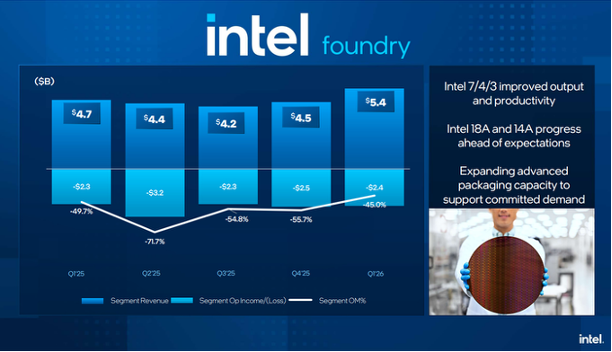
IFS revenue then exploded to $17.5 billion in 2024 and increased to $17.8 billion last year. The pattern continued into 2026’s first quarter, with Intel’s foundry business earning $5.4 billion, a nearly $1 billion jump from the previous quarter.

Intel Foundry

What sparked such a drastic revenue surge?

  • Intel began manufacturing its own products, including the Core Ultra Series 3 and Xeon 6 processors, rather than having them manufactured by Taiwan Semiconductor.
  • The AI data-center boom pushed demand for Intel’s Xeon processors to unprecedented levels.
  • Intel’s application-specific integrated circuit (“ASIC”) custom chip business increased by more than 50% thanks to demand from cloud customers…

And what might be the best

AI demand is obviously still quite strong, so Intel is doubling down on its AI investments.

In its press release, Intel stated that:

Progress in emerging areas including physical AI, purpose-built silicon, advanced packaging and external wafers represent significant growth opportunities for Intel.

Thus, Intel decided to offer the common stock for sale and put the proceeds toward capital expenditures (“capex”), working capital, and growth opportunities. In other words, Intel is looking to grow its AI-infrastructure business significantly. And this offering would greatly expand the available capital Intel needs to do so.

That capital comes without Intel increasing its debt, which is important considering, in July, Intel upped its 2026 capex projection to more than $20 billion.

Other key details of the transaction:

  • The offering’s share price came in at $95, meaning 210,526,315 new shares were made available for purchase.
  • The offering’s underwriters will have a 30-day option (called a “greenshoe”) to purchase up to a total of $2.25 billion in additional shares of common stock at the public offering price, minus underwriting discounts.
  • This would add another 31,578,947 shares of stock to the market, resulting in a total of around 242 million new shares of Intel common stock, based on the $95 share price.
  • Wall Street titans JPMorgan Securities, Goldman Sachs, Morgan Stanley, and Citigroup are serving as joint book-running managers for the offering, reflecting the magnitude of this transaction.

As I mentioned earlier, Intel stock took a hit upon the initial news of the transaction, falling more than 4% on August 10. The reason? Concerns about dilution for existing Intel shareholders… a common worry whenever a company makes this much stock available for public sale.

And it’s a legitimate concern. Issuing $20 billion in new equity will, indeed, dilute Intel’s investors. But the other side of the argument is also valid. Intel stands to gain up to $20 billion in needed capital from the stock sale, giving the company tons of liquidity as it continues to invest in future growth. And it does so without increasing its debt.

The dip in stock price on August 10 may be a blip on the radar, but it’s worth monitoring for investors – especially those who own a sizable stake in the company.

The Federal Government’s 10% Stake in Intel Faces Dilution

About a year ago, the United States government, with the backing of President Donald Trump and his administration, purchased 433.3 million shares of Intel at $20.47 per share. That gave the federal government 9.9% ownership of Intel.

Whether coincidental or not, Intel has since taken off, seeing its stock price increase by nearly five times since the federal government’s investment last August. Intel and its investors – especially the government – have made a lot of money during that span.

Now, with this $20 billion stock offering, the government’s 10% stake is about to shrink. Based on the math used earlier, and the fact that the government did not participate in this sale, that 10% became roughly 9.5%.

Also, as part of the administration’s deal with Intel, the government received a five-year warrant at $20 per share for an additional 5% of Intel common shares, which, according to Intel, is “exercisable only if Intel ceases to own at least 51% of the foundry business.”

Because the August 2025 deal locked in 240.5 million warrants at $20 per share, the growing pool of total outstanding shares automatically dilutes the ownership of those warrants. In other words, the government’s 5% of additional shares from that warrant will also dip closer to 4.64%.

Unfortunately for the government, as a passive minority shareholder, it doesn’t hold any veto or voting power. So, there’s nothing Trump or his Cabinet can do to stop the offering. Ultimately, the government stayed on the sidelines.

On Monday evening, the only official comments from the administration came from White House National Economic Council Director Kevin Hassett, who told CNBC that it’s ultimately up to President Trump when the administration sells its stake – which it does not appear ready to do just yet. So, that’s also something to watch.

What the $20 Billion Offering Means for Intel Investors

We should learn the details of Intel’s stock offering after the sale closes on August 12, as the Wall Street banks running the transaction build an order book. At that point, we should have a better idea of how much Intel’s stock will be impacted.

But you can probably count on an Intel stock slide in the immediate aftermath of the transaction.

Why’s that? Dilution, for one. Then there are discounts. Underwriters often price newly available shares at a small discount (generally 2% to 5%) below the current trading price to entice institutional investors to spend millions or billions on the new shares. Sure enough, Intel’s stock was priced at $95, a discount of 2.6% from its August 10 ​close.

Finally, simple supply and demand negatively impact the stock’s price when millions of new shares are added without an instant surge in buyer demand. But considering Intel’s sale did see a big swing in buyer demand, this shouldn’t be much of a factor.

We don’t have to look back too far for similar examples:

  • In 2020, as Tesla (TSLA) stock was soaring, Musk and company took full advantage of the high price by rolling out multiple multibillion-dollar capital raises. One example was a huge $5 billion “at-the-market” stock offering, which immediately pulled Tesla stock back, resulting in a loss of roughly 4.7% by market close that day.
  • Earlier this year, Oracle (ORCL) announced it was raising nearly $40 billion in capital through mixed debt and equity offerings to bankroll its AI-infrastructure and cloud data-center build-out. The company’s shares plunged more than 12% in after-hours trading as investors lost their collective minds over the amount of money needed to support Oracle’s AI expansion.

But what about long-term impact? This is where things get more complicated. A short-term reaction – or overreaction – is one thing, because it’s typically based on impulsive investor and analyst emotion and sentiment, whether it’s sheer panic or total exuberance.

Long-term impact is generally driven by more rational and strategic thinking. It takes time to analyze and unpack how a company has performed after certain transactions have completed – in Intel’s case, the $20 billion public stock offering.

If you’re considering investing in Intel, you’ll want to see whether this transaction leads to real revenue and profit, whether there’s significant growth and expansion of its foundry facilities to handle demand for its AI hardware, and whether Intel can establish strong cash flow.

During the second quarter of fiscal year 2026, Intel operations generated an impressive $7 billion in cash flow. However, the company’s free cash flow (“FCF”) came in at negative $8.42 billion – compared with last year’s negative $1.1 billion – because of rising capex.

Intel is projecting another year of negative FCF, which would extend its streak to five straight years… the company accumulated a negative FCF of roughly $44 billion between 2022 and 2025, fueled by constant investments in AI and foundry expansions.

Here’s the thing: Intel is probably doing the right thing by increasing its capex to fund its AI infrastructure and meet customer demand. And doing so by diluting its existing shareholders was preferable to growing its debt by the billions, from Intel’s perspective.

The problem is, AI expenditures and financing are simply out of control.

Intel is seemingly doing everything right. Just look at the highlights from its July quarterly earnings report.

  • $16.1 billion total revenue, well above the projected $14.4 billion.
  • Data-center and AI revenue of $6.3 billion, a massive 59% year-over-year gain.
  • Non-generally accepted accounting principles (“GAAP”) earnings per share (“EPS”) of $0.42, doubling expectations.
  • A 40.4% gross margin, up from 27.5% year over year.

By any standard, that’s a highly successful quarter. Until you look at the company’s second-quarter net loss of $11 billion, up from $2.9 billion the year before.

All the positives are being negated by capex that appears to be unsustainable over the long term. And it shows no signs of slowing.

Intel Chief Financial Officer David Zinsner, who had already raised 2026 capex guidance from $18 billion to more than $20 billion, noted that 2027 capex would be “significantly above” that threshold.

So the questions investors must ask themselves are, “Will all of this pay off?” And, “If so, when?”

That’s yet to be determined. In the meantime, investors can take some comfort in knowing Intel is raising capital through equity rather than taking on more debt.

Which begs the question… Does this $20 billion stock offering make Intel a buy, or is this a warning that AI expenditures are simply too overwhelming for the company?

From my view, it’s another ominous warning of the prohibitive costs of financing the AI boom. Sure, the stock offering makes some sense from a bottom-line perspective. But when successful companies – and Intel has been riding a yearlong wave of success – start looking for different avenues to help them raise money to pay their seemingly endless string of capex bills, it’s worrisome.

The Bottom Line on Intel Stock

Intel has momentum. As I mentioned earlier, its stock price has nearly quintupled over the past year, clearly a positive sign. And, if Intel manages this stock offering the right way and makes smart investments with this capital, there’s no reason to think the company won’t continue along the right path, and its stock along with it.

But there’s no escaping the daunting shadow of AI capex that hovers over everything Intel does. The company has already burned billions in cash to expand its capacity, making some investors and analysts tired of the nonstop AI-related expenses that grow more exorbitant by the day.

It’s resulting in too many reputable companies with negative FCF despite growing revenues. And there’s no sure answer as to whether these massive investments will ultimately pay off. That’s just the uncertainty of the AI economy.

Intel is truly straddling the buy/sell fence right now. It’s possible the investments made using the capital from the $20 billion stock offering push Intel into “elite global foundry” territory alongside Taiwan Semiconductor Manufacturing (TSM). That makes Intel look undervalued.

But there’s also a possibility that Intel’s AI investments don’t pay off the way it envisions and the company never even remotely approaches anything close to that status. (Let’s face it, TSM has no peer and probably never will.) That, combined with shareholder dilution, is not looked upon favorably by investors.

The AI-expenditure crisis certainly isn’t unique to Intel. It spans the entire industry. But the spotlight is on Intel now, after its public stock offering. And the investing world will be watching its every move to see where it goes from here.

Regards,

David Engle

Editor’s Note: Whitney Tilson called the rise of Apple, Amazon, and Netflix… as well as the collapse of dozens of companies that went bankrupt. Now the former $200M hedge fund firm manager is stepping forward with what he calls the most important financial warning of his 30-year career. He’s sharing two free stock recommendations  (one to buy, one to sell immediately)  along with details of a new proprietary system fueling his predictions. See it all in his free presentation. 

The post Does Intel’s $20 Billion Stock Sale Signal a Buying Opportunity or a Warning Sign? appeared first on MarketWise.

  • ✇Market Wise
  • Strategy’s New Bitcoin-Backed ‘Digital Credit’ Plan: Does the Juiced Preferred Stock Have Upside? James Royal
    Key Points Strategy continues to deploy its recently announced “digital credit” plan, which manages the company’s STRC preferred stock and aims to improve its fundraising capabilities over time. The company continues to sell bitcoin and repurchase preferred stock, helping push the high-yielding shares closer to par, where Strategy may consider issuing more. By more actively managing its securities, Strategy aims to double its bitcoin per common share within seven years, with
     

Strategy’s New Bitcoin-Backed ‘Digital Credit’ Plan: Does the Juiced Preferred Stock Have Upside?

12 August 2026 at 08:39

Key Points

  • Strategy continues to deploy its recently announced “digital credit” plan, which manages the company’s STRC preferred stock and aims to improve its fundraising capabilities over time.
  • The company continues to sell bitcoin and repurchase preferred stock, helping push the high-yielding shares closer to par, where Strategy may consider issuing more.
  • By more actively managing its securities, Strategy aims to double its bitcoin per common share within seven years, with any increase in bitcoin’s price providing additional upside.

Strategy (MSTR) continues to sell bitcoins for cash, plowing the proceeds into shares of its own STRC Series A preferred stock, as part of the firm’s recently announced “digital credit” plan.

In the week ending August 9, Strategy made several key moves:

  • Sold common stock worth $653.1 million, at an average price of about $99.17.
  • Sold 1,690 bitcoins for $108.6 million, at an average price of $64,262.
  • Repurchased 1,152,020 shares of STRC Series A preferred stock for a total price of $108.6 million, or about $94.27 per share.

Strategy’s moves effectively exchanged its 1,690 bitcoins for more than 1.15 million shares of the preferred stock. The cash proceeds from the common stock went to the company’s USD Reserve, now at $4.65 billion, which backstops the payment of dividends and other interest.

After the sale, Strategy owns 840,447 bitcoins at an average purchase price of $75,385. It is the world’s largest bitcoin treasury firm, owning about 4% of the cryptocurrency’s total issuance.

The intent of the digital credit plan is to increase the number of bitcoins per common share by closely managing Strategy’s common stock, STRC preferred stock, and its bitcoin holdings. The recent sales bolster the firm’s balance sheet, raising investors’ confidence that Strategy can meet the payments on its preferred stock and other indebtedness without needing to raise cash in a fire sale, which might occur while bitcoin prices are low or at a similarly inopportune time.

Strategy’s focus on its STRC preferreds has worked out well for holders so far. The shares have bounced back significantly from a major June downdraft, after investors’ confidence was rattled. The digital credit plan may lead to further gains in the preferreds in the short term as well.

Strategy’s Digital Credit Plan: How it Works

Strategy’s recent portfolio moves are part of what executive chair Michael Saylor calls the company’s digital credit plan. This plan refocuses the company’s fundraising around its STRC Series A preferred stock, with Strategy managing its dividend yield and price, so that it can increase the number of bitcoins it owns per share of its common stock.

Saylor says that the STRC preferreds are already the “most liquid and largest preferred stock in the world.” By carefully managing the preferred, Strategy can raise cash more cheaply.

“We expect to keep laser focus on it,” said Saylor in the second-quarter earnings call. “We’re going to do everything we can to make it the most appealing credit in the entire digital credit space.”

This approach means that Strategy will keep a tight rein on its Series A preferreds so that they stay popular with investors while also offering a reliable source of funds for buying bitcoins.

In a real sense, then, Strategy is acting like a central bank of bitcoin, using some of the same tools as an actual central bank, such as adjusting interest rates and liquidity.

As I explained in this recent piece on Strategy’s new gambit, Strategy has the following tools:

  • Strategy can use dollars to repurchase preferreds if they drift too low, or it can issue them for more dollars if the price reaches a favorable range.
  • Strategy can adjust the yield on this preferred to raise its price, for example, if it wants to raise cash or if bitcoin is surging and its preferred stock enjoys investors’ confidence.
  • By creating a greater market for this preferred, Strategy creates more liquidity in the financial instrument itself, meaning it can more easily issue the preferred and likely lower the cost of funding over time as investors come to trust the stock.

So, Strategy will take advantage of pricing in each of its markets – bitcoins, common stock, and preferred stock – for the purpose of raising the number of bitcoins per common share. To do so, it has recently raised cash to strengthen its balance sheet, giving it a more defensive posture.

At the same time, it has the potential to go on offense when the time is right to buy bitcoins, ideally giving it more ability to accumulate bitcoins if the STRC preferred becomes highly trusted.

So, Strategy’s digital credit plan requires a longer-term approach to acquiring bitcoins rather than the short-term “squeeze” of the bitcoin market that some traders may have first envisioned.

Is There Upside in Strategy’s STRC Preferred Stock?

A key part of Strategy’s approach is ensuring that its STRC preferred stock trades close to its par value of $100. At this price, it will likely issue more shares to fund its bitcoin purchases. Strategy’s moves here may offer a short-term opportunity to profit for its preferred investors.

Strategy can help STRC reach its $100 reference price in a few ways, including maintaining investors’ confidence that it will reliably pay its high dividend, adjusting the dividend to attract investors, and buying back the preferred stock in order to push up its trading price.

In fact, Strategy has recently made all three of these moves:

  • Management’s focus on the preferred share price and a more resilient cash-heavy balance sheet have helped restore confidence in its preferred stock.
  • Strategy authorized a $1 billion buyback for the preferred series and has already begun deploying the cash.

The result? The STRC preferreds are up solidly from their 52-week low of $71.25 in June to around $95 today. Plus, there may be even more upside as the company looks to return the stock to par.

Saylor effectively promised to return the preferreds to par in this time frame, almost down to the day, in the company’s last earnings call, though without making any explicit promise to do so.

“When we came public with STRC, it took us about 70 trading days to reach par,” said Saylor. “Some people forget this, but when we did the IPO, we IPO’d at $90. It took us 70 days to get to par…. If we were to trace forward 70 trading days from when STRC fell out of our trading range, that would put us around September 8.”

Saylor noted on the call that if the $1 billion authorization doesn’t work,

We have ample additional capital in order to cure the dislocation. We’re currently in a discovery process to figure out how much capital will be required on our part in order to return STRC to par. We’re certain that we will return STRC to par.

So, expect further upside for the STRC preferred series for now. Then tack on that heavy dividend – which looks safe at least in the short term – while you wait for shares to move higher.

However, Strategy will have a tough balancing act down the road, since it will want to lower the shares’ steep 12% coupon. But if it lowers the payout, will the stock remain near par, or will Strategy be forced to buy back shares in order to keep the price in management’s target range of $99 to $100?

Strategy’s refined digital credit plan sees the company playing all sides of its markets to keep the number of bitcoins per common share rising over time. We’ll watch how well it does.

Regards,

James Royal, PhD

Editor’s Note: Every generation or so, the way money moves gets a fundamental upgrade. The people who see it coming have the chance to get extraordinarily wealthy. Everyone else watches from the sidelines. Luke Lango says that moment is here again, and Elon Musk is behind the upgrade in an amazing way. He’s revealing exactly what to buy, including one free pick, in this presentation.

The post Strategy’s New Bitcoin-Backed ‘Digital Credit’ Plan: Does the Juiced Preferred Stock Have Upside? appeared first on MarketWise.

❌