❌

Normal view

  • ✇Market Wise
  • The 15 Best Cybersecurity Stocks to Buy Whether AI Booms or Busts Jonathan Rose
    Everyone is trying to figure out how to own artificial intelligence without owning the froth. After a two-year sprint in chips and data-center names, “How do I hedge the AI bubble?” has become one of the most asked questions in investing. I spent 28 years on the trading floors at the CBOE and CME before building Masters in Trading, and one lesson from the pits never changes: when everyone crowds the same trade, you look for the adjacent one nobody’s fighting over. Right now, that trade is cyb
     

The 15 Best Cybersecurity Stocks to Buy Whether AI Booms or Busts

15 September 2026 at 07:55

Everyone is trying to figure out how to own artificial intelligence without owning the froth. After a two-year sprint in chips and data-center names, “How do I hedge the AI bubble?” has become one of the most asked questions in investing.

I spent 28 years on the trading floors at the CBOE and CME before building Masters in Trading, and one lesson from the pits never changes: when everyone crowds the same trade, you look for the adjacent one nobody’s fighting over. Right now, that trade is cybersecurity stocks.

Here’s the logic, and it isn’t complicated. AI is a double-edged sword. The same technology racing through corporate America is also arming attackers, enabling faster, cheaper, autonomous attacks at a scale we’ve never seen. That means security stops being a “nice-to-have” line item and becomes a bill companies cannot stop paying. Cyber vendors get paid whether AI succeeds spectacularly or blows up in someone’s face. Both outcomes create threats. Both require defense.

We got a live preview of this rotation on Monday, September 14, the day the chip names sold off on fresh AI-risk warnings — with Nvidia down nearly 3% and the VanEck Semiconductor ETF (SMH) off 4.4% — the pure-play cybersecurity names had their best session in years. CrowdStrike hit a record high. Zscaler and SentinelOne jumped double digits. The market wasn’t fleeing AI. It was repricing who benefits from it.

Below are the 15 best cybersecurity stocks to buy now, each positioned to ride that shift and grouped by the role it plays in a portfolio.

How Big Is the Cybersecurity Market in 2026?

Before we look at the names, consider these numbers — because the size of this market is the whole thesis.

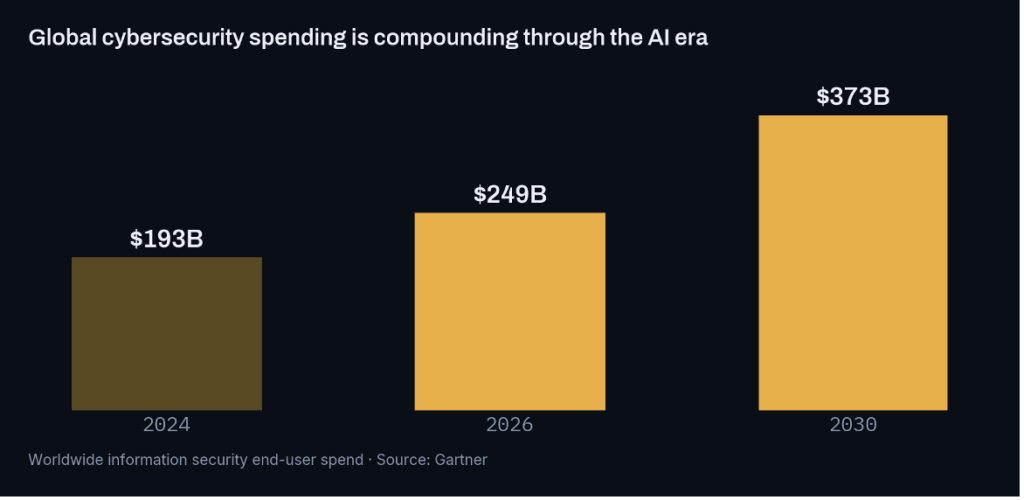
Gartner projects global information security spending will hit roughly $249 billion in 2026, up nearly 13% year over year, on track for about $373 billion by 2030. That’s up from just $193 billion in 2024 — a ~29% jump in two years, at a time when most enterprise software budgets are getting squeezed.

Global information security spending, 2024–2030. Source: Gartner.

Add in security services, and Cybersecurity Ventures pegs the broader market above $520 billion. A Morgan Stanley survey of CIOs found cybersecurity budgets are expected to grow roughly 50% faster than overall software spending.

The fastest-growing slice of the entire market is a category that barely existed 18 months ago: “securing AI” — projected to overtake endpoint protection as the single largest security category by 2029.

Translation: this isn’t a headline-of-the-week trade. It’s a multi-year, structurally funded spending supercycle. Now onto the stocks.

Want to see how I’m trading this theme in real time? I break down setups like these — with live entries, exits, and risk levels — every weekday at 11 a.m. ET on MiT Live.

A watchlist of cyber security companies

 The 15 Best Cybersecurity Stocks at a Glance

StockWhat it doesEst. rev. growthValuationAnalyst view
CrowdStrike (CRWD)Endpoint / XDR~26%PremiumStrong Buy
Palo Alto (PANW)Platform / identity~25%Above avg.Buy
Fortinet (FTNT)Network / firewall~20%ValueBuy / Hold
Zscaler (ZS)Zero Trust / SASE~24%ModerateBuy
Microsoft (MSFT)Bundled security giantDiversifiedModerateStrong Buy
SentinelOne (S)AI-native endpoint~23%ValueBuy
Okta (OKTA)Identity & access~11%ValueModerate Buy
Rubrik (RBRK)Cyber resilience~48%ModerateBuy
Cloudflare (NET)Edge / AI infra~36%PremiumHold / Buy
Check Point (CHKP)Firewall / SASE~7%ValueHold
Qualys (QLYS)Vuln. mgmt.~9%ModerateHold
Varonis (VRNS)Data security / DSPM~9%*ModerateBuy
Tenable (TENB)Exposure mgmt.~11%ValueBuy
Rapid7 (RPD)Vuln. mgmt. / SecOps~flatValueHold
Gen Digital (GEN)Consumer security~4%ValueHold
Figures are approximate, based on the most recent quarterly reports as of September 2026; *Varonis total revenue grew ~9% but its SaaS ARR is growing far faster (~60%+) through its subscription transition. Valuation reflects EV/revenue relative to the ~25x sector median.

The Rose Take: Where I Would (and Wouldn’t) Put New Money

After 28 years reading order flow, I’ve learned the best company and the best stock aren’t always the same thing. Here’s how I’d rank them:

  • Best business, hands down — CrowdStrike (CRWD). Nothing else in the group has its brand, retention, or platform breadth. The only knock is the price: it’s trading near Wall Street’s most bullish targets, so you’re buying perfection.
  • My No. 1 pick for new money — Palo Alto (PANW). It has the scale of CrowdStrike, faster-improving platform economics, a brand-new identity engine from the CyberArk deal, and it still trades at a discount to CRWD. It’s the best risk-adjusted way to own the theme.
  • Boldest high-upside bet — SentinelOne (S). The cheapest of the leaders, growing more than 20%, with real takeover optionality. If it keeps closing the gap with CrowdStrike, it has the most torque on the list.
  • Handle with care — Cloudflare (NET) and CrowdStrike (CRWD). Two of the best stories in tech, at two of the richest multiples. I’d rather wait for a pullback than chase them here.
  • The one I wouldn’t chase — Rapid7 (RPD). Revenue is essentially flat. It’s a turnaround-and-takeover bet, not a growth story — treat it that way.

The Blue-Chip Generals: Best Cybersecurity Stocks for Core Exposure

Large-cap, profitable platforms. They offer core exposure to the theme , and they’re the names institutions buy first.

1. CrowdStrike (CRWD)

The category gold standard. Its Falcon platform is the purest expression of the “AI threat means more security spend” trade, and management now openly calls the company “AI security infrastructure.” Net new annual recurring revenue grew more than 50% year over year in its most recent quarter, its new AI-detection product is scaling fast, and gross retention sits near 97% — a sign customers simply don’t leave. The catch: it’s the most expensive name in the group, and after a 4-for-1 split this summer, it’s already trading near Wall Street’s most bullish price targets. You’re paying up for the best.

2. Palo Alto Networks (PANW)

The consolidation play. While rivals sell point products, Palo Alto is pitching enterprises on running their entire security stack through one vendor — and it’s working, with next-generation security ARR above $9 billion and growing north of 30%. Its roughly $25 billion acquisition of CyberArk, which closed earlier this year, bolts on a dedicated identity pillar right as AI agents make machine identity a top priority. The catch: growth is decelerating off a huge base, and the stock has already had a monster year.

3. Fortinet (FTNT)

The value general. Fortinet owns better than half the global firewall market, differentiates with its own custom silicon, and — critically — is consistently profitable. It typically screens as the cheapest of the mega-cap pure plays, which makes it the “sleep at night” name in the group. The catch: it carries more hardware exposure than the pure cloud names, so its growth is steadier but slower.

4. Zscaler (ZS)

The zero-trust leader. Zscaler replaced the old perimeter-firewall model with cloud-native traffic inspection, and it’s leaning hard into securing agentic AI as its next growth leg, with ARR growing around 25% to nearly $4 billion. It often trades at a meaningful discount to CrowdStrike on forward earnings. The catch: the market punishes any hint of a growth slowdown here — recent guidance wobbles have triggered sharp drops.

5. Microsoft (MSFT)

The elephant nobody counts as a “cyber stock.” Microsoft has quietly built a security business worth roughly $37 billion — larger than CrowdStrike, Palo Alto, and Zscaler combined — and bundles it into enterprise agreements customers already sign. You won’t get pure-play torque, but you get the most defensible distribution in the entire industry with a fraction of the single-name risk. The catch: security is a rounding error in Microsoft’s overall story, so it won’t move the stock on its own.

The High-Growth Disruptors: AI Cybersecurity Stocks With the Most Upside

More torque, more risk. These are the challengers and turnarounds with the most upside if they execute.

6. SentinelOne (S)

The direct CrowdStrike challenger. Its AI-native Singularity platform and Purple AI tools are built exactly for the autonomous-threat era, ARR has crossed $1 billion, and it’s the cheapest of the leaders on a price-to-sales basis — trading around 3.5x forward revenue versus far richer peers. It’s also a perennial takeover candidate. That combination gives it the most torque on the list. The catch: it’s still proving durable profitability and faces the risk of being out-muscled by the platform giants.

7. Okta (OKTA)

The identity turnaround. Identity is the front door to every network — and with AI agents multiplying, every one of them needs an identity to manage. Okta is the leader in that lane and has been climbing steadily back after years in the wilderness. The catch: the platform giants are bundling identity too, so Okta has to keep proving it’s the better standalone tool.

8. Rubrik (RBRK)

The “after the breach” play. While most names focus on preventing attacks, Rubrik focuses on cyber resilience — clean, fast recovery after ransomware hits. That’s a fundamentally different exposure, and a critical one, since no defense is perfect. It’s been one of the stronger performers among the newer public names. The catch: it’s a younger, higher-volatility stock still scaling toward consistent profitability.

9. Cloudflare (NET)

The AI-infrastructure hybrid. Cloudflare isn’t a pure cybersecurity play — it sits at the intersection of edge computing, AI infrastructure, and security, growing revenue nearly 30%. For investors who want the AI build-out and the security angle in one ticker, it’s a rare two-for-one. The catch: that breadth means it competes on multiple fronts, and it trades at a premium valuation.

The Under-the-Radar Value & Niche Cybersecurity Stocks

Cheaper, specialized, less-crowded corners of the space — where the asymmetric setups often hide.

10. Check Point Software (CHKP)

The steady compounder. Check Point rarely grabs headlines, but it delivers consistent margins and cash flow while quietly building out its cloud and zero-trust offerings. It’s the low-drama way to own the theme.

11. Qualys (QLYS)

The profitable niche leader in cloud-based vulnerability scanning and compliance — the unglamorous plumbing that every regulated enterprise has to buy.

12. Varonis (VRNS)

A direct “securing AI” play hiding in plain sight. Varonis discovers, classifies, and monitors sensitive data and catches insider threats — exactly the problem that explodes when companies point AI models at their internal data. Its shift to a SaaS model is gaining traction.

13. Tenable (TENB)

The exposure-management specialist. Tenable helps organizations find what’s actually exploitable before attackers do — a discipline that only grows in importance as AI accelerates vulnerability discovery on the offensive side.

14. Rapid7 (RPD)

The small-cap wildcard. Same vulnerability-management and security-operations lane as the bigger names, but at a fraction of the market cap — which means more torque on any sector re-rating, and more risk if execution slips.

15. Gen Digital (GEN)

The consumer angle. The owner of Norton and Avast is the steadier, income-oriented way to play cybersecurity — protecting individuals rather than enterprises, with a profile closer to a cash-flow compounder than a hyper-growth bet.

Bonus: 3 Cybersecurity ETFs for One-Click Exposure

Not sure which horse to back? Own the whole field. These three ETFs give you diversified exposure without single-name blowup risk:

  • First Trust NASDAQ Cybersecurity ETF (CIBR) — the largest and most liquid, weighted toward Palo Alto, CrowdStrike, and Fortinet. It’s pulled in roughly $1.5 billion of net inflows over the past year, so it’s where sector money shows up first.
  • Amplify Cybersecurity ETF (HACK) — the original cyber ETF, with a similar large-cap tilt.
  • Global X Cybersecurity ETF (BUG) — a cleaner pure-play tilt with less legacy-tech overlap.

The Bottom Line on the Cybersecurity Play

Cybersecurity is one of the only enterprise budgets still expanding through an uncertain economy — and AI is pouring fuel on it from both sides. That’s the definition of a durable trade.

A few rules to play it well. Treat the tiers as roles, not rankings — the generals for core exposure, the disruptors for torque, the niche names for less-crowded setups, and the ETFs when you’d rather own the theme than pick a winner. Watch net new ARR at every earnings report; it’s the one number that separates a real spending shift from a headline pop. And remember that after a big move like Monday’s, headlines fade but bookings don’t — the names that hold their gains are the ones with the recurring revenue to back it up.

The AI era needs defending. These are the companies getting paid to do it.

Editor’s Note: What ever happened to the AI stock boom? Even AI darlings like Nvidia have essentially gone nowhere since summer 2025. Our friend and colleague at InvestorPlace, Louis Navellier, may have the answer. According to Louis, the AI industry is quietly “staging” ahead of the next great AI breakthrough… a new class of AI he calls “Superintelligence… but better.” How will it trigger a $100 trillion reset of the AI markets. How will the launch of this tech send some stocks to zero, and others soaring? And why does Louis say: Don’t buy or sell an AI stock in 2026 until you see what’s coming next? Go here for the full story (and Louis’ #1 pick).  

Cybersecurity Stocks FAQ

What is the best cybersecurity stock to buy in 2026?

There’s no single answer for every investor, but the strongest candidates are CrowdStrike for quality, Palo Alto for the best balance of growth and value, and SentinelOne for the most upside if you can stomach the risk. Match the name to your risk tolerance, not the other way around.

Are cybersecurity stocks a good hedge against an AI bubble?

They’re one of the more logical ways to stay exposed to AI without betting purely on the chip and data-center trade. Security spending is largely non-discretionary and rises whether AI adoption succeeds or produces new threats — so the group can hold up even if AI enthusiasm cools.

What is the best cybersecurity ETF?

The First Trust NASDAQ Cybersecurity ETF (CIBR) is the largest and most liquid, making it the default choice for diversified exposure. Amplify’s HACK and Global X’s BUG are smaller alternatives with slightly different holdings.

How is AI changing the cybersecurity industry?

AI is arming attackers with faster, cheaper, autonomous attacks — and forcing defenders to buy AI-powered tools to keep up. Gartner now tracks “securing AI” as its fastest-growing category, projected to become the single largest area of security spending by 2029.

CrowdStrike vs. Palo Alto — which is the better stock?

CrowdStrike is the higher-quality, faster-compounding business; Palo Alto is the broader platform at a more reasonable valuation. For new money at current prices, Palo Alto arguably offers the better risk-reward — but both belong on a serious watchlist.

Trade This Theme With Me – Live, Every Morning

A watchlist is a starting point. Turning it into actual trades — knowing when to get in, where to set risk, and when to walk away — is the hard part, and it’s what I do out loud every single day.

Join me on MiT Live, weekdays at 11 a.m. ET. I go live to break down the market’s biggest themes and the specific setups I’m watching in real time — cybersecurity, AI, and wherever the money is rotating next. It’s free, it’s unscripted, and it’s where lists like this one turn into real trade plans. Drawing on 28 years as a CBOE and CME floor trader, I’ll show you exactly how I’m thinking through these moves as they happen.

Watch live at youtube.com/@LiveOptionsWithJR — hit subscribe and set a reminder so you never miss the 11 a.m. open.

About the author

Jonathan Rose is a 28-year veteran trader who spent his career as a market maker on the Chicago Board Options Exchange (CBOE) and a floor trader at the CME and CBOT. He is the founder of Masters in Trading, where he teaches options and shares live trades and market themes every weekday at 11 a.m. ET on MiT Live. His focus is helping everyday investors think about risk and opportunity the way professional traders do.

The post The 15 Best Cybersecurity Stocks to Buy Whether AI Booms or Busts appeared first on MarketWise.
  • ✇Market Wise
  • Oracle Earnings: Watch Out for Massive OpenAI Risk Despite Blowout First Quarter James Royal
    Key Points Oracle reported strong results in its fiscal first quarter, with sales and adjusted earnings per share soaring 30%, while AI cloud revenue surged 121%. Oracle delivered 850 megawatts of data-center capacity during the quarter and boosted its remaining performance obligations, a measure of future contract revenue, to $664 billion. Oracle’s success is so closely tied to contracted revenue from OpenAI that investors can’t afford to ignore the risk, especially as OpenA
     

Oracle Earnings: Watch Out for Massive OpenAI Risk Despite Blowout First Quarter

11 September 2026 at 11:10

Key Points

  • Oracle reported strong results in its fiscal first quarter, with sales and adjusted earnings per share soaring 30%, while AI cloud revenue surged 121%.
  • Oracle delivered 850 megawatts of data-center capacity during the quarter and boosted its remaining performance obligations, a measure of future contract revenue, to $664 billion.
  • Oracle’s success is so closely tied to contracted revenue from OpenAI that investors can’t afford to ignore the risk, especially as OpenAI’s fundamentals and business environment worsen.

Oracle (ORCL) reported strong results in its fiscal first quarter on Thursday, with earnings blowing past analysts’ expectations. Total revenue climbed 30% year over year, to $19.3 billion, while adjusted earnings per share grew 30% to $1.92, topping the Bloomberg analyst consensus of $1.75 per share.

All eyes should be on Oracle’s artificial-intelligence (“AI”) infrastructure business, since that’s where the company has staked its future growth. This Cloud Infra unit, as Oracle calls it, saw sales surge 121% to $7.4 billion in the quarter, above the analyst consensus of $7.19 billion.

Oracle noted that it delivered 850 megawatts of data-center capacity in the quarter. This allows the company to start generating revenue from the additional capacity.

Oracle signed $30 billion in AI cloud contracts in the quarter, bringing its remaining performance obligations (“RPO”) to $664 billion. The RPO is future contract revenue that Oracle expects to earn from its data-center tenants. This includes, most importantly, OpenAI, which represents about half of Oracle’s RPO, including a $300 billion deal between the two companies.

Management projected that the second quarter of fiscal 2027 would look similar to, or maybe better than, this quarter: sales up 30% to 34% and adjusted earnings per share of $1.85 to $1.93. That level of earnings per share represents growth of 21% to 25% – down from the first quarter.

Management stood firm on its prior sales expectations of $90 billion for the year, but raised earnings-per-share guidance from $8.05 to $8.10. It also stuck to its capital spending expectations of $90 billion to $95 billion for this year, a level that’s already strained its finances.

Oracle is spending aggressively to build out its data-center network, so its first-quarter earnings translated into negative $5 billion in free cash flow. The company has borrowed a staggering amount to fund the build-out – sporting $130 billion in notes payable and other borrowing, as of May – and completed a $20 billion equity offering in the quarter to raise non-debt financing.

The concern is significant enough that the company is telling investors that its new RPO contracts do not create the need for an incremental capital raise.

Oracle CFO Hilary Maxson detailed on the earnings call that the “vast majority of those new contracts were via prepay or bring your own hardware or similar mechanic,” and that the RPO wouldn’t hit revenue or capital expenditures until fiscal 2028 (which begins in June 2027) or beyond.

Oracle’s quarterly results may calm the nerves of some investors for now, but the company will need to show that its key data-center tenant can pay its bills. At this point, that’s not certain.

Oracle’s Future Is Linked to OpenAI’s Success

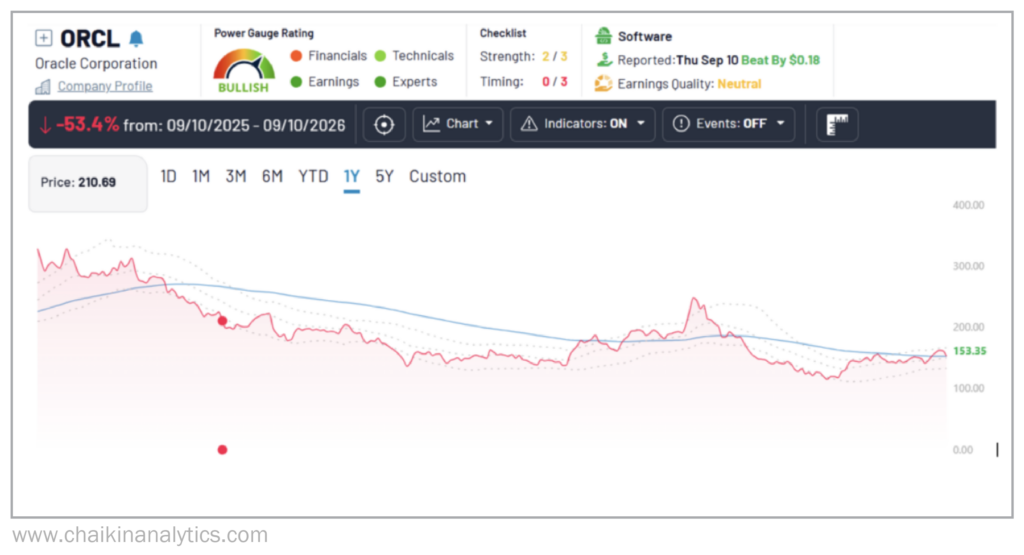
Oracle stock has been on a roller coaster over the past year as investors try to decide whether the company will be one of the biggest beneficiaries of AI… or one of the biggest losers. Big tech companies have hitched their AI fortunes to two money-losing firms: OpenAI and Anthropic.

Oracle Chaikin Graph

Some investors are betting big that Oracle will plummet – a 50% drawdown is well possible, after similar downdrafts in the past year – and the cost to insure Oracle’s debt against default has soared during that time.

The key risk is OpenAI, given its large share of Oracle’s RPO and OpenAI’s continuing losses. OpenAI is a linchpin in the AI industry, with future spending commitments to major players, including Cerebras Systems (CBRS), CoreWeave (CRWV), and Oracle. So, it’s crucial to the AI industry and Oracle that OpenAI stays solvent and continues to spend. If not, a range of AI-related stocks may go to zero if the bubble pops.

OpenAI Continues to Burn Billions in Cash

However, OpenAI is unprofitable, and it’s not clear whether it can ever turn a profit. OpenAI lost $20.9 billion on an operating basis in 2025, followed by a $9.3 billion loss in the first quarter and a further $12.3 billion loss, including stock compensation, in the second quarter.

The business environment continues to worsen for OpenAI, too. The company’s sales grew just 18% quarter over quarter, while Anthropic more than doubled its revenue in the same period.

Meanwhile, Chinese AI models are taking significant share from American models, including OpenAI. They’re offering good enough performance at substantially lower prices, so software developers are turning to these low-cost providers to build their models.

As if that wasn’t enough, token prices continue to plummet, reducing the revenue OpenAI can generate. Silicon Data’s LLM Token Expenditure Index shows token pricing cut in half from the end of May to late August, from $2 per million tokens to just $1.02.

With poor and worsening economics, OpenAI will need to raise at least tens of billions of dollars soon to stay afloat. So, in effect, Oracle’s success – some analysts say survival – depends on whether investors will keep funding OpenAI indefinitely.

Oracle’s own shakier financial status is shown by the fact that S&P Global Ratings downgraded the company’s debt by a notch to BBB-, just one level above “junk.” As mentioned, the cost to insure Oracle’s debt against default has sharply risen over the past year.

All of that is tied to OpenAI in some way or another.

So, while Oracle’s own first-quarter results look excellent on the surface, its key customer is showing severe problems. If not fixed, it’s only a matter of time before they become Oracle’s problems, too.

Regards,

James Royal, PhD

Editor’s Note: Whitney Tilson — the hedge fund manager CNBC called “The Prophet” — says America has reached its “Ripping Point.” The old financial order is being torn apart, and he believes most investors have no idea what’s coming in the next six months. He’s named the stocks he thinks will be destroyed in the chaos — and the ones he believes will soar. Watch his free presentation while it’s still available.

The post Oracle Earnings: Watch Out for Massive OpenAI Risk Despite Blowout First Quarter appeared first on MarketWise.

  • ✇Market Wise
  • The AI Bubble in 2026: Why OpenAI Is Cracking and CoreWeave (CRWV) Could Be the First to Hit Zero Whitney Tilson
    As I read the back and forth on AI, over and over again I keep thinking the same thing: If you substitute the word “Internet” for “AI,” it’s the same as 1999/early 2000. AI, like the Internet, is a revolutionary, world-changing technology that some early adopters and companies are using to massively benefit. But as the Internet bubble inflated, the spend far outpaced the demand, resulting in circular financing, terrible companies achieving absurd valuations, etc. – a classic bubble that bu
     

The AI Bubble in 2026: Why OpenAI Is Cracking and CoreWeave (CRWV) Could Be the First to Hit Zero

11 September 2026 at 10:12

As I read the back and forth on AI, over and over again I keep thinking the same thing: If you substitute the word “Internet” for “AI,” it’s the same as 1999/early 2000.

AI, like the Internet, is a revolutionary, world-changing technology that some early adopters and companies are using to massively benefit.

But as the Internet bubble inflated, the spend far outpaced the demand, resulting in circular financing, terrible companies achieving absurd valuations, etc. – a classic bubble that burst, taking the great companies down 80%… and the lousy companies to ZERO.

There’s little doubt in my mind that we’re in a similar AI bubble right now – but I’m much less certain how much further it will inflate and when exactly it will burst.

Are we in early 1999, when Internet stocks doubled over the next year before crashing? Or are we in early 2000, on the edge of the precipice?

In today’s essay, I’ll explain exactly where I think we are in the market… why I’m not rushing to sell my stocks yet… and where I see tremendous value today… 

CNBC’s Jim Cramer recently visited a construction site in Idaho for a Micron Technology (MU) semiconductor plant. He complained that “there’s an incredibly jarring gulf between stock prices and reality” and that “Micron’s stock is radically undervalued.”

This is significant because, for decades, Cramer has been a great contra-indicator.

It reminds me of his infamous “Winners of the New World” speech on February 29, 2000, just 10 days before the Nasdaq Composite Index peaked. In it, he named 10 Internet-related stocks and said:

We try to own every one of them. Every single one. And if I had my druthers, I wouldn’t own any other stocks in the year 2000. Because these are the only ones worth owning right now in this extremely difficult, extremely narrow stock market. They are the only ones that are going higher consistently in good days and bad. I love every one of them, just as I loathe the rest of the stock universe.

Within 15 months of his speech, the basket of stocks lost more than 80% of its value. By 2009, all 10 companies were either bankrupt, delisted, or acquired for a tiny fraction of their peak bubble valuations.

I think history is likely to repeat itself with the AI bubble…

And make no mistake, we are living through a bubble. Consider that outside of drugmaker Moderna (MRNA) and oil company Marathon Petroleum (MPC), the best-performing stocks in the S&P 500 Index through the end of August are all beneficiaries of the AI-infrastructure boom:

RankCompanyTickerTotal Return
1SandiskSNDK469%
2ModernaMRNA355%
3Dell TechnologiesDELL260%
4Micron TechnologyMU204%
5Seagate TechnologySTX189%
6Western DigitalWDC140%
7Marvell TechnologyMRVL137%
8LumentumLITE137%
9Marathon PetroleumMPC129%
10IntelINTC127%

I looked at what the same list looked like in the last stage of the Internet bubble. Sure enough, they were all tech stocks – Qualcomm (QCOM), Oracle (ORCL), Adobe (ADBE), and Apple (AAPL) among them – reflecting the Internet craze at the time.

Things Are Getting Worse for OpenAI

I’ve been warning my readers about ChatGPT operator OpenAI for years, calling it “a cash-burning furnace.” And things continue to go from bad to worse for the company…

As reported in the Wall Street Journal, its second-quarter revenue was up only 18% from the first quarter. Meanwhile, revenue more than doubled for rival Anthropic.

At the beginning of this year, OpenAI had twice as much annual recurring revenue as Anthropic. But it has now fallen far behind, as this chart from TMT Breakout shows:

Combined OpenAI and Anthropic Chart

And the cash-flow trends are even more starkly divergent, as you can see in this chart created by my friend James Emanuel:

These trends are why I think Anthropic will have a successful initial public offering, perhaps as soon as October. Meanwhile, I doubt OpenAI will ever go public. It’s more likely to implode spectacularly.

If I’m right, the consequences will go far beyond one company, as blogger Ed Zitron writes here: What Happens If OpenAI Dies? He summarizes why he’s so bearish on the company:

OpenAI has no economies of scale, it’s horribly-unprofitable, and does not have a stable business. This naturally means that it has to continually raise capital, except raising further capital is going to be difficult, based on the sheer amounts it needs, the dwindling funds available for it to raise, its already-inflated valuation, and the fact that it’s way behind a competitor facing exactly the same problems.

OpenAI has promised the impossible, and built a company that only makes sense if you’re willing to ignore the worst economics in the history of capitalism. Its future is dependent on raising over a hundred billion dollars a year in one of the worst funding climates in history. Its revenues are slowing, its competitor (and there’s really only one) has outpaced it (all while slowing itself), and its CEO is one of the single-worst spokespeople in history…

The collapse of OpenAI would likely be a result of the walls closing in around its ruinous obligations and economics, with counterparties left short-changed and deals broken as things begin to unravel.

How might the unraveling play out? Zitron outlines a number of scenarios, but I think this is the most likely one:

While I imagine some rescue package is pulled together, OpenAI could simply be allowed to run out of money, short-changing nearly a trillion dollars’ worth of compute contracts, killing CoreWeave, Cerebras, and anyone else reliant on its income. Its customers would be given API keys that flow to Microsoft AI Foundry, Amazon Bedrock and Google Vertex, and be told that there would be little or no further development or training of OpenAI’s models.

This situation, while obviously destructive for the entire industry, would give everybody a scapegoat. Who made all the promises? Sam Altman. Who ran a shitty company into the ground? Sam Altman. Who misled everyone into believing that there’d be infinite demand for compute? Sam Altman. Stories will leak that OpenAI was “not consistently candid” with its financial condition with partners, allowing everybody to reframe a trillion-plus dollars in waste as the result of one egregious con artist.

If Zitron and I are right that OpenAI is going to be a train wreck, the first stock to go to zero will likely be data-center builder CoreWeave (CRWV).

The No. 1 Victim of an AI Bust

Let’s take a look at CoreWeave’s historical financials, which are quite limited because it’s less than 10 years old. (It was originally called Atlantic Crypto Corporation – talk about a red flag! – and changed its name to CoreWeave in December 2019.)

Revenue growth has been strong, but the company barely breaks even on an operating-profit basis. And it has had negative net income every quarter thanks to high, rising debt payments:

Coreweave Revenue and operating income graph

Analysts don’t expect the company to turn profitable anytime soon. Consensus earnings estimates are negative $5.20 per share this year, narrowing slightly to negative $4.24 next year.

CoreWeave has generated a bit of operating cash flow, but this is far exceeded by its capital expenditures (“capex”). As a result, free cash flow (“FCF”) is accelerating to the downside:

Corweave cash from operations graph

CoreWeave funds its huge cash burn by borrowing more and more money, resulting in rapidly rising net debt:

These are among the ugliest financials I’ve ever seen…

Net debt of $46 billion is nearly equal to CoreWeave’s market cap of $48.5 billion, giving the company an enterprise value of $94.5 billion. That’s ridiculous.

CoreWeave investors are betting that the AI boom will expand even further, allowing the company to turn profitable and pay off its enormous debt load. Not likely…

I think what they’re really betting on is that someone will buy their stock at a higher price at some point in the very near future – the very definition of speculation.

Why I’m Staying in the Market

But I’m not urging my readers to sell. For one thing, earnings growth for companies in the S&P 500 has been off the charts this year.

In a post on his Week in Charts blog, Charlie Bilello of Creative Planning, notes that as of August 18, second-quarter earnings growth of 29% was “the biggest upside surprise in history.” And it has risen to more than 50% year over year – the highest quarterly growth rate in five years.

As a result, Bilello notes…

S&P 500 earnings are now expected to surge 32% in 2026, more than double the 15% growth expected at the start of the year.

In this chart, you can see how growth has been climbing steadily for the past three years:

S&P 500 Calendar year EPS graph

This growth is largely driven by the AI infrastructure bubble.

Earnings of tech companies in the S&P 500 soared 71% year over year in the second quarter. That’s all the more remarkable considering just one year ago, these companies saw less than one-third of that growth, as this chart from Ritholtz Wealth Management shows:

The base that matters graph

Given that the S&P 500 is “only” up around 12% this year – far less than earnings growth – simple math dictates that the index’s price-to-earnings multiple has gone down this year.

That means stocks are cheaper and therefore a better buy today than they were at the beginning of the year, right?

Not so fast…

Five of the six periods of extremely high earnings growth in the past quarter century – all but last year – have preceded significant market drops.

My friend Doug Kass of Seabreeze Partners Management agrees that strong earnings per share (“EPS”) doesn’t equate to strong price gains. He argues that this year offers a combination of unique market challenges compared with prior periods. From one of his recent pieces, he cites:

  • High and rising inflation and interest rates.
  • A burgeoning deficit and U.S. debt load may be a permanent condition giving the general lack of discipline from both parties in Washington DC.
  • Improvisational geopolitical and fiscal policies that present threats to political and economic stability.
  • Both parties are moving to extremes – the Republican party more to the right and the Democratic party to the left. With a possible Democratic congressional majority win in November, anti-corporate policy (higher corporate taxes, etc.) may be in the offing.
  • Traditional valuation metrics in the 98th percentile, two standard deviations above the average.
  • The AI capital spending spree and gains from investments have inflated S&P profit reports… an earnings reckoning may lie in the not too distant future.

I think Doug is right that huge corporate earnings growth likely won’t translate into a comparable huge rise in stocks.

Unlike Doug, I’m not bearish on stocks in general – with the exception of the AI bubble. When it bursts, stocks that have soared during this boom – such as CoreWeave (CRWV) – will undoubtedly crash.

But plenty of stocks are likely to hold up well. While investors are fawning over red-hot AI stocks like Sandisk (SNDK), Dell (DELL), and Micron (MU), they’re completely ignoring a corner of the market where I’ve grown extremely bullish in recent months. 

I recently sat down on camera to discuss a major shift I see coming to the market for the first time in nearly 30 years – the same opportunity that helped me make my name on Wall Street back in 1999.

In my video, I discuss why I see market leadership shifting from the hottest AI names in the market to a different class of stocks. And I share everything I can to help you position your money while there’s still time to take advantage of this shift.

The post The AI Bubble in 2026: Why OpenAI Is Cracking and CoreWeave (CRWV) Could Be the First to Hit Zero appeared first on MarketWise.

  • ✇Market Wise
  • SB Energy IPO: This Hidden Detail Is a Major Warning About the AI Bubble James Royal
    Key Points SB Energy has announced plans to go public, but AI investors should be wary, as the company had to give away billions of dollars in value to secure OpenAI as a tenant. SB Energy issued warrants now worth $5.5 billion to OpenAI as part of a deal to land the AI lab as a tenant at data centers it’s developing in Milam County, Texas. A poorly capitalized SB Energy, with little history of developing data centers, is paying an AI lab with a history of rising losses to oc
     

SB Energy IPO: This Hidden Detail Is a Major Warning About the AI Bubble

10 September 2026 at 13:10

Key Points

  • SB Energy has announced plans to go public, but AI investors should be wary, as the company had to give away billions of dollars in value to secure OpenAI as a tenant.
  • SB Energy issued warrants now worth $5.5 billion to OpenAI as part of a deal to land the AI lab as a tenant at data centers it’s developing in Milam County, Texas.
  • A poorly capitalized SB Energy, with little history of developing data centers, is paying an AI lab with a history of rising losses to occupy its massive but not-yet-built facility.

SB Energy (SBE) is planning to go public, but details in its recently filed S-1 initial public offering (“IPO”) prospectus should give artificial intelligence (“AI”) investors a wake-up call. The data-center developer had to give away billions of dollars in value to secure OpenAI as a tenant at to-be-constructed facilities, according to SB Energy’s prospectus.

SB Energy’s move suggests demand for AI data centers may not be nearly as robust as AI bulls suggest, especially as OpenAI seems to lose more money each quarter.

Let’s dig into the details to understand what SB Energy did and why.

In January, SB Energy issued warrants to OpenAI as part of a deal to land the AI lab as a tenant at data centers it’s developing in Milam County, Texas. As of the prospectus date, OpenAI owns 3.99 million warrants, valued at $5.5 billion on June 30, and they expire in 2036.

Warrants are a kind of financial derivative that entitle the owner to buy a security from the issuer at a specified price until the expiration date. In this case, OpenAI can buy up to 3.99 million shares at $0.01 per share if and when each of the eight warrant tranches vests.

One tranche has already vested when the two companies signed a lease for 800 megawatts at SB Energy’s Milam County facility. A second tranche will vest if SB Energy prices an initial public offering (“IPO”). The firms have agreed to a cashless exercise of these vested warrants, so that OpenAI simply receives the value of the warrants as shares of SB Energy stock without having to put up any money of its own – a valuable point for OpenAI, since it’s burning cash.

Six further tranches vest under other conditions, including five that vest as SB Energy’s market capitalization hits milestones from $80 billion to $200 billion.

Why would SB Energy just give away warrants that were worth more than $3.6 billion at the time of issuance – and now valued at $5.5 billion?

SB Energy Just Gave Away Billions to OpenAI

As part of its IPO, SB Energy is looking to raise between $5 billion and $7 billion with an initial market cap of $50 billion. But the firm has a history of losses, and almost all of its handful of data centers are yet to be constructed. In the first six months of 2026, SB Energy reported sales of $138.7 million and losses of $3.2 billion, mostly due to changes in the warrants’ value.

So, enticing OpenAI to sign a lease with billions in warrants gets SB Energy in the game quickly with a tenant that has billions in financing. With a signed contract in hand for a future data center, SB Energy can go to a lender and access financing on more agreeable terms (or at all). That’s how neoclouds such as CoreWeave (CRWV) have been playing the game, too.

Subsequently, SB Energy announced it will build another massive data center to be leased by OpenAI, an 8.0-gigawatt facility known as the PORTS-Pike Technology Campus in Pike County, Ohio. Nvidia (NVDA) stepped in to backstop up to $105 billion for the facility’s first 4.25 gigawatts and has an option to backstop the remaining portion of the build-out. Operation will begin in phases in 2028.

But step back for a moment and consider what SB Energy’s financing move really does. If the AI market is really as hot as bulls say it is, why does a developer need to pay a prospective tenant? Shouldn’t AI labs – which are unable to keep up with demand, the story goes – be clamoring for a data-center deal, so that a supplier such as SB Energy doesn’t need to pay its tenants?

What we’re seeing is relatively little demand for AI data centers that isn’t driven by the two major labs, OpenAI and Anthropic. The two most lavishly funded labs are running around signing massive deals, such as with Oracle (ORCL), which is building data centers for OpenAI. The AI lab owes around half of Oracle’s $638 billion in remaining performance obligations as rent.

OpenAI has $1.4 trillion in spending commitments, and Anthropic inked $517 billion in compute deals in just 11 months. That’s translating into a huge share of AI revenue for the hyperscalers: 70% of Microsoft’s (MSFT) revenue in its latest fiscal year, per Bloomberg estimates. Analyst Ed Zitron pegs OpenAI and Anthropic’s sales at a similar level to Google and Amazon (AMZN).

In short, a poorly capitalized SB Energy with little history in developing data centers is paying an AI lab with a history of rising operating losses to occupy its massive but not-yet-built facility.

That sounds like a recipe for trouble.

SB Energy’s IPO Timeline: Will It Race to Go Public?

SB Energy is relying on the weakest major player among AI labs, OpenAI. It’s on the hook to spend $1.4 trillion and generated a $12.3 billion loss in the second quarter, after a $9.3 billion loss in the first quarter. It will keep burning money and may be structurally unprofitable.

While OpenAI raised $122 billion earlier this year in a huge funding round, it’s going to need to raise cash again soon – and not just a little. And it has a few ways to lose in the fundraising process and really just one way to win. It needs to raise at least tens of billions of dollars at a higher valuation than it received in its latest funding round in March, $852 billion.

It loses if it can’t raise enough money, the valuation does not rise enough, or – horror! – the valuation actually falls. Given that OpenAI postponed an IPO over concerns it would not reach a $1 trillion valuation, the potential upside here may be limited.

If OpenAI can’t get a fundraising round that sustains investors’ optimism about AI as a business, it will be felt across the industry. As a result, SB Energy may be racing to the IPO window in the next few weeks to get ahead of this possibility. But even if SB Energy does complete its offering, it will still be almost wholly reliant on OpenAI to survive.

Regards,

James Royal, PhD

Editor’s Note: A highly secure site in West Texas now houses an emerging potential $10 trillion technology backed by Elon Musk and Sam Altman. This breakthrough could completely replace our need for foreign oil – and send one small group of stocks soaring in the process. Click here to learn how you can invest in Elon’s next $10 trillion move.

The post SB Energy IPO: This Hidden Detail Is a Major Warning About the AI Bubble appeared first on MarketWise.

❌