❌

Normal view

  • ✇Market Wise
  • How to trade AI stocks from here Brian Hunt
    Today’s issue in preview: How to get paid again and again by owning the world’s best businesses How to trade AI stocks from here This bull market in energy is generating huge winners. Here are four good ways to invest. Learn our Top Themes to buy now How to trade AI stocks from here Credit: KanawatTH The giant AI infrastructure boom has its believers and its doubters. And they can disagree on many things. But they can all agree that no matter if this trend is going to move higher or

     

How to trade AI stocks from here

16 October 2026 at 12:00

Today’s issue in preview:

  • How to get paid again and again by owning the world’s best businesses

  • How to trade AI stocks from here

  • This bull market in energy is generating huge winners. Here are four good ways to invest.

  • Learn our Top Themes to buy now


How to trade AI stocks from here

Image

Credit: KanawatTH

The giant AI infrastructure boom has its believers and its doubters. And they can disagree on many things.

But they can all agree that no matter if this trend is going to move higher or lower from here, it’s going to do so quickly… and with plenty of volatility.

Case in point: After ripping higher in September, most of this megatrend’s key stocks and ETFs have suffered steep declines over the past week. This rapid series of up-and-down moves has left the larger trend back to trading in a directionless, sideways market… or “becalmed,” like a sailboat on a windless sea.

In other words, the “world’s most important trend” is back in a holding pattern. Here’s what it means for your portfolio…

Over the past three months, we’ve published a special series of research notes analyzing the AI infrastructure trend.

The status of this critical trend has become one of the great sagas of the business and investment world… a source of intense disagreement among industry bulls and bears. It’s a trend whose outcome could have large effects on your portfolio.

Given AI’s enormous promise, large tech firms such as Alphabet (GOOG), Amazon (AMZN), and Microsoft (MSFT) have invested over $1 trillion in AI infrastructure. They are on pace to invest over $700 billion this year alone and more than $3 trillion after that.

Both the scale and the velocity of this investment boom are unprecedented. It is the largest collective investment effort in history.

Big Tech’s historic investment boom has made the entire “AI infrastructure” trend responsible for a large share of America’s GDP growth and stock market returns over the past two years. It has also drawn the skeptical scrutiny of many widely followed investment analysts who claim the trend is a bubble… one that will soon explode and cause tremendous damage to stock prices and the global economy.

If this hugely consequential trend isn’t the most important trend in the stock market, then it is certainly in the top three.

I believe the AI infrastructure trend has years to run. I believe the world’s smartest, most connected tech insiders who know the true state of bleeding-edge AI development and have real-time stats on AI investment ROI, such as Elon Musk, Jensen Huang (Nvidia), Satya Nadella (Microsoft) and Andy Jassy (Amazon), perhaps maybe… just might… know far more about AI and their businesses than outsiders know about it.

As much press as AI gets, let’s remember that less than 1% of the global population pays for top-tier AI programs. And I estimate less than 10% of large companies believe AI has made a meaningful impact on their businesses.

This revolutionary technology hasn’t yet proliferated, achieved mass adoption, or had mass impact. However, the Agent Supernova is coming.

Regular readers know I care a lot more about what the market thinks of any stock, trend or theme than what any one person thinks of it, including me. You can be bullish or bearish on a trend all you like, but if that trend is moving strongly against you, then your idea isn’t worth much in my book.

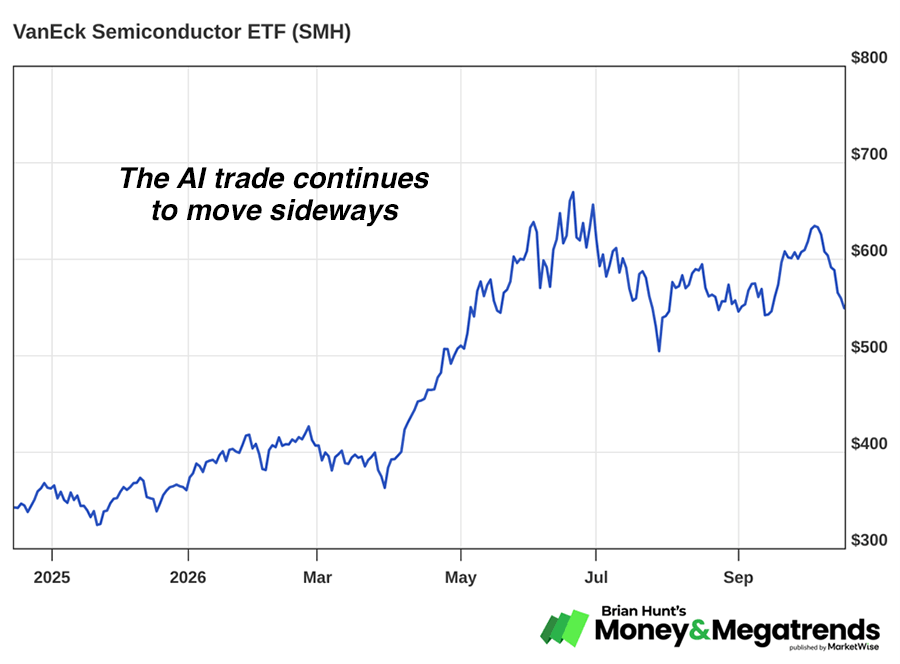
One of the best ways to gauge what the market thinks of AI infrastructure is analyzing the VanEck Semiconductor ETF (SMH).

This fund is full of key semiconductor firms whose fortunes rise and fall with AI infrastructure spending trends. Major holdings include Nvidia (NVDA), Taiwan Semiconductor (TSM), AMD (AMD), Texas Instruments (TXN), ASML Holdings (ASML) and Micron (MU).

As you can see in the two-year chart below, SMH enjoyed a gigantic run from June 2025 to June 2026. The fund gained 176%. Since June 2026, however, the fund has corrected and moved in a volatile, sideways pattern. The fund attempted a breakout in late Sept/early Oct, but huge selling pressure over the past week has sent it back into its sideways base. Back to a trendless state.

I’ll keep you updated on the world’s most important trend. It won’t be long before we get meaningful price action that provides more direction for trading the semis and AI as a megatrend.
Image

Recommended Link:

The #1 Stock Picker Who Called AMD Is Going Public With His Next Big Idea

Ad Image

TipRanks once named Luke Lango the #1 stock picker out of 15,000. He recommended AMD back when Wall Street dismissed it as a gaming company – before it soared as much as 26,797%. Now Luke’s found what he believes could be the most lucrative move of Elon Musk’s career – along with the $15 stock at the center of it all. Click here for the full story.

How to get paid again and again by owning the world’s best businesses

Image

Credit: Liudmila Chernetska

This week, the stock market sent us a subtle but important message…

It says that if you don’t want to deal with the complexity and volatility of investing in rapidly evolving technologies like AI, consider focusing on the simplicity of just getting paid.

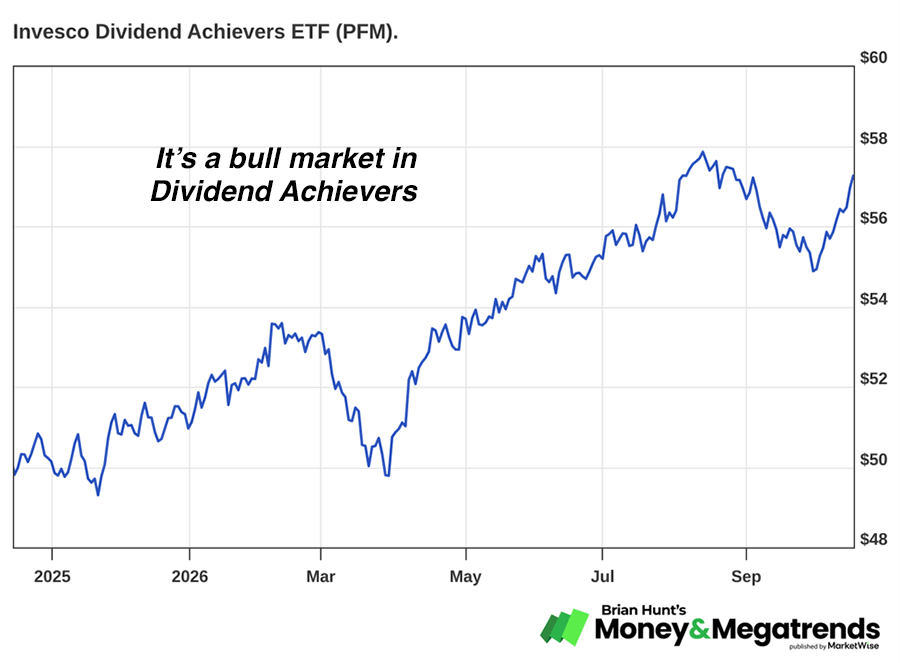
Focus on the strategy employed by investment funds like the Invesco Dividend Achievers ETF (PFM).

PFM is a unique fund that invests exclusively in high-quality dividend-paying stocks. A dividend is a payment a company makes to its shareholders, typically distributed from its profits. Dividends are typically paid by companies on the larger, more stable side of the stock market spectrum.

In the world of dividend payers, there is an elite class of firms that have raised their dividends for 10 consecutive years. These elite, high-quality firms are called Dividend Achievers. Only the strongest, most durable companies can qualify for membership in this club.

Some legendarily great businesses that are members of the exclusive Dividend Achievers club include Johnson & Johnson (JNJ), PepsiCo (PEP), 3M (MMM), Wal-Mart (WMT), Visa (V), Procter & Gamble (PG), Coca-Cola (KO), Chevron (CVX), and ExxonMobil (XOM).

Some of these firms have increased their dividends not for “just” 10 years in a row, but 30, 40, and even 50+ years in a row (and are called “Dividend Aristocrats”).

These businesses have paid and increased their dividends through recessions, bear markets, and a global pandemic. In terms of consistency, these firms rank just behind the rising sun. PFM is a fund designed specifically to own such firms.

Over the past week, many high-profile technology stocks, such as Lumentum (LITE), Dell Technologies (DELL), and Applied Materials (AMAT), have suffered large short-term sell-offs. Each firm is down more than 15% over the past five trading sessions.

Meanwhile, PFM has climbed by 2% over the same period. It’s something of a “port in the storm.” As you can see in the one-year chart below, the fund is enjoying a strong uptrend and is near its all-time high.

We are wildly bullish on the power of technology to create greater prosperity, longer lifespans, and large investment returns. However, we understand that “going big” into technology investments isn’t for everyone. And of course, it’s smart to have a diversified portfolio.

If you’re of the same mind, it’s good to know that investing in stable compounders and insisting on “getting paid” is still working well.
Image


This bull market in energy is generating huge winners. Here are four good ways to invest.

Image

Credit: Stock87

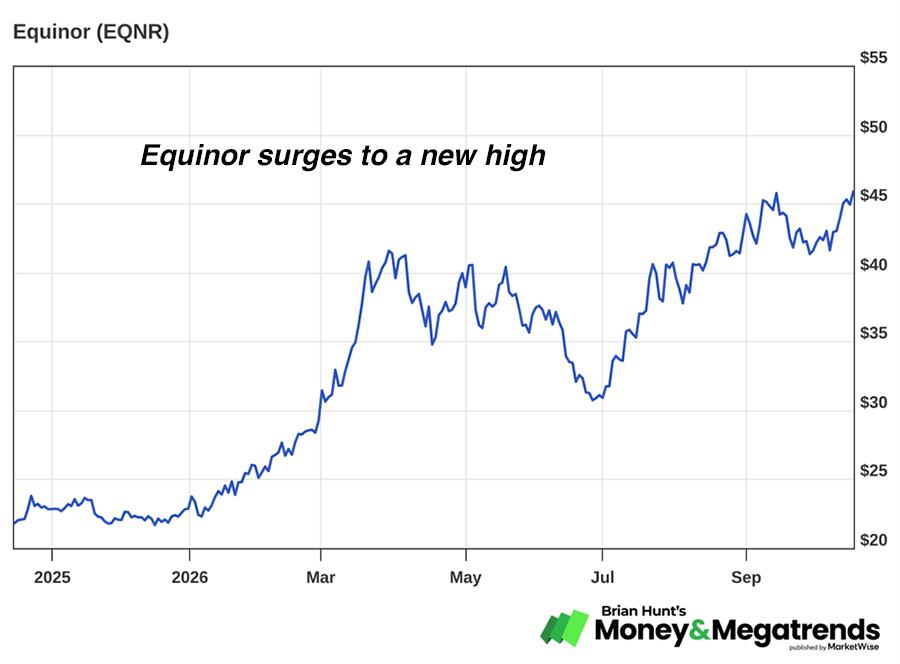
This morning, the stock prices of Canadian oil giants Suncor Energy (SU) and Canadian Natural Resources (CNQ) reached new all-time highs. Shares of Norwegian oil and gas giant Equinor (EQNR) did the same.

This price action tells us that it’s still a bull market in “non-Middle Eastern” oil supplies… and that our September 2025 recommendation to get long oil stocks was very well timed.

Last September, I made the case for going long the emerging uptrend in oil and gas stocks: As the global economy grows, oil demand will remain solid. However, importantly, U.S. shale oil production growth appears to be peaking.

Flatlining supply from this region would remove a critical and reliable source of production growth that has been in place for more than a decade. Plus, oil was very cheap relative to gold and other assets, indicating good value.

With all that in mind, we’ve written frequently and bullishly about owning Suncor, ExxonMobil (XOM), the diversified State Street Energy Select Sector SPDR Fund (XLE), and oilfield service stocks like those in the SPDR S&P Oil & Gas Equipment & Services ETF (XES). The oil sector has been one of the true market leaders over the past year. Both XOM and XLE recently reached new all-time highs.

When I recommended oil and started trading it from the long side, I did not factor in the potential bullish driver of the Iran War. That’s been a “bonus” driver of gains in oil stocks. Sometimes, the dice rolls in your favor.

Although positive news related to the Iran War could emerge at any time and trigger a short-term correction in oil and oil stocks, the long-term picture remains bullish. I see three reasons why this is the case.

One: Critical oil infrastructure in the Middle East has been damaged. Oil flows will not return to pre-war levels for possibly over a year. This supports oil prices north of $80 per barrel, which in turn supports strong cash flows for oil and gas firms.

Two: Most countries maintain substantial above-ground “buffer” supplies of oil and refined petroleum products in the event of market disruptions such as the Iran War. Over the past six months, much of these buffer supplies have been depleted to compensate for the loss of Middle Eastern flows. They must be replenished.

The coming restocking of buffer supplies will support oil prices north of $80 per barrel… which, again, supports large cash flows for oil and gas firms.

Three: Although oil stocks have enjoyed a large run since our September call, they aren’t up much over the past ten years. Adjusted for dollar debasement over the past decade, key oil and gas ETFs are down significantly. This is not an aging bull market that has attracted too many fans and too much capital. It is the opposite of that.

I’ve been especially bullish on companies with all or most of their assets in safe, reliable “not Middle Eastern” asset bases such as Canada, Brazil, and Norway (where Equinor is a major player).

As I’ve covered over the past five months, for many countries and businesses, the Iran War is a powerful reminder: If your survival or smooth operation depends on uninterrupted resource flows from the Middle East, you are in a dangerous, vulnerable position.

No politician, CEO, or major shareholder wants their business to be in that position. No citizen wants their country to be in that position. Many powerful and influential people are realizing this is a big risk that must be mitigated if humanly possible. Executives and politicians will get fired for not addressing it effectively.

This means building and buying as many forms of “not Middle Eastern” and “non-Russian” resource supply chains as possible economically… like those from safe, resource-rich Canada, Norway, and Brazil. With today’s new highs for Suncor, Canadian Natural Resources, and Equinor in mind, I repeat my big picture takeaway: It’s a bull market in safe, reliable oil supplies… so stay long Canada and Norway.
Image


Market Notes

  • Our recommendation to own healthcare stocks continues to pay off. The Health Care Select Sector Fund (XLV) reached a new one-year high today.

  • Software leaders Atlassian (TEAM), Veeva Systems (VEEV), DocuSign (DOCU), Freshworks (FRSH) and Paylocity (PCTY) hit new one-year highs today.

  • Our January 28th recommendation to own the AI application layer is paying off. Zeta Global Holdings (ZETA) just hit a new yearly high. It is up 88% since our initial recommendation.

  • Payment giants Visa (V) and Mastercard (MA) hit new one-year highs today. These are positive economic signals.

  • E-commerce giant eBay (EBAY) hit a new one-year high today.

Regards,

Brian Hunt signature

Brian Hunt signature

Brian Hunt
Editor, Money & Megatrends


An urgent message from our colleagues:

FCC Rule Change Could Fast-Track New Elon Device

Image

New FCC Rule Change Could Make It Easier to Launch Elon’s Next Big Project. See why this new FCC rule change could be the most important evidence for Elon’s newest tech.

Click here.


The post How to trade AI stocks from here appeared first on MarketWise.

  • ✇Market Wise
  • A new kind of AI trade is emerging. Here are the stocks to play it. Brian Hunt
    Today’s issue in preview: A new kind of AI trade is emerging. Here are the stocks to play it. Why Apple could be one of the biggest winners of the AI agent boom A new development for the world’s most important trend… and what it means for your portfolio Learn our Top Themes to buy now A new kind of AI trade is emerging. Here are the stocks to play it. Credit: valentinrussanov After we’ve invested more than a trillion dollars in AI infrastructure, new, leading AI models such as OpenAI
     

A new kind of AI trade is emerging. Here are the stocks to play it.

13 October 2026 at 12:00

Today’s issue in preview:

  • A new kind of AI trade is emerging. Here are the stocks to play it.

  • Why Apple could be one of the biggest winners of the AI agent boom

  • A new development for the world’s most important trend… and what it means for your portfolio

  • Learn our Top Themes to buy now


A new kind of AI trade is emerging. Here are the stocks to play it.

Image

Credit: valentinrussanov

After we’ve invested more than a trillion dollars in AI infrastructure, new, leading AI models such as OpenAI’s ChatGPT-6 Astra and Anthropic’s Claude Fable 5.1 have become far more than just great search engines compared to the models of 18 months ago.

These models have extraordinary capabilities. They can analyze complex information, solve difficult problems, make decisions, and automate a wide range of tasks and business functions. They can generate useful “agents” that do lots of work for us.

So how in the heck do we leverage this new, awesome power inside our business?

That’s the question thousands of executives, corporate boards, and entrepreneurs are asking themselves today. It’s one of the hottest topics in the business world… one that will create huge opportunities for you as an investor.

After all, a company that successfully uses AI to increase efficiency, reduce costs, and generate more revenue could gain an enormous advantage over its competitors.

And a company that fails to embrace and master AI could find itself falling hopelessly behind.

That’s why many business leaders – especially those in knowledge industries such as law, software, consulting, research, marketing, and media – justifiably view mastering AI as one of their defining challenges of 2026 and beyond. Failure to do so poses an existential risk.

And when something is an existential risk that could result in a business leader getting fired, losing a big executive salary, and seeing her stock grants lose 75% of their value, that business leader is going to go to great lengths to prevent that potential risk from becoming real.

This means spending lots of money on enterprise software and data analytics firms that help companies integrate and leverage AI.

Enterprise software refers to applications and technology platforms that help businesses manage operations, organize and analyze data, automate tasks, and improve productivity. These systems support functions such as finance, sales, R&D, human resources, and supply chain management. Increasingly, enterprise software incorporates AI to help companies make better decisions and operate more efficiently.

In fact, to capitalize on the “mad dash” of businesses trying to incorporate AI, a smart enterprise software company will sell itself as an “enterprise AI” company.

Consulting giant Gartner expects AI software spending to rise from approximately $283 billion in 2025 to $453 billion in 2026.

Enterprise software has such strong AI-related growth prospects because taking old, legacy databases and software platforms and transforming them into lean, mean, AI-centric systems is a messy, complicated business.

This cannot be done by purchasing a ChatGPT subscription and having two run-of-the-mill employees work on it. Transitioning a large company’s disparate tech systems into a safe, reliable package of AI-powered systems is a huge task whose bill can run into the many millions of dollars.

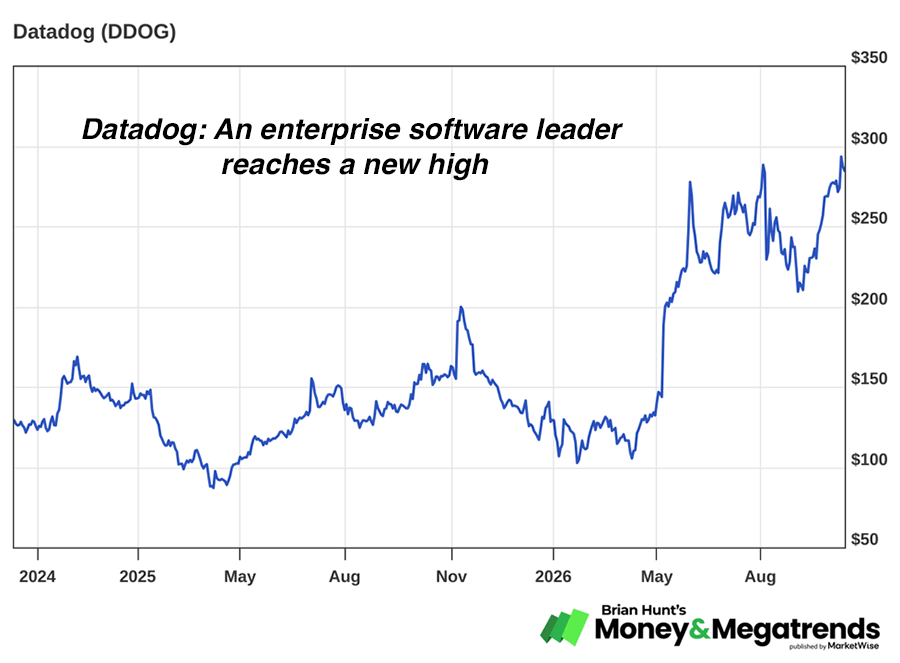
This situation is proving to be bullish for enterprise software firms such as Palantir (PLTR), Datadog (DDOG), Dynatrace (DT), Snowflake (SNOW), ServiceNow (NOW), MongoDB (MDB) and UiPath (PATH).

This under-the-radar tech trend is one of the strongest themes in the market right now. Palantir, Datadog, Snowflake, and Dynatrace recently reached new one-year highs. Many such firms are enjoying 15%+ annual revenue growth.

The AI boom is entering a powerful new phase. After spending more than a trillion dollars building AI infrastructure, the business world is now racing to put that technology to work. For large corporations, integrating AI into existing systems is a complex, expensive, and increasingly urgent undertaking.

That creates an enormous opportunity for enterprise software and data analytics companies. As businesses scramble to harness AI’s capabilities, or risk falling behind, the companies helping them make that transition could generate big stock returns.

Image

Recommended Link:

Debunking the SpaceX Phone Rumors

Ad Image

“I spent years as a Bloomberg tech reporter… and as an analyst for one of Wall Street’s most ruthless hedge fund billionaires. Here’s what I think about Elon building an AI phone…” Click here.

Why Apple could be one of the biggest winners of the AI agent boom

Image

Credit: valentinrussanov

In yesterday’s issue, we detailed how the “AI Applications Layer” is a business and investment area with extraordinary potential over the next three years.

We expect to see dozens of businesses follow in the footsteps of legendary winners such as Amazon, YouTube, Facebook, and Netflix.

These winners didn’t build the physical network of fiber optic lines, routers, servers, and switches that made up the internet. Instead, they built the wonderful businesses on top of that revolutionary infrastructure.

They were the “applications” layer of the internet.

It’s important to understand the applications layer concept because we’re on the cusp of a historic boom in companies that don’t build critical AI “hard infrastructure” such as data centers and semiconductors…but instead build wonderful businesses on top of that infrastructure… just like Apple, Amazon, and Google did with the internet.

I’m talking about AI-centric businesses that revolutionize how we invest, how we develop medicines, how we educate, how we entertain ourselves, how we manufacture, how we shop, how we transfer money, and much more.

The internet changed every industry and created many new ones. AI will do the same.

Investors who follow the Internet applications layer playbook into big AI applications layer winners stand to make giant returns.

In yesterday’s issue, we highlighted how AI-centric data analytics firm Palantir (PLTR) is a powerful example of this strategy. The business is booming and its stock is up more than 1,100% since Jan. 1, 2024.

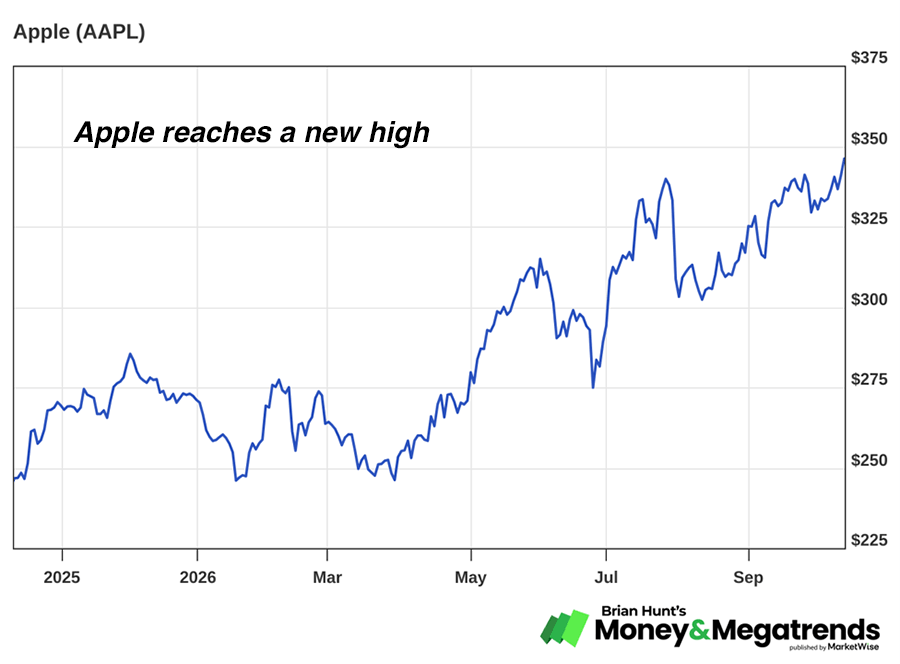
Today, the market is sending us a message that Apple (AAPL) is emerging as a winner in this trend.

Apple is the largest smartphone seller in the U.S. It also generates substantial revenue by selling iPads, Mac computers, and Apple Watches.

For more than 145 million Americans and more than 1 billion people globally, Apple devices are the primary gateway to the internet and, increasingly, to AI applications. In other words, Apple owns one of the most powerful and valuable digital product distribution networks in all recorded history.

As AI agents become more powerful and useful, consumers will increasingly spend money on agentic apps and services that perform complex tasks, solve problems, and manage their daily lives.

And for more than a billion people, Apple products will be the primary gateway to this new world. Their iPhones, iPads, and Macs will serve as the interfaces through which they interact with AI agents, issue instructions, and receive results. Apple doesn’t have to develop the world’s smartest AI models to become a big beneficiary of the agentic AI revolution. It already owns one of the world’s most valuable digital distribution networks.

Don’t take our word for it, however. Take the market’s word. This week, Apple reached a new all-time high. The stock has returned 40% over the past 12 months. It looks like, in Apple’s case, AI is going to help the big get bigger, and the rich get richer. And if the company could make Siri “not terrible,” then the sky is the limit!

Image


A new development for the world’s most important trend… and what it means for your portfolio

Image

Credit: BlackJack3D

Apple’s new high (see above) isn’t good news just for Apple shareholders.

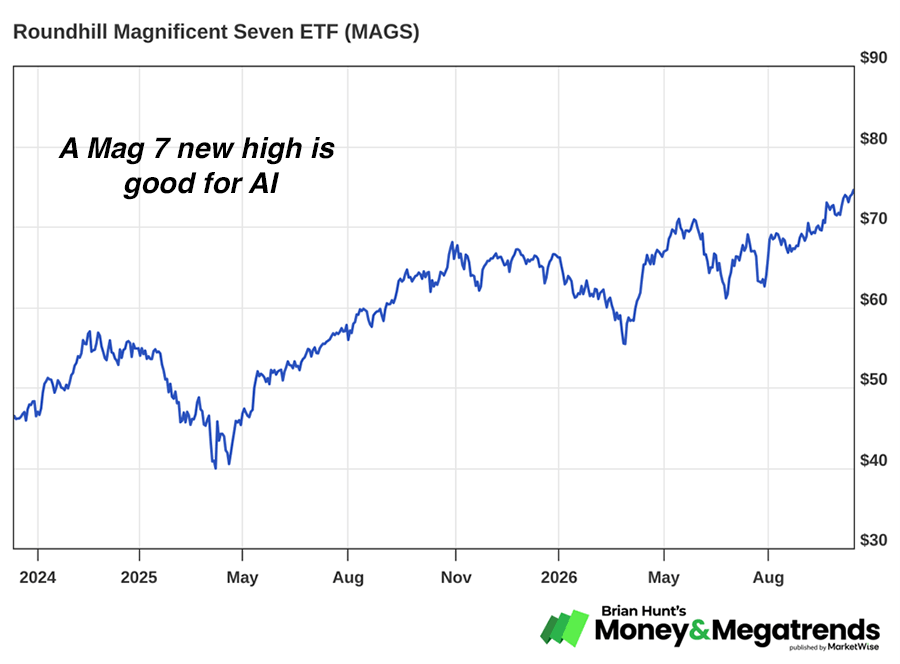
Strength in the stock helped power the Roundhill Magnificent Seven ETF (MAGS) to a new all-time high today.

That’s a great signal for the technology sector in general and the AI infrastructure trade specifically. It tells us the “world’s most important trend” is alive and well… and continuing to confound the very vocal group of AI bears that claim the trend is in a bubble.

MAGS is the largest ETF specifically designed to give investors exposure to the “Magnificent 7,” a group of dominant technology firms comprised of Nvidia (NVDA), Microsoft (MSFT), Alphabet (GOOG), Tesla (TSLA), Amazon (AMZN), Apple (AAPL), and Meta (META).

Together, these firms are worth about $25 trillion and make up roughly 31% of the benchmark S&P 500. No group of companies in history has wielded this group’s awesome combination of power, technological expertise, and vast financial resources. This group includes nearly all the “hyperscalers” leading the AI revolution.

And the ETF that tracks this group reached an all-time high today.

This is a huge development for “the world’s most important trend.”

Over the past two months, we’ve published a special series of research notes analyzing the AI infrastructure megatrend.

The status of this critical trend has become one of the great sagas of the business and investment world… a source of intense disagreement among industry bulls and bears. It’s a trend whose outcome could have large effects on your portfolio.

Given AI’s enormous promise, the firms above have invested over $1 trillion in AI infrastructure. They are on pace to invest over $700 billion this year alone and more than $4 trillion after that.

Both the scale and the velocity of this investment boom are unprecedented. It is the largest collective investment effort in history.

Big Tech’s historic investment boom has made the entire “AI infrastructure” trend responsible for a large share of America’s GDP growth and stock market returns over the past two years. It has also drawn the skeptical scrutiny of many widely followed investment analysts who claim the trend is a bubble… one that will soon explode and cause tremendous damage to stock prices and the global economy.

If this hugely consequential trend isn’t the most important trend in the stock market, then it is certainly in the top three.

I believe the AI infrastructure trend has years to run. I believe the world’s smartest, most connected tech insiders who know the true state of bleeding-edge AI development and have real-time stats on AI investment ROI, such as Elon Musk, Jensen Huang (Nvidia), Satya Nadella (Microsoft) and Andy Jassy (Amazon), could possibly… perhaps maybe… just might… know far more about AI and their businesses than outsiders know about it.

As much press as AI gets, let’s remember that less than 1% of the global population pays for top-tier AI programs. And I estimate less than 10% of large companies believe AI has made a meaningful impact on their businesses.

This revolutionary technology hasn’t yet proliferated, achieved mass adoption, or had mass impact. Plus, as I’ve recently pointed out, anyone who says AI is a “bubble” should have their brain checked for defects.

Regular readers know I care a lot more about what the market thinks of any stock, trend, or theme than what any one person thinks of it, including me. You can be bullish or bearish on a trend all you like, but if that trend is moving strongly against you, then your idea isn’t worth much in my book.

Over the past few months, we have analyzed price action in critical areas of the AI infrastructure trade – including the VanEck Semiconductor ETF (SMH), computer memory giant Micron (MU), and optical networking stocks – to guide our trading.

Since the Mag 7 plays a central role in AI infrastructure, it is central to our analysis. Several of these firms have been singled out by bears for issuing debt to invest in AI data center construction.

However, right now, the market is saying debt issuance and ROI on AI infrastructure spend aren’t much of a worry… and that things are going quite well for the Mag 7.

As you can see in the two-year chart below, MAGS is in a clear uptrend and just broke out to an all-time high. This is bullish for the AI infrastructure trade, bullish for the tech sector in general, and bullish for America.

Image


Market Notes

  • Payment giants Visa (V) and Mastercard (MA) just hit yearly highs. This is a positive sign for the economy.

  • The Iran War and its constriction of oil and refined products continue to benefit U.S. refiners. Refining giants Phillips 66 (PSX) and Marathon Petroleum (MPC) reached new one-year highs today.

  • Our September 2025 recommendation to invest in oil and gas stocks continues to pay off. Oil and gas giants Shell (SHEL), BP (BP), Suncor Energy (SU) and Petrobras (PBR) reached new one-year highs today.

  • Last October’s recommendation to own the Boomer healthcare trend is paying off. AbbVie (ABBV) just hit new yearly highs. It’s now up 12% over the last month alone. Other healthcare-related names Oscar Health (OSCR), Haemonetics (HAE), and Hinge Health (HNGE) also reached new highs today.

  • Space economy leader AST SpaceMobile (ASTS) reached a new one-year low today.

Regards,

Brian Hunt signature

Brian Hunt signature

Brian Hunt
Editor, Money & Megatrends


An urgent message from our colleagues:

“The Prophet’s” #1 Retirement Stock Right Now — Free

Image

Whitney Tilson — the man CNBC calls “The Prophet,” twice featured on 60 Minutes — is revealing the name and ticker of what he calls America’s Greatest Retirement Stock. Completely free. It’s already outperformed Apple, Amazon, and the S&P 500 combined… A billionaire put 60% of his $9 billion fund into it… And Google’s former CEO just partnered with it directly. Right now it’s trading at a rare discount.

No email required. Get the name free.

The post A new kind of AI trade is emerging. Here are the stocks to play it. appeared first on MarketWise.

  • ✇Market Wise
  • A new AI investment strategy that could generate 1,100%+ returns Brian Hunt
    Today’s issue in preview: A new AI investment strategy that could generate 1,100%+ returns This energy trend is producing winners day after day. Are you benefiting? Learn our Top Themes to buy now This energy trend is producing winners day after day. Are you benefiting? Credit: sefa ozel As it turns out, being bullish on oil stocks was a good idea. Last week, one of our top energy recommendations – Canadian oil giant Suncor Energy (SU) – climbed 3.8% to reach a new all-time high. The s
     

A new AI investment strategy that could generate 1,100%+ returns

12 October 2026 at 12:00

Today’s issue in preview:

  • A new AI investment strategy that could generate 1,100%+ returns

  • This energy trend is producing winners day after day. Are you benefiting?

  • Learn our Top Themes to buy now


This energy trend is producing winners day after day. Are you benefiting?

Image

Credit: sefa ozel

As it turns out, being bullish on oil stocks was a good idea.

Last week, one of our top energy recommendations – Canadian oil giant Suncor Energy (SU) – climbed 3.8% to reach a new all-time high. The stock has returned 73.5% since our original bullish oil call back in September 2025.

Last September, I made the case for going long the emerging uptrend in oil and gas stocks: As the global economy grows, oil demand will remain solid. However, importantly, U.S. shale oil production growth appears to be peaking.

Flatlining supply from this region would remove a critical and reliable source of production growth that has been in place for more than a decade. Plus, oil was very cheap relative to gold and other assets, indicating good value.

With all that in mind, we’ve written frequently and bullishly about owning Suncor, ExxonMobil (XOM), the diversified State Street Energy Select Sector SPDR Fund (XLE), and oilfield service stocks like those in the SPDR S&P Oil & Gas Equipment & Services ETF (XES). The oil sector has been one of the true market leaders over the past year. Both XOM and XLE recently reached new all-time highs.

When I recommended oil and started trading it from the long side, I did not factor in the potential bullish driver of the Iran War. That’s been a “bonus” driver of gains in oil stocks. Sometimes, the dice rolls in your favor.

Although positive news related to the Iran War could emerge at any time and trigger a short-term correction in oil and oil stocks, the long-term picture remains bullish. I see three reasons why this is the case.

One: Critical oil infrastructure in the Middle East has been damaged. Oil flows will not return to pre-war levels for possibly over a year. This supports oil prices north of $80 per barrel, which in turn supports strong cash flows for oil and gas firms.

Two: Most countries maintain substantial above-ground “buffer” supplies of oil and refined petroleum products in the event of market disruptions such as the Iran War. Over the past six months, much of these buffer supplies have been depleted to compensate for the loss of Middle Eastern flows. They must be replenished.

The coming restocking of buffer supplies will support oil prices north of $80 per barrel… which, again, supports large cash flows for oil and gas firms.

Three: Although oil stocks have enjoyed a large run since our September call, they aren’t up much over the past ten years. Adjusted for dollar debasement over the past decade, key oil and gas ETFs are down significantly. This is not an aging bull market that has attracted too many fans and too much capital. It is the opposite of that.

Avid Money & Megatrends readers know that I like to know both the bull and bear cases for any trend… but I care a lot more about what the market thinks of those cases than anything else. You can be bullish on an industry or theme all you like, but if the market is going against you, then your bullish thesis isn’t worth much.

As for the bull case for oil stocks, the market is enthusiastically supporting it… especially for companies with safe, reliable “not Middle Eastern” asset bases like key Canadian oil sand firms Suncor, Canadian Natural Resources (CNQ), Cenovus Energy (CVE), plus Argentine oil firm YPF (YPF). Our guidance remains: Stay long oil stocks.

Image

Recommended Link:

“AI Bank” pays 6% APY

Ad Image

Your bank has been ripping you off for years with low interest rates, high fees, bad customer service. Well now you have an alternative – an “AI Bank” that pays 6% interest and gives you full control of your money. See the details here… and why this is striking fear into Wall Street bankers.

A new AI investment strategy that could generate 1,100%+ returns

Image

Credit: imaginima

Since Jan. 1, 2024, the market value of AI-centric defense giant Palantir (PLTR) is up 1,117%. Last Friday, the stock reached a new all-time high.

This giant gain makes Palantir one of the top-performing stocks of the 2020s.

It’s also a demonstration of how powerful the strategy of owning “AI Applications Layer” winners can be.

This strategy – which we most recently detailed in our July 15 issue – is so powerful that it can change your life. Like an “add a zero to your net worth” kind of change.

For a refresher of this strategy, think about Apple, Amazon, Google, Facebook, Netflix, and YouTube for a moment.

These are among the largest and most successful businesses in history.

Their early investors made 10X returns and, in some cases, 100X+ returns.

And they all have one thing in common: They didn’t build the physical network of fiber optic lines, routers, servers, and switches that made up the internet.

Instead, they built the wonderful businesses on top of that revolutionary infrastructure.

They were the “applications” layer of the internet.

It’s important to understand the applications layer concept because we’re on the cusp of a historic boom in companies that don’t build critical AI “hard infrastructure” such as data centers and semiconductors…but instead build wonderful businesses on top of that infrastructure… just like Apple, Amazon, and Google did with the internet.

The revolutionary AI program ChatGPT was released to the public in late 2022. Since then, big tech firms have invested over $1 trillion in semiconductors, networking equipment, computer memory, physical data centers, and other components of AI infrastructure.

This infrastructure powers extraordinary AI models that become more capable and faster by the month.

Now that so much infrastructure has been installed, thousands of businesses can be built upon it… much like how Amazon, YouTube, and Netflix were built upon the internet.

I’m talking about AI-centric businesses that revolutionize how we develop medicines, how we educate, how we entertain ourselves, how we manufacture, how we shop, how we transfer and invest money, and much more.

The internet changed every industry and created many new ones. AI will do the same.

Investors who follow the Internet applications layer playbook into big AI applications layer winners stand to make giant returns. In fact, I’d say this theme is one of the best places to find 10X+ winners over the next decade.

Palantir is a very early leader in this field.

Palantir is a leading software company that helps its customers use AI to organize, analyze, and act on huge amounts of complex data.

Palantir’s major products include Gotham, used extensively by defense and intelligence agencies; Foundry, designed for commercial enterprises; and Artificial Intelligence Platform (AIP), which integrates advanced AI models into business workflows.

Palantir’s largest customer is the U.S. government. Palantir provides military and intelligence agencies with advanced software that integrates battlefield intelligence, satellite imagery, sensor data, and operational information. Its AI-powered platforms help commanders identify threats, track adversaries, plan missions, coordinate forces, and make decisions.

If you want to conduct war in an ultra-high-tech fashion, you work with Palantir.

To be clear, Palantir did not build any AI data centers. Nor did it develop one of the leading frontier AI models. Instead, it has built software that harnesses the power of models from companies such as OpenAI and runs on computing infrastructure provided by others.

In effect, Palantir has positioned itself as a critical bridge between the extraordinary capabilities of AI and the organizations that can put those capabilities to work.

Palantir’s early mastery of AI and data analytics has helped it generate extraordinary revenue growth over the past six years. In 2020, annual revenue came in at $1.09 billion. In 2025, revenue came in at $4.48 billion. Palantir expects 2026 revenue to grow by an incredible 82% this year to about $8.15 billion.

Given this blazing growth, it’s no wonder Palantir is up more than 10X since early 2024. This is the AI Applications Layer phenomenon at work.

The AI infrastructure buildout is far from over. But enough advanced models have been developed, and enough infrastructure is in place, to fuel an extraordinary next phase of the AI boom.

Innovative companies in the “AI Applications Layer” can now harness this technology to build great businesses with extraordinary growth potential. Palantir is just the beginning.

Image


Market Notes

  • Our 8th recommendation to own the Boomer healthcare trend is paying off. Biogen (BIIB) and AbbVie (ABBV) just hit new yearly highs.

  • Our March 27th recommendation to own cybersecurity stocks is paying off well. Fortinet (FTNT), Okta (OKTA), Qualys (QLYS) and Dynatrace (DT) all hit new highs. OKTA is now up 160% in the last year alone.

  • The Iran War and its constriction of oil and refined product supplies continues to work in favor of oil shipping firms. Industry leaders Frontline (FRO), Torm (TRMD) and Hafnia (HAFN) reached new one-year highs this week.

  • Small Modular Reactor players Oklo (OKLO) and NuScale Power (SMR) both hit new yearly lows last week.

Regards,

Brian Hunt signature

Brian Hunt signature

Brian Hunt
Editor, Money & Megatrends


An urgent message from our colleagues:

Elon just declared war on your phone

Image

Elon Musk just dropped another bombshell… He’s going after your cell phone provider. For months, Elon kept these plans under wraps. But late last week, he finally showed his hand. I’ve tracked this story for months, and it’s playing out exactly as I predicted. Next, I believe Elon could launch a new device that kills the iPhone… and hands early investors his biggest payday yet. Potentially 50 times their money. Here’s everything you need to do BEFORE he makes his move. Just act quickly because this story is moving fast.

Click here.

The post A new AI investment strategy that could generate 1,100%+ returns appeared first on MarketWise.
  • ✇Market Wise
  • Seven stocks that could explode as AI goes mainstream Brian Hunt
    Today’s issue in preview: Seven stocks that could explode as AI goes mainstream AI’s hidden income opportunity: How to earn large income streams from the boom Why the U.S. dollar is plummeting in value… and how to protect yourself Learn our Top Themes to buy now Seven stocks that could explode as AI goes mainstream Credit: Petrovich9 In June, Nvidia (NVDA) CEO Jensen Huang stood on stage next to Marvell Technology (MRVL) CEO Matt Murphy and predicted Marvell would be the “next trill
     

Seven stocks that could explode as AI goes mainstream

9 October 2026 at 12:00

Today’s issue in preview:

  • Seven stocks that could explode as AI goes mainstream

  • AI’s hidden income opportunity: How to earn large income streams from the boom

  • Why the U.S. dollar is plummeting in value… and how to protect yourself

  • Learn our Top Themes to buy now


Seven stocks that could explode as AI goes mainstream

Image

Credit: Petrovich9

In June, Nvidia (NVDA) CEO Jensen Huang stood on stage next to Marvell Technology (MRVL) CEO Matt Murphy and predicted Marvell would be the “next trillion-dollar company.”

As a result, MRVL shares jumped 32% in a single day, which was the largest one-day gain in the company’s history. Plus, Marvell became one of the most widely followed companies in the tech world.

Why is Jensen – the “Michael Jordan of AI” – so bullish on Marvell?

Marvell is one of the world’s leading suppliers of optical networking semiconductors, particularly the chips that enable high-speed data transmission inside AI data centers. Market cap is $241 billion.

Jensen believes Marvell could become the next trillion-dollar company because it solves one of AI’s biggest challenges: moving enormous amounts of data between chips.

As AI data centers grow to include hundreds of thousands of processors, connecting those chips quickly and efficiently becomes critical. Marvell specializes in high-speed networking chips, optical connections, and custom processors that enable this.

Jensen sees these technologies becoming increasingly valuable as AI infrastructure spending explodes. Nvidia is so bullish on Marvell’s future that it invested $2 billion in the company and formed a strategic partnership to develop next-generation AI infrastructure.

Over the past two months, we’ve published a special series of research notes analyzing the AI infrastructure trend.

The status of this critical trend has become one of the great sagas of the business and investment world… a source of intense disagreement among industry bulls and bears. It’s a trend whose outcome could have large effects on your portfolio.

Given AI’s enormous promise, large tech firms such as Alphabet (GOOG), and Microsoft (MSFT) have invested over $1 trillion in AI infrastructure. They are on pace to invest over $700 billion this year alone and more than $3 trillion after that.

Both the scale and the velocity of this investment boom are unprecedented. It is the largest collective investment effort in history.

Big Tech’s historic investment boom has made the entire “AI infrastructure” trend responsible for a large share of America’s GDP growth and stock market returns over the past two years. It has also drawn the skeptical scrutiny of many widely followed investment analysts who claim the trend is a bubble… one that will soon explode and cause tremendous damage to stock prices and the global economy.

If this hugely consequential trend isn’t the most important trend in the stock market, then it is certainly in the top three.

Recently, we’ve detailed how new highs for Nvidia, AI chip leader Nvidia (NVDA), semiconductor manufacturer Taiwan Semiconductor (TSM) and the Roundhill Magnificent 7 ETF (MAGS) indicate the market is enthusiastically endorsing a continuation of the AI infrastructure megatrend.

This of course, is also bullish for Marvell.

Although bleeding edge semiconductors from the likes of Nvidia get most of the headlines, those chips are only as good as the connections between them.

As AI data centers grow more complex and more powerful, the number of chips connected inside them increases. A modern AI cluster, for example, ties together hundreds of thousands of chips that all must act together. If that data between chips moves too slowly, these expensive processors just sit there idle.

Traditionally, these data connections have been made from copper. But at the speeds required today, copper can’t keep up. It loses signal and burns power too quickly.

The fix is to slowly replace electrical signals traveling over copper with light signals traveling over fiber-optic cables. That’s what optical networking does. And it’s what Marvell is a world leader in.

Recently, Marvell put a huge spotlight on this technology at its investor day, held on October 6.

Until MRVL’s investor day, we knew optical networking gear had at least two years of solid demand ahead. But we never saw forecasts through to 2030 and beyond.

Marvell’s investor day just changed that.

Here’s is big news:

  • Management estimates its total market opportunity will expand to approximately $400 billion, growing around 45% annually from 2025.

  • Management forecasts annual revenue to climb from $8.2 billion in fiscal year 2026 to $80 billion in fiscal year 2031.

In other words, Marvell has made one of the most aggressive industry forecasts in the technology world… and one of the most aggressive company growth forecasts.

This forecast – plus the word of Jensen Huang – makes optical networking stocks like Marvell and fellow industry players Coherent (COHR), Lumentum (LITE), Ciena (CIEN), Credo Technology (CRDO) and Applied Optoelectronics (AAOI) one of the most compelling technology trends to monitor and consider as an investment candidate.

It is one of the highest leverage ways to invest in the mass adoption of AI.

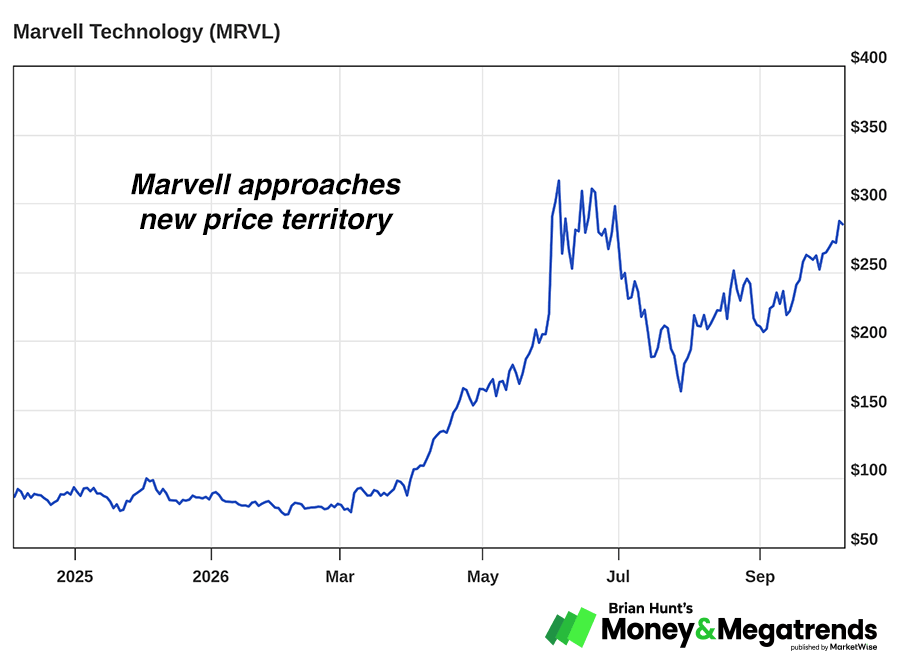
Like most components of the AI infrastructure trade, Marvell enjoyed a big spring rally this year and a significant summer correction. It has since digested this correction, rallied, and is closing in on an all-time high. A break above that high would be a very bullish signal for the optical networking theme. We will keep you apprised of the situation.

Image

Recommended Link:

10 Doubles in 12 Months, or He Works for Free

Ad Image

On October 14, Master Trader Jonathan Rose is putting his reputation on the line by promising at least TEN 100% recommendations over the next 12 months. He’ll reveal the specifics during his $10k to $100k Challenge. Details here.

AI’s hidden income opportunity: How to earn large income streams from the boom

Image

Credit: stanley45

In yesterday’s issue, we highlighted how both large tech firms such as Google (GOOG) and the U.S. government are making huge investments in nuclear energy.

As more individuals and businesses leverage the power of “super intelligence,” more demands are placed on AI infrastructure… which means more demands on our national electric power system.

Since that overloaded system is already straining, AI has a “power problem.” We don’t have enough electric power plants. We don’t have enough connections to existing power plants. We don’t have enough high-voltage transmission lines.

A big part of the solution to this problem is nuclear energy. According to a 2026 analysis by energy consulting firm KeyLogic, annual U.S. nuclear power investment could reach $80 billion to $94 billion by 2035 under an ambitious expansion scenario designed to quadruple the nation’s nuclear generating capacity by 2050.

However, nuclear is only part of the solution to AI’s power problem.

Natural gas – and America’s natural gas transportation network – is a huge part of the solution as well.

Although building large amounts of nuclear power generation capacity is a compelling long-term solution to AI’s power problem, it is not a short-term solution.

Getting permits and project financing for a nuclear power plant typically takes years. And with permits in hand and financing secured, the industry expects build times of 7-10 years.

A nuclear plant is a gigantic, extraordinarily complex construction project. It requires huge reactor vessels, steam generators, coolant pumps, heat exchangers, and miles of specialized piping. Many of these components are frequently custom-built or produced in tiny quantities. There is nothing resembling the mass-production supply chain for conventional industrial equipment.

Once these often enormous, often highly specialized components are built, they must be installed in a precise sequence, inspected, tested, and integrated into a single safety-critical system.

Because the safety stakes are so high, nuclear power plant components are subject to rigorous testing. A problem with one component can hold up several downstream construction activities.

You typically cannot throw more workers at a nuclear power plant project to speed it up. You often cannot even throw more money at it to make it go faster. And so, it takes 7-10 years to build a new nuclear plant.

All this has made my recommendation of energy pipelines a big winner… and should keep it winning for years.

In early 2024, I began to see the oil and gas pipeline industry as the best way to generate substantial passive income from the AI boom.

The U.S. has enormous reserves of clean-burning natural gas. Plus, it has over 2,000 natural gas-fired power plants. An additional natural gas power plant can be built in less than a third of the time it takes to build a new nuclear plant.

However, all the natural gas reserves in the world aren’t worth much if you can’t get the gas from the wellhead to the plants.

This is where America’s vast natural gas transportation, processing, and storage industry comes in.

An extensive network of pipes crisscrosses America that allows energy companies to transport natural gas from prolific fields in Texas, Pennsylvania, New Mexico, West Virginia, and Louisiana to the nation’s power plants.

A boom in AI-related electricity demand by default means a boom in demand for natural gas transportation services.

Since 2024, the market has enthusiastically supported our bull case for energy pipelines. Blue chip pipeline operator Enterprise Products (EPD) has returned 67%. Fellow blue chip operators Energy Transfer (ET) and Kinder Morgan (KMI) have returned 92% and 129%, respectively. Each of these firms is enjoying terrific growth in volumes and revenue.

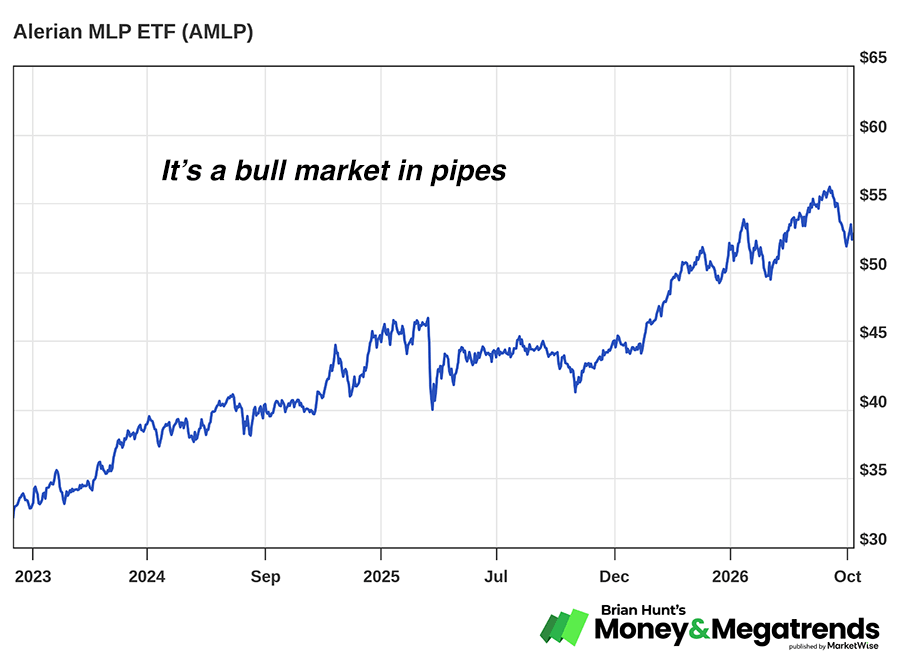
These individual stock gains have powered the energy pipeline-focused Alerian MLP ETF (AMLP) to a 64% total return since 2024. Despite AMLP’s big run and shares being near all-time highs, it still yields around 7.75%.

The typical pipeline operator is not your conventional “high-risk, high-reward” AI play. Instead, it’s a boring, predictable business that generates steady cash flows and shareholder distributions.

But the AI megatrend is giving natural gas a boost that will last for years. Plus, the Iran War and its constriction of Middle Eastern energy flows have made U.S. natural gas exports increasingly more valuable to customers in Europe and Asia. The Russia/Ukraine war is doing the same with its constriction of Russian natural gas exports.

Generating stable cash flows by transporting oil and gas isn’t as exciting as some high-tech industries, but business is booming… and will most likely do so for years. It’s a bull market in pipes!

Image


Why the U.S. dollar is plummeting in value… and how to protect yourself

Image

Credit: Backyard Production

Every day across America, people complain about high prices.

The price of gasoline is high.

The price of groceries is high.

Young people can’t afford homes because their prices are high.

We all know the prices of many things we buy a lot of are way up over the past seven years.

But do we all know why?

I’ll answer that for you: No.

Most people have a vague, nagging feeling that soaring prices may have something to do with runaway government spending, the U.S. deficit, and inflation. They know something isn’t quite right… But they don’t fully understand what is happening.

Here is what is happening in simple terms anyone can understand…

Over the past 50 years, the U.S. and state governments have made many promises to many people. Social security payments. Medicare. Medicaid. Pensions. Defense contracts. Veterans’ benefits. Government employment contracts. Unemployment benefits. Food stamps. Federal education programs. Plus, you have the day-to-day costs of things like roads, bridges, police, and regulatory enforcement.

And over those same 50 years, a dangerous trend has taken root. More and more people have grown very comfortable voting themselves benefits paid by their fellow taxpayers. This trend has become so strong that our government has promised far too many things to far too many people. They are spending far more on social programs, pensions, and wars than they collect in tax revenues.

The related debts and obligations governments have taken on cannot be paid back with sound money. They can only be paid back with debased, devalued money… much of which is created out of thin air. Every freshly printed unit of currency debases an existing one.

This is driving inflation and significant currency debasement. Prices are going up because the value of our money is going down.

Measured against a basket of widely used raw materials like crude oil, corn, silver, sugar, and soybeans, the U.S. dollar has lost 48% of its value over the past eight years.

Here in mid 2026, the problem is worse than ever. In America, millions of people are net tax recipients – meaning they receive more in benefits than they pay in taxes. Plus, according to the U.S. Bureau of Labor Statistics, about 15% of all jobs in America are government jobs (federal, state, local). These folks aren’t voting for fewer benefits or fewer jobs.

No politician can win a major election by promising reduced spending.

Too many people are now riding the gravy train.

Democrat or Republican, it doesn’t matter.

Campaigning on sensible spending is a sure loser.

So, what stops the insanity?

How can we get spending under control?

Sorry – bad news. Too many voters either work for the government directly or indirectly or are net tax recipients. They will flat-out not vote for someone who promises to cut benefits, handouts, and spending. This crazy spending is a runaway train.

We will only “get religion” after a financial market crisis forces us to get it.

It’s like how most alcoholics won’t make a change until they’ve almost killed themselves in a car crash or something… or how someone that doesn’t exercise and has a horrible diet won’t change their ways unless a health crisis forces them to.

It’s just human nature. We tend not to change unless we get hit with a metaphorical 2×4 to the head.

So, keep all this in mind next time you see high prices or think about inflation. Sure, you can think of it as prices going up. Or, you can think of it as the value of the money is going down.

This phenomenon shapes all kinds of things and distorts many concepts people hold. For example…

*People like to make a big deal about the massive market values of giants like Nvidia (NVDA) and Apple (AAPL). But keep in mind that since the value of the dollar has declined by about 50% over the past eight years, today’s $5 trillion is worth about $2.5 trillion in 2018 dollars.

*People like to point out that oil prices are very high, but today’s $90 barrel of oil is worth about $45 in 2018 dollars.

*People who recently sold a house for a lot more than they paid for it 10 years ago aren’t actually any wealthier. The value of the money plummeted, so the home’s price went way up. They essentially treaded water, minus all the insurance costs, maintenance costs, and taxes. Their “profits” are largely an illusion: The money they pocketed doesn’t buy any more food, gas, or housing than it did 10 years ago.

*If a company generated $1 million in profits in 2018 and generated $2 million in profits in 2025, it didn’t grow in real terms.

*A $250,000 salary in 2018 is worth roughly a salary of $125,000 in 2026.

You get the picture.

It’s easy to get tripped up or mistaken by the great “money illusion”

The government wants you to see rising wages, rising home prices, and rising stock prices and then feel richer and happier.

That would mean you’re more likely to support the status quo and less likely to agitate for change.

But it’s an illusion.

We’re all “earning” more money… and we’re all “making” money in the housing and stock markets…

… But those gains are a mirage.

The money we’ve been making at our jobs, in our homes, and in our stocks aren’t buying us any extra food, fuel, or free time.

We aren’t increasing our level of real wealth because the price of everything is going up.

The value of our money is going down.

You can think of prices for everything in America – homes, cars, gasoline, food, insurance, medical care – as boats on a lake.

And our money supply is the water level in the lake.

As the water level rises and rises, all the boats go up. But your real wealth doesn’t increase a bit. Every vessel on the water goes up with the water level.

And remember…

More water has been pumped into America’s “money supply” lake in the past five years than was pumped over the previous 100 years.

Sure, the price of your home is rising, but the price of everything you buy is rising.

You can think about “cashing in” and banking some profits produced by the rising price of your home, but remember that if you sell your existing house, you must buy a different house at a greatly elevated price!

You can think of the price going up, but you should also know the value of our money is going down.

This is all why it’s more important than ever to be vigilant against inflation and own many of the “inflation defense” assets we’ve covered, such as oil and gas pipelines, gold, timberland, copper mines, gravel pits, and solid, growing businesses.


Market Notes

  • Medical device giant Boston Scientific (BSX) reached a new one-year low this week.

  • Casino giant Las Vegas Sands (LVS) reached a new one-year low this week.

  • The Iran War and its constriction of oil and refined product supplies continues to work in favor of oil shipping firms. Industry leaders Frontline (FRO), International Seaways (INSW), and Hafina (HAFN) reached new one-year highs this week.

  • Software leader Atlassian (TEAM) reached a new one-year high this week.

Regards,

Brian Hunt signature

Brian Hunt signature

Brian Hunt
Editor, Money & Megatrends


An urgent message from our colleagues:

Blue Origin… DOOMED

Image

Jeff Bezos should be terrified. He will be down on his knees, begging Elon for mercy. Because Elon is set to: Cut Amazon out of the AI race ENTIRELY…Completely DESTROY Blue Origin…And take control of the potential $25 TRILLION DOLLAR PER YEAR AI INDUSTRY. And in his wake, potentially create 1,806,000 NEW millionaires over the coming years… Starting December 8. And this is your chance to be one of them. Legendary tech investor, James Altucher, shows why a single FCC filing proves it.

Click here to see why.

The post Seven stocks that could explode as AI goes mainstream appeared first on MarketWise.

❌