The richest man in the world says he is not building a phone… again, and again, and again…
Last October, Elon Musk sat down with Joe Rogan. “I am not working on a phone,” he said.
On January 30, someone on X chimed in …
The important part there is that “it would be a very different device than current phones.”
Then, a few days later, Reuters reported that SpaceX had plans for a Starlink phone. Musk’s response:
Then on July 1, the Wall Street Journal reported that SpaceX had shown investors a prototype of a handset-like AI device before its June IPO. The report said the device was slimmer than an iPhone, ran its own operating system, and used technology from Musk’s AI company, xAI. Musk posted two words in reply:
Case closed?
Not quite, according to Josh Baylin – a former Bloomberg tech reporter and hedge-fund trader. And he thinks the denial is the most interesting part of this story…
His argument is simple: Musk may indeed be telling the truth when he says there’s no finished phone sitting in a drawer in Starbase.
Nonetheless, practically every piece required to build a phone has already been bought, filed, licensed, or launched by one of Musk’s companies… The spectrum, satellites, chips, AI, trademarks, and even the regulatory clearances.
And just a few days ago, the U.S. government handed SpaceX the last piece of the puzzle…
In early October, the Federal Communications Commission approved SpaceX’s plan to launch 15,000 next-generation satellites for a service called Starlink Mobile. More importantly, the agency waived the rule requiring SpaceX to lease spectrum from a ground-based carrier.
In plain English, SpaceX can now sell wireless service to Americans on its own.
A company that can beam 5G to your phone from orbit… that owns one of the most capable AI models in the world… and that controls the cheapest and most reliable rocket launches on Earth now has permission to be your phone company.
Here’s the timeline so far…
September 2025. SpaceX agrees to pay $17 billion for wireless airwaves owned by EchoStar (SATS). Half in cash, half in SpaceX stock. This is spectrum that gives SpaceX the exclusive right to broadcast on a slice of radio frequencies… including straight to ordinary cell phones.
October 2025. SpaceX files to trademark the name “Starlink Mobile.” The application covers personal cellular service and two-way voice, text, and audio. That sure sounds like a phone company to me. The company also filed a companion mark, “Powered by Starlink.”
November 2025. SpaceX buys another $2.6 billion worth of spectrum from EchoStar.
January 2026. SpaceX asks the FCC for permission to launch up to one million satellites that would run AI in orbit.
February 2026. SpaceX absorbs xAI, the company behind the Grok AI chatbot. Now Elon’s rockets, satellites, social network X, and AI all sit under one roof.
May 2026. Ahead of its IPO, SpaceX files its SEC paperwork… defining Starlink Mobile as a service that delivers cellular connectivity straight to everyday smartphones via satellite. It says the next generation of mobile satellites, combined with the EchoStar airwaves, is designed to deliver “a connectivity solution on par with terrestrial mobile networks.”
October 2026. SpaceX announces it intends to acquire a low-band spectrum license portfolio in the 800 MHz band. As the company put it… “This prime low-band spectrum addresses one of the key remaining technical gaps that will pave the way for Starlink Mobile to become a major mobile carrier in the US.”
So here’s the question Josh keeps asking: Why would Musk build all of that and then let another company sell you the device?
The stakes here are massive. Your phone is the most personal piece of technology ever made… It’s the first thing most folks touch in the morning, and the last thing they put down on the nightstand in the evening.
Update – September 21, 2026: Since this article discussing what’s coming for white-collar workers and investors in America was originally published in April, several major developments have happened with AI that you should be aware of…
First, the white-collar layoff wave that we detailed here has only grown stronger in recent months. AI was the leading reason given for layoffs for a record five months straight… beginning in April, when we first published this guide, through July. And it remains the leading reason for layoffs so far in 2026. Already this year, more than 100,000 Americans have been laid off thanks to AI.
The corporate examples keep piling up. Uber (UBER) plans to eliminate more than 3,000 roles… Microsoft (MSFT) laid off nearly 5,000 employees… Oracle (ORCL) has axed more than 20,000… British American Tobacco (BTI) is cutting 9,000 as it tries to become “more digital and AI-focused”… and dozens of other tech companies are shedding double-digit percentages of employees thanks to AI-focused restructuring.
Nonetheless, investors are still early to this story… The “ripping point” gap that we’ve detailed below is widening. And AI is only getting smarter. The next six months will likely create more wealth than the last 100 years combined. But only for those who are prepared.
The rest of this guide has been updated to reflect these developments…
Days ago, Wall Street veteran Whitney Tilson started sounding an alarm.
He calls it America’s “ripping point.” And if you haven’t heard the term yet, you soon will.
Whitney is the man who CNBC once dubbed “The Prophet” for his string of eerily accurate market calls. And now, he says the country is entering a stretch of upheaval unlike anything he has seen during his career.
It’s all due to artificial intelligence (“AI”)… and it’s beginning to tear the economic fabric of the nation apart.
AI will create massive new fortunes for a small group of people, while ripping away the livelihoods and security of millions of others. Already, white-collar workers like lawyers, analysts, consultants, managers, and software engineers are watching AI creep into their jobs… and wondering for how much longer they’ll still have a job.
You’ll see another tech layoff in the headlines soon. And another after that. You’ll see hundreds more as Whitney’s ripping point prediction plays out.
I’m concerned that our whole way of life is being swept away in front of our eyes…
Hundreds of thousands of people are losing their jobs. Violent swings are battering the stock market. Entire industries are collapsing around us.
I’m not only worried for older folks like me. I have three beautiful daughters. And it feels like their future gets more unstable with every passing day.
It’s not just because of the extreme political division or violent protests that seem to be a regular part of our lives now. I mean the deeper change that we can all feel.
We’re living through a permanent reset in our economy. It’s making the world – the one our children are going to inherit – deeply unstable.
He wrote that in March… For the next five months in a row, AI led as the reason for job cuts according to outplacement firm Challenger, Gray & Christmas. And so far, they report that more than 100,000 people this year alone have been laid off thanks to AI.
Looking ahead, Whitney’s “ripping point” prediction will affect every American with a 401(k) or retirement account. And it comes down to three core ideas.
First, America has hit a societal and economic breaking point.
One group of Americans is using AI to race toward new wealth – or simply to grow their current wealth. But another group is sliding into financial insecurity. And the gap between them is growing fast.
A key measure of wealth concentration called the Gini coefficient sits at 60-year highs according to a report from U.S. Bank, and terms like the “K-shaped economy” are now commonplace.
“This is not a cyclical or temporary phenomena,” said Mark Zandi, chief economist at Moody’s Analytics. “This is a structural, fundamental issue.”
Federal Reserve data shows that the top 1% in America now control nearly one-third of the nation’s wealth. The bottom half of the U.S. population, on the other hand, controls less than 3%.
And white-collar hiring keeps shrinking… Core office sectors have been cutting jobs for three straight years now, according to the Bureau of Labor Statistics.
Social unrest is growing. Debt is ballooning. Political extremism is spreading.
For a wide swath of the population, the American dream is getting harder to even imagine, much less attain.
Second, Whitney believes the AI revolution is the primary force behind this American fracture.
AI adoption is advancing much faster than most people expected.
So, even as traditional white-collar roles and entire business models are getting gutted, new fortunes are also being built at a speed we have never seen before.
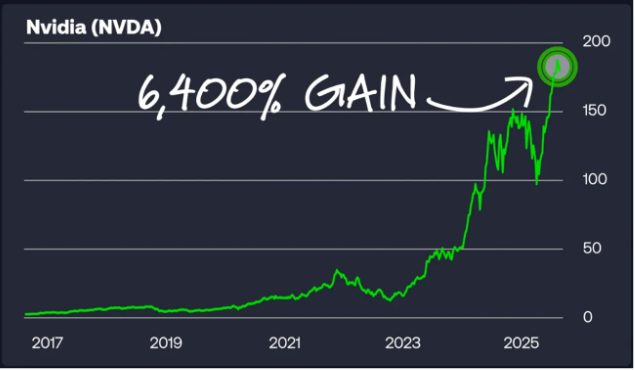
But what you might not know is that Stansberry Research, the publishing firm where Whitney hangs his hat, actually initiated coverage of Nvidia back in 2004 at a split-adjusted price of about $0.12 per share, listing it as their No. 1 buy.
Nvidia is up more than 150,000% from that initial coverage. And subscribers had multiple opportunities to buy in along the way, including right before it went on its recent tear.
The opportunities Whitney is spotting today could be just as powerful for your portfolio.
That’s why the final part of Whitney’s prediction is so important.
There is a way forward for everyday Americans, using AI in their investing instead of being afraid of it. He has helped build an AI-powered investing system specifically designed as a financial life raft for those folks willing to grab hold.
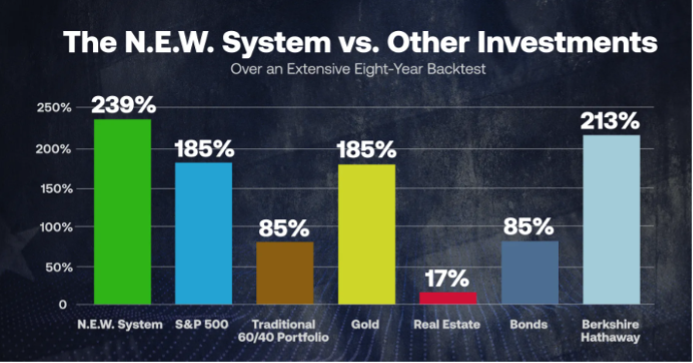
The system uses AI to crunch financial data on thousands of publicly traded companies and identify the stocks most likely to outperform. In back testing, the approach beat the S&P 500 Index, bonds, gold, and even Warren Buffett’s Berkshire Hathaway (BRK.B) over recent years.
We’ll examine each of these three ideas here today. But if you read nothing else, you should at least know Whitney’s core recommendation: Stop fearing AI, and start using it.
The American Ripping Point: A Tale of Two Economies
Whitney believes the United States has split into “Two Americas.” And this divide is reaching a “ripping point.”
By that, he means the gap between those who are thriving and those who are struggling has gotten so wide that it no longer feels like a gap. It feels like a tear.
On one side are people riding booming asset prices, cashing in on new technology, and watching their portfolios grow. On the other side are people dealing with stagnant wages, climbing costs, and a gnawing sense that they are falling behind for good.
Economists have a name for this pattern: The “K-shaped economy.”
Picture the letter K on a chart. One arm shoots upward. That is the segment of the population doing well – rising incomes, growing net worth, and expanding opportunity. The other arm falls downward. Those are the folks losing ground.
Morgan Stanley Wealth Management’s Lisa Shalett has increasingly been sounding the alarm from her perch as chief investment officer. She told Fortune in an October 2025 interview, “The income inequality stuff is really getting like completely wackadoo,” specifically citing Zandi’s research: “That means 90% of the country is only half the consumption, I mean holy cannoli.”
Now, Whitney says the K-shaped economy has started to rip. And one of the clearest signs is white-collar job losses.
Of course, people are clever. We’ll create other interesting, human jobs in new industries. But it’s going to take time.
In [our previous] doom-loop article, we gave the example of the 50-year period during the early Industrial Revolution when GDP growth exploded, but workers’ wages stagnated for half a century. All the gains went to capital owners.
That could absolutely happen again today.
And if it does, it will be devastating for American workers, especially for anyone who currently sits at a desk.
Using data from the Bureau of Labor Statistics, Axios reports that core white-collar employment – sectors like finance, insurance, information, and professional services – has fallen for three straight years.
For context, from 2010 to 2019, these sectors added an average of 569,000 jobs a year. In the last three years, they’ve lost an average of 191,000 jobs a year.
These sectors account for more than 40% of U.S. GDP and 20% of U.S. employment.
When the economy is expanding, these jobs have historically grown in size. These were the “safe” jobs. The desk jobs parents told their kids to get. The ones that were supposed to be recession-proof. Today, they’re disappearing.
That would be roughly 22 million Americans, suddenly out of work…
Already, social tensions are boiling over in America. What do you think will happen when millions more Americans find themselves jobless, thanks in large part to AI?
In addition, monetary policy is now squeezing the lower arm of the K even harder… Last week, the Federal Reserve raised its benchmark rate for the first time since July 2023. And most analysts expect more rate hikes to come.
Higher rates mean pricier mortgages, car loans, and credit-card balances for households already falling behind, even as asset owners in the upper K keep riding the AI boom.
America is living through a foundational shift. We stand at the beginning of a new era. But for that era to begin, the old era must end. And a huge portion of the population risks being left behind.
Whitney compares this moment to earlier transformative periods, like the advent of railroads or the arrival of electricity. These were times that reshaped society in a generation, exactly as AI is doing today.
The AI Revolution’s Winners and Losers
If Whitney’s ripping-point prediction describes what is happening to America today, then AI explains why it is happening so fast.
Whitney calls AI the most destructive and creative economic force of our lifetimes. And it certainly looks that way.
For 45 years, it has been one of the biggest consulting firms in the world and has thousands of staff worldwide. It’s the whitest of white-collar firms.
And yet, it took just months to wipe out HALF of its market value, including a 31% one-day plunge in February.
Companies that were once pillars of finance, analytics, and consulting have all gotten hit as investors realize AI can replicate some or much of what these firms do.
In finance and law, the early signs are already showing up. Junior analysts and attorneys face replacement by AI that drafts reports or contracts in seconds.
For example, Goldman Sachs’ CEO David Solomon noted last year that AI can now draft 95% of an IPO prospectus in minutes. That task once took a six-person team working on it for two weeks. In other words, some 480 hours of highly compensated human effort can now be done in maybe 20 minutes by AI.
Today, Goldman employs some 11,000 engineers, largely to push forward on AI initiatives.
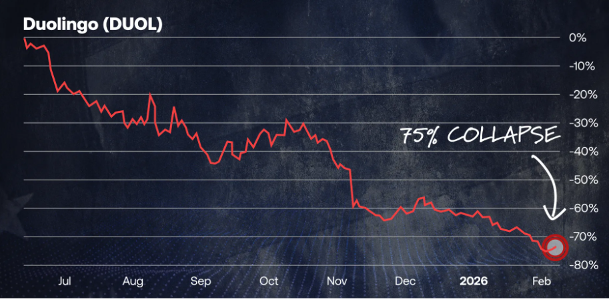
Or take language-learning app Duolingo (DUOL). Whitney continues,
The language-learning app was once a darling of the AI world. In fact, its CEO publicly pushed an “AI-first” strategy.
But now?
It turns out any off-the-shelf AI system can do what Duolingo’s software does.
The stock collapsed 75% in less than a year.
Why pay a premium for a company whose competitive advantage just evaporated?
This goes far beyond a handful of companies.
If a business depends on information brokerage, routine data analysis, content creation, or any repeatable cognitive task, it is in trouble.
And if your job depends on something similar, that, too, is in trouble.
Amazon CEO Andy Jassy warned employees last summer that AI would reduce the corporate workforce “in the coming years.” Sure enough, a few months later, Amazon announced plans to fire some 30,000 white-collar office workers in two waves.
Amazon’s corporate layoff is an early sign of what’s coming to other large tech companies. Back in 2022, Amazon was also the first mover – laying off 27,000 over several months. It was quickly followed by dozens of other well-known tech companies, shedding tens of thousands of their own employees. Expect to see plenty more folks purged in the months ahead as tech companies refocus their spending from salaries to AI compute.
AI will ultimately replace millions of jobs. The current layoffs are only the beginning.
And when it starts happening in earnest, it won’t be a gradual change. It will be sudden.
After all, companies have already been cutting jobs despite solid economic growth to increase efficiencies and squeeze more output from fewer workers. The latest AI capabilities are just accelerating a trend already in motion.
The same wave that is crushing some companies is sending other businesses into orbit.
Semiconductor firms that supply the chips and equipment AI runs on, like Micron Technology (MU) and Lam Research (LRCX), have seen their stocks soar.
And then there is Nvidia. Long before the stock was on most of Wall Street’s radar, Stansberry Research subscribers were tipped off to the role Nvidia would soon play in artificial intelligence.
When machines begin learning for themselves, it will be a watershed moment in human history. And these “artificial brains” will bring huge profits to early investors.
And although Nvidia is a well-known tech company, nobody on Wall Street is betting on artificial brains as a business segment.
Sure enough, Nvidia shares have soared in the years since.
It isn’t just the chipmakers. The established tech giants keep leaning on AI to widen their lead. When Alphabet (GOOGL) and Meta Platforms (META) reported earnings this spring, both posted blowout numbers… even as they poured tens of billions more into AI. As Whitney noted:
Management is smart to spend however much it takes to win the AI race. Established companies like Alphabet, Meta, Amazon, and Microsoft (MSFT) can leverage AI to grow their dominant businesses.
What is happening in the market right now is a massive rotation of capital. Money is flowing out of firms threatened by AI, and into firms building or powering AI.
Whitney cites Massachusetts Institute of Technology research, noting that going back over 100 years of data, wealth has never been created at this size and speed. Think about that. Not during the dot-com boom. Not during the post-war industrial expansion. Not during the Roaring ’20s.
Yet most Americans are missing out.
Many investors never owned these stocks. Or they bailed out early when things got volatile. And the workers losing their jobs? They are probably not sharing in the stock market’s gains.
This feeds directly back into the K-shape economy we talked about earlier. The upper arm accelerates because of AI. The lower arm falls faster because of AI.
Imagine the progress of the entire 20th century compressed into a single decade. That’s what insiders say is happening now.
That kind of growth is almost impossible for the human brain to comprehend.
But think about it like this…
The world economy grew 19-fold in the 20th century.
If the economy grew at that pace in the next century, it would create hundreds of trillions of dollars in new wealth every year.
And it’s beginning, right now. You can feel it. The pace of change is picking up. The next six months will define everything.
Anthropic, valued at nearly $1 trillion earlier this year, confidentially filed its IPO prospectus in June and has been widely expected to list as soon as next month. Some investors have discussed a valuation approaching $2 trillion, which would rank it among the most highly valued companies ever to enter public markets.
OpenAI is going the other way. Altman said in a September 12 interview that “right now would be an ill-advised moment to go public,” and the company now targets 2027.
Either way, new fortunes are being built right now… exactly the wealth creation Whitney describes in his latest prediction.
That stark divide sets up Whitney’s third idea. How can regular investors get themselves on the right side and use AI for their own investing?
Harnessing AI for Investors With the New Engine of Wealth System
At the center of Whitney’s plan for regular investors is his firm’s AI-powered investing system: The N.E.W. System, short for “New Engine of Wealth.”
The core question it tries to answer: How can everyday investors come out ahead in an era dominated by AI and rapid disruption?
Here is how it works.
The N.E.W. System is an AI-driven, fully allocated model investment portfolio.
It’s the end product of more than a decade of research and development, involving dozens of coders, developers, and research staff – and costing millions of dollars.
It uses artificial intelligence to analyze financial data on more than 5,000 publicly traded companies. Then it identifies a mix of investments with the highest chance of delivering strong returns, while dodging the big losers.
Think of it as a “best of the best” portfolio assembled with more computing power and analytical rigor than most individual investors could manage alone.
Whitney’s team built it by feeding an AI vast amounts of data and running simulations. Trillions of possible outcomes. Different market conditions. Bull markets, crashes, sideways grinds. The AI searched for patterns and combinations of stocks that held up across all of them.
The result is a model investment portfolio that gets updated quarterly. And Whitney’s team vets every pick before it goes out to subscribers.
That last part matters. This is not a robot on autopilot. Whitney and a committee of human analysts review each recommendation – checking for statistical flukes, real-world factors the algorithm might miss, and anything that does not pass the common-sense test. Investors aren’t blindly following a computer.
Of course, nobody can guarantee future returns. But the back-tested track record is striking.
The strategy would have beaten the S&P 500, long-term Treasury bonds, gold, and even Berkshire Hathaway over recent years. And with lower volatility than chasing hot AI stocks on your own.
Today, AI is leveling the playing field for individual investors.
For decades, big Wall Street firms had enormous teams and expensive data tools that gave them a structural edge that regular folks simply couldn’t replicate. Whitney cites Renaissance Technologies’ Medallion Fund, widely considered the most successful hedge fund ever. It generated roughly 66% annual returns over decades. Their secret? Better data and better models than everyone else.
But today, advances in AI make serious analytical firepower accessible to smaller investors. That is the whole idea behind the N.E.W. System – packaging an elite-level analytical engine in a form regular people can use.
Subscribers also get access to a few key tools.
The Stansberry Score is an AI-driven rating for thousands of stocks, showing how each one ranks against the system’s criteria. You can look up any stock and instantly see where it stands.
StansberryGPT is a financial chatbot that answers plain-English questions from market data. It is like having a 24/7 analyst at your fingertips, minus the $20,000 Bloomberg terminal bill.
And a year of access to the N.E.W. System, with Whitney’s latest recommendations of the strongest-rated companies to buy right now for the highest potential gains. Should you choose to invest, all you’ll need to do is type in your portfolio size, and his calculator will spit out exactly how many shares of each company to buy.
Today, you can use the same technology that is shaking everything up to invest smarter, avoid being blindsided by big market declines, and even find the next big winners before everyone else catches on.
Whitney puts it like this:
In short, we’ve taught our AI to find you the unique combination of stocks that is most likely to double or triple your money, with a level of confidence that has never been possible before.
And keep in mind, the N.E.W. System updates its model portfolio roughly four times a year, or as needed, based on market conditions. That means regular updates on what stocks to add, which to trim or sell, and the latest highest-potential new recommendations to add.
This frequency is intentional. It’s not a day-trading system that will bombard you with constant trades, but it’s also not a “set-and-forget for years” approach.
In short, the N.E.W. System offers a radically different, high-tech approach to stock investing – one that tilts the odds in your favor by using vast data and computing power.
Stansberry Research is one of the largest and most respected independent financial research firms in the world.
Founded in 1999, the firm made its name by giving individual investors access to the kind of in-depth research and contrarian ideas often reserved for Wall Street insiders. Today, Stansberry Research is a cornerstone of the financial publishing industry.
The firm has subscribers all around the globe. And its publications are read by hundreds of thousands of folks.
A key differentiator is that, unlike big banks or brokers, Stansberry doesn’t manage money or earn commissions on trades. They strictly publish research and investment recommendations. And they are known for sometimes taking bold, unpopular stances that later proved prescient.
For example, Stansberry Research analysts warned about the housing bubble and the impending collapse of Fannie Mae and Freddie Mac before the 2008 crisis, saving attentive subscribers from huge losses. They were early in predicting the rebound of oil and natural gas in the mid-2010s. And they even covered burgeoning trends like bitcoin as far back as 2017.
Over the years, Stansberry’s various services have logged dozens of triple-digit winners and a handful of 1,000%-plus gainers.
Of course, no firm gets every call right. That’s why Stansberry Research analysts also regularly acknowledge their mistakes – including in an annual “Report Card” where the publisher grades each publication, no holds barred. Their mission is to put the kind of research and tools that used to be reserved for Wall Street insiders into the hands of regular investors. The company employs experts on macroeconomics, commodities, biotech, insurance stocks, and much more… and now, an AI system is working for you, too.
Who Is Whitney Tilson?
Whitney Tilson is a familiar name in investing circles… and beyond. His career spans hedge funds, research publishing, philanthropy, and even a run at New York City politics. Understanding his background helps explain why people take his “ripping point” warning seriously.
The short version…
Whitney graduated from Harvard College and Harvard Business School, where he finished in the top 5% of his class and was named a Baker Scholar. In 1999, he co-founded what became Kase Capital Management. He started with $1 million and ran the whole thing from a folding Ikea desk in the corner of his bedroom. Over the next dozen or so years, he grew his fund to more than $200 million in assets and nearly tripled his investors’ money.
That stretch included the dot-com crash, the 2008 financial crisis, and a flat-to-brutal market for long stretches. Steering a fund through all of that and coming out well ahead was no small feat.
He also earned a reputation for calling big turns in the market.
During the depths of the financial crisis, he went on 60 Minutes and argued it was a once-in-a-lifetime buying opportunity for stocks. At the time, fear was rampant. But he was right – it marked the bottom… And the ensuing bull market became the longest in history.
In 2015, he again appeared on 60 Minutes to expose fraud at a company named Lumber Liquidators, which was found to be selling toxic Chinese-made laminate flooring. Following that, the stock plummeted 80%, and the CEO resigned. Whitney’s actions potentially saved consumers and investors from a disastrous situation.
He predicted the exact market bottom in March 2020 during the COVID-19 crash. Anyone who listened would have caught the huge rebound that followed.
These and other calls earned him that “Prophet” nickname from CNBC.
Over his career, Whitney rubbed elbows with some of the greats – even baking cookies for the legendary investor Warren Buffett every Christmas. Whitney also counts hedge-fund legends like Bill Ackman, Joel Greenblatt, David Einhorn, and Seth Klarman among his circle.
After leaving the hedge fund world, Whitney moved into investment research and education and now heads up a team of analysts at Stansberry Research. He brings a rare combination to the table: proven investment skill, connections with legendary investors, and a down-to-earth teaching mentality.
Whitney has published four books, including The Art of Value Investing. He has traveled to Ukraine multiple times during the war to deliver aid. He helped launch the nonprofit Teach For America as a founding member. He even ran for mayor of New York City.
Question: What does Whitney mean by “ripping point”?
Answer: “Ripping point” is Whitney’s term for when America’s economic and social fabric tears apart under extreme pressure from technology and wealth inequality.
Think of it as a more violent version of a tipping point – a rapid, visible split between those getting richer and those getting left behind. This gap is now showing up in political polarization, consumer debt, career anxiety… You name it. And in Whitney’s view, AI is speeding this up from a slow divergence into something much more abrupt.
Question: Why is Whitney’s ripping-point prediction causing panic among white-collar workers?
Answer: White-collar professionals have historically been largely shielded from automation. A college degree and an office job meant stability, but AI is changing that assumption.
Soon, you may have an “always-on” AI at your desk, watching what you do, and learning to do it without you.
That sounds dystopian… or maybe just far-fetched.
But it has happened before with American workers training their offshore replacements in the late 1990s… That trend sped up following the dot-com crash in the early 2000s as companies faced intense pressure to survive by cutting costs. This time, instead of being replaced with a cheaper worker in a foreign country, it’s an AI in the cloud
As AI costs go up and AI gets smarter, human headcounts come down. And if you’re one of the millions of folks employed in a white-collar office setting, your job is likely more at risk than you would have ever expected.
Question: Haven’t we faced disruptions from technology before?
Answer: We absolutely have. Mechanization gutted farming jobs early in the 20th century. Robots changed manufacturing late in the 20th century. Each time, new job categories eventually appeared.
Two things stand out about AI, though:
First, the scope. AI can hit many industries and many types of cognitive work at once – legal research, marketing copy, financial analysis, and software code. It’s not limited to one sector.
Second is the speed. AI models improve on a timeline of months, not decades. And the newest tools are accelerating a trend already in motion.
So, whether Whitney’s comparison of compressing 100 years into a single decade holds up perfectly, the pace is genuinely unlike anything in recent memory.
Question: How does the N.E.W. System work?
Answer: The New Engine of Wealth (N.E.W.) System uses machine learning to comb through years of market data – stock prices, financial statements, and economic indicators. It looks for patterns that predict strong performance.
It runs trillions of simulations to find combinations of stocks that hold up well across different conditions. From that analysis, it builds a model portfolio of 10 to 20 stocks, updated quarterly.
Of course, Whitney and his analyst team review every pick before sending it to subscribers. So there is a human check on the algorithm’s output. Subscribers also get access to the Stansberry Score, which rates thousands of stocks on demand, and StansberryGPT, a financial chatbot that answers plain-English questions from market data.
Question: If the system works so well, why share it?
Answer: Fair question. Whitney has addressed it directly. Part of his answer is personal. He has already run a hedge fund and made his money on Wall Street. At this point in his career, he says he is more motivated by teaching and helping individual investors.
In addition, Stansberry Research is in the business of selling research, not managing money. By creating a product like the N.E.W. System, they can attract subscribers willing to pay for high-quality insights. In a sense, scaling it to thousands of subscribers is more lucrative for them than trying to quietly run a small fund with it.
Finally, both Whitney and Stansberry Research have built a reputation on delivering big ideas to readers. This is, in a way, their next big idea to retain and grow that audience.
Question: Is the system all tech stocks?
Answer: Nope. The recommendations look diverse, based on what Whitney has shared publicly. His examples include a health care small-cap. A fintech firm. An ad-tech company. An industrial manufacturer. A biotech. A gold-related firm. A defense-parts maker.
The AI searches across every sector for the best risk-reward opportunities. That could mean a boring industrial stock sitting right next to a high-growth tech name. The system also steers users away from popular-but-overpriced names if the data does not support additional upside.
Question: Can an average investor use Whitney’s N.E.W. System?
Answer: Absolutely. It was designed with everyday investors in mind. The system outputs a model portfolio with ticker symbols and allocation percentages. It even has an online calculator. Enter how much you want to invest, and it computes how many dollars to put in each stock. You would make trades a few times a year to rotate into new picks or adjust your positions. No advanced tech skills required.
If you can read a report and place a trade in your brokerage account, you can follow it. Whitney’s team also provides a Quick Start Guide, monthly updates, and customer support. You can find more details on the order form. (This link does not go to a long video.)
How an Investor Can Profit From Whitney’s Ripping-Point Prediction
We could soon be blindsided by a permanent change in our economy…
America’s “ripping point” will be far more wide-reaching than a stock market crash or banking collapse. It has the potential to split our entire financial system in two.
But buried in that chaos is an opportunity to do incredible things with your money.
That’s why Whitney has gone public with his warning today.
Whether you choose to watch Whitney’s documentary on the N.E.W. System, the takeaway is clear: AI is transforming investing. It’s showing us ways to beat stocks, gold, bonds, real estate – and even potentially outperform the great Warren Buffett.
And keep in mind: AI is only going to get stronger (and smarter) from here.
So, even if you don’t see a threat from AI right now, that doesn’t mean it won’t be here tomorrow.
As Whitney predicts:
Today’s AI is the dumbest it’ll ever be. It’s getting smarter at an exponential rate. In fact, AI’s capability has doubled roughly every seven months for the past six years.
It gets smarter and more powerful with every passing day.
You can’t fight it.
None of us can.
But you can use it to grow wealthy – by making sure AI works for you, not against.
And of course, Whitney is offering a full 30-day money-back guarantee for all new subscribers. So you can give his research a try without worrying about a long-term commitment today.
Wall Street veteran Whitney Tilson has spent decades hunting for one thing…
A business so durable, and so hard to copy, that an investor could build an entire retirement portfolio around it.
For years, his answer was Warren Buffett’s Berkshire Hathaway (BRK-B).
Whitney owned shares… recommended the company to his friends, family, and readers… and even flew to Omaha for 27 of the past 28 Berkshire annual meetings.
But today, he says he has found a business that could deliver even bigger, more durable returns… and keep delivering for decades.
It’s a company that most investors have never heard of. It has barely more than 100 employees and sits on a stretch of West Texas and New Mexico bigger than the size of Rhode Island.
Now, Texas might make you think about oil…
But this company doesn’t drill wells… doesn’t own a data center… or generate any power. Instead, it owns the ground beneath one of the largest industrial build-outs in modern American history.
And every single time someone wants to use that ground… this company collects a payment.
Why You Should Buy America’s Greatest Retirement Stock
Before we get to the company itself… and yes, Whitney reveals the name and ticker symbol free of charge, which we’ll cover below… it helps to understand why he’s making such an extraordinary claim in the first place.
After all, this is a legendary investor who spent nearly two decades running hedge funds in Manhattan. And for most of his career, he told anyone who would listen that Berkshire Hathaway was the single best place to park retirement money.
He hasn’t turned against Berkshire, exactly. In his free daily letter this January, Whitney highlighted several of his favorite stocks for 2026. There, he noted Berkshire’s share price was trading at about a 7% discount to its intrinsic value, concluding that:
At that price, I view Berkshire as a comfortable hold, not a buy.
And sure enough, so far this year, Berkshire has traded in a fairly tight, go-nowhere range.
The stock is trading at a 14.6% discount to my estimate of intrinsic value.
So, in the past year, Berkshire has swung from being 8.9% overvalued to 14.6% undervalued. That’s why it wasn’t attractive then – but is today.
I’m especially bullish because in addition to today’s discounted stock price, I’m optimistic that [new CEO Greg] Abel can create value via operational improvements and capital allocation.
This combination leads me to believe that Berkshire’s stock is highly likely to beat the S&P 500 [Index] over the next five years, perhaps by a margin of two to three percentage points. So if the S&P 500 compounds at 5%, I would expect Berkshire to do roughly 7% to 8% – with a bias toward the upside.
That’s a solid outperformance expectation… But if you’re putting new money to work for the next 10 or 20 years, Whitney believes there’s a better option.
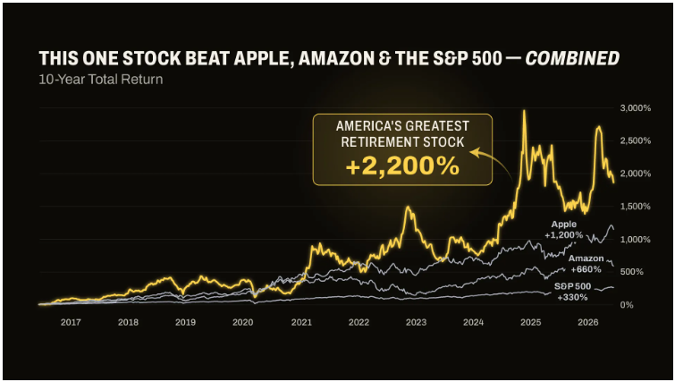
This single stock returned more than 2,200% over the past decade. Over that same stretch, he notes, the S&P 500 returned about 330%, Amazon (AMZN) returned about 660%, and Apple (AAPL) returned about 1,200%.
By his math, this single company beat Apple, Amazon, and the S&P 500… combined.
The question is… can it do it again?
Can This Company Turn $10,000 Into $220,000?
This company operates what Whitney calls the world’s most profitable tollbooth.
It’s a surprise beneficiary of two industries that the federal government is now treating as matters of national security… artificial intelligence (“AI”) and energy. Plus, it overlaps with a third resource that almost nobody on Wall Street is watching.
The core business of America’s Greatest Retirement Stock is simple: It owns land… And it leaves the hard work to everyone else.
When an oil giant pumps crude from under its land, the company collects a royalty.
When someone pulls natural gas from the same ground, another royalty.
When a tech giant wants to build on the surface, it pays lease and easement fees.
And when anyone needs water out in that desert… sure enough, they buy it from this company, too.
That’s four separate streams of income, just from owning a big patch of dirt. And because the company operates like a tollbooth, it hardly has any costs.
As a result, this company’s business model produces incredible numbers…
It carries no debt, has averaged gross margins of around 90% for the past five years, and converts more than 60 cents of every dollar in revenue into pure profit.
All that cash has to go somewhere. That’s why, while the company pays a regular quarterly dividend like many blue chips, it also pays a special dividend once or twice a year to shareholders that can run 5 to 10 times the size of the normal payout.
By Whitney’s count, an investor who held 1,000 shares would have collected more than $45,000 in total dividends in 2024 alone… and roughly $146,000 over the past six years.
Of course, those amounts depend entirely on when you buy and how much you own. But the point is that this is a business that gushes cash and hands it back to its investors. And Whitney expects it will keepdoing so, just as it has through the many booms and busts over the past century.
And right now, the heavyweights are taking notice…
Eric Schmidt, the man who ran Alphabet’s (GOOGL) Google for a decade, jumped in this past December. He’s building massive AI data-center campuses on this exact stretch of West Texas land. Schmidt explained his reasoning in an interview with Fortune magazine earlier this year:
Energy is the main constraint in scaling AI. If we want to keep America competitive, we have to solve this problem… We realized that combining my technical expertise with [this company’s] unrivaled land, abundant water, and access to low-cost energy could create the infrastructure needed to meet the virtually infinite demand for compute.
One of the most connected technologists alive looked across the entire country for the best place to solve AI’s biggest problem… and picked this company’s land.
Add it all up, and Whitney lands on an extraordinary projection. He believes a $10,000 investment in this company today could grow into $220,000 over the long term. (You can watch his full interview by clicking here.)
That’s not a guarantee, of course. But Whitney argues that number could even prove conservative if the build-out he witnessed in Texas keeps accelerating.
So let’s dig into the details that Whitney believes will drive the next decade of gains…
The Largest Construction Boom in American History
America’s Greatest Retirement Stock, according to Whitney Tilson, is Texas Pacific Land (TPL).
It owns roughly 882,000 acres across West Texas and southern New Mexico, with most of that footprint sitting in the Permian Basin… the most productive oil basin on the planet. As Fortune noted, that’s more acreage than the entire state of Rhode Island.
For years, that land mostly just sat there… Then came the shale revolution, and the royalty checks started rolling in. And now, something even bigger is happening…
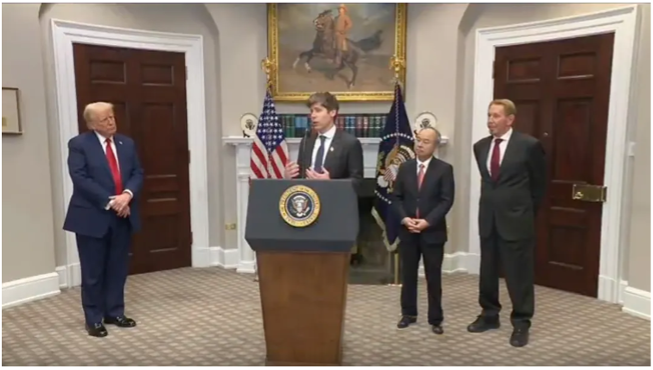
On his first full day back in the White House, President Donald Trump stood beside three of the most powerful men in technology… OpenAI’s Sam Altman, Oracle’s (ORCL) Larry Ellison, and SoftBank’s (SFTBY) Masayoshi Son… and announced a venture called Project Stargate.
The plan calls for up to $500 billion of AI infrastructure spending in the U.S. by 2029.
Trump framed the program as a response to a national emergency, and promised to use executive orders liberally to clear the way for the construction permits and power plants the facilities will need.
And right now, the first Stargate data-center campus is going up outside Abilene, Texas.
The campus now covers ground equal to about 750 football fields, with plans for enough electricity to power 750,000 homes. And just down the road, the Pentagon is pouring $1.6 billion into Dyess Air Force Base to prepare it for the B-21 Raider, America’s new stealth bomber.
Whitney flew to Abilene with his research team, then rented a helicopter to see all this construction from the air. His guide was an old friend and longtime source – third-generation Texas wildcatter Charles Schroeder… who everybody simply calls “Cactus.”
It’s like it pops up overnight… Those construction people are working 24/7. They have lights. They work all night, they work all weekend.
AI spending by the biggest tech companies is expected to jump 71% this year alone, from roughly $380 billion in 2025 to an estimated $650 billion in 2026, according to my colleague Jim Royal’s analysis of the major tech companies. Whitney pegs spending by the five biggest players at nearly $700 billion this year.
And this stretch of West Texas is ideal for four reasons, as Whitney notes:
Vast open acreage… cheap and abundant power… massive water supplies… and the right geology – rock formations that hold the natural gas needed to power these projects.
America’s Greatest Retirement Stock controls all four on nearly a million acres… in the exact region where all of this is happening.
In addition, West Texas is remote… There’s almost nobody around to object to these massive projects. The permit fights and lawsuits I noted in my data-center backlash coverage mostly happen where data centers crowd against suburbs.
Out past Pecos and Abilene, the nearest angry neighbor might be a herd of cattle.
It’s no surprise that land values out there have gone vertical. When Cactus started working this land decades ago, Whitney says, ranch land changed hands for $300 to $500 an acre. Today, AI companies are paying as much as $50,000 an acre.
Of course, TPL isn’t selling…
Instead, the company collects its surface leases, easements, and access fees… keeping its ownership of the dirt underneath. And a tech giant building a data center stuffed full of billions of dollars of chips is one of the “stickiest” long-term tenants out there.
But as big as the land story is, Whitney believes Wall Street is missing an even bigger opportunity…
Every Data Center Needs Water
A single large data center can consume up to 5 million gallons of water per day… about the same as a city with 50,000 residents.
And dozens of these data centers are planned for West Texas…
That’s another big opportunity for TPL. Over the years, it has built one of the largest water operations in the Permian Basin.
Oil drillers were TPL’s original customers. Every fracked well needs massive volumes of water to get the oil out. And now, data centers are lining up for access, too.
As part of the joint venture, America’s Greatest Retirement Stock holds the right of first refusal to supply water to every project built through the partnership.
In other words, Schmidt agreed to make this company his water supplier – for every facility he builds.
Even Schmidt himself called out this company’s “abundant water” as one of the key reasons he made this $150 million bet.
Mark my words: Within 24 months, Wall Street analysts will be valuing the water business of America’s Greatest Retirement Stock alone at billions of dollars. Right now, most of them barely mention it.
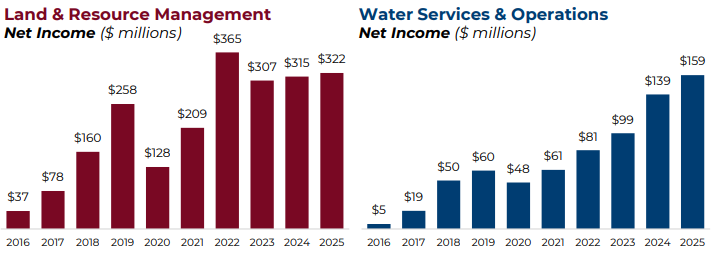
Already, TPL’s water business – through water sales and produced water royalties – made up nearly half of its revenue in its latest fiscal year. And it’s growing fast.
The chart below from the company’s recent investor presentation compares its net income for its land and resource operations with its water business…
The kind of repricing that Whitney is expecting can move TPL stock massively.
And of course, we still haven’t gotten to the company’s true focus…
Royalty Checks on Both Oil and Natural Gas
TPL’s vast acreage is in the Permian Basin, where ExxonMobil (XOM) and Chevron (CVX) run some of their largest operations. So when those oil majors pull crude oil from under TPL’s land, the company collects a royalty on every barrel.
It’s one of the world’s best businesses…
While an oil producer has to spend millions on drilling holes and hiring crews, a royalty business like TPL that owns the land just collects a check. That makes royalties one of the cleanest hedges for inflation, rising energy prices, and a falling dollar.
But Whitney believes TPL’s oil royalties are only part of the story now… and that its natural gas income stream is about to surge.
AI data centers require electricity on a scale the American power grid simply cannot deliver. Whitney’s presentation puts the average wait to connect a large new facility to the grid at more than eight years. That’s not a realistic time frame for hyperscalers trying to win the AI race.
The U.S. power grid can’t keep up with AI’s electricity demands.
Mainstream publications like the Wall Street Journal and the Washington Post have called the current U.S. grid “archaic” with “onerous and outdated” regulation and years of underinvestment.
The North American Electric Reliability Corporation (“NERC”), the body responsible for ensuring grid reliability, has warned of growing risks of widespread blackouts. The Department of Energy is also projecting sharp increases in blackout risk by 2030.
So, to power its data centers, Big Tech companies have stopped waiting and started building their own power plants… typically fueled by natural gas.
In Texas alone, natural gas power projects in development will add nearly 58 gigawatts of new generating capacity. For comparison, that’s more than the annual peak demand of the entire state of California. And most of that new capacity – 40 gigawatts’ worth – was specifically planned to power data centers.
And this summer, the biggest behind-the-meter deal yet landed right in TPL country.
Project Kilby is expected to consume about 2.7 gigawatts (“GW”) of power. According to CNBC, that’s enough power to fuel more than 2 million homes. Construction hasn’t started just yet. The data center is expected to start receiving power in 2028.
Chevron has a large footprint in the Permian Basin in West Texas and southeastern New Mexico. This allows it to quickly and efficiently supply power to Texas data centers like Project Kilby, says Jeff Gustavson, Chevron’s president of New Energies, in a statement announcing the deal.
Follow the money on this kind of deal, and you can watch TPL cash in on every single one of its four main royalty streams…
When Chevron pulls Permian gas to fuel its turbines, TPL collects a percentage.
When Microsoft (MSFT) builds its data center on leased TPL land, it collects a rent check.
When millions of gallons of water are used for cooling the chips inside the data center, TPL’s water business gets paid.
And when pipelines and power lines cross TPL’s acreage to supply these data centers, the company also gets paid easement fees.
In nearly 20 years of running a hedge-fund firm, I’ve analyzed thousands of businesses. I have never seen anything like this one.
It has no debt… nearly $500 million in annual free cash flow… more than 60 cents of every revenue dollar converted into net profit… and remarkably low operating expenses – because this company doesn’t drill, doesn’t build, and doesn’t lay pipe.
It makes deals and turns those assets into cash.
You don’t have to guess which AI company wins. You don’t have to pick the best oil driller, either. You can simply buy TPL and enjoy its regular royalty stream as the AI race grows more frenetic.
Of course, while TPL is a great way to play this trend over the long term, Whitney also points to potentially much bigger gains to be made in the short term, too…
How to Make Even Bigger Gains From the Commodity Supercycle
Now, the one commonality across TPL’s royalty streams is that they’re largely focused on hard assets… land, oil, natural gas, water.
Commodities.
And right now, Whitney believes we may be at the beginning of the biggest commodity supercycle of our lifetimes.
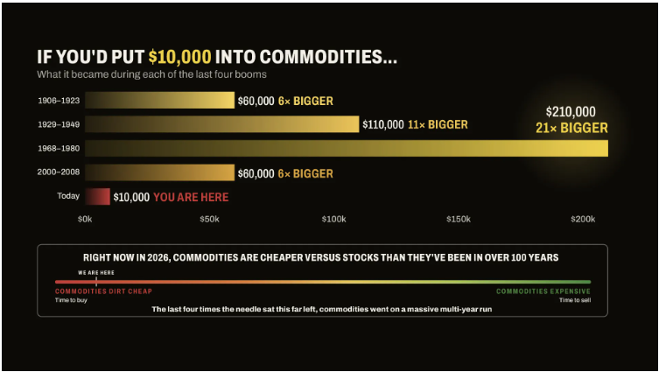
In each cycle, he says, the best resource investments handed early buyers gains of 500%, 1,000%, or more… even as ordinary stocks stagnated.
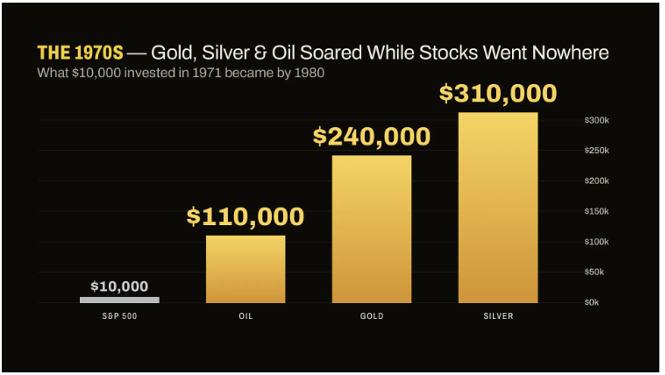
Take the late 1960s and early 1970s…
By his figures, silver exploded 3,000% in the following decade, gold soared 2,300%, and oil climbed 1,000%… while the S&P 500 went nowhere for 10 straight years.
And today, commodities are currently trading near the cheapest levels of the past century. Whitney charted out 120 years of commodity prices with the stock market in his presentation:
Why is this supercycle kicking off right now? Whitney points to three specific catalysts:
First, a decade of starved supply has sent prices higher. Mining exploration budgets have collapsed about 40% from their 2012 peak, and oil and gas capital spending has fallen from $900 billion in 2014 to $570 billion in 2025.
Second, demand is exploding, courtesy of the AI build-out we covered above. Every data center needs massive amounts of electricity, copper, steel, and fuel.
Finally, the dollar itself is under pressure. Gold has been shattering records as central banks swap Treasury bonds for bullion, a trend Whitney notes has topped 1,000 tonnes of official annual gold purchases for three consecutive years.
When paper money weakens, hard assets tend to rise. And TPL may be the hardest asset of them all… land that gets paid royalties from oil, gas, and water… located smack-dab in the one place America’s biggest companies are spending trillions.
What Investors Should Do Today
Whitney believes commodities are the single best thing you can own in the world today.
And he has the credentials to back up that claim…
As a former hedge-fund manager, he grew $1 million into a collection of funds worth more than $200 million.
He has helped his readers get into stocks like Netflix (NFLX) at 78 cents, adjusted for stock splits, before it soared more than 11,000%… Apple at 38 cents, before it climbed 80,000%… and Amazon at $2.80… before it went on a 9,000% run.
And he has been featured in practically every major financial publication and TV show, including two appearances on CBS’s 60 Minutes to announce a major stock exposé.
After leaving the hedge-fund world, Whitney moved into investment research and education and now heads a team of analysts at one of the largest independent financial publishers in the world.
There, he shares his highest-upside opportunities with tens of thousands of subscribers… including at least five paid-up billionaires.
And of course, Whitney is offering a full 30-day money-back guarantee for all new subscribers. So you can give his research a try without a long-term commitment today.

 Login