❌

Reading view

Discover The “Other” South Of France—Without The Riviera Price

I recently sat down with Dennelle Taylor Nizoux, an American expat who has been living in Montpellier for 15 years now.

One of the fastest-growing cities in France, particularly in southern France, Montpellier is becoming an increasingly popular option for foreigners looking for a new life in France.

This university city offers a superb, laid-back lifestyle, culture, great connectivity, year-round sunshine, and mild seasons—without the big price tag of places like Nice or Paris.

Dennelle founded Renestance real estate services in 2015, and has since helped countless international buyers navigate the French property market and get settled in the region.

I was eager for her to share her insider knowledge: what it’s really like to buy here, what surprises people, what ideal costs look like, who really belongs in Montpellier—and who doesn’t…

Kat: Let’s start with your story—how did you end up in Montpellier?

Dennelle: I was a student in Provence in college, so I got to know a little bit of the south of France and the Mediterranean area.

It never really felt like home to me, so I kind of wrote off the Mediterranean part of the south of France.

Later, my U.S. company transferred me to Paris, and I lived there for 10 years and met my French husband, who is from Normandy.

By coincidence, his best friend from Normandy moved to Montpellier in 2001. We would take the train down to visit him, and he and his wife had their first baby the same year we had ours.

We kept going down to visit them, and every time we had to take the TGV back to Paris, it just got harder and harder to leave Montpellier.

The more we saw of Montpellier, the more we liked the vibe. It’s low-key, easygoing, open-minded, and has an indoor-outdoor lifestyle. I was born and raised in Southern California, and it felt a bit like home.

We were living the grind in Paris with two small children, doing the métro, boulot, dodo (metro, work, sleep), as they say. It felt like living to work, whereas our friends in Montpellier got off work at 5 p.m., grabbed the kids, a bottle of rosé, and headed to the beach to enjoy life.

I thought, “This is what I want.”

We moved down here in 2010 with our kids, who are grown now.

Kat: For somebody who’s never been to Montpellier, how would you describe it as a city for living?

Dennelle: It ticks a lot of boxes.

It’s walkable; you don’t need to get in the car for everything. We’ve got five tram lines that are free for residents.

It’s also near the beach—only about 10 kilometers (6 miles) away.

There’s lots of hiking and easy access to nature. Within 20 or 30 minutes of downtown, you could be hiking in the hills or mountains.

It’s also a very young, dynamic city because of the universities, and that brings a lot of culture.

We have a lot of artists and writers, and anybody who’s attracted to the arts can usually find what they’re looking for in Montpellier. We even have two opera houses.

It’s a very well-rounded city, but also, as they say in French, à taille humaine—human scale. It’s still manageable. I think it’s around 500,000 people now, including the metropolitan area. So it doesn’t feel too big, but it still has everything you might be looking for.

Kat: Right, as a university town, would you say that students are the main demographic? Is this also a city where French people tend to retire, or is retirement more concentrated in the villages around Montpellier?

Dennelle: Yes, there’s definitely a population of retirees here.

During Covid we had a lot of Parisians and French people from colder or less favorable climates come down to Montpellier because they could work remotely. There have always been people who wanted to retire to the south of France within France, but now we also have more remote workers here.

I think the villages can be attractive to retirees, particularly areas outside Montpellier—more countryside locations around places like Béziers.

You can get more for your money, and you’re not reliant on the job market.

Kat: You’ve experienced different parts of France, and I’m curious about your husband’s perspective since he’s from Normandy. Was there ever a pull to go north instead of south?

Obviously, the weather is the biggest difference, but aside from that was that ever a debate between the two of you?

Dennelle: He was perfectly fine with the weather in Paris—it was similar to what he grew up with.

But once we started spending more time in Montpellier, he really saw the appeal of being able to be outside most of the year.

We actually kept our apartment in Paris for probably the first 10 years we were in Montpellier because we weren’t sure if we were going to stay.

But pretty quickly, we both realized that waking up and seeing a blue sky every day changes everything.

Honestly, I think he was probably sold on it faster than I was.

Start Your New Life Overseas Today!
Sign up for our free daily e-letter, Overseas Opportunity Letter, and we'll send you a FREE report on the 12 Best Places To Retire Overseas In 2026.
We Value Your Privacy! We will not share your email address with anyone else, period.


Kat: All right, let’s get into the property market. We’ve talked a bit about the lifestyle and who fits in this city.

You’ve been working in real estate down here for how long now?

Dennelle: Almost a decade now…

I started Renestance as a full-service relocation agency officially in 2015, and then I got my degree in real estate and immobilier in 2017. We’ve been dedicated buyer’s agents since 2017.

Kat: And you’ve been on the ground here for so long, you’ve seen how the market has changed… So, what is the market like right now?

Dennelle: Well, Montpellier has been one of the fastest—if not the fastest—growing cities in France for at least 20 years.

It was already growing quickly when we moved down here.

And, like I said, there was a bump during Covid, when a lot of people came because they could work remotely, so growth has been steady.

In terms of price per square meter, Montpellier is still about half the price of Nice and some of the other destinations in the south of France, while offering many of the same advantages in terms of climate and lifestyle.

It’s also a fantastic travel hub.

Property values have appreciated steadily over time, and with good reason.

Bonne route,

kat kalashian signature

The post Discover The “Other” South Of France—Without The Riviera Price appeared first on Live and Invest Overseas.
  •  

A Jet-Setter’s Playground On The Parisian Riviera

Deauville, known as the Parisian Riviera and the “Saint-Tropez Normande,” is one of the most famous getaways from Paris…

Located on Normandy’s Côte Fleurie (Flowered Coast), and the closest beach to France’s capital at just two hours away by car or train, Deauville has long drawn the most distinguished and flashiest of European society from France’s capital…

Josephine Baker walked her pet cheetah down Deauville’s beach promenade…

She spent time there with one of my favorite artists, French-Dutch painter Kees van Dongen, who lived there with his son and said the town “fit him like a glove.”

The late Queen Elizabeth II was allowed to drive her car down the planks of the same boardwalk, where vehicles are ordinarily strictly forbidden.

It inspired Ian Fleming’s “Casino Royale”…

Tom and Daisy honeymooned here in “The Great Gatsby”…

Marcel Proust, Agatha Christie, and Noël Coward all used it as a setting, too…

And it was the birthplace of Coco Chanel’s career in clothing, she even opened her second shop in Deauville.

Thanks to the American Film Festival that has taken place here every year since 1975, the town is just as familiar with more contemporary celebrities… George Clooney, Matt Damon, and Harrison Ford have all spent plenty of time here, along with hosts of other American movie stars.

Yves Saint Laurent had a house here, as does Gérard Depardieu and many other French celebrities, socialites, and politicians.

Needless to say, this town was made for pleasure seeking and being seen…

In fact, that’s literally true.

Boasting the so-called queen of the Normandy beaches, the area was targeted for major development in the 1860s by Napoleon’s brother-in-law. He put in a rail line direct from Paris, and had the casino and hippodrome built (the region was already well-known as prime horse country).

With these investments came grand hotels, upscale restaurants, an enormous casino, famous art galleries, a major spa, and seaside promenade and tables were installed.

By 1910, the town was rich and attracted the rich. Luxury boutiques on every corner, record sales in all industries, yachts in the harbor…

When the airport was built in 1931, the town’s reputation went international.

Nowadays, Deauville is just as much a darling to the wealthy, but it’s within reach of us mere mortals, as well… the train from Paris costs less than €20, and the town has plenty of affordable hotels and Airbnb options for visitors.

Living here, the lifestyle would be laid-back and refined.

All the best shopping that you’d expect in Paris is available here, but also the produce market, where you can join locals in shopping for organic produce, meat, eggs, dairy, and flowers.

The eating out options here are excellent, but not many. This is a small town (population about 3,500), and they mostly cater to tourists with money, so eating out can paint you into a bit of a corner. In the middle of town, you’ll have to fork over to lift a fork… prices are on par with Paris’.

But with great seafood, especially shellfish, and farm-fresh dairy and produce coming in every day, any foodie would be happy here.

One of my favorite autumn dishes in France is poêlée de champignons, pan fried mushrooms, and the one I had here was the best I’ve ever had (prepared with diced foie gras and raspberries).

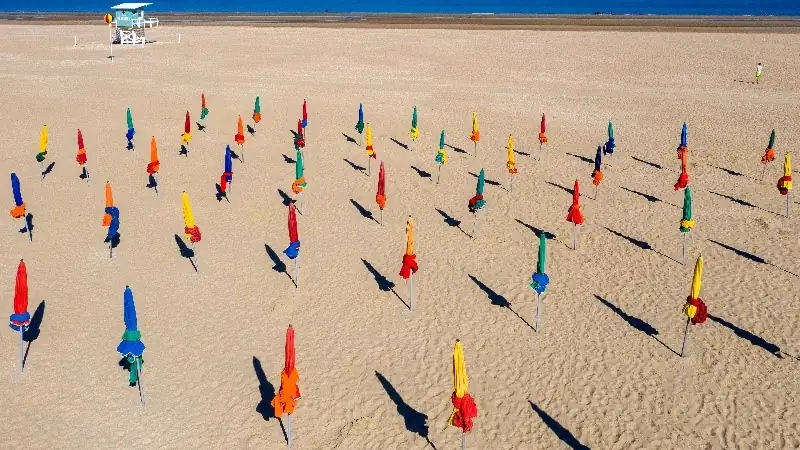
The beach that initially attracted the Napoleonic dynasty is as much a draw as it has ever been, and with good reason. I’ve seen a lot of beaches in my day… and this was possibly the widest beach I’ve ever visited.

Aerial view of colorful closed beach umbrellas spread across a wide sandy beach beside the ocean.

To get from the boardwalk to the sea takes a few minutes’ walk on the beach. It’s famous for its multi-colored umbrellas tied in a specific way in summer.

The beach is packed with sunbathers and swimmers in summer. But in winter when the tourists have gone, the vast beach is practically empty but for a few locals walking dogs and riders exercising their thoroughbreds early in the morning.

In summer, the town brings in not just beach lovers, but also music lovers attending the local jazz festival and boaters visiting for regattas or the local sailing.

In fall, the Paris-Deauville rally brings classic cars to the city, when the streets become overtaken with exquisite vintage autos.

And as I mentioned, this is horse country. The area was long-known for quality horse breeding operations, which led it to be a popular racing town. Deauville is sister cities with Lexington, Kentucky, and Kildare, Ireland, two other global horse centers, with the goal of uniting the cities in their love of thoroughbreds and the horse industry.

The prestigious local studs attract some of the world’s wealthiest and best-known breeders, and the Hippodrome Deauville-La Touques and associated training facility is one of the largest, most famous, and most highly regarded in Europe. Called the “Four Seasons Racetrack,” the track hosts high profile events year-round.

The other local track offers courses for jumping, steeplechase, obstacle courses, and trotting courses—the only multidisciplinary course in Normandy.

Start Your New Life Overseas Today!
Sign up for our free daily e-letter, Overseas Opportunity Letter, and we'll send you a FREE report on the 12 Best Places To Retire Overseas In 2026.
We Value Your Privacy! We will not share your email address with anyone else, period.


It’s a family-friendly track, offering just as many amenities to the not-so-horse-minded visitor, including an exhibition space, many restaurants and bars, free daycare, pony and donkey rides for kids, carriage and mini-car rentals, and more. Clairefontaine track also hosts theme days, good fun for all.

The local polo club is a hub for entertainment and networking, as well, with tennis and polo matches held year-round.

While the French aren’t avid golfers, there are several golf courses here, all of them very well acclaimed—even a mini-golf course next to the beach.

The main local museum, Les Franciscaines, converted from a former convent, is more a community center than traditional museum, and it’s a hub for local families. Part library, lounge, education center, games venue, kitchen, and much more, it’s always busy with folks of all ages enjoying all it has to offer.

The attached café has a few options for snacks, but the dining room also features cooking appliances of all kinds, that all guests are welcome to use—bring something to toast or microwave and enjoy it in the beautiful atrium.

But despite all the finery and the glitzy events, Deauville somehow manages to feel quaint… not overwhelming or exclusive. Another writer described it as “understated elegance.”

A cute local tradition has most houses ornamenting their rooves with small clay animals, sometimes posed in vignettes: a cat chasing pigeons away, an owl eyeing a mouse.

The Hotel Barrière, the grand hotel that dominates a main square near the beach has a many-gabled roof covered in not just animals, but mermaids, jockeys, and more.

While it’s not very well known to North Americans, Deauville is a wonderful option for a new life in Normandy, offering all the chic and convenience of Paris with a small-town feel.

Bonne route,

kat kalashian signature

The post A Jet-Setter’s Playground On The Parisian Riviera appeared first on Live and Invest Overseas.

  •  

Expat Life Lessons

Cordon Bleu pastry chef, Frédéric Hoël, held up two handfuls of dough, one that you could have mistaken for a neatly folded (albeit miniature) sheet in a linen store… the other more closely resembled a half-deflated air mattress that someone tried to fold before it was fully emptied.

“This is good,” he proclaimed, holding the neat stack up high.

“This is bad,” hoisting up the messy pile. “It will not work.” He shook his head darkly.

We giggled nervously and looked around at one another… who among us 12 or so novices had created the failure dough? Who was the phenom? Only time would tell.

Learning as an adult can be hard… humbling, even.

My pastry-making class at the Cordon Bleu here in Paris was a good reminder that no beginner is ever good at anything. And before you become good at something, the learning process is a challenge all itself.

Living overseas, there’s a learning curve that can’t be denied, and it’s compounded by all the other things you have to learn at the same time—as you plan your move you have to learn about residency options, tax consequences, health care and insurance availability…

And then once you arrive you also likely have to learn a new language, how to get around in your new home, become familiar with a new culture, be taught how to properly eat a new cuisine… and so much more that you won’t even guess at before arriving.

Plus, there’s just the simple fact that learning later in life is… uncomfortable, at least, if not more difficult. You’re not used to being “bad” at things once you’re an accomplished adult. You’re not used to being a beginner anymore.

And, frankly, it’s not the best feeling to be the underdog… to always feel like you’re behind, trying to catch up.

But it does pass—as long as you put in a consistent effort—and bit by bit, you realize you are getting better… that you’re no longer the newbie… that you’re becoming more and more comfortable.

This is true of anything new that we start to do routinely, be it a sport, an art form, a cooking technique, a computer program, a new remote control, a new route to work… etc.

I’ve recently adopted a new life motto: Get comfortable being uncomfortable. 

So much of what we don’t like in life is simply discomfort. We become used to our routines, our friends, our home, our favorite foods, our way of life… and once we do, we don’t like to try new things.

Because it wouldn’t be as easy… it would be uncomfortable. (Hence the proverbial comfort zone.)

In the fitness world, this is called “plateauing.” You do the same workout so much that your body no longer sees it as a workout—it’s no longer a challenge, it’s just an everyday activity. Your body takes it in stride and you cease to gain muscle or lose weight, maybe even put some more back on.

To overcome this inevitable pitfall, any good fitness trainer knows you need to change things regularly.

Which doesn’t feel good.

You have to push your body to do something it doesn’t usually do, so it feels awkward, it hurts, it burns, your joints pop, breathing is difficult… and none of that is desirable in itself.

More than anything, though, it’s just uncomfortable. Because a week later, your body is used to it and you don’t feel the way you did that first day.

You’ve become comfortable being uncomfortable.

Moving to Europe will certainly have you uncomfortable plenty of the time—but that’s the whole point of your live-overseas fantasy, isn’t it?

To no longer eat the same foods every day, take the same street home…

Start Your New Life Overseas Today!
Sign up for our free daily e-letter, Overseas Opportunity Letter, and we'll send you a FREE report on the 12 Best Places To Retire Overseas In 2026.
We Value Your Privacy! We will not share your email address with anyone else, period.

What pushed you to make this leap is the excitement of meeting new people, trying new things, and be challenged by a new way of life—to stop living on autopilot.

Moving to Europe, you are as literally as possible getting out of your comfort zone.

So don’t fret that it takes time to adapt and integrate… to figure out exactly which part of town you want to live in… which local delicacy to relish (and which, perhaps, to avoid)…

In the beginning, anything new you do is uncomfortable—including living overseas—you just have to keep at it. (Like me making disastrous croissants…)

I’m not saying that learning can’t be fun and rewarding, it should always be both of those things. But that doesn’t mean it isn’t challenging… and a challenge is by definition uncomfortable.

When it comes to moving to Europe, there’s no shortage of things to learn and be taught, and while it can be uncomfortable, perhaps even overwhelming, there are some things you can do to give yourself a head start, things we talk about here regularly: ask for referrals, do your own research and due diligence, visit in person at all times of year, rent before you buy, etc.

But the ultimate way to streamline the process is to learn in person. If you’re planning a move to Europe, the best thing you can do to educate yourself is to hire a tutor.

To learn from someone who has the time to explain everything in full detail and to whom you can ask all your questions as they arise—or, even better, many someones…

Those who are professional experts in their fields in your new home…

And those who have come before you—expats who have already been through the ringer…

Which is exactly what we deliver and our Live And Invest Conferences and this week’s France Virtual Conference is no exception. It’s happening online this Thursday and Friday, Sept. 24 and 25. You’ll find all the details here.

I’m excited to be connecting with our team of in-country experts to share all that life in this Old World great has to offer.

I’ll be dialing in from my home in Paris. I hope you can join in the fun from wherever in the world you are and look forward to connecting with you online on Thursday.

Bonne route,

kat kalashian signature

The post Expat Life Lessons appeared first on Live and Invest Overseas.

  •  
❌