❌

Normal view

  • ✇Market Wise
  • How to invest with Donald Trump massively on your side Brian Hunt
    Today’s issue in preview: How to invest with Donald Trump massively on your side Visa and Mastercard just trampled the stock market bears. That’s important for your 401(k) Should you be selling stocks because of “weak breadth?” This chart has the answer Learn our Top Themes to buy now Visa and Mastercard just trampled the stock market bears. That’s important for your 401(k) Credit: VioletaStoimenova This week, shares of credit card giants Visa (V) and Mastercard (MA) reached new all-

     

How to invest with Donald Trump massively on your side

14 October 2026 at 12:00

Today’s issue in preview:

  • How to invest with Donald Trump massively on your side

  • Visa and Mastercard just trampled the stock market bears. That’s important for your 401(k)

  • Should you be selling stocks because of “weak breadth?” This chart has the answer

  • Learn our Top Themes to buy now


Visa and Mastercard just trampled the stock market bears. That’s important for your 401(k)

Image

Credit: VioletaStoimenova

This week, shares of credit card giants Visa (V) and Mastercard (MA) reached new all-time highs.

We can take several insights away from their strength, but the most important one is this:

If two of America’s most important consumer spending companies are enjoying strong growth and soaring stock prices, then the economy isn’t struggling as many bearish investment professionals claim… it’s actually “humming along nicely.”

Visa and MasterCard are the world’s largest credit card companies. Their payment networks connect billions of consumers, merchants, and banks.

Rather than lending money, they earn fees by facilitating credit and debit card transactions. The two firms are effectively a duopoly in U.S. credit card payments. Together, they account for roughly 85% of U.S. general-purpose credit card purchase volume, with American Express and Discover accounting for most of the remainder.

Visa and Mastercard have leveraged their entrenched positions and massive networks to generate market-leading long-term growth and large profit margins. Business quality aficionados consider their financial metrics a thing of beauty.

Visa and Mastercard’s positions also make them good “real world” economic indicators.

Many investors fixate on government data such as unemployment figures, job hirings, and the Consumer Price Index. I like to know that data as everyone else does.

However, when I want a read on what’s really happening in the economy, I place far greater focus on what’s happening in the real world. I look at stock prices. In doing this, I listen to the judge, jury, and executioner of any thesis, any trend, and any claim: The market.

Visa and Mastercard are sensitive to the health of the American consumer. Last quarter, both firms reported double-digit revenue growth, healthy transaction volumes, and resilient consumer spending. That business strength – plus expectations of more in the future – has propelled both stocks to new all-time highs.

Does the U.S. economy have imbalances, distortions, and risks? Absolutely. It always does. But making money in stocks is never the result of a problem-free economic environment. It’s always about being in an environment where the big problems are overwhelmed by the even bigger positives.

Right now, the market is telling us that the positives are currently much stronger than the negatives. Manage your financial affairs accordingly!

Image


Recommended Link:

Up 26% in a Month — And Navellier Says It’s Just Getting Started

Ad Image

This AI stock just posted record orders. Some of its biggest customers are signing multi-year deals without even knowing the final price. Louis Navellier — who’s recommended over 675 stocks that went on to gain 100% or more — says its biggest move is still ahead. Don’t wait. Get the name and ticker now.

How to invest with Donald Trump massively on your side
Image

Credit: halbergman

Want to know if America’s manufacturing renaissance is real?

Don’t listen to the mainstream news or politicians.

Instead, listen to the market.

It’s far smarter and far more honest than the sources above. And it’s saying the “Made in America” megatrend is gathering steam.

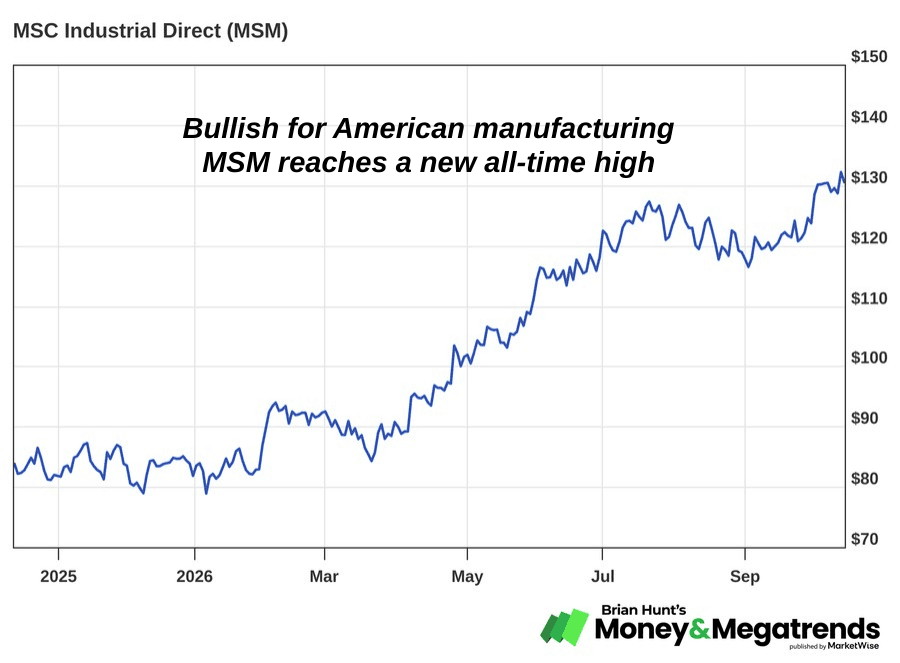
As evidence, we cite the bull market in industrial supply distributors Fastenal (FAST), W.W. Grainger (GWW), and MSC Industrial Direct (MSM).

Fastenal, Grainger, and MSC Industrial Direct are three of America’s leading industrial supply distributors. They provide manufacturers, construction companies, and industrial facilities with essential products such as fasteners, cutting tools, safety equipment, replacement parts, and maintenance supplies.

Fastenal specializes in fasteners and on-site inventory management. Grainger offers a vast catalog of industrial and maintenance products. MSC focuses heavily on metalworking and manufacturing supplies. All three benefit from increased U.S. manufacturing activity and industrial investment.

This means their stock price trends tell us a lot about the Made in America megatrend.

Back in January, I made the case for going long the Made in America megatrend… for investing in companies that supply critical equipment and services for building and operating today’s high-tech factories.

The bull case here is simple…

President Donald Trump – along with many business and military leaders – believes that the U.S. has outsourced far too much of its industrial capacity to China over the past 25 years.

We outsourced significant portions of our semiconductor, appliance, medicine, weapons, and machinery production. We outsourced the capacity to produce and process critical resources, such as rare earth elements.

The COVID-19 pandemic showed that depending on other countries for critical economic inputs makes the U.S. economy less safe and secure. To put it bluntly, it is very stupid to not make products critical to national security like AI semiconductors within our own borders.

Trump has staked his legacy and reputation on expanding our industrial base… and he’s working with business leaders to invest trillions to pursue this goal. Apple (AAPL), for example, has committed to invest $600 billion in U.S.-based manufacturing over the next four years. Nvidia (NVDA) says it will invest $500 billion in U.S.-based manufacturing over the next four years.

Drug giant Eli Lilly (LLY) said it has committed more than $50 billion in domestic manufacturing commitments since 2020, including four additional U.S. plants announced in 2025. Lilly says it will be the largest domestic drug manufacturing investment in U.S. history.

In Money & Megatrends, we’ve capitalized on this “Made in America” megatrend with strong returns in robotics, factory automation, and machine component makers such as Cognex (CGNX), Ouster (OUST), and RBC Bearings (RBC).

The stock price trends of FAST, GWW, and MSM suggest the Made in America megatrend is gaining momentum. Over the past 12 months, their shares have surged 21.5%, 41.6%, and 54%, respectively. This week, MSM reached a new all-time high. All three companies are reporting year-over-year quarterly revenue growth exceeding 7.5%.

These impressive business results and stock market performances send a powerful message: American manufacturers and industrial companies are spending heavily on the equipment, supplies, and materials they need to expand and maintain their operations. We recommend staying long the Made in America megatrend.
Image


Should you be selling stocks because of “weak breadth?” This chart has the answer

Image

Credit: roman_slavik

No matter how strong corporate earnings are… or how strong broad market averages like the S&P 500 are, two or three “Big Worries” are always circulating around the investment community.

There are always potential risks and concerns held by investment professionals that keep them light on stocks or out of them completely.

This fall, one of the Big Worries is “weak market breadth.”

“Breadth” is Wall Street’s preferred term for how widely a stock market’s gains or losses are spread across individual stocks.

Rather than focusing solely on the movement of a major index like the S&P 500, breadth reveals how many stocks are participating in the trend. The general idea is that if you’re bullish, you want to see strong breadth, which shows many stocks are in uptrends.

Common breadth indicators include the percentage of stocks above their 50- or 200-day moving averages, the percentage of advancing versus declining stocks, and the percentage of new highs versus new lows.

Strong breadth suggests widespread participation, while weak breadth indicates that relatively few stocks are driving the market.

Over the past two months, stock market breadth has grown weak. Rising interest rates and several smaller market forces have hammered many key market sectors, including real estate, utilities, defense, financials, and consumer spending-related stocks.

Meanwhile, the strength in technology stocks we’ve been covering has supported the broad market averages. The S&P 500 is less than 2% off its all-time high.

Many investment professionals look at select weak breadth indicator readings and say it’s bearish. They say it means “time to sell.”

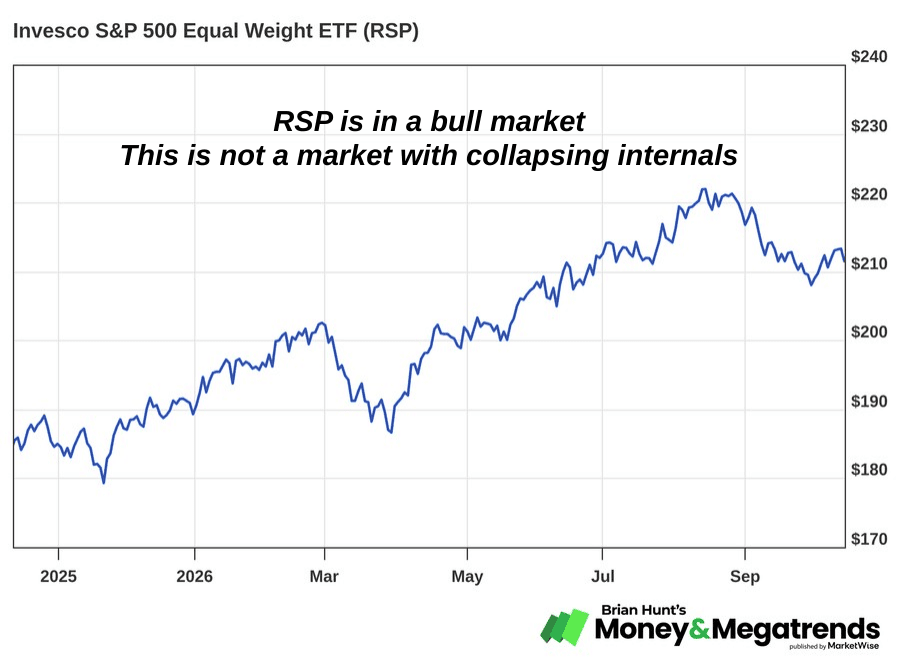
But before you do that, have a look at the Invesco S&P 500 Equal Weight ETF (RSP).

The popular S&P 500 Index is a “market-cap weighted” index. This means the biggest companies, such as Nvidia (NVDA) and Apple (AAPL), have a greater impact on the index’s value than smaller companies. A big rally in a $5 trillion giant like Apple can overwhelm losses in 30 smaller companies.

An “equal weight” index nullifies market-value-related impacts – assigning equal weight to each stock in the index regardless of company size. With an equal-weight index, a massive 100% annual gain in a giant like Nvidia cannot mask or overwhelm weakness in hundreds of smaller stocks.

An equal-weight index does a much better job of showing how the market is doing broadly than how the 10 largest companies are doing.

RSP is by far the largest ETF that tracks the S&P 500 Equal Weight Index. As you can see in the one-year chart below, this fund is comfortably within the confines of an uptrend. And while it isn’t trading near its all-time high, it’s not far from it (less than 5%).

RSP’s uptrend shows that all the hype and hoopla over “weak market breadth” and the supposed horrible market conditions it reflects is ignorant and misplaced. This is not a market with a small handful of leaders and a collapsing interior.

Having said this, keep an eye on RSP’s September low of $209 per share. If we hold above this line, I’m not worried at all about weak breadth. But a break below $209 is cause for concern. We will keep you updated on this Big Worry that is getting so much attention.
Image


Market Notes

  • Our recommendation to get long oil and gas stocks continues to pay off. Oil giants Chevron (CVX), Shell (SHEL), Canadian Natural Resources (CNQ), EOG Resources (EOG), Suncor Energy (SU), and Petroleo Brasileiro (PBR) hit new one-year highs today.

  • The Iran War and its constriction of oil and refined products continue to benefit U.S. refiners. Refining giants Valero Energy (VLO), Phillips 66 (PSX), HF Sinclair (DINO), and Marathon Petroleum (MPC) reached new one-year highs today.

  • The Iran War and its constriction of oil and refined product supplies continue to work in favor of oil shipping firms. Industry leaders International Seaways (INSW) and Tsakos Navigation (TEN) reached new one-year highs this week.

  • Leading financial technology company SoFi Technologies (SOFI) reached a new one-year low today.

  • Space economy leader AST SpaceMobile (ASTS) reached a new one-year low today.

  • Large homebuilders DR Horton (DHI), KB Home (KBH), PulteGroup (PHM), and Lennar (LEN) reached new one-year lows today.

  • Leading air taxi firm Joby Aviation (JOBY) reached a new one-year low today.

Regards,

Brian Hunt signature

Brian Hunt signature

Brian Hunt
Editor, Money & Megatrends


An urgent message from our colleagues:

“Do NOT buy high flying tech stocks like Nvidia, SpaceX”

Image

One of America’s leading AI pioneers is stepping forward today with this urgent warning… and to reveal exactly where to move your money for a chance at 1,000%+ returns before October 31st.

Get the full details here.

The post How to invest with Donald Trump massively on your side appeared first on MarketWise.
  • ✇Market Wise
  • This Trump-backed stock trade could generate triple-digit returns Brian Hunt
    Today’s issue in preview: This Trump-backed stock trade could generate triple-digit returns An important new development in “the world’s most important trend” Learn our Top Themes to buy now This Trump-backed stock trade could generate triple-digit returns Credit: William_Potter After decades of being indifferent or outright hostile towards mining, the U.S. government is now one of the industry’s best friends. Over the past 18 months I’ve frequently cited how this unique situation is
     

This Trump-backed stock trade could generate triple-digit returns

18 September 2026 at 12:00

Today’s issue in preview:

  • This Trump-backed stock trade could generate triple-digit returns

  • An important new development in “the world’s most important trend”

  • Learn our Top Themes to buy now


This Trump-backed stock trade could generate triple-digit returns

Image

Credit: William_Potter

After decades of being indifferent or outright hostile towards mining, the U.S. government is now one of the industry’s best friends.

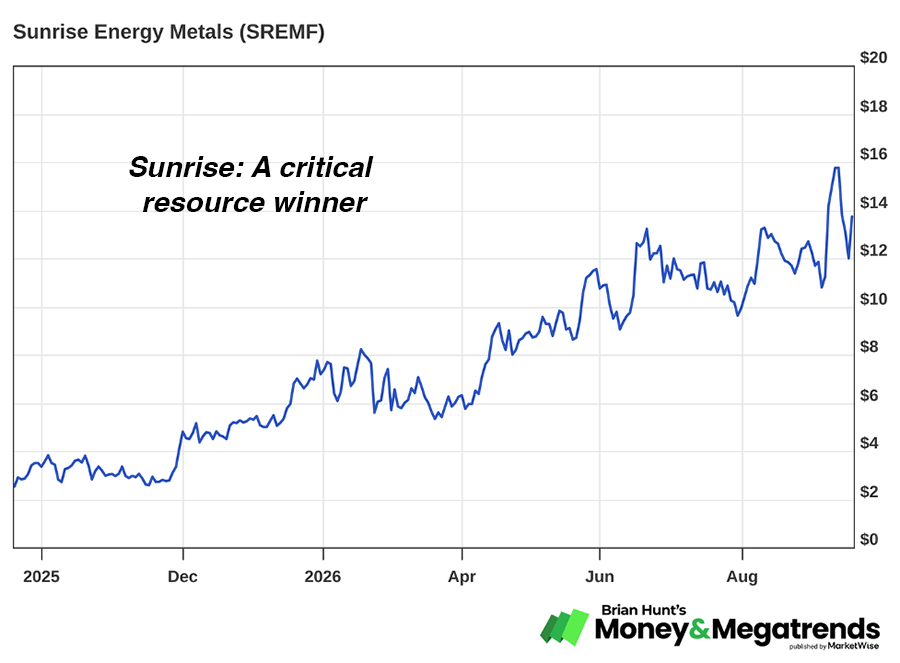
Over the past 18 months I’ve frequently cited how this unique situation is producing large financial opportunities. As evidence, we present the recent new highs reached by Sunrise Energy Metals (SREMF). The stock is up 150% since we first profiled it on March 20.

The megatrend thesis goes like this: President Donald Trump – along with many business and military leaders – believes that the U.S. has outsourced far too much of its industrial capacity to China over the past 25 years.

We outsourced significant portions of our semiconductor, appliance, medicine, weapons, and machinery production. We outsourced the capacity to produce and process critical resources, such as rare earth elements.

The COVID-19 pandemic showed that depending on other countries for critical economic inputs makes the U.S. economy less safe and secure. To put it bluntly, it is very stupid to not make products critical to national security like AI semiconductors within our own borders.

Trump has staked his legacy and reputation on expanding our industrial base… and he’s working with business leaders to invest trillions to pursue this goal.

Apple (AAPL), for example, has committed to invest $600 billion in U.S.-based manufacturing over the next four years. Nvidia (NVDA) says it will invest $500 billion in U.S.-based manufacturing over the next four years. The government is investing heavily in high-tech weapon systems manufacturing as well.

However, any plan to increase domestic manufacturing capacity must overcome a big problem: We don’t have sufficient supplies of critical resources needed to build the required infrastructure.

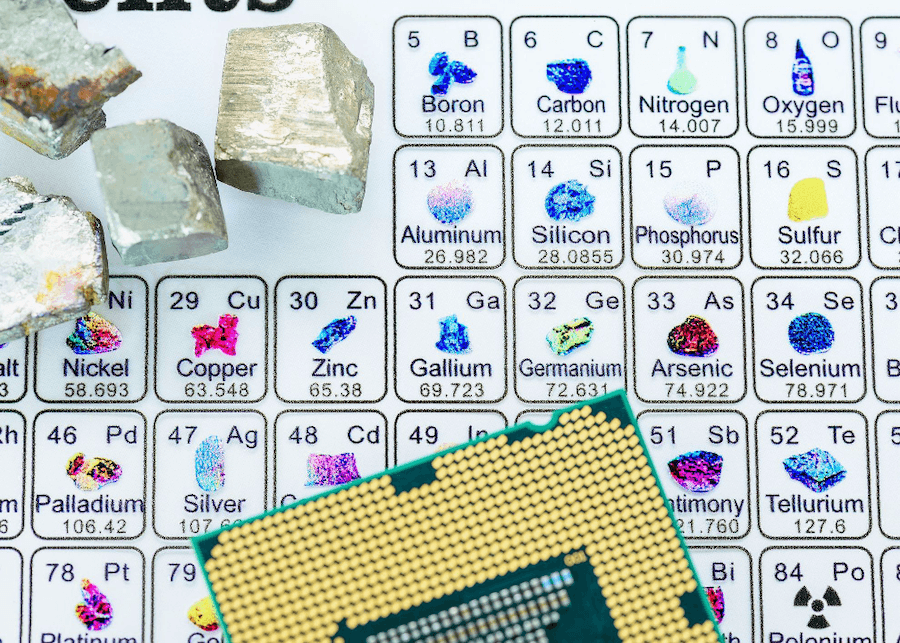
We don’t have the copper, iron ore, rare earths, lithium, antimony, nickel, and other vital building blocks required to build all those data centers… all those factories… all those robots… all those electric grids… all those power plants… and so on.

To make matters worse, we also lack the refining, smelting, and processing facilities needed to turn the raw forms of those resources into ready-to-use end products. We rely on China for a lot of that.

It’s as if we very much want to build a big house… but we don’t have all the lumber, screws, or nails we need to get the job done.

Solving the big “critical resources problem” is possible… and it is an enormous financial opportunity.

To ensure we have the critical resources to build trillions of dollars in infrastructure, the U.S. government will change any law, kill any regulation, and write any check that will increase production and processing capacity.

This means that after more than 30 years of the U.S. government being hostile to domestic mines and mineral processing facilities and indifferent towards supporting production in friendly nations, it is now supportive of the industry. Trump can’t have his big manufacturing dream without them.

And no matter who is president, the U.S. economy needs a diversified critical resources mining and processing base to lessen its dependency on China. Having that would make the U.S. economy much safer and more robust.

With all this in mind, the U.S. government has struck many important deals to support domestic and friendly country critical resource production over the past 12 months. They include:

-A $450 million preferred-equity investment in The Elmet Group (ELMT) to expand domestic tungsten mining, refining and manufacturing.

-A $725 million conditional loan commitment to Energy Fuels (UUUU) to expand U.S. rare-earth processing capacity.

-A $36.5 million direct equity investment in copper mining firm Trilogy Metals (TMQ), which is developing resources in Alaska.

-A $400 million conditional loan made to Sunrise Energy Metals to develop its enormous Syerston scandium project in Australia.

The U.S. government’s support of Sunrise has made our March 20 recommendation of the stock a big winner. Back then, we noted how scandium is one of the most critical metals you never hear about.

Scandium is a lightweight, rare metal valued mainly for strengthening aluminum. Small amounts added to aluminum create alloys that are stronger, lighter, more corrosion-resistant, and easier to weld – useful in aerospace, defense, and high-performance vehicles.

This is why securing critical minerals like scandium has become a national security imperative. Without scandium, the U.S. doesn’t have the most advanced missiles and drones. As the U.S. rebuilds missile stockpiles depleted by the Iran War, scandium demand will rise.

Scandium also has an “AI demand kicker” that should act as a long-term tailwind. The massive fuel cell maker Bloom Energy (BE) uses a lot of scandium to produce its products, which are in high demand for AI data center power infrastructure.

Sunrise’s Syerston project is one of the largest scandium resources in the world. Its development is seen as a key part of the U.S.A.’s scandium supply chain. Sunrise has signed a five-year scandium option with Lockheed Martin (LMT), giving the defense giant the right to purchase up to 25% of Sunrise’s scandium. The company is backed by mining powerhouse Robert Friedland… and is now backed by the U.S. government.

The Sunrise story demonstrates how the enormous geopolitical and economic forces working to secure critical resources right now can end up producing very large capital gains for investors.

Companies that could benefit greatly from this trend include U.S. firms Idaho Strategic Resources (IDR), Perpetua Resources (PPTA), Energy Fuels (UUUU), and MP Materials (MP). ETFs worth investigating include the Sprott Rare Earths Ex-China ETF (REXC) and the Sprott Critical Materials ETF (SETM).

Our stance on this situation now is the same as it was one year ago. We sum it up like this: Partnering with the U.S. government to increase domestic and friendly-country supplies of critical resources will prove to be one of the most lucrative financial activities of this decade.

Image

Recommended Link:

Log into Our New $5,000 “Super AI” Right Now

Ad Image

It foresees the future prices of 2,334 stocks, to the penny, with 85% backtested accuracy. This year, you could’ve already crushed the stock market by 218%, as of August. Including gains of 46.8% in 5 days on (RVMD)… 36.8% in 29 days on (ALB)… 32.4% in 2 days on (BE), and dozens more. Until Tuesday, get free access here (no purchase required).

An important new development in “the world’s most important trend”

Image

Credit: Black_Kira

Chalk one up in favor of technology stocks this week.

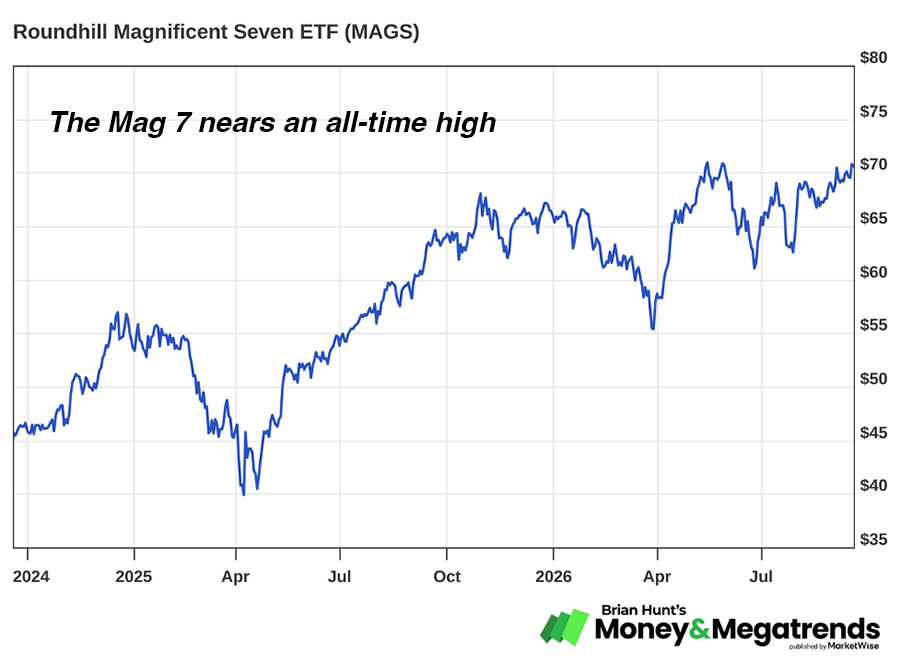
On Thursday, the Roundhill Magnificent Seven ETF (MAGS) reached a three-month high… and is just pennies from reaching a new all-time high.

MAGS is the largest ETF specifically designed to give investors exposure to the “Magnificent 7,” a group of dominant technology firms comprised of Nvidia (NVDA), Microsoft (MSFT), Alphabet (GOOG), Tesla (TSLA), Amazon (AMZN), Apple (AAPL), and Meta (META).

Together, these firms are worth about $24 trillion and make up roughly 31% of the benchmark S&P 500. No group of companies in history has wielded this group’s awesome combination of power, technological expertise, and vast financial resources. This group includes nearly all of the “hyperscalers” leading the AI revolution.

And the ETF that tracks this group is within pennies of its all-time high.

This is an important development for “the world’s most important trend.”

Over the past month, we’ve published a special series of research notes analyzing the AI infrastructure megatrend.

The status of this critical trend has become one of the great sagas of the business and investment world… a source of intense disagreement among industry bulls and bears. It’s a trend whose outcome could have large effects on your portfolio.

Given AI’s enormous promise, the firms above have invested over $1 trillion in AI infrastructure. They are on pace to invest over $700 billion this year alone and more than $4 trillion after that.

Both the scale and the velocity of this investment boom are unprecedented. It is the largest collective investment effort in history.

Big Tech’s historic investment boom has made the entire “AI infrastructure” trend responsible for a large share of America’s GDP growth and stock market returns over the past two years. It has also drawn the skeptical scrutiny of many widely followed investment analysts who claim the trend is a bubble… one that will soon explode and cause tremendous damage to stock prices and the global economy.

If this hugely consequential trend isn’t the most important trend in the stock market, then it is certainly in the top three.

I believe the AI infrastructure trend has years to run. I believe the world’s smartest, most connected tech insiders who know the true state of bleeding-edge AI development and have real-time stats on AI investment ROI, such as Elon Musk, Jensen Huang (Nvidia), Satya Nadella (Microsoft) and Andy Jassy (Amazon) could possibly… perhaps maybe… just might… know far more about AI and their businesses than outsiders know about it.

As much press as AI gets, let’s remember that less than 1% of the global population pays for top-tier AI programs. And I estimate less than 10% of large companies believe AI has made a meaningful impact on their businesses.

This revolutionary technology hasn’t yet proliferated, achieved mass adoption, or had mass impact.

Regular readers know I care a lot more about what the market thinks of any stock, trend or theme than what any one person thinks of it, including me. You can be bullish or bearish on a trend all you like, but if that trend is moving strongly against you, then your idea isn’t worth much in my book.

Over the past few months, we have analyzed price action in critical areas of the AI infrastructure trade – including the VanEck Semiconductor ETF (SMH), computer memory giant Micron (MU), and optical networking stocks – to guide our trading.

Since the Mag 7 plays a central role in AI infrastructure, it plays a central role in our analysis of it. Several of these firms have been singled out by bears for issuing debt to invest in AI data center construction.

However, right now, the market is saying debt issuance and ROI on AI infrastructure spend aren’t much of a worry… and that things are going quite well for the Mag 7. As you can see in the two-year chart below, MAGS is in a clear uptrend and is close to reaching an all-time high. A break above it would be bullish for the AI infrastructure trade, bullish for the tech sector in general, and bullish for America.

Image


Market Notes

  • The Iran War and its constriction of critical resources continue to work in favor of U.S. refiners. Valero Energy (VLO) reached a new all-time high today.

  • Food and beverage giant PepsiCo (PEP) reached a new one-year low today.

  • Fast food giant McDonald’s (MCD) reached a new one-year low today.

  • Home improvement giant Lowe’s (LOW) reached a new one-year low today.

  • Casino giant Las Vegas Sands (LVS) reached a new one-year low today.

Regards,

Brian Hunt signature

Brian Hunt signature

Brian Hunt
Editor, Money & Megatrends


An urgent message from our colleagues:

Emmy-winning analyst releases his next big story

Image

Whitney Tilson shocked the nation on 60 Minutes when he accused a major company of poisoning its customers. The investigation won an Emmy and the stock fell nearly 80%. (He also called the housing crisis and the collapse of Bear Stearns and Lehman Brothers). Now, he’s releasing his next big story. He says a dangerous pattern is forming, and most Americans have no idea how exposed they really are.

For the full presentation, go here.

The post This Trump-backed stock trade could generate triple-digit returns appeared first on MarketWise.
  • ✇Market Wise
  • A unique inflation hedge you’ve probably never considered Brian Hunt
    Today’s issue in preview: A unique inflation hedge you’ve probably never considered This Bitcoin catalyst could trigger soon and send it past $100,000 Learn our Top Themes to buy now A unique inflation hedge you’ve probably never considered Credit: f9photos For anyone looking to protect themselves against inflation, it’s worth knowing that it’s not just timberland on sale right now. World-class collections of gravel pits are also on sale. Over the past six months, I’ve written a speci
     

A unique inflation hedge you’ve probably never considered

11 September 2026 at 12:00

Today’s issue in preview:

  • A unique inflation hedge you’ve probably never considered

  • This Bitcoin catalyst could trigger soon and send it past $100,000

  • Learn our Top Themes to buy now


A unique inflation hedge you’ve probably never considered

Image

Credit: f9photos

For anyone looking to protect themselves against inflation, it’s worth knowing that it’s not just timberland on sale right now. World-class collections of gravel pits are also on sale.

Over the past six months, I’ve written a special series of research notes on publicly traded assets such as timberland giant Weyerhaeuser (WY) and construction aggregates firm Vulcan Materials (VMC) that can add a robust “inflation defense” component to your financial life.

You probably know why being vigilant against inflation is important: governments in most Western nations have promised far too many things to far too many people. They are spending far more on taxpayer benefits and wars than they collect in tax revenues.

The related debts and obligations governments have taken on cannot possibly be paid back with sound money. They can only be paid back with debased, devalued money… much of which is created out of thin air. This is driving inflation and significant currency debasement.

Prices are going up because the value of our money is going down.

Measured against a basket of widely used raw materials like crude oil, corn, copper, natural gas, sugar, and soybeans, the U.S. dollar has lost 53% of its value over the past eight years.

When I provide guidance on inflation defense, I urge people to keep my number one rule in mind: own in-demand, useful assets that cannot be easily replaced or replicated.

That is inflation defense in a nutshell. You want to own businesses and properties that produce in-demand, scarce resources, products, experiences, and services.

This group of assets includes quality farmland, beachfront real estate, timberland, mountain-view properties, great businesses, and oil and gas pipelines.

When a very difficult or impossible-to-replicate business or property produces in-demand, scarce resources, products, experiences, or services, it tends to hold its value no matter what the dollar is doing.

Its price will constantly “recalibrate” to accommodate an increase in currency units. It’s like the difference between slicing a pizza into 6 or 8 pieces. The number of slices changed, but the amount of pizza is the same.

In Monday’s issue, we detailed how timberland giant Weyerhaeuser was trading near one-year lows thanks to the rising interest rates and their depressive effects on the housing market.

Rising rates are also driving weakness in blue-chip construction aggregate producers Vulcan Materials and Martin Marietta Materials (MLM).

Together, Vulcan and Martin Marietta own and operate hundreds of mines across America that produce gravel, sand, and crushed stone – aka “construction aggregates.”

These raw materials are literally the foundation of highways, bridges, airports, offices, apartments, homes, and factories. You are virtually guaranteed to have driven on a road made possible by the construction aggregates produced by Vulcan or Martin Marietta. They are the giants of the industry.

Importantly, many of Vulcan and Martin Marietta’s mines are in coveted locations near America’s major metropolitan areas. This is key because construction aggregates are very heavy and therefore costly to transport over long distances. Transporting $5 million worth of gold and transporting $5 million worth of gravel are two very different things.

Given how difficult, expensive, and time-consuming it can be to permit and develop a large gravel mine, we can say both VMC and MLM own irreplaceable collections of scarce, in-demand resources. Again, these attributes are key to playing inflation defense. They’ve allowed the market values of VMC and MLM to rise and outpace dollar debasement over the past seven years.

VMC and MLM are also enjoying the U.S. factory and data center building boom we’ve been investing in with great success. As America grows, VMC and MLM grow with it.

We believe the attributes above are why master “quality” investor Chris Hohn is accumulating stakes in both firms.

Owning a collection of gravel pits and sand mines isn’t as exciting as owning SpaceX or AI stocks. However, if you want to play inflation defense by owning irreplaceable collections of scarce, in-demand assets whose prices can rise along with the rate of money creation, consider VMC and MLM.

Image

Recommended Link:

America’s New Money – Explained

Ad Image

Porter Stansberry reveals how Executive Order 14241 may have unleashed the first U.S. Dollar reset in 52 years. If you own property, stocks or have savings in the bank – discover what it could mean for your personal wealth. Go here to watch now.
  

This Bitcoin catalyst could trigger soon and send it past $100,000

Image

Credit: Vertigo3d

Bitcoin owners and watchers take note: The world’s leading digital asset is poised to clear a critical price level… which could serve as a catalyst to send it past $100,000 per coin.

Back in March, we wrote a bullish research note on how we believed Bitcoin had reached an important bottom.

After reaching an all-time high of around $125,000 last October, Bitcoin entered a brutal bear market, declining by about 48% to the mid-$60,000 range.

Crypto specialists attributed this decline to the U.S. government withdrawing liquidity from financial markets, as well as to gold and AI trades drawing money flows that could have been directed toward Bitcoin.

Most long-term Bitcoin believers see it as a “store of value” that should maintain its purchasing power like gold and beachfront homes do. It should be a digital form of “hard money.” Sounds great.

However, from October 2025 to February 2026, Bitcoin traded more like a failing technology company than anything you’d call strong and stable.

In March, Bitcoin’s trading behavior underwent a significant change. It formed a bottom and gained 9.5% in one month, while technology stocks dropped and gold gained just 3.2%.

Importantly, Bitcoin outperformed stocks and gold as Operation Epic Fury created tremendous market volatility and hammered many sectors of the stock market. It was a “port in the storm.”

Importantly, Bitcoin recently rallied above its long-term 200-day moving average. This is a good sign of an improving health trend.

Remember what we say about the 200-day moving average around here: Securities below their 200-day moving average are on the wrong side of the tracks. It’s the ugly part of town. All the really bad things happen below the 200-day moving average. Bitcoin has broken above it.

So, after a year of disappointing believers, has Bitcoin regained its place as a “store of value”? Is it ready to be a “port in the storm” and a stabilizing component of serious portfolios?

I hope so.

The world is a better place when Bitcoin is rising, and we have not one but two forms of hard money to own.

Bitcoin is currently trading for around $79,000. You can see in the chart below that a break above $82,500 would mark Bitcoin’s highest level in over six months.

This break could signal to the market that Bitcoin is back in a bull market… which could attract billions in new buying and send it north of $100,000 per coin. This would, in turn, drive adjacent bull markets in blockchain-based stablecoin and tokenization trends.

We’re bullish… and we’ll keep you updated on this potential catalyst.

Image


Market Notes

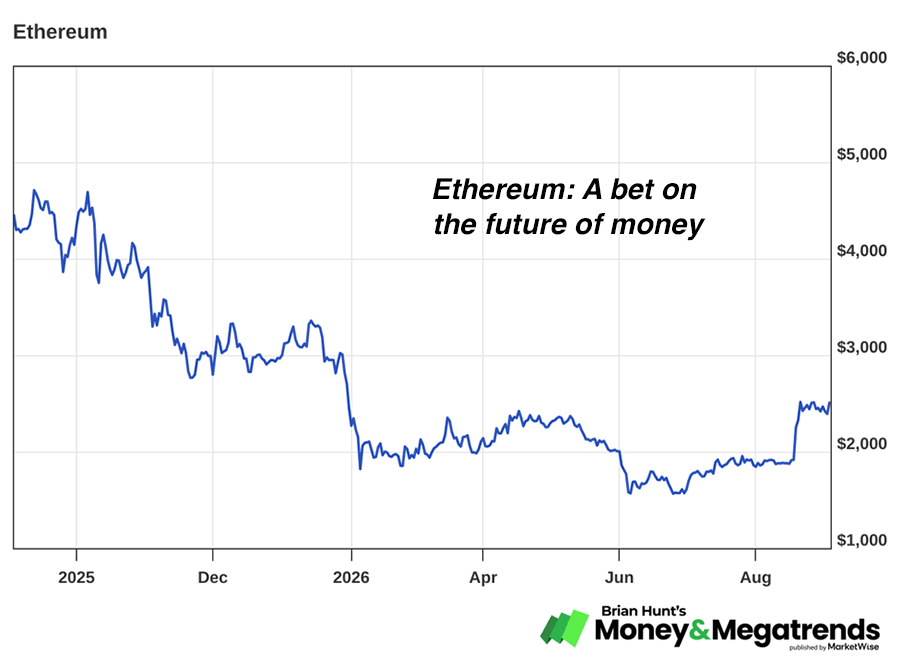
  • The tokenization trend we’ve been writing about picked up momentum today. Ethereum reached a six-month high.

  • The VanEck Oil Refiners ETF (CRAK) hit a new high today. Individual refining giants Valero Energy (VLO) and Marathon Petroleum (MPC) reached highs, too.

  • Japanese banking giant Mizuho Financial Group (MFG) hit new highs along with Bancolombia (CIB), Colombia’s largest bank. International banks continue their momentum.

  • Our November 17 recommendation to own biotech is doing well. 10X Genomics (TXG) hit new highs today, which puts it up 191% since our recommendation.

  • Our February 3rd recommendation to own space bottleneck play Frequency Electronics (FEIM) just surged 35% post stellar earnings. It’s now up 54% since our February recommendation.

  • Our March 20th recommendation to invest into scandium with Sunrise Energy Metals (SREMF) has performed extremely well. The stock is now up 22% in the last month and 211% since our March recommendation.

Regards,

Brian Hunt signature

Brian Hunt signature

Brian Hunt
Editor, Money & Megatrends


An urgent message from our colleagues:

AI Breakthrough Could Soon Reorder Stock Market Winners and Losers

Image

For years, we’ve been led to believe the tech firm operating at 500 Howard Street in Silicon Valley is “one of the good guys.” But will the advanced form of AI that just emerged from this location change the way we live, work and invest forever? Marc Chaikin reveals the time-sensitive details of this discovery and offers you a FREE 3-part playbook to protect your future.

Click here for the details.

The post A unique inflation hedge you’ve probably never considered appeared first on MarketWise.

  • ✇Market Wise
  • AI is about to revolutionize money and banking. Here’s how to profit Brian Hunt
    Today’s issue in preview: AI is about to revolutionize money and banking. Here’s how to profit This giant trend is creating more stock market winners than any other One of the world’s most important infrastructure firms just reached an all-time high. That’s good for you. Learn our Top Themes to buy now AI is about to revolutionize money and banking. Here’s how to profit Credit: jroballo Over the past two weeks, we have written a special series of research notes on the coming revoluti
     

AI is about to revolutionize money and banking. Here’s how to profit

4 September 2026 at 12:00

Today’s issue in preview:

  • AI is about to revolutionize money and banking. Here’s how to profit

  • This giant trend is creating more stock market winners than any other

  • One of the world’s most important infrastructure firms just reached an all-time high. That’s good for you.

  • Learn our Top Themes to buy now


AI is about to revolutionize money and banking. Here’s how to profit

Image

Credit: jroballo

Over the past two weeks, we have written a special series of research notes on the coming revolution in money, finance, and investing.

In short, the confluence of AI and blockchain technology is about to revolutionize how we save, spend, transfer, and invest our money. This revolution is poised to generate enormous gains in the stock market and cryptocurrency markets.

For example, we’ve singled out cryptocurrency exchange and infrastructure firm Coinbase (COIN) and stablecoin firm Circle Internet Group (CRCL) as companies poised to benefit from the coming revolution.

But as you review the investment landscape here, don’t forget about the foundation much of it runs on: Ethereum.

Ethereum is the foundation on which stablecoins run. It’s where most tokenized assets are held. It’s the global infrastructure layer for this revolution in money.

Ethereum is not a company or a stock. Instead, it is a blockchain network that enables developers to build applications and execute smart contracts – programs that automatically execute transactions when certain conditions are met. Its native cryptocurrency, Ether (ETH), is used to pay transaction fees.

Think of Ethereum as a computer that everyone can use… one with powerful financial utility.

Right now, when you send money or buy a stock, there are middlemen: banks, brokers, clearing houses, agents, etc. They’re the recordkeepers, and they maintain the ledger that says who owns what.

Ethereum replaces those middlemen with something called a blockchain. This is a shared, tamper-proof record book maintained by thousands of computers simultaneously around the world. No single bank or government can control it.

But Ethereum didn’t stop at just being the recordkeeper. Its founders built it to be programmable, so developers can run code on top of it. This means that:

  • Money can be sent when certain conditions are met

  • Issuance of digital versions of stock can be given

  • A loan can be created that manages itself

This programmability and adaptability make Ethereum the key blockchain above all other blockchains.

And this is why the majority of stablecoins – the “dollars that computers use” as we’ve described them – run on Ethereum.

USDC, the stablecoin issued by Circle, settles on Ethereum. Most of the stablecoin volume processed by Visa runs through Ethereum.

In fact, Ethereum currently holds a 53% share of all decentralized finance activity globally.

Here’s a key part to understand: ETH is not a stock in a company. There is no corporate balance sheet, no earnings calls, and no claims on anyone’s profits.

It is the asset that makes this shared computer run – the fuel for every stablecoin transfer, every tokenized share, and every self-executing loan built on top of it. You are not buying equity in Ethereum.

You can purchase ETH directly through crypto exchanges such as Coinbase, but it does not sit inside a standard brokerage account the way a stock does.

For many investors, particularly those who prefer to stay within their existing brokerage and don’t want to manage crypto wallets… buying ETH can be outside their comfort zone.

This is where Bitmine Immersion Technologies (BMNR) can come in handy.

BMNR is a publicly traded company on the NYSE that gives you a leveraged bet on the Ethereum trade. The company has adopted an aggressive Ethereum treasury strategy. Rather than holding cash or bonds, BMNR has accumulated ETH at an incredible scale. It holds approximately 5.9 million ETH tokens. It is the largest corporate owner of ETH in the world.

It’s a similar strategy to what Michael Saylor has employed at Strategy (MSTR) (formerly MicroStrategy), raising capital to accumulate Bitcoin. Bitmine is pursuing the same playbook to buy more ETH.

BMNR has performed poorly during this crypto pullback, but over the last month, it has risen 37%, reaching fresh three-month highs. This makes it a stock to watch for a continued breakout.

Ethereum isn’t just part of the AI-native finance revolution we have been detailing in Money & Megatrends. In many respects, it is the revolution.

Image

Recommended Link:

Elon Musk, Peter Thiel, Sam Altman Back New Potential $367 Trillion “Medical AI”

Ad Image

The three most successful tech billionaires in history are now backing a new use for AI that could dwarf anything we’ve seen before. And Nature says this tech is so revolutionary, it could add $367 trillion to the economy – the equivalent of $1 million per American. Click here to see the stocks that could soar as “Medical AI” goes online nationwide.

This giant trend is creating more stock market winners than any other

Image

Credit: Pixelbizz

The bull market in “Boomer healthcare” we’ve been writing so much about got even stronger yesterday.

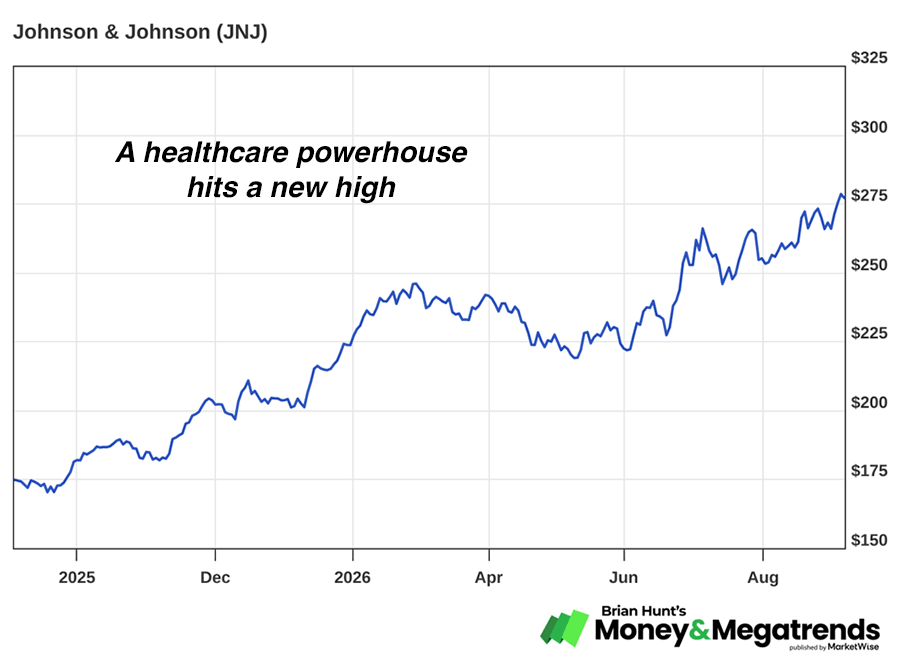
Pharmaceutical giants Johnson & Johnson (JNJ) and Bristol Myers Squibb (BMY) reached new all-time highs.

J&J is one of the world’s largest healthcare companies. It focuses on prescription drugs and medical devices, such as orthopedic implants and cardiovascular devices. The company’s blood cancer treatment, Darzalex, is one of the top-selling drugs in the world, with annual sales over $14 billion.

For years, J&J had a large consumer product division that sold Tylenol, Band-Aids, and Listerine, but that business was spun off in 2023 into a company called Kenvue (KVUE).

Bristol Myers Squibb is a major pharmaceutical company concentrated in oncology, hematology, cardiovascular disease and immunology. Its biggest products include Eliquis (blood thinner), Opdivo (cancer immunotherapy) and Revlimid (multiple myeloma).

For more than three years, I’ve made “Boomer health care” one of my highest conviction long-term investment themes. This means I’ve been bullish on biotech, genomics, and healthcare in general. In more than 20 Money & Megatrends research notes over the past year, we’ve been very bullish on stocks and ETFs related to this trend.

Regular readers are familiar with the bull case here. More than 10,000 Americans reach retirement age every day. The U.S. population aged 80 and older is projected to roughly double, from 14.7 million in 2025 to 29.4 million by 2045.

This is the enormous Baby Boom generation entering the phase of life where health care and longevity spending skyrocket. For many boomers, a typical month involves going to see at least one doctor to have something looked at, removed, or treated.

This means many health care businesses are experiencing huge demand now – and will for at least the next decade. It means boom times ahead for many “ology” businesses, stocks, and careers. Dermatology. Cardiology. Radiology. Oncology. Anesthesiology. Ophthalmology. The list goes on.

Investing in many healthcare businesses over the next decade will be investing with a gale-force tailwind at your back. If you’re a parent and worried about your child getting a job, just point them to the booming healthcare industry. The new highs generated by two of the largest leaders show this bull market is alive and well.

The strong demographic tailwinds described above are driving powerful revenue and profit growth for companies like Johnson & Johnson and Bristol Myers Squibb. Given the very long-term nature of this trend, we expect to see many more new highs in the healthcare sector.

Image


One of the world’s most important infrastructure firms just reached an all-time high. That’s good for you.

Image

Credit: Maudib

If you’re looking for a reason to feel optimistic about the global economy over the weekend, look no further:

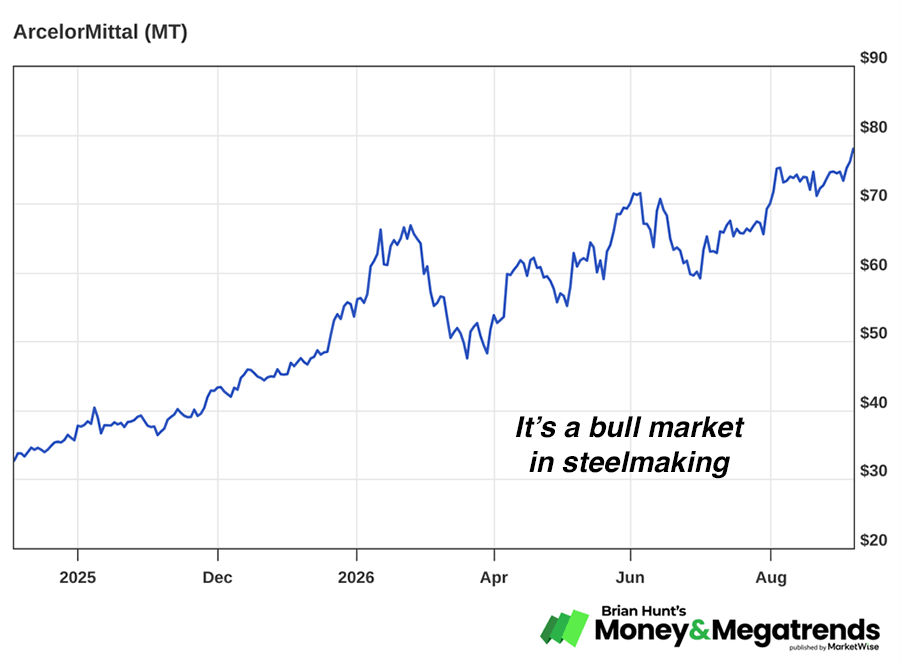
The world’s largest public steelmaker by production – ArcelorMittal (MT) – just reached an all-time high.

That’s a bullish economic signal. And it’s a great signal for your 401(k).

ArcelorMittal is one of the most important companies that most people have never heard of. MT was created in 2006 through the merger of European steel giant Arcelor and Indian steel giant Mittal Steel.

Headquartered in Luxembourg, ArcelorMittal produces roughly 55-60 million metric tons of steel annually, with major operations across Europe, North America, South America, and Africa. Its steel is used in automobiles, construction, infrastructure, machinery, appliances, and energy projects.

Unlike many steelmakers, ArcelorMittal is also vertically integrated, owning substantial iron ore and coal mining operations that supply raw materials to its mills. The company produces everything from automotive-grade sheet steel to heavy plate and structural products.

In today’s high-tech world of iPhones, ChatGPT, video streaming, and Instagram, it’s easy to forget our world is built on a low-tech foundation of steel, concrete, and lumber.

Steel is a major component of bridges, cars, trucks, electric grids, ships, pipes, factories, construction equipment, and skyscrapers. This makes the steel industry highly sensitive to the economy’s ups and downs. When the economy booms, the steel industry booms with it. When the economy busts, so does the steel business.

Over the past eight months, I’ve written over a dozen research notes analyzing the soaring share prices of similar highly economically sensitive industry groups, including trucking stocks, railroad stocks, regional banks, manufacturing stocks, shopping mall operators, and hotel chains.

At the end of each note, I pointed to their soaring stock prices and told readers that the U.S. economy is doing much better than most people think.

These economically sensitive firms are important “real world” indicators. They almost always do a better job of telling us what is happening in the economy than any media outlet or economist. And their uptrends are moving in a bullish upward direction for the global economy as a whole.

Driven by strong demand, MT’s latest earnings report detailed 5% annual revenue growth and 11% EBITDA growth. MT’s stock is up 138% over the past year and reached a new all-time high today.

Does the global economy have imbalances and big problems? Of course. It always does. But making money in stocks is never the result of a problem-free economic environment. It’s always about being in an environment where the big problems are overwhelmed by the even bigger positives.

Right now, these bigger positives are sending MT to new all-time highs. The world’s largest steelmaker does not do this when the economy is weak.

Image


Market Notes

  • The bull market in agriculture we’ve been detailing just drove farm equipment giant CNH Industrial (CNH) to a new one-year high.

  • Apparel giant Lululemon (LULU) dropped 17% this morning to reach a new one-year low after reporting weak earnings and guidance.

  • The WisdomTree Emerging Markets High Dividend Fund (DEM) reached a new all-time high today.

  • The iShares Singapore ETF (EWS) reached a new all-time high today.

  • Oil shipping giant Frontline (FRO) reached a new one-year high today.

Regards,

Brian Hunt signature

Brian Hunt signature

Brian Hunt
Editor, Money & Megatrends


An urgent message from our colleagues:

Landmark Executive Order 14241 Unleashes Trump’s New Dollar

Image

Republican or Democrat – whether you support or oppose Trump’s New Dollar – every American could soon be forced to use it.

Discover three critical moves to help you prepare, before it’s too late.

The post AI is about to revolutionize money and banking. Here’s how to profit appeared first on MarketWise.
  • ✇Market Wise
  • Two critical U.S. infrastructure firms are in bull markets. Invest accordingly! Brian Hunt
    Today’s issue in preview: Two critical U.S. infrastructure firms are in bull markets. Invest accordingly! Rare earth stocks have huge upside potential. A status update on this trade Business is booming for “Made in America” infrastructure stocks. Are you benefitting? Learn our Top Themes to buy now Two critical U.S. infrastructure firms are in bull markets. Invest accordingly! Credit: Maudib Make sure to put Nucor (NUE) and Steel Dynamics (STLD) on your watch list today. These two
     

Two critical U.S. infrastructure firms are in bull markets. Invest accordingly!

6 August 2026 at 12:00

Today’s issue in preview:

  • Two critical U.S. infrastructure firms are in bull markets. Invest accordingly!

  • Rare earth stocks have huge upside potential. A status update on this trade

  • Business is booming for “Made in America” infrastructure stocks. Are you benefitting?

  • Learn our Top Themes to buy now


Two critical U.S. infrastructure firms are in bull markets. Invest accordingly!

Image

Credit: Maudib

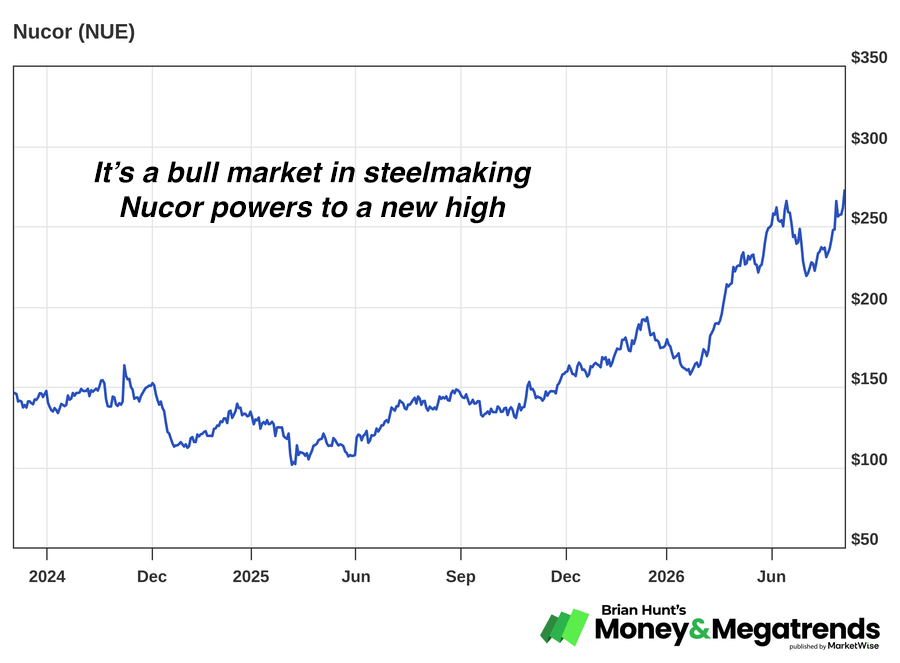
Make sure to put Nucor (NUE) and Steel Dynamics (STLD) on your watch list today.

These two stocks are clear market leaders right now. Nucor just reached a new all-time high. Steel Dynamics is close to one.

These bull markets are important signs the U.S. economy is rocking and rolling.

Nucor and Steel Dynamics are the two largest U.S. steel producers.

They manufacture the structural steel that goes into our office buildings, data centers, electric grids, hospitals, automobiles, factories, and skyscrapers.

In today’s high-tech world of iPhones, ChatGPT, video streaming, and Instagram, it’s easy to forget our world is built on a low-tech foundation of steel, concrete, and lumber.

Steel is a major component of bridges, cars, trucks, electric grids, ships, pipes, factories, construction equipment, and skyscrapers. This makes the steel industry highly sensitive to the economy’s ups and downs. When the economy booms, the steel industry booms with it. When the economy busts, so does the steel business.

Over the past eight months, I’ve written over a dozen research notes analyzing the soaring share prices of similar highly economically sensitive industry groups, including trucking stocks, railroad stocks, regional banks, manufacturing stocks, shopping mall operators, and hotel chains.

At the end of each note, I pointed to their soaring stock prices and told readers that the U.S. economy is doing much better than most people think.

These economically sensitive firms are important “real world” indicators. They almost always do a better job of telling us what is happening in the economy than any media outlet or economist. And their uptrends are moving in a bullish upward direction for the U.S.A.

Driven by strong demand, Nucor and Steel Dynamics are enjoying bull markets. Nucor is up 99% over the past year. Steel Dynamics is up 118%. Their strength indicates a strong economy.

So, keep these two on your watchlist. America’s largest steelmakers don’t hit new all-time highs when the economy is struggling.

Instead, they hit new all-time highs during economic expansions… when we have the capacity to finance, build, and operate mega infrastructure projects, skyscrapers, factories, and transportation networks. What’s good for steelmakers is good for America. Both are trending higher.

Image

Recommended Link:

Is This Elon’s Most Brilliant Gambit to Date?

Ad Image

This ingenious scheme – hatched in the shadow of the Global Financial Crisis – could come to fruition in the coming weeks. It may turn Elon into a multi-trillionaire while erasing a looming threat one top Trump insider calls “an economic apocalypse.” This is what it means for your money.


Rare earth stocks have huge upside potential. A status update on this trade

Image

Credit: William_Potter

Investors might end up making big money in the rare earth element business, but they’re going to have to wait a while. After all, the market simply isn’t interested in this trend now.

By now, you’ve probably heard about America’s rare earth element problem… and how there’s money to be made in solving it.

President Donald Trump – along with many business and military leaders – believes that the U.S. has outsourced far too much of its industrial capacity to China over the past 25 years. We outsourced significant portions of our semiconductor, appliance, medicine, weapons, and machinery production. We outsourced the capacity to produce and process critical resources, such as rare earth elements.

The COVID-19 pandemic showed that depending on other countries for critical economic inputs makes the U.S. economy less safe and secure. To put it bluntly, it is very stupid not to produce products critical to national security, like AI semiconductors, within our own borders.

President Donald Trump has staked his legacy and reputation on massively expanding U.S. manufacturing capacity. His administration is working with business leaders to invest trillions to pursue this goal.

However, any plan to increase domestic manufacturing capacity must overcome a major problem: we don’t have the critical resources to build the necessary infrastructure.

We don’t have the copper, iron ore, rare earths, lithium, antimony, nickel, and other vital building blocks required to build all those data centers… all those factories… all those robots…. all those electric grids… all those power plants… and so on.

To make matters worse, we also lack the refining, smelting, and processing facilities needed to turn those resources into ready-to-use end products. We rely on China for a lot of that.

It’s as if we very much want to build a big house… but we don’t have the lumber, screws, or nails we need to make it happen.

Solving the big “critical resources problem” is possible… and it is a big financial opportunity.

To ensure we have the critical resources to build trillions of dollars in high-tech hardware and physical infrastructure, the U.S. government will change any law, kill any regulation, and write any check that increases critical resource production and processing capacity.

This means that after more than 30 years of the U.S. government being hostile toward domestic mines and mineral processing facilities, it now supports them. Trump can’t have his big manufacturing dream without them.

It’s all a bullish backdrop for companies that will act as “national champions” to mine, process, and refine rare earth elements… and help the U.S. get ready access to these critical raw materials… whether through domestic sources or “friendly to the U.S. sources” such as Australia.

This bullish backdrop made companies with rare earth exposure big winners in 2025. MP Materials (MP), Idaho Strategic Resources (IDR), Critical Metals Corp. (CRML) and Energy Fuels (UUUU) each enjoyed 100%+ rallies.

Unfortunately, going from “A: This rich mineral deposit could be a profitable mine” to “B: We are mining and selling a refined resource” is often a frustrating process that costs a lot more than most people think it will and takes a lot longer than most people think it will.

To go from “promising mineral deposit” to “producing mine,” a mining firm must delineate the deposit, convince the locals a dirty, noisy mine is a good idea, arrange financing to develop the mine, get permits to develop the mine, build roads and electrical infrastructure to the mine, then build the mine, and sometimes build domestic ore processing and refining facilities near the mine (especially important for U.S. and rare earths).

To this end, mining firms often must spend far more on lawyers, political campaigns, bankers, lobbyists, environmental consultants, experts, and political bribes than their backers anticipate. All too often, a three-year development plan turns into a six-year development plan.

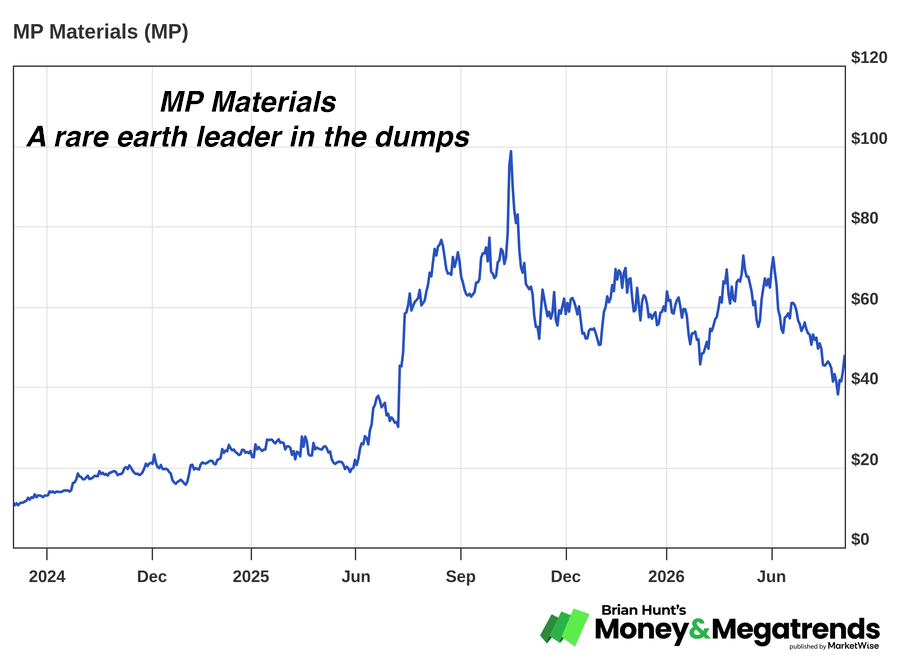
This is the situation investors in U.S. rare-earth and strategic-metals firms find themselves in. The long-term fundamentals seem quite bullish, but the difficult short-term realities of mining have greatly diminished investor enthusiasm. MP Materials – the largest and highest profile U.S. rare earth stock – is down 27% over the past year and recently reached a new one-year low.

Someday, investors may return to the rare earth theme with enthusiasm and capital. But for now, the market is saying this trend is dead in the water. I’ll keep you updated as new developments happen.

Image


Business is booming for “Made in America” infrastructure stocks. Are you benefitting?

Image

Credit: gorodenkoff

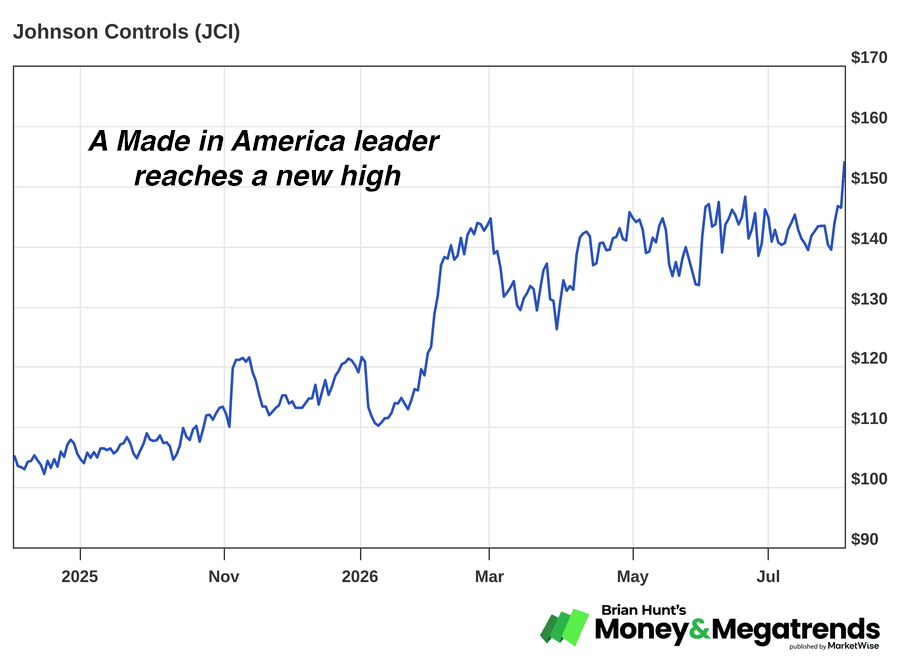
On Tuesday of this week, shares of Johnson Controls (JCI) surged 5% to reach a new all-time high.

If you needed confirmation that the “Made in America” megatrend is a compelling case for investment capital, this is it.

Johnson Controls isn’t a household name. But it’s a giant of American manufacturing. Its market cap is $88 billion, and it employs over 80,000 people.

Johnson is essentially a “commercial building tech” company, and one of the largest of its kind. It manufactures and services industrial heat pumps, refrigeration systems, HVAC systems, security systems, temperature control systems, and virtually everything else you need to keep a factory, data center, hangar, hospital, warehouse, or airport running properly. We’re talking high-tech manufacturing on a massive scale.

This makes Johnson Controls a key player in our “Made in America” megatrend. Wall Street is attributing the company’s recent high to its earnings report, which showed strong earnings growth and new orders.

Back in January, I made the case for going long the Made in America megatrend… for investing in companies that supply critical equipment and services for building and operating today’s high-tech factories.

The bull case here is simple…

President Donald Trump – along with many business and military leaders – believes that the U.S. has outsourced far too much of its industrial capacity to China over the past 25 years. We outsourced significant portions of our semiconductor, appliance, medicine, weapons, and machinery production.

We outsourced the capacity to produce and process critical resources, such as rare earth elements.

The COVID-19 pandemic showed that depending on other countries for critical economic inputs makes the U.S. economy less safe and secure. To put it bluntly, it is very stupid to not make products critical to national security like AI semiconductors within our own borders… especially when we are in an economic and geopolitical “great powers” contest with China.

Trump has staked his legacy and reputation on greatly expanding our industrial base… and he’s working with business leaders to invest trillions to pursue this goal. Apple (AAPL), for example, has committed to invest $600 billion in U.S.-based manufacturing over the next four years. Nvidia (NVDA) says it will invest $500 billion in U.S.-based manufacturing over the next four years.

In Money & Megatrends, we’ve capitalized on this “Made in America” megatrend with strong returns in robotics, factory automation, and machine component makers such as Cognex (CGNX), Ouster (OUST), and RBC Bearings (RBC). Plus, new ideas in this trend include ESAB Corp (ESAB), Lincoln Electric (LECO), Xometry (XMTR) and Applied Industrial Technologies (AIT).

The Made in America megatrend involves building huge amounts of new AI data centers, high-tech factories, electrical infrastructure, and industrial machines. JCI’s excellent earnings report and surging stock price indicate this trend is in full swing. We remain bullish!

Image


Market Notes

  • The Invesco S&P SmallCap Industrials ETF (PSCI) reached a new all-time high this week. This indicates the U.S. manufacturing sector is very strong.

  • Our recommendation to invest in cybersecurity via Palo Alto Networks (PANW) is paying off. The stock reached a new all-time high this week.

  • Drug development giant Charles River Laboratories (CRL) reached a new all-time high this week.

  • It’s a bull market in defense stocks. The iShares Aerospace & Defense ETF (ITA) reached a new all-time high this week.

  • The Financials Select Sector Fund (XLF) reached a new all-time high this week. This fund owns a “who’s who” of large financial companies. The new high is a bullish economic signal. 

Regards,

Brian Hunt signature

Brian Hunt signature

Brian Hunt
Editor, Money & Megatrends


An urgent message from our colleagues:

Earnings season is already proving Navellier’s biggest AI call right

Image

Taiwan Semiconductor – the company that makes the chips inside almost every AI system on earth, recently reported blowout earnings. At least, that’s the headline Wall Street ran with. But, here’s the one they buried: TSM is putting ANOTHER $100 billion into U.S. chip manufacturing. On top of the $165 billion it already committed. That’s $265 billion, from a single Taiwanese company, betting on American soil, in the middle of an AI arms race with China. Ask yourself why. I don’t think it’s about tariffs. I think TSM knows something the rest of Wall Street hasn’t priced in yet.

Go here for the full details – before I’m forced to take this down.

The post Two critical U.S. infrastructure firms are in bull markets. Invest accordingly! appeared first on MarketWise.

❌