❌

Normal view

Why strong results aren’t saving stocks this earnings season

15 October 2026 at 11:04

Goldman Sachs (GS) just crushed earnings estimates, yet its stock fell alongside other market leaders. Here's why strong results aren't enough anymore... and how investors should position their portfolios.

The post Why strong results aren’t saving stocks this earnings season appeared first on Curzio Research.

  • ✇Market Wise
  • Seven stocks that could explode as AI goes mainstream Brian Hunt
    Today’s issue in preview: Seven stocks that could explode as AI goes mainstream AI’s hidden income opportunity: How to earn large income streams from the boom Why the U.S. dollar is plummeting in value… and how to protect yourself Learn our Top Themes to buy now Seven stocks that could explode as AI goes mainstream Credit: Petrovich9 In June, Nvidia (NVDA) CEO Jensen Huang stood on stage next to Marvell Technology (MRVL) CEO Matt Murphy and predicted Marvell would be the “next trill
     

Seven stocks that could explode as AI goes mainstream

9 October 2026 at 12:00

Today’s issue in preview:

  • Seven stocks that could explode as AI goes mainstream

  • AI’s hidden income opportunity: How to earn large income streams from the boom

  • Why the U.S. dollar is plummeting in value… and how to protect yourself

  • Learn our Top Themes to buy now


Seven stocks that could explode as AI goes mainstream

Image

Credit: Petrovich9

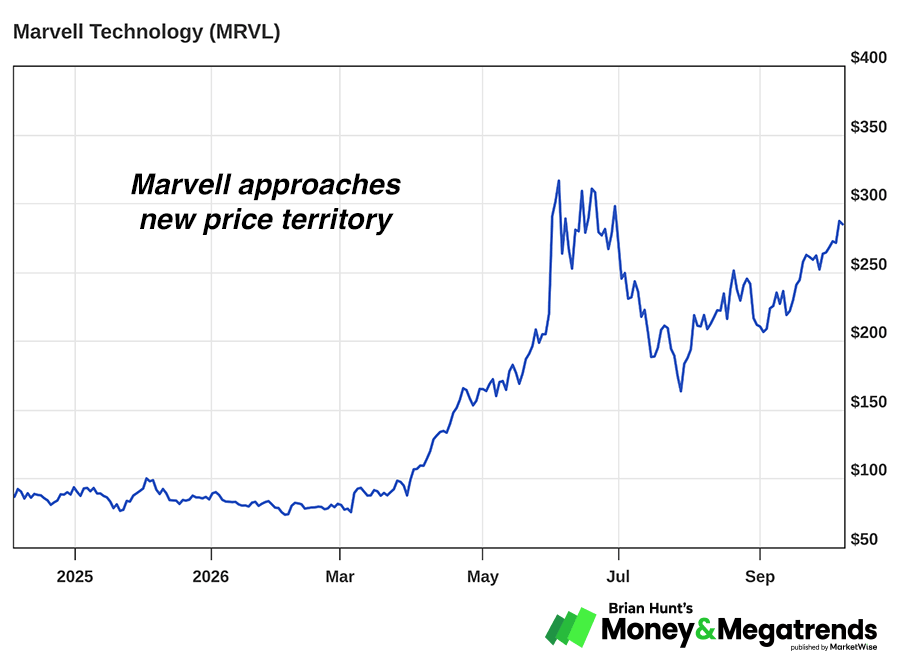
In June, Nvidia (NVDA) CEO Jensen Huang stood on stage next to Marvell Technology (MRVL) CEO Matt Murphy and predicted Marvell would be the “next trillion-dollar company.”

As a result, MRVL shares jumped 32% in a single day, which was the largest one-day gain in the company’s history. Plus, Marvell became one of the most widely followed companies in the tech world.

Why is Jensen – the “Michael Jordan of AI” – so bullish on Marvell?

Marvell is one of the world’s leading suppliers of optical networking semiconductors, particularly the chips that enable high-speed data transmission inside AI data centers. Market cap is $241 billion.

Jensen believes Marvell could become the next trillion-dollar company because it solves one of AI’s biggest challenges: moving enormous amounts of data between chips.

As AI data centers grow to include hundreds of thousands of processors, connecting those chips quickly and efficiently becomes critical. Marvell specializes in high-speed networking chips, optical connections, and custom processors that enable this.

Jensen sees these technologies becoming increasingly valuable as AI infrastructure spending explodes. Nvidia is so bullish on Marvell’s future that it invested $2 billion in the company and formed a strategic partnership to develop next-generation AI infrastructure.

Over the past two months, we’ve published a special series of research notes analyzing the AI infrastructure trend.

The status of this critical trend has become one of the great sagas of the business and investment world… a source of intense disagreement among industry bulls and bears. It’s a trend whose outcome could have large effects on your portfolio.

Given AI’s enormous promise, large tech firms such as Alphabet (GOOG), and Microsoft (MSFT) have invested over $1 trillion in AI infrastructure. They are on pace to invest over $700 billion this year alone and more than $3 trillion after that.

Both the scale and the velocity of this investment boom are unprecedented. It is the largest collective investment effort in history.

Big Tech’s historic investment boom has made the entire “AI infrastructure” trend responsible for a large share of America’s GDP growth and stock market returns over the past two years. It has also drawn the skeptical scrutiny of many widely followed investment analysts who claim the trend is a bubble… one that will soon explode and cause tremendous damage to stock prices and the global economy.

If this hugely consequential trend isn’t the most important trend in the stock market, then it is certainly in the top three.

Recently, we’ve detailed how new highs for Nvidia, AI chip leader Nvidia (NVDA), semiconductor manufacturer Taiwan Semiconductor (TSM) and the Roundhill Magnificent 7 ETF (MAGS) indicate the market is enthusiastically endorsing a continuation of the AI infrastructure megatrend.

This of course, is also bullish for Marvell.

Although bleeding edge semiconductors from the likes of Nvidia get most of the headlines, those chips are only as good as the connections between them.

As AI data centers grow more complex and more powerful, the number of chips connected inside them increases. A modern AI cluster, for example, ties together hundreds of thousands of chips that all must act together. If that data between chips moves too slowly, these expensive processors just sit there idle.

Traditionally, these data connections have been made from copper. But at the speeds required today, copper can’t keep up. It loses signal and burns power too quickly.

The fix is to slowly replace electrical signals traveling over copper with light signals traveling over fiber-optic cables. That’s what optical networking does. And it’s what Marvell is a world leader in.

Recently, Marvell put a huge spotlight on this technology at its investor day, held on October 6.

Until MRVL’s investor day, we knew optical networking gear had at least two years of solid demand ahead. But we never saw forecasts through to 2030 and beyond.

Marvell’s investor day just changed that.

Here’s is big news:

  • Management estimates its total market opportunity will expand to approximately $400 billion, growing around 45% annually from 2025.

  • Management forecasts annual revenue to climb from $8.2 billion in fiscal year 2026 to $80 billion in fiscal year 2031.

In other words, Marvell has made one of the most aggressive industry forecasts in the technology world… and one of the most aggressive company growth forecasts.

This forecast – plus the word of Jensen Huang – makes optical networking stocks like Marvell and fellow industry players Coherent (COHR), Lumentum (LITE), Ciena (CIEN), Credo Technology (CRDO) and Applied Optoelectronics (AAOI) one of the most compelling technology trends to monitor and consider as an investment candidate.

It is one of the highest leverage ways to invest in the mass adoption of AI.

Like most components of the AI infrastructure trade, Marvell enjoyed a big spring rally this year and a significant summer correction. It has since digested this correction, rallied, and is closing in on an all-time high. A break above that high would be a very bullish signal for the optical networking theme. We will keep you apprised of the situation.

Image

Recommended Link:

10 Doubles in 12 Months, or He Works for Free

Ad Image

On October 14, Master Trader Jonathan Rose is putting his reputation on the line by promising at least TEN 100% recommendations over the next 12 months. He’ll reveal the specifics during his $10k to $100k Challenge. Details here.

AI’s hidden income opportunity: How to earn large income streams from the boom

Image

Credit: stanley45

In yesterday’s issue, we highlighted how both large tech firms such as Google (GOOG) and the U.S. government are making huge investments in nuclear energy.

As more individuals and businesses leverage the power of “super intelligence,” more demands are placed on AI infrastructure… which means more demands on our national electric power system.

Since that overloaded system is already straining, AI has a “power problem.” We don’t have enough electric power plants. We don’t have enough connections to existing power plants. We don’t have enough high-voltage transmission lines.

A big part of the solution to this problem is nuclear energy. According to a 2026 analysis by energy consulting firm KeyLogic, annual U.S. nuclear power investment could reach $80 billion to $94 billion by 2035 under an ambitious expansion scenario designed to quadruple the nation’s nuclear generating capacity by 2050.

However, nuclear is only part of the solution to AI’s power problem.

Natural gas – and America’s natural gas transportation network – is a huge part of the solution as well.

Although building large amounts of nuclear power generation capacity is a compelling long-term solution to AI’s power problem, it is not a short-term solution.

Getting permits and project financing for a nuclear power plant typically takes years. And with permits in hand and financing secured, the industry expects build times of 7-10 years.

A nuclear plant is a gigantic, extraordinarily complex construction project. It requires huge reactor vessels, steam generators, coolant pumps, heat exchangers, and miles of specialized piping. Many of these components are frequently custom-built or produced in tiny quantities. There is nothing resembling the mass-production supply chain for conventional industrial equipment.

Once these often enormous, often highly specialized components are built, they must be installed in a precise sequence, inspected, tested, and integrated into a single safety-critical system.

Because the safety stakes are so high, nuclear power plant components are subject to rigorous testing. A problem with one component can hold up several downstream construction activities.

You typically cannot throw more workers at a nuclear power plant project to speed it up. You often cannot even throw more money at it to make it go faster. And so, it takes 7-10 years to build a new nuclear plant.

All this has made my recommendation of energy pipelines a big winner… and should keep it winning for years.

In early 2024, I began to see the oil and gas pipeline industry as the best way to generate substantial passive income from the AI boom.

The U.S. has enormous reserves of clean-burning natural gas. Plus, it has over 2,000 natural gas-fired power plants. An additional natural gas power plant can be built in less than a third of the time it takes to build a new nuclear plant.

However, all the natural gas reserves in the world aren’t worth much if you can’t get the gas from the wellhead to the plants.

This is where America’s vast natural gas transportation, processing, and storage industry comes in.

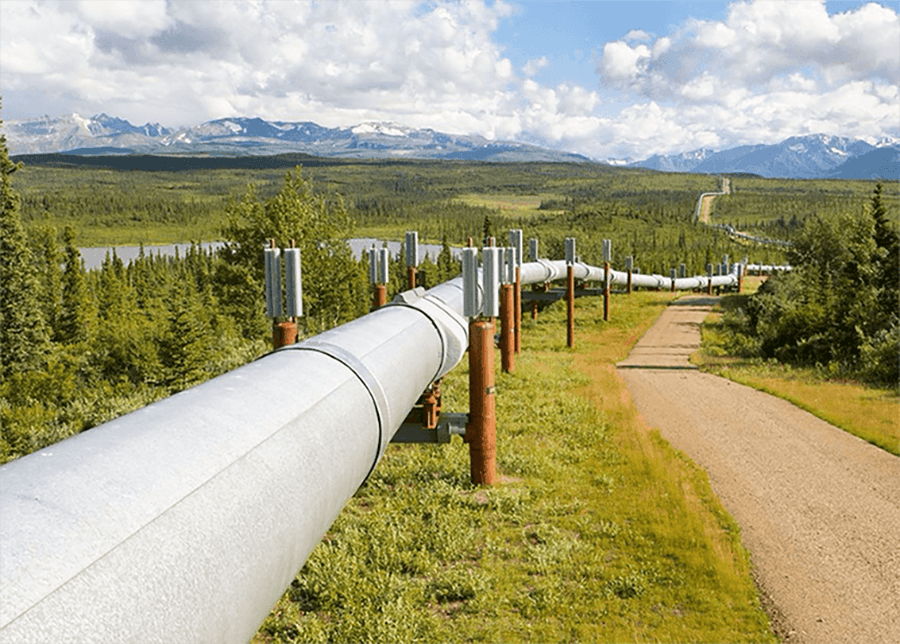
An extensive network of pipes crisscrosses America that allows energy companies to transport natural gas from prolific fields in Texas, Pennsylvania, New Mexico, West Virginia, and Louisiana to the nation’s power plants.

A boom in AI-related electricity demand by default means a boom in demand for natural gas transportation services.

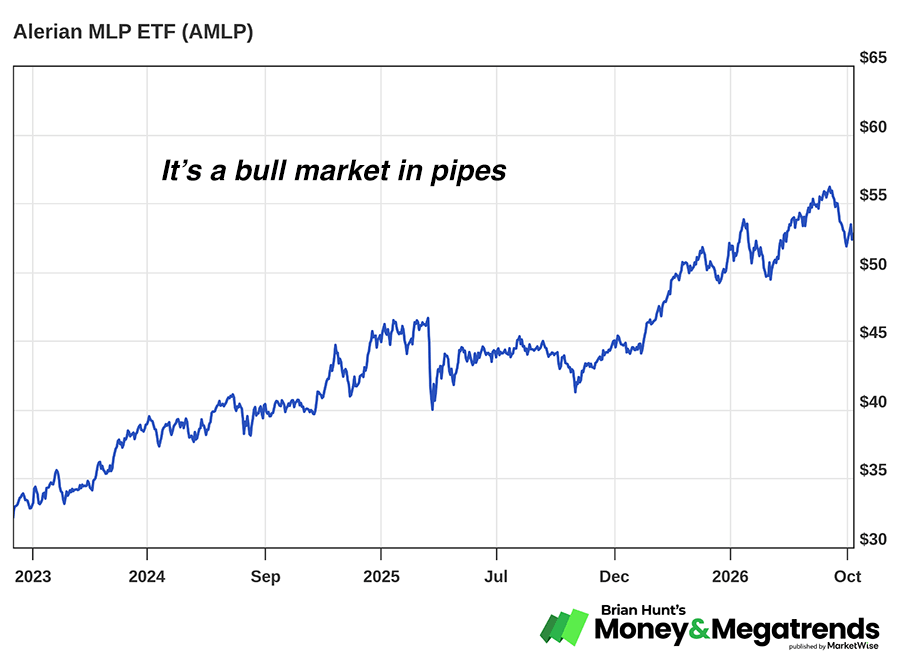
Since 2024, the market has enthusiastically supported our bull case for energy pipelines. Blue chip pipeline operator Enterprise Products (EPD) has returned 67%. Fellow blue chip operators Energy Transfer (ET) and Kinder Morgan (KMI) have returned 92% and 129%, respectively. Each of these firms is enjoying terrific growth in volumes and revenue.

These individual stock gains have powered the energy pipeline-focused Alerian MLP ETF (AMLP) to a 64% total return since 2024. Despite AMLP’s big run and shares being near all-time highs, it still yields around 7.75%.

The typical pipeline operator is not your conventional “high-risk, high-reward” AI play. Instead, it’s a boring, predictable business that generates steady cash flows and shareholder distributions.

But the AI megatrend is giving natural gas a boost that will last for years. Plus, the Iran War and its constriction of Middle Eastern energy flows have made U.S. natural gas exports increasingly more valuable to customers in Europe and Asia. The Russia/Ukraine war is doing the same with its constriction of Russian natural gas exports.

Generating stable cash flows by transporting oil and gas isn’t as exciting as some high-tech industries, but business is booming… and will most likely do so for years. It’s a bull market in pipes!

Image


Why the U.S. dollar is plummeting in value… and how to protect yourself

Image

Credit: Backyard Production

Every day across America, people complain about high prices.

The price of gasoline is high.

The price of groceries is high.

Young people can’t afford homes because their prices are high.

We all know the prices of many things we buy a lot of are way up over the past seven years.

But do we all know why?

I’ll answer that for you: No.

Most people have a vague, nagging feeling that soaring prices may have something to do with runaway government spending, the U.S. deficit, and inflation. They know something isn’t quite right… But they don’t fully understand what is happening.

Here is what is happening in simple terms anyone can understand…

Over the past 50 years, the U.S. and state governments have made many promises to many people. Social security payments. Medicare. Medicaid. Pensions. Defense contracts. Veterans’ benefits. Government employment contracts. Unemployment benefits. Food stamps. Federal education programs. Plus, you have the day-to-day costs of things like roads, bridges, police, and regulatory enforcement.

And over those same 50 years, a dangerous trend has taken root. More and more people have grown very comfortable voting themselves benefits paid by their fellow taxpayers. This trend has become so strong that our government has promised far too many things to far too many people. They are spending far more on social programs, pensions, and wars than they collect in tax revenues.

The related debts and obligations governments have taken on cannot be paid back with sound money. They can only be paid back with debased, devalued money… much of which is created out of thin air. Every freshly printed unit of currency debases an existing one.

This is driving inflation and significant currency debasement. Prices are going up because the value of our money is going down.

Measured against a basket of widely used raw materials like crude oil, corn, silver, sugar, and soybeans, the U.S. dollar has lost 48% of its value over the past eight years.

Here in mid 2026, the problem is worse than ever. In America, millions of people are net tax recipients – meaning they receive more in benefits than they pay in taxes. Plus, according to the U.S. Bureau of Labor Statistics, about 15% of all jobs in America are government jobs (federal, state, local). These folks aren’t voting for fewer benefits or fewer jobs.

No politician can win a major election by promising reduced spending.

Too many people are now riding the gravy train.

Democrat or Republican, it doesn’t matter.

Campaigning on sensible spending is a sure loser.

So, what stops the insanity?

How can we get spending under control?

Sorry – bad news. Too many voters either work for the government directly or indirectly or are net tax recipients. They will flat-out not vote for someone who promises to cut benefits, handouts, and spending. This crazy spending is a runaway train.

We will only “get religion” after a financial market crisis forces us to get it.

It’s like how most alcoholics won’t make a change until they’ve almost killed themselves in a car crash or something… or how someone that doesn’t exercise and has a horrible diet won’t change their ways unless a health crisis forces them to.

It’s just human nature. We tend not to change unless we get hit with a metaphorical 2×4 to the head.

So, keep all this in mind next time you see high prices or think about inflation. Sure, you can think of it as prices going up. Or, you can think of it as the value of the money is going down.

This phenomenon shapes all kinds of things and distorts many concepts people hold. For example…

*People like to make a big deal about the massive market values of giants like Nvidia (NVDA) and Apple (AAPL). But keep in mind that since the value of the dollar has declined by about 50% over the past eight years, today’s $5 trillion is worth about $2.5 trillion in 2018 dollars.

*People like to point out that oil prices are very high, but today’s $90 barrel of oil is worth about $45 in 2018 dollars.

*People who recently sold a house for a lot more than they paid for it 10 years ago aren’t actually any wealthier. The value of the money plummeted, so the home’s price went way up. They essentially treaded water, minus all the insurance costs, maintenance costs, and taxes. Their “profits” are largely an illusion: The money they pocketed doesn’t buy any more food, gas, or housing than it did 10 years ago.

*If a company generated $1 million in profits in 2018 and generated $2 million in profits in 2025, it didn’t grow in real terms.

*A $250,000 salary in 2018 is worth roughly a salary of $125,000 in 2026.

You get the picture.

It’s easy to get tripped up or mistaken by the great “money illusion”

The government wants you to see rising wages, rising home prices, and rising stock prices and then feel richer and happier.

That would mean you’re more likely to support the status quo and less likely to agitate for change.

But it’s an illusion.

We’re all “earning” more money… and we’re all “making” money in the housing and stock markets…

… But those gains are a mirage.

The money we’ve been making at our jobs, in our homes, and in our stocks aren’t buying us any extra food, fuel, or free time.

We aren’t increasing our level of real wealth because the price of everything is going up.

The value of our money is going down.

You can think of prices for everything in America – homes, cars, gasoline, food, insurance, medical care – as boats on a lake.

And our money supply is the water level in the lake.

As the water level rises and rises, all the boats go up. But your real wealth doesn’t increase a bit. Every vessel on the water goes up with the water level.

And remember…

More water has been pumped into America’s “money supply” lake in the past five years than was pumped over the previous 100 years.

Sure, the price of your home is rising, but the price of everything you buy is rising.

You can think about “cashing in” and banking some profits produced by the rising price of your home, but remember that if you sell your existing house, you must buy a different house at a greatly elevated price!

You can think of the price going up, but you should also know the value of our money is going down.

This is all why it’s more important than ever to be vigilant against inflation and own many of the “inflation defense” assets we’ve covered, such as oil and gas pipelines, gold, timberland, copper mines, gravel pits, and solid, growing businesses.


Market Notes

  • Medical device giant Boston Scientific (BSX) reached a new one-year low this week.

  • Casino giant Las Vegas Sands (LVS) reached a new one-year low this week.

  • The Iran War and its constriction of oil and refined product supplies continues to work in favor of oil shipping firms. Industry leaders Frontline (FRO), International Seaways (INSW), and Hafina (HAFN) reached new one-year highs this week.

  • Software leader Atlassian (TEAM) reached a new one-year high this week.

Regards,

Brian Hunt signature

Brian Hunt signature

Brian Hunt
Editor, Money & Megatrends


An urgent message from our colleagues:

Blue Origin… DOOMED

Image

Jeff Bezos should be terrified. He will be down on his knees, begging Elon for mercy. Because Elon is set to: Cut Amazon out of the AI race ENTIRELY…Completely DESTROY Blue Origin…And take control of the potential $25 TRILLION DOLLAR PER YEAR AI INDUSTRY. And in his wake, potentially create 1,806,000 NEW millionaires over the coming years… Starting December 8. And this is your chance to be one of them. Legendary tech investor, James Altucher, shows why a single FCC filing proves it.

Click here to see why.

The post Seven stocks that could explode as AI goes mainstream appeared first on MarketWise.

  • ✇Curzio Research
  • Political headwinds can’t derail the AI trade Frank Curzio
    Forget politics: The AI power story is stronger than ever. Plus, breaking down the market volatility… What the PMI means for inflation… A diesel export ban? … BofA's year-end targets… And McDonald's (MCD) bleak Investor Day. The post Political headwinds can’t derail the AI trade appeared first on Curzio Research.
     

Political headwinds can’t derail the AI trade

23 September 2026 at 11:03

Forget politics: The AI power story is stronger than ever. Plus, breaking down the market volatility… What the PMI means for inflation… A diesel export ban? … BofA's year-end targets… And McDonald's (MCD) bleak Investor Day.

The post Political headwinds can’t derail the AI trade appeared first on Curzio Research.

  • ✇Curzio Research
  • Wall Street’s biggest risks are starting to collide Curzio Research
    High interest rates, rising energy costs, and a more expensive AI buildout are creating new risks for stocks. Here's how these headwinds reinforce one another—and what investors can do to protect their portfolios. The post Wall Street’s biggest risks are starting to collide appeared first on Curzio Research.
     

Wall Street’s biggest risks are starting to collide

17 September 2026 at 11:10

High interest rates, rising energy costs, and a more expensive AI buildout are creating new risks for stocks. Here's how these headwinds reinforce one another—and what investors can do to protect their portfolios.

The post Wall Street’s biggest risks are starting to collide appeared first on Curzio Research.

  • ✇Curzio Research
  • Prepare for a 10–20% market pullback Frank Curzio
    The market could pull back 20% from current levels. Plus, Bessent's bond move… Sectors to buy (and avoid) as long-term rates rise… Offshore oil stocks… How to manage big winners… And one of the best business models in the world. The post Prepare for a 10–20% market pullback appeared first on Curzio Research.
     

Prepare for a 10–20% market pullback

3 September 2026 at 12:55

The market could pull back 20% from current levels. Plus, Bessent's bond move… Sectors to buy (and avoid) as long-term rates rise… Offshore oil stocks… How to manage big winners… And one of the best business models in the world.

The post Prepare for a 10–20% market pullback appeared first on Curzio Research.

  • ✇Market Wise
  • Own the world’s best inflation defense stocks in one ETF Brian Hunt
    Today’s issue in preview: Own the world’s best inflation defense stocks in one ETF This unique market indicator is flashing BULLISH right now This trend is generating a stream of wealth that will turn into a river. Are you benefiting yet? Learn our Top Themes to buy now Own the world’s best inflation defense stocks in one ETF Credit: bjdlzx Over the past six months, I’ve written a special series of research notes on publicly traded assets such as timberland giant Weyerhaeuser (WY),
     

Own the world’s best inflation defense stocks in one ETF

25 August 2026 at 12:00

Today’s issue in preview:

  • Own the world’s best inflation defense stocks in one ETF

  • This unique market indicator is flashing BULLISH right now

  • This trend is generating a stream of wealth that will turn into a river. Are you benefiting yet?

  • Learn our Top Themes to buy now


Own the world’s best inflation defense stocks in one ETF

Image

Credit: bjdlzx

Over the past six months, I’ve written a special series of research notes on publicly traded assets such as timberland giant Weyerhaeuser (WY), U.S. natural gas stocks, and construction aggregates firm Vulcan Materials (VMC) that can add a robust “inflation defense” component to your financial life.

You probably know why being vigilant against inflation is important: governments in most Western nations have promised far too many things to far too many people. They are spending far more on taxpayer benefits and wars than they collect in tax revenues.

The related debts and obligations governments have taken on cannot possibly be paid back with sound money. They can only be paid back with debased, devalued money… much of which is created out of thin air. This is driving inflation and significant currency debasement.

Measured against a basket of commonly traded raw materials, the dollar has lost 51% of its value over the past eight years. That’s an annualized loss of purchasing power of about 10%.

Prices are going up because the value of our money is going down.

Everyone should consider which assets can help them preserve their wealth during periods of inflation.

When I provide people recommendations on how to approach this challenge, I urge them to keep my number one rule in mind: You want to own in-demand, useful assets that cannot be easily replaced or replicated. You want to own businesses and real estate properties that produce in-demand, scarce resources, products, and services.

This group of assets includes quality farmland, beachfront real estate, timberland, great businesses, and oil and gas pipelines.

When a very difficult or impossible-to-replicate business or piece of real estate produces in-demand, scarce resources, products, and services, it tends to hold its value no matter what the dollar is doing. Its price will constantly “recalibrate” to accommodate an increase in currency units.

It’s like the difference between slicing a pizza into 6 or 8 pieces. The number of slices changed, but the amount of pizza is the same.

To put these ideas into practice, you can review our work (linked above) on copper mines, timberland, natural gas deposits, oil and gas pipelines, and construction aggregate mines and accumulate ownership stakes in the stocks we’ve profiled.

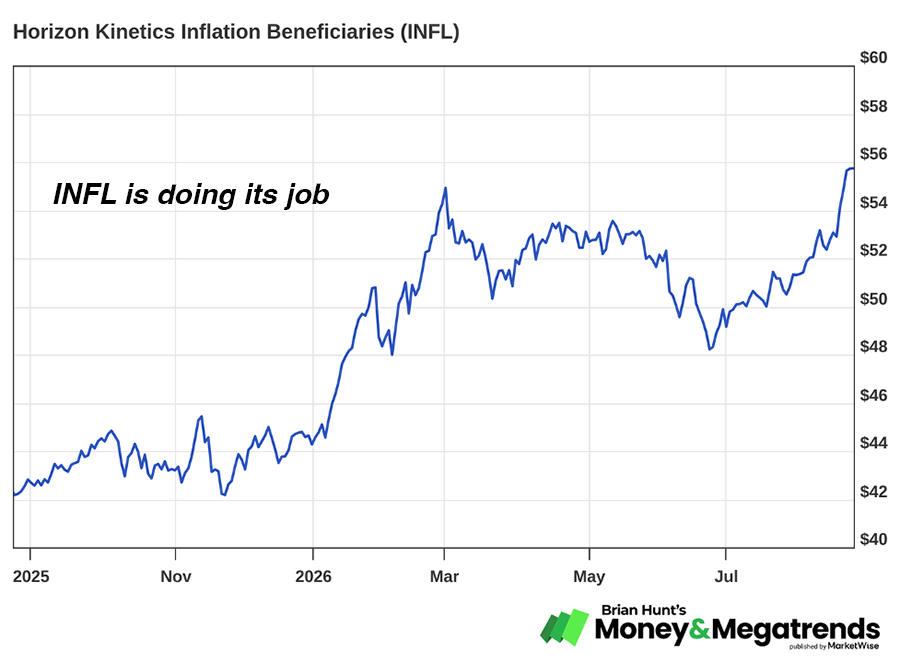
Or, if you don’t want to spend the time and energy required to buy individual stocks, you can make it easy and buy the Horizon Kinetics Inflation Beneficiaries ETF (INFL).

INFL is built around the ideas of the highly respected investor Murray Stahl and his team at Horizon Kinetics. Stahl – who passed away this year – was an “intellectual pioneer” in the world of investing. A dive into his writings and teachings is a wonderful education on many important wealth-building and investment concepts.

Stahl understood currency debasement and how to protect yourself from it as well as anyone else. INFL is the product of his company’s thinking. It holds precious metals royalty firms such as Wheaton Precious Metals (WPM), OR Royalties (OR), and Franco-Nevada (FNV). It also holds oil and gas royalty firms PrairieSky Royalty (PSK.TO), Viper Energy (VNOM), and Permian Basin Royalty Trust (PBT).

Natural resource royalty firms are a unique type of company. They do not engage in the actual business of drilling for oil or mining gold or copper. Instead, they are essentially resource banking/investment firms. They raise investor capital and then invest it in prospective or existing resource projects.

They partner with mine and oilfield operators… buying upfront stakes in projects in exchange for a share of future production. In doing this, the best royalty firms own diversified resource portfolios and enjoy high-margin businesses without doing the day-to-day work of operating mines or oilfields.

This “high margin, heavy asset-lite” business model makes firms like Wheaton and Franco-Nevada preferred natural resource investment vehicles for many sophisticated investors. And INFL is heavily invested in them.

INFL owns a mixed bag of other quality stocks with irreplaceable assets. It owns blue chip uranium miner Cameco (CCJ). It owns Texas-based A.I. data center play LandBridge (LB), which supplies the tech industry with the land, water, natural gas, and infrastructure resources to build and operate data centers. It also owns financial exchanges Intercontinental Exchange (ICE, operator of NYSE) and CME Group (CME, a futures and options giant). Revenue for these firms rises as inflation pushes the value of financial contracts higher.

Recent government spending and taxation data tell us the government is going “full speed ahead” with spending, borrowing, and printing. This means owning quality “inflation defense” assets is as important as ever. If you don’t want to spend the time and energy picking the kinds of individual stocks mentioned above, INFL is a quality “one click, and you’re done” way to do it. The fund is doing its job. It hit a new high this week.

Image

Recommended Link:

Elon Musk’s Insane Projection: 7,692,207%

Ad Image

Where should you invest $100 right now? Elon Musk just invented and patented this new AI technology… And he’s predicting it will launch a NEW industry that will grow more than 7 million percent in the coming years. Even if he’s only 10% right, that would still be enough to grow $100 into more than $700,000. Click here to see the details on what Elon Musk called “an infinite money glitch.”

This unique market indicator is flashing BULLISH right now

Image

Credit: Vladimir Razguliaev

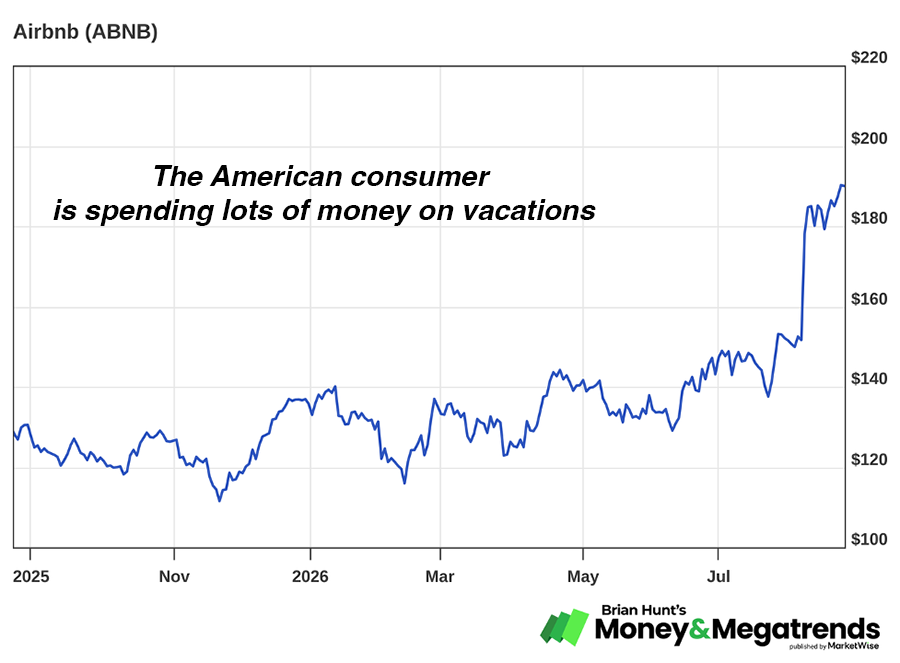
On Aug. 6, travel and hospitality giant Airbnb (ABNB) reported revenue, bookings, and earnings that exceeded Wall Street analyst expectations.

Year-over-year revenue grew 17%. Gross Booking Value (the total value of all bookings) grew 16%. Net income grew 27%.

This excellent news sent Airbnb stock soaring to a new one-year high, with the highest trading volume of the year. Thanks to its strong growth and profitability metrics, Airbnb shares have gained 46% over the past year.

Airbnb’s outstanding performance is yet another “real world” indicator that says the American consumer and the economy that depends on it are doing quite well.

Many investors fixate on government data such as unemployment figures, job hirings, and the Consumer Price Index. I like to know that data as everyone else does.

However, when I want a read on what’s really happening in the economy, I place far greater focus on what’s happening in the real world. I look at the stock price action of companies that play important roles in our economy. In doing this, I listen to the judge, jury, and executioner of any thesis, any trend, and any claim: The market. The market knows a hell of a lot more about the economy than any economist or financial guru. You’re wise to listen to it.

Today’s market prices are the sum total and current manifestation of all knowledge held by industry insiders, connected investors, government officials, and bankers who quietly control huge swaths of the economy. These people know 50 times as much about their industries of focus as you or I do.

Their knowledge manifests itself through action… and that action that sets market prices. Market prices are not always perfect, but most of the time, they know hell of a lot more than any economist, podcaster, X poster, or investment guru.

Over the past eight months, I’ve written over a dozen research notes analyzing the soaring share prices of highly economically sensitive industry groups, including trucking stocks, railroad stocks, regional banks, manufacturing stocks, steelmakers, shopping mall operators, and hotel chains.

At the end of each note, I pointed to their soaring stock prices and told readers that the U.S. economy is doing much better than most people think

Each of the above industries is highly sensitive to ups and downs in the U.S. economy. Their fortunes rise and fall with America’s ability to build infrastructure projects, go on vacation, transport goods, spend money at the mall, and generally just “get along.” And many people don’t realize this, but stock prices in those industries are booming.

This exceptional price strength across a broad swath of critical companies, which are highly sensitive to U.S. economic health, suggests the economy is doing very well.

Airbnb is another piece of this mosaic of bullish market signals. Airbnb is one of the world’s largest online travel marketplaces. It connects travelers with hosts offering homes, apartments, and other accommodations. Unlike conventional hotel chains, Airbnb owns virtually no lodging itself.

Given Airbnb’s line of business, its fortunes rise and fall along with the American consumer’s propensity to spend money on vacations and family get-togethers. This company does not enjoy rising earnings and a soaring stock price when the American consumer is struggling.

Add Airbnb’s strong business and stock performance to our growing list of trends that are moving in a very bullish direction for the U.S.A.

Image


This trend is generating a stream of wealth that will turn into a river. Are you benefiting yet?

Image

Credit: gorodenkoff

As we go to press today, one of our top megatrend “picks to click” – the ARK Genomic Revolution ETF (ARKG) is up 4.8% to reach a new one-year high. It’s now up 57% since our bullish May 28 note.

It’s also a strong sign that we are in an extremely favorable environment for the healthcare/biotechnology megatrend.

One of our core jobs at Money & Megatrends is to get you on the right side of gigantic, multi-year tech, business, and demographic trends that shape our world and create enormous wealth.

We’re looking to invest in themes and industries with such massive runways for growth… with so much potential to create value for society… that could attract such large money flows… that financially, we are running downhill… and playing the game of wealth-building in “Easy” mode.

We believe healthcare and biotechnology are such areas. Importantly, the market is agreeing with us. It is paying us to think this way.

This means the Preventive Diagnostics theme we introduced on June 12 is a compelling investment trend you should be aware of.

Over the past 20 years, preventive healthcare diagnostics have improved dramatically due to advances in genomics, imaging technology, and data analytics. Genetic testing has become faster and less expensive, allowing earlier identification of disease risks. High-resolution imaging and improved laboratory testing can detect conditions such as cancer, heart disease, and diabetes at much earlier stages.

Wearable devices and remote monitoring tools continuously track vital signs and health trends, enabling early intervention. Electronic health records and artificial intelligence help clinicians identify risk patterns and personalize screening recommendations.

Together, these innovations are shifting healthcare from reactive illness care to predictive, preventive, and proactive disease management before serious symptoms develop. The shift from reactive treatment to early detection is still early, but the numbers already reflect its momentum.

The U.S. health care diagnostics market was valued at $35.7 billion in 2024 and is projected to reach nearly $60 billion by 2030, growing at an annual rate of over 9%. Globally, clinical diagnostics is on track to hit $170 billion by the end of the decade. North America commands nearly half of that market.

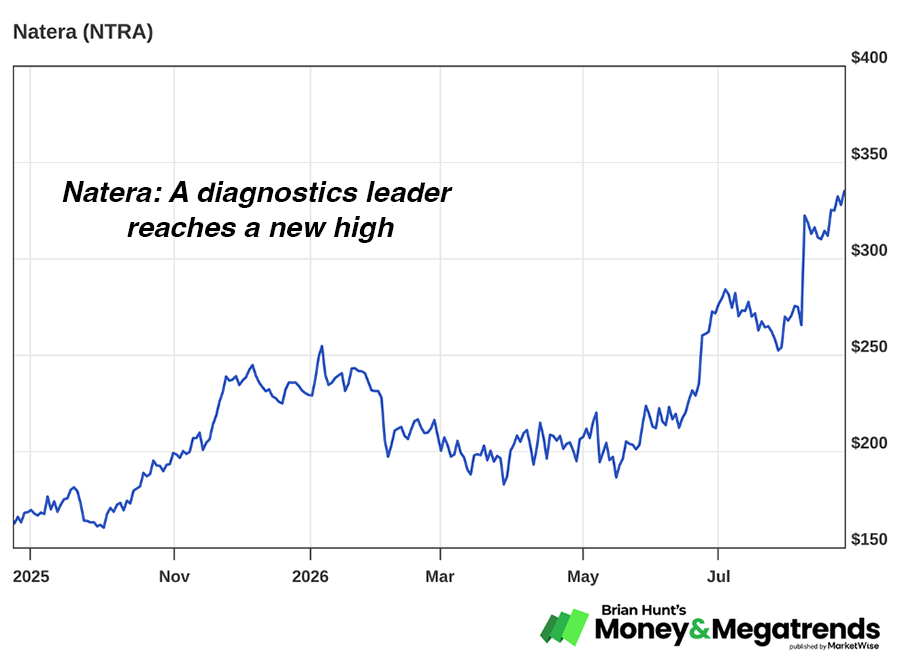
In our June 12 note, we highlighted cancer diagnostics firms GRAIL (GRAL) and Natera (NTRA) as compelling opportunities inside this trend.

This morning, GRAL advanced 8% to reach a new six-month high. The stock is up 37% in less than three months since our note. Natera advanced 1.9% to reach a new all-time high. The stock is up 52% since our note. DNA sequencing and analytics giant Illumina (ILMN) – which we’ve highlighted many times in our genomics analysis – advanced to a new all-time high this week.

We are in the early innings of a historic revolution in health care. Technological advances in DNA sequencing, AI analytics, imaging, wearables, and testing are moving this area of our lives from the reactive, “one size fits all” shotgun approach to the much better proactive, preventative, customized-for-the-individual approach. This will change the world and create huge amounts of wealth along the way. The gains detailed above are a stream that will become the Amazon River.

Image


Market Notes

  • Our Oct. 30th recommendation to go long biotech is doing well. AbCellera (ABCL) is up 10% today, Corcept Therapeutics (CORT) hit a new high, and Twist Bioscience (TWST) also hit a new high. TWST is now up 443% in the last year.

  • The American consumer continues to spend. Credit card giant Visa (V) reached a new all-time high this week.

  • Our recommendation to get long the copper mining megatrend continues to pay off. Blue chip miner Freeport-McMoRan (FCX) reached a new all-time high today.

  • Our June 8th recommendation to invest in healthcare businesses and oncology businesses is paying off. Kura Oncology (KURA), Ideaya Biosceinces (IDYA), Xencor (XNCR), and Crinetics Pharmaceuticals (CRNX) are all up at highs today.

  • LNG shipping leaders are hitting new highs. Pyxis Tankers (PXS) and BW LPG (BWLP) hit new highs today.

  • Regional banks like First Community Bankshares (FCBC) and Private Bancorp of America (PBAM) hit new highs today.

  • Our March 13th recommendation to get long Bitcoin is working out well. Crypto ETFs like iShares Bitcoin Premium Income ETF (BITA) and Bitwise Solana Staking ETF (BSOL) hit new multi-month highs today.

Regards,

Brian Hunt signature

Brian Hunt signature

Brian Hunt
Editor, Money & Megatrends


An urgent message from our colleagues:

#1 Stock to Own as Trump Launches Historic Mission Backing “Medical AI”

Image

In the biggest federal push since the Apollo program that landed on the Moon… Trump is now pouring the full support of the federal government into a new type of AI that could soon be worth 500 times more than ChatGPT. It works 10,000 times faster than human PhDs… and Elon Musk calls the underlying tech “the most disruptive force in history.”

Click here to learn about the #1 stock to own as this new AI goes live.

The post Own the world’s best inflation defense stocks in one ETF appeared first on MarketWise.

❌