
 Login

Own the world’s best inflation defense stocks in one ETF
Today’s issue in preview:
-
Own the world’s best inflation defense stocks in one ETF
-
This unique market indicator is flashing BULLISH right now
-
This trend is generating a stream of wealth that will turn into a river. Are you benefiting yet?
-
Learn our Top Themes to buy now
Own the world’s best inflation defense stocks in one ETF

Credit: bjdlzx
Over the past six months, I’ve written a special series of research notes on publicly traded assets such as timberland giant Weyerhaeuser (WY), U.S. natural gas stocks, and construction aggregates firm Vulcan Materials (VMC) that can add a robust “inflation defense” component to your financial life.
You probably know why being vigilant against inflation is important: governments in most Western nations have promised far too many things to far too many people. They are spending far more on taxpayer benefits and wars than they collect in tax revenues.
The related debts and obligations governments have taken on cannot possibly be paid back with sound money. They can only be paid back with debased, devalued money… much of which is created out of thin air. This is driving inflation and significant currency debasement.
Measured against a basket of commonly traded raw materials, the dollar has lost 51% of its value over the past eight years. That’s an annualized loss of purchasing power of about 10%.
Prices are going up because the value of our money is going down.
Everyone should consider which assets can help them preserve their wealth during periods of inflation.
When I provide people recommendations on how to approach this challenge, I urge them to keep my number one rule in mind: You want to own in-demand, useful assets that cannot be easily replaced or replicated. You want to own businesses and real estate properties that produce in-demand, scarce resources, products, and services.
This group of assets includes quality farmland, beachfront real estate, timberland, great businesses, and oil and gas pipelines.
When a very difficult or impossible-to-replicate business or piece of real estate produces in-demand, scarce resources, products, and services, it tends to hold its value no matter what the dollar is doing. Its price will constantly “recalibrate” to accommodate an increase in currency units.
It’s like the difference between slicing a pizza into 6 or 8 pieces. The number of slices changed, but the amount of pizza is the same.
To put these ideas into practice, you can review our work (linked above) on copper mines, timberland, natural gas deposits, oil and gas pipelines, and construction aggregate mines and accumulate ownership stakes in the stocks we’ve profiled.
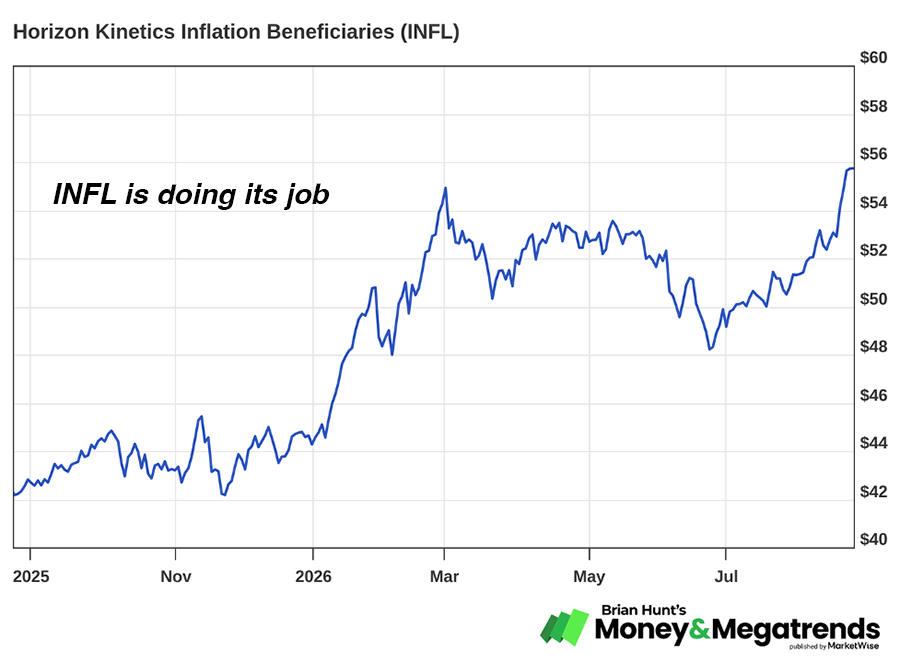
Or, if you don’t want to spend the time and energy required to buy individual stocks, you can make it easy and buy the Horizon Kinetics Inflation Beneficiaries ETF (INFL).
INFL is built around the ideas of the highly respected investor Murray Stahl and his team at Horizon Kinetics. Stahl – who passed away this year – was an “intellectual pioneer” in the world of investing. A dive into his writings and teachings is a wonderful education on many important wealth-building and investment concepts.
Stahl understood currency debasement and how to protect yourself from it as well as anyone else. INFL is the product of his company’s thinking. It holds precious metals royalty firms such as Wheaton Precious Metals (WPM), OR Royalties (OR), and Franco-Nevada (FNV). It also holds oil and gas royalty firms PrairieSky Royalty (PSK.TO), Viper Energy (VNOM), and Permian Basin Royalty Trust (PBT).
Natural resource royalty firms are a unique type of company. They do not engage in the actual business of drilling for oil or mining gold or copper. Instead, they are essentially resource banking/investment firms. They raise investor capital and then invest it in prospective or existing resource projects.
They partner with mine and oilfield operators… buying upfront stakes in projects in exchange for a share of future production. In doing this, the best royalty firms own diversified resource portfolios and enjoy high-margin businesses without doing the day-to-day work of operating mines or oilfields.
This “high margin, heavy asset-lite” business model makes firms like Wheaton and Franco-Nevada preferred natural resource investment vehicles for many sophisticated investors. And INFL is heavily invested in them.
INFL owns a mixed bag of other quality stocks with irreplaceable assets. It owns blue chip uranium miner Cameco (CCJ). It owns Texas-based A.I. data center play LandBridge (LB), which supplies the tech industry with the land, water, natural gas, and infrastructure resources to build and operate data centers. It also owns financial exchanges Intercontinental Exchange (ICE, operator of NYSE) and CME Group (CME, a futures and options giant). Revenue for these firms rises as inflation pushes the value of financial contracts higher.
Recent government spending and taxation data tell us the government is going “full speed ahead” with spending, borrowing, and printing. This means owning quality “inflation defense” assets is as important as ever. If you don’t want to spend the time and energy picking the kinds of individual stocks mentioned above, INFL is a quality “one click, and you’re done” way to do it. The fund is doing its job. It hit a new high this week.
Recommended Link:
Elon Musk’s Insane Projection: 7,692,207%

Where should you invest $100 right now? Elon Musk just invented and patented this new AI technology… And he’s predicting it will launch a NEW industry that will grow more than 7 million percent in the coming years. Even if he’s only 10% right, that would still be enough to grow $100 into more than $700,000. Click here to see the details on what Elon Musk called “an infinite money glitch.”
This unique market indicator is flashing BULLISH right now

Credit: Vladimir Razguliaev
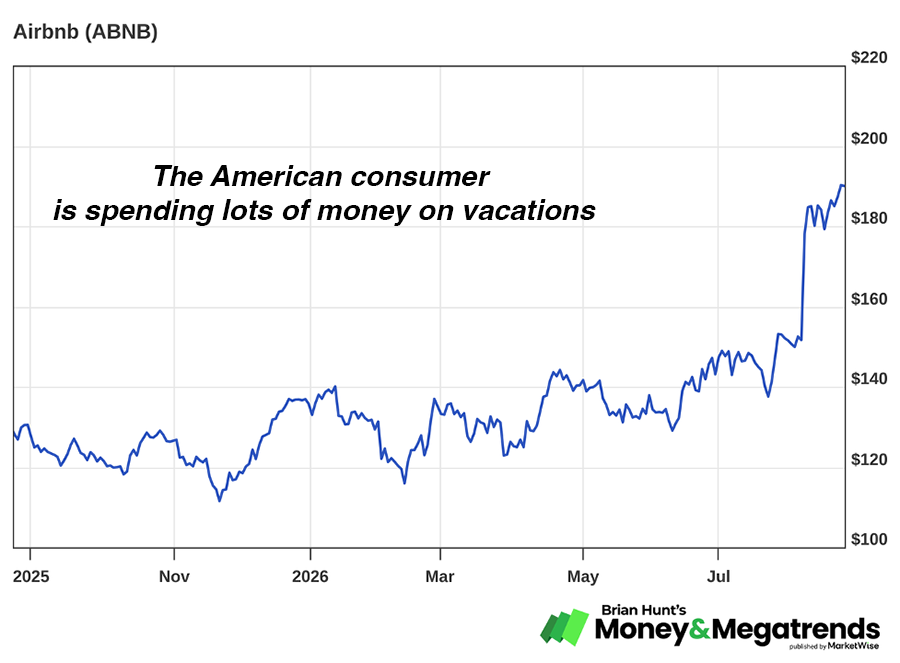
On Aug. 6, travel and hospitality giant Airbnb (ABNB) reported revenue, bookings, and earnings that exceeded Wall Street analyst expectations.
Year-over-year revenue grew 17%. Gross Booking Value (the total value of all bookings) grew 16%. Net income grew 27%.
This excellent news sent Airbnb stock soaring to a new one-year high, with the highest trading volume of the year. Thanks to its strong growth and profitability metrics, Airbnb shares have gained 46% over the past year.
Airbnb’s outstanding performance is yet another “real world” indicator that says the American consumer and the economy that depends on it are doing quite well.
Many investors fixate on government data such as unemployment figures, job hirings, and the Consumer Price Index. I like to know that data as everyone else does.
However, when I want a read on what’s really happening in the economy, I place far greater focus on what’s happening in the real world. I look at the stock price action of companies that play important roles in our economy. In doing this, I listen to the judge, jury, and executioner of any thesis, any trend, and any claim: The market. The market knows a hell of a lot more about the economy than any economist or financial guru. You’re wise to listen to it.
Today’s market prices are the sum total and current manifestation of all knowledge held by industry insiders, connected investors, government officials, and bankers who quietly control huge swaths of the economy. These people know 50 times as much about their industries of focus as you or I do.
Their knowledge manifests itself through action… and that action that sets market prices. Market prices are not always perfect, but most of the time, they know hell of a lot more than any economist, podcaster, X poster, or investment guru.
Over the past eight months, I’ve written over a dozen research notes analyzing the soaring share prices of highly economically sensitive industry groups, including trucking stocks, railroad stocks, regional banks, manufacturing stocks, steelmakers, shopping mall operators, and hotel chains.
At the end of each note, I pointed to their soaring stock prices and told readers that the U.S. economy is doing much better than most people think
Each of the above industries is highly sensitive to ups and downs in the U.S. economy. Their fortunes rise and fall with America’s ability to build infrastructure projects, go on vacation, transport goods, spend money at the mall, and generally just “get along.” And many people don’t realize this, but stock prices in those industries are booming.
This exceptional price strength across a broad swath of critical companies, which are highly sensitive to U.S. economic health, suggests the economy is doing very well.
Airbnb is another piece of this mosaic of bullish market signals. Airbnb is one of the world’s largest online travel marketplaces. It connects travelers with hosts offering homes, apartments, and other accommodations. Unlike conventional hotel chains, Airbnb owns virtually no lodging itself.
Given Airbnb’s line of business, its fortunes rise and fall along with the American consumer’s propensity to spend money on vacations and family get-togethers. This company does not enjoy rising earnings and a soaring stock price when the American consumer is struggling.
Add Airbnb’s strong business and stock performance to our growing list of trends that are moving in a very bullish direction for the U.S.A.
This trend is generating a stream of wealth that will turn into a river. Are you benefiting yet?

Credit: gorodenkoff
As we go to press today, one of our top megatrend “picks to click” – the ARK Genomic Revolution ETF (ARKG) is up 4.8% to reach a new one-year high. It’s now up 57% since our bullish May 28 note.
It’s also a strong sign that we are in an extremely favorable environment for the healthcare/biotechnology megatrend.
One of our core jobs at Money & Megatrends is to get you on the right side of gigantic, multi-year tech, business, and demographic trends that shape our world and create enormous wealth.
We’re looking to invest in themes and industries with such massive runways for growth… with so much potential to create value for society… that could attract such large money flows… that financially, we are running downhill… and playing the game of wealth-building in “Easy” mode.
We believe healthcare and biotechnology are such areas. Importantly, the market is agreeing with us. It is paying us to think this way.
This means the Preventive Diagnostics theme we introduced on June 12 is a compelling investment trend you should be aware of.
Over the past 20 years, preventive healthcare diagnostics have improved dramatically due to advances in genomics, imaging technology, and data analytics. Genetic testing has become faster and less expensive, allowing earlier identification of disease risks. High-resolution imaging and improved laboratory testing can detect conditions such as cancer, heart disease, and diabetes at much earlier stages.
Wearable devices and remote monitoring tools continuously track vital signs and health trends, enabling early intervention. Electronic health records and artificial intelligence help clinicians identify risk patterns and personalize screening recommendations.
Together, these innovations are shifting healthcare from reactive illness care to predictive, preventive, and proactive disease management before serious symptoms develop. The shift from reactive treatment to early detection is still early, but the numbers already reflect its momentum.
The U.S. health care diagnostics market was valued at $35.7 billion in 2024 and is projected to reach nearly $60 billion by 2030, growing at an annual rate of over 9%. Globally, clinical diagnostics is on track to hit $170 billion by the end of the decade. North America commands nearly half of that market.
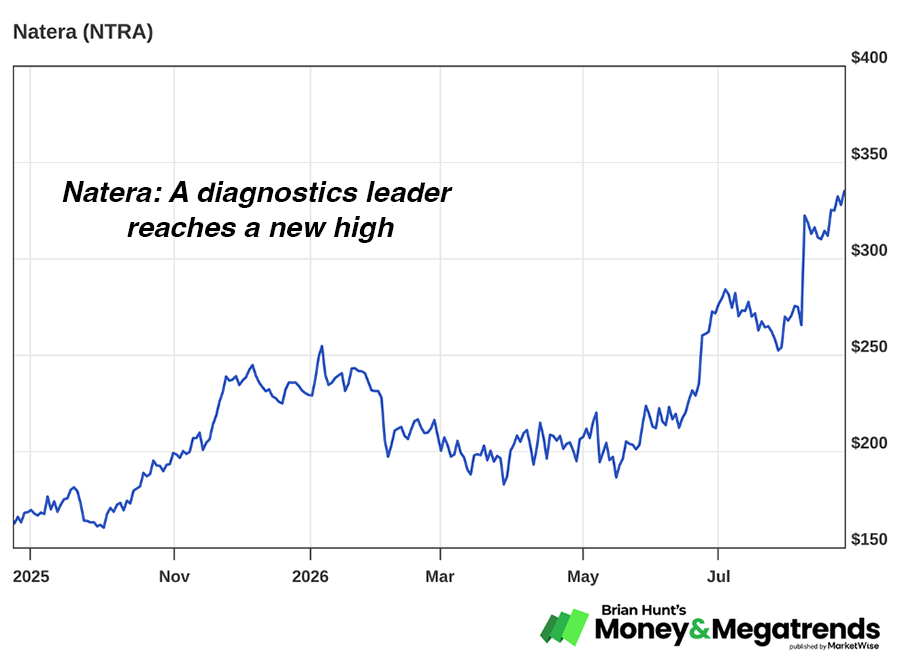
In our June 12 note, we highlighted cancer diagnostics firms GRAIL (GRAL) and Natera (NTRA) as compelling opportunities inside this trend.
This morning, GRAL advanced 8% to reach a new six-month high. The stock is up 37% in less than three months since our note. Natera advanced 1.9% to reach a new all-time high. The stock is up 52% since our note. DNA sequencing and analytics giant Illumina (ILMN) – which we’ve highlighted many times in our genomics analysis – advanced to a new all-time high this week.
We are in the early innings of a historic revolution in health care. Technological advances in DNA sequencing, AI analytics, imaging, wearables, and testing are moving this area of our lives from the reactive, “one size fits all” shotgun approach to the much better proactive, preventative, customized-for-the-individual approach. This will change the world and create huge amounts of wealth along the way. The gains detailed above are a stream that will become the Amazon River.
Market Notes
-
Our Oct. 30th recommendation to go long biotech is doing well. AbCellera (ABCL) is up 10% today, Corcept Therapeutics (CORT) hit a new high, and Twist Bioscience (TWST) also hit a new high. TWST is now up 443% in the last year.
-
The American consumer continues to spend. Credit card giant Visa (V) reached a new all-time high this week.
-
Our recommendation to get long the copper mining megatrend continues to pay off. Blue chip miner Freeport-McMoRan (FCX) reached a new all-time high today.
-
Our June 8th recommendation to invest in healthcare businesses and oncology businesses is paying off. Kura Oncology (KURA), Ideaya Biosceinces (IDYA), Xencor (XNCR), and Crinetics Pharmaceuticals (CRNX) are all up at highs today.
-
LNG shipping leaders are hitting new highs. Pyxis Tankers (PXS) and BW LPG (BWLP) hit new highs today.
-
Regional banks like First Community Bankshares (FCBC) and Private Bancorp of America (PBAM) hit new highs today.
-
Our March 13th recommendation to get long Bitcoin is working out well. Crypto ETFs like iShares Bitcoin Premium Income ETF (BITA) and Bitwise Solana Staking ETF (BSOL) hit new multi-month highs today.
Top Themes to Buy Now
🔌 This “AI Power” trade is moving higher… are you on board?
Regards,
Brian Hunt
Editor, Money & Megatrends
An urgent message from our colleagues:
#1 Stock to Own as Trump Launches Historic Mission Backing “Medical AI”
In the biggest federal push since the Apollo program that landed on the Moon… Trump is now pouring the full support of the federal government into a new type of AI that could soon be worth 500 times more than ChatGPT. It works 10,000 times faster than human PhDs… and Elon Musk calls the underlying tech “the most disruptive force in history.”
Click here to learn about the #1 stock to own as this new AI goes live.
The post Own the world’s best inflation defense stocks in one ETF appeared first on MarketWise.
