Key Points
Anthropic is reportedly in talks to acquire Decart AI, an AI optimization and world model company, for an estimated $6 billion as it looks to reduce operating costs and improve efficiency.
The potential deal comes as Anthropic prepares for an IPO that its investors argue could value the company at $2 trillion or more, potentially making it the largest public-market debut ever.
Anthropic’s investors are working to build excitement around the IPO before the company’s
Anthropic is reportedly in talks to acquire Decart AI, an AI optimization and world model company, for an estimated $6 billion as it looks to reduce operating costs and improve efficiency.
The potential deal comes as Anthropic prepares for an IPO that its investors argue could value the company at $2 trillion or more, potentially making it the largest public-market debut ever.
Anthropic’s investors are working to build excitement around the IPO before the company’s financials become public, which could reveal substantial losses.
Anthropic is on the verge of acquiring Decart AI, a company that increases the efficiency of artificial intelligence (“AI”) chips, as Anthropic seeks to lower operating costs in a brutally competitive market. Anthropic is racing toward what its investors insist will be a $2 trillion initial public offering (“IPO”), and the company needs a compelling story showing how it can get on a path to profitability.
The deal would be worth about $6 billion, according to Bloomberg, making it the AI lab’s largest acquisition ever. Decart provides optimization software that helps squeeze more performance from chips, lowering the cost of training AI models. The startup also builds “world models,” a kind of simulation that mimics the real world and helps AI models navigate it effectively.
Besides the potential to lower costs, the acquisition of Decart could allow Anthropic to serve more users on existing hardware. That may prove useful as AI labs say they’re capacity-constrained by the fast-rising demand for services and the relatively slow build-out of AI data centers.
Anthropic and its key American rival, OpenAI, face rapidly increasing cost pressures, as low-cost Chinese AI model companies such as DeepSeek and Moonshot churn out high-quality models that may cost just 5% to 10% of what their American rivals charge. As a result, Chinese models have been rapidly growing their market share.
OpenAI has responded by slashing prices on one of its newest AI models by up to 80%, a move that threatens to heat up a simmering price war in the industry. OpenAI’s move shows AI labs lack pricing power and threatens the company’s ability to ever go public.
Anthropic feels the price pressure as well. As the AI industry’s dynamics rapidly shift and costs become ever more important, Anthropic is rushing its IPO across the finish line. Reports suggest that the company is still targeting an October debut, and it has been touting its sales growth in recent months to keep investors warm for the offering.
Media Pumping Anthropic $2 Trillion IPO Rumor
Have you ever gone to a restaurant and paid for a meal before you even knew what you’re being served? Of course not, but that’s what a few investors are doing for the Anthropic IPO, trying to attach a $2 trillion price tag to the offering before the public knows what they’re getting.
Unfortunately, the Financial Times is helping them do it. The pink paper quoted a half-dozen Anthropic investors who said the AI lab could hit a $2 trillion valuation for an IPO. That would make Anthropic the largest IPO of all time, surpassing SpaceX’s (SPCX) recent public offering.
Sharp investors should be highly dubious and consider this primarily as an approach to pump the stock of an upcoming IPO:
Anthropic’s backers say booming demand for the lab’s advanced AI models and tools justifies their lofty expectations. Investors expect the Claude maker’s annualised revenue to be between US$100 billion and US$120 billion by the end of 2026 — using the start-up’s preferred measure, which infers full-year sales from recent performance — up by more than 10 times over the course of 2026.
Incredibly, the Financial Times goes on to quote one investor who posits a $3 trillion valuation on Anthropic.
Let’s unpack some of what’s happening here.
The $2 trillion IPO valuation is insiders’ price target. Insiders are trying to normalize a $2 trillion figure for the investing public, so it looks reasonable. A $3 trillion valuation, also tossed around, helps make $2 trillion look less extreme.
The public is being fed this info by highly interested insiders.This valuation data is being fed to the media by insiders who have an investment interest of millions to billions in an Anthropic IPO, so they want to use the largest number possible.
No detailed financial information is public yet. Anthropic’s financial info remains high-level in this FT article, so the public can’t clearly know what it would get for $2 trillion. How much money is Anthropic losing, and what is its trend toward profitability?
Annualized revenue is not defined. While insiders provide a target for annualized revenue, the formula isn’t clearly defined. A guess might be that it’s 12 times the last month’s revenue, but that is not really clear. This lack of clarity works well for those who want the investing public to be ready to buy the IPO stock at any price.
Annualized revenue is not revenue.Annualizing revenue is a forecast of what revenue would look like over the course of a year. So it’s not a statement of realized revenue, as the figures on financial statements filed by publicly traded companies are. For a high-growth company, annualized revenue will generally look much higher than actual revenue.
In short, the Financial Times is offering readers the best possible image of Anthropic – full of make-up, doused with perfume, and with a photo filter on. The point of this kind of “media plant” is to get the investing public excited about AI as “the wave of the future,” so that it uncritically buys whatever the big investors are selling BEFORE they see the financials.
Billionaire Elon Musk used a similar strategy with the SpaceX IPO. Musk publicized a $1.5 trillion IPO figure in late 2025 and early 2026 before detailed financials were made public – indeed before even filing the IPO paperwork. The pre-IPO figure rose to $1.75 trillion, and company officials even briefly worked $2 trillion into the conversation before the IPO.
While SpaceX went up briefly in the wake of the IPO, it has been mostly down since then. The pre-IPO jawboning helped the company price the stock at a massive overvaluation.
So, investors should carefully review Anthropic’s financials when they’re released to see what they’d be getting for their money. Insiders are using the media to normalize a huge valuation before the public is forced to see Anthropic’s actual – quite likely terrible – financial figures.
Regards,
James Royal, PhD
Editor’s Note: Could a major AI company’s “silent IPO” end up overshadowing both SpaceX and Anthropic?
According to Marc Chaikin — the 60-year Wall street legend who called Nvidia before it shot up 45,000% — a tech firm that been called “the unseen winner of the AI race” could soon break itself up into three separate companies.
If it does, the next Netflix… the next Tesla… and the next Amazon are all poised to spin off just from this one stock. That means, if you simply make one trade today, you could could automatically get your hands on shares of all these potential spinoff IPOs with no more work on your part.
Key Points
Stablecoins are becoming an increasingly ordinary part of the financial system’s infrastructure, and that shift toward mainstream adoption is creating a new investment case.
Circle and Coinbase offer different ways to invest in the same stablecoin ecosystem, with both positioned to benefit from the new GENIUS Act regulatory framework.
Real-world stablecoin usage remains small but is doubling, while clearer regulation could encourage banks, payment companies, and la
Stablecoins are becoming an increasingly ordinary part of the financial system’s infrastructure, and that shift toward mainstream adoption is creating a new investment case.
Circle and Coinbase offer different ways to invest in the same stablecoin ecosystem, with both positioned to benefit from the new GENIUS Act regulatory framework.
Real-world stablecoin usage remains small but is doubling, while clearer regulation could encourage banks, payment companies, and large businesses to accelerate adoption.
Shares of Circle Internet Group (CRCL) and Coinbase (COIN) both moved higher on Monday after the Treasury Department proposed new rules for the GENIUS Act, the stablecoin law enacted in July 2025. The proposal will be open to public comment for 60 days, with a final rule expected before January 2027.
Although stablecoins won’t suddenly become mainstream simply because the Treasury Department published its proposal, something more important has already happened.
Stablecoins are getting boring.
For most of crypto’s history, that would have sounded like an insult. Now, it may be stablecoins’ investment case.
The original crypto pitch involved overthrowing banks, replacing currencies, and cutting out financial intermediaries. Stablecoins are turning into something much less dramatic – a form of payments infrastructure. Mastercard (MA) is building around them. Payments app MoneyGram uses them. Businesses can settle payments at midnight on a Sunday instead of waiting for the banking system to open.
In short, stablecoins are becoming part of our ordinary world.
The GENIUS Act’s Impact on Stablecoins and Crypto Stocks
That leaves investors with a more useful question than whether crypto is “the future.” The question now is: If stablecoins become ordinary financial plumbing, who gets paid for it?
Circle and Coinbase have two very different answers…
A stablecoin such as Circle’s USDC is a digital dollar that can move across blockchain networks at any hour. The useful part of that idea has little to do with a person buying a cup of coffee… Electronic payment networks such as Mastercard and Visa (V) already handle those types of transactions just fine.
The bigger opportunity is where the existing system gets expensive or slow. Again, with traditional finance, those drawbacks happen with things like cross-border payments, remittances, corporate treasury, and settlement outside banking hours.
On stablecoin rails, the payment and settlement can become the same event rather than a message followed by money moving a day or two later. The hope is to fix these inefficiencies.
That gets us to Circle.
Circle issues USDC and holds reserves against those coins. It earns interest on the reserves it holds. In the second quarter, reserve income was $667.7 million, or 95.2% of Circle’s total revenue. Average USDC in circulation reached about $76.5 billion, up from $61 billion a year earlier.
The attraction is obvious. If more businesses and consumers use USDC, Circle gets more dollars to hold in reserve and potentially more reserve income.
But there’s a catch.
Circle’s economics depend heavily on interest rates. Lower rates mean lower returns on those reserves. Circle’s own filing estimates that a one-percentage-point decline in rates, if USDC circulation remains constant, would cut annual reserve income by roughly $737 million.
Then there’s Coinbase.
Coinbase is fascinating because it sits on the other side of Circle’s economics. It distributes USDC and gets paid handsomely for doing it.
Circle paid Coinbase $324.6 million in distribution costs in the second quarter alone. Coinbase says its customers held a total of $20 billion in USDC in Coinbase Products, on average, during the quarter – more than 30% of the total supply of USDC.
Coinbase captured roughly half of all USDC economics (meaning the yield earned by the investments USDC holds and who benefits from it) over the past year.
That gives investors two very different stocks tied to the same trend.
Circle makes more money when USDC circulation and reserve income grow… while Coinbase gets a large piece of the economics for putting USDC in front of customers.
Stablecoins also give Coinbase something it badly wants: revenue that doesn’t require customers to trade bitcoin constantly. Subscription and services revenue reached $555 million last quarter, or 48% of net revenue.
The Next Test for Stablecoins Is Real-World Use
There’s plenty of room for stablecoins to disappoint, however.
Most stablecoin activity still has little to do with buying goods or paying workers. The figures I have been watching put actual payments at roughly $390 billion out of about $35 trillion in stablecoin-network activity over a recent 12-month period (annualized for 2025 in December). Call it 1%. Trading, arbitrage, and machines moving liquidity still dominate the industry.
I keep coming back to the other side of that number, though.
The payments portion is tiny, but it more than doubled from 2024 to 2025.
The GENIUS Act will not make stablecoins mainstream by itself. The Treasury cannot force people to use USDC. What stablecoin regulation can do is remove one of the primary reasons banks, payment companies, and large businesses have hesitated to build around it.
That creates competition, too. Circle and Coinbase will not have this market to themselves.
But the investment question has become much more concrete. We no longer have to ask whether blockchain will someday find a use beyond crypto trading.
Money is already moving over these networks, and we’ll soon get to find out who exactly stands to gain when stablecoins become part of the main financial plumbing.
Good investing,
Eric Wade
Editor’s Note: Whitney Tilson … hedge fund legend, Harvard grad, and the investor CNBC called “The Prophet” … just stepped forward not just as a financial expert, but as a father and an American. He says we’re entering the most chaotic six months this country has seen in a generation. The signs are already everywhere. And he believes most people have no idea what’s coming for their money. His warning (and the one move he says can make all the difference) is in his free presentation.
Key Points
CoreWeave has rebounded about 54% from its one-month low, fueled partly by stunning sales growth despite the company’s continued lack of profitability.
While revenue grew 112% in the second quarter, CoreWeave’s net profit margin worsened year over year as soaring interest expenses consumed much of the incremental gains.
A broad range of insiders have aggressively sold hundreds of millions of dollars worth of shares, raising a major warning sign for investors.
CoreWeave has rebounded about 54% from its one-month low, fueled partly by stunning sales growth despite the company’s continued lack of profitability.
While revenue grew 112% in the second quarter, CoreWeave’s net profit margin worsened year over year as soaring interest expenses consumed much of the incremental gains.
A broad range of insiders have aggressively sold hundreds of millions of dollars worth of shares, raising a major warning sign for investors.
Neocloud stock CoreWeave (CRWV) has sharply risen by about 54% from its one-month low of $60.55, making now a good time for investors to consider heading to the sidelines after the latest rally.
The artificial-intelligence (“AI”) data-center company is both debt-heavy and relies on continual financing to stay afloat. Worse, the people who know the company best – executives and other insiders – have been unloading the stock as fast as they can.
In short, if the AI bubble bursts, there are reasons to think that CoreWeave could go to zero.
If you look at the surface of CoreWeave’s results, you might think that nothing’s the matter. In fact, the company’s rapidly increasing sales in recent quarters would seem to nullify any bearish fears. But a closer look shows why I said CoreWeave is one of five AI stocks that could go bust.
Period
Sales growth
Operating margin
Interest expense
Net margin
Q1 2025/2026
112%
-2.7%/-6.9%
$264/$536*
-32.1%/-35.5%
Q2 2025/2026
112%
1.6% / -1.9%
$267/$640*
-23.9%/-24.3%
* Figures in millions of dollars
On the top line, CoreWeave grew sales 112% year over year in both the first and second quarters of 2026. For any normal company, such rapid sales growth would quickly translate into much higher operating margins, but the improvement has been less obvious here.
We didn’t see higher operating margins in the first quarter, as they fell from negative 2.7% last year to negative 6.9% in the first quarter of this year. Second-quarter operating margin also fell, from 1.6% last year to negative 1.9% this year. However, operating margin improved sequentially from the first quarter to the second quarter, so it’s important to see whether this trend continues.
While operating margin is a key financial factor, CoreWeave’s heavy use of leverage makes the net margin especially important. Despite CoreWeave’s stellar sales growth, it’s taking on significant interest expense to finance that growth. As a result, net margin is not improving much, especially in the second quarter.
For example, CoreWeave paid $267 million in interest expense during the second quarter a year ago. In the second quarter this year, interest costs ballooned to $640 million. So, despite CoreWeave’s 112% sales growth, net margin actually worsened year over year, from negative 23.9% to negative 24.3%.
While CoreWeave reports those fast-growing sales figures in its press releases, it leaves out the fast-growing liabilities that finance them. To see that, you need to turn to Form 10-Q, where you can see just how much the company relies on liabilities.
Of the company’s $77.1 billion in assets as of June 30, 2026, about $72 billion are financed by liabilities. That leaves a meager $5 billion in shareholders’ equity supporting that pile of assets. In other words, CoreWeave is massively leveraged. If the value of those assets is written down by 6.5% or more, the company will have zero or negative shareholders’ equity.
Zero or negative shareholders’ equity might be fine for a company that has a strong history of turning a profit, but that’s not CoreWeave. It must keep financing its assets and paying interest.
With the company’s market capitalization of about $51.4 billion, investors are willing to pay about 9.1 times the book value of the company. Put another way, the market is saying the company’s assets are 9.1 times as valuable as their book value.
Despite huge growth, this valuation doesn’t make sense given the lack of profitability.
CoreWeave Insiders Are Selling Aggressively
But this analysis is not the only thing telling you CoreWeave’s valuation doesn’t add up. Key company insiders have been telling you all year that CoreWeave is overvalued, selling hundreds of millions of dollars in stock as fast as they can. The company’s recent addition to the Nasdaq 100 Index gave the stock another boost that insiders could sell into.
Before we run through some numbers, CoreWeave bulls will point out (rightly) that insiders may sell for many reasons. They sell to diversify their own portfolios, because they need cash elsewhere, and because they’re raising money to pay taxes on stock grants. At the same time, they typically buy only when they believe the stock is poised to go up.
Or as the old investment saying goes, “insiders sell for many reasons, but they buy for only one.”
But you rarely see the depth and breadth of selling that’s evident at CoreWeave. It’s the kind of thing that you should be terrified of if you own the stock. Insiders have been selling at a furious pace since August 2025 – when the company’s lockup on insider selling expired as part of its initial public offering. They’ve been selling every month since then, too. Plus, there has not been a single insider buy over that time, according to MarketBeat.
Let’s look at selling from the company’s CEO, Michael Intrator, over the past few months.
Insider
July (Sales/$)
June (Sales/$)
May (Sales/$)
CEO Michael Intrator
7 sales / $75.4 million
10 sales / $174.5 million
9 sales / $136.2 million
Source: MarketBeat
Intrator sold shares in seven separate batches in July for a total of $75.4 million, according to MarketBeat. That followed 10 sales for $174.5 million in June and nine sales for $136.2 million in May.
The CEO’s sales pattern goes back to August 2025.
But it’s not just the CEO selling shares. Rather, it’s a “Who’s Who” of CoreWeave that has been getting rid of shares at a brisk pace:
Brannin McBee, chief development officer
Nitin Agrawal, CFO
Kristen McVeety, general counsel
Brian Venturo, co-founder, director
Jack Cogen, director
Chen Goldberg, senior vice president of engineering
Jeff Baker, chief accounting officer
Sachin Jain, COO
Karen Boone, director
The amounts of stock they’ve sold differ, of course, from relatively small sales of a few shares to gargantuan amounts, such as the $49.4 million from Brannin McBee in September 2025 or the $105.3 million from Jack Cogen that same month.
All those sales and literally zero insider buys. Nothing is illegal, but as an investor (or potential investor) in CoreWeave, it’s an unambiguous signal that’s quite valuable.
Insiders selling CoreWeave stock this aggressively tells you almost everything you need to know about it as an investment. Tack on a business that can’t even budge its net profit margin despite 112% sales growth, and you have a stock that could plummet if the AI bubble bursts.
Regards,
James Royal, PhD
Editor’s Note: Whitney Tilson — the hedge fund manager CNBC called “The Prophet” — says America has reached its “Ripping Point.” The old financial order is being torn apart, and he believes most investors have no idea what’s coming in the next six months. He’s named the stocks he thinks will be destroyed in the chaos — and the ones he believes will soar. Watch his free presentation while it’s still available.
Key Points
The best dividend stocks can build long-term wealth while generating a growing stream of income that investors can use however they choose.
These top stocks offer current dividend yields of up to 5.9% and have increased their payouts by nearly 20% annually over the past five years.
The strongest dividend stocks are backed by durable businesses that can keep raising payouts for decades while also delivering capital gains.
The best dividend stocks offer solid
The best dividend stocks can build long-term wealth while generating a growing stream of income that investors can use however they choose.
These top stocks offer current dividend yields of up to 5.9% and have increased their payouts by nearly 20% annually over the past five years.
The strongest dividend stocks are backed by durable businesses that can keep raising payouts for decades while also delivering capital gains.
The best dividend stocks offer solid payouts that investors can rely on for years. They help investors build wealth over time, offer a growing dividend, and are backed by the safety of a company with a solid track record. With a sizable portion of their returns paid out in cash, these top stocks are a great choice for retirees or anyone seeking income.
Top dividend stocks can offer investors the following benefits:
Strong, long-term returns, with attractive capital gains and not just a high payout
A high dividend, with yields higher than 2%, much greater than the S&P 500’s yield
A growing dividend, with a payout that grows at least at the target rate of inflation
A solid business, a larger company that has survived and thrived, often for decades
Lower volatility, meaning the stock fluctuates less than the average stock
The best dividend stocks give you the chance to build wealth while offering a growing stream of dividends for decades, giving you the cash to spend however you like. Certain investors prefer dividend stocks with high yields and some growth over time, while others prefer a lower yield today but higher growth potential over time.
This list of 11 dividend stocks offers options for both approaches.
Best Dividend Stocks: How They Compare
Stock (Ticker)
Dividend yield
Five-year annualized dividend growth
Five-year annualized return
Verizon Communications (VZ)
5.9%
2.0%
2.0%
Edison International (EIX)
5.0%
5.7%
8.6%
Kimco Realty (KIM)
4.4%
8.6%
5.7%
Fidelity National Financial (FNF)
4.3%
8.4%
4.5%
Lamar Advertising (LAMR)
4.1%
19.9%
10.9%
Paychex (PAYX)
3.8%
11.9%
4.2%
CareTrust REIT (CTRE)
3.7%
6.0%
15.0%
Public Storage (PSA)
3.7%
8.5%
4.7%
NextEra Energy (NEE)
2.9%
10.7%
2.8%
McDonald’s (MCD)
2.7%
7.3%
5.0%
Coca-Cola (KO)
2.4%
4.5%
11.1%
Data: Charles Schwab, Morningstar, as of August 14, 2026
Everyone knows Verizon as one of the major U.S. telecom players, but maybe less well known is that it pays a massive dividend of nearly 6%. The trade-off for that high current yield is slow dividend growth, but investors can decide for themselves how they want to play the dividend game. The stock has not had a great five-year run, but its higher current yield gives investors plenty of reason to stick around and wait for the stock to catch a bid.
Market cap: $201 billion
Dividend yield: 5.9%
2. Edison International (EIX)
Electrical utilities can be great dividend picks because they enjoy stable, growing demand for their key product. They also tend to increase prices year after year, and their stock tends to be relatively stable because of these advantages. For California-based Edison, that has resulted in an attractive dividend and a history of raising it quickly.
Market cap: $27 billion
Dividend yield: 5.0%
3. Kimco Realty (KIM)
Kimco Realty is a real estate investment trust (“REIT”) that owns grocery-anchored shopping centers and mixed-use properties in major metro areas. Kimco’s “must-visit” properties generate reliable rents that grow over time, and as a REIT, it must pay out most of its income as dividends.
The company’s meaty current yield doesn’t come at the expense of strong dividend growth over the past five years either.
Market cap: $16 billion
Dividend yield: 4.4%
4. Fidelity National Financial (FNF)
Fidelity National Financial may not be a familiar name for many investors, but if you’ve ever bought or sold a house, there’s a good chance you’ve used the company for its title insurance. It’s the leading player in this oligopolistic industry, and it has delivered excellent returns over time, even if the past five years have been ho-hum.
It offers a high current yield, and management hasn’t been stingy about increasing the payout over the past half-decade, giving investors reason to hold the stock for a while.
The company has grown its meaty dividend nearly 20% annually over the past five years, on the way to putting up nearly 11% annualized returns.
Market cap: $16 billion
Dividend yield: 4.1%
6. Paychex (PAYX)
Paychex offers human resources management and payroll processing for small- and medium-sized businesses, among other related services. It has delivered tremendous returns for investors over time, even if the past five years have been a bit mediocre.
But that may be just a brief pause before another period of exceptional performance. Today’s investors can lock in a strong dividend and look for signs that management will raise that payout aggressively moving forward.
Market cap: $43 billion
Dividend yield: 3.8%
7. CareTrust REIT (CTRE)
CareTrust may not be a household name like others on this list, but it has delivered solid returns to investors, with a high yield and a growing payout over time.
As a REIT, it must make sizable dividend payments, and its business of leasing out healthcare facilities on long-term leases with annual rent escalators ensures the stable revenue that’s a prerequisite for a top dividend stock.
Market cap: $9 billion
Dividend yield: 3.7%
8. Public Storage (PSA)
Public Storage is the behemoth in the self-storage space. As a real estate investment trust, it has to pay out most of its income as dividends. It offers a high current yield that has grown at a brisk 8.5% annually over the past five years, meaning you’re getting the best of both worlds.
NextEra is one of the largest North American electric utilities, with about 80 gigawatts of generation and storage capacity. NextEra is almost the definition of a “must-have” asset, with a product that will always be in demand, even while offering strong upside as AI-driven power demand pushes prices higher.
The stock’s above-average dividend has been growing quickly over the past half-decade, and recent price weakness may be a long-term opportunity.
Market cap: $179 billion
Dividend yield: 2.9%
10. McDonald’s (MCD)
McDonald’s may be famous for its Big Mac, but the firm makes much of its money from franchise fees and leasing out the real estate that sits beneath its thousands of restaurants.
As one of the most popular consumer businesses, the Golden Arches has shown notable durability, helping drive a solid dividend that’s grown at a fast 7.3% over the past five years.
Market cap: $193 billion
Dividend yield: 2.7%
11. Coca-Cola (KO)
While everyone knows the company’s namesake drink, Coca-Cola is a drink distributor that can deliver whatever consumers want – sodas, water, sports drinks, and juices. Coca-Cola has proven that it can thrive over decades, while increasing its dividend for 64 straight years.
Although its yield is on the lower side of our list, it has grown at a reasonable 4.5% annualized clip, while the stock has returned about 11% annually on average over the past five years.
Market cap: $377 billion
Dividend yield: 2.4%
Another Top Dividend Stock to Consider for Retirement Investors
The best dividend stocks offer strong returns over time that investors can rely on year after year, and Wall Street veteran Whitney Tilson has spent decades hunting for a business so durable that an investor could build an entire retirement portfolio around it.
Now, he says he has found a business that could deliver even bigger, more durable returns than the legendary business of Berkshire Hathaway and keep delivering for decades.
Most investors have never heard of this company, and it only has around 100 employees. The company doesn’t exactly sit in a major metropolitan area either, doing business on a stretch of West Texas and New Mexico bigger than the size of Rhode Island.
That might make you think of oil, but this company doesn’t drill wells and doesn’t own a data center or generate any power. Instead, it owns the ground beneath one of the largest industrial build-outs in modern American history.
And every single time someone wants to use that ground, this company collects a payment.
Key Points
SpaceX and Tesla appear increasingly likely to merge in the near term as Elon Musk continues to highlight collaboration between the two companies on key projects.
Musk’s involvement in both companies creates a potential conflict of interest, raising concerns that he could prioritize the interests of one company over the other.
Musk could receive a significant payday if Tesla is acquired at a high valuation, suggesting SpaceX stock could potentially be used to purch
SpaceX and Tesla appear increasingly likely to merge in the near term as Elon Musk continues to highlight collaboration between the two companies on key projects.
Musk’s involvement in both companies creates a potential conflict of interest, raising concerns that he could prioritize the interests of one company over the other.
Musk could receive a significant payday if Tesla is acquired at a high valuation, suggesting SpaceX stock could potentially be used to purchase Tesla at a substantial premium.
It is looking increasingly likely that SpaceX (SPCX) will acquire carmaker Tesla (TSLA), with even SpaceX and Tesla CEO Elon Musk not denying the possibility. While the move could make some sense for operational and business reasons, Musk’s insatiable ego is the driving factor.
But as pessimistic as I was about the rationale for the merger, I still failed to account for a key reason for Musk to merge the two firms: He stands to earn megabucks in performance bonuses from Tesla as part of the $1 trillion compensation package he signed with the carmaker last year.
For investors in Tesla and SpaceX, the ultimate question is really: Will SpaceX vastly overpay for Tesla, hurting SpaceX investors for the benefit of Tesla investors? Or will SpaceX offer a fair price for Tesla, thereby reducing the stock price of the massively inflated Tesla and benefiting SpaceX investors?
The best prediction is probably to look at Musk’s compensation package and determine the circumstances in which he benefits most.
Here’s How Elon Musk Benefits in a SpaceX-Tesla Merger
Musk benefits in the event of a takeover of Tesla, due to his 2025 CEO Performance Award Agreement with Tesla. The agreement laid out 12 different awards that Musk could earn for achieving various operational goals, such as delivering 20 million Tesla vehicles, or by market capitalization goals such as Tesla being valued at $2 trillion or $2.5 trillion, for example.
For each of the 12 levels, Musk could earn more than 35.3 million shares of Tesla, which are currently worth about $11.5 billion at a stock price of $326.
But achieving the operational goals is not necessary in the event of a change of control, such as if SpaceX acquires Tesla. In this case, all that needs to happen is for Tesla’s market cap to exceed one or more of the thresholds for Musk to achieve at least some of the shares.
At a share price of $500 – where Tesla’s market cap is about $2 trillion – each 35.3-million-share tranche is worth nearly $18 billion. So, the bigger the size of the deal, the larger his payday could become, as he earns more shares at a higher valuation.
Because Musk owns supervoting stock in SpaceX that gives him effective control of the company, he has a strong ability to decide whether SpaceX acquires Tesla and at what price. So, he has both the incentive to overpay for Tesla and the means to make a merger occur.
Given his strong voting position in SpaceX, he can even overpay for Tesla using SpaceX stock while still maintaining effective control of the newly merged firm, as a Wall Street Journal article shows. Even if SpaceX pays at the top of the compensation range for Tesla – a whopping $8.5 trillion – Musk would still hold control of the merged company, with about 56% of the vote.
At that level, he’d add more than $800 billion to his personal wealth, soaking SpaceX investors by massively overpaying for Tesla stock. Again, there’s that conflict of interest.
This level of self-dealing – It may all be too much for even the most ardent Musk fans, despite all the opportunity inside the company: rocket ships, Starlink satellites, Optimus robots, Terafab, as well as the hidden financial business inside SpaceX.
Tesla Explores Divesting Its China Business
A SpaceX-Tesla merger might require Tesla to separate its Chinese business in some form, and Tesla has been exploring that possibility, according to the Wall Street Journal. While Musk called the article “fake news,” a divestiture would prove problematic, given Tesla’s enormous valuation.
The concern here is that SpaceX is a significant defense contractor, with the federal government making up 20.9% of its 2025 sales. With SpaceX units such as top-secret satellites, the U.S. would want some separation between the company and China. At the same time, China would take a close look at a SpaceX merger if it led to a U.S. contractor controlling Tesla factories.
Tesla executives have been told to prepare for the Chinese unit to be hived off, whether that’s a spinoff, a sale, or even a closure. A sale or spinoff could prove particularly problematic because it would cause a standalone Chinese unit to be valued separately from Tesla as a whole.
A standalone valuation of the China unit will prove problematic because Tesla is so overvalued to start with. Tesla might actually be worth 80%, 90%, or maybe 95% less than today’s value, about $1.3 trillion, but Tesla enjoys a Musk premium, a price boost because Musk is at the helm.
But a strategic acquirer such as another car company will not purchase Tesla China at a price that’s 5 to 20 times higher than its actually worth, as the stock market is doing. So, a sale of the China unit at something near fair value necessarily means that the remaining non-China units are being priced by the market at an even more massive overvaluation, given their assets.
In this case, a SpaceX acquisition of Tesla near its current price implies a huge overpayment for the remaining Tesla assets. In other words, SpaceX investors get hosed, while Tesla investors enjoy a huge windfall by selling their overinflated assets – one reason Tesla is too risky to short.
A spinoff of Tesla China into a separate publicly traded company isn’t likely to solve the problem either. If the market is not willing to award the spinoff a Musk premium, it’s not going to fetch the kind of price that it’s currently doing inside Tesla today, where it’s likely 5 to 20 times overvalued. In this case, SpaceX would again vastly overpay for the remaining Tesla assets, soaking investors.
Given the huge difficulties created by Tesla’s overvaluation, the company has been exploring other ways of “firewalling” the Tesla China unit from the rest of the business.
Why SpaceX Is Likely to Acquire Tesla
Besides the personal payday for Musk, Musk may seek to combine SpaceX and Tesla for a variety of other reasons:
Musk has a history of merging companies to paper over bad news: Tesla bought the debt-laden SolarCity in 2016, of which Musk owned 20%. The move bailed out Musk’s personal investment in the renewable energy company, which his cousins managed.
A merger puts Musk in total control:Musk runs the whole ship at SpaceX through his supervoting stock, and a purchase of Tesla may mean that he can simply ignore investors who want to challenge his decisions or compensation, for instance.
Investors should expect to see more of Musk and his team laying the groundwork for a potential merger in the coming quarters, much as he did in the last earnings call:
Well, as you can tell from all the many collaborations on so many fronts with SpaceX, there’s more and more overlap, especially with Terafab, that’s really going to be a gigantic project. Obviously, we can’t talk about combining companies and that kind of thing on an earnings call. It’s got to be done with the appropriate process.
This kind of non-denial shows that Musk is likely to be actively pursuing a merger, and it’s only a matter of time before we get the details. As we’ve seen in Musk’s recent deals, he’s going to come out of it just fine. The real question is which investor group – SpaceX’s or Tesla’s – gets worked over harder. It looks like Musk’s money is riding on SpaceX to pay up for Tesla.
Regards,
James Royal, PhD
Editor’s Note: Elon Musk revived the electric car, pioneered reusable rockets, and beamed down internet to the four corners of the Earth. But his new initiative – “XPANSE” – could be bolder… more transformative… and far more lucrative than all of these innovations combined. And, like Tesla and SpaceX, it could make early investors incredibly wealthy. Click here for the details…
Key Points
Bitdeer is making a major pivot from bitcoin mining to AI infrastructure, highlighted by a $4.7 billion, 16-year agreement with Volta Infrastructure to convert its Norwegian mining campus into four AI data halls serving Anthropic.
The deal gives Anthropic access to 133 megawatts of Norwegian hydropower and wind energy, computing capacity, and Nvidia’s next-generation Vera Rubin chips while reducing its dependence on Amazon.
The agreement could create new opportunit
Bitdeer is making a major pivot from bitcoin mining to AI infrastructure, highlighted by a $4.7 billion, 16-year agreement with Volta Infrastructure to convert its Norwegian mining campus into four AI data halls serving Anthropic.
The deal gives Anthropic access to 133 megawatts of Norwegian hydropower and wind energy, computing capacity, and Nvidia’s next-generation Vera Rubin chips while reducing its dependence on Amazon.
The agreement could create new opportunities for AI infrastructure stocks, with Bitdeer, Nvidia, and Dell positioned to benefit while JPMorgan’s $1.3 billion credit backstop helps reduce the financial risk of the massive long-term lease.
In a somewhat hush-hush deal reported by Bloomberg on August 4, Anthropic signed a six-year, $10 billion agreement with Volta Infrastructure, a Singapore-based AI neocloud startup that, according to its website, “is the upstream enabling layer for AI infrastructure in high-growth markets,” which “control[s] the physical prerequisites that make hyperscale deployment possible.”
With this deal, Anthropic receives exclusive access to 133 gross megawatts (“MW”) of power capacity from Volta at Bitdeer Technologies’ (BTDR) Tydal data-center campus in Norway. This ensures Anthropic has plenty of Norwegian hydropower and wind energy to train its next-generation Claude AI models.
But the Anthropic news is only one layer of a much bigger deal between Bitdeer and Volta.
On August 4, Bitdeer signed a 16-year lease and services agreement with Volta worth roughly $4.7 billion in scheduled payments through its initial term. The deal could potentially reach a total of $8 billion through a one-time eight-year lease extension, per Bitdeer.
Bitdeer expects to deliver the 133 gross MW capacity through four data halls (which are secure areas housed inside data centers) split into two phases… The first is slated for completion by December 31 and the second by March 31, 2027.
The data halls – which are being converted from a bitcoin-mining campus – will be outfitted with PowerRack infrastructure from Dell Technologies (DELL) using Nvidia (NVDA) advanced Vera Rubin AI-accelerator chips.
It’s all a bit complicated, so here’s a quick recap of each deal:
The Volta-Bitdeer Deal: $4.7 Billion Over 16 Years, With a Path to $8 Billion
Volta and Bitdeer agreed to a 16-year physical infrastructure colocation lease and services agreement in which Volta pays $4.7 billion in total contracted revenue to Bitdeer, with options that could push the total value to $8 billion.
Bitdeer supplies 133 gross MW of renewable power to Volta through four data halls in Tydal, Norway.
Bitdeer takes on the physical conversion of the bitcoin-mining facilities into data-center structures and runs the operations (such as power management and cooling) for each facility.
Volta deploys Dell and Nvidia AI hardware within the facilities.
The Anthropic-Volta Deal: $10 Billion for Six Years of Tydal Capacity
Anthropic and Volta agreed to a six-year contract that involves Anthropic paying Volta $10 billion to secure direct cloud access to the computing capacity from the Tydal data centers, which it will use to train its Claude models.
Volta is effectively the neocloud layer between the physical site (owned by Bitdeer) and the data-center equipment from Dell and Nvidia, which Volta will install and manage.
These are important deals for a couple of reasons. For one, they demonstrate how AI companies are increasingly looking outside the box (in this case, to Norway) to secure the power they need to train and run their constantly evolving models.
The deals also illustrate the push that AI companies are making to use the newest generations of chips… in this case, Nvidia’s much-anticipated Vera Rubin architecture. They also show how traditional bitcoin-mining companies like Bitdeer are finding other revenue streams – in this case, converting its crypto sites into AI cloud data halls – during a time when the crypto market as a whole is trying to find its footing after losing roughly 50% of its value since its peak last October.
Investors noticed Bitdeer’s strategy shift after its deal with Volta (and Volta’s deal with Anthropic) and pushed the stock up as high as roughly 14%, to $12.93, during August 4 trading.
The JPMorgan $1.3 Billion Credit Backstop That Was Key to the Bitdeer-Volta Deal
Inconspicuously listed as the 10th bullet point, way down within Bitdeer’s August 4 press release announcing the deal with Volta, was this:
Institutional-grade Credit Support: Volta’s obligations are anticipated to be backed by Letters of Credit arranged by affiliates of J.P. Morgan and another top-tier global financial institution, totaling approximately $1.3 billion and subject to customary conditions.
This is critical. JPMorgan Chase’s (JPM) credit support was instrumental in facilitating the deal. And this $1.3 billion credit backstop essentially secures Volta’s payment obligations and helps protect Bitdeer against potential credit defaults by Volta, a company still in its infancy.
But it’s JPMorgan’s credit-decoupling structure that made it all possible. With JPMorgan and another top-tier bank putting together the $1.3 billion in letters of credit, Bitdeer didn’t have to underwrite a massive loan for a new startup (Volta) on an equally massive 16-year lease. Instead, it underwrote for two globally elite financial institutions.
Put simply, JPMorgan’s letters of credit “decoupled” Volta’s basically non-existent credit profile from the deal. This allowed Bitdeer to secure a major AI data-center lease without taking on Volta’s potential credit risk.
While this credit separation paved the way for Bitdeer’s pivot from crypto miner to high-margin data-center landlord, the fact remains that Bitdeer still needs up to $500 million to fund infrastructure costs and meet the aggressive deadlines. Bitdeer plans to finance through debt and a dilutive $1 billion stock offering.
Even as it flies somewhat under the radar, JPMorgan’s backing in this deal could very well represent a pivotal moment of the AI boom. By providing the $1.3 billion letters-of-credit backstop, JPMorgan told the world that Wall Street is ready to assume the risk inherent in brokering deals between startup AI companies and data-center operators.
In other words, AI-startup financing may have just transitioned from high-risk venture into institutional-grade backing.
This deal also opens the door for other bitcoin miners to pivot from volatile crypto mining toward AI infrastructure (as Bitdeer did) without taking on significant lending risks. And, of course, JPMorgan’s role in this deal encourages new AI startups to seek substantial data-center leases if they can secure bank-grade credit.
What This Deal Means for Bitdeer, Dell, Nvidia, and Anthropic
Besides providing the AI hardware and infrastructure for the data centers in Norway, Dell CEO Michael Dell and Nvidia backed Volta as it raised $300 million in venture funding, which valued the company at $2.4 billion. So, Dell and Nvidia are – literally – invested in Volta’s deal with Bitdeer.
But all parties involved stand to benefit. Here’s how.
Bitdeer (BTDR): $4.7 Billion Guaranteed, but a “Very Bearish” Rating
Bitdeer may gain the most from its deal with Volta, as the company almost instantly morphed from a struggling bitcoin-mining business into a landlord of four potentially high-margin AI data halls in Norway.
The company’s strategic decision to convert its energy-intensive bitcoin-mining campuses into data centers is already paying off, as the 16-year lease with Volta guarantees the company at least $4.7 billion – with the potential of that sum growing to $8 billion if the lease is extended.
Bitdeer could certainly use it. While its total revenue was strong during the second quarter of fiscal 2026 ($228.8 million, a year-over-year increase of 47%), the company suffered a year-over-year gross loss of $8.5 million and a net loss of $92.3 million – both significantly worse numbers than 2025’s, though improvements from the previous quarter. Additionally, its generally accepted accounting principles (“GAAP”) earnings per share (“EPS”) of negative $0.37 missed consensus expectations.
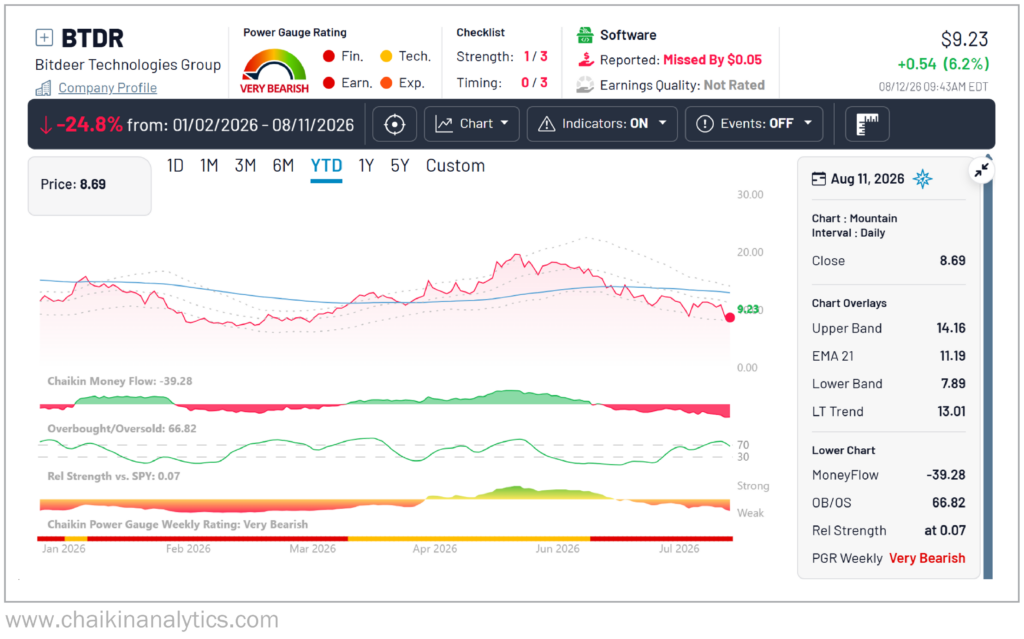
Bitdeer stock has been on a gradual downward slide since the start of the year, dropping nearly 25% as of August 11.
Chaikin Analytics, the investment-research platform founded in 2009 by legendary 60-year Wall Street veteran Marc Chaikin, rates Bitdeer “very bearish” in its Chaikin Power Gauge, a 20-factor stock-rating system that scans more than 5,000 stocks and 2,300 exchange-traded funds (“ETFs”).
Despite the bearishness, Bitdeer could rebound as it establishes itself more as a data-center landlord rather than a shaky crypto company.
Nvidia (NVDA): Backing the Customer That Buys Its Chips
It’s not as if the chip bellwether was relying on these Bitdeer/Volta/Anthropic deals to turn its fortunes around. It is, after all, the most valuable company in the world. But these types of deals certainly don’t hurt, especially as Nvidia rolls out its next-generation Vera Rubin AI architecture on a large scale.
The Bitdeer/Volta data-center campus is simply a showcase for Nvidia’s latest and greatest. But by backing – both financially and with its state-of-the-art technology – a specialized startup like Volta, Nvidia diversifies and expands its already sizeable footprint. And it will likely result in more startups lining up at Nvidia’s door, hoping for the same level of support.
Unsurprisingly, Nvidia gets a “very bullish” rating from the Chaikin Power Gauge.
Dell (DELL): PowerRack and Liquid Cooling Inside All Four Tydal Halls
Most people know Dell as a long-standing, successful, and reputable business within the consumer-computing industry. But the company has proven itself to be a major player in the AI world. These deals further solidify that sentiment.
The Bitdeer/Volta deal places Dell’s enterprise hardware, PowerRack server systems, and liquid cooling technology into the new data halls in Norway – another major milestone for Dell’s growing AI business.
And it’s that AI business that has pushed Dell stock up 245% since the start of 2026 (as of August 11) and prompted a “very bullish” Chaikin Power Gauge rating.
Anthropic: 133 MW and Less Reliance on Amazon
The Volta deal is huge for Anthropic on a couple of fronts. First and foremost, it gets 133 gross MW of power that it desperately needs to run the infrastructure that will train and deploy its next-generation Claude AI models and Claude Code.
Second, it secures this infrastructure using renewable, clean energy at a large scale. By tapping into Norway’s nearly carbon-free hydropower, Anthropic not only complies with strict European environmental regulations, but it also avoids the overly congested U.S. power grid and its yearslong connectivity wait times.
And this transaction also lessens Anthropic’s dependence on Amazon (AMZN), its main cloud provider. Expanding your supplier network, especially geographically, is never a bad idea in the AI world. Doing so will help Anthropic avoid bottlenecks, reduce geopolitical risk, and even improve performance.
The Risks: $500 Million Unfunded and a Chip That Just Started Shipping
While these agreements certainly have upsides for all involved parties, there are some risky elements… especially for Anthropic and Bitdeer.
Let’s start with Bitdeer. Per the agreement, the company must finish roughly $500 million of physical build-out on the Tydal data-center campus to meet both phases of delivery – the first by the end of 2026, the second by the end of next March.
The problem is, as of August 12, Bitdeer has not yet closed financing for those funds. If Bitdeer fails to meet those delivery deadlines, it faces potentially steep penalties and even the possibility of contract termination.
For Anthropic, the primary risk is the heavy reliance on a brand-new cloud infrastructure company (Volta) as the only safety net between itself and the hardware to be provided by Dell and Nvidia.
Speaking of hardware, that’s no sure thing either, considering large-scale production of Nvidia’s Vera Rubin platform only began in late May. Deploying the new hardware on the expedited timeline required by Bitdeer’s delivery deadlines undoubtedly introduces a layer of uncertainty.
Do the potential upsides outweigh the risks of these deals? That all depends on the level of risk investors are willing to take on. Sure, there’s a possibility that the Volta deal blows up for Anthropic. After all, it’s putting a lot of faith in a company that has only existed since January – a company that will be responsible for installing the hardware and managing the cloud-computing-power operation of a massive new data-center campus.
But that deal also secures much-needed computing capacity for Anthropic’s newest Claude models. And it expands the company’s global footprint.
For Bitdeer, this deal opens a brand-new revenue stream as a data-center landlord – one that should be far steadier and more lucrative than its bitcoin-mining business. We should know by next spring whether these deals proved successful not only for Bitdeer and Anthropic, but also for Dell and Nvidia.
Regards,
David Engle
Editor’s Note: Marc Chaikin, the founder of Chaikin Analytics, built an award-winning system that flagged Nvidia as a BUY before it soared as high as 45,000%. It also turned “bearish” on software stocks two months before they crashed this year. Now, Marc’s warning that a “jump to lightspeed” has taken place behind the doors of a Silicon Valley AI lab – and says the repercussions are about to cleave the market in half this summer. This 60-year Wall Street legend has a FREE Hotlist of stocks to buy and an urgent Hitlist of stocks to sell now. Click for the full story, including stock names and tickers here…
Key Points
Intel (INTC) raised $20 billion through an upsized stock offering to fund AI infrastructure, foundry expansion, and other growth initiatives without adding more debt.
The offering will dilute existing shareholders, while Intel’s heavy capital spending and negative free cash flow raise questions about how long its AI investment strategy can continue.
Intel stock could offer upside if its AI and foundry investments pay off, but the offering also highlights the enormo
Intel (INTC) raised $20 billion through an upsized stock offering to fund AI infrastructure, foundry expansion, and other growth initiatives without adding more debt.
The offering will dilute existing shareholders, while Intel’s heavy capital spending and negative free cash flow raise questions about how long its AI investment strategy can continue.
Intel stock could offer upside if its AI and foundry investments pay off, but the offering also highlights the enormous costs and risks surrounding the AI infrastructure boom.
Initially, Intel announced in a brief press release on Monday that it aimed to raise $15 billion from the new stock offering. Investors didn’t react very positively to that news.
Between the dilution of existing shares and companies’ uninhibited spending on AI, many investors are skeptical of and, frankly, fatigued by this type of development. Not surprisingly, Intel’s stock, which closed at $101.65 on Friday, August 7, fell during pre-market trading, opening Monday morning at $98.26.
This unexpected announcement also raised some questions.
Why the surprise public stock offering? What does it mean for Intel and its investors? And is this offering a good buying opportunity at a lower stock price, or is it an AI warning sign?
Why Intel Sold $20 Billion of Common Stock
If you guessed artificial intelligence (“AI”), you are correct! What decisions aren’t driven by AI these days? If you haven’t paid much attention to Intel in the past few years, let’s get you caught up.
In 2022 and 2023, Intel Foundry Services (“IFS”) earned external foundry revenue of $895 million and $952 million, respectively.
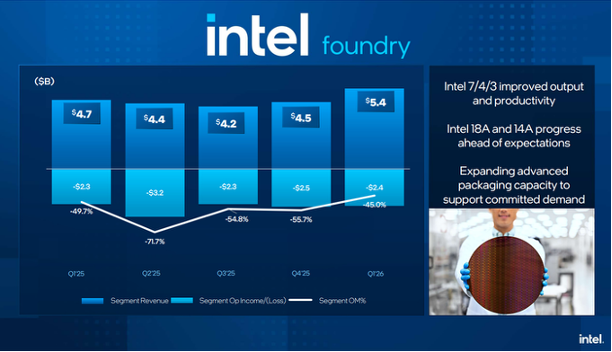
IFS revenue then exploded to $17.5 billion in 2024 and increased to $17.8 billion last year. The pattern continued into 2026’s first quarter, with Intel’s foundry business earning $5.4 billion, a nearly $1 billion jump from the previous quarter.
What sparked such a drastic revenue surge?
Intel began manufacturing its own products, including the Core Ultra Series 3 and Xeon 6 processors, rather than having them manufactured by Taiwan Semiconductor.
The AI data-center boom pushed demand for Intel’s Xeon processors to unprecedented levels.
Intel’s application-specific integrated circuit (“ASIC”) custom chip business increased by more than 50% thanks to demand from cloud customers…
And what might be the best
AI demand is obviously still quite strong, so Intel is doubling down on its AI investments.
In its press release, Intel stated that:
Progress in emerging areas including physical AI, purpose-built silicon, advanced packaging and external wafers represent significant growth opportunities for Intel.
Thus, Intel decided to offer the common stock for sale and put the proceeds toward capital expenditures (“capex”), working capital, and growth opportunities. In other words, Intel is looking to grow its AI-infrastructure business significantly. And this offering would greatly expand the available capital Intel needs to do so.
That capital comes without Intel increasing its debt, which is important considering, in July, Intel upped its 2026 capex projection to more than $20 billion.
Other key details of the transaction:
The offering’s share price came in at $95, meaning 210,526,315 new shares were made available for purchase.
The offering’s underwriters will have a 30-day option (called a “greenshoe”) to purchase up to a total of $2.25 billion in additional shares of common stock at the public offering price, minus underwriting discounts.
This would add another 31,578,947 shares of stock to the market, resulting in a total of around 242 million new shares of Intel common stock, based on the $95 share price.
Wall Street titans JPMorgan Securities, Goldman Sachs, Morgan Stanley, and Citigroup are serving as joint book-running managers for the offering, reflecting the magnitude of this transaction.
As I mentioned earlier, Intel stock took a hit upon the initial news of the transaction, falling more than 4% on August 10. The reason? Concerns about dilution for existing Intel shareholders… a common worry whenever a company makes this much stock available for public sale.
And it’s a legitimate concern. Issuing $20 billion in new equity will, indeed, dilute Intel’s investors. But the other side of the argument is also valid. Intel stands to gain up to $20 billion in needed capital from the stock sale, giving the company tons of liquidity as it continues to invest in future growth. And it does so without increasing its debt.
The dip in stock price on August 10 may be a blip on the radar, but it’s worth monitoring for investors – especially those who own a sizable stake in the company.
The Federal Government’s 10% Stake in Intel Faces Dilution
Whether coincidental or not, Intel has since taken off, seeing its stock price increase by nearly five times since the federal government’s investment last August. Intel and its investors – especially the government – have made a lot of money during that span.
Now, with this $20 billion stock offering, the government’s 10% stake is about to shrink. Based on the math used earlier, and the fact that the government did not participate in this sale, that 10% became roughly 9.5%.
Also, as part of the administration’s deal with Intel, the government received a five-year warrant at $20 per share for an additional 5% of Intel common shares, which, according to Intel, is “exercisable only if Intel ceases to own at least 51% of the foundry business.”
Because the August 2025 deal locked in 240.5 million warrants at $20 per share, the growing pool of total outstanding shares automatically dilutes the ownership of those warrants. In other words, the government’s 5% of additional shares from that warrant will also dip closer to 4.64%.
Unfortunately for the government, as a passive minority shareholder, it doesn’t hold any veto or voting power. So, there’s nothing Trump or his Cabinet can do to stop the offering. Ultimately, the government stayed on the sidelines.
On Monday evening, the only official comments from the administration came from White House National Economic Council Director Kevin Hassett, who told CNBC that it’s ultimately up to President Trump when the administration sells its stake – which it does not appear ready to do just yet. So, that’s also something to watch.
What the $20 Billion Offering Means for Intel Investors
We should learn the details of Intel’s stock offering after the sale closes on August 12, as the Wall Street banks running the transaction build an order book. At that point, we should have a better idea of how much Intel’s stock will be impacted.
But you can probably count on an Intel stock slide in the immediate aftermath of the transaction.
Why’s that? Dilution, for one. Then there are discounts. Underwriters often price newly available shares at a small discount (generally 2% to 5%) below the current trading price to entice institutional investors to spend millions or billions on the new shares. Sure enough, Intel’s stock was priced at $95, a discount of 2.6% from its August 10 close.
Finally, simple supply and demand negatively impact the stock’s price when millions of new shares are added without an instant surge in buyer demand. But considering Intel’s sale did see a big swing in buyer demand, this shouldn’t be much of a factor.
We don’t have to look back too far for similar examples:
In 2020, as Tesla (TSLA) stock was soaring, Musk and company took full advantage of the high price by rolling out multiple multibillion-dollar capital raises. One example was a huge $5 billion “at-the-market” stock offering, which immediately pulled Tesla stock back, resulting in a loss of roughly 4.7% by market close that day.
Earlier this year, Oracle (ORCL) announced it was raising nearly $40 billion in capital through mixed debt and equity offerings to bankroll its AI-infrastructure and cloud data-center build-out. The company’s shares plunged more than 12% in after-hours trading as investors lost their collective minds over the amount of money needed to support Oracle’s AI expansion.
But what about long-term impact? This is where things get more complicated. A short-term reaction – or overreaction – is one thing, because it’s typically based on impulsive investor and analyst emotion and sentiment, whether it’s sheer panic or total exuberance.
Long-term impact is generally driven by more rational and strategic thinking. It takes time to analyze and unpack how a company has performed after certain transactions have completed – in Intel’s case, the $20 billion public stock offering.
If you’re considering investing in Intel, you’ll want to see whether this transaction leads to real revenue and profit, whether there’s significant growth and expansion of its foundry facilities to handle demand for its AI hardware, and whether Intel can establish strong cash flow.
During the second quarter of fiscal year 2026, Intel operations generated an impressive $7 billion in cash flow. However, the company’s free cash flow (“FCF”) came in at negative $8.42 billion – compared with last year’s negative $1.1 billion – because of rising capex.
Intel is projecting another year of negative FCF, which would extend its streak to five straight years… the company accumulated a negative FCF of roughly $44 billion between 2022 and 2025, fueled by constant investments in AI and foundry expansions.
Here’s the thing: Intel is probably doing the right thing by increasing its capex to fund its AI infrastructure and meet customer demand. And doing so by diluting its existing shareholders was preferable to growing its debt by the billions, from Intel’s perspective.
Intel is seemingly doing everything right. Just look at the highlights from its July quarterly earnings report.
$16.1 billion total revenue, well above the projected $14.4 billion.
Data-center and AI revenue of $6.3 billion, a massive 59% year-over-year gain.
Non-generally accepted accounting principles (“GAAP”) earnings per share (“EPS”) of $0.42, doubling expectations.
A 40.4% gross margin, up from 27.5% year over year.
By any standard, that’s a highly successful quarter. Until you look at the company’s second-quarter net loss of $11 billion, up from $2.9 billion the year before.
All the positives are being negated by capex that appears to be unsustainable over the long term. And it shows no signs of slowing.
Intel Chief Financial Officer David Zinsner, who had already raised 2026 capex guidance from $18 billion to more than $20 billion, noted that 2027 capex would be “significantly above” that threshold.
So the questions investors must ask themselves are, “Will all of this pay off?” And, “If so, when?”
That’s yet to be determined. In the meantime, investors can take some comfort in knowing Intel is raising capital through equity rather than taking on more debt.
Which begs the question… Does this $20 billion stock offering make Intel a buy, or is this a warning that AI expenditures are simply too overwhelming for the company?
From my view, it’s another ominous warning of the prohibitive costs of financing the AI boom. Sure, the stock offering makes some sense from a bottom-line perspective. But when successful companies – and Intel has been riding a yearlong wave of success – start looking for different avenues to help them raise money to pay their seemingly endless string of capex bills, it’s worrisome.
The Bottom Line on Intel Stock
Intel has momentum. As I mentioned earlier, its stock price has nearly quintupled over the past year, clearly a positive sign. And, if Intel manages this stock offering the right way and makes smart investments with this capital, there’s no reason to think the company won’t continue along the right path, and its stock along with it.
But there’s no escaping the daunting shadow of AI capex that hovers over everything Intel does. The company has already burned billions in cash to expand its capacity, making some investors and analysts tired of the nonstop AI-related expenses that grow more exorbitant by the day.
It’s resulting in too many reputable companies with negative FCF despite growing revenues. And there’s no sure answer as to whether these massive investments will ultimately pay off. That’s just the uncertainty of the AI economy.
Intel is truly straddling the buy/sell fence right now. It’s possible the investments made using the capital from the $20 billion stock offering push Intel into “elite global foundry” territory alongside Taiwan Semiconductor Manufacturing (TSM). That makes Intel look undervalued.
But there’s also a possibility that Intel’s AI investments don’t pay off the way it envisions and the company never even remotely approaches anything close to that status. (Let’s face it, TSM has no peer and probably never will.) That, combined with shareholder dilution, is not looked upon favorably by investors.
The AI-expenditure crisis certainly isn’t unique to Intel. It spans the entire industry. But the spotlight is on Intel now, after its public stock offering. And the investing world will be watching its every move to see where it goes from here.
Regards,
David Engle
Editor’s Note: Whitney Tilson called the rise of Apple, Amazon, and Netflix… as well as the collapse of dozens of companies that went bankrupt. Now the former $200M hedge fund firm manager is stepping forward with what he calls the most important financial warning of his 30-year career. He’s sharing two free stock recommendations (one to buy, one to sell immediately) along with details of a new proprietary system fueling his predictions. See it all in his free presentation.
Key Points
Strategy continues to deploy its recently announced “digital credit” plan, which manages the company’s STRC preferred stock and aims to improve its fundraising capabilities over time.
The company continues to sell bitcoin and repurchase preferred stock, helping push the high-yielding shares closer to par, where Strategy may consider issuing more.
By more actively managing its securities, Strategy aims to double its bitcoin per common share within seven years, with
Strategy continues to deploy its recently announced “digital credit” plan, which manages the company’s STRC preferred stock and aims to improve its fundraising capabilities over time.
The company continues to sell bitcoin and repurchase preferred stock, helping push the high-yielding shares closer to par, where Strategy may consider issuing more.
By more actively managing its securities, Strategy aims to double its bitcoin per common share within seven years, with any increase in bitcoin’s price providing additional upside.
Strategy (MSTR) continues to sell bitcoins for cash, plowing the proceeds into shares of its own STRC Series A preferred stock, as part of the firm’s recently announced “digital credit” plan.
In the week ending August 9, Strategy made several key moves:
Sold common stock worth $653.1 million, at an average price of about $99.17.
Sold 1,690 bitcoins for $108.6 million, at an average price of $64,262.
Repurchased 1,152,020 shares of STRC Series A preferred stock for a total price of $108.6 million, or about $94.27 per share.
Strategy’s moves effectively exchanged its 1,690 bitcoins for more than 1.15 million shares of the preferred stock. The cash proceeds from the common stock went to the company’s USD Reserve, now at $4.65 billion, which backstops the payment of dividends and other interest.
After the sale, Strategy owns 840,447 bitcoins at an average purchase price of $75,385. It is the world’s largest bitcoin treasury firm, owning about 4% of the cryptocurrency’s total issuance.
The intent of the digital credit plan is to increase the number of bitcoins per common share by closely managing Strategy’s common stock, STRC preferred stock, and its bitcoin holdings. The recent sales bolster the firm’s balance sheet, raising investors’ confidence that Strategy can meet the payments on its preferred stock and other indebtedness without needing to raise cash in a fire sale, which might occur while bitcoin prices are low or at a similarly inopportune time.
Strategy’s focus on its STRC preferreds has worked out well for holders so far. The shares have bounced back significantly from a major June downdraft, after investors’ confidence was rattled. The digital credit plan may lead to further gains in the preferreds in the short term as well.
Strategy’s Digital Credit Plan: How it Works
Strategy’s recent portfolio moves are part of what executive chair Michael Saylor calls the company’s digital credit plan. This plan refocuses the company’s fundraising around its STRC Series A preferred stock, with Strategy managing its dividend yield and price, so that it can increase the number of bitcoins it owns per share of its common stock.
Saylor says that the STRC preferreds are already the “most liquid and largest preferred stock in the world.” By carefully managing the preferred, Strategy can raise cash more cheaply.
“We expect to keep laser focus on it,” said Saylor in the second-quarter earnings call. “We’re going to do everything we can to make it the most appealing credit in the entire digital credit space.”
This approach means that Strategy will keep a tight rein on its Series A preferreds so that they stay popular with investors while also offering a reliable source of funds for buying bitcoins.
In a real sense, then, Strategy is acting like a central bank of bitcoin, using some of the same tools as an actual central bank, such as adjusting interest rates and liquidity.
Strategy can use dollars to repurchase preferreds if they drift too low, or it can issue them for more dollars if the price reaches a favorable range.
Strategy can adjust the yield on this preferred to raise its price, for example, if it wants to raise cash or if bitcoin is surging and its preferred stock enjoys investors’ confidence.
By creating a greater market for this preferred, Strategy creates more liquidity in the financial instrument itself, meaning it can more easily issue the preferred and likely lower the cost of funding over time as investors come to trust the stock.
So, Strategy will take advantage of pricing in each of its markets – bitcoins, common stock, and preferred stock – for the purpose of raising the number of bitcoins per common share. To do so, it has recently raised cash to strengthen its balance sheet, giving it a more defensive posture.
At the same time, it has the potential to go on offense when the time is right to buy bitcoins, ideally giving it more ability to accumulate bitcoins if the STRC preferred becomes highly trusted.
So, Strategy’s digital credit plan requires a longer-term approach to acquiring bitcoins rather than the short-term “squeeze” of the bitcoin market that some traders may have first envisioned.
Is There Upside in Strategy’s STRC Preferred Stock?
A key part of Strategy’s approach is ensuring that its STRC preferred stock trades close to its par value of $100. At this price, it will likely issue more shares to fund its bitcoin purchases. Strategy’s moves here may offer a short-term opportunity to profit for its preferred investors.
Strategy can help STRC reach its $100 reference price in a few ways, including maintaining investors’ confidence that it will reliably pay its high dividend, adjusting the dividend to attract investors, and buying back the preferred stock in order to push up its trading price.
In fact, Strategy has recently made all three of these moves:
Management’s focus on the preferred share price and a more resilient cash-heavy balance sheet have helped restore confidence in its preferred stock.
Strategy authorized a $1 billion buyback for the preferred series and has already begun deploying the cash.
The result? The STRC preferreds are up solidly from their 52-week low of $71.25 in June to around $95 today. Plus, there may be even more upside as the company looks to return the stock to par.
Saylor effectively promised to return the preferreds to par in this time frame, almost down to the day, in the company’s last earnings call, though without making any explicit promise to do so.
“When we came public with STRC, it took us about 70 trading days to reach par,” said Saylor. “Some people forget this, but when we did the IPO, we IPO’d at $90. It took us 70 days to get to par…. If we were to trace forward 70 trading days from when STRC fell out of our trading range, that would put us around September 8.”
Saylor noted on the call that if the $1 billion authorization doesn’t work,
We have ample additional capital in order to cure the dislocation. We’re currently in a discovery process to figure out how much capital will be required on our part in order to return STRC to par. We’re certain that we will return STRC to par.
So, expect further upside for the STRC preferred series for now. Then tack on that heavy dividend – which looks safe at least in the short term – while you wait for shares to move higher.
However, Strategy will have a tough balancing act down the road, since it will want to lower the shares’ steep 12% coupon. But if it lowers the payout, will the stock remain near par, or will Strategy be forced to buy back shares in order to keep the price in management’s target range of $99 to $100?
Strategy’s refined digital credit plan sees the company playing all sides of its markets to keep the number of bitcoins per common share rising over time. We’ll watch how well it does.
Regards,
James Royal, PhD
Editor’s Note: Every generation or so, the way money moves gets a fundamental upgrade. The people who see it coming have the chance to get extraordinarily wealthy. Everyone else watches from the sidelines. Luke Lango says that moment is here again, and Elon Musk is behind the upgrade in an amazing way. He’s revealing exactly what to buy, including one free pick, in this presentation.
Key Points
OpenAI is aiming for a $1 trillion IPO valuation, but AI’s increasingly poor economics and its own terrible financials mean that the OpenAI IPO delay may turn into no IPO at all.
OpenAI is now severely marking down the price of its high-end AI models created just weeks before, suggesting it’s having significant trouble competing.
With a price war, OpenAI is likely to be burning more cash at an even faster clip than before, meaning it will need to raise cash sooner
OpenAI is aiming for a $1 trillion IPO valuation, but AI’s increasingly poor economics and its own terrible financials mean that the OpenAI IPO delay may turn into no IPO at all.
OpenAI is now severely marking down the price of its high-end AI models created just weeks before, suggesting it’s having significant trouble competing.
With a price war, OpenAI is likely to be burning more cash at an even faster clip than before, meaning it will need to raise cash sooner than some may have thought.
OpenAI CEO Sam Altman is aiming for a $1 trillion valuation for the initial public offering (“IPO”) of the artificial-intelligence (“AI”) model company. But the increasingly poor economics of AI and the company’s terrible financials mean that even an already delayed IPO may never arrive.
OpenAI is facing white-hot competition, with the company now severely marking down the price of high-end AI models created just weeks before. Altman and his public relations team tried to balance that news with the fact that OpenAI’s customers now comprise more than 1 billion users and more than two million businesses. Instead, investors need to pay attention to OpenAI’s lack of pricing power.
In late July, Altman announced the following price cuts on two recently adopted models and an upgrade on a third model.
AI model
Feature
Price cut
GPT‑5.6 Luna
Fastest and most affordable model
-80%
GPT‑5.6 Terra
Balanced model for everyday work
-20%
GPT‑5.6 Sol
Now offers Fast mode
None
As part of the announcement, OpenAI explained that GPT-5.6 had become more efficient to run, so the company said: “We’re passing those gains on to customers with lower prices…”
It’s a sales pitch that feels a lot like a seedy car salesman trying to “get you in a new car today.” But businesses aren’t usually trying to lower prices – their profit driver – unless they need to. And that’s even more true for a company’s latest and greatest models, as is the case at OpenAI.
That’s the tough situation OpenAI finds itself in today, as Chinese AI rivals such as Kimi K3 and DeepSeek models make heavy incursions into OpenAI’s user base. They’re releasing high-power AI models that do most of what OpenAI’s (and Anthropic’s) models do, but they charge a fraction of the price, sometimes just a few percentage points of what higher-end models charge.
It’s a price war that OpenAI simply can’t afford, one way or the other. OpenAI is already burning cash furiously and must be propped up by its customers. At the same time, it needs revenue to make good on an estimated $1.4 trillion in spending commitments in the coming years.
So, OpenAI must raise money to continue operating, but investors need to see a credible path to profitability before Altman’s IPO goal of $1 trillion can ever come to fruition. This impasse means that OpenAI has tentatively delayed its IPO until 2027, but it may be “delayed” permanently.
OpenAI’s Cash Burn Is Probably Getting Worse
The unprecedented scale of OpenAI’s ability to lose money is something to behold. OpenAI reported an operating loss of $20.9 billion in 2025 and estimates for the first quarter of 2026 peg its operating loss at a further $7 billion. At this rate, OpenAI could easily lose $30 billion in 2026 and possibly even $35 billion to $37 billion. We’ll have to wait for leaked financials for a better idea.
But a price war won’t likely improve profitability, even if it does increase sales for the moment.
In fact, we’re seeing OpenAI’s sales continue to soar, though the company’s executives provided only very high-level financials. CFO Sarah Friar told employees that OpenAI’s July annualized recurring revenue had exceeded the company’s total for the second quarter, according to CNBC.
While that feat may actually be less impressive than it sounds at first, it does indicate a ramp in sales at the end of the quarter. But it may well be one that the company can’t afford.
The interesting detail here is what leaders attributed the growth to: the company’s enterprise agent ChatGPT Work, its AI coding tool Codex, and its GPT-5.6 series of models.
That is, the same GPT model that OpenAI put on sale at a severe discount at the end of July.
For normal companies, sales growth translates into scaling profitability. In OpenAI’s case, higher sales translate into even greater losses, and we have plenty of signs that OpenAI is burning more cash than ever, as it’s forced to lower prices to keep getting business.
So, higher sales are not good news when you’re losing more money in absolute terms.
The inability to price AI models so that they’re profitable shows that AI models are mostly fungible. Businesses are shifting to the lowest-cost model to carry out their work, and some are reserving the high-cost models for their best and highest uses. But Chinese AI models have been showing that they, too, can move upmarket, leaving less room for OpenAI here, too.
For example, among AI startups using open-source software, about 80% are using Chinese AI models, according to Andreessen Horowitz.
All this means that OpenAI is likely to be burning even more cash at an even faster clip than before. The upshot then is that it will need to raise another funding round sooner than some may have thought. OpenAI last raised $122 billion in March, valuing the company at $852 billion.
OpenAI is under significant constraints, however. Venture-stage companies do not like to raise money at a lower valuation than the prior funding round. It indicates that something’s not right and dings the company’s reputation. That reputational worry is even greater in the field of AI, which is being hyped as much as any technology ever has been. If OpenAI can’t raise its valuation in the next funding round, it will look like there’s something wrong. (And there is…)
OpenAI needs to raise money at ever-higher valuations to keep the market’s confidence up and so that it can retain the potential to raise even more money in the future.
Of course, Altman wants to line up funding before he needs it, too. Increasingly larger losses in future quarters will hurt investors’ confidence to put up more cash. At the same time, ready cash that can subsidize its ongoing losses means OpenAI is not immediately subject to the market’s whims, giving Altman some maneuvering room if funding conditions tighten for a while.
Like the last funding round in March, OpenAI’s next round is likely to be funded by mega-cap companies that need the AI party to continue. Last time out, Amazon (AMZN), Nvidia (NVDA), and SoftBank (SFTBY) put up $110 billion of the $122 billion raised by OpenAI. Investors may need to raise cash from the debt markets themselves to plow into the money-losing OpenAI.
OpenAI is a linchpin in the AI economy, since it’s promised to spend literally more than $1 trillion across some of the biggest AI-related firms. If it’s unable to meet these commitments – and it must raise the cash to do so – the dominoes will begin to fall across the entire AI sector.
Confidence is key in these situations, and investors are already feeling skittish after a poor debut from SpaceX (SPCX) and massive declines in memory stocks such as Micron Technology (MU). The inability of OpenAI to raise at a higher valuation could be a sign that the Teflon stock market for AI stocks may be about to turn. So, keep a close eye on OpenAI’s ability to raise funding.
Regards,
James Royal, PhD
Editor’s Note: One company quietly beat Apple, Amazon, and the S&P 500 — combined. Over the long run it has returned more than 8,300%… enough to turn $10,000 into $830,000. Yet most investors have never heard of it. Former fund manager Whitney Tilson says right now it’s trading at a rare discount — and he’s revealing the name and ticker, free of charge. Click here for the details…
OpenAI IPO Delay FAQ
Why is OpenAI’s IPO delayed?
OpenAI has tentatively delayed its IPO until 2027. Sam Altman is holding out for a $1 trillion valuation, but investors need to see a credible path to profitability before that can happen, and OpenAI hasn’t demonstrated one.
When will OpenAI’s IPO happen?
OpenAI has tentatively set 2027 as its new timeline, after already delaying the offering once before. Given OpenAI’s mounting losses and the pricing pressure it’s facing from competitors, that date isn’t set in stone.
Could OpenAI’s IPO never happen at all?
It’s possible. OpenAI’s already-delayed IPO may never arrive at all, given the increasingly poor economics of AI and the company’s own terrible financials. What looks like a delay to 2027 could turn out to be permanent.
Why is OpenAI cutting the price of its AI models?
In late July, OpenAI cut prices on GPT-5.6 Luna by 80% and Terra by 20%, just weeks after launching them. OpenAI said it was passing along efficiency gains, but the cuts come as Chinese AI rivals like DeepSeek and Kimi K3 offer similar models for a fraction of the cost.
How much money is OpenAI losing?
OpenAI reported a $20.9 billion operating loss in 2025, with estimates putting its first-quarter 2026 loss at another $7 billion. At that pace, OpenAI could lose $30 billion to $37 billion in 2026.
How much has OpenAI raised in funding, and at what valuation?
OpenAI raised $122 billion in March at an $852 billion valuation, with Amazon, Nvidia, and SoftBank contributing $110 billion of that total. OpenAI will likely need to raise again soon, and doing so at a lower valuation than its last round would signal to the market that something is wrong.
Which stocks could be hurt if OpenAI’s IPO stalls or fails?
Companies that depend on OpenAI for revenue, including Oracle, Cerebras Systems, and CoreWeave, could be badly hurt. OpenAI has promised more than $1 trillion in spending commitments across the AI industry, and if it can’t raise the cash to meet them, the dominoes could begin to fall across the entire AI sector.
Companies don’t give away $200 million businesses.
Except Boeing just did. On purpose. And if you understand why, you understand where the next wave of AI money is headed.
On Monday, the Boeing-Archer deal was announced. Boeing (BA) handed three of its subsidiaries — Wisk Aero, SkyGrid, and Insitu — to Archer Aviation (ACHR). Three businesses. Two decades of investment. One of them generating over $200 million a year in defense revenue across 35 countries, with drones flown by the U.S. Nav
Companies don’t give away $200 million businesses.
Except Boeing just did. On purpose. And if you understand why, you understand where the next wave of AI money is headed.
On Monday, the Boeing-Archer deal was announced. Boeing (BA) handed three of its subsidiaries — Wisk Aero, SkyGrid, and Insitu — to Archer Aviation (ACHR). Three businesses. Two decades of investment. One of them generating over $200 million a year in defense revenue across 35 countries, with drones flown by the U.S. Navy.
The price? Zero dollars.
Boeing took stock instead. A 19.75% stake in Archer, plus options to buy more over the next four years — all laid out in a regulatory filing, not a marketing deck.
The market heard it. ACHR stock ripped 20% by mid-morning.
So why would Boeing do this? Simple. I spent 28 years on trading floors in Chicago, and I watched this exact trade a hundred times: when a market maker holds a position he can’t run properly, he doesn’t dump it at the bid — he swaps it to the guy who can run it and keeps a piece of the upside. That’s what Boeing did. CEO Kelly Ortberg has been shedding everything that isn’t commercial planes, defense, or space since he took over — he sold the Jeppesen flight-planning unit for $10.55 billion last year. But this time, instead of taking cash and walking away, Boeing kept a nearly 20% seat at the table and licensed back Wisk’s autonomy tech for its own future aircraft. Sell the headache, keep the upside. That’s not desperation. That’s a pro’s trade.
But here’s the part most investors will miss: the deal announcement gave Wall Street something more valuable than a stock pop.
It gave Wall Street new language.
“Physical AI” Just Entered the Chat
Archer didn’t call this a drone acquisition. It didn’t call it an eVTOL consolidation.
It called it an “end-to-end physical AI platform for aerospace and defense.”
Physical AI. Remember that phrase. You’re going to hear it a thousand times over the next year.
Here’s the plain-English version. The first wave of AI lived in a data center. It wrote your emails. It answered your questions. It made Nvidia the most valuable company in history.
Physical AI is what happens when that intelligence gets a body. Aircraft that fly themselves. Drones that navigate without a pilot. Air traffic systems that manage thousands of autonomous vehicles at once.
That’s what Archer just bought:
Wisk Aero — six generations of autonomous electric aircraft, more than 1,700 test flights
SkyGrid — the air traffic management software that keeps autonomous aircraft from hitting each other
Insitu — military drones flown worldwide, including by the U.S. Navy, with 3,500+ systems built and $200M+ in annual revenue
Feed all of it — nearly two million combined flight hours of data — into Archer’s AI foundation model, called ZEE. That’s the platform.
Whether Archer executes on that vision is a different question. But the theme just got a name, a poster child, and a Boeing endorsement. Themes with all three don’t stay quiet.
The Tape Told You Everything at 10 A.M.
I don’t care what a press release says. I care what the money does.
So here’s what the money did on Monday.
ACHR jumped 20% — fine, that’s the deal stock, it’s supposed to move. Part of that pop was mechanical anyway: nearly 15% of Archer’s float was sold short, and shorts covering into a takeover headline is rocket fuel that has nothing to do with conviction.
None of those companies were in the deal. Not one.
That’s called a sympathy move, and it’s one of the most honest signals in markets. Nobody issued a press release telling AVAV to rally 9%. Real buyers showed up because the deal re-priced what an autonomous-systems business is worth. Insitu — a drone maker doing $200 million a year — just got valued inside a “physical AI” wrapper, and every fund manager holding a comparable business did the same math before lunch.
Meanwhile Boeing itself? Up less than 1%. The market shrugged at the seller and chased the theme.
That’s what the tape can’t hide, folks. The money went straight to the drone complex.
Follow the Money: 3 Ways to Play Physical AI Stocks
I’m not going to hand you a “buy this now” list. What I’ll do is show you where the money is pointing, so you can do your own work.
The pure comp: AeroVironment (AVAV). If you want to know what Insitu is, look at AVAV. Military drones, loitering munitions, U.S. defense contracts. It led Monday’s sympathy rally for a reason — it’s the closest public company to the business Boeing just handed Archer. When the theme gets a re-rating, the cleanest comp gets it first.
The autonomy arms dealer: Kratos (KTOS). Kratos builds tactical drones and the autonomy software that flies them. If “physical AI” becomes the label funds put on their defense-tech sleeve, Kratos sits in the middle of it.
The small-cap torque: Red Cat (RCAT). Higher risk, higher beta. Red Cat’s Teal drones won a U.S. Army short-range reconnaissance program, and the stock moves violently when the drone theme catches a bid. This is the name that goes up the most when the theme is hot — and down the most when it isn’t. Size accordingly.
And a word on the obvious one everybody will mention: Palantir (PLTR) is the software layer of battlefield AI, but it’s already priced like everyone knows it. The fresh money in a new theme usually flows to the names that haven’t been discovered yet.
Read the Fine Print Before Chasing the Boeing-Archer Deal
Two things to keep in your back pocket before you chase anything.
The deal isn’t done. It’s expected to close by the end of 2026, pending antitrust review. Between now and then, Archer is a story stock with a $200 million revenue business attached to a press release, not a balance sheet.
Archer paid in paper. This was an all-stock deal. Archer just issued roughly 20% of itself to Boeing. Dilution is real, and existing shareholders paid for these assets whether they realize it or not.
None of that kills the theme. It just means the theme and the ticker are two different trades. You can believe in physical AI without believing ACHR at any price.
Physical AI Stocks: The Bottom Line on the New Theme
Twenty-eight years of watching order flow taught me one thing above everything else: nothing matters until the money moves.
On Monday, the money moved. Boeing swapped $200 million of annual revenue for equity in a startup. The drone complex re-rated in hours on a deal it wasn’t even part of. And Wall Street got handed a brand-new theme with a Fortune 50 company’s signature on it.
Chatbots were the first act. Physical AI — machines that fly, see, and decide — is the sequel.
The smart money already bought its ticket. The question is whether you’re watching the screen or the popcorn line.
Editor’s Note: Every generation or so, the way money moves gets a fundamental upgrade. The people who see it coming have the chance to get extraordinarily wealthy. Everyone else watches from the sidelines. Luke Lango says that moment is here again, and Elon Musk is behind the upgrade in an amazing way. He’s revealing exactly what to buy, including one free pick, in this presentation.
The Boeing-Archer Deal FAQ
Why did Boeing sell Wisk, SkyGrid, and Insitu?
Boeing is streamlining under CEO Kelly Ortberg to focus on commercial aircraft, defense, and space. Rather than selling the three autonomy-focused units for cash, Boeing traded them for a 19.75% stake in Archer — keeping upside exposure to the technology while removing the units from its own cost structure. Boeing also retains licensed access to Wisk’s autonomous flight systems.
What is physical AI?
Physical AI refers to artificial intelligence embedded in machines that operate in the real world — autonomous aircraft, drones, robots, and the systems that manage them — rather than software that only generates text or images. The Boeing-Archer deal made it a Wall Street buzzword by branding the combined Wisk, SkyGrid, and Insitu businesses an “end-to-end physical AI platform.”
Why did Archer Aviation stock go up?
Archer (ACHR) surged roughly 20% after announcing it would acquire three Boeing subsidiaries — including profitable defense drone maker Insitu — in an all-stock deal that gives Boeing a 19.75% stake. Heavy short interest (about 15% of the float) amplified the move as short sellers covered.
What did Boeing get in the Archer deal?
Boeing received a 19.75% equity stake in Archer’s Class A shares, options to purchase additional shares over four years, and continued access to Wisk’s autonomous flight technology for its own current and future aircraft. Boeing took no cash.
What are the best physical AI stocks?
There’s no official “physical AI” index yet, but the names the market treated as beneficiaries on deal day were AeroVironment (AVAV), Kratos Defense (KTOS), Red Cat Holdings (RCAT), and Planet Labs (PL) — all up 5–9% on the news despite having no role in the transaction. Always do your own research; sympathy rallies can fade as fast as they appear.
Is the Boeing-Archer deal complete?
No. The companies signed definitive agreements on August 10, 2026, but the transaction is expected to close by the end of 2026 and remains subject to antitrust review.
Want to see how a 28-year floor trader reads moves like this in real time? Jonathan Rose goes live every weekday at 11 a.m. ET on Masters in Trading Live — breaking down the tape, unusual options activity, and trades like these as they happen. It’s free. Search “Masters in Trading Live” on YouTube and pull up a chair.
Key Points
AI-driven demand has pushed memory supply to its limits, with Micron Technology, SK Hynix, and Samsung Electronics reportedly sold out of DRAM and high-bandwidth memory through 2027.
Memory stocks have declined despite record demand as investors weigh valuation concerns, uncertainty around future AI spending, and profit-taking after earlier gains.
Emerging technologies such as High-Bandwidth Flash and growing competition from new memory suppliers could reshape the
AI-driven demand has pushed memory supply to its limits, with Micron Technology, SK Hynix, and Samsung Electronics reportedly sold out of DRAM and high-bandwidth memory through 2027.
Memory stocks have declined despite record demand as investors weigh valuation concerns, uncertainty around future AI spending, and profit-taking after earlier gains.
Emerging technologies such as High-Bandwidth Flash and growing competition from new memory suppliers could reshape the industry while increasing long-term volatility.
During Micron Technology’s (MU) first-quarter earnings call on December 17, CEO Sanjay Mehrotra stated:
Over the last few months, our customers’ AI data center build-out plans have driven a sharp increase in demand forecasts for memory and storage. We believe that the aggregate industry supply will remain substantially short of the demand for the foreseeable future…
Micron is working hard to support our customers’ demand during this time, and we expect to grow our [dynamic random-access memory (“DRAM”)] and NAND bit shipments approximately 20% in calendar [year] 2026. Despite significant efforts, we are disappointed to be unable to meet demand from our customers, across all market segments.
After Micron’s second-quarter earnings were released on March 18, Mehrotra told CNBC:
We are only able to supply, for our key customers in the midterm, about 50% to two-thirds of their requirements.
We’re now into August, and the supply of memory hasn’t improved. The world’s leading memory manufacturers – Micron, SK Hynix (SKHY), and Samsung Electronics (005930.KS) – have sold out their entire DRAM and high-bandwidth memory (“HBM”) not just through the rest of this year… but through all of 2027.
That should be good news for these companies, right? Sellouts mean that all of your product has been purchased, with backlogs promising millions or billions in future revenue. So, why has Micron stock sunk from its all-time closing high of $1,213.56 on June 25 to its August 3 closing price of $829.50? That’s a nearly 32% drop. In the same time frame, Samsung, which trades on the Korea Exchange, has fallen roughly 33%. And since SK Hynix went public on the Nasdaq on July 10, its price is down 15% through August 3.
What should investors make of this broad decline in the top memory stocks?
Why the 2027 Memory Sellout Matters
As bad as 2026 has been for memory shortages, 2027 will likely be much worse, at least according to SK Hynix CEO Kwak Noh-jung, who told Reuters that 2027 will likely be “the worst year in the industry’s history from the supply perspective.” He also projected that customer demand will exceed supply capacity “even beyond 2030.”
Here’s why: Memory manufacturers have been encouraging customers to sign long-term (three-to-five-year) contracts, “using an advance payment deposit model where customers essentially pre-pay for some of the memory capacity,” according to TechPowerUp.
With all of 2027’s memory allocation already being sold out, the only customers who will receive any memory supply are those who signed these agreements. Everyone else looks to be out of luck. There literally isn’t enough DRAM available. Those businesses that didn’t sign contracts with the memory manufacturers will be without the memory they need in 2027 and forced to wait until the 2028 supply is made available to order.
Even for those customers that did sign contracts, they’re still not guaranteed the memory supply in 2027. That’s because most of the memory supply will go to AI data centers, hyperscalers, and cloud-service providers. For example, Samsung has five-year agreements in place to supply the world’s five largest data-center operators with the memory they need… and that amounts to between 60% and 70% of Samsung’s memory production capacity.
It’s undoubtedly a smart business move by Samsung because it locks in steady revenue for the next five years. But who suffers the most from these deals? Everyday consumers.
With up to 70% of all memory production going everywhere but into consumer-electronics items, simple math tells us that only 30% of the memory supply remains for everyday products like phones, computers, tablets, and gaming consoles, to name a few.
And when supply is that limited, Economics 101 informs us prices rise. In fact, if you’ve shopped recently for some of these products, you’re already seeing the ripple effect.
So far, this year:
Steam PC prices have increased between $240 and $300.
Xbox and PlayStation game console prices have jumped between $100 and $150.
Apple (AAPL) iPads are between $150 and $200 more expensive, and MacBook prices have soared by $100 to $300.
Computer and server makers Dell Technologies (DELL), HP (HPQ), Acer, Asus, and Lenovo have also raised prices between 15% and 20%.
On top of the price hikes, global smartphone shipments are projected by IDC’s Worldwide Quarterly Mobile Phone Tracker to finish 2026 down nearly 14% from last year. That would represent the largest annual decline in the history of smartphones. IDC also projects a 1.1% decline in 2027.
All of this trickles down to other types of memory as well. With DRAM silicon wafers in such short supply, electronics manufacturers are turning toward alternative memory options, like NAND flash and solid-state drives (“SSDs”). And that higher demand is pushing those prices up.
With all that in mind, it’s fair to ask why memory manufacturers’ stocks continue to fall.
Why Memory Stock Prices Are Falling Despite Record Sales
There isn’t one clear answer as to why memory stocks have been sinking even as memory manufacturers have completely sold out their supply through next year. Multiple factors are contributing to the stocks’ declines.
For one, as the market looks ahead, there are serious concerns about how sustainable this nonstop AI spending is, even if most of the companies spending are flush with cash. Investors cast a wary eye on hyperscalers and other tech companies and wonder whether this head-spinning spending will slow.
Second, the valuation of stocks like Micron and SK Hynix has been bolstered by huge price surges. While those increases may have been warranted based on the seemingly endless demand for their products as well as the subsequent sold-out inventory, the massive growth may already be baked into their stock prices. That leaves Micron and SK Hynix stocks with a paper-thin margin for error if demand for memory wanes even slightly.
Finally, this is just how the market works. Before the recent memory-stock dip, Micron, for example, experienced a huge move higher. For example, investors could have bought Micron shares for $367.85 on April 1. By June 25, the stock’s price rose to $1,213.56. That’s an increase of 230%… in less than three months. After an otherworldly surge like that, Micron was bound to fall back to Earth – which it has done since, falling roughly 27% (as of August 6) since its late-June high.
That’s simply a product of investors selling high and taking their profit, which brings the stock price back down. The market also tends to correct itself when stocks get ahead of themselves (see SpaceX). This volatility is likely the new norm for memory stocks, which will probably continue to see periods of big gains followed by pullbacks. This isn’t a reflection on the products or the demand, however. That remains real.
How New High-Bandwidth Flash Memory Impacts the AI Build-Out
A brand-new technology has entered the mix. On August 3, flash memory giant Sandisk (SNDK) announced that it, along with SK Hynix, had released the High-Bandwidth Flash (“HBF”) technical specification through the Open Compute Project.
Sandisk and SK Hynix were joined in this venture by Google and AI startup Tenstorrent to create this specification, which, according to Sandisk’s press release, “provides companies and developers designing AI inference systems and accelerators with a common technical framework for incorporating HBF technology where larger, near-compute memory capacity and higher bandwidth are needed to improve power and performance metrics and help reduce total cost of ownership.”
Near-compute memory capacity is essentially HBM placed close to computing cores, which is what AI inference systems need to process today’s AI workloads. The new HBF technology accomplishes this by merging high bandwidth with high capacity.
HBF basically bridges the gap between fast HBM and slow SSDs by stacking NAND flash memory, which provides high storage capacities at speeds that rival HBM. This technology has the potential to loosen AI inference bottlenecks and reduce costs, as HBF is substantially cheaper than HBM because it removes expensive DRAM from the equation.
Plus, HBF could potentially alleviate the AI data-center power problem. Most data centers today use HBM built with DRAM, which consumes power while constantly refreshing itself. HBF, using NAND flash memory, doesn’t require those refresh cycles. That means less power is used during AI inference, which could help lower costs.
Keep in mind, however, that HBF is just in its blueprint stage. It’s not a buyable product yet. Sandisk and SK Hynix expect HBF memory samples later this year, with actual AI-inference products possibly available in early 2027. This is a development worth watching, as it could play a large role later next year if it’s deployed at a commercial scale.
What to Watch for Going Into 2027
We know that all of Micron’s, SK Hynix’s, and Samsung’s memory inventory is sold out through 2027. So, what should investors watch for in the memory industry and its stocks going into next year?
We’ve alluded to some of these already, but they all bear repeating.
The influx of HBM and DRAM memory alternatives: If data-center operators and consumer-electronics companies want memory, they don’t have any other choice but to look for alternatives to HBM and DRAM since there isn’t any available. Keep a close eye on different types of memory, such as NAND flash memory, high-speed graphics memory (GDDR6 / GDDR7), enterprise SSDs, and the emerging HBF memory.
The companies making those memory alternatives: SK Hynix is still one to watch, as it manufactures high-speed graphics memory, enterprise-grade NAND flash, and data-center SSDs, as well as the sold-out HBM and DRAM. The South Korean company, as mentioned earlier, was also instrumental in the development of HBF. Samsung also produces the same memory types as SK Hynix and is now developing its own HBF solutions. And Micron is one of the world’s leading makers of high-speed graphics memory, NAND flash wafers, and enterprise SSDs.
Besides those “Big Three,” however, there are other major memory players. The largest being Sandisk, the longtime leader in advanced flash memory that partnered with SK Hynix in the development of HBF technology. In fact, Sandisk’s stock has seen some of the biggest growth in the history of the American stock market. A year ago, Sandisk was trading for roughly $42 per share. As of August 6? $1,258.58 per share. That’s a mind-boggling 2,890% increase in one year.
And that’s actually down from its June 25 closing high of $2,335 (which means, at that point, Sandisk was up 4,841% year over year). This backs up my earlier point regarding the volatility of the memory sector. After its absolutely massive surge, the market pulled back as investors sold off.
While NAND flash memory is a strong alternative, it’s also important to keep in mind that Sandisk, Micron, and Samsung have also sold out their full-year 2026 NAND flash capacity, and SK Hynix expects its inventory to sell out by the end of this month.
The memory-making wild cards: You may not know much about Asian memory manufacturers Kioxia or CXMT. But they’re worth monitoring.
Kioxia, which trades on the Tokyo Stock Exchange, is actually a spinoff from Toshiba, the Japanese electronics giant that invented NAND flash memory. So, it’s no surprise that Kioxia is a global leader in the manufacturing of NAND flash memory as well as SSDs.
ChangXin Memory Technologies (“CXMT”) is a Chinese manufacturer of DRAM chips for smartphones, computers, servers, and other consumer-electronics products.
This isn’t a recommendation to invest in Kioxia or CXMT. Rather, it’s an alert to watch these Asian tech giants because they could very well eat into the profits of Micron, SK Hynix, and Samsung.
CXMT, for example, is quickly ramping up its DRAM production. In fact, it currently holds a significant 8% of the global DRAM market. And CXMT’s late-July IPO on Shanghai’s STAR Market closed around 466% above its offer price, ensuring it has plenty of financial heft (roughly $8.6 billion) behind it to keep expanding its production.
How Risky Are Memory Stocks?
The massive gains have certainly been enticing. Anyone who bought Micron or Sandisk stock at this time last year must like what they see in their portfolios right now. However, as lucrative as the memory industry has been, some risks come with investing in it.
As I mentioned, the memory industry is volatile. Since late 2022 and the start of the AI data-center boom, it has been riding a massive growth wave that hasn’t fully crashed down yet. One only needs to look at the recent stock growth of all the companies discussed in this article.
Until recently, that is. Consider this recent downturn part of the boom-and-bust cycle.
Back in May, William de Gale, a portfolio manager at BlueBox Asset Management, told CNBC that the industry typically experiences “enormous ups and downs” and that, “in the long run, it’s a pretty dreadful industry.”
While de Gale’s view is pretty grim, his point is valid. Investors in the memory industry better buckle their seat belts, because they’re in for a wild ride.
Consider the five-year betas, which measure stock volatility compared with the overall market, for Micron (2.21), SK Hynix (2.41), and Samsung (1.56), all of which are roughly 1.5 to 2.4 times more volatile than the market.
Investing in memory stocks through 2027 may produce big gains simply because of supply and demand. But what happens in 2028, when more memory is expected to be available? Again, supply and demand come into play. As more product becomes available, prices should drop, which would result in tighter profit margins… and more than likely lead to a pullback in memory stocks.
Is that a guarantee? Of course not. Nothing investment-related ever is. And who knows what may unfold between now and 2028? But simple economics has stood the test of time for a reason. So there’s a strong chance memory stocks suffer as more capacity is manufactured.
Similarly, what happens if hyperscalers and AI companies tighten the reins on their spending? If you’re considering investing in memory stocks, pay close attention to what Amazon (AMZN), Alphabet (GOOGL), Meta Platforms (META), and Microsoft (MSFT) are spending on AI infrastructure over the next year or so. If there’s a downturn in spending, you can bet memory stocks and their investors will feel the consequences.
And don’t forget about companies like CXMT and Kioxia as they expand production and threaten to take a larger bite out of the global memory pie.
The bottom line? Memory stocks are a fascinating play. Despite this recent downturn, which we can likely attribute to simple valuation and market correction driven by selldowns, the industry is as strong as it’s ever been. And with AI’s demand for memory not expected to die down anytime soon, its stocks could bounce back soon.
Regards,
David Engle
Editor’s Note: What ever happened to the AI stock boom? Even AI darlings like Nvidia have essentially gone nowhere since summer 2025. Our friend and colleague at InvestorPlace, Louis Navellier, may have the answer. According to Louis, the AI industry is quietly “staging” ahead of the next great AI breakthrough… a new class of AI he calls “Superintelligence… but better.” How will it trigger a $100 trillion reset of the AI markets. How will the launch of this tech send some stocks to zero, and others soaring? And why does Louis say: Don’t buy or sell an AI stock in 2026 until you see what’s coming next? Go here for the full story (and Louis’ #1 pick).
Key Points
Major tech sectors including semiconductors, software, AI, and space are benefiting from the investment boom, and ETFs offer one of the simplest ways to gain exposure.
Leading tech ETFs have delivered annualized returns ranging from roughly 30% to more than 50% over the past three years.
While investors should not expect those outsized returns to continue indefinitely, tech ETFs remain a compelling long-term way to invest in high-growth companies.
Major tech
Major tech sectors including semiconductors, software, AI, and space are benefiting from the investment boom, and ETFs offer one of the simplest ways to gain exposure.
Leading tech ETFs have delivered annualized returns ranging from roughly 30% to more than 50% over the past three years.
While investors should not expect those outsized returns to continue indefinitely, tech ETFs remain a compelling long-term way to invest in high-growth companies.
Major technology sectors – semiconductors, software, and artificial intelligence (“AI”) – are some of the stock market’s hottest investments right now. With major tech companies investing in AI at record levels, many related stocks have surged to all-time highs over the past year.
For investors looking to ride this investment wave, it can be challenging to pick individual tech stocks. An easier way to get diversified exposure to these companies and find winners is to invest in some of the best tech exchange-traded funds (“ETFs”), often for a low cost.
The best tech ETFs in chips, software, and AI have returned 30%, 40%, and even 50% annually over the past three years – without investors needing to analyze and trade stocks.
While tech darlings such as Nvidia (NVDA) and Broadcom (AVGO) have raced higher for years, the big winners aren’t all trillion-dollar mega-cap stocks. In fact, even smaller chip companies and lesser-known software and AI companies can offer huge returns in the investment boom.
So, the best tech ETFs offer an accessible way for investors of all skill levels to invest in a portfolio of winning stocks across the semiconductor, software, space, and AI sectors.
Top Tech ETFs to Invest in for 2026
Fund (ticker)
One-year return
Three-year annualized return
Expense ratio
VanEck Semiconductor ETF (SMH)
99.0%
55.3%
0.35%
Invesco PHLX Semiconductor ETF (SOXQ)
116.7%
49.0%
0.19%
State Street SPDR S&P Kensho Final Frontiers ETF (ROKT)
69.8%
40.2%
0.45%
Franklin Intelligent Machines ETF (IQM)
37.1%
32.0%
0.50%
Procure Space ETF (UFO)
54.3%
35.2%
0.75%
Invesco AI and Next Gen Software ETF (IGPT)
83.6%
39.3%
0.56%
Amplify Bloomberg AI Equal Weight ETF (AIVC)
99.5%
44.0%
0.59%
Source: Data from Morningstar as of August 6, 2026
How MarketWise Selected These Funds
MarketWise chose its best tech funds based on the following criteria:
Funds with exposure to the semiconductor, software, AI industries, and others
Funds with at least three years of strong returns
A reasonable expense ratio
No leveraged or inverse funds
1. VanEck Semiconductor ETF (SMH)
This fund tracks the MVIS U.S. Listed Semiconductor 25 Index, which includes 25 semiconductor production and equipment companies. This fund also makes our list of best semiconductor ETFs.
This VanEck fund is the market’s largest semiconductor-focused ETF, and it charges a fair 0.35% expense ratio. Its returns were notably strong over the past year and three years, and even its five-year returns bested the largest chip-focused funds, too.
This passively managed Invesco fund tracks the PHLX Semiconductor Sector Index, which includes the 30 largest semiconductor companies listed on U.S. exchanges. The fund’s low expense ratio of 0.19% means that more money stays in your pocket rather than going to the fund manager.
This chip fund recorded the best one-year returns on our list as well as the second-best annualized returns here over the past three years. It’s a testament to the fact that you don’t need a high-cost fund to achieve attractive total returns.
3. State Street SPDR S&P Kensho Final Frontiers ETF (ROKT)
This passive fund tracks the S&P Kensho Final Frontiers Index, which includes companies driving the exploration of space and the deep seas.
The fund has had a tremendous run over the past year and three years, and yet it still charges a not-too-costly expense ratio of 0.45%, putting it among the lower half of expense ratios on the list, despite those stellar returns. This State Street fund also ranks in our list of best space ETFs.
Assets under management: $209.2 million
Top holdings: Oceaneering International (OII), Ducommun (DCO), RTX (RTX), Forum Energy Technologies (FET), Heico (HEI)
4. Franklin Intelligent Machines ETF (IQM)
This Franklin actively managed fund invests in stocks that fit the theme of intelligent machines, where AI is driving the “transformation of products, software, systems and machinery as well as product design, manufacture, logistics, distribution and maintenance….,” according to the prospectus.
Despite being an actively managed fund, it doesn’t charge a steep expense ratio, at just 0.5%. And it has delivered some outstanding annual returns over the past year and three years.
This passively managed fund tracks the S-Network Space Index, which includes companies with a majority of their sales coming from space-related sectors, including satellite-based telecoms, space technology and hardware, as well as rocket and satellite manufacturing, among others. The fund’s above-average expense ratio of 0.75% has been worth the extra returns you’re getting, at least so far.
This fund’s portfolio is more tightly focused on telecom names such as Viasat and Sirius XM, as well as rocket companies such as SpaceX (SPCX) and Rocket Lab (RKLB). So, the fund may be a better pick for investors with that kind of investment angle on space.
This passively managed Invesco ETF tracks the STOXX World AC NexGen Software Development Index, which includes “companies with significant exposure to technologies or products that contribute to future software development through direct revenue,” per the prospectus.
The fund’s one-year performance at more than 80% is nothing short of amazing, while its three-year annualized performance approaches 40% – all for a reasonable expense ratio.
Assets under management: $1.2 billion
Top holdings: Advanced Micro Devices, Alphabet (GOOGL), Nvidia, Meta Platforms (META), Micron Technology
7. Amplify Bloomberg AI Equal Weight ETF (AIVC)
This passively managed Amplify fund tracks the Bloomberg AI Value Chain Equal Weight Total Return Index, which includes cloud computing, semiconductor, and hardware companies that form the basis of AI technologies. The fund uses an equal-weight approach, where stocks have a broadly similar position size in the portfolio.
The fund’s price has effectively doubled over the past year, while its 44% annualized returns over the past three years would have generated some significant wealth. This fund’s returns have been among the best on this list of superstars, and it charges a not-too-high expense ratio.
Assets under management: $120.9 million
Top holdings: Alibaba (BABA), Atlassian (TEAM), Hewlett Packard Enterprise (HPE), Microsoft (MSFT), Snowflake (SNOW)
Are Tech Stocks a Good Long-Term Investment?
Tech stocks have long been among the market’s most popular investments. The best stocks offer scalability – that is, their profits can grow much faster than their sales. As they grow, their profits often soar as their operating margin improves.
Semiconductor stocks have performed very strongly in the past few years, as Big Tech companies, such as Microsoft and Alphabet, have poured money into AI investments. However, much of this high return has occurred in the past year, with two funds in the list up about 100% or more.
This level of performance will be hard-pressed to continue over time, even if semiconductors do post attractive long-term returns. It’s effectively impossible for a stock or fund to put up this level of return over extended periods. So, investors should expect returns to come back to more normal levels, say 20% annually over time. Even this more manageable level will build huge wealth over time.
For investors who like the prospects of the top tech stocks, it’s important to invest cautiously, especially after the phenomenal returns over the past year and three years. Take a long-term view on the market and invest regularly over time. Doing so helps reduce your risk of buying at a relatively high point, and it still can deliver attractive long-term returns.
Regards,
James Royal, PhD
Editor’s Note: One company quietly beat Apple, Amazon, and the S&P 500 — combined. Over the long run it has returned more than 8,300%… enough to turn $10,000 into $830,000. Yet most investors have never heard of it. Former fund manager Whitney Tilson says right now it’s trading at a rare discount — and he’s revealing the name and ticker, free of charge. Click here for the details…
In Tolkien lore, the “palantíri” were indestructible dark crystals used to “see” across vast distances telepathically. The stones themselves weren’t necessarily dangerous. But the person who controlled them could be a major threat… Alex Karp, who named his company after these stones, seems to wield this massive power. And Wall Street is hanging on his every word.
This past Monday, Aug. 3, Palantir Technologies (PLTR) reported an “otherworldly” quarter as revenue accelerated to its fastest pac
In Tolkien lore, the “palantíri” were indestructible dark crystals used to “see” across vast distances telepathically. The stones themselves weren’t necessarily dangerous. But the person who controlled them could be a major threat… Alex Karp, who named his company after these stones, seems to wield this massive power. And Wall Street is hanging on his every word.
This past Monday, Aug. 3, Palantir Technologies (PLTR) reported an “otherworldly” quarter as revenue accelerated to its fastest pace ever. At the same time, U.S. commercial sales grew 149% year-over-year, and management lifted full-year guidance by roughly half a billion dollars.
The next morning PLTR stock rose about 30%, its largest single-day move in years, and closed back above a technical line it had failed to hold all year. So, is Palantir stock a buy? Karp’s conference call seemed to answer with a simple idea: in the age of interchangeable frontier AI models, the value goes to whoever holds the stone.
And right now, that’s Palantir.
Palantir’s Q2 2026 Earnings, by the Numbers
Palantir posted second-quarter revenue of $1.935 billion, up 93% year-over-year, its highest growth rate as a public company. Adjusted earnings came in at 41 cents per share against consensus near 35 cents, the ninth straight beat. GAAP earnings also reached 41 cents, a sign the profits were real rather than a product of adjustments.
The U.S. business is what carried the quarter. U.S. commercial revenue surged 149% to $764 million. U.S. government revenue grew 90% to $809 million. Combined, U.S. revenue reached $1.573 billion, up 115%, now more than 81% of the total.
The forward-looking metrics have changed how analysts are modeling the company.
Net dollar retention climbed to 157%, up 700 basis points from the prior quarter, meaning existing customers spent 57% more than they did a year earlier. U.S. commercial total contract value bookings hit $2.132 billion, up 153% and nearly $800 million above the prior record. Adjusted operating income was $1.194 billion, a 62% margin. Adjusted free cash flow reached $1.22 billion, a 63% margin. The company’s Rule of 40 score, which adds revenue growth to profit margin, reached 155%, well above the 40 threshold considered elite.
Management raised full-year 2026 revenue guidance to a range of $8.15 billion to $8.158 billion, roughly 82% growth at the midpoint, up from $7.65 billion to $7.66 billion. The company also guided U.S. commercial revenue above $3.424 billion, at least 134% growth. “This quarter was otherworldly,” Karp said in the release.
Palantir’s “SaaSmageddon” and Why Better AI Makes PLTR More Valuable
On the other side of the AI boom, one particular “anti-trend” dominated the discourse for much of 2026: “SaaSmageddon.” The idea is simple: if AI agents can do the same work as certain software, then enterprises will opt for the AI over a per-seat subscription model.
By SaaStr’s measure, software’s forward price-to-earnings (P/E) multiple collapsed from 84.1 times at the 2020-2022 peak to 22.7 times by March 2026, the first time the sector traded below the S&P 500 on that basis. Salesforce (CRM) fell about 30% and Workday (WDAY) fell 33% over that same stretch.
Initially, Palantir itself was part of the SaaSmageddon thesis, with investors worried the company would be eaten alive by frontier AI. But Karp turned that criticism of his company on its head, going to the media to argue that raw model access is the commodity, and value only goes to the layer that connects AI models to proprietary data and workflows.
This layer is what Palantir calls its “Ontology,” which is wrapped in its Artificial Intelligence Platform (AIP) and staffed with engineers who deploy at client sites. Take its partnership with Nvidia (NVDA): Palantir runs Nemotron models air-gapped in customer-controlled environments. And, as Karp notes, more and more enterprises are refusing to become “vassals” of the large-language labs.
Bottom line: The cheaper AI models become, the more valuable the plumbing (the layer that governs and connects AI to enterprise operations) becomes. If you needed evidence of that, look no further than the 157% net dollar retention metric Palantir posted this quarter. If SaaSmageddon were affecting Palantir, customers would not be expanding their usage. This marks the first quarter with hard evidence against that thesis.
Is Palantir Stock Still a Buy After Its 30% Pop?
Palantir’s recent earnings surge repaired some of the technical damage to the stock, but PLTR is still down ~13% as of this writing. Let’s talk about this a bit before getting to the meaty bits.
PLTR stock peaked around $207.52 in November 2025, before collapsing throughout 2026 and bottoming near $106 in June. That’s a ~49% drawdown from Palantir’s highs. Heading into earnings, shares were still close to a 30% shave YTD. Palantir stock formed a death cross when it fell below its 200-day moving average (MA) in February. After earnings, the stock is back above the 200-day MA (around $153). Nevertheless, it’s still below its old high, so there’s more room for PLTR to run.
After the recent quarter, several analysts lifted (or affirmed) their Palantir stock price targets. Citi’s Tyler Radke lifted his target to $245 from $200, Mizuho to $215, and D.A. Davidson to $200, while Bank of America reiterated its Street-high $255 target. Deutsche Bank’s Brad Zelnick upgraded the stock to “Buy” at $200, calling Palantir “a time traveler, having already arrived in the AI future others are still aspiring towards.” Per TipRanks, the consensus is a “Moderate Buy” across 21 analysts, with a pre-surge average target near $187 to $189.
On the road to $200+, Palantir’s nitrous boost, if you will, is the sovereign AI argument. That is, if enterprises and governments increasingly reject frontier AI labs in favor of AI they own and control, then it is Palantir that’s best-positioned to be the operating layer for such demand.
Still, the risks involved with investing in Palantir stock cannot be overstated.
The first big risk is valuation.
Even after the drawdown and even on raised guidance, PLTR trades near 43 to 50 times forward sales, against a software peer group closer to five times enterprise-value-to-revenue. RBC’s Rishi Jaluria kept an “Underperform” rating with a $90 target, writing that PLTR “remains the most expensive stock across our RBC All-SaaS universe at ~40x EV/CY26” and that “we struggle to underwrite a scenario that justifies current valuation levels.” Morningstar’s Mark Giarelli pegs fair value at $153, below where the stock closed after the pop. A move from a 77-times forward P/E down to a still-rich 40 times, with no change in estimates, would roughly halve the stock.
The second big risk is political contagion.
On Aug. 5, the Centre for International Corporate Tax Accountability and Research published an analysis, commissioned by European public-service unions, estimating Palantir’s global effective tax rate at 1.4% on pre-tax profit of about $1.66 billion, with under $21.7 million in global net corporate tax and zero U.S. federal tax in 2025, achieved by booking European revenues in the U.S. parent. Unison’s Andrea Egan said “systems that enable tax to be shirked on an industrial scale clearly have to change.” But Palantir calls this sort of transfer pricing “entirely standard practice.”
That’s not all, however.
The European backlash to Palantir is pulsating and tangible. Germany’s domestic intelligence service, the BfV, picked French firm ChapsVision over Palantir, the German army cut ties entirely, France’s Thales is courting Belgium, the Netherlands and others, and Palantir is suing London’s Mayor’s Office for Policing and Crime (MOPAC) after losing a Metropolitan Police contract. All the while, a £330 million NHS contract faces parliamentary pressure. As such, Palantir’s international revenue slipped to roughly 19% of the total in Q2, from 26% a year earlier. For a company billing itself as selling sovereignty, there’s an irony in being the sovereign no European nation actually wants.
So again, is PLTR stock a buy? Going only off Palantir’s growth, it’s an album with a story told in two sides:
The A-Side: An American growth machine and sovereign AI beneficiary.
The B-Side: A European trust deficit.
The verdict: Palantir delivered the quarter the bulls were waiting for, and the fundamental case is stronger than at any point in its history. But the valuation now prices in flawless execution, and the European resistance caps the global ambition the multiple assumes. PLTR is a buy for investors who can hold through 20%-plus swings and who are buying the operating layer rather than the price. For everyone else, the layers around Palantir are cheaper
3 Palantir Alternatives to Buy
If data and workflow layers increase in value the more frontier models are commoditized, then there are several stocks to buy that own those layers at a fraction of Palantir stock’s multiple. Here they are, in no particular order:
PLTR Alternative No. 1: Snowflake (SNOW)
Snowflake is the proprietary-data layer. Its fiscal Q4 2026 product revenue grew 30% to $1.23 billion, remaining performance obligations jumped 42% to $9.77 billion, and net revenue retention held at 125%. More than 9,100 accounts use its AI weekly, and consumption pricing means revenue scales as AI workloads grow. It trades near 12 to 14 times forward sales, rich for software but well below Palantir. The catch is GAAP losses and a forward P/E near 124. Clean, governed data is the fuel every enterprise AI system needs, and Snowflake stores it.
PLTR Alternative No. 2: ServiceNow (NOW)
ServiceNow is the workflow and agent-orchestration layer, what CEO Bill McDermott calls the “AI control tower.” Q2 2026 subscription revenue grew 24.5% to $3.877 billion, AI annual contract value crossed $1 billion for the first time, and agentic AI production deployments grew ninefold in nine months. The stock fell about 37% in 2026 on the same SaaSmageddon fear, leaving it near 5.8 times enterprise-value-to-revenue, a discount that looks misplaced against accelerating growth. As enterprises deploy fleets of agents, someone has to govern them. ServiceNow is building to be that someone.
PLTR Alternative No. 3: MongoDB (MDB)
MongoDB is the operational data backbone of AI-native applications. Fiscal Q4 2026 revenue grew 27% to $695.1 million, Atlas grew 29%, and the company posted its first GAAP-profitable quarter. Its document model plus integrated vector search and Voyage AI embeddings puts it under the applications developers are building on top of models. It trades far below Palantir’s revenue multiple.
The Bottom Line on Palantir Stock
Palantir’s earnings, much like the palantíri seeing-stones, do not lie. The company is more valuable than ever to enterprises, especially those who wish to free themselves from frontier model vassalage.
Yet, the road ahead for Palantir stockholders isn’t clear of wheel-breaking stones. Both the valuation question and the resolution to the European backlash still encircle the company. For the remainder of 2026, Alex Karp needs to prove that the company selling sovereignty is sovereign in its own right.
Editor’s Note: What ever happened to the AI stock boom? Even AI darlings like Nvidia have essentially gone nowhere since summer 2025. Our friend and colleague at InvestorPlace, Louis Navellier, may have the answer. According to Louis, the AI industry is quietly “staging” ahead of the next great AI breakthrough… a new class of AI he calls “Superintelligence… but better.” How will it trigger a $100 trillion reset of the AI markets. How will the launch of this tech send some stocks to zero, and others soaring? And why does Louis say: Don’t buy or sell an AI stock in 2026 until you see what’s coming next? Go here for the full story (and Louis’ #1 pick).
Is Palantir Stock a Buy? Your Questions Answered (FAQ)
Is Palantir stock overvalued? By conventional measures, yes. At roughly 43 to 50 times forward sales, it is among the most expensive large-cap software stocks, and bears like RBC see fair value near $90. The counter is that Palantir grows several times faster than peers with 60%-plus margins, which no traditional software comparison captures.
Is it too late to buy Palantir stock? It is too late to buy it cheap. It closed near $162 after the pop, below its $207 high but far above its June low near $106. Investors buying now are paying for years of execution, and the technical reclaim of the 200-day moving average argues the trend has turned.
What are the best alternatives to Palantir? For exposure to the same “own the layer” thesis at lower multiples: Snowflake for data, ServiceNow for workflow and agent governance, and MongoDB for the operational backbone.
Will Palantir stock keep going up in 2026? Analysts lean yes, with a median target near $200, but the range runs from $90 to $255, which tells you how uncertain the answer is. The upside needs continued triple-digit U.S. commercial growth. The downside is a valuation reset or a widening European backlash.
Wall Street veteran Whitney Tilson has spent decades hunting for one thing…
A business so durable, and so hard to copy, that an investor could build an entire retirement portfolio around it.
For years, his answer was Warren Buffett’s Berkshire Hathaway (BRK-B).
Whitney owned shares… recommended the company to his friends, family, and readers… and even flew to Omaha for 27 of the past 28 Berkshire annual meetings.
But today, he says he has found a business that could deliver even bigg
Wall Street veteran Whitney Tilson has spent decades hunting for one thing…
A business so durable, and so hard to copy, that an investor could build an entire retirement portfolio around it.
For years, his answer was Warren Buffett’s Berkshire Hathaway (BRK-B).
Whitney owned shares… recommended the company to his friends, family, and readers… and even flew to Omaha for 27 of the past 28 Berkshire annual meetings.
But today, he says he has found a business that could deliver even bigger, more durable returns… and keep delivering for decades.
It’s a company that most investors have never heard of. It has barely more than 100 employees and sits on a stretch of West Texas and New Mexico bigger than the size of Rhode Island.
Now, Texas might make you think about oil…
But this company doesn’t drill wells… doesn’t own a data center… or generate any power. Instead, it owns the ground beneath one of the largest industrial build-outs in modern American history.
And every single time someone wants to use that ground… this company collects a payment.
Why You Should Buy America’s Greatest Retirement Stock
Before we get to the company itself… and yes, Whitney reveals the name and ticker symbol free of charge, which we’ll cover below… it helps to understand why he’s making such an extraordinary claim in the first place.
After all, this is a legendary investor who spent nearly two decades running hedge funds in Manhattan. And for most of his career, he told anyone who would listen that Berkshire Hathaway was the single best place to park retirement money.
He hasn’t turned against Berkshire, exactly. In his free daily letter this January, Whitney highlighted several of his favorite stocks for 2026. There, he noted Berkshire’s share price was trading at about a 7% discount to its intrinsic value, concluding that:
At that price, I view Berkshire as a comfortable hold, not a buy.
And sure enough, so far this year, Berkshire has traded in a fairly tight, go-nowhere range.
The stock is trading at a 14.6% discount to my estimate of intrinsic value.
So, in the past year, Berkshire has swung from being 8.9% overvalued to 14.6% undervalued. That’s why it wasn’t attractive then – but is today.
I’m especially bullish because in addition to today’s discounted stock price, I’m optimistic that [new CEO Greg] Abel can create value via operational improvements and capital allocation.
This combination leads me to believe that Berkshire’s stock is highly likely to beat the S&P 500 [Index] over the next five years, perhaps by a margin of two to three percentage points. So if the S&P 500 compounds at 5%, I would expect Berkshire to do roughly 7% to 8% – with a bias toward the upside.
That’s a solid outperformance expectation… But if you’re putting new money to work for the next 10 or 20 years, Whitney believes there’s a better option.
This single stock returned more than 2,200% over the past decade. Over that same stretch, he notes, the S&P 500 returned about 330%, Amazon (AMZN) returned about 660%, and Apple (AAPL) returned about 1,200%.
By his math, this single company beat Apple, Amazon, and the S&P 500… combined.
The question is… can it do it again?
Can This Company Turn $10,000 Into $220,000?
This company operates what Whitney calls the world’s most profitable tollbooth.
It’s a surprise beneficiary of two industries that the federal government is now treating as matters of national security… artificial intelligence (“AI”) and energy. Plus, it overlaps with a third resource that almost nobody on Wall Street is watching.
The core business of America’s Greatest Retirement Stock is simple: It owns land… And it leaves the hard work to everyone else.
When an oil giant pumps crude from under its land, the company collects a royalty.
When someone pulls natural gas from the same ground, another royalty.
When a tech giant wants to build on the surface, it pays lease and easement fees.
And when anyone needs water out in that desert… sure enough, they buy it from this company, too.
That’s four separate streams of income, just from owning a big patch of dirt. And because the company operates like a tollbooth, it hardly has any costs.
As a result, this company’s business model produces incredible numbers…
It carries no debt, has averaged gross margins of around 90% for the past five years, and converts more than 60 cents of every dollar in revenue into pure profit.
All that cash has to go somewhere. That’s why, while the company pays a regular quarterly dividend like many blue chips, it also pays a special dividend once or twice a year to shareholders that can run 5 to 10 times the size of the normal payout.
By Whitney’s count, an investor who held 1,000 shares would have collected more than $45,000 in total dividends in 2024 alone… and roughly $146,000 over the past six years.
Of course, those amounts depend entirely on when you buy and how much you own. But the point is that this is a business that gushes cash and hands it back to its investors. And Whitney expects it will keepdoing so, just as it has through the many booms and busts over the past century.
And right now, the heavyweights are taking notice…
Eric Schmidt, the man who ran Alphabet’s (GOOGL) Google for a decade, jumped in this past December. He’s building massive AI data-center campuses on this exact stretch of West Texas land. Schmidt explained his reasoning in an interview with Fortune magazine earlier this year:
Energy is the main constraint in scaling AI. If we want to keep America competitive, we have to solve this problem… We realized that combining my technical expertise with [this company’s] unrivaled land, abundant water, and access to low-cost energy could create the infrastructure needed to meet the virtually infinite demand for compute.
One of the most connected technologists alive looked across the entire country for the best place to solve AI’s biggest problem… and picked this company’s land.
Add it all up, and Whitney lands on an extraordinary projection. He believes a $10,000 investment in this company today could grow into $220,000 over the long term. (You can watch his full interview by clicking here.)
That’s not a guarantee, of course. But Whitney argues that number could even prove conservative if the build-out he witnessed in Texas keeps accelerating.
So let’s dig into the details that Whitney believes will drive the next decade of gains…
The Largest Construction Boom in American History
America’s Greatest Retirement Stock, according to Whitney Tilson, is Texas Pacific Land (TPL).
It owns roughly 882,000 acres across West Texas and southern New Mexico, with most of that footprint sitting in the Permian Basin… the most productive oil basin on the planet. As Fortune noted, that’s more acreage than the entire state of Rhode Island.
For years, that land mostly just sat there… Then came the shale revolution, and the royalty checks started rolling in. And now, something even bigger is happening…
On his first full day back in the White House, President Donald Trump stood beside three of the most powerful men in technology… OpenAI’s Sam Altman, Oracle’s (ORCL) Larry Ellison, and SoftBank’s (SFTBY) Masayoshi Son… and announced a venture called Project Stargate.
The plan calls for up to $500 billion of AI infrastructure spending in the U.S. by 2029.
Trump framed the program as a response to a national emergency, and promised to use executive orders liberally to clear the way for the construction permits and power plants the facilities will need.
And right now, the first Stargate data-center campus is going up outside Abilene, Texas.
The campus now covers ground equal to about 750 football fields, with plans for enough electricity to power 750,000 homes. And just down the road, the Pentagon is pouring $1.6 billion into Dyess Air Force Base to prepare it for the B-21 Raider, America’s new stealth bomber.
Whitney flew to Abilene with his research team, then rented a helicopter to see all this construction from the air. His guide was an old friend and longtime source – third-generation Texas wildcatter Charles Schroeder… who everybody simply calls “Cactus.”
It’s like it pops up overnight… Those construction people are working 24/7. They have lights. They work all night, they work all weekend.
AI spending by the biggest tech companies is expected to jump 71% this year alone, from roughly $380 billion in 2025 to an estimated $650 billion in 2026, according to my colleague Jim Royal’s analysis of the major tech companies. Whitney pegs spending by the five biggest players at nearly $700 billion this year.
And this stretch of West Texas is ideal for four reasons, as Whitney notes:
Vast open acreage… cheap and abundant power… massive water supplies… and the right geology – rock formations that hold the natural gas needed to power these projects.
America’s Greatest Retirement Stock controls all four on nearly a million acres… in the exact region where all of this is happening.
In addition, West Texas is remote… There’s almost nobody around to object to these massive projects. The permit fights and lawsuits I noted in my data-center backlash coverage mostly happen where data centers crowd against suburbs.
Out past Pecos and Abilene, the nearest angry neighbor might be a herd of cattle.
It’s no surprise that land values out there have gone vertical. When Cactus started working this land decades ago, Whitney says, ranch land changed hands for $300 to $500 an acre. Today, AI companies are paying as much as $50,000 an acre.
Of course, TPL isn’t selling…
Instead, the company collects its surface leases, easements, and access fees… keeping its ownership of the dirt underneath. And a tech giant building a data center stuffed full of billions of dollars of chips is one of the “stickiest” long-term tenants out there.
But as big as the land story is, Whitney believes Wall Street is missing an even bigger opportunity…
Every Data Center Needs Water
A single large data center can consume up to 5 million gallons of water per day… about the same as a city with 50,000 residents.
And dozens of these data centers are planned for West Texas…
That’s another big opportunity for TPL. Over the years, it has built one of the largest water operations in the Permian Basin.
Oil drillers were TPL’s original customers. Every fracked well needs massive volumes of water to get the oil out. And now, data centers are lining up for access, too.
As part of the joint venture, America’s Greatest Retirement Stock holds the right of first refusal to supply water to every project built through the partnership.
In other words, Schmidt agreed to make this company his water supplier – for every facility he builds.
Even Schmidt himself called out this company’s “abundant water” as one of the key reasons he made this $150 million bet.
Mark my words: Within 24 months, Wall Street analysts will be valuing the water business of America’s Greatest Retirement Stock alone at billions of dollars. Right now, most of them barely mention it.
Already, TPL’s water business – through water sales and produced water royalties – made up nearly half of its revenue in its latest fiscal year. And it’s growing fast.
The chart below from the company’s recent investor presentation compares its net income for its land and resource operations with its water business…
The kind of repricing that Whitney is expecting can move TPL stock massively.
And of course, we still haven’t gotten to the company’s true focus…
Royalty Checks on Both Oil and Natural Gas
TPL’s vast acreage is in the Permian Basin, where ExxonMobil (XOM) and Chevron (CVX) run some of their largest operations. So when those oil majors pull crude oil from under TPL’s land, the company collects a royalty on every barrel.
It’s one of the world’s best businesses…
While an oil producer has to spend millions on drilling holes and hiring crews, a royalty business like TPL that owns the land just collects a check. That makes royalties one of the cleanest hedges for inflation, rising energy prices, and a falling dollar.
But Whitney believes TPL’s oil royalties are only part of the story now… and that its natural gas income stream is about to surge.
AI data centers require electricity on a scale the American power grid simply cannot deliver. Whitney’s presentation puts the average wait to connect a large new facility to the grid at more than eight years. That’s not a realistic time frame for hyperscalers trying to win the AI race.
The U.S. power grid can’t keep up with AI’s electricity demands.
Mainstream publications like the Wall Street Journal and the Washington Post have called the current U.S. grid “archaic” with “onerous and outdated” regulation and years of underinvestment.
The North American Electric Reliability Corporation (“NERC”), the body responsible for ensuring grid reliability, has warned of growing risks of widespread blackouts. The Department of Energy is also projecting sharp increases in blackout risk by 2030.
So, to power its data centers, Big Tech companies have stopped waiting and started building their own power plants… typically fueled by natural gas.
In Texas alone, natural gas power projects in development will add nearly 58 gigawatts of new generating capacity. For comparison, that’s more than the annual peak demand of the entire state of California. And most of that new capacity – 40 gigawatts’ worth – was specifically planned to power data centers.
And this summer, the biggest behind-the-meter deal yet landed right in TPL country.
Project Kilby is expected to consume about 2.7 gigawatts (“GW”) of power. According to CNBC, that’s enough power to fuel more than 2 million homes. Construction hasn’t started just yet. The data center is expected to start receiving power in 2028.
Chevron has a large footprint in the Permian Basin in West Texas and southeastern New Mexico. This allows it to quickly and efficiently supply power to Texas data centers like Project Kilby, says Jeff Gustavson, Chevron’s president of New Energies, in a statement announcing the deal.
Follow the money on this kind of deal, and you can watch TPL cash in on every single one of its four main royalty streams…
When Chevron pulls Permian gas to fuel its turbines, TPL collects a percentage.
When Microsoft (MSFT) builds its data center on leased TPL land, it collects a rent check.
When millions of gallons of water are used for cooling the chips inside the data center, TPL’s water business gets paid.
And when pipelines and power lines cross TPL’s acreage to supply these data centers, the company also gets paid easement fees.
In nearly 20 years of running a hedge-fund firm, I’ve analyzed thousands of businesses. I have never seen anything like this one.
It has no debt… nearly $500 million in annual free cash flow… more than 60 cents of every revenue dollar converted into net profit… and remarkably low operating expenses – because this company doesn’t drill, doesn’t build, and doesn’t lay pipe.
It makes deals and turns those assets into cash.
You don’t have to guess which AI company wins. You don’t have to pick the best oil driller, either. You can simply buy TPL and enjoy its regular royalty stream as the AI race grows more frenetic.
Of course, while TPL is a great way to play this trend over the long term, Whitney also points to potentially much bigger gains to be made in the short term, too…
How to Make Even Bigger Gains From the Commodity Supercycle
Now, the one commonality across TPL’s royalty streams is that they’re largely focused on hard assets… land, oil, natural gas, water.
Commodities.
And right now, Whitney believes we may be at the beginning of the biggest commodity supercycle of our lifetimes.
In each cycle, he says, the best resource investments handed early buyers gains of 500%, 1,000%, or more… even as ordinary stocks stagnated.
Take the late 1960s and early 1970s…
By his figures, silver exploded 3,000% in the following decade, gold soared 2,300%, and oil climbed 1,000%… while the S&P 500 went nowhere for 10 straight years.
And today, commodities are currently trading near the cheapest levels of the past century. Whitney charted out 120 years of commodity prices with the stock market in his presentation:
Why is this supercycle kicking off right now? Whitney points to three specific catalysts:
First, a decade of starved supply has sent prices higher. Mining exploration budgets have collapsed about 40% from their 2012 peak, and oil and gas capital spending has fallen from $900 billion in 2014 to $570 billion in 2025.
Second, demand is exploding, courtesy of the AI build-out we covered above. Every data center needs massive amounts of electricity, copper, steel, and fuel.
Finally, the dollar itself is under pressure. Gold has been shattering records as central banks swap Treasury bonds for bullion, a trend Whitney notes has topped 1,000 tonnes of official annual gold purchases for three consecutive years.
When paper money weakens, hard assets tend to rise. And TPL may be the hardest asset of them all… land that gets paid royalties from oil, gas, and water… located smack-dab in the one place America’s biggest companies are spending trillions.
What Investors Should Do Today
Whitney believes commodities are the single best thing you can own in the world today.
And he has the credentials to back up that claim…
As a former hedge-fund manager, he grew $1 million into a collection of funds worth more than $200 million.
He has helped his readers get into stocks like Netflix (NFLX) at 78 cents, adjusted for stock splits, before it soared more than 11,000%… Apple at 38 cents, before it climbed 80,000%… and Amazon at $2.80… before it went on a 9,000% run.
And he has been featured in practically every major financial publication and TV show, including two appearances on CBS’s 60 Minutes to announce a major stock exposé.
After leaving the hedge-fund world, Whitney moved into investment research and education and now heads a team of analysts at one of the largest independent financial publishers in the world.
There, he shares his highest-upside opportunities with tens of thousands of subscribers… including at least five paid-up billionaires.
And of course, Whitney is offering a full 30-day money-back guarantee for all new subscribers. So you can give his research a try without a long-term commitment today.
Key Points
Recent Big Tech earnings showed investors are increasingly rewarding companies that are already converting AI investments into revenue and profits rather than future promises.
Alphabet, Microsoft, and Amazon impressed Wall Street with strong cloud and AI growth, while Meta Platforms, Apple, and Tesla faced pressure over weaker AI execution or disappointing financial results.
For investors, a clear AI strategy and proven ability to monetize AI are becoming just as i
Recent Big Tech earnings showed investors are increasingly rewarding companies that are already converting AI investments into revenue and profits rather than future promises.
Alphabet, Microsoft, and Amazon impressed Wall Street with strong cloud and AI growth, while Meta Platforms, Apple, and Tesla faced pressure over weaker AI execution or disappointing financial results.
For investors, a clear AI strategy and proven ability to monetize AI are becoming just as important as technological innovation.
There are two wildly different artificial-intelligence (“AI”) tales showing up in Big Tech’s latest earnings.
On one hand, you have cloud-focused hyperscalers like Alphabet (GOOGL), Microsoft (MSFT), and Amazon (AMZN) reporting stellar results that, combined, helped the companies add nearly $1.5 trillion to their market capitalizations.
On the other hand, you have Meta Platforms (META), Apple (AAPL), and Tesla (TSLA) – three tech giants that still don’t seem to know what to do with AI – that lost nearly $450 billion in combined market value after reporting earnings last week.
At this point, the message from Wall Street seems crystal clear: If you don’t have a firm AI strategy already producing tangible financial results, we don’t have faith in your business.
The Cloud-Focused Winners of This Past Quarter: Alphabet, Microsoft, and Amazon
It’s no coincidence that the most successful tech companies this past quarter have been the ones with a sound AI strategy. The winners here have all established themselves as AI cloud-computing forces, as you’ll see below.
Alphabet
Alphabet, Google’s parent company, reported its 2026 second-quarter earnings on July 22.
Some of the highlights include:
$119.8 billion in revenue, a 24.2% year-over-year increase
$40.8 billion in operating income, up 30% year over year
A staggering $9.11 in earnings per share (“EPS”), which shattered expectations of roughly $3.00 and represented a year-over-year increase of 294%
And it was the cloud business that drove many of these gains. Google Cloud revenue soared to $24.8 billion for the quarter, an 82% year-over-year increase. Google’s cloud division also reported $8.8 billion in operating income, a 35.6% operating margin (up from 20.7% the year prior), and an impressive cloud backlog of $514 billion.
Google Services, which includes Gmail, YouTube, and Google Search, still drives most of the business. In the second quarter of 2026, the category earned $94.5 billion in revenue, up 15% year over year. Operating income jumped 20% to $39.5 billion, and YouTube ad revenue increased by 13%.
I must point out, however, that Alphabet stock took a roughly 7% dip after its earnings call despite massive revenue growth. All the AI-related spending pushed the company’s free cash flow (“FCF”) below zero for the first time since Alphabet’s public-trading debut.But Alphabet quickly bounced back, gaining more than 17.5% between July 23 and August 3.
Microsoft reported its fiscal fourth-quarter 2026 earnings on July 29, exceeding Wall Street expectations behind strong performance by – you guessed it – its Azure cloud services and AI growth.
Among Microsoft’s fourth-quarter highlights were:
$90 billion in revenue, up 18% year over year, and full-year revenue of $331.8 billion, also up 18%
$40.6 billion in operating income, an 18% year-over-year increase, and full-year operating income of $155.2 billion, with year-over-year growth of 21%
GAAP (generally accepted accounting principles) net income of $35.8 billion (up 31%) and non-GAAP net income of $35.3 billion (up 22%)
GAAP diluted EPS of $4.81 (up 32%) and non-GAAP diluted EPS of $4.74 (up 23%)
And just as Google Cloud drove Alphabet’s second-quarter success, Microsoft Cloud was a huge difference-maker for the company in its fourth quarter.
Microsoft Cloud generated $59.3 billion in revenue, growing 27% year over year. Drilling down a bit more, revenue for the company’s Intelligent Cloud – which includes server products and cloud services mainly anchored by Microsoft Azure, enterprise server software, and cloud-based AI and data platforms – reached $39.3 billion, a 32% year-over-year increase.
Intelligent Cloud revenue actually surpassed that of Microsoft’s Productivity and Business Processes segment. This unit, which includes Microsoft 365, LinkedIn, and Dynamics 365, delivered $37.8 billion in revenue.
And Microsoft’s cloud services continue to grow yearly. Microsoft 365 Commercial cloud revenue increased by 16%, and Microsoft 365 Consumer cloud revenue grew by 24%. Azure and other cloud-services revenue surged 43%.
Not to mention that Azure revenue passed $100 billion for the first time during fiscal 2026. Plus, Microsoft 365 Copilot passed the 30 million paid seats milestone, and the company added 88 new data centers during the year to support demand for its rapidly growing AI services.
Amazon
Amazon enjoyed another stellar quarter, reporting $200.6 billion in net sales – up 20% year over year – during the second quarter. Of course, much of Amazon’s revenue is driven by its ginormous e-commerce and retail machine.
But Amazon Web Services (“AWS”) is steadily closing the gap as the company’s cloud platform continues to make money hand over fist.
In the second quarter:
AWS sales grew 37% year over year to $42.2 billion and reached a $169 billion annualized run rate.
AWS operating income jumped from $10.2 billion to $16.6 billion year over year.
Amazon’s AI and custom chips – which include Trainium, Inferentia, Graviton, and the Nitro System – doubled last year’s annualized revenue run rate.
During the earnings call, Amazon President and CEO Andy Jassy said, “AWS is booming, growing 36.7% year-over-year in Q2 – our fastest growth in 18 quarters – and our AI and Chips businesses each eclipsed run rates of more than $25 billion.”
That, plus the results delivered by Alphabet and Microsoft, is exactly what investors and analysts want to see from companies focused on AI. It’s no longer good enough for a tech company to say, “We’ve got really cool ideas and AI innovations coming up, and they’re going to change the world.”
Wall Street is past the point of promises and grand visions. It wants tangible AI strategy, technology, and – most importantly – results. The companies above have been delivering that already. The next three… well, we’re all still waiting.
This Past Quarter’s Big AI Losers: Meta, Apple, and Tesla
Alphabet, Microsoft, and Amazon have developed clear AI strategies and executed them. But Meta, Apple, and Tesla are fumbling around in the dark, still not entirely sure what to do with AI and how to make something tangible and useful out of it – and, more importantly, something that will move both the top and bottom lines.
[CEO Mark] Zuckerberg’s laser focus on Meta’s AI ambitions is understandable, considering the company has fallen behind many of its competitors.
Earlier this year, after pouring billions into the project, Meta delayed the release of its new foundational AI model (code name: Avocado, official name: Muse Spark) until April due to performance issues…
That delay was just the latest AI setback for Meta. In February, the company stopped the release of its chatbot because internal testing found that it egregiously (between roughly 55% and 67% of the time) failed to block dangerous content involving minors…
On a less disturbing note, back in September 2025, Meta’s AI repeatedly – and rather embarrassingly – failed during a live demonstration of the company’s new smart glasses at its Meta Connect event.
All of this, to me, leads to a simple question: What exactly is Meta’s AI goal?
Now we know. Meta, in fact, had no specific AI goal. The company took more of a “throw everything at the wall and see what sticks” approach. Unfortunately for Meta, hardly anything stuck to the wall.
So, Zuckerberg wisely pivoted, with Meta announcing that it plans to sell access to its expansive – and excess – AI compute power and models.
Interestingly, with Meta finally recognizing the value of the AI cloud space, it holds an advantage over its hyperscale competitors, as mentioned in my July 8 article:
What we do know is that Meta is planning to sell access to its AI-infrastructure models. Like Amazon’s serverless Bedrock platform, Meta would operate the hardware and data centers that power the AI models while charging developers for access. But that’s only one piece of Meta’s reported cloud puzzle.
The other is Meta Compute, a division that plans to sell raw compute capacity built specifically for AI computing, as a neocloud provider such as CoreWeave or Nebius does.
Meta’s two-pronged approach – selling both infrastructure access and raw compute capacity – is something AWS, Google Cloud, and Azure simply can’t currently offer.
Given this recent development, it may seem strange to see Meta listed in the “losers” portion of this article.
A look at its recent performance helps explain why:
Meta’s year-over-year revenue did increase by 28% to $60.8 billion during the second quarter. Still, its costs and expenses skyrocketed by 55% to $42 billion, which drove income from operations down 8% and operating margins down by 12 percentage points.
Net income fell 14% to roughly $15.8 billion.
Diluted EPS dropped 13% to $6.18.
Worst of all, Meta’s FCF plummeted 91% year over year thanks in part to capital expenditures (“capex”) that increased by roughly $14 billion year over year.
The numbers are rough. But the numbers aren’t even the main plot point in Meta’s sad AI story. It’s the decisions that were – and weren’t – made years ago on how to turn AI into a profitable business segment. Amazon, Microsoft, and Alphabet figured it out. Meta is just now putting the puzzle together.
It took Meta until 2026 to realize it could monetize its excess raw AI compute capacity and application programming interfaces (“APIs”) by renting them out to other businesses. It will take some time for this pivot to make an impact on Meta’s balance sheet.
Plus, as Meta continues to invest in building data centers, it does so with the money it makes from its primary advertising business, not to mention plenty of borrowing. Amazon, Microsoft, and Alphabet, on the other hand, use capital generated by a consistent stream of dedicated cloud revenue.
Josh Gilbert, lead APAC analyst at online investing platform eToro, said it best:
Meta is spending like a hyperscaler without a hyperscaler’s business model. Microsoft, Alphabet and Amazon can point their data center dollars at cloud businesses that sell compute straight back out the door, but Meta doesn’t have the same outlet, so every dollar of build-out leans on the ads business.
This has investors wondering whether or not they’re looking at another Metaverse-like flop. What we do know, however, is that Meta’s AI strategy still isn’t clear, and its second-quarter earnings reflect as much.
Apple
Apple spent a few days in late July reclaiming its position as the world’s most valuable company. It didn’t take long for Nvidia (NVDA) to nudge past Apple again, however. On July 31, Apple lost nearly half a trillion dollars in market value.
Why? Primarily weak fiscal fourth-quarter earnings guidance. Apple’s projected next-quarter growth of 9% to 11% fell short of Wall Street’s roughly 12% expectation. And the primary reason for the soft guidance is a shortage of memory chips and processors that Apple needs for iPhone and Mac computer production.
AI is hoarding these components, leaving precious few for consumer-electronics makers like Apple, forcing them to raise prices and tighten margins. Apple’s outgoing CEO Tim Cook labeled the supply-chain issues as “very significant” during his final earnings call. This all helped push Apple stock down nearly 10% on July 31.
The drop in stock doesn’t negate Apple’s strong third quarter, which included:
$109.4 billion in revenue, a 16% year-over-year increase
$29.8 billion in net income, up 27% from last year
A third-quarter record operating cash flow of $34.4 billion
$2.02 in diluted EPS, a 29% jump from last year
A 50.1% gross margin, a year-over-year bump from 46.5%
As far as Apple’s AI strategy is concerned… well, it doesn’t really have one. And that has suited Apple just fine. Unlike most of the other “Magnificent Seven” tech companies, Apple entered the AI build-out fray very quietly and thoughtfully, which is one reason its stock has performed more steadily than the others.
My colleague Jim Royal recently wrote about Apple’s decision to stay out of the AI frenzy, stating:
One of the key takeaways for investors here is that companies can still deliver excellent returns by avoiding the reckless spending that’s driving the AI bubble. By staying focused on its tried-and-true investment discipline, Apple’s management has delivered for shareholders.
Unfortunately for Apple, even as it keeps itself relatively insulated from the day-to-day AI-driven market chaos, it’s still being impacted, primarily through the supply-chain bottlenecks. That alone was enough to contribute to its weak forecast and massive loss in market value.
Tesla
Finally, we have Tesla, which suffered its worst day in years on July 23, following its second-quarter earnings call. The company’s stock lost 14.5% that day, driven by a huge earnings miss, significant cash burn, tight margins, and no real answers or timelines on upcoming production.
Some of Tesla’s second-quarter reporting included:
A $0.33 non-GAAP EPS that fell well short of Wall Street’s $0.54 expectation
A 26% year-over-year overall revenue increase
An operating margin that plunged from an already-tight 4.1% last year to 1.4%
GAAP net income that fell 5%, while non-GAAP net income nosedived by 17% year over year
But Tesla’s FCF during the second quarter… it was absolutely ghastly. It fell off a cliff, dropping 848% year over year (yes, 848%) to negative $1.09 billion. That’s what $5.8 billion in capex will do to FCF.
During the second-quarter earnings call, Musk took several questions from investors on these topics, which he has been promoting as life-changing for years. But Robotaxi is only available in limited areas in the U.S., and Optimus is nowhere near ready for consumers to purchase.
Investors wanted concrete answers on rollout timelines, as Musk has missed most of his own target dates… as he is known to do. Instead, Musk talked around quite a bit without providing any real answers, and even brought up the many obstacles Tesla is facing, specifically regarding Optimus.
At a time when consumers may be looking closely at electric vehicles, considering the escalating gas prices stemming from the war in Iran, Tesla is moving away from its automotive success and funneling its capital into AI so Optimus and Robotaxis may someday come to fruition.
Not surprisingly, this isn’t sitting well with investors, as Tesla continues to burn through money with very little to show for it.
What’s important to remember, however, is that AI isn’t the only revenue stream for these companies. In most cases, it’s not even their primary revenue source.
Meta has its incredibly successful advertising model, which generates nearly 98% of its total revenue. Amazon’s colossal retail arm accounts for roughly 40% of its revenue, as of last year. In 2025, Google Search & Other brought in roughly 56% of Alphabet’s total revenue. And more than 70% of Tesla’s 2025 revenue came from automotive sales.
Only Microsoft can count AI/cloud business as its biggest revenue driver, with around 39% coming from its Server Products and Cloud Services unit in fiscal 2026.
All of that is to say companies like Meta, Apple, and Tesla aren’t necessarily bad investments. But there are warning signs that shouldn’t be swept under the rug, either.
Year to date, as of August 3, Meta stock was down roughly 11%, and Tesla had plunged 28%. Apple, however, was up around 12%, because it knows what it’s good at – innovating, making high-grade consumer electronics that its customers adore, and locking them into an extremely sticky ecosystem that, well, they also adore.
As for the winners here, Amazon is up roughly 23% year to date, Alphabet has increased 19.3%, and Microsoft is up around 0.8%, mostly due to high AI-related capex in 2026.
The bottom line for investors is that the companies successfully monetizing AI (Amazon, Microsoft, and Alphabet) are in far better shape – AI-wise – than those that are simply throwing money into the AI ether without having a firm, specific strategy for that spending. Looking at you, Mark and Elon.
Regards,
David Engle
Editor’s Note: CNBC nicknamed him “The Prophet.” He called Netflix at a split-adjusted 78 cents, Apple at 38 cents, and Amazon at $2.80 – long before anyone knew their names. He’s appeared on 60 Minutes twice. Now former hedge-fund manager Whitney Tilson is naming what he calls “America’s Greatest Retirement Stock” right now – one company at the center of the AI and energy boom. He’s giving away the name and ticker, free. Click here…
Key Points
Hackers reportedly stole an estimated $116 million in bitcoin from Coldcard hardware wallets, which had long been considered among the safest storage options.
A 2021 software update quietly weakened the wallets’ password randomness, significantly reducing their security.
The flaw went undetected for five years, while users who generated their own random passwords—often using physical dice—appear to have avoided the vulnerability.
Hackers have drained an esti
Hackers reportedly stole an estimated $116 million in bitcoin from Coldcard hardware wallets, which had long been considered among the safest storage options.
A 2021 software update quietly weakened the wallets’ password randomness, significantly reducing their security.
The flaw went undetected for five years, while users who generated their own random passwords—often using physical dice—appear to have avoided the vulnerability.
Hackers have drained an estimated 1,800 bitcoin (BTC), worth roughly $116 million, over the past week from Coldcard hardware wallets in a breach that has rocked the crypto industry, according to data from Galaxy Research.
Bitcoin’s price dropped by around $2,000 in the three days following the first wave of hacks on July 30, as investor confidence was shaken, but has since recovered.
The CoinMarketCap Crypto Fear and Greed Index sits at 39 out of 100 as of August 6, indicating fear in the market. A hawkish Federal Reserve and August’s lousy track record for crypto share some of the blame here. But the timing is hard to miss.
Coldcard Exploit: How It Happened
As the first reports of drained wallets surfaced, financial-technology company Block’s (XYZ) bitcoin engineering and security teams went looking for the cause.
Working alongside independent researchers who have stayed anonymous, they pulled apart the firmware and traced the losses to the broken random-number password generator.
They later disclosed what they found to Coldcard manufacturer Coinkite and published the full technical breakdown publicly within hours.
Coinkite issued a preliminary advisory the same day and confirmed the five-year scope of the flaw on August 3.
The most surprising part of this stolen-bitcoin story? The victims were the careful ones.
A hardware wallet is a small physical device, about the size of a key fob, that stores the secret code protecting your bitcoin. People buy them precisely to keep their money out of banks, off exchanges, and away from the Internet. It’s supposed to be one of the safest storage options in the entire asset class.
Unfortunately, in this particular hack, these wallets were exactly the type of bitcoin storage that was breached.
In other words, the victims weren’t people who left their coins in an account on an exchange and hoped they were safe. These were careful investors who kept their crypto in one of the most secure and private wallets on the market – the bitcoin-only, air-gapped Coldcard wallet.
But for years, these investors had unknowingly been taking a big risk.
That’s because protecting bitcoin relies on “randomness” – using random numbers, which hackers can’t easily guess, to secure your account. It’s the same reason you would avoid using 1234 as your personal identification number (“PIN”).
The Coldcard wallet was supposed to generate a random number so strong (specifically, 128 bits) that it was like using a 38-digit number as your PIN. (“Bits” are used to measure the security strength of a crypto wallet’s private key or seed phrase. A higher number, such as 128, means the wallet is harder for hackers to break into.)
However, a 2021 software update reduced the Coldcard wallet security to as low as 40 bits, or more like a 13-digit PIN. It doesn’t take Stephen Hawking to see the difference.
This change in security protocol for wallet protection – that 40-bit random number – made hacking users’ bitcoin much easier.
Unfortunately, wallet users had no way of knowing this vulnerability existed. Auditors missed it, and the exploit sat quietly for five years before hackers began using it to breach Coldcard wallets.
Wallet holders who supplied their own randomness when generating their protective code appear to be unaffected by the breach.
Many of them used ordinary dice – like the kind we play games with – to determine a set of random numbers to protect their bitcoin.
What Is the Safest Way to Store Bitcoin Right Now?
Stephen Wooldridge II, an analyst for Stansberry Research’s Crypto Capital newsletter, puts it plainly: “Self-custody gives you full control over your funds, but good security practices are what let you keep them.”
There’s no single safest way to store bitcoin. Each option comes with trade-offs, so it’s important to pick one carefully… especially when just one BTC currently trades for north of $60,000.
There’s no perfect place to keep bitcoin. Here are the main options, and the trade-off each one asks you to accept.
Invest in a bitcoin exchange-traded fund (“ETF”), like BlackRock’s iShares Bitcoin Fund (IBIT), eliminates key risk – the risk you accept when you hold your own private keys (what failed for Coldcard) – and hands you counterparty risk instead. That is, you’re trusting BlackRock, the other party, to secure the investment. Some investors may not like that.
However, investing in an ETF removes any ability to move the asset off-chain, and it only trades during market hours versus bitcoin, which trades 24/7. Plus, if you’re attracted to bitcoin as an asset nobody can freeze… holding shares of an ETF gives that up.
Keep your bitcoin on an exchange, such as Coinbase, Kraken, Gemini, or Crypto.com, or in a brokerage account, such as Fidelity Digital Assets, which will maintain custody of your assets. They maintain the highest level of security possible, but like with ETFs you are still subject to counterparty risks.
Dice-generated paper wallets (where you write down your wallet address and private key) get you the strongest randomness if you want to create your own key or seed phrase. But they come with the weakest security… as a simple house fire is now your enemy.
Hardware wallets, such as Ledger or Trezor, can be loaded with randomness you supply yourself, but they rely on you to do the work. Having several keys held across different manufacturers in different locations can help mitigate your potential loss.
Think of securing your bitcoin like having millions of dollars in a bank account and finding out only a small portion of the total balance is insured by the Federal Deposit Insurance Corporation.
As a result, you might make deposits in multiple banks to maximize your protection. That’s what spreading your private keys across multiple devices can offer… the added security of spreading your risk so one compromised wallet can’t become a total loss.
Why the Coldcard Hack Isn’t a Bitcoin Problem
The uncomfortable part of this breach: Bitcoin worked as designed in this situation.
Nobody broke the protocol… The network saw valid transactions and signatures and did precisely what it was built to do: settle them without appeal. Immutability doesn’t take your side. It takes the side of whoever holds the key.
A vendor’s build script failed. The ledger didn’t.
Here’s what should really unsettle you: Every security system you rely on rests on parts you aren’t permitted to inspect. But still, you trust those… because you have no way of checking them yourself.
Your bank’s software, for instance, is closed to the public. When a bank does get breached (and they do!), you get a press release and a year of free credit monitoring… rather than a thorough explanation of how their systems were compromised.
Coldcard’s code, however, was public.
That’s not what caught the bug, of course. It sat in plain view for five years, and a paid outside security review missed it.
But once the coins started moving, independent researchers traced the root cause and published the full autopsy within a day, while the theft was still in progress. From that, the bitcoin industry immediately started working to improve security.
What Bitcoin Investors Are Doing Now
Many small bitcoin holders have already started moving their funds to increase their security.
Bitcoin-tracking sites report coins flowed back onto exchanges at a pace not seen in years after news of the hacks became public.
Now, you wouldn’t be faulted if, even after hearing about the hack, you didn’t want to send your bitcoin to an exchange and turn your asset into somebody’s receipt.
But you need more than conviction. It’s essential to ensure your bitcoin is held safely in a wallet built with proper random-number generation. Using ordinary dice makes sense if you want absolute randomness.
Think of it like this: If losing your bitcoin would majorly impact your financial life, the weekend it takes to build a real security setup isn’t an unreasonable cost.
Good investing,
Eric Wade
Editor’s Note: Whitney Tilson — the hedge fund manager CNBC called “The Prophet” — says America has reached its “Ripping Point.” The old financial order is being torn apart, and he believes most investors have no idea what’s coming in the next six months. He’s named the stocks he thinks will be destroyed in the chaos — and the ones he believes will soar. Watch his free presentation while it’s still available.
SpaceX (SPCX), which I’ve long called the most overvalued large-cap stock of all time, reported earnings yesterday after the close…
And even the greatest stock promoter of all time, CEO Elon Musk, couldn’t keep the shares from tumbling as much as 13% early this morning.
Year over year, revenue grew 92% – from roughly $4.1 billion to $7.8 billion. Meanwhile, losses from operations narrowed from about $970 million to $143 million. And “Segment Adjusted EBITDA” (earnings before interest, taxe
SpaceX (SPCX), which I’ve long called the most overvalued large-cap stock of all time, reported earnings yesterday after the close…
And even the greatest stock promoter of all time, CEO Elon Musk, couldn’t keep the shares from tumbling as much as 13% early this morning.
Year over year, revenue grew 92% – from roughly $4.1 billion to $7.8 billion. Meanwhile, losses from operations narrowed from about $970 million to $143 million. And “Segment Adjusted EBITDA” (earnings before interest, taxes, depreciation, and amortization) grew from around $1.2 billion to $3.5 billion.
SpaceX also said that cash provided by operating activities rose from roughly $351 million to $3.5 billion. However, the company only reported “Selected Cash Flow Information” for the first six months of this year versus that period last year – which is totally unacceptable for one of the most valuable companies on the planet.
Take a look at this breakdown from page 10 of the earnings release:
So why did the stock take such a hit?
Massive Capex Spending Swallows Cash Flows
In part, it’s because of a massive increase in capital expenditures (“capex”) – largely in the company’s AI division (which includes chatbot Grok and social media platform X).
Take a look at the breakdown here on page 3 of the release:
The company’s roughly $28.5 billion capex amounted to more than 8 times its $3.5 billion operating cash flow. As a result, SpaceX’s free cash flow (“FCF”) was a horrific negative $25 billion in the first six months of the year.
… the company’s gem is Starlink. It more than doubled its subscriber count from the first quarter of 2025 and is highly profitable…
Though it lost money in the first quarter, the space-launch business is also unparalleled. It accounts for more than 50% of all worldwide orbital launches and more than 80% of all mass sent into orbit.
But a totally unrelated segment, xAI, is dragging down these two great businesses. It’s burning huge amounts of cash in an attempt to keep up with its much larger competitors – not just [Alphabet’s (GOOGL)] Google but also Meta Platforms (META), Amazon (AMZN), and Microsoft (MSFT), among others.
SPCX Float Creates a Drag on its Share Price
Another major factor weighing on the stock is that the number of SpaceX shares that are eligible to trade (its so-called the “float”) nearly tripled. SpaceX sold 555.6 million shares in its June 12 IPO at $135 each – raising about $75 billion while valuing the company at roughly $1.77 trillion.
Under the IPO prospectus, up to 911.5 million shares – about 20% of the early-release eligible pool held by employees and most pre-IPO investors – become transferable just after the first earnings report.
At SpaceX’s price early this morning, that’s around $100 billion of stock.
I have to imagine that many holders will be eager to sell to diversify – especially in light of the stock’s absurd valuation.
And that’s the main problem with SpaceX’s stock…
With a tiny float of 4% to 5% since the June 12 IPO and a huge $500 million payoff to the Wall Street banks – whose analysts of course debased themselves pumping it (as I covered in my July 9 e-mail) – the stock was manipulated to the moon.
What SpaceX Might Actually Be Worth
The company just reported around $7.8 billion in quarterly revenue. Annualized, that comes out to roughly $31.4 billion.
But on the conference call, Musk said SpaceX will reach a $100 billion annual revenue run rate (“ARR”) by the end of the year thanks to AI compute deals.
This is as ridiculous as his claim a year ago that, by the end of 2025, Tesla (TSLA) would be serving half of the American population with fully autonomous robotaxis. The actual number at year end was roughly 15 robotaxis in one city – Austin, Texas.
Being extremely generous, I’ll give SpaceX a $50 billion ARR by year-end and an equally generous multiple of 10 times revenue. That’s $500 billion.
The stock price decline early this morning put the market cap at around $1.5 trillion. That would mean the stock would be overvalued by at least 3 times – by roughly $1 trillion.
I continue to believe that SpaceX is the most overvalued large-cap stock ever.
Editor’s Note: This article was adapted from today’s edition of Whitney Tilson’s Daily. Every day, Whitney emails his readers with his comments on the most important topics of the day, including stocks he’s investigating… great articles he has read… his media and podcast appearances. You can sign up here to receive all of Whitney’s daily thoughts and insights.
Key Points
The Federal Reserve is expected to raise short-term interest rates at least once this year, increasing pressure on the credit markets that help finance the AI boom.
Even before any rate hikes, companies such as Amazon and Oracle are facing investor scrutiny over their rising AI spending and growing debt levels.
Low-cost financing remains critical for cash-burning AI companies like OpenAI and Anthropic, which continue to rely heavily on outside capital to fund their
The Federal Reserve is expected to raise short-term interest rates at least once this year, increasing pressure on the credit markets that help finance the AI boom.
Even before any rate hikes, companies such as Amazon and Oracle are facing investor scrutiny over their rising AI spending and growing debt levels.
Low-cost financing remains critical for cash-burning AI companies like OpenAI and Anthropic, which continue to rely heavily on outside capital to fund their growth.
Soaring prices for computer memory chips, skyrocketing debt at hyperscalers, and price wars have been worrisome for investors in the artificial intelligence (“AI”) trade. You can add the Federal Reserve to that growing list of concerns, as the U.S. central bank may raise interest rates at its next meeting in September.
The Fed is looking to reduce inflation, which has risen significantly from the bank’s long-term target of 2% in recent months. From a recent low of 2.4% in February, inflation rose to 4.2% in May but then dipped back down to 3.5%. Fed policymakers are waiting to see if inflation cools further or whether soaring energy prices will become more embedded in the economy.
The soaring inflation is due to President Trump’s tariffs as well as the effects of the Iran War, which has drastically cut the supply of oil coming from the Persian Gulf. Rising oil prices affect almost all sectors of the economy, which then raise their own prices to offset the impact.
Newly appointed Fed chair Kevin Warsh has talked a good game about getting inflation under control. But his reputation – a key reason that President Donald Trump appointed him – is as someone who would be more interested in keeping interest rates low.
Currently, there’s about a 60% chance that the Fed raises rates by 0.25 percentage points at its September meeting, according to the CME Group’s FedWatch. It also estimates the odds at more than 33% that the Fed will raise rates by 0.50 percentage points or more in total by its December meeting.
If the Fed raises short-term rates, it could put significant pressure on an increasingly tenuous funding environment for the AI industry. Rising rates would reduce the affordability of credit for funding the AI build-out. Higher rates translate into less money flowing through the industry, while AI firms desperately need adequate access to capital to continue.
The AI build-out – the massive spending going into AI data centers, costly memory chips, and AI model training – can continue at its breakneck pace only as long as firms can borrow cheaply.
The biggest AI investors, including Amazon (AMZN), Microsoft (MSFT), Alphabet (GOOGL), Oracle (ORCL), and Meta Platforms (META), are borrowing hundreds of billions of dollars so that they can keep building the capabilities that they say will be needed in future years.
In total, the big four hyperscalers – everyone above but Oracle – are expected to spend some $725 billion this year. Many analysts expect this figure to top more than $1 trillion in 2027. They simply don’t have the cash flow to pay for this level of build-out without borrowing heavily.
In fact, the borrowing has already become so intense that investors are beginning to pull back somewhat. They’re requiring incrementally higher yields on debt being issued by even top-tier borrowers, such as the hyperscalers above, and showing less overall interest in buying bonds.
For example, last month, Amazon marketed $25 billion in bonds and had to raise the rates on its longest-duration notes. Plus, demand was not as robust as it had been. Orders came in at just 2.5 times the bonds being offered, compared with 3.2 times in a March debt offering.
In the case of Oracle, investors are becoming even more skittish about the company’s debt. The cost to insure the company’s bonds against default over the next five years, through derivatives known as credit default swaps, has risen aggressively since mid-2025 and keeps rising.
Oracle is already substantially indebted and will likely have to sell even more bonds to meet its investing commitments. S&P Global Ratings recently downgraded Oracle’s debt to one notch above “junk” status, and a further downgrade could raise its future cost of borrowing. This setup means that Oracle stock could fall another 50% after already being cut in half earlier this year.
Meanwhile, less well-heeled AI players such as CoreWeave (CRWV) are being forced to cough up junk bond-like yields for much more modest borrowings. It’s negotiating a bond at a rate 5.5 percentage points above the benchmark, or up to 1.25 percentage points above its initial talks. Already, that amounts to a yield of more than 9%. Firms needing to raise money could see their benchmark rate rise and therefore their actual rate, if the Fed decides to raise short-term rates.
So, if the Federal Reserve raises interest rates, it could rapidly put a damper on the fundraising that’s so critical to the AI build-out, even as investors are already questioning AI’s economics.
OpenAI, Anthropic Must Raise Money to Survive
The necessity of even the largest companies to raise money shows how much the AI build-out relies on affordable credit. This is something that will be felt the most by financially weaker players, names such as OpenAI and Anthropic, that need financing to survive. These companies are burning cash furiously – OpenAI recorded an operating loss of $20.9 billion in 2025 alone.
These AI modelers are effectively no longer being funded by the usual Silicon Valley venture capital investors. The same companies above that are funding them must raise money and so are subject to the same dynamics in the credit market as everyone else.
For example, in its March funding round, OpenAI raised $122 billion, but almost all of it ($110 billion) came from three investors:
Amazon: $50 billion
Nvidia (NVDA): $30 billion
SoftBank (SFTBY): $30 billion
If the Fed raises interest rates, it will reduce the capacity of large investors such as these and the hyperscalers to raise incremental capital, hurting their ability to fund OpenAI and Anthropic.
Perpetual money burners such as OpenAI MUST raise money to survive, since it cannot make money on its own. Given its estimated $1.4 trillion in spending commitments – money that’s spent all over the AI industry – OpenAI is essential to propping up the AI sector.
If companies find it increasingly less affordable to raise money – perhaps due to the Fed raising short-term rates – it has the potential to spiral out of control, popping the AI bubble. The road to bursting the AI bubble may run right through the Federal Reserve.
Regards,
James Royal, PhD
Editor’s Note: Whitney Tilson — the hedge fund manager CNBC called “The Prophet” — says America has reached its “Ripping Point.” The old financial order is being torn apart, and he believes most investors have no idea what’s coming in the next six months. He’s named the stocks he thinks will be destroyed in the chaos — and the ones he believes will soar. Watch his free presentation while it’s still available.

 Login