❌

Normal view

  • ✇Market Wise
  • Six stocks to play inflation defense and the AI boom at the same time Brian Hunt
    Today’s issue in preview: Six stocks to play inflation defense and the AI boom at the same time A major reason why you should be bullish on stocks right now This stock is the best way to invest in AI and robotics at the same time Learn our Top Themes to buy now Six stocks to play inflation defense and the AI boom at the same time Credit: Ron and Patty Thomas It’s ugly. It’s volatile. But it’s a bull market in U.S. natural gas stocks. And if you’d like to make money from the AI boom
     

Six stocks to play inflation defense and the AI boom at the same time

14 August 2026 at 12:00

Today’s issue in preview:

  • Six stocks to play inflation defense and the AI boom at the same time

  • A major reason why you should be bullish on stocks right now

  • This stock is the best way to invest in AI and robotics at the same time

  • Learn our Top Themes to buy now


Six stocks to play inflation defense and the AI boom at the same time

Image

Credit: Ron and Patty Thomas

It’s ugly. It’s volatile.

But it’s a bull market in U.S. natural gas stocks.

And if you’d like to make money from the AI boom or protect your financial life from the harmful effects of inflation, or both, you should look into what’s happening and why.

Over the past six months, I’ve written a special series of research notes on publicly traded assets such as timberland giant Weyerhaeuser (WY) and construction aggregates firm Vulcan Materials (VMC) that can add a robust “inflation defense” component to your financial life.

You probably know why being vigilant against inflation is important: governments in most Western nations have promised far too many things to far too many people. They are spending far more on taxpayer benefits and wars than they collect in tax revenues.

The related debts and obligations governments have taken on cannot possibly be paid back with sound money. They can only be paid back with debased, devalued money… much of which is created out of thin air. This is driving inflation and significant currency debasement.

Measured against a basket of commonly traded raw materials, the dollar has lost 55% of its value over the past seven years. That’s an annualized loss of purchasing power of about 10%.

Prices are going up because the value of our money is going down.

Everyone should consider which assets can help them preserve their wealth during periods of inflation.

When I provide people recommendations on how to approach this challenge, I urge them to keep my number one rule in mind: You want to own in-demand, useful assets that cannot be easily replaced or replicated. You want to own businesses and real estate properties that produce in-demand, scarce resources, products, and services.

This group of assets includes quality farmland, beachfront real estate, timberland, great businesses, and oil and gas pipelines.

When a very difficult or impossible-to-replicate business or piece of real estate produces in-demand, scarce resources, products, and services, it tends to hold its value no matter what the dollar is doing. Its price will constantly “recalibrate” to accommodate an increase in currency units.

It’s like the difference between slicing a pizza into 6 or 8 pieces. The number of slices changed, but the amount of pizza is the same.

In addition to the assets listed above, I’ve added “enormous proven reserves of in-demand natural gas” to our list of inflation defense vehicles this year.

Avid Money & Megatrends readers know that AI Power Consumption and the Power Grid Upgrade are two of our highest-conviction long-term themes.

Given AI’s enormous promise, big tech firms like Meta (META), Amazon (AMZN), and Microsoft (MSFT) are racing to build the world’s best AI models and infrastructure. They’ve already spent more than a trillion dollars. This year, they are on pace to spend over $700 billion on AI infrastructure, with more than $3 trillion expected to follow.

All that AI infrastructure is poised to consume vast amounts of electricity. S&P Global estimates that global electricity demand will increase by nearly 50% by 2040.

I’ve frequently mentioned that AI’s growing power demands are a major driver of natural gas demand, as it is the preferred clean-burning fuel for power plants that support AI data centers. Growing demand for U.S. natural gas from Europe and Asia is another powerful demand driver.

A compelling way to invest in this theme – and fortify your portfolio against inflation to boot – is to own a basket of America’s leading natural gas producers. This group includes EQT (EQT), Expand Energy (EXE), Antero Resources (AR), Range Resources (RRC), CNX Resources (CNX), and Comstock Resources (CRK).

Buying a basket of these firms makes you the owner of a vast and diversified collection of the highest-quality natural gas fields in the United States.

As you can see in the four-year chart below for natural gas giant Range Resources, the stock has formed a series of higher highs and higher lows since 2023. (Charts of fellow giants EQT and EXE are very similar.) A series of higher highs and higher lows is one of the quintessential features of a long-term bull market.

Mind you, this series of higher highs and higher lows is extremely volatile. You could even call it ugly. Range and its fellow producers have volatile stocks because the natural gas market itself is volatile. Natural gas prices are subject to huge swings.

Natural gas demand is greatly influenced by weather, while supply depends on infrastructure, production capacity, and storage availability. This creates a volatile price environment where sudden changes in the weather can produce huge swings in the natural gas price.

It may be volatile, and it may be ugly, but it’s still a series of higher highs and higher lows for U.S. natural gas producers. If you have a strong stomach and a desire to invest in the AI boom while playing inflation defense, consider adding this theme to your portfolio.

Image

Recommended Link:

PLEASE: Heed Marc Chaikin’s Disturbing New Warning for August 18

Ad Image

He called the 2025 crash 13 days before it unfolded… the 2020 and 2022 crashes… and the 2023 bank run four months before it occurred. Now, he’s warning the public to RAISE CASH for August 18 and get ready for the market’s biggest move in three years. Position yourself by Tuesday, August 18. Click here to learn more.

A major reason why you should be bullish on stocks right now

Image

Credit: Art Wager

This week, the stock market sent us a message loud and clear: It’s a bull market in megabanks.

And that’s good for the value of your 401(k).

This week, JPMorgan Chase (JPM), U.S. Bancorp (USB), and Bank of America (BAC) reached new all-time highs. Japanese banking giant Mitsubishi UFJ (MUFG) reached a new high. Spanish banking giants Banco Bilbao Vizcaya Argentaria (BBVA) and Banco Santander (SAN) reached new all-time highs. Canadian banking giants Bank of Montreal (BMO) and Bank of Nova Scotia (BNS) reached new all-time highs.

You know JP Morgan Chase and Bank of America.

You may not know the others, but they are massive, consequential parts of the global financial machine. And they are all registering new highs. This is a big deal.

As a rule, I avoid investing in individual banking stocks. Since I started trading stocks in 1997, I’ve seen too many seemingly strong and safe financial companies look good one day and then be crippled the next day… only for the investment community to later find out they were hiding or mismanaging liabilities.

However, I like to monitor the price action in broad groups of banking stocks. The health of a region’s financial system can serve as a good barometer of its overall economic health… or at least a good gauge of all-important financial liquidity, which has a huge influence on asset price movements. All the good time and all the bad times in a geographical region eventually make their way to the P&L statements of banks.

The stock market is the world’s greatest forecasting mechanism. It tends to look ahead 6-12 months. When an industry is in a recession, its stock prices will rise before the news media announces it is recovering. When an industry seems to be doing well, its stock prices will decline before the news covers its downturn. This is often called “discounting” or “pricing in” the future.

Applied to banking, when a region is about to start doing well, its banks will rise in advance of the good times. When a region is about to struggle, its banks will plummet in advance of the bad times.

A list of banking stocks as large and varied as the one above, all hitting new highs, means there is tremendous liquidity sloshing around the world’s banking systems.

It means there’s plenty of money to loan out to businesses, consumers, real estate developers, and infrastructure builders. It also means there’s plenty of money that can flow into stocks and send them higher. In layman’s terms, it means “Party On.”

Reading about bank stocks isn’t nearly as exciting as explosive sectors, such as AI and space, but this surge across a wide variety of major banks is hugely important.

Will the boom in global financial liquidity and stock markets come to an end someday? Sure. All booms eventually end. But for now, the money spigots are open, and this very important trend is up. Position yourself accordingly!

Image


This stock is the best way to invest in AI and robotics at the same time

Image

Credit: HJBC

Over the past year, I’ve frequently called Amazon (AMZN) “the best way to invest in AI and robotics at the same time.”

To this thesis, the market is saying, “So far, so good.”

Avid Money & Megatrends readers know that we believe AI and robotics are two of the biggest business and investment trends of the 21st century. They will revolutionize the way we work and play as much as electricity or the automobile did…. while creating huge stock market winners along the way.

Tech giant Amazon is uniquely positioned to benefit from both technologies.

Although everyone knows about Amazon, the online retailer, and almost everyone is a customer, most people don’t know about Amazon, the giant employer of robots.

Last June, Amazon announced it had deployed its 1 millionth robot across its business. It describes itself as the world’s largest manufacturer and operator of mobile robotics.

Amazon operates more than 1,000 warehouses in the U.S. It ships millions of packages across millions of miles every month. This blizzard of activity can become more efficient and profitable with AI-enhanced logistics and robots that don’t complain, don’t take coffee breaks, and don’t ask for raises.

In other words, Amazon is uniquely well-suited to benefit from a megatrend in which robots will become cheaper, faster, more dexterous, more durable, and smarter in the near future.

Amazon is also heavily involved in AI. Its huge AWS cloud computing division is benefiting from skyrocketing demand for AI compute. Amazon recently reported that this division generated a huge $42 billion in quarterly revenue and 37% year-over-year growth. Amazon also owns equity stakes in AI leaders OpenAI and Anthropic.

Add these robotics and AI assets to the world’s largest online retail business, and you get a pretty good bet on the future of technology in one stock.

But don’t take our word for it. Take the market’s word.

After reporting fantastic second-quarter business results on July 30, Amazon’s stock surged to a new all-time high. The stock is up 18% over the past year. Given that we are in the early days of the proliferation of AI and robotics, we expect to see this uptrend continue.

Image


Market Notes

  • Our recommendation to invest in the Agent Supernova via the communication infrastructure and cybersecurity provider Cloudflare (NET) continues to pay off. The stock jumped to an all-time high this week. It has risen 34% since our recommendation less than two months ago.

  • Our unique debasement trade of owning sports franchise firm Madison Square Garden Sports (MSGS) is a big winner. The stock is up 43% since our January research note.

  • Our recommendation to invest in the Boomer health care megatrend continues to pay off. Drug giant Merck (MRK) reached a new all-time high this week. The stock has returned 69% over the past year.

  • The ophthalmology boom we detailed in June continues to create stock winners. Eye health giant Glaukos (GKOS) reached a new all-time high this week.

Regards,

Brian Hunt signature

Brian Hunt signature

Brian Hunt
Editor, Money & Megatrends


An urgent message from our colleagues:

This AI System identified the stocks positioned to surge

Image

While everyone rushes into Nvidia and SpaceX, one AI insider says the real money will be made elsewhere. Keith Kaplan’s AI system has identified a small group of stocks positioned to surge as the big-name AI trade breaks down.

Watch his free briefing now before August 31st.

The post Six stocks to play inflation defense and the AI boom at the same time appeared first on MarketWise.
Tesla-SpaceX Merger: Here’s How Elon Musk’s Big Potential Payday Could Lead to an Overpay for Investors

13 August 2026 at 11:08

Key Points

  • SpaceX and Tesla appear increasingly likely to merge in the near term as Elon Musk continues to highlight collaboration between the two companies on key projects.
  • Musk’s involvement in both companies creates a potential conflict of interest, raising concerns that he could prioritize the interests of one company over the other.
  • Musk could receive a significant payday if Tesla is acquired at a high valuation, suggesting SpaceX stock could potentially be used to purchase Tesla at a substantial premium.

It is looking increasingly likely that SpaceX (SPCX) will acquire carmaker Tesla (TSLA), with even SpaceX and Tesla CEO Elon Musk not denying the possibility. While the move could make some sense for operational and business reasons, Musk’s insatiable ego is the driving factor.

But as pessimistic as I was about the rationale for the merger, I still failed to account for a key reason for Musk to merge the two firms: He stands to earn megabucks in performance bonuses from Tesla as part of the $1 trillion compensation package he signed with the carmaker last year.

For investors in Tesla and SpaceX, the ultimate question is really: Will SpaceX vastly overpay for Tesla, hurting SpaceX investors for the benefit of Tesla investors? Or will SpaceX offer a fair price for Tesla, thereby reducing the stock price of the massively inflated Tesla and benefiting SpaceX investors?

The best prediction is probably to look at Musk’s compensation package and determine the circumstances in which he benefits most.

Here’s How Elon Musk Benefits in a SpaceX-Tesla Merger

Musk benefits in the event of a takeover of Tesla, due to his 2025 CEO Performance Award Agreement with Tesla. The agreement laid out 12 different awards that Musk could earn for achieving various operational goals, such as delivering 20 million Tesla vehicles, or by market capitalization goals such as Tesla being valued at $2 trillion or $2.5 trillion, for example.

For each of the 12 levels, Musk could earn more than 35.3 million shares of Tesla, which are currently worth about $11.5 billion at a stock price of $326.

But achieving the operational goals is not necessary in the event of a change of control, such as if SpaceX acquires Tesla. In this case, all that needs to happen is for Tesla’s market cap to exceed one or more of the thresholds for Musk to achieve at least some of the shares.

At a share price of $500 – where Tesla’s market cap is about $2 trillion – each 35.3-million-share tranche is worth nearly $18 billion. So, the bigger the size of the deal, the larger his payday could become, as he earns more shares at a higher valuation.

Because Musk owns supervoting stock in SpaceX that gives him effective control of the company, he has a strong ability to decide whether SpaceX acquires Tesla and at what price. So, he has both the incentive to overpay for Tesla and the means to make a merger occur.

Given his strong voting position in SpaceX, he can even overpay for Tesla using SpaceX stock while still maintaining effective control of the newly merged firm, as a Wall Street Journal article shows. Even if SpaceX pays at the top of the compensation range for Tesla – a whopping $8.5 trillion – Musk would still hold control of the merged company, with about 56% of the vote.

At that level, he’d add more than $800 billion to his personal wealth, soaking SpaceX investors by massively overpaying for Tesla stock. Again, there’s that conflict of interest.

This level of self-dealing – It may all be too much for even the most ardent Musk fans, despite all the opportunity inside the company: rocket ships, Starlink satellites, Optimus robots, Terafab, as well as the hidden financial business inside SpaceX.

Tesla Explores Divesting Its China Business

A SpaceX-Tesla merger might require Tesla to separate its Chinese business in some form, and Tesla has been exploring that possibility, according to the Wall Street Journal. While Musk called the article “fake news,” a divestiture would prove problematic, given Tesla’s enormous valuation.

The concern here is that SpaceX is a significant defense contractor, with the federal government making up 20.9% of its 2025 sales. With SpaceX units such as top-secret satellites, the U.S. would want some separation between the company and China. At the same time, China would take a close look at a SpaceX merger if it led to a U.S. contractor controlling Tesla factories.

Tesla executives have been told to prepare for the Chinese unit to be hived off, whether that’s a spinoff, a sale, or even a closure. A sale or spinoff could prove particularly problematic because it would cause a standalone Chinese unit to be valued separately from Tesla as a whole.

A standalone valuation of the China unit will prove problematic because Tesla is so overvalued to start with. Tesla might actually be worth 80%, 90%, or maybe 95% less than today’s value, about $1.3 trillion, but Tesla enjoys a Musk premium, a price boost because Musk is at the helm.

But a strategic acquirer such as another car company will not purchase Tesla China at a price that’s 5 to 20 times higher than its actually worth, as the stock market is doing. So, a sale of the China unit at something near fair value necessarily means that the remaining non-China units are being priced by the market at an even more massive overvaluation, given their assets.

In this case, a SpaceX acquisition of Tesla near its current price implies a huge overpayment for the remaining Tesla assets. In other words, SpaceX investors get hosed, while Tesla investors enjoy a huge windfall by selling their overinflated assets – one reason Tesla is too risky to short.

A spinoff of Tesla China into a separate publicly traded company isn’t likely to solve the problem either. If the market is not willing to award the spinoff a Musk premium, it’s not going to fetch the kind of price that it’s currently doing inside Tesla today, where it’s likely 5 to 20 times overvalued. In this case, SpaceX would again vastly overpay for the remaining Tesla assets, soaking investors.

Given the huge difficulties created by Tesla’s overvaluation, the company has been exploring other ways of “firewalling” the Tesla China unit from the rest of the business.

Why SpaceX Is Likely to Acquire Tesla

Besides the personal payday for Musk, Musk may seek to combine SpaceX and Tesla for a variety of other reasons:

  • Musk has a history of merging companies to paper over bad news: Tesla bought the debt-laden SolarCity in 2016, of which Musk owned 20%. The move bailed out Musk’s personal investment in the renewable energy company, which his cousins managed.
  • A merger puts Musk in total control:Musk runs the whole ship at SpaceX through his supervoting stock, and a purchase of Tesla may mean that he can simply ignore investors who want to challenge his decisions or compensation, for instance.

Investors should expect to see more of Musk and his team laying the groundwork for a potential merger in the coming quarters, much as he did in the last earnings call:

Well, as you can tell from all the many collaborations on so many fronts with SpaceX, there’s more and more overlap, especially with Terafab, that’s really going to be a gigantic project. Obviously, we can’t talk about combining companies and that kind of thing on an earnings call. It’s got to be done with the appropriate process.

This kind of non-denial shows that Musk is likely to be actively pursuing a merger, and it’s only a matter of time before we get the details. As we’ve seen in Musk’s recent deals, he’s going to come out of it just fine. The real question is which investor group – SpaceX’s or Tesla’s – gets worked over harder. It looks like Musk’s money is riding on SpaceX to pay up for Tesla.

Regards,

James Royal, PhD

Editor’s Note: Elon Musk revived the electric car, pioneered reusable rockets, and beamed down internet to the four corners of the Earth. But his new initiative – “XPANSE” – could be bolder… more transformative… and far more lucrative than all of these innovations combined. And, like Tesla and SpaceX, it could make early investors incredibly wealthy. Click here for the details… 

The post Tesla-SpaceX Merger: Here’s How Elon Musk’s Big Potential Payday Could Lead to an Overpay for Investors appeared first on MarketWise.

Bitdeer’s $4.7 Billion Data-Center Lease to Cloud Startup Tied to Anthropic AI Deal: Here’s Who Benefits

13 August 2026 at 07:59

Key Points

  • Bitdeer is making a major pivot from bitcoin mining to AI infrastructure, highlighted by a $4.7 billion, 16-year agreement with Volta Infrastructure to convert its Norwegian mining campus into four AI data halls serving Anthropic.
  • The deal gives Anthropic access to 133 megawatts of Norwegian hydropower and wind energy, computing capacity, and Nvidia’s next-generation Vera Rubin chips while reducing its dependence on Amazon.
  • The agreement could create new opportunities for AI infrastructure stocks, with Bitdeer, Nvidia, and Dell positioned to benefit while JPMorgan’s $1.3 billion credit backstop helps reduce the financial risk of the massive long-term lease.

In a somewhat hush-hush deal reported by Bloomberg on August 4, Anthropic signed a six-year, $10 billion agreement with Volta Infrastructure, a Singapore-based AI neocloud startup that, according to its website, “is the upstream enabling layer for AI infrastructure in high-growth markets,” which “control[s] the physical prerequisites that make hyperscale deployment possible.”

With this deal, Anthropic receives exclusive access to 133 gross megawatts (“MW”) of power capacity from Volta at Bitdeer Technologies’ (BTDR) Tydal data-center campus in Norway. This ensures Anthropic has plenty of Norwegian hydropower and wind energy to train its next-generation Claude AI models.

But the Anthropic news is only one layer of a much bigger deal between Bitdeer and Volta.

On August 4, Bitdeer signed a 16-year lease and services agreement with Volta worth roughly $4.7 billion in scheduled payments through its initial term. The deal could potentially reach a total of $8 billion through a one-time eight-year lease extension, per Bitdeer.

Bitdeer expects to deliver the 133 gross MW capacity through four data halls (which are secure areas housed inside data centers) split into two phases… The first is slated for completion by December 31 and the second by March 31, 2027.

The data halls – which are being converted from a bitcoin-mining campus – will be outfitted with PowerRack infrastructure from Dell Technologies (DELL) using Nvidia (NVDA) advanced Vera Rubin AI-accelerator chips.

It’s all a bit complicated, so here’s a quick recap of each deal:

The Volta-Bitdeer Deal: $4.7 Billion Over 16 Years, With a Path to $8 Billion

  • Volta and Bitdeer agreed to a 16-year physical infrastructure colocation lease and services agreement in which Volta pays $4.7 billion in total contracted revenue to Bitdeer, with options that could push the total value to $8 billion.
  • Bitdeer supplies 133 gross MW of renewable power to Volta through four data halls in Tydal, Norway.
  • Bitdeer takes on the physical conversion of the bitcoin-mining facilities into data-center structures and runs the operations (such as power management and cooling) for each facility.
  • Volta deploys Dell and Nvidia AI hardware within the facilities.

The Anthropic-Volta Deal: $10 Billion for Six Years of Tydal Capacity

  • Anthropic and Volta agreed to a six-year contract that involves Anthropic paying Volta $10 billion to secure direct cloud access to the computing capacity from the Tydal data centers, which it will use to train its Claude models.
  • Volta is effectively the neocloud layer between the physical site (owned by Bitdeer) and the data-center equipment from Dell and Nvidia, which Volta will install and manage.

These are important deals for a couple of reasons. For one, they demonstrate how AI companies are increasingly looking outside the box (in this case, to Norway) to secure the power they need to train and run their constantly evolving models.

The deals also illustrate the push that AI companies are making to use the newest generations of chips… in this case, Nvidia’s much-anticipated Vera Rubin architecture. They also show how traditional bitcoin-mining companies like Bitdeer are finding other revenue streams – in this case, converting its crypto sites into AI cloud data halls – during a time when the crypto market as a whole is trying to find its footing after losing roughly 50% of its value since its peak last October.

Investors noticed Bitdeer’s strategy shift after its deal with Volta (and Volta’s deal with Anthropic) and pushed the stock up as high as roughly 14%, to $12.93, during August 4 trading.

The JPMorgan $1.3 Billion Credit Backstop That Was Key to the Bitdeer-Volta Deal

Inconspicuously listed as the 10th bullet point, way down within Bitdeer’s August 4 press release announcing the deal with Volta, was this:

Institutional-grade Credit Support: Volta’s obligations are anticipated to be backed by Letters of Credit arranged by affiliates of J.P. Morgan and another top-tier global financial institution, totaling approximately $1.3 billion and subject to customary conditions.

This is critical. JPMorgan Chase’s (JPM) credit support was instrumental in facilitating the deal. And this $1.3 billion credit backstop essentially secures Volta’s payment obligations and helps protect Bitdeer against potential credit defaults by Volta, a company still in its infancy.

But it’s JPMorgan’s credit-decoupling structure that made it all possible. With JPMorgan and another top-tier bank putting together the $1.3 billion in letters of credit, Bitdeer didn’t have to underwrite a massive loan for a new startup (Volta) on an equally massive 16-year lease. Instead, it underwrote for two globally elite financial institutions.

Put simply, JPMorgan’s letters of credit “decoupled” Volta’s basically non-existent credit profile from the deal. This allowed Bitdeer to secure a major AI data-center lease without taking on Volta’s potential credit risk.

While this credit separation paved the way for Bitdeer’s pivot from crypto miner to high-margin data-center landlord, the fact remains that Bitdeer still needs up to $500 million to fund infrastructure costs and meet the aggressive deadlines. Bitdeer plans to finance through debt and a dilutive $1 billion stock offering.

Even as it flies somewhat under the radar, JPMorgan’s backing in this deal could very well represent a pivotal moment of the AI boom. By providing the $1.3 billion letters-of-credit backstop, JPMorgan told the world that Wall Street is ready to assume the risk inherent in brokering deals between startup AI companies and data-center operators.

In other words, AI-startup financing may have just transitioned from high-risk venture into institutional-grade backing.

This deal also opens the door for other bitcoin miners to pivot from volatile crypto mining toward AI infrastructure (as Bitdeer did) without taking on significant lending risks. And, of course, JPMorgan’s role in this deal encourages new AI startups to seek substantial data-center leases if they can secure bank-grade credit.

What This Deal Means for Bitdeer, Dell, Nvidia, and Anthropic

Besides providing the AI hardware and infrastructure for the data centers in Norway, Dell CEO Michael Dell and Nvidia backed Volta as it raised $300 million in venture funding, which valued the company at $2.4 billion. So, Dell and Nvidia are – literally – invested in Volta’s deal with Bitdeer.

But all parties involved stand to benefit. Here’s how.

Bitdeer (BTDR): $4.7 Billion Guaranteed, but a “Very Bearish” Rating

Bitdeer may gain the most from its deal with Volta, as the company almost instantly morphed from a struggling bitcoin-mining business into a landlord of four potentially high-margin AI data halls in Norway.

The company’s strategic decision to convert its energy-intensive bitcoin-mining campuses into data centers is already paying off, as the 16-year lease with Volta guarantees the company at least $4.7 billion – with the potential of that sum growing to $8 billion if the lease is extended.

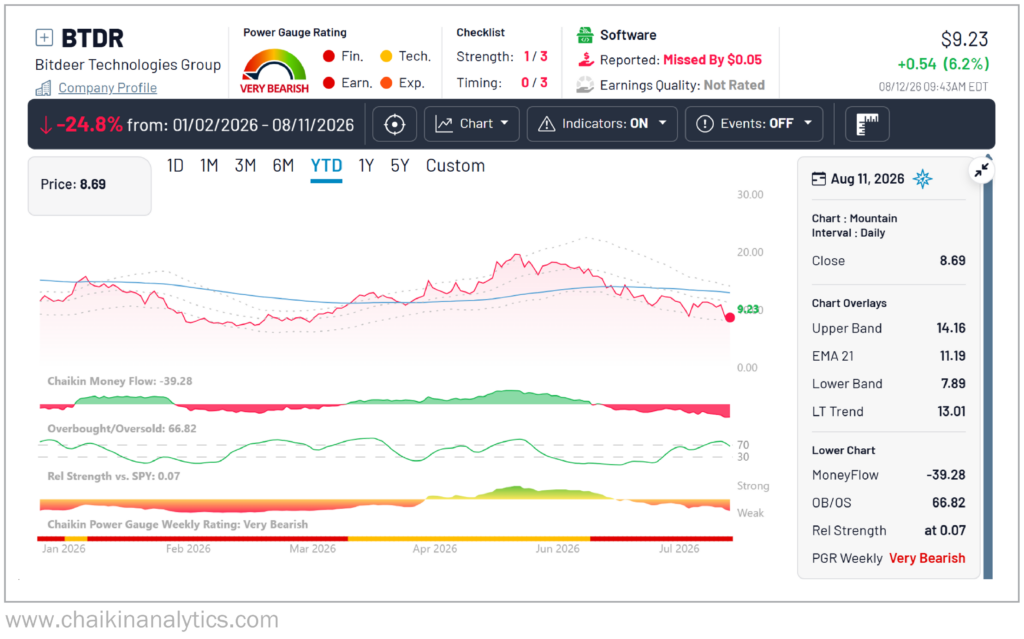
Bitdeer could certainly use it. While its total revenue was strong during the second quarter of fiscal 2026 ($228.8 million, a year-over-year increase of 47%), the company suffered a year-over-year gross loss of $8.5 million and a net loss of $92.3 million – both significantly worse numbers than 2025’s, though improvements from the previous quarter. Additionally, its generally accepted accounting principles (“GAAP”) earnings per share (“EPS”) of negative $0.37 missed consensus expectations.

Bitdeer stock has been on a gradual downward slide since the start of the year, dropping nearly 25% as of August 11.

Bitdeer Chaikin Analytics Graph

Chaikin Analytics, the investment-research platform founded in 2009 by legendary 60-year Wall Street veteran Marc Chaikin, rates Bitdeer “very bearish” in its Chaikin Power Gauge, a 20-factor stock-rating system that scans more than 5,000 stocks and 2,300 exchange-traded funds (“ETFs”).

Bitdeer Power Gauge Rating of Very Bearish

Despite the bearishness, Bitdeer could rebound as it establishes itself more as a data-center landlord rather than a shaky crypto company.

Nvidia (NVDA): Backing the Customer That Buys Its Chips

It’s not as if the chip bellwether was relying on these Bitdeer/Volta/Anthropic deals to turn its fortunes around. It is, after all, the most valuable company in the world. But these types of deals certainly don’t hurt, especially as Nvidia rolls out its next-generation Vera Rubin AI architecture on a large scale.

The Bitdeer/Volta data-center campus is simply a showcase for Nvidia’s latest and greatest. But by backing – both financially and with its state-of-the-art technology – a specialized startup like Volta, Nvidia diversifies and expands its already sizeable footprint. And it will likely result in more startups lining up at Nvidia’s door, hoping for the same level of support.

Unsurprisingly, Nvidia gets a “very bullish” rating from the Chaikin Power Gauge.

Nvidia Power Gauge Rating of Very Bullish

Dell (DELL): PowerRack and Liquid Cooling Inside All Four Tydal Halls

Most people know Dell as a long-standing, successful, and reputable business within the consumer-computing industry. But the company has proven itself to be a major player in the AI world. These deals further solidify that sentiment.

The Bitdeer/Volta deal places Dell’s enterprise hardware, PowerRack server systems, and liquid cooling technology into the new data halls in Norway – another major milestone for Dell’s growing AI business.

And it’s that AI business that has pushed Dell stock up 245% since the start of 2026 (as of August 11) and prompted a “very bullish” Chaikin Power Gauge rating.

Dell Chaikin Graph

Anthropic: 133 MW and Less Reliance on Amazon

The Volta deal is huge for Anthropic on a couple of fronts. First and foremost, it gets 133 gross MW of power that it desperately needs to run the infrastructure that will train and deploy its next-generation Claude AI models and Claude Code.

Second, it secures this infrastructure using renewable, clean energy at a large scale. By tapping into Norway’s nearly carbon-free hydropower, Anthropic not only complies with strict European environmental regulations, but it also avoids the overly congested U.S. power grid and its yearslong connectivity wait times.

And this transaction also lessens Anthropic’s dependence on Amazon (AMZN), its main cloud provider. Expanding your supplier network, especially geographically, is never a bad idea in the AI world. Doing so will help Anthropic avoid bottlenecks, reduce geopolitical risk, and even improve performance.

The Risks: $500 Million Unfunded and a Chip That Just Started Shipping

While these agreements certainly have upsides for all involved parties, there are some risky elements… especially for Anthropic and Bitdeer.

Let’s start with Bitdeer. Per the agreement, the company must finish roughly $500 million of physical build-out on the Tydal data-center campus to meet both phases of delivery – the first by the end of 2026, the second by the end of next March.

The problem is, as of August 12, Bitdeer has not yet closed financing for those funds. If Bitdeer fails to meet those delivery deadlines, it faces potentially steep penalties and even the possibility of contract termination.

For Anthropic, the primary risk is the heavy reliance on a brand-new cloud infrastructure company (Volta) as the only safety net between itself and the hardware to be provided by Dell and Nvidia.

Speaking of hardware, that’s no sure thing either, considering large-scale production of Nvidia’s Vera Rubin platform only began in late May. Deploying the new hardware on the expedited timeline required by Bitdeer’s delivery deadlines undoubtedly introduces a layer of uncertainty.

Do the potential upsides outweigh the risks of these deals? That all depends on the level of risk investors are willing to take on. Sure, there’s a possibility that the Volta deal blows up for Anthropic. After all, it’s putting a lot of faith in a company that has only existed since January – a company that will be responsible for installing the hardware and managing the cloud-computing-power operation of a massive new data-center campus.

But that deal also secures much-needed computing capacity for Anthropic’s newest Claude models. And it expands the company’s global footprint.

For Bitdeer, this deal opens a brand-new revenue stream as a data-center landlord – one that should be far steadier and more lucrative than its bitcoin-mining business. We should know by next spring whether these deals proved successful not only for Bitdeer and Anthropic, but also for Dell and Nvidia.

Regards,

David Engle

Editor’s Note: Marc Chaikin, the founder of Chaikin Analytics, built an award-winning system that flagged Nvidia as a BUY before it soared as high as 45,000%. It also turned “bearish” on software stocks two months before they crashed this year. Now, Marc’s warning that a  “jump to lightspeed” has taken place behind the doors of a Silicon Valley AI lab – and says the repercussions are about to cleave the market in half this summer. This 60-year Wall Street legend has a FREE Hotlist of stocks to buy and an urgent Hitlist of stocks to sell now. Click for the full story, including stock names and tickers here… 

The post Bitdeer’s $4.7 Billion Data-Center Lease to Cloud Startup Tied to Anthropic AI Deal: Here’s Who Benefits appeared first on MarketWise.

  • ✇Market Wise
  • Does Intel’s $20 Billion Stock Sale Signal a Buying Opportunity or a Warning Sign? David Engle
    Key Points Intel (INTC) raised $20 billion through an upsized stock offering to fund AI infrastructure, foundry expansion, and other growth initiatives without adding more debt. The offering will dilute existing shareholders, while Intel’s heavy capital spending and negative free cash flow raise questions about how long its AI investment strategy can continue. Intel stock could offer upside if its AI and foundry investments pay off, but the offering also highlights the enormo
     

Does Intel’s $20 Billion Stock Sale Signal a Buying Opportunity or a Warning Sign?

13 August 2026 at 06:55

Key Points

  • Intel (INTC) raised $20 billion through an upsized stock offering to fund AI infrastructure, foundry expansion, and other growth initiatives without adding more debt.
  • The offering will dilute existing shareholders, while Intel’s heavy capital spending and negative free cash flow raise questions about how long its AI investment strategy can continue.
  • Intel stock could offer upside if its AI and foundry investments pay off, but the offering also highlights the enormous costs and risks surrounding the AI infrastructure boom.

Intel (INTC) raised $20 billion from a new stock offering this week, allowing it to turbocharge the company’s AI-infrastructure investments.

Initially, Intel announced in a brief press release on Monday that it aimed to raise $15 billion from the new stock offering. Investors didn’t react very positively to that news.

Between the dilution of existing shares and companies’ uninhibited spending on AI, many investors are skeptical of and, frankly, fatigued by this type of development. Not surprisingly, Intel’s stock, which closed at $101.65 on Friday, August 7, fell during pre-market trading, opening Monday morning at $98.26.

This unexpected announcement also raised some questions.

Why the surprise public stock offering? What does it mean for Intel and its investors? And is this offering a good buying opportunity at a lower stock price, or is it an AI warning sign?

Why Intel Sold $20 Billion of Common Stock

If you guessed artificial intelligence (“AI”), you are correct! What decisions aren’t driven by AI these days? If you haven’t paid much attention to Intel in the past few years, let’s get you caught up.

As I wrote in a May 1 article about Intel’s fast-rising stock, much of Intel’s recent success can be attributed to the revival of Intel Foundry Services.

Here’s an excerpt from that article:

In 2022 and 2023, Intel Foundry Services (“IFS”) earned external foundry revenue of $895 million and $952 million, respectively.

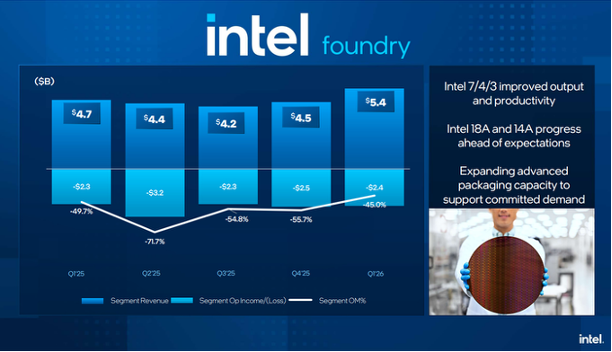
IFS revenue then exploded to $17.5 billion in 2024 and increased to $17.8 billion last year. The pattern continued into 2026’s first quarter, with Intel’s foundry business earning $5.4 billion, a nearly $1 billion jump from the previous quarter.

Intel Foundry

What sparked such a drastic revenue surge?

  • Intel began manufacturing its own products, including the Core Ultra Series 3 and Xeon 6 processors, rather than having them manufactured by Taiwan Semiconductor.
  • The AI data-center boom pushed demand for Intel’s Xeon processors to unprecedented levels.
  • Intel’s application-specific integrated circuit (“ASIC”) custom chip business increased by more than 50% thanks to demand from cloud customers…

And what might be the best

AI demand is obviously still quite strong, so Intel is doubling down on its AI investments.

In its press release, Intel stated that:

Progress in emerging areas including physical AI, purpose-built silicon, advanced packaging and external wafers represent significant growth opportunities for Intel.

Thus, Intel decided to offer the common stock for sale and put the proceeds toward capital expenditures (“capex”), working capital, and growth opportunities. In other words, Intel is looking to grow its AI-infrastructure business significantly. And this offering would greatly expand the available capital Intel needs to do so.

That capital comes without Intel increasing its debt, which is important considering, in July, Intel upped its 2026 capex projection to more than $20 billion.

Other key details of the transaction:

  • The offering’s share price came in at $95, meaning 210,526,315 new shares were made available for purchase.
  • The offering’s underwriters will have a 30-day option (called a “greenshoe”) to purchase up to a total of $2.25 billion in additional shares of common stock at the public offering price, minus underwriting discounts.
  • This would add another 31,578,947 shares of stock to the market, resulting in a total of around 242 million new shares of Intel common stock, based on the $95 share price.
  • Wall Street titans JPMorgan Securities, Goldman Sachs, Morgan Stanley, and Citigroup are serving as joint book-running managers for the offering, reflecting the magnitude of this transaction.

As I mentioned earlier, Intel stock took a hit upon the initial news of the transaction, falling more than 4% on August 10. The reason? Concerns about dilution for existing Intel shareholders… a common worry whenever a company makes this much stock available for public sale.

And it’s a legitimate concern. Issuing $20 billion in new equity will, indeed, dilute Intel’s investors. But the other side of the argument is also valid. Intel stands to gain up to $20 billion in needed capital from the stock sale, giving the company tons of liquidity as it continues to invest in future growth. And it does so without increasing its debt.

The dip in stock price on August 10 may be a blip on the radar, but it’s worth monitoring for investors – especially those who own a sizable stake in the company.

The Federal Government’s 10% Stake in Intel Faces Dilution

About a year ago, the United States government, with the backing of President Donald Trump and his administration, purchased 433.3 million shares of Intel at $20.47 per share. That gave the federal government 9.9% ownership of Intel.

Whether coincidental or not, Intel has since taken off, seeing its stock price increase by nearly five times since the federal government’s investment last August. Intel and its investors – especially the government – have made a lot of money during that span.

Now, with this $20 billion stock offering, the government’s 10% stake is about to shrink. Based on the math used earlier, and the fact that the government did not participate in this sale, that 10% became roughly 9.5%.

Also, as part of the administration’s deal with Intel, the government received a five-year warrant at $20 per share for an additional 5% of Intel common shares, which, according to Intel, is “exercisable only if Intel ceases to own at least 51% of the foundry business.”

Because the August 2025 deal locked in 240.5 million warrants at $20 per share, the growing pool of total outstanding shares automatically dilutes the ownership of those warrants. In other words, the government’s 5% of additional shares from that warrant will also dip closer to 4.64%.

Unfortunately for the government, as a passive minority shareholder, it doesn’t hold any veto or voting power. So, there’s nothing Trump or his Cabinet can do to stop the offering. Ultimately, the government stayed on the sidelines.

On Monday evening, the only official comments from the administration came from White House National Economic Council Director Kevin Hassett, who told CNBC that it’s ultimately up to President Trump when the administration sells its stake – which it does not appear ready to do just yet. So, that’s also something to watch.

What the $20 Billion Offering Means for Intel Investors

We should learn the details of Intel’s stock offering after the sale closes on August 12, as the Wall Street banks running the transaction build an order book. At that point, we should have a better idea of how much Intel’s stock will be impacted.

But you can probably count on an Intel stock slide in the immediate aftermath of the transaction.

Why’s that? Dilution, for one. Then there are discounts. Underwriters often price newly available shares at a small discount (generally 2% to 5%) below the current trading price to entice institutional investors to spend millions or billions on the new shares. Sure enough, Intel’s stock was priced at $95, a discount of 2.6% from its August 10 ​close.

Finally, simple supply and demand negatively impact the stock’s price when millions of new shares are added without an instant surge in buyer demand. But considering Intel’s sale did see a big swing in buyer demand, this shouldn’t be much of a factor.

We don’t have to look back too far for similar examples:

  • In 2020, as Tesla (TSLA) stock was soaring, Musk and company took full advantage of the high price by rolling out multiple multibillion-dollar capital raises. One example was a huge $5 billion “at-the-market” stock offering, which immediately pulled Tesla stock back, resulting in a loss of roughly 4.7% by market close that day.
  • Earlier this year, Oracle (ORCL) announced it was raising nearly $40 billion in capital through mixed debt and equity offerings to bankroll its AI-infrastructure and cloud data-center build-out. The company’s shares plunged more than 12% in after-hours trading as investors lost their collective minds over the amount of money needed to support Oracle’s AI expansion.

But what about long-term impact? This is where things get more complicated. A short-term reaction – or overreaction – is one thing, because it’s typically based on impulsive investor and analyst emotion and sentiment, whether it’s sheer panic or total exuberance.

Long-term impact is generally driven by more rational and strategic thinking. It takes time to analyze and unpack how a company has performed after certain transactions have completed – in Intel’s case, the $20 billion public stock offering.

If you’re considering investing in Intel, you’ll want to see whether this transaction leads to real revenue and profit, whether there’s significant growth and expansion of its foundry facilities to handle demand for its AI hardware, and whether Intel can establish strong cash flow.

During the second quarter of fiscal year 2026, Intel operations generated an impressive $7 billion in cash flow. However, the company’s free cash flow (“FCF”) came in at negative $8.42 billion – compared with last year’s negative $1.1 billion – because of rising capex.

Intel is projecting another year of negative FCF, which would extend its streak to five straight years… the company accumulated a negative FCF of roughly $44 billion between 2022 and 2025, fueled by constant investments in AI and foundry expansions.

Here’s the thing: Intel is probably doing the right thing by increasing its capex to fund its AI infrastructure and meet customer demand. And doing so by diluting its existing shareholders was preferable to growing its debt by the billions, from Intel’s perspective.

The problem is, AI expenditures and financing are simply out of control.

Intel is seemingly doing everything right. Just look at the highlights from its July quarterly earnings report.

  • $16.1 billion total revenue, well above the projected $14.4 billion.
  • Data-center and AI revenue of $6.3 billion, a massive 59% year-over-year gain.
  • Non-generally accepted accounting principles (“GAAP”) earnings per share (“EPS”) of $0.42, doubling expectations.
  • A 40.4% gross margin, up from 27.5% year over year.

By any standard, that’s a highly successful quarter. Until you look at the company’s second-quarter net loss of $11 billion, up from $2.9 billion the year before.

All the positives are being negated by capex that appears to be unsustainable over the long term. And it shows no signs of slowing.

Intel Chief Financial Officer David Zinsner, who had already raised 2026 capex guidance from $18 billion to more than $20 billion, noted that 2027 capex would be “significantly above” that threshold.

So the questions investors must ask themselves are, “Will all of this pay off?” And, “If so, when?”

That’s yet to be determined. In the meantime, investors can take some comfort in knowing Intel is raising capital through equity rather than taking on more debt.

Which begs the question… Does this $20 billion stock offering make Intel a buy, or is this a warning that AI expenditures are simply too overwhelming for the company?

From my view, it’s another ominous warning of the prohibitive costs of financing the AI boom. Sure, the stock offering makes some sense from a bottom-line perspective. But when successful companies – and Intel has been riding a yearlong wave of success – start looking for different avenues to help them raise money to pay their seemingly endless string of capex bills, it’s worrisome.

The Bottom Line on Intel Stock

Intel has momentum. As I mentioned earlier, its stock price has nearly quintupled over the past year, clearly a positive sign. And, if Intel manages this stock offering the right way and makes smart investments with this capital, there’s no reason to think the company won’t continue along the right path, and its stock along with it.

But there’s no escaping the daunting shadow of AI capex that hovers over everything Intel does. The company has already burned billions in cash to expand its capacity, making some investors and analysts tired of the nonstop AI-related expenses that grow more exorbitant by the day.

It’s resulting in too many reputable companies with negative FCF despite growing revenues. And there’s no sure answer as to whether these massive investments will ultimately pay off. That’s just the uncertainty of the AI economy.

Intel is truly straddling the buy/sell fence right now. It’s possible the investments made using the capital from the $20 billion stock offering push Intel into “elite global foundry” territory alongside Taiwan Semiconductor Manufacturing (TSM). That makes Intel look undervalued.

But there’s also a possibility that Intel’s AI investments don’t pay off the way it envisions and the company never even remotely approaches anything close to that status. (Let’s face it, TSM has no peer and probably never will.) That, combined with shareholder dilution, is not looked upon favorably by investors.

The AI-expenditure crisis certainly isn’t unique to Intel. It spans the entire industry. But the spotlight is on Intel now, after its public stock offering. And the investing world will be watching its every move to see where it goes from here.

Regards,

David Engle

Editor’s Note: Whitney Tilson called the rise of Apple, Amazon, and Netflix… as well as the collapse of dozens of companies that went bankrupt. Now the former $200M hedge fund firm manager is stepping forward with what he calls the most important financial warning of his 30-year career. He’s sharing two free stock recommendations  (one to buy, one to sell immediately)  along with details of a new proprietary system fueling his predictions. See it all in his free presentation. 

The post Does Intel’s $20 Billion Stock Sale Signal a Buying Opportunity or a Warning Sign? appeared first on MarketWise.

  • ✇Market Wise
  • A high probability stock trade with significant upside Brian Hunt
    Today’s issue in preview: A high probability stock trade with significant upside The best and most important economic news you’re not hearing in the mainstream press How to trade the world’s hottest market of 2026: An update in our series Learn our Top Themes to buy now A high probability stock trade with significant upside Credit: Orhan Turan Over the past two months, the iShares Biotechnology ETF (IBB) is up 17% and recently reached a new all-time high. This makes IBB one of the wo
     

A high probability stock trade with significant upside

12 August 2026 at 12:00

Today’s issue in preview:

  • A high probability stock trade with significant upside

  • The best and most important economic news you’re not hearing in the mainstream press

  • How to trade the world’s hottest market of 2026: An update in our series

  • Learn our Top Themes to buy now


A high probability stock trade with significant upside

Image

Credit: Orhan Turan

Over the past two months, the iShares Biotechnology ETF (IBB) is up 17% and recently reached a new all-time high.

This makes IBB one of the world’s top-performing ETFs of the past two months. It also makes our recommendation to invest in this theme a big winner.

On August 18, 2025, I sent a research note to colleagues outlining my bullish view of the biotech sector’s price action. Since then, I’ve written more than a dozen updates on the biotech bull market, as IBB has risen 52%, far outpacing the S&P’s 21% gain.

IBB focuses on large biotech firms such as Amgen (AMGN), Vertex Pharmaceuticals (VRTX), and Gilead Sciences (GILD). The S&P Biotech ETF (XBI), which focuses on smaller biotechs, has risen 86% compared to the S&P’s 21% gain.

The biotechnology sector comprises companies working on cures and treatments for hundreds of diseases. When investors grow interested in this industry, the returns can be incredible. During the last biotech bull market, the sector soared 300% over four years.

Biotech performed poorly from 2021 through 2025, so most investors are indifferent to it. But I see major potential here. This industry is poised to generate many stock market doubles and triples over the coming decade.

The fusion of AI plus biology will generate dozens of compelling stock narratives over the coming years. Researchers running superintelligent AI programs will be able to run millions of digital simulations of drugs and treatments. This will put medical innovation into overdrive… and create many big stock market winners.

Companies that leverage AI to “crack the code” for various diseases, treatments and drugs will enjoy 100%… 500%… even 1,000%+ stock rallies.

In many cases, these rallies will happen thanks to stories and potential… rather than a company generating revenue or earnings.

Capitalizing on many of today’s biggest stock market trends means focusing on promise over profits. The biotech sector holds the potential for both.

Biotech has another powerful factor working in its favor: Virtual anonymity.

The investment public is largely indifferent to the biotech industry right now. Investment newsletter sales related to biotech are tiny. Biotech specialists posting on X get scant attention. CNBC does not have a show devoted to biotech. Presentations on biotechnology stocks are not popular at investment conferences.

If I were to bring up biotech investing to a group of casual, amateur investors, I’d get blank stares in return. To put the situation in blunt, conversational terms, “Nobody gives a s**t” about biotech.

This “state of indifference” is very bullish for biotech stocks.

When the investment public is indifferent towards a powerful theme, it tells you valuations have not been bid up to unrealistic levels… so there’s plenty of room to grow into high valuations. Plus, it means there’s a lot of money on the sidelines that could eventually pile into the trend, sending it much higher.

In other words, “A strong industry uptrend + public indifference towards that industry” is one of the greatest moneymaking equations in all of finance.

Investors with the time to spend on picking individual biotech stocks and managing the positions can generate large returns in a biotech industry uptrend. For example, over the past year, at least 14 companies with “therapeutics” in their names have delivered returns of 300%+ or more.

If you don’t want to spend time researching and managing individual biotech stock positions, ETFs can get you exposure to this industry. XBI and IBB are worth considering.

The biotech industry has tremendous price momentum working in its favor… plus the investment public is largely indifferent to its success. This is a powerful combination that makes more new highs a high-probability bet. I remain bullish on biotech.

Image

Recommended Link:

Small Colorado Company (Backed by Sam Altman) Could Save U.S. Power Grid

Ad Image

A small Colorado company now owns rights to a tech that could save the entire public power grid from collapse. And billionaire Sam Altman is now an investor. Click here to learn this company’s name for free.

The best and most important economic news you’re not hearing in the mainstream press

Image

Credit: IURII KRASILNIKOV

It’s too bad our biology makes us fixate on alarming news, scandals, wars, fights, murders, and disasters.

If that weren’t the case, more people would know that the entire world is in a bull market.

Many people like to blame the mainstream media for fanning the flames of political divides, culture wars, social unrest and other conflicts. But don’t blame the media. The people working at Fox, CNN, ABC, NBC, and CBS have kids and mortgages and cars to pay for, like the rest of us. They are chasing high salaries, bonuses, capital gains, and dividends like the rest of us.

And they know their customers (you and me) like to click on and watch news about wars, crises, murders, political fights, and the like. This desire is seared into our DNA.

Fixating on potential dangers and sources of conflict is a useful survival instinct. A million years ago, it’s how our ancestors survived. Back then, an unusual noise coming from behind a bush could mean a tiger was about to attack.

These days, we don’t need to worry about tiger attacks, but our old survival instincts still dictate our actions. We still fixate on potential dangers. That’s why we are compelled to click on headlines that promise information about war, murder, fights, crises, natural disasters, recessions, and bear markets.

Again, you can blame the media. But it’s just responding to consumer demand.

If this weren’t the case, more people would know that literally the whole world is a bull market. Today, the Vanguard Total World Stock ETF (VT) reached a new all-time high.

VT aims to do what its name implies. It owns over 10,000 stocks to give investors exposure to dozens of countries, dozens of industries, and thousands of different stocks from around the world.

U.S. stocks. European stocks. Asian stocks. Growth stocks. Value stocks. Tech stocks. Mining stocks. Health care stocks. Emerging market stocks. You get it all with VT. For those of you scoring at home, the fund aims to track the FTSE Global All Cap Index.

Does the global economy have imbalances and big problems? Of course. It always does. But making money in stocks is never the result of a problem-free economic environment. It’s always about being in an environment where the big problems are overwhelmed by the even bigger positives.

For stocks around the world, the big positives are strong enough to send VT to all-time highs. The fund is up 23% over the past year. Trends tend to persist, so consider us bullish on stocks worldwide.

Image


How to trade the world’s hottest market of 2026: An update in our series

Image

Credit: KanawatTH

Today, bulls on the “AI infrastructure” trade received some excellent news. The VanEck Semiconductor ETF (SMH) reached its highest point since mid-June.

The status of this critical tech sector has become one of the great sagas of the business and investment world… a source of intense disagreement among industry bulls and bears.

Is this consequential industry group a buy, a sell, or something else?

Today, we update you on this industry’s “trend health” and offer guidance on how to think about and trade this sector. This is the third part of our special series on “the state of semis.”

The semiconductor industry has always been a critical part of our high-tech economy. Semiconductors are the “tiny engines” that power our computers. However, the proliferation of AI has turbocharged the industry’s revenues and stock prices. It has also made industry leader Nvidia (NVDA) a $5.4 trillion colossus. The stock is up more than 1,200 since January 1, 2023.

In June 2025, semiconductor stocks broke out of a sideways consolidation pattern and began a rally for the ages. During this rally, the world’s largest semiconductor ETF – SMH – gained 147% in just under a year.

Individual semiconductor leaders AMD (AMD), Marvell Technology (MRVL), and Lattice Semiconductor (LSCC) gained more than 200% during that time. Stock gains of 25% in a month became commonplace.

When a sector gains 50% in a year, that’s considered incredible. What semis returned was “triple incredible.”

Avid Money & Megatrends readers know what drove those giant returns. Given AI’s enormous promise, large tech firms such as Alphabet (GOOG), Amazon (AMZN), and Microsoft (MSFT) have invested over $1 trillion in AI infrastructure. They are on pace to invest over $700 billion this year alone and more than $3 trillion after that.

Both the scale and the velocity of this investment boom are unprecedented. It is the largest collective investment effort in history.

A lot of this money was used to purchase semiconductors. Semiconductor industry revenue totaled $793 billion in 2025, an increase of 21% year-over-year, according to Gartner, Inc.

Given its AI drivers and big returns, it’s no wonder semis became the world’s “hottest trade.” And when any theme becomes the world’s hottest trade, it becomes a leading candidate to experience a significant correction or something worse.

That’s just how the stock market works. When a bull market grows very popular and attracts a lot of speculation, it likes to “buck off” market participants with a sharp correction or worse.

That’s what has happened to the semiconductor trade this summer. After soaring from June 2025 to June 2026, SMH declined 24%. Some individual semi names declined by more than 35%.

So, what is next for the “world’s hottest” trade?

Let’s size up this trend and make some “trend health” conclusions.

As you can see in the two-year chart below, the SMH share price declined from the mid-$600s to the mid-$500s. But over the past two weeks, SMH has rallied back into the $580s and has recently reached its highest level since June. This rally has erased the worst of July’s selloff.

In my initial trend health analysis of SMH, I stated that if long-term AI bulls are proven right by the market, SMH will likely “digest” its summer losses by trading in a sideways consolidation pattern for 3-6 months… and then recover to trade back to the mid-$600 area and beyond.

If the AI bears are right, SMH won’t see that mid-$600-per-share level for years… and we are much better off focusing on other trends.

Since SMH began selling off in July, I’ve leaned towards thinking SMH’s decline will prove to be a short-term correction inside a long-term bull market. However, I place much more weight on what the market thinks about this trend (and every other trend) than on what anyone else thinks about it, including me.

With all this in mind, traders looking to ride clear, healthy uptrends should see the recent SMH rally as a huge step in the right direction back towards “excellent trend health.” Further gains into the $610 per share area will tell us the semi trend is officially alive and well. Our updates on this all-important trend will continue…

Image


Market Notes

  • Our recommendation to invest in the booming oil and gas pipeline industry continues to pay off bigly. Blue chip pipeline firm Energy Transfer (ET) reached a new all-time high today.

  • The strong economy continues to express itself via the bull market in Full Service Restaurants (FSR). The Cheesecake Factory (CAKE) and Brinker International (EAT, Chili’s) reached new all-time highs today.

  • Mega bank JPMorgan Chase (JPM) reached a new all-time high today. This is a significant bullish economic signal.

  • The Power Grid Upgrade theme continues to create winners. Electrical infrastructure giant Eaton (ETN) reached a new all-time high today.

  • Drug development giant Charles River Laboratories (CRL) reached a new all-time high today.

Regards,

Brian Hunt signature

Brian Hunt signature

Brian Hunt
Editor, Money & Megatrends


An urgent message from our colleagues:

Elon Now Pays 15X More Than Your Bank

Image

Elon Musk is now paying you 15X more than your bank… Thanks to a project he’s been working on for the last 27 years. All you have to do is sign up for his new bank. For years, America’s biggest banks have been telling you they have no choice but to pay you interest rates as low as 0.4% (that’s the national average). Now, suddenly… Elon is exposing many of these bankers for the sharks they really are. He’s not offering double… or triple… or even five times the interest… But 15 times the national average – at 6% per year. This is just one of the radical ways Elon’s new bank is disrupting the financial sector…

Luke Lango is revealing how it could impact your money (and how you should prepare) here.

The post A high probability stock trade with significant upside appeared first on MarketWise.

❌