❌

Normal view

  • ✇Market Wise
  • Six elite stocks to play the bull market in gold Brian Hunt
    Today’s issue in preview: Six elite stocks to play the bull market in gold AI will drive a revolution in money and banking. Three stocks for the coming shift. Learn our Top Themes to buy now Six elite stocks to play the bull market in gold Credit: Backyard Production Last week, the U.S. government announced that total U.S. debt topped $40 trillion for the first time. The government’s debt has more than doubled in less than a decade, from $19.95 trillion when President Donald Trump was
     

Six elite stocks to play the bull market in gold

26 August 2026 at 12:00

Today’s issue in preview:

  • Six elite stocks to play the bull market in gold

  • AI will drive a revolution in money and banking. Three stocks for the coming shift.

  • Learn our Top Themes to buy now


Six elite stocks to play the bull market in gold

Image

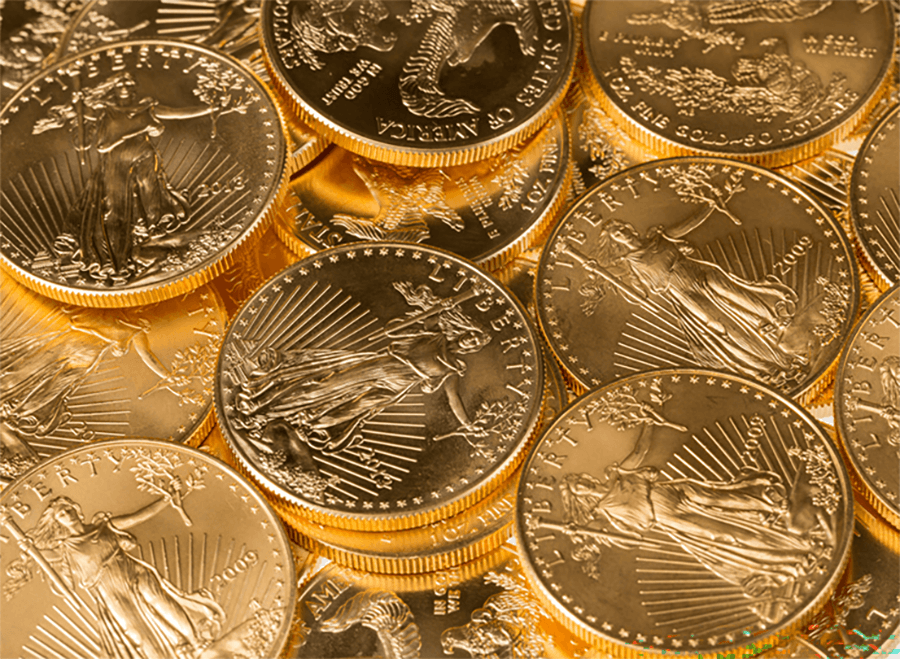
Credit: Backyard Production

Last week, the U.S. government announced that total U.S. debt topped $40 trillion for the first time.

The government’s debt has more than doubled in less than a decade, from $19.95 trillion when President Donald Trump was sworn in for the first time in January 2017.

Net interest payments on the debt are projected to total more than $1 trillion in fiscal 2026. Interest payments now exceed defense spending and Medicare spending. Servicing debt is now the second-largest item in the federal budget, behind only Social Security. It is expected to cost more than $16.2 trillion over the next decade.

Given all this, it is no wonder gold recently rallied from $4,000 per ounce to $4,600 and resumed its long-term uptrend.

In 2003, I placed over half of my net worth into physical gold. Since making that bet, gold has risen about 1,170%, far outperforming stocks. I haven’t sold one ounce along the way. Over the years, I’ve held huge positions in gold stocks.

And now, all these years later, the best reason I can find to be bullish on gold is the same reason why I bought gold in the first place…

The U.S. government is spending far more money than it takes in and then makes up the difference by borrowing and printing money by the trainload. Every freshly printed unit of currency debases an existing one. This raises the nominal price of real money (gold). Gold has spent the past 23 years constantly revaluing itself to accommodate the huge increase in new currency units.

Here in mid 2026, the problem is worse than ever. In America, millions of people are net tax recipients – meaning they receive more in benefits than they pay in taxes.

No politician can win a major election by promising reduced spending. Too many people are now riding the gravy train. Democrat or Republican, it doesn’t matter. Campaigning on sensible spending is a sure loser.

This makes it a good time to know “who’s who” in the gold royalty business.

In our recent analysis of the unique ETF, Horizon Kinetics Inflation Beneficiaries ETF (INFL), I covered its business model.

Gold royalty firms are a unique type of company. They do not engage in the business of operating gold mines. Instead, they are essentially resource banking/investment firms. They raise investor capital and then invest it in prospective or existing resource projects.

They partner with mine and oilfield operators… buying upfront stakes in projects in exchange for a share of future production. In doing this, the best royalty firms own diversified resource portfolios and enjoy high-margin businesses without doing the day-to-day work of operating mines or oilfields.

This “high margin, asset-lite” business model allows the best royalty firms to generate strong profit margins, consistent cash flow and leverage to rising gold prices. This in turn makes royalty firms the preferred vehicles for many sophisticated investors to invest in gold for the long term.

Compelling gold royalty firms include:

Royal Gold (RGLD): RGLD is one of the largest precious metals companies. Royal Gold has major interests in several large, long-lived mines, including Mount Milligan in Canada, Pueblo Viejo in the Dominican Republic, Cortez in Nevada, Andacollo in Chile and Kansanshi in Zambia. Mount Milligan and Pueblo Viejo are particularly important cash generators. The portfolio is primarily gold-focused but provides meaningful exposure to copper. Market cap: $22.6 billion.

Franco-Nevada (FNV): Franco-Nevada owns one of the industry’s largest and most diversified portfolios, spanning hundreds of mining and energy assets across numerous countries. Major contributors have included Candelaria, Antapaccay, Antamina and various Nevada gold operations. Gold accounts for most of its value, supplemented by silver, platinum-group metals, copper and energy. Market cap $52 billion.

Triple Flag Precious Metals (TFPM): Triple Flag’s important assets include Northparkes and Ravenswood in Australia, Cerro Lindo in Peru, Impala Bafokeng in South Africa, Buriticá in Colombia and Fosterville in Australia. Its portfolio is heavily weighted toward gold and silver and geographically concentrated in the Americas and Australia. Market cap $7.2 billion.

OR Royalties (OR): Formerly Osisko Gold Royalties, OR’s flagship asset is its valuable interest in Agnico Eagle’s Canadian Malartic complex in Quebec, one of Canada’s largest gold operations. OR also has exposure to other producing and development projects, including several Canadian assets. Market cap $7.3 billion.

Gold Royalty Corp. (GROY): Gold Royalty has assembled a large portfolio of interests across the Americas, with particularly significant exposure to gold projects in Canada and the United States. Unlike the industry’s giants, much of GROY’s potential value comes from mines and projects that are still being developed, expanded or explored. That creates potentially substantial production growth over time but also makes future cash flows less certain. Market cap: $815 million.

Versamet Royalties (VMET): Versamet is an emerging player whose portfolio provides exposure to precious and base metals across producing, development and exploration-stage properties. The company’s attraction is largely its growth potential: because it remains relatively small, successful mine developments, expansions and additional acquisitions can materially increase its cash flow and asset value. Market cap $1.2 billion.

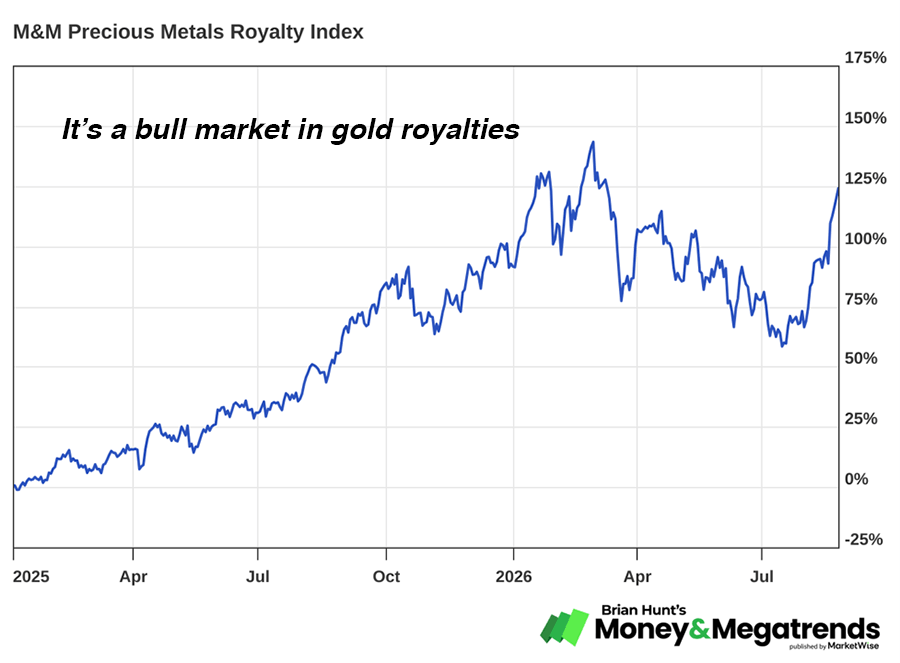
Recent government spending and taxation data tell us the government is going “full speed ahead” with spending, borrowing, and printing. This means owning quality “inflation defense” assets is as important as ever. Gold royalty firms are worthy members of this club. If gold continues its bull market, as I think it will, these stocks will be large winners. As you can see in the chart below, our Precious Metals Royalty Index is poised to reach new highs:
Image

Recommended Link:

“Do NOT buy high flying tech stocks like Nvidia, SpaceX”

Ad Image

One of America’s leading AI pioneers is stepping forward today with this urgent warning… and to reveal exactly where to move your money for a chance at 1,000%+ returns before August 31st. Get the full details here.

AI is poised to drive a revolution in money and banking. Three stocks for the coming shift.

Image

Credit: jroballo

In May, Microsoft said the number of active AI agents in its business software suite (the Microsoft 365 ecosystem) increased 15-fold from March 2025 to March 2026.

This significant increase in agent usage marks the start of a massive AI trend… one that will create many large opportunities for investors. It’s also proof that the Agent Supernova we forecasted is here.

On March 16, we urged readers to prepare for the “Agent Supernova” our nickname for the coming explosion in AI agent usage.

Years of development have made AI advanced enough to perform many everyday tasks people do now… and the list of tasks is only getting bigger.

In the next 12–24 months, AI agents will assist with managing factories… performing financial analysis… managing business inventories… writing software… designing websites… creating legal documents… and thousands of other things.

Within the next two years, the number of AI agents operating in the American economy isn’t poised to increase by 10X… or 50X… or even by 1,000X. Try at least 10,000X.

This is the coming Agent Supernova. Agents working with people. Agents working with other agents. Agents running businesses. Agents negotiating and haggling with other agents.

The Agent Supernova is about to introduce billions of “AI workers” into our economy to perform all kinds of roles… with very little day-to-day human oversight.

The business and investment implications are huge. The Agent Supernova will transform many businesses and industries, and end many as we know them… while creating new ones. The economic deck is about to get reshuffled.

The bigger the impact a megatrend can have on our world, the bigger the capital gains it can generate in your portfolio. This is why the Agent Supernova is such a big opportunity. It’s why we will be writing about and investing in this trend for years.

One compelling facet of this megatrend is how AI will revolutionize money, payments, and banking.

Very soon, there may be more AI agents than humans transferring money and making payments in our economy.

That’s not our claim. That’s what the CEO of Coinbase, Brian Armstrong, said on March 9:

“Very soon, there are going to be more AI agents than humans making transactions. They can’t open a bank account, but they can own a crypto wallet. Think about it.”

Money is about to have far more machine use than human use. And once you understand that machines and AI agents can’t use bank accounts as we know them… the only logical use case will be stablecoins… aka “dollars that computers use without having bank accounts.”

Why do more AI agents mean more stablecoins?

Currently, AI agents can do the following:

  • Talk to other APIs (services)

  • Rent computer power

  • Buy and sell data and

  • Send lots of small payments every day.

That is all programmed in advance and easy for an agent to do.

However, an agent cannot go to a bank, show an ID, sign forms, or open an account. That’s why the traditional banking system as we know it today isn’t agent-friendly.

But an agent can manage a digital wallet protected by a key or code. Stablecoins are simply dollars that live inside these keyed, or coded, wallets that can move dollars instantly, anytime, anywhere. This makes them a natural fit for how agents spend and receive money.

Compelling investment candidates related to this trend include:

Circle (CRCL): CRCL is a $23 billion company that is the issuer of USDC, the #1 stablecoin in transaction volume globally. Unlike Tether (another key stablecoin), which operates predominantly outside the more regulated US industry, CRCL is a fully regulated entity that has created a stablecoin that banks, institutions, and asset managers are regularly using.

The business model is simple. It issues USDC, holds the corresponding dollar reserves in T-bills (for yield), and earns yield on those reserves. This means it’s a simple play on the adoption of stablecoins that CRCL CEO Jeremy Allaire has recently compared to where the internet was in 2002.

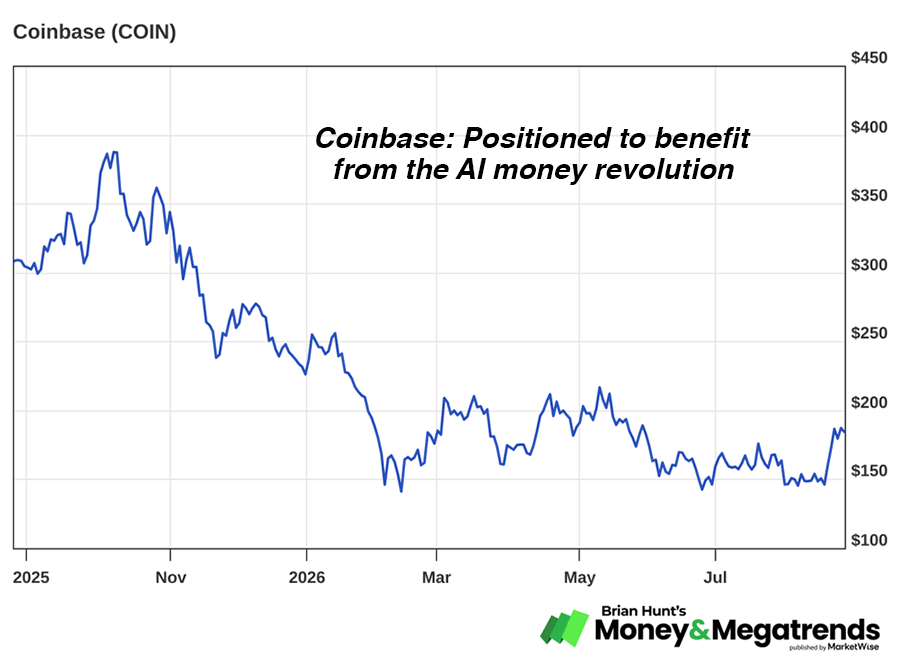
Coinbase (COIN): COIN is a $50 billion company that can be best described as the “everything crypto company,” which includes stablecoins.

COIN doesn’t issue stablecoins the way Circle (CRCL) does, but it has a revenue-sharing partnership, agreed upon until 2029, that allows it to profit from USDC. COIN is now at a level where over 90% of all agentic stablecoin transactions settle through Base, COIN’s own blockchain, which has processed over $32 trillion in stablecoin transfer volume over the last 12 months.

Visa (V): V is a $720 billion payments giant that is quietly also becoming one of the most important plays in the stablecoin infrastructure world. V has been settling transactions in USDC on chain since 2021. This quarter, it launched the Visa Stablecoin Platform, which allows it to issue, move, and manage stablecoins.

V’s CEO Ryan McInerey has been explicit in the recent earnings call that the company is not picking one stablecoin winner. It is connecting clients to the entire ecosystem, meaning V will win as long as the stablecoin market continues to win.

For investors, V can offer a safer exposure to the stablecoin market because the stablecoin segment is wrapped inside one of the most durable, cash-generative business models on earth.

If Brian Armstrong and his fellow bulls on stablecoins are even half right, the next big user of money won’t be humans. It’ll be agents. If that’s true, stablecoins become the default money for machines, and COIN, CRCL, V will enjoy huge tailwinds.
Image


Market Notes

  • The American consumer continues to spend. Credit card giant and emerging stablecoin giant Visa (V) reached a new all-time high this week.

  • U.S. manufacturing giant Nordson (NDSN) reached a new all-time high this week.

  • Steelmaking giant ArcelorMittal (MT) reached a new all-time high today. This is a bullish economic signal.

  • Our recommendation to invest in the genomics megatrend continues to pay off. Genomic testing/analytics giant Illumina (ILMN) reached a new one-year high today.

  • Our recommendation to get long the copper mining megatrend continues to pay off. Ero Copper Corp. (ERO) reached a new all-time high today. The Global X Copper Miners ETF (COPX) reached a new all-time high today.

  • It’s a bull market in Poland. The iShares MSCI Poland ETF (EPOL) reached a new all-time high today.

Regards,

Brian Hunt signature

Brian Hunt signature

Brian Hunt
Editor, Money & Megatrends


An urgent message from our colleagues:

These 3 Stocks Could Soar as Sam Altman Announces New Venture After OpenAI

Image

Elon Musk calls it “the most disruptive force in history.” The test staff are sworn to keep it secret – by law. And 3 little-known stocks are poised to take off, as Sam Altman releases what could be the biggest venture of his life – 500 times bigger than ChatGPT.

Click here to learn about the stocks tied to Sam Altman’s NEXT big move after OpenAI.

The post Six elite stocks to play the bull market in gold appeared first on MarketWise.

  • ✇Market Wise
  • Six stocks to play inflation defense and the AI boom at the same time Brian Hunt
    Today’s issue in preview: Six stocks to play inflation defense and the AI boom at the same time A major reason why you should be bullish on stocks right now This stock is the best way to invest in AI and robotics at the same time Learn our Top Themes to buy now Six stocks to play inflation defense and the AI boom at the same time Credit: Ron and Patty Thomas It’s ugly. It’s volatile. But it’s a bull market in U.S. natural gas stocks. And if you’d like to make money from the AI boom
     

Six stocks to play inflation defense and the AI boom at the same time

14 August 2026 at 12:00

Today’s issue in preview:

  • Six stocks to play inflation defense and the AI boom at the same time

  • A major reason why you should be bullish on stocks right now

  • This stock is the best way to invest in AI and robotics at the same time

  • Learn our Top Themes to buy now


Six stocks to play inflation defense and the AI boom at the same time

Image

Credit: Ron and Patty Thomas

It’s ugly. It’s volatile.

But it’s a bull market in U.S. natural gas stocks.

And if you’d like to make money from the AI boom or protect your financial life from the harmful effects of inflation, or both, you should look into what’s happening and why.

Over the past six months, I’ve written a special series of research notes on publicly traded assets such as timberland giant Weyerhaeuser (WY) and construction aggregates firm Vulcan Materials (VMC) that can add a robust “inflation defense” component to your financial life.

You probably know why being vigilant against inflation is important: governments in most Western nations have promised far too many things to far too many people. They are spending far more on taxpayer benefits and wars than they collect in tax revenues.

The related debts and obligations governments have taken on cannot possibly be paid back with sound money. They can only be paid back with debased, devalued money… much of which is created out of thin air. This is driving inflation and significant currency debasement.

Measured against a basket of commonly traded raw materials, the dollar has lost 55% of its value over the past seven years. That’s an annualized loss of purchasing power of about 10%.

Prices are going up because the value of our money is going down.

Everyone should consider which assets can help them preserve their wealth during periods of inflation.

When I provide people recommendations on how to approach this challenge, I urge them to keep my number one rule in mind: You want to own in-demand, useful assets that cannot be easily replaced or replicated. You want to own businesses and real estate properties that produce in-demand, scarce resources, products, and services.

This group of assets includes quality farmland, beachfront real estate, timberland, great businesses, and oil and gas pipelines.

When a very difficult or impossible-to-replicate business or piece of real estate produces in-demand, scarce resources, products, and services, it tends to hold its value no matter what the dollar is doing. Its price will constantly “recalibrate” to accommodate an increase in currency units.

It’s like the difference between slicing a pizza into 6 or 8 pieces. The number of slices changed, but the amount of pizza is the same.

In addition to the assets listed above, I’ve added “enormous proven reserves of in-demand natural gas” to our list of inflation defense vehicles this year.

Avid Money & Megatrends readers know that AI Power Consumption and the Power Grid Upgrade are two of our highest-conviction long-term themes.

Given AI’s enormous promise, big tech firms like Meta (META), Amazon (AMZN), and Microsoft (MSFT) are racing to build the world’s best AI models and infrastructure. They’ve already spent more than a trillion dollars. This year, they are on pace to spend over $700 billion on AI infrastructure, with more than $3 trillion expected to follow.

All that AI infrastructure is poised to consume vast amounts of electricity. S&P Global estimates that global electricity demand will increase by nearly 50% by 2040.

I’ve frequently mentioned that AI’s growing power demands are a major driver of natural gas demand, as it is the preferred clean-burning fuel for power plants that support AI data centers. Growing demand for U.S. natural gas from Europe and Asia is another powerful demand driver.

A compelling way to invest in this theme – and fortify your portfolio against inflation to boot – is to own a basket of America’s leading natural gas producers. This group includes EQT (EQT), Expand Energy (EXE), Antero Resources (AR), Range Resources (RRC), CNX Resources (CNX), and Comstock Resources (CRK).

Buying a basket of these firms makes you the owner of a vast and diversified collection of the highest-quality natural gas fields in the United States.

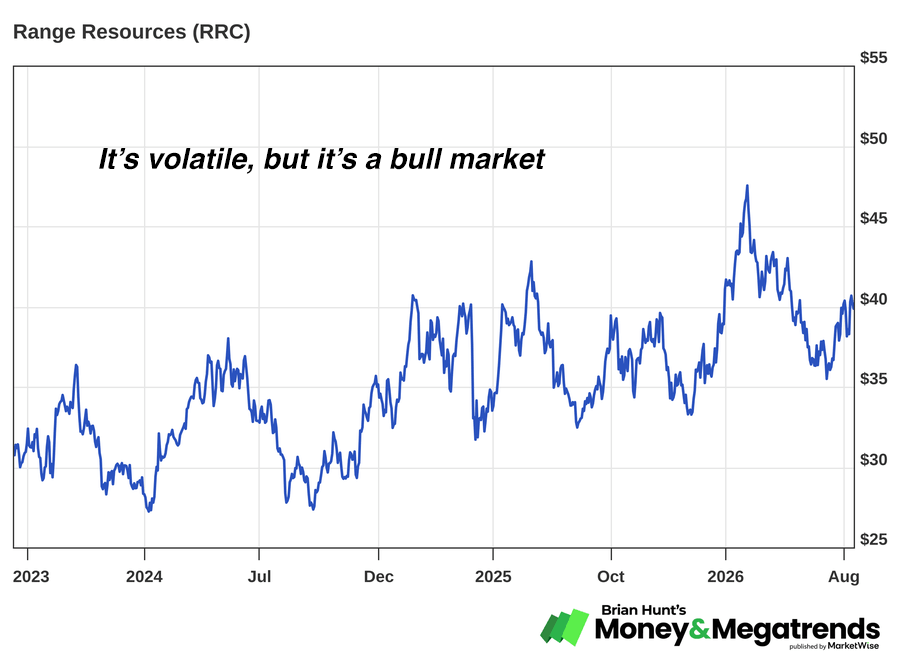
As you can see in the four-year chart below for natural gas giant Range Resources, the stock has formed a series of higher highs and higher lows since 2023. (Charts of fellow giants EQT and EXE are very similar.) A series of higher highs and higher lows is one of the quintessential features of a long-term bull market.

Mind you, this series of higher highs and higher lows is extremely volatile. You could even call it ugly. Range and its fellow producers have volatile stocks because the natural gas market itself is volatile. Natural gas prices are subject to huge swings.

Natural gas demand is greatly influenced by weather, while supply depends on infrastructure, production capacity, and storage availability. This creates a volatile price environment where sudden changes in the weather can produce huge swings in the natural gas price.

It may be volatile, and it may be ugly, but it’s still a series of higher highs and higher lows for U.S. natural gas producers. If you have a strong stomach and a desire to invest in the AI boom while playing inflation defense, consider adding this theme to your portfolio.

Image

Recommended Link:

PLEASE: Heed Marc Chaikin’s Disturbing New Warning for August 18

Ad Image

He called the 2025 crash 13 days before it unfolded… the 2020 and 2022 crashes… and the 2023 bank run four months before it occurred. Now, he’s warning the public to RAISE CASH for August 18 and get ready for the market’s biggest move in three years. Position yourself by Tuesday, August 18. Click here to learn more.

A major reason why you should be bullish on stocks right now

Image

Credit: Art Wager

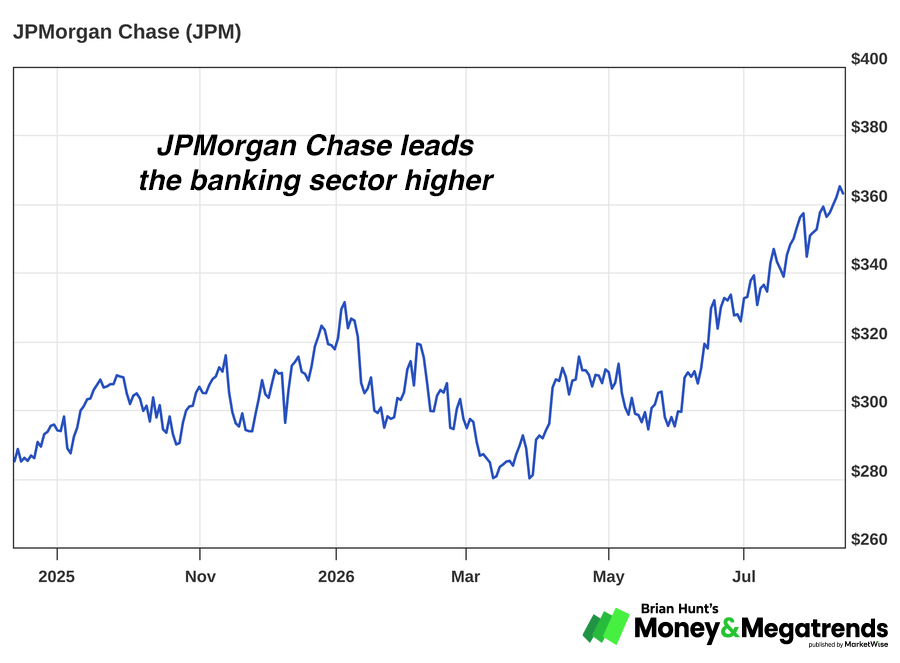
This week, the stock market sent us a message loud and clear: It’s a bull market in megabanks.

And that’s good for the value of your 401(k).

This week, JPMorgan Chase (JPM), U.S. Bancorp (USB), and Bank of America (BAC) reached new all-time highs. Japanese banking giant Mitsubishi UFJ (MUFG) reached a new high. Spanish banking giants Banco Bilbao Vizcaya Argentaria (BBVA) and Banco Santander (SAN) reached new all-time highs. Canadian banking giants Bank of Montreal (BMO) and Bank of Nova Scotia (BNS) reached new all-time highs.

You know JP Morgan Chase and Bank of America.

You may not know the others, but they are massive, consequential parts of the global financial machine. And they are all registering new highs. This is a big deal.

As a rule, I avoid investing in individual banking stocks. Since I started trading stocks in 1997, I’ve seen too many seemingly strong and safe financial companies look good one day and then be crippled the next day… only for the investment community to later find out they were hiding or mismanaging liabilities.

However, I like to monitor the price action in broad groups of banking stocks. The health of a region’s financial system can serve as a good barometer of its overall economic health… or at least a good gauge of all-important financial liquidity, which has a huge influence on asset price movements. All the good time and all the bad times in a geographical region eventually make their way to the P&L statements of banks.

The stock market is the world’s greatest forecasting mechanism. It tends to look ahead 6-12 months. When an industry is in a recession, its stock prices will rise before the news media announces it is recovering. When an industry seems to be doing well, its stock prices will decline before the news covers its downturn. This is often called “discounting” or “pricing in” the future.

Applied to banking, when a region is about to start doing well, its banks will rise in advance of the good times. When a region is about to struggle, its banks will plummet in advance of the bad times.

A list of banking stocks as large and varied as the one above, all hitting new highs, means there is tremendous liquidity sloshing around the world’s banking systems.

It means there’s plenty of money to loan out to businesses, consumers, real estate developers, and infrastructure builders. It also means there’s plenty of money that can flow into stocks and send them higher. In layman’s terms, it means “Party On.”

Reading about bank stocks isn’t nearly as exciting as explosive sectors, such as AI and space, but this surge across a wide variety of major banks is hugely important.

Will the boom in global financial liquidity and stock markets come to an end someday? Sure. All booms eventually end. But for now, the money spigots are open, and this very important trend is up. Position yourself accordingly!

Image


This stock is the best way to invest in AI and robotics at the same time

Image

Credit: HJBC

Over the past year, I’ve frequently called Amazon (AMZN) “the best way to invest in AI and robotics at the same time.”

To this thesis, the market is saying, “So far, so good.”

Avid Money & Megatrends readers know that we believe AI and robotics are two of the biggest business and investment trends of the 21st century. They will revolutionize the way we work and play as much as electricity or the automobile did…. while creating huge stock market winners along the way.

Tech giant Amazon is uniquely positioned to benefit from both technologies.

Although everyone knows about Amazon, the online retailer, and almost everyone is a customer, most people don’t know about Amazon, the giant employer of robots.

Last June, Amazon announced it had deployed its 1 millionth robot across its business. It describes itself as the world’s largest manufacturer and operator of mobile robotics.

Amazon operates more than 1,000 warehouses in the U.S. It ships millions of packages across millions of miles every month. This blizzard of activity can become more efficient and profitable with AI-enhanced logistics and robots that don’t complain, don’t take coffee breaks, and don’t ask for raises.

In other words, Amazon is uniquely well-suited to benefit from a megatrend in which robots will become cheaper, faster, more dexterous, more durable, and smarter in the near future.

Amazon is also heavily involved in AI. Its huge AWS cloud computing division is benefiting from skyrocketing demand for AI compute. Amazon recently reported that this division generated a huge $42 billion in quarterly revenue and 37% year-over-year growth. Amazon also owns equity stakes in AI leaders OpenAI and Anthropic.

Add these robotics and AI assets to the world’s largest online retail business, and you get a pretty good bet on the future of technology in one stock.

But don’t take our word for it. Take the market’s word.

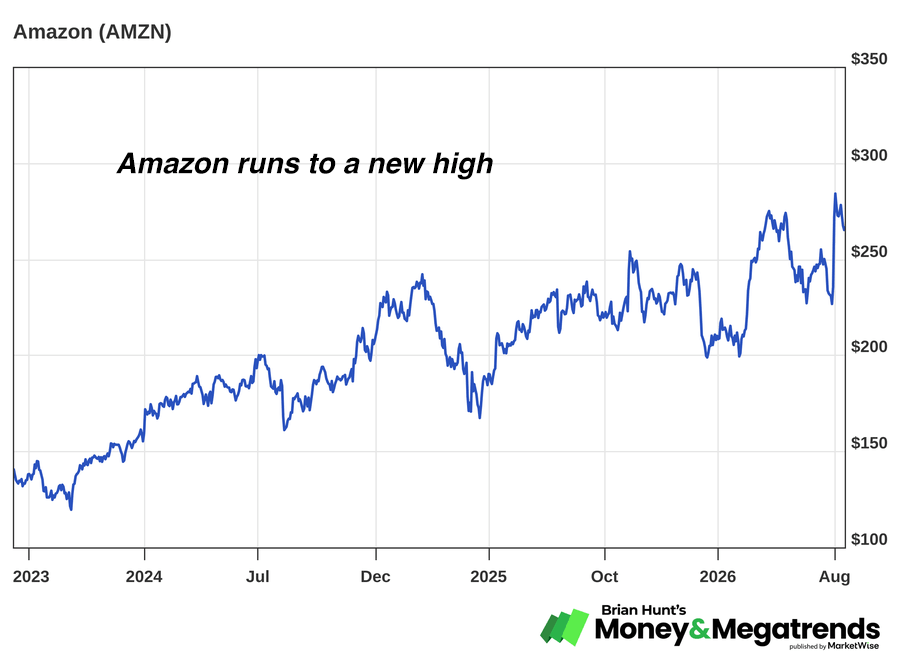
After reporting fantastic second-quarter business results on July 30, Amazon’s stock surged to a new all-time high. The stock is up 18% over the past year. Given that we are in the early days of the proliferation of AI and robotics, we expect to see this uptrend continue.

Image


Market Notes

  • Our recommendation to invest in the Agent Supernova via the communication infrastructure and cybersecurity provider Cloudflare (NET) continues to pay off. The stock jumped to an all-time high this week. It has risen 34% since our recommendation less than two months ago.

  • Our unique debasement trade of owning sports franchise firm Madison Square Garden Sports (MSGS) is a big winner. The stock is up 43% since our January research note.

  • Our recommendation to invest in the Boomer health care megatrend continues to pay off. Drug giant Merck (MRK) reached a new all-time high this week. The stock has returned 69% over the past year.

  • The ophthalmology boom we detailed in June continues to create stock winners. Eye health giant Glaukos (GKOS) reached a new all-time high this week.

Regards,

Brian Hunt signature

Brian Hunt signature

Brian Hunt
Editor, Money & Megatrends


An urgent message from our colleagues:

This AI System identified the stocks positioned to surge

Image

While everyone rushes into Nvidia and SpaceX, one AI insider says the real money will be made elsewhere. Keith Kaplan’s AI system has identified a small group of stocks positioned to surge as the big-name AI trade breaks down.

Watch his free briefing now before August 31st.

The post Six stocks to play inflation defense and the AI boom at the same time appeared first on MarketWise.

❌