❌

Normal view

  • ✇Live And Invest Overseas
  • Seeing Is Believing Kathleen Peddicord
    I’m all in on Panama. I’ve been spending time and money in this country since 1997. Lief and I have been living here full- and part-time since 2008. We’ve raised our son here. Based our business here. Made every kind of property investment it’s possible to make from pre-construction condos to commercial buildings and from productive land to land for banking and the legacy undertaking that is Los Islotes on Panama’s gloriously undiscovered Veraguas Pacific coast. Based on all that exp
     

Seeing Is Believing

1 October 2026 at 08:00

I’m all in on Panama.

I’ve been spending time and money in this country since 1997.

Lief and I have been living here full- and part-time since 2008.

We’ve raised our son here. Based our business here. Made every kind of property investment it’s possible to make from pre-construction condos to commercial buildings and from productive land to land for banking and the legacy undertaking that is Los Islotes on Panama’s gloriously undiscovered Veraguas Pacific coast.

Based on all that experience, what do I say to anyone who asks me what I think of Panama today?

“Get on a plane and come see for yourself,” I suggest.

Because if you aren’t taking a good close look at all that Panama has to offer right now, you’re missing out.

This is true regardless of your agenda.

Whether you’re looking to improve your lifestyle…

To make some money…

Or both…

Panama should be at the top of your list.

Our Live And Invest Overseas business is based in the heart of Panama City. We’re in good company. The Panamanian capital is home to hundreds of international operations, including some of the world’s biggest from Estee Lauder and Nike to Dell, Caterpillar, Nestle, and on and on.

I appreciate the great advantages that Panama offers the globally minded entrepreneur, but, to be honest, I don’t love Panama City.

Panama City is a boom town… crowded, dirty, noisy, and hot.

Our now 27-year-old son, on the other hand, enjoys every chance to return to the town where he grew up. He and his friends from school hit the clubs, the restaurants, the casinos.

Panama City is recognized by his generation and other folks younger than me as Miami South.

My favorite thing about Panama City is driving out of Panama City, across the Bridge Of The Americas, headed west.

Because while Panama City is not my lifestyle cup of tea, life out at Los Islotes, west of the capital and way down at the bottom of the western coast of the Azuero Peninsula, is my definition of paradise. No nightclubs or casinos in these parts. No shopping malls or fast food either. This is a frontier.

Privacy, elbow room, and a chance to create your own reality in the most virgin natural setting imaginable—those are the things that attracted Lief and me to this outpost in the first place and those are the things we most appreciate about this secret coast still.

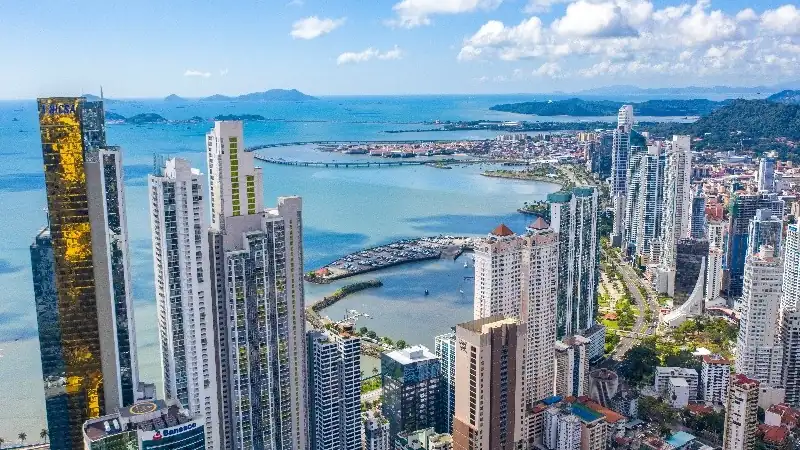
Panama City is the most developed city in the region and increasingly recognized as a brand-name city on the world stage alongside Miami and Dubai…

Panama City skyline overlooking the Pacific Ocean and modern waterfront high-rises.

Panama’s Veraguas coast is one of the most unspoiled spots on our planet…

Scenic black-sand beach with lush tropical vegetation and mountains in the distance.

In between are just about every other lifestyle option you could be in the market for… from cool, comfortable living among a welcoming community of fellow expats in Panama’s highlands…

Lush countryside with gardens, farmland, and mountain views in Panama.

To beaches that are weekend-commutable, within a couple of hours drive of Panama City…

Panoramic coastal view of Panama from a high-rise balcony overlooking the beach and ocean.

Pounding Pacific beaches that attract the world’s best surfers…

 Surfers walking along a beach at sunset, carrying their boards as golden light reflects on the wet sand.

And tranquil Caribbean beaches ideal for unplugging and recharging…

Crystal-clear turquoise water surrounding a lush tropical island with palm trees and a thatched-roof pavilion.

This little country is hugely diverse not only when it comes to lifestyle. Panama also offers one of the world’s most diversified investment markets.

Start Your New Life Overseas Today!
Sign up for our free daily e-letter, Overseas Opportunity Letter, and we'll send you a FREE report on the 12 Best Places To Retire Overseas In 2026.
We Value Your Privacy! We will not share your email address with anyone else, period.


Venezuelans, Colombians, Hondurans, El Salvadorans, Argentines, and others from across Latin America… when they have capital to safeguard, they put it in Panama.

Americans and Canadians, too, likewise, prize this safe-haven marketplace… alongside the French, the Dutch, the Irish, the Spanish, Norwegians, Brits…

As well as, increasingly, investors from Dubai and across the Middle East…

Anyone anywhere seeking safe harbor… they’re looking to Panama.

I sat down with longtime friend in Panama Jose Bern for a conversation to launch my new Living And Investing Overseas With Kathleen Peddicord podcast. (Subscribe to our YouTube channel to be the first to hear when it’s released.)

Lief, Kathleen and a man posing together on a sandy beach with ocean waves and dramatic clouds in the background.

Jose’s father Herman was one of the first people I met in Panama. Herman took me to see the beach just outside Panama City that he was preparing to develop.

Today, nearly three decades later, that Playa Bonita is a Westin-branded stretch of coastline. We hosted our Beachfront Living Event here this past July…

Aerial view of a tropical coastal resort overlooking a beautiful turquoise bay, surrounded by lush greenery and mountains.

In the decades since we connected with him, Herman’s Empresas Bern has become “The Brand That Built Panama City”… headed up now by Jose.

As Jose put it when we spoke, investors who want to grow their money need to go to a place that’s growing.

After decades of firsthand experience on the ground in this country, I can tell you…

Boy, howdy, yes indeed. Panama’s growing.

If you’re interested in expanding your lifestyle… or your investment portfolio… or, like me, both…

I strongly recommend that you come on down and see this little country for yourself.

I’d love the chance to show you all that Panama has to offer in person.

Until next time, 

Kathleen Peddicord Signature

The post Seeing Is Believing appeared first on Live and Invest Overseas.

  • ✇Curzio Research
  • 3 warning signs that a dividend cut is coming Curzio Research
    If you're an income investor, there's one piece of news you never want to hear: that a company in your portfolio is cutting its dividend. Fortunately, there are signs you can watch out for to help identify coming dividend cuts. The post 3 warning signs that a dividend cut is coming appeared first on Curzio Research.
     

3 warning signs that a dividend cut is coming

25 August 2026 at 22:00

If you're an income investor, there's one piece of news you never want to hear: that a company in your portfolio is cutting its dividend. Fortunately, there are signs you can watch out for to help identify coming dividend cuts.

The post 3 warning signs that a dividend cut is coming appeared first on Curzio Research.

  • ✇Market Wise
  • Best Index Funds: Top Funds For the S&P 500, Nasdaq, and Dow Jones James Royal
    Key Points The best index funds let investors earn attractive returns from major indexes such as the S&P 500, Nasdaq-100, and Dow Jones Industrial Average with little effort. Index funds provide diversification and reduce the risks of investing in individual stocks, but their broad exposure also means some individual stocks can dramatically outperform them. Investors who successfully identify and invest in outperforming stocks have the potential to generate returns well a
     

Best Index Funds: Top Funds For the S&P 500, Nasdaq, and Dow Jones

25 August 2026 at 07:29

Key Points

  • The best index funds let investors earn attractive returns from major indexes such as the S&P 500, Nasdaq-100, and Dow Jones Industrial Average with little effort.
  • Index funds provide diversification and reduce the risks of investing in individual stocks, but their broad exposure also means some individual stocks can dramatically outperform them.
  • Investors who successfully identify and invest in outperforming stocks have the potential to generate returns well above the average returns offered by index funds.

Index funds can be a great way to invest in the stock market, and the best index funds allow you to earn attractive returns. The largest and most popular index funds track major stock indexes such as the Standard & Poor’s 500 (“S&P 500”) and the Nasdaq 100 Index.

The S&P 500, Nasdaq 100, and Dow Jones Industrial Average are stock indexes that include America’s largest publicly traded companies and come with a strong long-term track record. The funds based on these stock indexes deliver nearly the same return as the indexes themselves. So, they’re an attractive way to achieve the index’s return with minimal analysis and work.

Top index funds also typically charge low expense ratios, the annual cost of the fund as a percentage of your investment. Top funds might charge $2 to $3 annually for every $10,000 invested in a fund, so you’re not paying a lot for the fund’s advantages. Index funds can charge low fees because they’re passively managed, meaning that they simply replicate the stocks in the index rather than paying analysts to actively find and invest in stocks.

Here are the best index funds for the major indexes, including both exchange-traded funds (“ETFs”) and mutual funds.

(Looking for a step-by-step plan to help you use AI in your own investing? Here’s how the N.E.W. System works.)

Top S&P 500 Index Funds in 2026

Fund (ticker)Five-year annual returnsExpense ratioMinimum investment
Fidelity ZERO Large Cap Index (FNILX)12.9%0%None
Vanguard S&P 500 ETF (VOO)13.1%0.03%None
SPDR S&P 500 ETF Trust (SPY)13.1%0.095%None
iShares Core S&P 500 ETF (IVV)13.1%0.03%None
Schwab S&P 500 Index Fund (SWPPX)13.1%0.02%None
Vanguard 500 Index Fund Admiral Shares (VFIAX)13.1%0.04%$3,000
Fidelity 500 Index Fund (FXAIX)13.2%0.015%None
Source: Returns from Morningstar, as of Aug. 24, 2026

These funds track the S&P 500, which includes around 500 of the largest stocks traded on American exchanges, such as Nvidia (NVDA) and Apple (AAPL). So, it shouldn’t be surprising that these funds have basically the same average annual return of 13.1% over the previous five years. Therefore, the key differentiator here is the fund’s expense ratio, which ranges from 0% to 0.095%.

While ETFs are usually available to buy and sell wherever you can trade stocks, not all brokerages give you access to the entire mutual fund universe. Mutual funds often charge a minimum initial investment, too.

Three of these S&P 500 funds are ETFs, while four are mutual funds. Just one fund – the Vanguard mutual fund – charges a minimum investment, while its counterpart – the Vanguard S&P 500 ETF – charges a lower expense ratio and does not have a minimum investment. So, it makes sense to buy the Vanguard ETF or another lower-cost ETF unless you can’t access them.

Some of these funds also appear on this year’s list of the best ETFs.

Top Nasdaq Funds in 2026

Fund (ticker)5-year annual returnsExpense ratioMinimum investment
Invesco QQQ Trust (QQQ)14.9%0.18%None
Invesco Nasdaq 100 ETF (QQQM)14.9%0.15%None
Victory Nasdaq-100 Index Fund   (USNQX)14.6%0.42%$3,000
Fidelity Nasdaq Composite Index ETF (ONEQ)13.3%0.21%None
Source: Returns from Morningstar, as of Aug. 24, 2026

These funds track the Nasdaq, with three following the Nasdaq 100, which includes the 100 largest non-financial firms on that exchange. The other fund tracks the Nasdaq Composite, which measures the performance of all stocks trading on that Nasdaq exchange, including Microsoft (MSFT) and Amazon (AMZN).

While the Invesco QQQ Trust has long been the most popular ETF, the recently introduced Invesco Nasdaq 100 ETF has delivered the same performance at a lower expense ratio.

Meanwhile, the Victory Nasdaq-100 index fund is a mutual fund tracking the Nasdaq 100 and requires a $3,000 minimum investment. The Fidelity fund here tracks the Nasdaq Composite rather than the Nasdaq 100, giving it broader exposure and less concentration in the largest tech stocks.

The Nasdaq Exchange includes the world’s largest tech companies, such as the recently debuted SpaceX (SPCX). (CEO Elon Musk is working on a way to disrupt the global financial system, here’s how.)

Top Dow Jones Industrials Funds in 2026

Fund (ticker)Five-year annual returnsExpense ratioMinimum investment
SPDR Dow Jones Industrial Average ETF Trust (DIA)10.6%0.16%None
Invesco Dow Jones Industrial Average Dividend ETF (DJD)11.9%0.07%None
Source: Returns from Morningstar, as of Aug. 24, 2026

Fewer funds track the Dow Jones Industrial Average and its 30 stocks, including Goldman Sachs (GS) and Caterpillar (CAT). The SPDR Dow Jones Industrial Average ETF is the key name to watch here. Meanwhile, the Invesco ETF here focuses only on dividend-paying stocks in the Dow Jones Industrials.

Investors looking for more dividend-paying investments should review the best dividend ETFs.

Which Index Fund Is Best for You?

In general, if you’re searching for an index fund for a major index such as the S&P 500 or Nasdaq 100, you have several fund choices. Since funds tracking the same index deliver very similar performance, the best pick is often the one with the lowest expense ratio.

Any of the funds on these lists are cheap or reasonably priced. The S&P 500 funds here offer the lowest expense ratios overall, but even funds in other categories are still fairly priced.

If you go with the Fidelity ZERO fund above, which charges no expense ratio, it’s important to know it does so by avoiding the S&P branding and the related fees. The fund still tracks the index, but Fidelity can’t market it as an S&P 500 fund.

In general, unless you need to buy a mutual fund – say, you’re investing in a retirement account – an ETF is often the better choice. They tend to have a lower expense ratio and don’t require a minimum initial investment, unlike mutual funds. Plus, they trade throughout the market day, unlike mutual funds, which are priced and traded only at the end of the day.

As mentioned above, not all mutual funds are available at all brokers. For example, the Fidelity fund with no expense ratio is not available at many brokers. However, any of the ETFs above should be available at any broker that offers stock trading.

Reasons to Invest in an Index Fund

The key advantage of an index fund is that investors can earn strong returns without spending much time or energy analyzing stocks.

Investors in an S&P 500 Index fund get exposure to the 500 or so stocks in that index, and the funds closely track the index’s performance, which has been about 10% over long periods and even more recently. Each share of the index fund lets investors own a small slice of all the companies in the index, and it charges one low management fee that is deducted seamlessly from the account.

Index funds offer immediate diversification, lowering the risk of investing in an individual stock. Diversification is the idea that your money is spread out across many different investments, so that the performance of one stock doesn’t hurt your overall performance too much.

Of course, there’s a flip side to diversification, too. An index fund’s performance is just the weighted average performance of all the stocks in it. So, it’s necessarily an average. In other words, some stocks will perform much better than the average.

If you can find outperforming stocks, your overall return can do drastically better than an index fund’s average. So, it can be worth your time and money to search out high-flying stocks.

Regards,

James Royal, PhD

Editor’s Note: Whitney Tilson called the rise of Apple, Amazon, and Netflix… as well as the collapse of dozens of companies that went bankrupt. Now the former $200M hedge fund firm manager is stepping forward with what he calls the most important financial warning of his 30-year career. He’s sharing two free stock recommendations  (one to buy, one to sell immediately) along with details of a new proprietary system fueling his predictions. See it all in his free presentation.

The post Best Index Funds: Top Funds For the S&P 500, Nasdaq, and Dow Jones appeared first on MarketWise.

  • ✇Schiff Sovereign
  • The Whole World Is Stockpiling Like It’s 1939 Schiff Sovereign
    On June 7, 1939, US President Franklin Roosevelt signed a new law authorizing $100 million (a lot of money back then) to buy rubber, tin, tungsten, etc., and put it all in storage. The United States was still at peace at the time. World War II had not yet broken out, and global trade was still relatively seamless. But anyone reading a newspaper could see what was coming. Hitler had annexed Austria the year before and swallowed the rest of Czechoslovakia that March. Japan had been at war in China
     

The Whole World Is Stockpiling Like It’s 1939

24 August 2026 at 09:34

On June 7, 1939, US President Franklin Roosevelt signed a new law authorizing $100 million (a lot of money back then) to buy rubber, tin, tungsten, etc., and put it all in storage.

The United States was still at peace at the time. World War II had not yet broken out, and global trade was still relatively seamless.

But anyone reading a newspaper could see what was coming. Hitler had annexed Austria the year before and swallowed the rest of Czechoslovakia that March. Japan had been at war in China for two years.

Every commodity on Roosevelt’s list had one thing in common: America produced next to none of it. Nearly all of the rubber used by US companies, for example, came from British Malaya and the Dutch East Indies. A lot of tin came from Malaya as well.

Congress and Roosevelt were being appropriately cautious. And within a short time they had stockpiled hundreds of thousands of tons of these strategic assets.

Then came the War. Then Pearl Harbor. And then full-blown economic chaos.

By March 1942, for example, Japanese troops had overrun Malaya and the Dutch East Indies… meaning that about 90% of America’s rubber supply vanished overnight. Fortunately, their foresight to build stockpiles cushioned the blow.

This critical lesson in self-sufficiency is easily forgotten. As long as global peace and cooperation feel permanent, governments never think about resource scarcity. They assume they will always be able to trade for what they need… so why waste money stockpiling?

But global peace and cooperation can quickly turn to conflict and tension, and that is the environment we are in today.

The last major global conflict was World War II. Before it was over, 730 delegates from 44 nations literally sat down at a conference and hammered out a new framework for economic cooperation that made the US dollar the world’s undisputed reserve currency.

As a result, every country on earth has parked its savings in US government bonds for the past eight decades.

It hasn’t always been easy. The US formally ended the convertibility between the dollar and gold in the 1970s, and there was some thought to creating a new financial system. But the dollar managed to survive as king.

The dollar’s status has also been at risk throughout this century, between the skyrocketing US national debt and heavy-handed legislation (like FATCA) that the US government forced on the rest of the world.

But, still, the dollar survived. And foreign countries kept buying dollars and Treasury bonds.

But everyone has a breaking point, including foreign countries.

The US government’s response to freeze Russian assets in 2022 was the start. Then came last year’s so-called “Liberation Day”, when decades of trade policy were upended, overnight. Then came the Iran war. And now a $40 trillion national debt with no end in sight.

This has all been enough for foreign governments and central banks to finally reverse course; at first they slowed their purchases of US Treasury bonds. Now they’re actually selling… and diversifying away from the dollar.

The immediate beneficiary has been gold. And we’ve written about this— gold is the most logical asset for central bank diversification because it is already a traditional reserve asset… plus the gold market is very large and liquid.

We believe this trend will continue; gold prices will rise as a result, and quality mining companies should prosper.

But there’s a second element to this diversification story.

After Iran closed the Strait of Hormuz— which carried a fifth of the world’s oil and a host of other critical resources— every government on the planet re-learned the same lesson of World War II: trade and cooperation can vanish in an instant.

And now the entire globe feels a sense of urgency to prepare for the next conflict.

Will China invade Taiwan? Will the US and China go to war? Will Russia and NATO come to blows? Nobody knows, and no government wants to be caught flat-footed, unable to import the critical resources that their economies need to function.

In Roosevelt’s era it was things like rubber and tin.

Today, these critical resources (what we refer to as ‘real assets’) start with energy— oil, natural gas, even coal… plus uranium for some countries.

Now, not every commodity is a real asset. Sugar is a commodity… but the world would be just fine without it. No government is going to stockpile orange juice, lumber, or wool. Or even rubber anymore.

But cut off a country’s oil supply and it reverts to the Dark Ages.

That’s why countries are now stockpiling the strategic assets that are the vital inputs to their economies: copper, rare earths, and even the IP and hardware that power AI.

China is the clearest example. In 2025 alone it added more than a million barrels a day to an oil stockpile and now holds roughly 1.4 billion barrels— the world’s largest reserve.

When Hormuz closed and the US and 31 other countries released 400 million barrels from their emergency reserves, China barely touched its pile and by July was adding to it again.

Its nuclear-fuel imports hit a record last year too, far beyond what its reactors burn; the excess went into stockpiles. And this summer Beijing put a new $9 billion state company in charge of buying mines around the world.

Saudi Arabia, on the other hand, produces plenty of oil, so they don’t need to stockpile it. But they are building nearly two gigawatts of data centers at home rather than risk being cut off from computing power.

A government that sells a Treasury still has to put the money somewhere, and the sensible places are the assets that the US government cannot freeze… and that no central bank can print. That is why the long-term direction of gold is still up.

But it’s also why energy, industrial metals, productive technology, and other vital resources— plus the companies which produce them— have a bright future.

This is the thesis behind Schiff Sovereign’s investment research newsletter, Strategic Assets. A world that no longer trusts the US government moves into gold, and a world that can no longer count on trade cooperation secures its own stockpiles.

We provide research on companies that mine, pump, and build what governments are stockpiling.

Subscribers who acted on our research locked in more than 10x on a small silver producer and more than 6x on a gold and silver producer, both in under a year.

A tin producer featured last summer is up more than 3x, a zinc producer more than 2.5x, and a tanker company about 2.5x. Across the companies we have closed out, winners and losers together, the average return is 172%.

We cordially invite you to learn more about Strategic Assets by clicking here.

Source

❌