❌

Normal view

  • ✇Market Wise
  • Three ways to invest in Elon Musk’s next big move Brian Hunt
    Today’s issue in preview: Three ways to invest in Elon Musk’s next big move The longevity gold rush has a clear winner. How to invest. These stocks are quietly crushing the rest of the market. Are you profiting? Learn Our Top Themes to Buy Now These stocks are quietly crushing the rest of the market. Are you profiting? Credit: Ridofranz To help us track and trade the world’s strongest business and technology trends, our Global Trend Tracker monitors over 170 industry groups, over 30

     

Three ways to invest in Elon Musk’s next big move

15 October 2026 at 12:00

Today’s issue in preview:

  • Three ways to invest in Elon Musk’s next big move

  • The longevity gold rush has a clear winner. How to invest.

  • These stocks are quietly crushing the rest of the market. Are you profiting?

  • Learn Our Top Themes to Buy Now


These stocks are quietly crushing the rest of the market. Are you profiting?

Image

Credit: Ridofranz

To help us track and trade the world’s strongest business and technology trends, our Global Trend Tracker monitors over 170 industry groups, over 30 proprietary thematic indexes, over 70 ETFs, and over 3,500 public stocks.

This trend-tracking system serves as our “all-seeing eye” – an early-detection system that continuously monitors money flows and shifts in the market climate.

It is designed to identify powerful trends very early in their lifespans, giving us the opportunity to capitalize on them before they become popular investment themes. A business, product, or technology trend can barely twitch without being picked up by our Global Trend Tracker.

This week, our tracker emphatically states that in a market where many important sectors are trading weakly – including defense stocks, small caps, homebuilders, and banking stocks – the healthcare sector is displaying terrific “relative strength.”

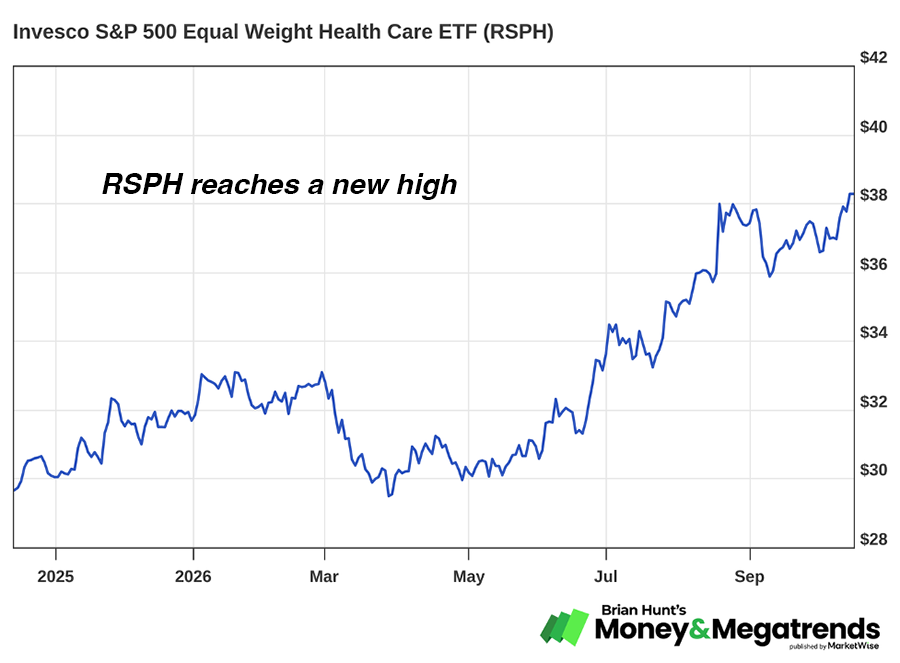
For example, while many sectors are down significantly over the past month, the Invesco S&P 500 Equal Weight Health Care ETF (RSPH) just reached a new one-year high.

This fund is an equal-weighted, diversified basket of large health care firms such as Illumina (ILMN, genomic sequencing), Revvity (RVTY, life sciences), Intuitive Surgical (ISRG, surgical robotics), Biogen (BIIB, biotech), ResMed (RMD, sleep devices), and Pfizer (PFE, pharma). The fund is up 29% over the past year and is one of the few equity ETFs outside of the oil and gas complex to reach a new one-year high this week.

Avid Money & Megatrends readers know that “Boomer healthcare” is one of our highest-conviction long-term investment megatrends. We don’t know of another investment research publication that has written more bullishly, more often about this booming industry than we have.

Over the past year, we have published more than two dozen pieces on opportunities in drug development, biotechnology, senior living facilities, genomics, cardiology, diagnostics, and more.

Our bullish stance has produced a parade of home runs, with the healthcare industry dominating the stock market’s list of new highs over the past year.

Healthcare stocks are generating extraordinary returns because they are benefiting from several megatrends simultaneously…

One is demographics. More than 10,000 Americans reach retirement age every day. The U.S. population aged 80 and older is projected to roughly double, from 14.7 million in 2025 to 29.4 million by 2045.

This is the enormous Baby Boom generation entering the phase of life where health care and longevity spending skyrocket. For many boomers, a typical month involves going to see at least one doctor to have something looked at, removed, or treated.

This means many health care businesses are experiencing huge demand now – and will for at least the next decade.

Two is exponential technological progress. Thanks to major advancements in genomic sequencing, AI-powered analytics, imaging technology, and preventative treatment, healthcare is becoming much better and more personalized. This is driving strong demand for all kinds of new tests, tools, and treatments.

After all, when a useful and important service you buy gets much better, you typically buy more of it

Investing in many healthcare businesses over the next decade will be investing with a gale-force tailwind at your back. If you’re a parent and worried about your child getting a job, just point them to the booming healthcare industry.

The new high in RSPH serves as a reminder: The giant business, tech, and demographic trends that shape our world tend to play out in five or more years, not five months. This means the stock market trends they manifest play out over the same time periods. With this trend truism in mind, I once again remind you that if you like money, keep it invested in healthcare.
Image

Recommended Link:

My Nearly $20 Million ‘Bar Tab’ With Stansberry Research

Ad Image

I’m an ordinary guy – a financial newsletter reader like you. But a few years ago, I landed in an extraordinary position: unmasking a priceless secret from inside Stansberry Research, unfiltered, on camera. In the years since, my ongoing efforts have COST Stansberry nearly $20 million and counting – money that has stayed in readers’ bank accounts instead. Today, I’m speaking out one FINAL time.

The longevity gold rush has a clear winner. How to invest.

Image

Credit: svetikd

As with any large part of our economy, the booming healthcare sector (see above) comprises many smaller “sub-industries” that often perform much better or much worse than the broader sector.

Currently, one prominent member of the “doing better” category is the business of selling GLP-1 drugs.

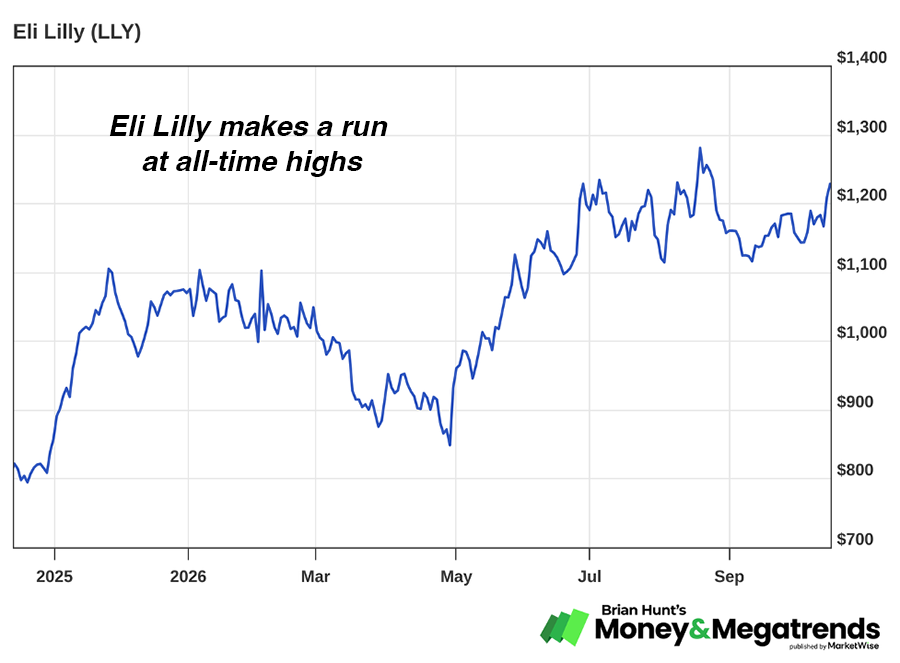
As evidence, we cite the surging revenues and strong stock trend of one of our top healthcare “picks to click,” Eli Lilly (LLY).

Back in June, I detailed how drug giant Eli Lilly is uniquely positioned to benefit from soaring health care and longevity spending.

Data from the Federal Reserve shows that between 15 million and 20 million baby boomers are millionaires. More than 1 million boomers are worth more than $10 million. As mentioned above, the U.S. population aged 80 and older is projected to roughly double, from 14.7 million in 2025 to 29.4 million by 2045.

This is the largest group of wealthy people in history. It includes many motivated, older, wealthy people who can spend big on longevity.

One of the leaders of this investment trend – you could even call it the poster child – is drug giant Eli Lilly.

Lilly is the world’s largest seller of glucagon-like peptide-1 (GLP-1) medications. GLP-1 drugs mimic a natural gut hormone. They control blood sugar by stimulating insulin release, thereby slowing digestion and reducing appetite.

Over the past 5 years, this class of medications has exploded in popularity. A representative of healthcare giant IQVIA says GLP-1 therapies for weight loss generated $55 billion in sales over the past 12 months, which is up from $2 billion in 2022.

Many people who take GLP-1 drugs see drastic weight loss in less than six months… which should extend their lives.

Studies indicate that GLP-1 drugs may also lower cholesterol, slow cancer growth, and reduce the risk of cardiac disease. They are also prescribed to treat sleep apnea, which is a pervasive problem whose effective treatment should extend many lives.

In other words, GLP-1s are believed to be the closest thing to “miracle longevity drugs” that we currently have.

As a result, Eli Lilly’s sales are skyrocketing. The company recently reported quarterly sales growth of 48%. The results were driven by a 91% jump in demand for Lilly’s weight-loss drug, Mounjaro.

Soaring GLP-1 revenues are driving strong returns for Lilly shareholders. The stock has returned 49.7% over the past year… and is currently making a run to eclipse its all-time high reached in August. The Boomer health care theme continues.
Image


Three ways to invest in Elon Musk’s next big move
Image

Credit: Walter Cicchetti

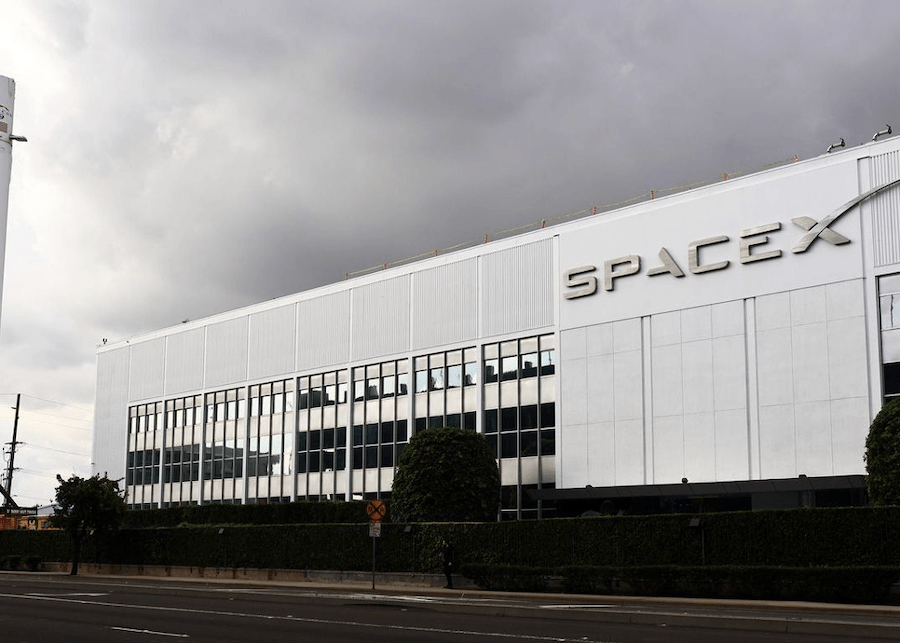
Last week, shares of America’s three biggest telecommunication firms took one of their worst beatings in decades, thanks to Elon Musk’s SpaceX (SPCX).

Verizon (VZ), AT&T (T), and T-Mobile (TMUS) all dropped between 9% and 13%, wiping roughly $45 billion off their collective market value.

The trigger?

SPCX announced it was acquiring a nationwide spectrum license to become a major mobile carrier in the U.S. It’s paying about $8 billion for up to 14 megahertz of low-band airwaves. In other words, it is buying the legal rights to transmit wireless signals over specific radio frequencies.

Musk called it a “very big deal.” It potentially puts SpaceX on a collision course with Verizon, AT&T, and T-Mobile.

For years, Starlink has been considered a backup phone service… one that kicked in when you lost signal on a hiking trail or a rural highway. Not anymore. Investors now see a fourth national carrier coming to take customers from the incumbents.

And SPCX isn’t starting from zero. An estimated 13.5 million people already pay for Starlink internet, including about 4.1 million in the U.S. Those are likely easier wins: customers who already trust the brand and pay a monthly bill. Bundling a phone plan for those customers is the next logical step.

Obviously, there’s a long way to go to disrupt incumbents like Verizon, which has about 147 million wireless connections. But in a market estimated at $600 billion annually, even a few percentage points of customers switching to Starlink each year would be worth a lot.

In any case, the threat of SPCX disruption is likely still years away. The spectrum deal still needs approval from the Federal Communications Commission. SPCX’s next-generation direct-to-phone satellites won’t start launching until the second half of 2027. And it takes years for people to upgrade their phones and decide to switch away from their current provider.

But in the background, while all of this plays out, the demand for hardware to build this network will arrive long before the first customers sign up.

As a result, the “picks and shovels” suppliers behind Starlink are already seeing orders.

When a company with SPCX’s scale and speed decides to build, its suppliers feel it first. That’s where you want to be positioned as an investor.

Compelling investment candidates inside this long-term trend include:

Filtronic (FTC.L) is a roughly $800 million UK-listed company that builds the powerful amplifiers Starlink uses to transmit enormous amounts of data between satellites and ground stations. SpaceX is its largest customer, accounting for 68% of annual revenue, and holds warrants to acquire up to 15% of Filtronic’s shares. On Oct. 1, Filtronic announced its largest-ever SpaceX order: $68.1 million for advanced amplifiers, with deliveries expected primarily in fiscal 2028.

As SpaceX launches thousands of additional satellites and pursues millions of mobile phone customers, its network will need to handle vastly more data traffic. That should drive growing demand for Filtronic’s specialized amplifiers, making this sub-$1 billion company an intriguing way to invest in the satellite communications boom.

STMicroelectronics (STM) is a roughly $42 billion semiconductor giant that has spent a decade co-designing custom chips with SpaceX. Its advanced BiCMOS technology is a critical component of Starlink’s satellite dishes, and the company has reached a remarkable delivery rate of more than 5 million chips per day.

STM also supplies chips used aboard Starlink satellites and in ground infrastructure. Now SpaceX plans to expand into traditional mobile phone service, potentially installing small cellular base stations alongside its existing Starlink dishes. This could create another enormous market for advanced communications chips. STM expects to generate more than $3 billion in cumulative space-related revenue between 2026 and 2028, making it one of the clearest publicly traded beneficiaries of the satellite communications boom.

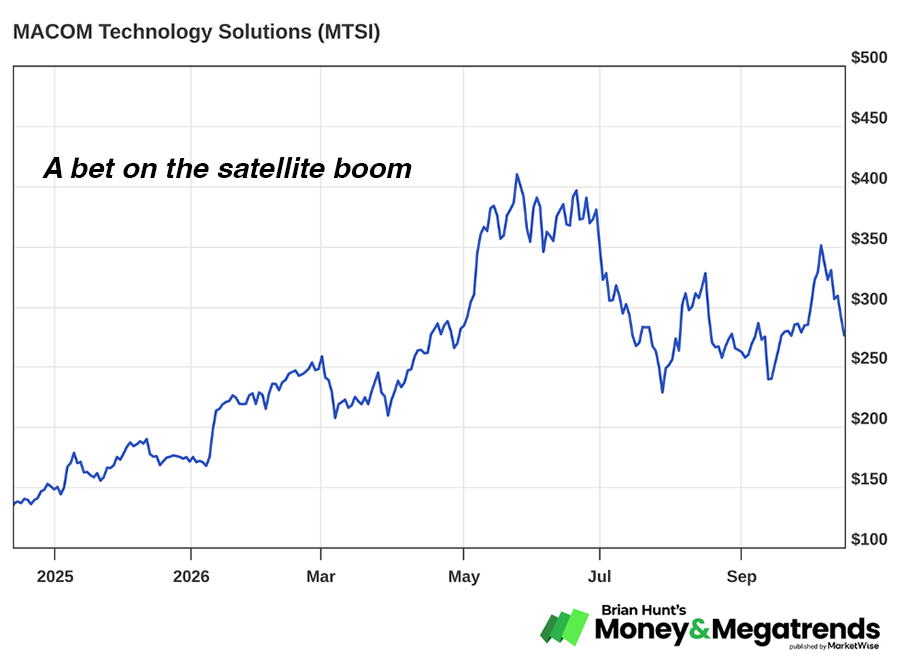
MACOM Technology Solutions (MTSI) is a $22 billion semiconductor company that makes the powerful radio-frequency chips satellite communications networks depend on.

Its specialty includes amplifiers that boost weak radio signals, allowing enormous amounts of data to travel between space and the ground. These chips are critical components of phased-array antennas, which use hundreds or thousands of tiny antenna elements working together to electronically steer signals.

In June, MACOM introduced new amplifier technology specifically designed for satellites that communicate directly with ordinary smartphones. That’s important because SpaceX plans to deploy up to 15,000 next-generation direct-to-phone satellites, each of which requires sophisticated communications hardware.

MACOM hasn’t been confirmed as a direct SpaceX supplier, but its technology positions it to benefit from the enormous satellite communications boom SpaceX is helping create.

Whether Starlink Mobile becomes America’s fourth major carrier in three years or ten, the hardware must be built first. STM, MTSI, and FTC all stand to benefit from the boom in satellite-based communications that SpaceX is leading.
Image


Market Notes

  • The Boomer health care megatrend continues to generate winners: Pharma giant Pfizer (PFE) reached a new one-year high today.

  • Worries over mid-term elections and potential changes in defense spending helped send military firms Aerovironment (AVAV) and Kratos Defense (KTOS) to new one-year lows today.

  • Quantum computing stocks Rigetti Computing (RGTI) and D-Wave Quantum (QBTS) reached new one-year lows today.

  • Uranium miners Denison Mines (DNN) and Uranium Energy Corp (UEC) reached a new one-year low today.

  • Air taxi firms Joby Aviation (JOBY) and Archer Aviation (ACHR) reached new one-year lows today.

  • Nuclear energy technology firms Oklo (OKLO) and NuScale Power (SMR) reached new one-year lows today.

Regards,

Brian Hunt signature

Brian Hunt signature

Brian Hunt
Editor, Money & Megatrends


An urgent message from our colleagues:

Free AI Demo – 10X Your Money

Image

Keith Kaplan, one of America’s top AI experts, leads a firm that spent $17 million building some of the most advanced AI models around. Today, he’s agreed to publicly demo a brand-new breakthrough, which he says could help you make more than 10X your money.

Join Keith here for the demo.

The post Three ways to invest in Elon Musk’s next big move appeared first on MarketWise.

  • ✇Schiff Sovereign
  • It Took 211 Years to Borrow $2.3 Trillion. Congress Just Did It in Twelve Months. Team Schiff Sovereign
    $2,307,765,598,614.61. That’s how much the national debt grew by in fiscal year 2026, which just ended last week on September 30. $2.3 trillion in a single year is clearly and obviously runaway debt growth; think about it— the entire national debt didn’t reach $2.3 trillion until 1987. By then the country was 211 years old, and it had been through a revolution, a civil war, two world wars, and the Great Depression. Now Congress adds that much in a single year. Rising debt has many consequences,
     

It Took 211 Years to Borrow $2.3 Trillion. Congress Just Did It in Twelve Months.

5 October 2026 at 08:28

$2,307,765,598,614.61.

That’s how much the national debt grew by in fiscal year 2026, which just ended last week on September 30.

$2.3 trillion in a single year is clearly and obviously runaway debt growth; think about it— the entire national debt didn’t reach $2.3 trillion until 1987.

By then the country was 211 years old, and it had been through a revolution, a civil war, two world wars, and the Great Depression. Now Congress adds that much in a single year.

Rising debt has many consequences, including inflation: when the government spends crazy amounts of money that it doesn’t have, that means more dollars chasing the same amount of goods and services. Prices go up.

In short, this mountain of debt is one of the big reasons for today’s sky-high cost of living.

What’s really bizarre is that Inflation affects EVERYONE. Yet hardly anyone understands that the root cause of the inflation is government spending.

It might be even crazier how little attention this story receives. The media chimes in whenever the debt hits a milestone; when the national debt crossed $40 trillion in August, there were a bunch of stories from the New York Times to CNN.

But that lasted for about a day. Then they went right back to their usual themes about racism, sexism, etc.

It seems like every other issue is more important than the debt. Just watch any random episode of The View and you’ll see a window into the topics monopolizing Americans’ attention instead. People are whipped into a frenzy over gender-affirming care for prison inmates, the Lincoln Memorial’s reflecting pool, and a pilot who stabbed his captain on a flydubai flight.

Attention is a scarce resource. So Congress does nothing about excessive spending because voters aren’t paying attention to the debt.

The bond market, on the other hand, is absolutely paying attention.

The investors who lend money to the US government watch this complete lack of responsibility year after year. And they know there are obvious ways to cut the deficit.

The Government Accountability Office, Congress’s own auditor, estimates that between $233 billion and $521 billion is lost to fraud every year. Yet Congress won’t lift a finger to stop it.

At some point, lenders don’t feel like loaning more money to a government that won’t even stop obvious fraud. And it’s a major reason why bond yields have skyrocketed very quickly.

The 10-year Treasury yield went from about 4.6% in early August to above 5.3% on October 1, its highest level since 2002.

Now, I have a sneaking suspicion that part of this surge in yields is deliberate… that China and a few of America’s ‘frenemies’ are intentionally pushing yields higher as a form of financial warfare, maybe to manipulate next month’s midterm elections, among other reasons.

But the reality is that this crisis is entirely of the US government’s own making, and stopping it is completely under their control. All they have to do is make some hard decisions, do the work, and cut spending.

They just won’t do it.

So there are a few ways this can end.

The hopeful one is voluntary— the 535 members of Congress and the Senate get together, realize serious cuts are needed, and do what’s necessary for the good of America.

Unfortunately I don’t think that’s going to happen anytime soon.

That leads to option two, where they are forced to cut spending under duress because the bond market makes them.

If yields continue to surge, sooner or later Congress will be forced to act. There is SOME interest rate… maybe it’s 8%, maybe 10%, that will be too high for even Congress to ignore.

It’s basic arithmetic: five years from now the national debt will be at least $50 trillion. If bond yields at the time are 8%, that means the average interest rate on the debt could easily be 5% or more. That’s $2.5 TRILLION each year just to pay interest, about twice as much as military spending.

At that point Congress would have no choice but an austerity budget: cuts to military spending, cuts to Social Security and Medicare, and a significant increase in taxes, all at once.

Then there’s option three, their preferred option: do nothing. Make no hard decisions. And wait for the Federal Reserve to bail them out by creating new money to finance the deficit… trillions of dollars a year.

This is the tactic that worked in Japan for so long. Japan’s central bank conjured new money into existence and used it to buy government bonds. Eventually the central bank owned about half of Japan’s national debt.

That let the government keep borrowing at interest rates near zero.

But sooner or later, that creates serious inflation. Japan’s inflation hit a 41-year high in 2023, and its lenders now demand the highest interest rates in three decades.

Americans have seen it too. During the pandemic the Fed created roughly $5 trillion out of thin air, and the result was 9% inflation.

So ultimately when the Fed steps in to ‘print’ money and bail out the Treasury Department, the result of that will be continued and rampant inflation.

We’ve argued for years that real assets make so much sense in this environment; governments and central banks can produce debt and fiat currency. But they cannot create a barrel of oil, a BTU of natural gas, or an ounce of gold.

That’s why real assets tend to hold their value when the currency is losing its own… and why it makes sense to own them before the inflation cycle moves into its next phase.

P.S. Real assets are the whole premise of Schiff Sovereign’s investment research newsletter, Strategic Assets: profitable, low-debt companies that produce the things a government can’t print, researched while they’re still cheap.

We locked in gains of more than 10x on a small silver producer, and a precious metals company we still follow is up nearly 400%.

You can learn more about Strategic Assets here.

Source

  • ✇Schiff Sovereign
  • America Keeps Threatening the Lenders It Can’t Afford to Lose Schiff Sovereign
    Late last week, Congress and the White House established a new law authorizing the President to impose tariffs of up to 100% on any country that ranks among the five biggest buyers of Russian oil or gas. This law had broad, bi-partisan support and passed by a whopping 86-11 margin in the otherwise deadlocked Senate, and 262-159 in the House of Representatives. Their big idea is to penalize anyone who supports Russia economically by buying their oil & gas, and that specifically singles out Ch
     

America Keeps Threatening the Lenders It Can’t Afford to Lose

24 September 2026 at 10:34

Late last week, Congress and the White House established a new law authorizing the President to impose tariffs of up to 100% on any country that ranks among the five biggest buyers of Russian oil or gas.

This law had broad, bi-partisan support and passed by a whopping 86-11 margin in the otherwise deadlocked Senate, and 262-159 in the House of Representatives.

Their big idea is to penalize anyone who supports Russia economically by buying their oil & gas, and that specifically singles out China and India— the biggest buyers of Russian crude.

In fairness, India and China aren’t buying Russian oil to help prop up Putin or assist him in winning the war. They don’t really care. They just like the fact that Russian oil is REALLY cheap right now. It’s a good deal, and they like scoring good deals for their country.

At the moment there is no international law preventing anyone from buying Russian oil & gas; this restriction is something the US wants to impose in order to force Russia into a peace over Ukraine.

And it may very well be a good idea in terms of bringing an end to the war in Ukraine. We make no judgment on the moral implications.

Unfortunately the world is not so black and white, especially when you have a $40 trillion national debt. When your fiscal situation is in such dire straits, you have to weight the pro’s and con’s.

And the con’s are numerous: given its gargantuan national debt and the need to borrow an ADDITIONAL $2 trillion per year just to finance the budget deficit and stay afloat, the US government has to rely on foreign creditors more than ever.

In short, America desperately needs cash-rich foreigners to continue buying US government bonds.

It’s a bit difficult to shove this rule down their throats and tell foreign countries, “We will force you to stop buying cheap Russian oil,” yet simultaneously ask those same countries to loan you hundreds of billions of dollars.

The strangest part is that this is nothing new.

Back in February 2022, days after Russia invaded Ukraine, the US and its allies froze about $300 billion of the Russian central bank’s reserves.

Again, whether it was justified is beyond the point. US government bonds had long been considered the safest asset on earth. But every central banker on the planet learned that day that US Treasury bonds were only safe as long as their country stayed on America’s good side.

That’s why foreign governments and central banks have been quietly diversifying away from US government bonds and buying gold… because no other government can freeze the physical gold in their own vaults.

In fact, for the first time in decades, the world’s central banks now hold more gold than they hold US Treasury securities.

China in particular has cut its Treasury holdings in half since 2013, and they’re now at their lowest level since 2008.

Japan, the biggest foreign lender of all, has seen its Treasury holdings fall every month since April.

At peak (in 2011), foreigners owned nearly half of all marketable US Treasury bonds. Now foreigners’ share of Treasury securities is down to just over 30%.

That’s a fairly slow burn over 15 years; it’s not panic selling. But it’s a clear and obvious trend.

These same foreign nations have also been openly discussing how to rely less on the US financial system.

The BRICS countries, led by China, India, Russia, and Brazil, met in Delhi earlier this month and agreed to settle more of their trade in their own currencies.

This is a big deal; if India starts accepting Chinese yuan, or Russia accepts Indian rupee, these nations by definition won’t need to hold as many US dollars. And a decline in demand for US dollars translates into less demand to hold dollar-denominated assets like US government bonds.

Xi Jinping arrived at the White House yesterday, and he came to negotiate on trade as the leader of one of America’s three largest creditors.

China has serious leverage; even though they have been selling their Treasury bonds slowly over time, they still own a ton of them. And if Xi wanted to, he could dump them in a heartbeat and cause a complete collapse of the bond market. Interest rates would skyrocket.

To be clear, such a move would wound China as well. But America would be hurt the most. It’s a nuclear option he could exercise, and it gives him real negotiating power.

America seems to think it’s still the 1990s when everyone was begging to buy US government bonds… which is exactly what gave them the leverage to be able to weaponize the US dollar.

That is simply no longer the world we live in. US finances are incredibly weak. And every time America tries to flex its US dollar power over the financial system, more foreign lenders walk away.

It’s not clear to me if anyone in Washington even understands this reality. No one seems to be questioning, “Will this action increase or decrease foreigners’ demand to buy US dollars and US government bonds?”

And I doubt anyone is really doing any real analysis to weight the benefits of, say, peace in Ukraine, against the potential costs of losing more foreign lenders.

By the way, if you’re thinking, “Big deal, America can finance its own deficits,” it cannot.

The entirety of ALL net private savings in the US, i.e. the total amount that corporations and households manage to save, is only about $2.2 trillion each year. The budget deficit for FY2026 is projected to be about $2.1 trillion.

So basically the US economy would need to dump 95% of its total net savings into US government bonds, leaving just $100 billion to finance EVERYTHING ELSE in the economy, from data centers to mortgages to every other investment.

This is why the US needs foreigners so much. When you burn up that much money, you can’t afford to turn away any lender.

If they keep alienating foreigners, there will essentially be only one lender remaining— and that’s the Federal Reserve, which has the ability to create money out of thin air.

We all saw how that works during the pandemic, when the Fed created roughly $5 trillion to finance all of the debt-fueled government bailouts. The result of that money creation was 9% inflation.

This is why we continue to write that real assets make so much sense.

The Fed can create money by the trillion, and the government can borrow to oblivion. Neither can print an ounce of gold or a barrel of oil. And that’s why real assets tend to hold their value, and often climb, exactly when paper money is falling apart.

Owning a piece of the companies that produce real assets— metals, energy, productive technology— is a great way to protect yourself from higher prices and inflation.

P.S. Since 2022, Schiff Sovereign’s investment research service, Strategic Assets, has focused on exactly those companies: the metals, energy, food, and ships an economy actually runs on.

A company gets featured only when it is already profitable, carries little or no debt, and trades cheap against the cash it is generating. Two precious metals producers on our research list are up more than 300% and nearly 400%, and earlier this year we locked in gains of more than 10x on a small silver producer.

You can learn more about Strategic Assets here.

Source

  • ✇Schiff Sovereign
  • Some People Just Want to Go to a Concert Schiff Sovereign
    Ed Sheeran played his hit song “I Don’t Care” on his recent tour stop at MetLife Stadium in New Jersey. By the time he sang it, the crowd had already been told that not caring wasn’t an option. His opening act was the rapper Macklemore, who used his set to explain: “One of the reasons why I wanted to come on this tour was because I wanted to stand up here on stages and stadiums across America, and say two words that are very near and dear to my heart. Free Palestine.” Then he performed his pr
     

Some People Just Want to Go to a Concert

18 September 2026 at 12:33

Ed Sheeran played his hit song “I Don’t Care” on his recent tour stop at MetLife Stadium in New Jersey.

By the time he sang it, the crowd had already been told that not caring wasn’t an option.

His opening act was the rapper Macklemore, who used his set to explain: “One of the reasons why I wanted to come on this tour was because I wanted to stand up here on stages and stadiums across America, and say two words that are very near and dear to my heart. Free Palestine.”

Then he performed his protest song “Hind’s Hall” while footage of the destruction in Gaza played on the screens.

Doing that, two nights in a row, got him kicked off the tour.

Robert Kraft, who owns the New England Patriots and Gillette Stadium outside Boston, refused to host Macklemore at Sheeran’s two upcoming shows there, citing “a broader history of antisemitic rhetoric and imagery.” Other stadium owners on the tour joined him.

With stadiums refusing to have Macklemore, the tour’s promoter cut him from the remaining dates.

Macklemore didn’t care. He said his mission was accomplished. “I didn’t need 10 shows from Ed,” he wrote on Instagram afterward. “I needed two. Two chances to stand in front of 90,000 people.”

To be clear, Macklemore has every right to say whatever he wants at his own shows, to people who paid to hear it. But activists don’t seem to think the venue owners, stage crews, and Ed Sheeran himself have the right to refuse to be a part of Macklemore’s protests.

Biting the hand that feeds, Macklemore criticized Sheeran, who he said “couldn’t get past his public facing, ‘I don’t take sides.'”

Sheeran answered like a normal adult.

“There is a reason I do not use my professional platform for politics— my audience includes young people, often children, of all backgrounds,” he wrote. “Those who come to my shows do not expect a political forum.”

In other words, some people just want to go to a damn concert.

It was Macklemore or the tour, the promoter had warned, and Sheeran said he would never “abandon the touring crew and the other support acts and musicians who rely on me for work and to make a living.”

But fanatics argue that nobody gets to stay out of it.

Macklemore said so himself: “There is no neutral position between the oppressor and the oppressed.” The logic is that Gaza has to be solved, so Gaza has to be shoved down people’s throats.

And for his heinous crime of neutrality, Ed Sheeran is being canceled.

The day Sheeran posted his statement, every supporting act on the tour quit in protest. One of them wrote that “artists must not be silenced when they speak up for the oppressed.”

In Ireland, a radio station pulled Sheeran’s music from its playlists.

An Irish newspaper op-ed called him a “gutless coward.” The Irish actor Liam Cunningham wrote, “We know who Ed Sheeran is now.”

Even the children’s YouTube star Ms. Rachel piled on. No surprise there— her toddler show features a nonbinary “they/them” co-star and she now campaigns on Gaza, so she’s in the business of promoting political views where they don’t belong.

“Ed Sheeran is making a political statement to his fans when he does a concert to support Ukraine,” she wrote, “but considers Palestine too dangerous and political.”

And yes, Sheeran played a Ukraine benefit in 2022. But everyone there bought a ticket FOR the cause. Nobody at MetLife bought a ticket for Gaza.

Sadly, the fanatics do it because it works.

Macklemore pledged the $1 million he’d earned on the tour to Palestinian relief groups, and challenged Kraft to match it.

Kraft answered that Sheeran had already called him, told him he was donating $2 million “to aid in the region to fight this humanitarian crisis,” and asked Kraft to match it, which Kraft did.

It hasn’t bought Sheeran any peace. Tomorrow he plays Philadelphia, and two activist groups have announced a protest outside the stadium. They call it “his first show after caving to Zionist threats.”

Even when the activists successfully bully people into supporting their cause, it’s not enough for them. Nothing is acceptable but total, undying fealty to their political opinions.

And every cause claims the same right to your attention and support.

If nobody is allowed to be neutral about Gaza, nobody is allowed to be neutral about the climate, or race, or gender. Each of those causes has its own true believers, and they’re just as certain as Macklemore that THEIR emergency can’t wait.

So climate activists glue themselves to the road you take to work, and deface priceless works of art. Your kid’s school teaches gender ideology, and the parents who object get treated like domestic terrorists.

Then the ballgame opens with a knee for BLM. Try to get a coffee and the Starbucks baristas write their political slogans on your cup. Go to the movies and get lectured by Hollywood. Watch a football game and get shamed by the shaving brand Gillette, somewhat ironically, over toxic masculinity.

And what are you supposed to do? Raise a fist in solidarity? Be aware…? Give some corrupt activists money, so they can spend it on mansions for personal use, as the leaders of Black Lives Matter did?

Taken to its logical conclusion, your life gets consumed by things you’re forced to care about and can’t affect anyway. And it’s all at the service of people who’d rather hold you captive than entertain you, or teach your kids, or serve you coffee— the things you’re paying them to do.

Not every place lives like this. There are many cities, states, and countries where this type of behavior is not tolerated.

Most of the time I write about a Plan B as a way to protect your savings, and your freedom, from a bankrupt US government.

But this is also what a Plan B is for. Freedom is about lifestyle too, including freedom from the fanatics who insist that nobody gets to stay out of it.

It’s the option to opt out— somewhere to live where you can raise your kids, drive to work, watch a ballgame, order a coffee, and go to a concert without any of it turning into somebody else’s protest.

P.S. If you’d rather choose where you live by how you want to live, that’s what Schiff Sovereign’s flagship research service, Plan B Confidential, is for— actionable research on second residencies, foreign banking, and legal tax strategies, with boots-on-the-ground reports from more than 120 countries.

Source

  • ✇Curzio Research
  • Wall Street’s biggest risks are starting to collide Curzio Research
    High interest rates, rising energy costs, and a more expensive AI buildout are creating new risks for stocks. Here's how these headwinds reinforce one another—and what investors can do to protect their portfolios. The post Wall Street’s biggest risks are starting to collide appeared first on Curzio Research.
     

Wall Street’s biggest risks are starting to collide

17 September 2026 at 11:10

High interest rates, rising energy costs, and a more expensive AI buildout are creating new risks for stocks. Here's how these headwinds reinforce one another—and what investors can do to protect their portfolios.

The post Wall Street’s biggest risks are starting to collide appeared first on Curzio Research.

  • ✇Schiff Sovereign
  • Doing the math: interest expense is going to $2 trillion annually Schiff Sovereign
    It was January 2000. AOL had just announced it was buying Time Warner in what was then the biggest merger in history. Fourteen dot-com companies had bought Super Bowl ads, one of them starring a sock puppet that sold dog food. The US economy was growing at one of its fastest paces ever; GDP was up nearly 5% the year before— and that’s real growth, before adding inflation, which itself was just 1.4%. Unemployment was 4%, the lowest in thirty years. And there was no other country on the planet tha
     

Doing the math: interest expense is going to $2 trillion annually

17 September 2026 at 05:39

It was January 2000. AOL had just announced it was buying Time Warner in what was then the biggest merger in history. Fourteen dot-com companies had bought Super Bowl ads, one of them starring a sock puppet that sold dog food.

The US economy was growing at one of its fastest paces ever; GDP was up nearly 5% the year before— and that’s real growth, before adding inflation, which itself was just 1.4%.

Unemployment was 4%, the lowest in thirty years. And there was no other country on the planet that could come close to rivaling America’s dominance.

Best of all, the federal government was running a surplus… a real one. It was so strong that, even excluding the Social Security surplus, the government took in $86 billion more than it spent.

So the Treasury didn’t need to borrow any money. Naturally it still held bond auctions, because when you issue the global reserve currency, you have to give investors a safe place to park their money. But Treasury was retiring more debt than it issued, and even started buying its own bonds back early.

And after wondering what “the meaning of the word is is”, Bill Clinton bragged that the country was “on track to pay down nearly $300 billion in debt” by the end of the year.

And in the middle of all that, the 10-year Treasury yield hit 6.79%.

In other words, investors wanted a 6.79% annual return to hold extremely safe US government bonds… at a moment when America was on top of the world and the government’s finances were in their best shape in decades.

That interest rate was not a crisis. After all, the government didn’t have to borrow to keep the lights on or the military funded or Social Security solvent. So they didn’t really care.

The Treasury’s interest bill was shrinking as a share of tax revenue every single year.

Imagine that.

Fast forward to earlier this week, and after a hot inflation report and with oil back above $100, the same 10-year yield briefly crossed 5%.

The reaction was instant panic.

Imagine being able to go back in time for a moment… back to January 2000. Imagine talking to an economist back then. You explain that you’re from the future, and that in 2026, the national debt is $40 trillion and growing faster than the economy. The foreign central banks that used to buy America’s debt are dumping Treasuries and buying gold instead.

You explain that there are wars in Ukraine and Iran, socialism is creeping back into American politics, and Congress can barely function.

You then ask the economist from January 2000 to guess where they think the 10-year yield would be, given all of that bad news.

They’d probably guess 10%, maybe 12%, and they’d be amazed to hear it only just crossed 5%.

So why did it take so long?

Because after the 2008 financial crisis, the Fed cut rates to zero… and left them there for seven years. There were a few ceremonial hikes, but when COVID arrived, the Fed slashed rates right back to zero.

It was able to do this because the Fed conjured trillions of dollars out of thin air… and used that money to buy bonds and suppress yields.

The 10-year was so low, in fact, that the federal government could issue those notes at less than 0.5%.

For thirteen years money was essentially free, and an entire generation came to believe that was normal. It wasn’t, and that era is clearly over.

Think about what an opportunity that was: when you can borrow at 0.5%, $2 trillion in debt costs just $10 billion a year. Investing that money at even a measly 1% means the government would be making money on its debt.

A 1% hurdle rate is not particularly high. But Congress couldn’t manage even that much.

Despite racking up tens of trillions in debt, there’s realistically nothing to show for all of that money: the national debt has quadrupled since the financial crisis, while the economy has only doubled.

Now, each year, much of the national debt matures, and the Treasury doesn’t have the money to pay it back. So they have to issue new debt to repay the old debt.

Problem is, the new debt is issued at much higher rates. They were paying 0.5% on the old debt. The new yield of 5% is TEN times the interest on the same amount of debt.

And with an average maturity of about six years, most of the $40 trillion rolls over within just a few years… which means before long the annual interest bill will reach $2 trillion per year.

Add nearly $3 trillion for Social Security and Medicare, and that’s the vast majority of tax revenue.

Literally everything else, including the military, roads, and light bill at the White House, is funded with more debt.

In 2000, the government could shrug at a 6.79% yield because it was paying debt down. Today everyone’s panicking at 5% because Congress borrows $2 trillion a year and can’t stop.

So, is Congress going to suddenly find its inner fiscal discipline?

I’m not holding my breath.

That leaves exactly one way to get the 10-year back down, and it’s the same way the Fed did it back in 2020: conjure more money out of thin air and make capital infinite.

And as the world discovered shortly after in 2021 and 2022, the consequence of that policy is inflation.

P.S. In 2000, a 6.79% Treasury with 1.4% inflation was a fantastic deal. Today’s 5% Treasury with the inflation that’s coming is a losing one.

Real assets are where you come out ahead: gold, energy, and industrial metals rise when the dollar falls. The profitable, debt-free companies that produce them are what we research in Schiff Sovereign’s Strategic Assets.

You can learn more about Strategic Assets here.

Source

  • ✇Schiff Sovereign
  • They Called Refining a Dying Business. Diesel Just Hit $6. Schiff Sovereign
    On Sunday afternoon, the power went out at ExxonMobil’s refinery in Channahon, Illinois, a southwest suburb of Chicago. Oil refineries run at tremendous heat and pressure, so whenever the power goes out, all that heat and pressure has to go somewhere. It’s basic physics. Hence why the plant burned it off through the flare stacks, with black smoke visible for miles. The power came back around 7 p.m., but the plant stayed down, and as of Monday ExxonMobil still hadn’t said when it would restart, l
     

They Called Refining a Dying Business. Diesel Just Hit $6.

16 September 2026 at 06:56

On Sunday afternoon, the power went out at ExxonMobil’s refinery in Channahon, Illinois, a southwest suburb of Chicago.

Oil refineries run at tremendous heat and pressure, so whenever the power goes out, all that heat and pressure has to go somewhere. It’s basic physics. Hence why the plant burned it off through the flare stacks, with black smoke visible for miles.

The power came back around 7 p.m., but the plant stayed down, and as of Monday ExxonMobil still hadn’t said when it would restart, likely up to a week.

Bear in mind this is a plant that processes about 275,000 barrels of crude a day— close to 10% of the region’s fuel supply.

But that’s not what caused the highest diesel prices ever.

Even before this refinery was taken out of commission, the national average price of diesel went above $6 a gallon last week for the first time ever. Filling up a long-haul semi truck now costs more than $1,000.

It’s important to note that a barrel of crude oil is almost useless until somebody turns it into something. A refinery cooks the crude and breaks it apart into gasoline, diesel, jet fuel, heating oil, the raw material for plastics, etc.

Everyone knows about the squeeze on oil due to the war with Iran. But the shortage of REFINERIES is another issue.

Sure, the wars have taken a toll on refineries and other fuel plants. Iran bombed Bahrain’s only refinery, shut ever since. It also wrecked half of Shell’s Pearl GTL in Qatar, the world’s largest plant for turning natural gas into diesel, jet fuel and lubricants. Ukrainian drones, meanwhile, have cut Russia’s refining by roughly a third.

And the rest of the world’s refineries can’t pick up the slack.

US refineries are already running at almost 98% of capacity. There’s no spare refining capacity, and that’s because governments have treated refining as the enemy of humanity for the past decade.

For example, ten years ago Britain had six refineries. Then the UK government announced a ban on new gasoline and diesel cars and piled punitive taxes specifically on refineries, and today Britain is down to four.

I guess the “Just Stop Oil” fanatics are happy now. They actually declared victory last year and hung up their hi-vis (oil-based) vests, and quit (oil-based) gluing themselves to things, because “no new oil” had become official government policy in the UK.

California, meanwhile, imposed a new penalty tax on refinery margins, and then passed climate change regulations for refineries that are virtually impossible to achieve.

Unsurprisingly, in the past year, California lost two refineries: Phillips 66’s in Los Angeles and Valero’s in Benicia near San Francisco. That’s 17% of California’s refining capacity.

Then Newsom panicked and changed his tune, realizing that California fuel prices would surge. He suddenly promised to “work closely with refiners.” He directed his own energy commission to pause the punitive refinery tax for five years. He even pushed legislators to consider paying hundreds of millions of dollars to Valero to keep their plant open.

Too little, too late. The refiners left, or idled their plants. You can only bite the hand that feeds so many times before they take action.

But of course, everyone will pay for Newsom’s idiocy, because diesel moves everything. So much of American imports arrive at California ports (like the Port of Long Beach), and trucks haul it across the country from there. Trains do the rest.

And nearly every big truck and freight train runs on diesel, which is now a lot more expensive in California. So the cost of Newsom’s lunacy is paid by every consumer.

Harvest is starting across the Midwest right now, and everything from tractors to grain dryers burns fuel. Phosphate (another critical fertilizer ingredient) is mined and hauled with diesel.

So the farmer pays $6 a gallon, the trucker pays $6 a gallon… and consumers reimburse these costs in the form of higher prices.

And let’s not forget, winter is coming.

Heating oil is diesel by another name (it comes out of the same refinery), and about 5 million American homes heat with it, more than 80% of them in the Northeast. One Gulf oil executive warned last week of “a very difficult winter coming in Northwest Europe. This is only the beginning.”

Bottom line, the power outage at Channahon is a problem. But it’s a small problem compared to the larger war on refineries.

With the spare refineries gone, even the slightest issue at remaining refineries now shows up in the price of diesel, food and everything else that moves on a truck.

Unexpected disruptions from war and power outages are one thing.

But governments deliberately villainizing refiners and chasing them out of town, for the crime of creating the energy the world desperately relies on, is another.

Their green policies and ESG mandates also helped drive a decade of underinvestment in the physical things civilization runs on: ships, mines, oil fields, smelters… and refineries.

Now the world is in the midst of a destructive war. When there is no spare capacity, every disruption has to be resolved by price, and the companies that own the scarce, strategic assets collect the difference.

And owning a piece of those companies yourself is the best way to protect yourself from higher prices and inflation.

P.S. That’s the whole point of Schiff Sovereign’s investment research newsletter, Strategic Assets: profitable, low-debt companies that own or move real things, bought while they’re still cheap.

Two oil tanker owners we featured when nobody wanted them are up more than 180% and 130%— one of them runs the ships that haul diesel— and our palm oil grower is up nearly 140%.

If you’d like to see the full research, you can learn more about Strategic Assets here.

Source

  • ✇Schiff Sovereign
  • “Grow Our Way Out of Debt” Is Code for Inflation Schiff Sovereign
    Last week, Treasury Secretary Scott Bessent sat down for a fireside chat at Southern Methodist University in Dallas and told the room what the plan is for the national debt. “We don’t have a revenue problem,” he said. “We have a spending problem.” Contain the spending, add 3% growth, and America can “grow our way out of this.” That’s a nice idea… and, it’s possible. The key part there is the spending freeze: arrest the growth in federal spending, and the deficit will eventually melt away. The pr
     

“Grow Our Way Out of Debt” Is Code for Inflation

14 September 2026 at 09:15

Last week, Treasury Secretary Scott Bessent sat down for a fireside chat at Southern Methodist University in Dallas and told the room what the plan is for the national debt.

“We don’t have a revenue problem,” he said. “We have a spending problem.” Contain the spending, add 3% growth, and America can “grow our way out of this.”

That’s a nice idea… and, it’s possible. The key part there is the spending freeze: arrest the growth in federal spending, and the deficit will eventually melt away.

The problem, of course, is that Congress won’t even cut obvious fraud. So I don’t think taxpayers should hold their breath for sudden fiscal responsibility.

The growth side of his approach is feasible. But what does “grow our way out” of the debt actually mean?

The national debt is now a little over $40 trillion. Meanwhile the entire US economy— everything produced by every business and every worker in the country over a full year— is about $32.5 trillion.

This means the debt is 123% of GDP, i.e. the all-important debt-to-GDP ratio is 123%.

That ratio is the key indicator that bond investors watch. And it’s the number Secretary Bessent is talking about when he says the US can grow its way out of debt.

The whole point is to bring that percentage down, from 123% today to something more like 80% or 90%.

Notice what he did NOT say. He didn’t say the debt would shrink. He didn’t say the deficit would go away. Growing your way out means the debt keeps getting bigger… it just grows at a slower pace, while the economy grows at a much more rapid pace.

Specifically, the US national debt has been growing at an average 6.7% per year over the past few years… which means ‘growing our way out’ will require the US economy to expand by at LEAST 7% per year, just to make a dent in the debt-to-GDP ratio.

Now go back to Bessent’s number: he’s talking about 3% growth.

And when he says 3%, he means real growth, i.e. the economy producing 3% more goods and services than it did the year before. That means more cars, more houses, more software, more oil… more actual stuff.

But we just established that the economy will require 7% growth in order to fix the debt challenge.

So where, exactly, is the other 4% supposed to come from?

It comes from inflation. In short the economy produces 3% more stuff, but the stuff costs 4% more. In total that gets you to more or less 7% GDP growth, while the debt increases by 6.7%.

And with that, you have a tiny improvement to America’s dismal debt-to-GDP ratio.

This is already the path that they’re on; in the last year, America’s total (i.e. nominal) GDP growth was 6.5%. Of that, only 2% was real growth, i.e. the production of more goods and services.

The rest, about 4.5%, was from rising prices.

So “growing our way out” is really just a polite way of saying inflation. And the government is effectively telegraphing a 4% inflation target. As it happens, that’s about where inflation already is right now.

In other words, the plan is to make everything else more expensive faster than the debt grows, and to call that a fix.

Four percent a year doesn’t sound like much. But it compounds, and at that rate a dollar loses about a third of its purchasing power in ten years.

The solution is to own the stuff they can’t conjure out of thin air.

A government can print money by the trillion, but it can’t print an ounce of gold or a barrel of oil, or anything else that’s real or critical to the economy.

That’s why real assets tend to hold their value when the currency is losing value… and why the businesses that produce those assets— gold miners, energy companies, copper producers, chip makers, etc.— often do spectacularly well.

P.S. Real assets are the whole premise of Schiff Sovereign’s investment research newsletter, Strategic Assets: profitable, well-run companies that produce the things a government can’t print, researched while they’re still cheap.

We locked in gains of more than 10x on a small silver producer we featured last year, and a gold producer has gone up 5x yet still trades cheaper against its earnings than the day we wrote it up. Two oil tanker owners we covered when nobody wanted them are up more than 150% and 110%.

The subscription comes with a 30-day money-back guarantee. You can learn more about Strategic Assets here.

Source

  • ✇Schiff Sovereign
  • Here’s an obvious example of a critical resource shortage Schiff Sovereign
    In July, the Canadian uranium miner Cameco stopped producing at its mine in northern Saskatchewan (known as ‘Cigar Lake’) for two weeks. Cigar Lake itself was fine, nothing was wrong with the mine. The problem was their sulfuric acid plant— a crucial ingredient in processing uranium ore— broke down. Normally they would have just bought sulfuric acid from somewhere else while they fixed their company-owned acid plant. But this year that’s not so easy. About half the world’s seaborne sulfur moves
     

Here’s an obvious example of a critical resource shortage

10 September 2026 at 09:21

In July, the Canadian uranium miner Cameco stopped producing at its mine in northern Saskatchewan (known as ‘Cigar Lake’) for two weeks.

Cigar Lake itself was fine, nothing was wrong with the mine. The problem was their sulfuric acid plant— a crucial ingredient in processing uranium ore— broke down.

Normally they would have just bought sulfuric acid from somewhere else while they fixed their company-owned acid plant. But this year that’s not so easy.

About half the world’s seaborne sulfur moves through the Strait of Hormuz, and since the war with Iran began, those shipments have almost completely stopped. China, the world’s largest exporter of sulfuric acid, restricted its own exports in May to make sure they had enough.

So a simple mechanical problem at an acid plant caused a two-week shutdown of the world’s largest uranium mine.

Two weeks is a really long time for a huge mine like Cigar Lake to have an unscheduled shutdown; that’s because uranium is already in critical supply— there simply isn’t enough uranium being produced right now to keep up with demand.

The math is easy: miners produced roughly 155 million pounds of uranium in year. Reactors burn about 185 million pounds. So there’s already a significant deficit.

For the past several years, the deficit between uranium production versus reactor demand was covered by stockpiles that had been building up over decades. So the nuclear industry effectively burned through its uranium ‘savings’.

But those stockpiles of uranium are now basically depleted… which means that nuclear power companies will need to rely on uranium production in order to meet their needs.

This is a problem… and one that we can quantify.

Because uranium is literally THE most important resource for a nuclear reactor, the reactor companies tend to line up their uranium supply needs years and years in advance through forward contracts and term agreements.

There’s no black magic here— it’s a pretty predictable quantity. A 2GW nuclear plant, for example, already knows exactly how much electrical capacity they have, so they know how much fuel they need to serve their customers… hence they can forecast their future uranium needs.

For this year at least, US nuclear power companies have more or less the amount of uranium that they anticipate needing. But next year they’ll be in a deficit… and one that grows each year.

By 2030, US nuclear power companies will be short 40% of their anticipated uranium needs. By 2033, they’ll be short 91%. Basically all of it.

Big deal, right? Existing uranium producers can simply mine more.

But that’s not really happening… at least, not at current prices.

Kazatomprom (based in Kazakhstan) is the largest uranium miner in the world. And their management is deliberately pulling back on production right now.

The company believes that it’s simply not worth mining and selling uranium at the current price. Why bother producing at your full potential now when they KNOW the price is going to rise in the future, hence they make a LOT more money in the future if they mine less now.

OK well, the big shortage in the 2030s is still a few years away. So the industry has time to start more mines and bring new uranium production online.

Well, that’s easier said than done.

A company called NexGen Energy discovered a major uranium deposit in Saskatchewan back in 2014. They finally got their construction license this March, started building in August, and expect their first ore in 2030.

In other words, SIXTEEN years from discovery to production— and that’s about average for the industry.

You can’t just turn on uranium production like a light switch; it takes years and years to make most things happen in business, and uranium mining is no different.

This is common across many real assets— there has been years of underinvestment. Very few new uranium mines. Very little oil & gas exploration. Not enough new shipyards, refineries, smelters, etc.

It takes several years… plus a lot of risk capital… to discover a new resource deposit and bring a mine to life. Years.

Demand can grow much more quickly. Just look at the increase in electricity demand (thanks in large part to data centers). When electricity demand surges, but the supply of the fuel required to generate electricity is stagnant, the end result is higher prices.

And not just higher electricity prices— higher prices for the fuel as well, i.e. higher natural gas prices, higher uranium prices, and even higher coal prices.

(Coal is especially interesting— it was basically chased out of town. NO ONE wanted to invest in a new coal mine thanks to Greta Thunberg. Yet the International Energy Agency now expects coal-fired power generation to rise this year to make up for energy imbalances. Stagnant supply meets rising demand.)

That’s tough news for anyone with an electricity bill. But you can also be on the other side of it and make money from this trend.

When supply and demand is so fundamentally unbalanced, the companies that produce these scarce resources tend to perform extremely well.

This is the primary investment ethos for our investment research newsletter, Strategic Assets.

We look for the most critical resources that the economy runs on; we find sectors where there has been chronic underinvestment and focus on undervalued yet successful companies with great management and balance sheets.

Energy has been good to us. Two oil tanker owners we featured when nobody wanted them are up more than 150% and 110%.

A small South American oil producer we featured last month has no debt and sells every barrel at the wellhead to one of the largest oil companies on earth— so shipping is someone else’s problem. A typical new well takes years to pay for itself. This company’s fastest did it in 37 days.

Learn more about Strategic Assets here.

Source

  • ✇Schiff Sovereign
  • “Chuck the Debt in the Fire” Is officially a real solution Schiff Sovereign
    It’s so simple, how could no one have thought of this before? The man currently polling in second place to become the next President of France has put forward an ingenious solution to tackling France’s national debt, currently standing at around 117% of the country’s GDP. Jean-Luc Mélenchon says, “All we have to do is take the 18% held by the Bank of France and chuck it in the fire.” This is the guy who has a real shot at running the second-largest economy in the eurozone, and he’s telling voter
     

“Chuck the Debt in the Fire” Is officially a real solution

9 September 2026 at 07:52

It’s so simple, how could no one have thought of this before?

The man currently polling in second place to become the next President of France has put forward an ingenious solution to tackling France’s national debt, currently standing at around 117% of the country’s GDP.

Jean-Luc Mélenchon says, “All we have to do is take the 18% held by the Bank of France and chuck it in the fire.”

This is the guy who has a real shot at running the second-largest economy in the eurozone, and he’s telling voters that roughly €636 billion of what their government owes can simply be erased.

And the voters like the sound of it. Of course they do, who doesn’t love getting something for nothing?

Quick economics lesson for the brilliant man who wants to lead France: the Bank of France bought those bonds with euros it created for the purpose… the European Central Bank’s own explainer says buying bonds “creates money in the banking system.”

Normally those euros come back out of circulation as the debt gets repaid. Mélenchon’s plan skips that part: the government ‘throws the debt in the fire’ and doesn’t pay it back. So the central bank eats the loss… meaning that the €636 billion conjured out of nothing stays in the system.

This creates inflation, plain and simple.

Goods and services cannot be created out of nothing. Euros can. So when there’s suddenly more money in the system relative to the same amount of goods and services, the end result is inflation.

The other obvious implications is that France would still owe the rest of its debt… and those lenders will have seen that France is willing to default. I wonder what that would do to French bond yields?

Or maybe they’ll rest easy with Mélenchon’s assurance that “I’m not going after private creditors, not at this step in any case.”

Why do French voters even care about the national debt? Because they’ve been feeling the consequences of idiotic fiscal policy for years.

Interest alone costs the French government more than its entire defense budget. There’s no taxing their way out, either: the French are already the second-most-taxed people in the developed world, at about 44% of GDP.

So every fix takes some benefit away from taxpayers. Last year’s plan canceled two public holidays, froze pensions, and cut civil-service jobs… and the prime minister who proposed the solutions was thrown out.

The plan before that raised the retirement age from 62 to 64 brought the biggest protests France had seen in decades; that plan has now been suspended to keep the current government alive.

Meanwhile, growth was less than 1% last year, and unemployment is at its highest since 2020.

And here comes Mélenchon with a plan that costs nobody anything: delete a portion of the debt and go back to spending as if everything is OK.

However dumb the solution, at least the French are talking about the problem.

The US government crossed $40 trillion in debt last month. That’s roughly 123% of GDP, worse than France.

America gets away with it, for now, because the dollar is still the world’s reserve currency. Central banks hold a lot of their strategic financial reserves in US Treasury bonds, so Congress has always had a line of foreigners waiting to lend it money no matter how large the deficit.

But that line of foreigners is now getting shorter. Foreign holdings of Treasuries fell by $72 billion in June alone, China’s are at their lowest since 2008, and so far this year foreigners have bought just 7% of the new debt the US government issued.

The reasons aren’t a mystery: a dysfunctional government that can’t even pass a budget or eliminate fraud from its spending, while increasingly weaponizing access to the US dollar system.

When the foreign buyers stop showing up, America finds itself with France’s problem. Automatic cuts to Social Security are only six years away. Interest on the debt is already larger than the defense budget.

Extreme government spending is already pushing inflation higher… and socialists are everywhere now promising to spend even more.

These people genuinely believe that money is something you can conjure out of thin air with no consequence.

But whether they cancel the debt, or simply continue to ignore it, the consequence ultimately comes back to inflation.

That’s because conjuring money out of thin air, or borrowing from future generations to spend today, doesn’t produce one more barrel of oil, one more bushel of wheat, or one more pound of copper. It just produces more euros and dollars.

America has been here before.

Through the 1970s the US government ran deficits for Vietnam AND a historic expansion of welfare spending… then cut the dollar’s last link to gold in 1971. They created new money to cover the difference.

Consumer prices doubled over the decade, and the Dow finished 1979 where it started 1970, which after inflation was a loss of about half in real terms.

Meanwhile, gold went from $35 an ounce to $850. And oil went from about $3.40 a barrel to nearly $30. The world’s most important (and scarce) resources not only held their value, but they dominated. And the companies that produced them did far better.

Over roughly the same stretch, Barron’s index of gold mining stocks rose more than 1,200% while the S&P 500 managed 43%.

The new money has to go somewhere, and it flows into whatever the government cannot create more of.

Today, a lot of the companies that produce those real assets like metals, energy, food, and the ships that carry them, are still cheap.

We find them for subscribers of our investment research newsletter, Strategic Assets.

Gold and silver moved first, as central banks started diversifying out of the dollar. A small silver producer we featured in April 2025 rose more than 10x in ten months. A gold producer has gone up 5x, yet it’s earning money so fast that the stock is cheaper against its earnings today than the day we wrote it up. It pays a dividend, too.

Now the rest is showing life. A zinc producer we featured is up more than 150% in under a year. A tin miner is up more than 230% and trading at all-time highs. Two oil tanker owners we bought when nobody wanted them are up more than 150% and 110%, and one just reported the best quarter in its history.

Learn more about Strategic Assets here.

Source

  • ✇Curzio Research
  • Stocks finally have real competition Curzio Research
    For years, near-zero rates pushed investors into stocks. Today, cash and bonds offer attractive returns again—changing the market's risk/reward setup and giving investors more reason to be selective. Here's what it means for your portfolio. The post Stocks finally have real competition appeared first on Curzio Research.
     

Stocks finally have real competition

8 September 2026 at 12:03

For years, near-zero rates pushed investors into stocks. Today, cash and bonds offer attractive returns again—changing the market's risk/reward setup and giving investors more reason to be selective. Here's what it means for your portfolio.

The post Stocks finally have real competition appeared first on Curzio Research.

  • ✇Curzio Research
  • Prepare for a 10–20% market pullback Frank Curzio
    The market could pull back 20% from current levels. Plus, Bessent's bond move… Sectors to buy (and avoid) as long-term rates rise… Offshore oil stocks… How to manage big winners… And one of the best business models in the world. The post Prepare for a 10–20% market pullback appeared first on Curzio Research.
     

Prepare for a 10–20% market pullback

3 September 2026 at 12:55

The market could pull back 20% from current levels. Plus, Bessent's bond move… Sectors to buy (and avoid) as long-term rates rise… Offshore oil stocks… How to manage big winners… And one of the best business models in the world.

The post Prepare for a 10–20% market pullback appeared first on Curzio Research.

  • ✇Market Wise
  • August Jobs Report Preview: Forget the VIX — Watch the Bond Market Going Into Friday Jonathan Rose
    The latest nonfarm payrolls report lands Friday, September 4 at 8:30 a.m. ET, and it’s the biggest, most volatility-inducing number of the month. Consensus is looking for a gain of around +55,000 after July actually lost 23,000 jobs. But our August jobs report preview says the crowd has it wrong. I’m going to tell you the same thing I told our room on this morning’s live show: the number isn’t the story. Risk is already repricing where the real money lives — and it’s not in the VIX. It’s in t
     

August Jobs Report Preview: Forget the VIX — Watch the Bond Market Going Into Friday

2 September 2026 at 13:55

The latest nonfarm payrolls report lands Friday, September 4 at 8:30 a.m. ET, and it’s the biggest, most volatility-inducing number of the month. Consensus is looking for a gain of around +55,000 after July actually lost 23,000 jobs. But our August jobs report preview says the crowd has it wrong.

I’m going to tell you the same thing I told our room on this morning’s live show: the number isn’t the story. Risk is already repricing where the real money lives — and it’s not in the VIX. It’s in the bond market.

I spent 28 years making markets, first on the floor of the CBOE and then trading bonds from 2003 to 2012. And the yield curve was always my first tell for the direction of the whole stock market. Right now, that tell is flashing, most traders are watching the wrong gauge, and Friday’s print is the catalyst that decides which way this thing air-pockets.

Let me walk you through it.

Key Numbers to Know Before Friday

ReportAugust 2026 nonfarm payrolls (jobs report)
ReleaseFriday, September 4, 2026 — 8:30 a.m. ET (7:30 a.m. CT)
Consensus~ +55,000 jobs (estimates run from roughly −25K to +140K)
Prior (July)−23,000
Unemployment rateExpected to hold near 4.1%–4.2%
VIX~15–16 — near its lowest levels all year
MOVE index (bond vol)~78 and rising, up from ~70 last week
10-year Treasury yield~4.8%
Fed funds rate3.50%–3.75% — markets pricing ~65% odds of a hike in September

What Time Is the August 2026 Jobs Report Released?

The Bureau of Labor Statistics releases the August employment report on Friday, September 4, 2026, at 8:30 a.m. ET (7:30 a.m. CT). It’s the single biggest catalyst of the month — the one number that moves the dollar, the bond market, and the stock market in the same breath, usually inside the first few seconds.

What Is the Forecast for August Nonfarm Payrolls?

Consensus is centered around a gain of +55,000, with the unemployment rate expected to hold near 4.1%. But be honest about the spread: the estimates run all the way from a 25,000 decline to a gain of 140,000.

When the pros can’t agree inside a 165,000-job range, that’s your first tell. This is a convexity setup, not a coin flip. The wings are priced for a big move — up or down — because there’s simply too much uncertainty for this market to sit still. Nobody actually knows what prints, which means the market is going to react, hard, to whatever does.

MOVE Index vs. VIX: The Number That Matters

Here’s the part almost nobody is talking about.

For the last year, the crowd has watched the VIX — the “fear gauge” for the S&P. Fine. But the VIX is sitting down in the dumps around 15, near its lowest levels of the entire year, while the market has been quietly selling off. That combination — market down, VIX asleep — usually doesn’t happen. It’s a tell that traders have gotten too comfortable with risk.

So don’t watch the VIX right now. Watch the MOVE index.

The MOVE (it’s a Bank of America product) is to bonds what the VIX is to the S&P — it measures volatility in the Treasury market. And while the VIX naps, the MOVE has climbed to roughly 78, up from around 70 last week. Bond volatility is rising while stock volatility pretends everything’s fine. When those two disagree, you don’t fight the bonds. The bond market is bigger than the equity market, and it’s usually right first.

Why is bond vol waking up? The 10-year yield is pushing 4.8% and the 30-year is at its highest in a long while. The Treasury even stepped in to buy the back end of the curve to try to force those rates down — but you can’t fight the free markets for more than a day or two. That’s the real reason the QQQ, the IWM and the S&P have been leaking lower. It isn’t a VIX story. It’s a bond-volatility story, and the MOVE is your first tell. If it bounces again before Friday, this market goes into the number under serious pressure.

Will the Fed Raise Rates in September?

Now layer the jobs number on top of that.

For most of 2024 and 2025, the trade was simple: weak jobs → the Fed cuts → stocks rally. “Bad news is good news.” That trade is dead right now, and here’s why.

Sticky inflation never went back in the box — the Fed’s preferred gauge is still running well above its 2% target, and with U.S.–Iran tensions heating up and tankers being hit exiting the Strait of Hormuz, oil is catching a hard bid. That’s more inflation, not less. At Jackson Hole, Fed Chair Kevin Warsh made it about as clear as a central banker gets that prices worry him more than a soft patch in hiring. The July meeting was a 9–3 hold, and all three dissenters wanted to raise rates. After Warsh spoke, fed funds futures flipped to roughly two-in-three odds of a September hike.

I’ll say it plainly, same as I said it live: I strongly believe the Fed raises rates at its September meeting.

So flip your logic before Friday:

  • A hot number (think +100K or more) tells Warsh the labor market can take a hike — that’s the hawkish outcome, and it’s a headwind for stocks, a tailwind for the dollar and short-term yields.
  • A weak number is what takes hike risk off the table — and that’s the one the equity crowd would actually cheer.

Read that twice, because it’s backwards from what you’ve been conditioned to do. This is my First Law in action: money drives markets. Not the headline, not the pundit spin — the repricing of rate expectations. Ask yourself which game you’re playing before 8:30.

Why the VIX Looks Too Cheap Into the August Jobs Report

Put it all together and the VIX being this low makes no sense. We’re walking into nonfarm payrolls — the biggest catalyst of the month — in a September that’s historically one of the most volatile stretches of the year, with bond vol climbing, yields near the highs and inflation a live concern. And the crowd is treating protection like it’s worthless.

That’s exactly when volatility gets mispriced. Stocks don’t like to hang around big round numbers — right now the Nasdaq is sitting right on its 100-day moving average, and markets rarely just drift there. They give a level a kiss and then either bounce or air-pocket straight through it. Into a number with this much uncertainty, that’s a move waiting to happen — which is why watching and respecting volatility here matters far more than the crowd thinks.

And don’t let last week’s Nvidia headline lull you either. Everyone circled the 89% implied year-over-year revenue growth and cheered — but a big share of that profit came from Nvidia’s own investments in AI companies that turn around and buy its chips. That’s circular financing, and it’s part of why the rally underneath is more fragile than the tape looks.

What the Unemployment Rate Isn’t Telling You About the Jobs Report

One more thing the crowd gets wrong: the unemployment rate.

July’s rate “fell” to 4.1%, and you’ll see that spun as strength. It isn’t. It dropped for the wrong reason — the labor force shrank by more than a quarter-million people and the participation rate slid to 61.4%, the lowest outside the Covid shock since the mid-1970s.

When the workforce is shrinking, the number of jobs needed just to hold unemployment steady falls too. So, a small payroll print — even a slightly negative one — no longer automatically means the economy is cracking. This is my Third Law: nothing is cheap or expensive on its own. You have to know why a number moved before you trade it.

What the BLS Benchmark Revision Means for the Jobs Report

Two weeks ago the BLS dropped its preliminary benchmark revision — the annual re-basing of payrolls against actual tax records. The economy had 79,000 fewer jobs in the year through March 2026 than first reported. That’s 0.1%. A rounding error — and a fraction of last year’s roughly −911,000 revision that had half the internet screaming cover-up.

But don’t stop at the headline. Look at where the jobs moved, because the tape can’t hide. The biggest cuts hit retail trade (−154,600), private education and health (−96,000), wholesale trade (−86,200) and manufacturing (−67,000). The upward revisions went to transportation and warehousing (+135,100), government (+99,000), information (+87,000) and financial activities (+85,000). That’s not random. That’s the goods-and-retail economy bleeding while logistics, government and information hold the line. Follow the money and the picture gets a lot clearer than the one-line summary. Second Law: the tape can’t hide

How to Think About Trading the Jobs Report

I’m not handing you a ticket to punch — this is the setup, not a recommendation. But here’s how I’m framing Friday.

The edge on an event like this is almost never in guessing the number. It’s in watching the right gauge and understanding the reaction. So watch bonds. For those with access to futures, the ladder is your read: ZN (10-year), ZB (30-year), UB (ultra), ZF (5-year), ZT (2-year) — or just follow TLT and the MOVE index. If yields start coming down and the MOVE settles, the market can rally. If the MOVE bounces and TLT gets crushed, that’s very bearish for stocks.

And whatever you do, my Fourth and Fifth Laws carry the day on an event like this: decide your risk before you enter, not after the number prints — and survive first. Size it so a whipsaw can’t take you out of the game.

What the Jobs Report Means for the September Fed Rate Decision

This report doesn’t land in a vacuum. It’s the first of two big inputs before the Fed’s September meeting, with the August CPI report following the week after. Neither is a formula that spits out a decision — they’re evidence, and Warsh has told us he’s reading it through an inflation lens. A firm payroll number plus another sticky inflation print keeps the September hike squarely on the table. A clearly weak jobs report is what could talk the committee back toward patience.

FAQ

What time is the August 2026 jobs report?

Friday, September 4, 2026, at 8:30 a.m. ET (7:30 a.m. CT), from the U.S. Bureau of Labor Statistics.

Will the Fed raise rates in September 2026?

It’s a live debate, and it’s leaning hawkish. After Chair Warsh’s Jackson Hole speech, fed funds futures moved to roughly 65% odds of a quarter-point hike — a sharp shift from the pause markets had expected. Friday’s payrolls and the following week’s CPI will shape the final call.

Why is a strong jobs report bad for stocks right now?

Because inflation is still above target and the Fed is leaning toward hiking. A strong labor market gives the Fed cover to raise rates, which pressures equities and lifts the dollar and yields. The old “weak-jobs-means-cuts” trade is inverted for now.

What is the MOVE index and why does it matter for the jobs report?

The MOVE index measures expected volatility in the U.S. Treasury market — it’s the bond market’s version of the VIX. With bond volatility rising while the VIX stays low, the MOVE is the more honest read on risk heading into a market-moving number like nonfarm payrolls.

What was the July 2026 jobs report number?

Nonfarm payrolls fell by 23,000 in July against expectations for a gain, with prior months revised down by roughly 103,000 combined. The unemployment rate ticked to 4.1%, but largely because the labor force shrank.

The Bottom Line

Friday isn’t about the headline — it’s about the reaction to the headline, and the reaction function is flipped. Forget the VIX, watch the MOVE, respect the volatility, and know which game you’re playing before 8:30.

That’s how we do it every market morning over at Masters in Trading, 11:00 a.m. ET. Follow the money, not the narrative.

Editor’s Note: Forbes calls $1 billion fund manager Louis Navellier “the king of quants.” Today, he’s stepping forward to reveal why he’s investing $358 million of his own firm’s money in the next stage of Artificial Intelligence… a technological sea-change that could erase millions of jobs, solve humanity’s biggest mysteries, and spark a wave of moneymaking opportunities — both in and outside the stock market. Click here for the details… 

The post August Jobs Report Preview: Forget the VIX — Watch the Bond Market Going Into Friday appeared first on MarketWise.

  • ✇Live And Invest Overseas
  • Seeing Is Believing Kathleen Peddicord
    I’m all in on Panama. I’ve been spending time and money in this country since 1997. Lief and I have been living here full- and part-time since 2008. We’ve raised our son here. Based our business here. Made every kind of property investment it’s possible to make from pre-construction condos to commercial buildings and from productive land to land for banking and the legacy undertaking that is Los Islotes on Panama’s gloriously undiscovered Veraguas Pacific coast. Based on all that exp
     

Seeing Is Believing

1 October 2026 at 08:00

I’m all in on Panama.

I’ve been spending time and money in this country since 1997.

Lief and I have been living here full- and part-time since 2008.

We’ve raised our son here. Based our business here. Made every kind of property investment it’s possible to make from pre-construction condos to commercial buildings and from productive land to land for banking and the legacy undertaking that is Los Islotes on Panama’s gloriously undiscovered Veraguas Pacific coast.

Based on all that experience, what do I say to anyone who asks me what I think of Panama today?

“Get on a plane and come see for yourself,” I suggest.

Because if you aren’t taking a good close look at all that Panama has to offer right now, you’re missing out.

This is true regardless of your agenda.

Whether you’re looking to improve your lifestyle…

To make some money…

Or both…

Panama should be at the top of your list.

Our Live And Invest Overseas business is based in the heart of Panama City. We’re in good company. The Panamanian capital is home to hundreds of international operations, including some of the world’s biggest from Estee Lauder and Nike to Dell, Caterpillar, Nestle, and on and on.

I appreciate the great advantages that Panama offers the globally minded entrepreneur, but, to be honest, I don’t love Panama City.

Panama City is a boom town… crowded, dirty, noisy, and hot.

Our now 27-year-old son, on the other hand, enjoys every chance to return to the town where he grew up. He and his friends from school hit the clubs, the restaurants, the casinos.

Panama City is recognized by his generation and other folks younger than me as Miami South.

My favorite thing about Panama City is driving out of Panama City, across the Bridge Of The Americas, headed west.

Because while Panama City is not my lifestyle cup of tea, life out at Los Islotes, west of the capital and way down at the bottom of the western coast of the Azuero Peninsula, is my definition of paradise. No nightclubs or casinos in these parts. No shopping malls or fast food either. This is a frontier.

Privacy, elbow room, and a chance to create your own reality in the most virgin natural setting imaginable—those are the things that attracted Lief and me to this outpost in the first place and those are the things we most appreciate about this secret coast still.

Panama City is the most developed city in the region and increasingly recognized as a brand-name city on the world stage alongside Miami and Dubai…

Panama City skyline overlooking the Pacific Ocean and modern waterfront high-rises.

Panama’s Veraguas coast is one of the most unspoiled spots on our planet…

Scenic black-sand beach with lush tropical vegetation and mountains in the distance.

In between are just about every other lifestyle option you could be in the market for… from cool, comfortable living among a welcoming community of fellow expats in Panama’s highlands…

Lush countryside with gardens, farmland, and mountain views in Panama.

To beaches that are weekend-commutable, within a couple of hours drive of Panama City…

Panoramic coastal view of Panama from a high-rise balcony overlooking the beach and ocean.

Pounding Pacific beaches that attract the world’s best surfers…

 Surfers walking along a beach at sunset, carrying their boards as golden light reflects on the wet sand.

And tranquil Caribbean beaches ideal for unplugging and recharging…

Crystal-clear turquoise water surrounding a lush tropical island with palm trees and a thatched-roof pavilion.

This little country is hugely diverse not only when it comes to lifestyle. Panama also offers one of the world’s most diversified investment markets.

Start Your New Life Overseas Today!
Sign up for our free daily e-letter, Overseas Opportunity Letter, and we'll send you a FREE report on the 12 Best Places To Retire Overseas In 2026.
We Value Your Privacy! We will not share your email address with anyone else, period.


Venezuelans, Colombians, Hondurans, El Salvadorans, Argentines, and others from across Latin America… when they have capital to safeguard, they put it in Panama.

Americans and Canadians, too, likewise, prize this safe-haven marketplace… alongside the French, the Dutch, the Irish, the Spanish, Norwegians, Brits…

As well as, increasingly, investors from Dubai and across the Middle East…

Anyone anywhere seeking safe harbor… they’re looking to Panama.

I sat down with longtime friend in Panama Jose Bern for a conversation to launch my new Living And Investing Overseas With Kathleen Peddicord podcast. (Subscribe to our YouTube channel to be the first to hear when it’s released.)

Lief, Kathleen and a man posing together on a sandy beach with ocean waves and dramatic clouds in the background.

Jose’s father Herman was one of the first people I met in Panama. Herman took me to see the beach just outside Panama City that he was preparing to develop.

Today, nearly three decades later, that Playa Bonita is a Westin-branded stretch of coastline. We hosted our Beachfront Living Event here this past July…

Aerial view of a tropical coastal resort overlooking a beautiful turquoise bay, surrounded by lush greenery and mountains.

In the decades since we connected with him, Herman’s Empresas Bern has become “The Brand That Built Panama City”… headed up now by Jose.

As Jose put it when we spoke, investors who want to grow their money need to go to a place that’s growing.

After decades of firsthand experience on the ground in this country, I can tell you…

Boy, howdy, yes indeed. Panama’s growing.

If you’re interested in expanding your lifestyle… or your investment portfolio… or, like me, both…

I strongly recommend that you come on down and see this little country for yourself.

I’d love the chance to show you all that Panama has to offer in person.

Until next time, 

Kathleen Peddicord Signature

The post Seeing Is Believing appeared first on Live and Invest Overseas.

  • ✇Curzio Research
  • 3 warning signs that a dividend cut is coming Curzio Research
    If you're an income investor, there's one piece of news you never want to hear: that a company in your portfolio is cutting its dividend. Fortunately, there are signs you can watch out for to help identify coming dividend cuts. The post 3 warning signs that a dividend cut is coming appeared first on Curzio Research.
     

3 warning signs that a dividend cut is coming

25 August 2026 at 22:00

If you're an income investor, there's one piece of news you never want to hear: that a company in your portfolio is cutting its dividend. Fortunately, there are signs you can watch out for to help identify coming dividend cuts.

The post 3 warning signs that a dividend cut is coming appeared first on Curzio Research.

  • ✇Market Wise
  • Best Index Funds: Top Funds For the S&P 500, Nasdaq, and Dow Jones James Royal
    Key Points The best index funds let investors earn attractive returns from major indexes such as the S&P 500, Nasdaq-100, and Dow Jones Industrial Average with little effort. Index funds provide diversification and reduce the risks of investing in individual stocks, but their broad exposure also means some individual stocks can dramatically outperform them. Investors who successfully identify and invest in outperforming stocks have the potential to generate returns well a
     

Best Index Funds: Top Funds For the S&P 500, Nasdaq, and Dow Jones

25 August 2026 at 07:29

Key Points

  • The best index funds let investors earn attractive returns from major indexes such as the S&P 500, Nasdaq-100, and Dow Jones Industrial Average with little effort.
  • Index funds provide diversification and reduce the risks of investing in individual stocks, but their broad exposure also means some individual stocks can dramatically outperform them.
  • Investors who successfully identify and invest in outperforming stocks have the potential to generate returns well above the average returns offered by index funds.

Index funds can be a great way to invest in the stock market, and the best index funds allow you to earn attractive returns. The largest and most popular index funds track major stock indexes such as the Standard & Poor’s 500 (“S&P 500”) and the Nasdaq 100 Index.

The S&P 500, Nasdaq 100, and Dow Jones Industrial Average are stock indexes that include America’s largest publicly traded companies and come with a strong long-term track record. The funds based on these stock indexes deliver nearly the same return as the indexes themselves. So, they’re an attractive way to achieve the index’s return with minimal analysis and work.

Top index funds also typically charge low expense ratios, the annual cost of the fund as a percentage of your investment. Top funds might charge $2 to $3 annually for every $10,000 invested in a fund, so you’re not paying a lot for the fund’s advantages. Index funds can charge low fees because they’re passively managed, meaning that they simply replicate the stocks in the index rather than paying analysts to actively find and invest in stocks.

Here are the best index funds for the major indexes, including both exchange-traded funds (“ETFs”) and mutual funds.

(Looking for a step-by-step plan to help you use AI in your own investing? Here’s how the N.E.W. System works.)

Top S&P 500 Index Funds in 2026

Fund (ticker)Five-year annual returnsExpense ratioMinimum investment
Fidelity ZERO Large Cap Index (FNILX)12.9%0%None
Vanguard S&P 500 ETF (VOO)13.1%0.03%None
SPDR S&P 500 ETF Trust (SPY)13.1%0.095%None
iShares Core S&P 500 ETF (IVV)13.1%0.03%None
Schwab S&P 500 Index Fund (SWPPX)13.1%0.02%None
Vanguard 500 Index Fund Admiral Shares (VFIAX)13.1%0.04%$3,000
Fidelity 500 Index Fund (FXAIX)13.2%0.015%None
Source: Returns from Morningstar, as of Aug. 24, 2026

These funds track the S&P 500, which includes around 500 of the largest stocks traded on American exchanges, such as Nvidia (NVDA) and Apple (AAPL). So, it shouldn’t be surprising that these funds have basically the same average annual return of 13.1% over the previous five years. Therefore, the key differentiator here is the fund’s expense ratio, which ranges from 0% to 0.095%.

While ETFs are usually available to buy and sell wherever you can trade stocks, not all brokerages give you access to the entire mutual fund universe. Mutual funds often charge a minimum initial investment, too.

Three of these S&P 500 funds are ETFs, while four are mutual funds. Just one fund – the Vanguard mutual fund – charges a minimum investment, while its counterpart – the Vanguard S&P 500 ETF – charges a lower expense ratio and does not have a minimum investment. So, it makes sense to buy the Vanguard ETF or another lower-cost ETF unless you can’t access them.

Some of these funds also appear on this year’s list of the best ETFs.

Top Nasdaq Funds in 2026

Fund (ticker)5-year annual returnsExpense ratioMinimum investment
Invesco QQQ Trust (QQQ)14.9%0.18%None
Invesco Nasdaq 100 ETF (QQQM)14.9%0.15%None
Victory Nasdaq-100 Index Fund   (USNQX)14.6%0.42%$3,000
Fidelity Nasdaq Composite Index ETF (ONEQ)13.3%0.21%None
Source: Returns from Morningstar, as of Aug. 24, 2026

These funds track the Nasdaq, with three following the Nasdaq 100, which includes the 100 largest non-financial firms on that exchange. The other fund tracks the Nasdaq Composite, which measures the performance of all stocks trading on that Nasdaq exchange, including Microsoft (MSFT) and Amazon (AMZN).

While the Invesco QQQ Trust has long been the most popular ETF, the recently introduced Invesco Nasdaq 100 ETF has delivered the same performance at a lower expense ratio.

Meanwhile, the Victory Nasdaq-100 index fund is a mutual fund tracking the Nasdaq 100 and requires a $3,000 minimum investment. The Fidelity fund here tracks the Nasdaq Composite rather than the Nasdaq 100, giving it broader exposure and less concentration in the largest tech stocks.

The Nasdaq Exchange includes the world’s largest tech companies, such as the recently debuted SpaceX (SPCX). (CEO Elon Musk is working on a way to disrupt the global financial system, here’s how.)

Top Dow Jones Industrials Funds in 2026

Fund (ticker)Five-year annual returnsExpense ratioMinimum investment
SPDR Dow Jones Industrial Average ETF Trust (DIA)10.6%0.16%None
Invesco Dow Jones Industrial Average Dividend ETF (DJD)11.9%0.07%None
Source: Returns from Morningstar, as of Aug. 24, 2026

Fewer funds track the Dow Jones Industrial Average and its 30 stocks, including Goldman Sachs (GS) and Caterpillar (CAT). The SPDR Dow Jones Industrial Average ETF is the key name to watch here. Meanwhile, the Invesco ETF here focuses only on dividend-paying stocks in the Dow Jones Industrials.

Investors looking for more dividend-paying investments should review the best dividend ETFs.

Which Index Fund Is Best for You?

In general, if you’re searching for an index fund for a major index such as the S&P 500 or Nasdaq 100, you have several fund choices. Since funds tracking the same index deliver very similar performance, the best pick is often the one with the lowest expense ratio.

Any of the funds on these lists are cheap or reasonably priced. The S&P 500 funds here offer the lowest expense ratios overall, but even funds in other categories are still fairly priced.

If you go with the Fidelity ZERO fund above, which charges no expense ratio, it’s important to know it does so by avoiding the S&P branding and the related fees. The fund still tracks the index, but Fidelity can’t market it as an S&P 500 fund.

In general, unless you need to buy a mutual fund – say, you’re investing in a retirement account – an ETF is often the better choice. They tend to have a lower expense ratio and don’t require a minimum initial investment, unlike mutual funds. Plus, they trade throughout the market day, unlike mutual funds, which are priced and traded only at the end of the day.

As mentioned above, not all mutual funds are available at all brokers. For example, the Fidelity fund with no expense ratio is not available at many brokers. However, any of the ETFs above should be available at any broker that offers stock trading.

Reasons to Invest in an Index Fund

The key advantage of an index fund is that investors can earn strong returns without spending much time or energy analyzing stocks.

Investors in an S&P 500 Index fund get exposure to the 500 or so stocks in that index, and the funds closely track the index’s performance, which has been about 10% over long periods and even more recently. Each share of the index fund lets investors own a small slice of all the companies in the index, and it charges one low management fee that is deducted seamlessly from the account.

Index funds offer immediate diversification, lowering the risk of investing in an individual stock. Diversification is the idea that your money is spread out across many different investments, so that the performance of one stock doesn’t hurt your overall performance too much.

Of course, there’s a flip side to diversification, too. An index fund’s performance is just the weighted average performance of all the stocks in it. So, it’s necessarily an average. In other words, some stocks will perform much better than the average.

If you can find outperforming stocks, your overall return can do drastically better than an index fund’s average. So, it can be worth your time and money to search out high-flying stocks.

Regards,

James Royal, PhD

Editor’s Note: Whitney Tilson called the rise of Apple, Amazon, and Netflix… as well as the collapse of dozens of companies that went bankrupt. Now the former $200M hedge fund firm manager is stepping forward with what he calls the most important financial warning of his 30-year career. He’s sharing two free stock recommendations  (one to buy, one to sell immediately) along with details of a new proprietary system fueling his predictions. See it all in his free presentation.

The post Best Index Funds: Top Funds For the S&P 500, Nasdaq, and Dow Jones appeared first on MarketWise.

  • ✇Schiff Sovereign
  • The Whole World Is Stockpiling Like It’s 1939 Schiff Sovereign
    On June 7, 1939, US President Franklin Roosevelt signed a new law authorizing $100 million (a lot of money back then) to buy rubber, tin, tungsten, etc., and put it all in storage. The United States was still at peace at the time. World War II had not yet broken out, and global trade was still relatively seamless. But anyone reading a newspaper could see what was coming. Hitler had annexed Austria the year before and swallowed the rest of Czechoslovakia that March. Japan had been at war in China
     

The Whole World Is Stockpiling Like It’s 1939

24 August 2026 at 09:34

On June 7, 1939, US President Franklin Roosevelt signed a new law authorizing $100 million (a lot of money back then) to buy rubber, tin, tungsten, etc., and put it all in storage.

The United States was still at peace at the time. World War II had not yet broken out, and global trade was still relatively seamless.

But anyone reading a newspaper could see what was coming. Hitler had annexed Austria the year before and swallowed the rest of Czechoslovakia that March. Japan had been at war in China for two years.

Every commodity on Roosevelt’s list had one thing in common: America produced next to none of it. Nearly all of the rubber used by US companies, for example, came from British Malaya and the Dutch East Indies. A lot of tin came from Malaya as well.

Congress and Roosevelt were being appropriately cautious. And within a short time they had stockpiled hundreds of thousands of tons of these strategic assets.

Then came the War. Then Pearl Harbor. And then full-blown economic chaos.

By March 1942, for example, Japanese troops had overrun Malaya and the Dutch East Indies… meaning that about 90% of America’s rubber supply vanished overnight. Fortunately, their foresight to build stockpiles cushioned the blow.

This critical lesson in self-sufficiency is easily forgotten. As long as global peace and cooperation feel permanent, governments never think about resource scarcity. They assume they will always be able to trade for what they need… so why waste money stockpiling?

But global peace and cooperation can quickly turn to conflict and tension, and that is the environment we are in today.

The last major global conflict was World War II. Before it was over, 730 delegates from 44 nations literally sat down at a conference and hammered out a new framework for economic cooperation that made the US dollar the world’s undisputed reserve currency.

As a result, every country on earth has parked its savings in US government bonds for the past eight decades.

It hasn’t always been easy. The US formally ended the convertibility between the dollar and gold in the 1970s, and there was some thought to creating a new financial system. But the dollar managed to survive as king.

The dollar’s status has also been at risk throughout this century, between the skyrocketing US national debt and heavy-handed legislation (like FATCA) that the US government forced on the rest of the world.

But, still, the dollar survived. And foreign countries kept buying dollars and Treasury bonds.

But everyone has a breaking point, including foreign countries.

The US government’s response to freeze Russian assets in 2022 was the start. Then came last year’s so-called “Liberation Day”, when decades of trade policy were upended, overnight. Then came the Iran war. And now a $40 trillion national debt with no end in sight.

This has all been enough for foreign governments and central banks to finally reverse course; at first they slowed their purchases of US Treasury bonds. Now they’re actually selling… and diversifying away from the dollar.

The immediate beneficiary has been gold. And we’ve written about this— gold is the most logical asset for central bank diversification because it is already a traditional reserve asset… plus the gold market is very large and liquid.

We believe this trend will continue; gold prices will rise as a result, and quality mining companies should prosper.

But there’s a second element to this diversification story.

After Iran closed the Strait of Hormuz— which carried a fifth of the world’s oil and a host of other critical resources— every government on the planet re-learned the same lesson of World War II: trade and cooperation can vanish in an instant.

And now the entire globe feels a sense of urgency to prepare for the next conflict.

Will China invade Taiwan? Will the US and China go to war? Will Russia and NATO come to blows? Nobody knows, and no government wants to be caught flat-footed, unable to import the critical resources that their economies need to function.

In Roosevelt’s era it was things like rubber and tin.

Today, these critical resources (what we refer to as ‘real assets’) start with energy— oil, natural gas, even coal… plus uranium for some countries.

Now, not every commodity is a real asset. Sugar is a commodity… but the world would be just fine without it. No government is going to stockpile orange juice, lumber, or wool. Or even rubber anymore.

But cut off a country’s oil supply and it reverts to the Dark Ages.

That’s why countries are now stockpiling the strategic assets that are the vital inputs to their economies: copper, rare earths, and even the IP and hardware that power AI.

China is the clearest example. In 2025 alone it added more than a million barrels a day to an oil stockpile and now holds roughly 1.4 billion barrels— the world’s largest reserve.

When Hormuz closed and the US and 31 other countries released 400 million barrels from their emergency reserves, China barely touched its pile and by July was adding to it again.

Its nuclear-fuel imports hit a record last year too, far beyond what its reactors burn; the excess went into stockpiles. And this summer Beijing put a new $9 billion state company in charge of buying mines around the world.

Saudi Arabia, on the other hand, produces plenty of oil, so they don’t need to stockpile it. But they are building nearly two gigawatts of data centers at home rather than risk being cut off from computing power.

A government that sells a Treasury still has to put the money somewhere, and the sensible places are the assets that the US government cannot freeze… and that no central bank can print. That is why the long-term direction of gold is still up.

But it’s also why energy, industrial metals, productive technology, and other vital resources— plus the companies which produce them— have a bright future.

This is the thesis behind Schiff Sovereign’s investment research newsletter, Strategic Assets. A world that no longer trusts the US government moves into gold, and a world that can no longer count on trade cooperation secures its own stockpiles.

We provide research on companies that mine, pump, and build what governments are stockpiling.

Subscribers who acted on our research locked in more than 10x on a small silver producer and more than 6x on a gold and silver producer, both in under a year.

A tin producer featured last summer is up more than 3x, a zinc producer more than 2.5x, and a tanker company about 2.5x. Across the companies we have closed out, winners and losers together, the average return is 172%.

We cordially invite you to learn more about Strategic Assets by clicking here.

Source

The best-kept secret to building wealth… and it’s shockingly simple

19 August 2026 at 06:00

Reinvesting dividends is one great—and very simple—way to grow your wealth. Today, we'll go over how this method works… and share a few details that can make a big difference in the final outcome.

The post The best-kept secret to building wealth… and it’s shockingly simple appeared first on Curzio Research.

  • ✇Market Wise
  • 11 Best Dividend Stocks for 2026: High Yields and High Growth James Royal
    Key Points The best dividend stocks can build long-term wealth while generating a growing stream of income that investors can use however they choose. These top stocks offer current dividend yields of up to 5.9% and have increased their payouts by nearly 20% annually over the past five years. The strongest dividend stocks are backed by durable businesses that can keep raising payouts for decades while also delivering capital gains. The best dividend stocks offer solid
     

11 Best Dividend Stocks for 2026: High Yields and High Growth

17 August 2026 at 12:43

Key Points

  • The best dividend stocks can build long-term wealth while generating a growing stream of income that investors can use however they choose.
  • These top stocks offer current dividend yields of up to 5.9% and have increased their payouts by nearly 20% annually over the past five years.
  • The strongest dividend stocks are backed by durable businesses that can keep raising payouts for decades while also delivering capital gains.

The best dividend stocks offer solid payouts that investors can rely on for years. They help investors build wealth over time, offer a growing dividend, and are backed by the safety of a company with a solid track record. With a sizable portion of their returns paid out in cash, these top stocks are a great choice for retirees or anyone seeking income.

Top dividend stocks can offer investors the following benefits:

  • Strong, long-term returns, with attractive capital gains and not just a high payout
  • A high dividend, with yields higher than 2%, much greater than the S&P 500’s yield
  • A growing dividend, with a payout that grows at least at the target rate of inflation
  • A solid business, a larger company that has survived and thrived, often for decades
  • Lower volatility, meaning the stock fluctuates less than the average stock

The best dividend stocks give you the chance to build wealth while offering a growing stream of dividends for decades, giving you the cash to spend however you like. Certain investors prefer dividend stocks with high yields and some growth over time, while others prefer a lower yield today but higher growth potential over time.

This list of 11 dividend stocks offers options for both approaches.

Best Dividend Stocks: How They Compare

Stock (Ticker)Dividend yieldFive-year annualized dividend growthFive-year annualized return
Verizon Communications (VZ)5.9%2.0%2.0%
Edison International (EIX)5.0%5.7%8.6%
Kimco Realty (KIM)4.4%8.6%5.7%
Fidelity National Financial (FNF)4.3%8.4%4.5%
Lamar Advertising (LAMR)4.1%19.9%10.9%
Paychex (PAYX)3.8%11.9%4.2%
CareTrust REIT (CTRE)3.7%6.0%15.0%
Public Storage (PSA)3.7%8.5%4.7%
NextEra Energy (NEE)2.9%10.7%2.8%
McDonald’s (MCD)2.7%7.3%5.0%
Coca-Cola (KO)2.4%4.5%11.1%
Data: Charles Schwab, Morningstar, as of August 14, 2026

Some of these stocks are also included in MarketWise’s list of best retirement stocks for 2026.

1. Verizon Communications (VZ)

Everyone knows Verizon as one of the major U.S. telecom players, but maybe less well known is that it pays a massive dividend of nearly 6%. The trade-off for that high current yield is slow dividend growth, but investors can decide for themselves how they want to play the dividend game. The stock has not had a great five-year run, but its higher current yield gives investors plenty of reason to stick around and wait for the stock to catch a bid.

Market cap: $201 billion

Dividend yield: 5.9%

2. Edison International (EIX)

Electrical utilities can be great dividend picks because they enjoy stable, growing demand for their key product. They also tend to increase prices year after year, and their stock tends to be relatively stable because of these advantages. For California-based Edison, that has resulted in an attractive dividend and a history of raising it quickly.

Market cap: $27 billion

Dividend yield: 5.0%

3. Kimco Realty (KIM)

Kimco Realty is a real estate investment trust (“REIT”) that owns grocery-anchored shopping centers and mixed-use properties in major metro areas. Kimco’s “must-visit” properties generate reliable rents that grow over time, and as a REIT, it must pay out most of its income as dividends.

The company’s meaty current yield doesn’t come at the expense of strong dividend growth over the past five years either.

Market cap: $16 billion

Dividend yield: 4.4%

4. Fidelity National Financial (FNF)

Fidelity National Financial may not be a familiar name for many investors, but if you’ve ever bought or sold a house, there’s a good chance you’ve used the company for its title insurance. It’s the leading player in this oligopolistic industry, and it has delivered excellent returns over time, even if the past five years have been ho-hum.

It offers a high current yield, and management hasn’t been stingy about increasing the payout over the past half-decade, giving investors reason to hold the stock for a while.

Market cap: $13 billion

Dividend yield: 4.3%

5. Lamar Advertising (LAMR)

It seems like artificial intelligence (“AI”) or tech is disrupting nearly every business these days, so it’s refreshing when you find a business such as Lamar’s – billboard advertising – that seems largely unaffected. The company has some 360,000 billboards in the U.S. and Canada that advertise local and national brands to travelers.

The company has grown its meaty dividend nearly 20% annually over the past five years, on the way to putting up nearly 11% annualized returns.

Market cap: $16 billion

Dividend yield: 4.1%

6. Paychex (PAYX)

Paychex offers human resources management and payroll processing for small- and medium-sized businesses, among other related services. It has delivered tremendous returns for investors over time, even if the past five years have been a bit mediocre.

But that may be just a brief pause before another period of exceptional performance. Today’s investors can lock in a strong dividend and look for signs that management will raise that payout aggressively moving forward.

Market cap: $43 billion

Dividend yield: 3.8%

7. CareTrust REIT (CTRE)

CareTrust may not be a household name like others on this list, but it has delivered solid returns to investors, with a high yield and a growing payout over time.

As a REIT, it must make sizable dividend payments, and its business of leasing out healthcare facilities on long-term leases with annual rent escalators ensures the stable revenue that’s a prerequisite for a top dividend stock.

Market cap: $9 billion

Dividend yield: 3.7%

8. Public Storage (PSA)

Public Storage is the behemoth in the self-storage space. As a real estate investment trust, it has to pay out most of its income as dividends. It offers a high current yield that has grown at a brisk 8.5% annually over the past five years, meaning you’re getting the best of both worlds.

The REIT has redesigned its executive incentive system to help drive stock outperformance, a move that should help keep the dividend AND share price growing.

Market cap: $61 billion

Dividend yield: 3.7%

9. NextEra Energy (NEE)

NextEra is one of the largest North American electric utilities, with about 80 gigawatts of generation and storage capacity. NextEra is almost the definition of a “must-have” asset, with a product that will always be in demand, even while offering strong upside as AI-driven power demand pushes prices higher.

The stock’s above-average dividend has been growing quickly over the past half-decade, and recent price weakness may be a long-term opportunity.

Market cap: $179 billion

Dividend yield: 2.9%

10. McDonald’s (MCD)

McDonald’s may be famous for its Big Mac, but the firm makes much of its money from franchise fees and leasing out the real estate that sits beneath its thousands of restaurants.

As one of the most popular consumer businesses, the Golden Arches has shown notable durability, helping drive a solid dividend that’s grown at a fast 7.3% over the past five years.

Market cap: $193 billion

Dividend yield: 2.7%

11. Coca-Cola (KO)

While everyone knows the company’s namesake drink, Coca-Cola is a drink distributor that can deliver whatever consumers want – sodas, water, sports drinks, and juices. Coca-Cola has proven that it can thrive over decades, while increasing its dividend for 64 straight years.

Although its yield is on the lower side of our list, it has grown at a reasonable 4.5% annualized clip, while the stock has returned about 11% annually on average over the past five years.

Market cap: $377 billion

Dividend yield: 2.4%

Another Top Dividend Stock to Consider for Retirement Investors

The best dividend stocks offer strong returns over time that investors can rely on year after year, and Wall Street veteran Whitney Tilson has spent decades hunting for a business so durable that an investor could build an entire retirement portfolio around it.

Now, he says he has found a business that could deliver even bigger, more durable returns than the legendary business of Berkshire Hathaway and keep delivering for decades.

Whitney calls it “America’s Greatest Retirement Stock.”

Most investors have never heard of this company, and it only has around 100 employees. The company doesn’t exactly sit in a major metropolitan area either, doing business on a stretch of West Texas and New Mexico bigger than the size of Rhode Island.

That might make you think of oil, but this company doesn’t drill wells and doesn’t own a data center or generate any power. Instead, it owns the ground beneath one of the largest industrial build-outs in modern American history.

And every single time someone wants to use that ground, this company collects a payment.

Whitney recently took a helicopter out to see it for himself… Click here to watch his exclusive investigation.

Regards,

James Royal, PhD

The post 11 Best Dividend Stocks for 2026: High Yields and High Growth appeared first on MarketWise.

  • ✇Curzio Research
  • Rick Rule just told us where the real money is in resources Curzio Research
    Rick Rule is the GOAT of resource investing—and we just sat down together to go through every major commodity on the board. From gold's pullback to uranium's structural deficit, the opportunities are bigger than most investors realize. The post Rick Rule just told us where the real money is in resources appeared first on Curzio Research.
     

Rick Rule just told us where the real money is in resources

16 August 2026 at 22:00

Rick Rule is the GOAT of resource investing—and we just sat down together to go through every major commodity on the board. From gold's pullback to uranium's structural deficit, the opportunities are bigger than most investors realize.

The post Rick Rule just told us where the real money is in resources appeared first on Curzio Research.

❌