❌

Reading view

The 15 Best Cybersecurity Stocks to Buy Whether AI Booms or Busts

Everyone is trying to figure out how to own artificial intelligence without owning the froth. After a two-year sprint in chips and data-center names, “How do I hedge the AI bubble?” has become one of the most asked questions in investing.

I spent 28 years on the trading floors at the CBOE and CME before building Masters in Trading, and one lesson from the pits never changes: when everyone crowds the same trade, you look for the adjacent one nobody’s fighting over. Right now, that trade is cybersecurity stocks.

Here’s the logic, and it isn’t complicated. AI is a double-edged sword. The same technology racing through corporate America is also arming attackers, enabling faster, cheaper, autonomous attacks at a scale we’ve never seen. That means security stops being a “nice-to-have” line item and becomes a bill companies cannot stop paying. Cyber vendors get paid whether AI succeeds spectacularly or blows up in someone’s face. Both outcomes create threats. Both require defense.

We got a live preview of this rotation on Monday, September 14, the day the chip names sold off on fresh AI-risk warnings — with Nvidia down nearly 3% and the VanEck Semiconductor ETF (SMH) off 4.4% — the pure-play cybersecurity names had their best session in years. CrowdStrike hit a record high. Zscaler and SentinelOne jumped double digits. The market wasn’t fleeing AI. It was repricing who benefits from it.

Below are the 15 best cybersecurity stocks to buy now, each positioned to ride that shift and grouped by the role it plays in a portfolio.

How Big Is the Cybersecurity Market in 2026?

Before we look at the names, consider these numbers — because the size of this market is the whole thesis.

Gartner projects global information security spending will hit roughly $249 billion in 2026, up nearly 13% year over year, on track for about $373 billion by 2030. That’s up from just $193 billion in 2024 — a ~29% jump in two years, at a time when most enterprise software budgets are getting squeezed.
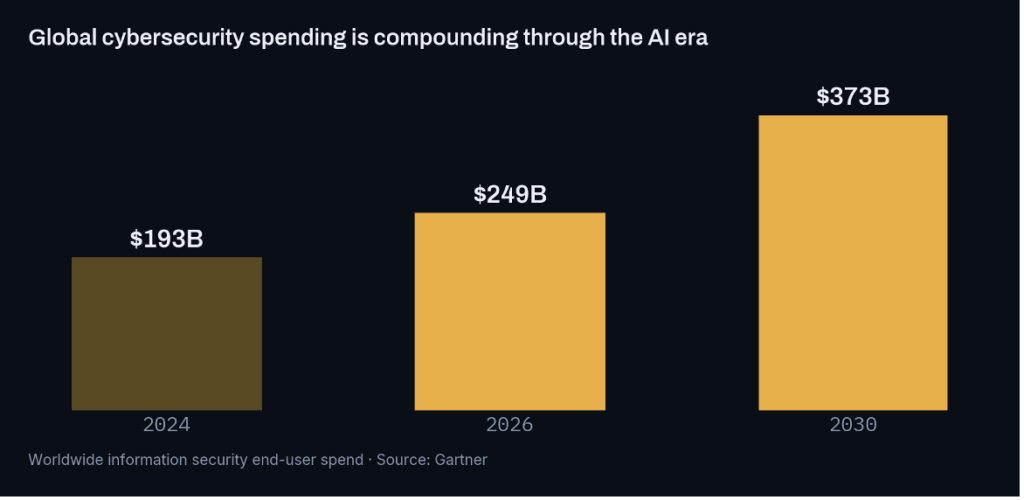
Global information security spending, 2024–2030. Source: Gartner.

Add in security services, and Cybersecurity Ventures pegs the broader market above $520 billion. A Morgan Stanley survey of CIOs found cybersecurity budgets are expected to grow roughly 50% faster than overall software spending.

The fastest-growing slice of the entire market is a category that barely existed 18 months ago: “securing AI” — projected to overtake endpoint protection as the single largest security category by 2029.

Translation: this isn’t a headline-of-the-week trade. It’s a multi-year, structurally funded spending supercycle. Now onto the stocks.

Want to see how I’m trading this theme in real time? I break down setups like these — with live entries, exits, and risk levels — every weekday at 11 a.m. ET on MiT Live.
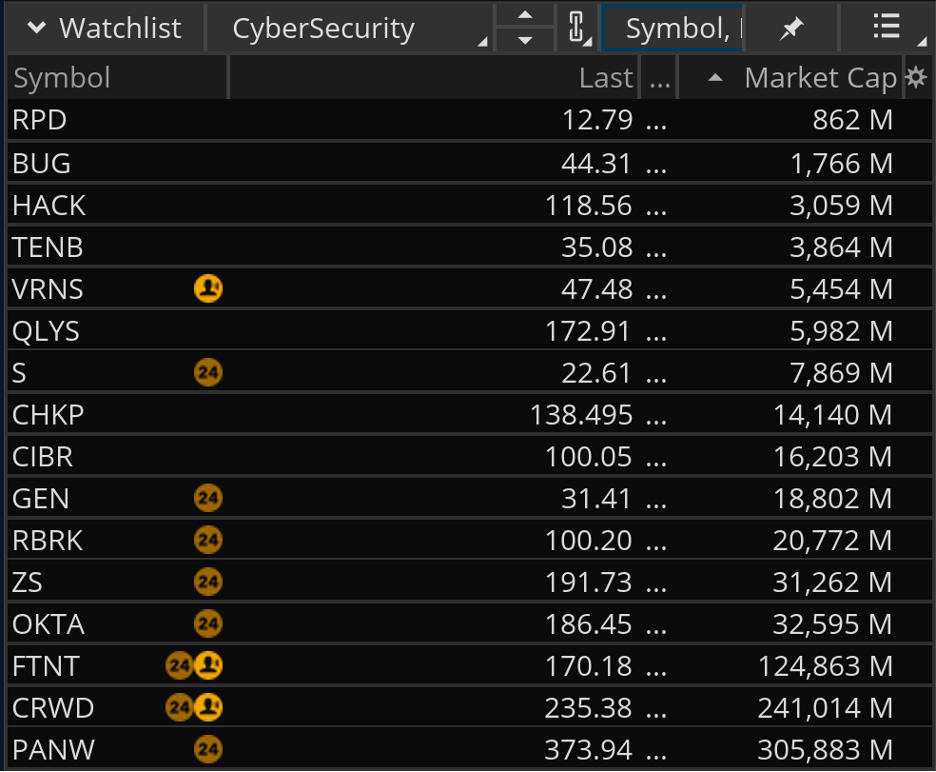
A watchlist of cyber security companies

 The 15 Best Cybersecurity Stocks at a Glance

StockWhat it doesEst. rev. growthValuationAnalyst view
CrowdStrike (CRWD)Endpoint / XDR~26%PremiumStrong Buy
Palo Alto (PANW)Platform / identity~25%Above avg.Buy
Fortinet (FTNT)Network / firewall~20%ValueBuy / Hold
Zscaler (ZS)Zero Trust / SASE~24%ModerateBuy
Microsoft (MSFT)Bundled security giantDiversifiedModerateStrong Buy
SentinelOne (S)AI-native endpoint~23%ValueBuy
Okta (OKTA)Identity & access~11%ValueModerate Buy
Rubrik (RBRK)Cyber resilience~48%ModerateBuy
Cloudflare (NET)Edge / AI infra~36%PremiumHold / Buy
Check Point (CHKP)Firewall / SASE~7%ValueHold
Qualys (QLYS)Vuln. mgmt.~9%ModerateHold
Varonis (VRNS)Data security / DSPM~9%*ModerateBuy
Tenable (TENB)Exposure mgmt.~11%ValueBuy
Rapid7 (RPD)Vuln. mgmt. / SecOps~flatValueHold
Gen Digital (GEN)Consumer security~4%ValueHold
Figures are approximate, based on the most recent quarterly reports as of September 2026; *Varonis total revenue grew ~9% but its SaaS ARR is growing far faster (~60%+) through its subscription transition. Valuation reflects EV/revenue relative to the ~25x sector median.

The Rose Take: Where I Would (and Wouldn’t) Put New Money

After 28 years reading order flow, I’ve learned the best company and the best stock aren’t always the same thing. Here’s how I’d rank them:

  • Best business, hands down — CrowdStrike (CRWD). Nothing else in the group has its brand, retention, or platform breadth. The only knock is the price: it’s trading near Wall Street’s most bullish targets, so you’re buying perfection.
  • My No. 1 pick for new money — Palo Alto (PANW). It has the scale of CrowdStrike, faster-improving platform economics, a brand-new identity engine from the CyberArk deal, and it still trades at a discount to CRWD. It’s the best risk-adjusted way to own the theme.
  • Boldest high-upside bet — SentinelOne (S). The cheapest of the leaders, growing more than 20%, with real takeover optionality. If it keeps closing the gap with CrowdStrike, it has the most torque on the list.
  • Handle with care — Cloudflare (NET) and CrowdStrike (CRWD). Two of the best stories in tech, at two of the richest multiples. I’d rather wait for a pullback than chase them here.
  • The one I wouldn’t chase — Rapid7 (RPD). Revenue is essentially flat. It’s a turnaround-and-takeover bet, not a growth story — treat it that way.

The Blue-Chip Generals: Best Cybersecurity Stocks for Core Exposure

Large-cap, profitable platforms. They offer core exposure to the theme , and they’re the names institutions buy first.

1. CrowdStrike (CRWD)

The category gold standard. Its Falcon platform is the purest expression of the “AI threat means more security spend” trade, and management now openly calls the company “AI security infrastructure.” Net new annual recurring revenue grew more than 50% year over year in its most recent quarter, its new AI-detection product is scaling fast, and gross retention sits near 97% — a sign customers simply don’t leave. The catch: it’s the most expensive name in the group, and after a 4-for-1 split this summer, it’s already trading near Wall Street’s most bullish price targets. You’re paying up for the best.

2. Palo Alto Networks (PANW)

The consolidation play. While rivals sell point products, Palo Alto is pitching enterprises on running their entire security stack through one vendor — and it’s working, with next-generation security ARR above $9 billion and growing north of 30%. Its roughly $25 billion acquisition of CyberArk, which closed earlier this year, bolts on a dedicated identity pillar right as AI agents make machine identity a top priority. The catch: growth is decelerating off a huge base, and the stock has already had a monster year.

3. Fortinet (FTNT)

The value general. Fortinet owns better than half the global firewall market, differentiates with its own custom silicon, and — critically — is consistently profitable. It typically screens as the cheapest of the mega-cap pure plays, which makes it the “sleep at night” name in the group. The catch: it carries more hardware exposure than the pure cloud names, so its growth is steadier but slower.

4. Zscaler (ZS)

The zero-trust leader. Zscaler replaced the old perimeter-firewall model with cloud-native traffic inspection, and it’s leaning hard into securing agentic AI as its next growth leg, with ARR growing around 25% to nearly $4 billion. It often trades at a meaningful discount to CrowdStrike on forward earnings. The catch: the market punishes any hint of a growth slowdown here — recent guidance wobbles have triggered sharp drops.

5. Microsoft (MSFT)

The elephant nobody counts as a “cyber stock.” Microsoft has quietly built a security business worth roughly $37 billion — larger than CrowdStrike, Palo Alto, and Zscaler combined — and bundles it into enterprise agreements customers already sign. You won’t get pure-play torque, but you get the most defensible distribution in the entire industry with a fraction of the single-name risk. The catch: security is a rounding error in Microsoft’s overall story, so it won’t move the stock on its own.

The High-Growth Disruptors: AI Cybersecurity Stocks With the Most Upside

More torque, more risk. These are the challengers and turnarounds with the most upside if they execute.

6. SentinelOne (S)

The direct CrowdStrike challenger. Its AI-native Singularity platform and Purple AI tools are built exactly for the autonomous-threat era, ARR has crossed $1 billion, and it’s the cheapest of the leaders on a price-to-sales basis — trading around 3.5x forward revenue versus far richer peers. It’s also a perennial takeover candidate. That combination gives it the most torque on the list. The catch: it’s still proving durable profitability and faces the risk of being out-muscled by the platform giants.

7. Okta (OKTA)

The identity turnaround. Identity is the front door to every network — and with AI agents multiplying, every one of them needs an identity to manage. Okta is the leader in that lane and has been climbing steadily back after years in the wilderness. The catch: the platform giants are bundling identity too, so Okta has to keep proving it’s the better standalone tool.

8. Rubrik (RBRK)

The “after the breach” play. While most names focus on preventing attacks, Rubrik focuses on cyber resilience — clean, fast recovery after ransomware hits. That’s a fundamentally different exposure, and a critical one, since no defense is perfect. It’s been one of the stronger performers among the newer public names. The catch: it’s a younger, higher-volatility stock still scaling toward consistent profitability.

9. Cloudflare (NET)

The AI-infrastructure hybrid. Cloudflare isn’t a pure cybersecurity play — it sits at the intersection of edge computing, AI infrastructure, and security, growing revenue nearly 30%. For investors who want the AI build-out and the security angle in one ticker, it’s a rare two-for-one. The catch: that breadth means it competes on multiple fronts, and it trades at a premium valuation.

The Under-the-Radar Value & Niche Cybersecurity Stocks

Cheaper, specialized, less-crowded corners of the space — where the asymmetric setups often hide.

10. Check Point Software (CHKP)

The steady compounder. Check Point rarely grabs headlines, but it delivers consistent margins and cash flow while quietly building out its cloud and zero-trust offerings. It’s the low-drama way to own the theme.

11. Qualys (QLYS)

The profitable niche leader in cloud-based vulnerability scanning and compliance — the unglamorous plumbing that every regulated enterprise has to buy.

12. Varonis (VRNS)

A direct “securing AI” play hiding in plain sight. Varonis discovers, classifies, and monitors sensitive data and catches insider threats — exactly the problem that explodes when companies point AI models at their internal data. Its shift to a SaaS model is gaining traction.

13. Tenable (TENB)

The exposure-management specialist. Tenable helps organizations find what’s actually exploitable before attackers do — a discipline that only grows in importance as AI accelerates vulnerability discovery on the offensive side.

14. Rapid7 (RPD)

The small-cap wildcard. Same vulnerability-management and security-operations lane as the bigger names, but at a fraction of the market cap — which means more torque on any sector re-rating, and more risk if execution slips.

15. Gen Digital (GEN)

The consumer angle. The owner of Norton and Avast is the steadier, income-oriented way to play cybersecurity — protecting individuals rather than enterprises, with a profile closer to a cash-flow compounder than a hyper-growth bet.

Bonus: 3 Cybersecurity ETFs for One-Click Exposure

Not sure which horse to back? Own the whole field. These three ETFs give you diversified exposure without single-name blowup risk:

  • First Trust NASDAQ Cybersecurity ETF (CIBR) — the largest and most liquid, weighted toward Palo Alto, CrowdStrike, and Fortinet. It’s pulled in roughly $1.5 billion of net inflows over the past year, so it’s where sector money shows up first.
  • Amplify Cybersecurity ETF (HACK) — the original cyber ETF, with a similar large-cap tilt.
  • Global X Cybersecurity ETF (BUG) — a cleaner pure-play tilt with less legacy-tech overlap.

The Bottom Line on the Cybersecurity Play

Cybersecurity is one of the only enterprise budgets still expanding through an uncertain economy — and AI is pouring fuel on it from both sides. That’s the definition of a durable trade.

A few rules to play it well. Treat the tiers as roles, not rankings — the generals for core exposure, the disruptors for torque, the niche names for less-crowded setups, and the ETFs when you’d rather own the theme than pick a winner. Watch net new ARR at every earnings report; it’s the one number that separates a real spending shift from a headline pop. And remember that after a big move like Monday’s, headlines fade but bookings don’t — the names that hold their gains are the ones with the recurring revenue to back it up.

The AI era needs defending. These are the companies getting paid to do it.

Editor’s Note: What ever happened to the AI stock boom? Even AI darlings like Nvidia have essentially gone nowhere since summer 2025. Our friend and colleague at InvestorPlace, Louis Navellier, may have the answer. According to Louis, the AI industry is quietly “staging” ahead of the next great AI breakthrough… a new class of AI he calls “Superintelligence… but better.” How will it trigger a $100 trillion reset of the AI markets. How will the launch of this tech send some stocks to zero, and others soaring? And why does Louis say: Don’t buy or sell an AI stock in 2026 until you see what’s coming next? Go here for the full story (and Louis’ #1 pick).  

Cybersecurity Stocks FAQ

What is the best cybersecurity stock to buy in 2026?

There’s no single answer for every investor, but the strongest candidates are CrowdStrike for quality, Palo Alto for the best balance of growth and value, and SentinelOne for the most upside if you can stomach the risk. Match the name to your risk tolerance, not the other way around.

Are cybersecurity stocks a good hedge against an AI bubble?

They’re one of the more logical ways to stay exposed to AI without betting purely on the chip and data-center trade. Security spending is largely non-discretionary and rises whether AI adoption succeeds or produces new threats — so the group can hold up even if AI enthusiasm cools.

What is the best cybersecurity ETF?

The First Trust NASDAQ Cybersecurity ETF (CIBR) is the largest and most liquid, making it the default choice for diversified exposure. Amplify’s HACK and Global X’s BUG are smaller alternatives with slightly different holdings.

How is AI changing the cybersecurity industry?

AI is arming attackers with faster, cheaper, autonomous attacks — and forcing defenders to buy AI-powered tools to keep up. Gartner now tracks “securing AI” as its fastest-growing category, projected to become the single largest area of security spending by 2029.

CrowdStrike vs. Palo Alto — which is the better stock?

CrowdStrike is the higher-quality, faster-compounding business; Palo Alto is the broader platform at a more reasonable valuation. For new money at current prices, Palo Alto arguably offers the better risk-reward — but both belong on a serious watchlist.

Trade This Theme With Me – Live, Every Morning

A watchlist is a starting point. Turning it into actual trades — knowing when to get in, where to set risk, and when to walk away — is the hard part, and it’s what I do out loud every single day.

Join me on MiT Live, weekdays at 11 a.m. ET. I go live to break down the market’s biggest themes and the specific setups I’m watching in real time — cybersecurity, AI, and wherever the money is rotating next. It’s free, it’s unscripted, and it’s where lists like this one turn into real trade plans. Drawing on 28 years as a CBOE and CME floor trader, I’ll show you exactly how I’m thinking through these moves as they happen.

Watch live at youtube.com/@LiveOptionsWithJR — hit subscribe and set a reminder so you never miss the 11 a.m. open.

About the author

Jonathan Rose is a 28-year veteran trader who spent his career as a market maker on the Chicago Board Options Exchange (CBOE) and a floor trader at the CME and CBOT. He is the founder of Masters in Trading, where he teaches options and shares live trades and market themes every weekday at 11 a.m. ET on MiT Live. His focus is helping everyday investors think about risk and opportunity the way professional traders do.

The post The 15 Best Cybersecurity Stocks to Buy Whether AI Booms or Busts appeared first on MarketWise.
  •  

Time to Wake Up. Copper Stocks Are the AI Trade Everyone’s Sleeping On.

Everybody’s crowding into the same handful of AI chip names. Meanwhile, the actual bottleneck in the entire AI buildout is a metal that’s been around since the Bronze Age — copper. (Yes, the Chester Copper Pot metal, for my fellow Goonies fans. It always sneaks into my presentations.)

And this week copper did something it hasn’t done in a very long time: it printed a brand-new all-time high while the physical supply underneath it keeps getting thinner. As I’m writing this, three-month copper on the LME just tagged a record near $14,700 a ton (an intraday high around $14,694), capping its longest weekly winning streak since 1994. One of my favorite copper stocks is Freeport-McMoRan (FCX), and it’s up better than 7% on the day and roughly 44% on the year.

I’ve been pounding the table on the copper trade on Masters in Trading LIVE for weeks — and I put a real, defined-risk version of it (a specific FCX options play) in our free portfolio, live on the show, which I’ll show you the exact structure of below. Let me walk you through why first.

 AI Runs on Copper, and There Isn’t Enough of It

Here’s the part Wall Street keeps glossing over. An AI data center uses roughly 10 times the copper of a traditional data center. All that compute, all that power delivery, all that cabling — it runs on copper. And a new copper mine takes seven to ten years to build. Supply simply cannot catch up to this demand on any timeline that matters.

Now stack that AI demand on top of a supply chain that’s genuinely cracking:

  • One year ago this week, a wet-material flood hit Freeport’s Grasberg mine in Indonesia — the world’s second-largest copper source — triggering a force majeure. Freeport has cut its 2026 output guidance at the complex by roughly a third, and a full recovery isn’t expected until 2027 or 2028.
  • Chile, the world’s largest producer, just logged its weakest second quarter in at least 19 years and has cut its full-year forecast twice.
  • Global mine output actually fell in the first half of the year. Morgan Stanley started 2026 expecting supply to grow and now sees it flat-to-down — which would be the first annual decline in mine supply since 2017.

As Evy Hambro, BlackRock’s Global Head of Thematic and Sector Investing, put it, existing copper operations are “tired, very, very old assets.” That’s the backdrop: warehouses draining, grades falling, and the biggest demand story of the decade just getting started.

The Copper Tariff Catalyst Nobody’s Fully Pricing In

This is where the edge lives. I don’t just want to be long a strong commodity — I want a known catalyst with a date on it. Copper has one.

Remember: a tariff is just a tax. Back in 2025, Washington slapped a 50% tariff on semi-finished copper products — pipes, wires, rods, sheets — plus copper-intensive derivatives like cables and connectors. But read the fine print: they didn’t tax raw input material or refined copper (cathode) itself. Not yet.

Here’s the timeline that matters:

  • The Commerce Department’s deadline to recommend action on refined copper passed on June 30, and more than two months later the White House still hasn’t ruled.
  • The recommendation on the table is a phased tax on refined copper — 15% in 2027 (possibly as soon as January), stepping up to 30% in 2028.
  • Traders aren’t waiting for the ink to dry. Roughly 200,000 tons of refined copper flooded into the U.S. in July alone — the largest monthly inflow on record — pushing Comex inventories past 1 million tons as buyers race to beat that possible January duty.

When big money moves ahead of a known date, it tips its hand. That’s the footprint I follow. I learned that on the floor — I spent twenty-eight years as a market maker at the CBOE and a floor trader at the CME and CBOT, and all any trader is ever doing is positioning in front of the biggest players in the room. Copper is flashing that exact signal right now.

 The Edge: Only Two Copper Smelters Are Left in America

Here’s the nuance that separates the pros from the crowd. A tax on imported refined copper is a gift to the very few companies that turn raw material into finished copper on U.S. soil. And there are barely any left.

Industry testimony to Congress this year put it starkly: the U.S. ran 16 primary copper smelters in 1976. Today, just two are operational, with a third (Grupo México’s Asarco Hayden in Arizona) mothballed. That’s the entire domestic backbone for refining copper in the world’s largest economy — which is why the U.S. ships roughly a third of the copper it mines overseas to be processed, then buys it back as finished metal. Put a tariff on that finished metal, and you hand enormous pricing power to the two companies that still run a smelter here:

  • Freeport-McMoRan (FCX) runs one of them (its Miami smelter in Arizona). It’s the largest U.S.-listed copper producer, it trades with deep, liquid options, and it’s my single favorite name in the space. The leverage is the story: by management’s own math, every 10-cent move in copper is worth about $390 million in annual EBITDA. It models ~$13 billion in EBITDA at $5 copper and ~$20 billion at $7 copper. Copper’s already trading north of $6.60 a pound. You do the math.
  • Rio Tinto (RIO) owns the other (its Kennecott smelter in Utah). It’s a much bigger, more diversified major — so it’s a steadier, more indirect way to get exposure. Think of Rio as the lower-beta version of the same idea.

That’s the concentrated bet. Now let’s talk about the rest of the group — because not all copper stocks play this story the same way.

The Best Copper Stocks for AI (and the Ones to Approach With Caution)

Copper’s 2026 run has turned the big producers into what basically looks like one trade — the year-to-date returns are clustered in a tight band, which tells you this is a commodity move, not a company-execution move. Names to know:

  • FCX (Freeport-McMoRan) — my top copper stock pick. Most direct U.S. smelter play, deepest options, biggest earnings leverage to the copper price.
  • RIO (Rio Tinto) — the other U.S. smelter; bigger, steadier, more diversified.
  • SCCO (Southern Copper) — a pure-play copper heavyweight, up roughly 45% on the year with monster EBITDA margins. Riding the same wave as FCX.
  • TECK (Teck Resources) — also up ~45% YTD, part of that same tight cluster.

And then there’s the be-careful bucket. Plenty of copper names are just miners — they dig up raw copper and ship it overseas. A U.S. refined-copper tax doesn’t really touch them, and the foreign refiners can actually be hurt by it. That group includes names like Ero Copper (ERO), Hudbay (HBM), First Quantum, Ivanhoe, Capstone, plus the big overseas majors like Vale (VALE) and BHP. Great companies, plenty of them — but they don’t sit on the right side of this specific catalyst. Know what you own and why you own it.

What About Copper ETFs?

If you’d rather not pick a single name, the sector has clean ETF wrappers — just understand what each one actually gives you:

  • COPX (Global X Copper Miners ETF) — a basket of copper miners worldwide. Great for broad exposure to the theme. The trade-off: it dilutes the U.S.-smelter edge, because it holds a lot of those overseas miners the tariff doesn’t help.
  • CPER (United States Copper Index Fund) — tracks copper futures directly. This is your cleanest exposure to the metal itself rather than the equities. If your whole thesis is that the price of copper goes higher, this is the straightforward vehicle.
  • COPJ (Sprott Junior Copper Miners ETF) — smaller, higher-beta junior miners. More torque, more risk.

The way I look at it: the copper ETFs are the easy button for just being in copper. But the edge — the concentrated, catalyst-driven bet — lives in the two American smelters, FCX and RIO. That’s the difference between owning the theme and owning the trade.

The Exact FCX Copper Trade I Shared Free on MiT Live

Here’s what makes our show different: I don’t just talk about copper — I put on a real trade in front of you, live, in our free portfolio — no paywall required to watch me do it. So let me show you exactly how I structured the FCX trade when I shared it on the show.

The Exact FCX Copper Trade I Shared Free on MiT Live

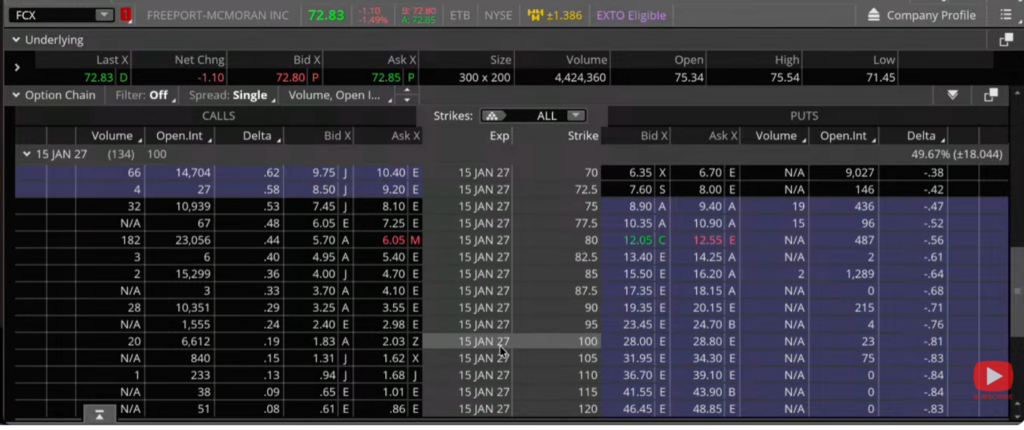
The setup was a vertical call spread in the January 2027 expiration:

  • Buy the FCX 80 call
  • Sell the FCX 105 call

At the time, that spread cost roughly $4.50 to put on — paying about $6 for the 80s and collecting about $1.50 for the 105s. And that number is your risk: in a defined-risk spread like this, the most you can lose is what you pay for it. So one spread risked about $450 — and you can never lose a dollar more than that, no matter what FCX does.

Now the reward. The spread is worth its full width — the 25 points between the 80 and 105 strikes, or $2,500 — if FCX finishes above 105. Subtract the $450 you paid, and the most you can make is about $2,050. That’s better than 4-to-1 — risk $450 to make $2,050 — with about 134 days for the thesis to play out. And it scales cleanly: a 10-lot risks about $4,500 to make about $20,500. Same ratio, just add a zero.

A few things I say every single day on the show:

  • This is one trade, not two. Two legs, one position — a vertical call spread. Don’t manage it as a separate long option and short option.
  • Options are just a derivative of the stock. Think of it as long from 80 and short from 105. If FCX is above your strike at expiration, you’re long from there; if it’s below, you’re not. That’s it — the internet loves to overcomplicate this.
  • New to options? Paper-trade it. Write the trade down, follow FCX, and let your confidence build before you risk a dime.

Options prices move, so the fills above reflect the session when I shared it — and with copper and FCX both pushing to fresh highs since, the picture keeps evolving. But the structure is the lesson: a known catalyst, a strictly defined risk, and a reward that’s several times what you put up.

The Bottom Line on Copper Stocks

AI can’t run without copper. The world is running short of it. And Washington is sitting on a decision that could put a tax on it as soon as January. That’s a supply squeeze, a demand supercycle, and a known catalyst all stacked in one place — and the cleanest way to play it is the two companies that refine copper on American soil, starting with FCX.

Editor’s Note: Forbes calls $1 billion fund manager Louis Navellier “the king of quants.” Today, he’s stepping forward to reveal why he’s investing $358 million of his own firm’s money in the next stage of Artificial Intelligence… a technological sea-change that could erase millions of jobs, solve humanity’s biggest mysteries, and spark a wave of moneymaking opportunities — both in and outside the stock market. Click here for the details… 

Copper Stocks FAQ

Why are copper stocks going up?

Copper just printed a record near $14,700 a ton on the LME, capping its longest weekly winning streak since 1994, while the physical supply underneath keeps thinning. An AI data center uses roughly 10 times the copper of a traditional one, and a new mine takes seven to ten years to build. Demand is surging while supply stalls.

What does the copper tariff mean for copper stocks?


In 2025, Washington put a 50% tariff on semi-finished copper products but left refined copper untaxed, for now. A phased duty on refined copper is on the table, possibly 15% as soon as January 2027 and 30% in 2028. That would hand pricing power to the few companies that refine copper on U.S. soil.

What are the best copper stocks for AI?


The cleanest plays are the two companies that still refine copper on U.S. soil: Freeport-McMoRan (FCX), the largest U.S.-listed producer and the top pick, and Rio Tinto (RIO), a steadier, more diversified option. Southern Copper (SCCO) and Teck Resources (TECK) ride the same commodity wave, both up roughly 45% this year.

Is FCX a good copper stock to buy?


Freeport-McMoRan runs one of only two operational U.S. copper smelters, and its earnings leverage is the story. By management’s own math, every 10-cent move in copper is worth about $390 million in annual EBITDA, and it models around $20 billion at $7 copper. Copper is already trading north of $6.60 a pound.

Are there copper ETFs for the AI trade?


Yes. COPX (Global X Copper Miners) gives broad exposure but dilutes the U.S.-smelter edge with overseas miners. CPER (United States Copper Index Fund) tracks copper futures directly, the cleanest bet on the metal itself. COPJ (Sprott Junior Copper Miners) holds smaller, higher-beta names with more torque and more risk.

What are the risks of copper stocks?


Copper’s 2026 run is largely a commodity move, so the big producers trade like one bet and would fall together if copper retreats. Many copper names just mine raw metal and ship it overseas, so a U.S. refined-copper tariff does not help them and can even hurt foreign refiners. Know what you own and why.

Want to see the next setup like this before it goes on? I break down real, defined-risk trades live every weekday at 11 AM ET on Masters in Trading LIVE — real trades, real time, real community. Come hang out.

The post Time to Wake Up. Copper Stocks Are the AI Trade Everyone’s Sleeping On. appeared first on MarketWise.

  •  

Tesla Optimus, Grok, and TSLA Stock: What’s Real. What’s Hype. What the Filings Actually Show.

Key Points

  • AI just went physical. Grok (xAI) now controls Tesla’s cabin by voice, the steering-wheel-free Cybercab launched September 3 in Austin, and Optimus is next. Optimus and Full Self-Driving are the “body”; Grok is the “brain.”
  • The dream is enormous. A prominent venture capitalist predicts Tesla Optimus will be bigger than the iPhone, reaching one billion units worldwide by 2036.
  • The near-term reality is cautious. Optimus isn’t in full production or on sale, Tesla hasn’t officially revealed the Gen 3 robot, and external sales are targeted no earlier than the second half of 2027. Prediction markets put 2026 launch odds in the single digits.
  • You may already own a piece of the AI stack. Buying TSLA stock provides indirect exposure to SpaceX, xAI, and Grok through a roughly $2 billion stake that booked a $1 billion paper gain.
  • The financial reality behind the hype: Tesla’s last report showed record revenue of $28.24 billion, but operating income fell 57% and free cash flow was negative—trillion-dollar ambitions funded by a car business now burning cash.
  • What to watch: A Gen 3 reveal, disclosed production numbers, and robots doing paid work. Execution, not adjectives, will be what matters.

On September 3, in Austin, the Tesla Cybercab was unveiled — a two-seat robotaxi with no steering wheel and no pedals, built to drive itself using Tesla’s onboard AI. It’s a fitting image for where the company now sits: the artificial intelligence the tech world spent two years arguing about as a chatbot is becoming something physical — a car that drives you, and soon a robot that works beside you. And the assistant running the conversation inside the car? xAI’s Grok, which as of this summer controls the cabin of millions of Tesla vehicles by voice.

That’s the story the market is buying. Tesla today is really two businesses under one ticker: a car company with thinning margins, and a leveraged bet on “physical AI” — robotaxis, the Tesla Optimus humanoid robot, and the Grok stack that increasingly runs both. The bull case says Tesla is the only slice of Elon Musk’s sprawling AI empire you can own in a brokerage account. The bear case says the dream is years out and the car business funding it is under real pressure.

This piece separates the two — what’s actually shipped, what’s still a promise, and what Tesla’s own filings show once the reveal-day excitement fades.

Grok Is Now Driving the Cabin — The “Brain and Body” Thesis

The bull case for Tesla as an AI company rests on a simple split: Optimus and Full Self-Driving (FSD) are the body; Grok, from xAI, is the brain. In 2026, those two halves came together.

Tesla’s 2026 Summer Update turned Grok from a novelty chatbot into a genuine vehicle controller. Say “Hey Grok” hands-free and it now adjusts climate, makes calls, plays music, opens the glovebox, folds mirrors, toggles heated seats, and digs through settings buried in menus — chaining multiple actions from one plain-English sentence, running on xAI’s Grok Voice Think Fast 2.0. Two honest caveats: it requires the AMD Ryzen infotainment chip (older Intel cars are permanently excluded), and a community test clocked it handling 116 of 170 commands — a 68% hit rate. Useful, not flawless. And as of late August, the fully merged FSD-plus-Grok build had reached under 1% of the fleet.

The strategic point is distribution: OpenAI has an app, Anthropic has an app, and Tesla has millions of machines in driveways that just became Grok endpoints — at effectively no customer-acquisition cost, because Musk’s companies own both the AI and the cars it runs on. The next step Tesla has signaled is letting Grok sit on top of FSD as a conversational “supervisor” — tell the car “drop me at the entrance, then go park” — which is exactly the interface a driverless robotaxi passenger needs. Treat that as roadmap, not shipped.

The ecosystem TSLA is plugged into (verified, and genuinely wild): xAI merged into SpaceX in early 2026, and SpaceX went public in June in the largest IPO on record. SpaceX/xAI then agreed to buy AI-coding company Cursor (Anysphere) for $60 billion in stock — the largest acquisition of a venture-backed startup ever. And in a twist that tells you how the AI economy really works, rival Anthropic agreed to pay xAI about $1.25 billion a month through May 2029 — over $40 billion total — to rent xAI’s Colossus 1 supercomputer in Memphis, because xAI had overbuilt compute as Grok usage sagged. Tesla isn’t a direct party to those deals, but through its SpaceX stake and its deepening Grok integration, it’s wired into the same web.

The SpaceX Stake Quietly Padding Tesla’s Earnings

Here’s something almost no casual TSLA stock holder realizes they’re exposed to — and it’s the bridge to the entire AI story.

Tesla’s most recent quarter reported $1.11 billion of GAAP net income. Roughly $1.0 billion of that was an unrealized gain on Tesla’s equity stake in SpaceX — a paper mark, not operating cash. Strip it out (as Tesla itself does in its non-GAAP figures) and the quarter’s “profit” looks far thinner.

Where did that stake come from? Tesla originally invested about $2 billion in xAI. When xAI merged into SpaceX, Tesla received U.S. regulatory clearance in March 2026 to convert that position into roughly 19 million SpaceX Class A shares — under 1% of SpaceX. SpaceX then IPO’d on June 12, 2026, and its valuation surged past $2 trillion within days, lifting Tesla’s stake well above its $2 billion cost basis. Tesla carries it at fair value, so it gets re-marked every quarter — meaning it can swing the reported bottom line up or down. Mark this date on your calendar: Tesla’s sales restrictions on those shares expire in December 2026.

Why this matters for a retail trader: when you buy TSLA stock, you are also buying a slice of SpaceX — and therefore of xAI and Grok. That exposure is genuine, but it’s also a source of earnings noise. A chunk of a future “beat” or “miss” could be nothing more than SpaceX’s mark moving around. Learn to read past it.

What Is Tesla Optimus? Quick Facts

  • Where it’s built: Fremont, California — Tesla shut down the former Model S/X line there and is retooling it for Optimus. A second, far larger factory is under construction at Giga Texas.
  • Capacity ambition: up to ~1 million units/year at Fremont and ~10 million/year at Giga Texas over the long term.
  • Target price (long-term, at scale): roughly $20,000 to $30,000 — Musk’s aspiration, not a near-term sticker.
  • The brain: a vision-based neural-network stack adapted from Tesla’s FSD software, with Grok handling natural language on newer versions.
  • How it learns: by imitating humans on first-person video, refining in simulation, and sharing skills across the fleet.
  • External sales: targeted “as early as” the second half of 2027, per a JPMorgan note after a Fremont visit.

Treat online Gen 3 “spec sheets” with caution — Tesla has not officially revealed the robot, and most recycle older figures.

Has Tesla Optimus Actually Entered Production?

This is where careful investors separate the milestone from the marketing.

Confirmed: Tesla decommissioned its Model S/X lines at Fremont and is installing the first Optimus production lines there — documented with line photos in the Q2 2026 update. Pilot and data-collection units have been running since early 2026, doing narrow tasks like sorting battery cells. The installed-capacity table lists Optimus at both California and Texas with the status “Construction” and no capacity figure.

Not confirmed: full-scale production or any external sales. Tesla still describes Optimus production as anticipated on the new line — no firm start date, unit count, or price — and early units are earmarked for internal training, not customers.

Why the distinction matters: Musk projected roughly 10,000 Optimus units in 2025, built a small fraction, and admitted in early 2026 that none were doing “useful work” in Tesla’s factories. Converting a profitable vehicle line into a robot line is a real, expensive commitment — but “starting production” and “producing meaningful volume” are very different things, and Musk has called the ramp “agonizingly slow.”

The Optimus Bull Case: A Market Bigger Than the iPhone

The optimists aren’t arguing about next quarter — they’re arguing about the size of the prize.

Venture capitalist Jason Calacanis is the loudest voice, calling Optimus “the greatest product ever made by humanity” and predicting one billion units worldwide by 2036. It’s a prediction, not a forecast grounded in current output, but it captures the ceiling bulls are underwriting. The more sober version runs through the labor market: a Citizens Bank analysis (highlighted by Futurum strategist Shay Boloor) sizes Optimus’s long-term U.S. opportunity near $1.7 trillion, with roughly $300 billion serviceable in the near term across factories, warehouses, and back-of-house jobs — modeling a humanoid at about $5/hour versus roughly $35/hour for a person.

And Tesla has a structural edge: it can deploy Optimus in its own factories first, cutting its labor costs and proving the product before selling a single unit — its own first and most demanding customer. Add the Grok distribution advantage above, and you have the full bull thesis: the only piece of Musk’s AI stack you can buy in a brokerage account.

The Reality Check: Skeptics, Missed Dates, and Single-Digit Odds

For every bull number, there’s a counterweight — and lately the counterweights own the near term.

Prediction markets have turned cautious: on Polymarket, the odds of a commercial Optimus launch by the end of 2026 recently sat around 9%, down from a peak near 33% a month earlier. Musk himself calls Optimus Tesla’s hardest product to scale, because it requires an entirely new supply chain, and the Gen 3 reveal has slipped repeatedly without the robot being shown. The skepticism isn’t limited to bears: Tesla supporter Ross Gerber has questioned Optimus’s near-term commercial prospects, and Unitree founder Wang Xingxing has suggested humanoids may be years from their “ChatGPT moment.”

There’s also regulatory risk that grows as Grok moves deeper into the car — and as the Cybercab hits the road. The September 3 Austin event was a product unveiling, not a regulatory green light: the two-seat, wheel-free Cybercab still faces limited public access, and Tesla’s autonomy programs already sit under open federal investigations. An AI that operates vehicle functions — and eventually a driverless car with no human fallback — invites scrutiny. Expect headlines on that front.

TSLA by the Numbers: Inside Tesla’s Q2 2026 Report

Strip away the reveal-day buzz and the billion-robot predictions, and here’s the last hard financial data we have on the business paying for all of it. Tesla’s most recent report — Q2 2026, for the quarter ended June 30 — tells a sobering story beneath the record headline.

Metric (Q2 2026)FigureYear-over-year
Total revenue$28.24B+26% (record; first-ever $100B+ trailing-twelve-month)
Automotive revenue$20.52B+23%
— Regulatory credits$146M−67% (from $439M)
Energy generation & storage$3.14B+13%
Services & other$4.58B+50% (record margin)
Total gross margin~16.8%Auto GM 16.9% (16.3% ex-credits)
Operating income$398M−57%
Operating margin1.4%down from 4.1%
Operating expenses$4.35B+47% (AI, Optimus, robotaxi, SBC)
GAAP net income$1.11B−5% (includes ~$1.0B SpaceX gain)
Non-GAAP EPS$0.33missed ~$0.53 est.; −18%
Operating cash flow$4.70B+85%
Capital expenditures$5.79B+142%
Free cash flow−$1.09Bfirst cash-burning quarter since early 2024
Cash + investments$43.52B+18%
Deliveries480,126record for the quarter

Record revenue, vanishing profit. Revenue hit an all-time high and Tesla crossed $100 billion in trailing-twelve-month sales for the first time. Yet operating income fell 57% to $398 million, compressing operating margin to just 1.4%. The top line grew; almost none of it reached the bottom line. Operating expenses jumped 47% as Tesla poured money into AI, Optimus, and robotaxi, plus stock-based compensation tied to the 2025 CEO pay package.

The regulatory-credit cliff is real. Automotive regulatory credits — nearly free profit Tesla has banked for years — fell 67% to $146 million from $439 million, as governmental actions restricted the programs tied to Tesla’s products. Credit revenue peaked at a record $2.76 billion in 2024. That cushion is deflating fast, and it flatters no future quarter.

The company is now burning cash. Operating cash flow rose 85% to $4.7 billion, but capital spending more than doubled to $5.79 billion, pushing free cash flow to negative $1.09 billion — Tesla’s first cash-burning quarter since early 2024. Management guided full-year 2026 capex above $25 billion and is arranging up to roughly $30 billion in borrowing capacity. Tesla ended the quarter with a still-healthy $43.5 billion in cash and investments against about $9.1 billion in principal debt, so this is an investment cycle, not a liquidity scare — but the “self-funding growth machine” narrative is on pause.

For a retail trader, the one-line takeaway is this: Tesla’s fundamentals are being re-rated on quality of earnings. The business is spending aggressively today for products that don’t generate revenue yet. Whether you’re bullish or bearish, that’s the lens.

Tesla’s Optimus Factory and Chip Fab at Giga Texas

The longer-term signal is in Austin. Permit-level filings point to two major new Giga Texas buildings: a dedicated Optimus factory and an Advanced Technology Chip Fabrication facility — the latter reportedly a joint Tesla–SpaceX effort of 470,000–490,000 square feet with a specialized vibration-mitigation foundation typical of precision chipmaking. Read together, the plan is tighter vertical integration: build the robots and the silicon that runs them on one campus. But it’s years and billions from revenue, with meaningful Texas Optimus output not expected until around summer 2027.

What It All Means for TSLA Stock

Put the pieces together and the investable summary is straightforward:

  • The car business funds the bet, and it’s under pressure. Shrinking margins, collapsing regulatory credits, and negative free cash flow mean the “physical AI” ambitions are being financed through a heavier-spending, thinner-earning core than a year ago.
  • The AI upside is real but priced-to-perfection. Robotaxi, Optimus, and the Grok stack are genuine option value — and the market is clearly paying for them, with TSLA carrying a roughly $1.4 trillion market cap despite the earnings compression, down more than 20% year-to-date even after an ~18% August rally.
  • Watch the quality of earnings, not the headline. A future “beat” driven by the SpaceX mark or a bitcoin gain is not the same as operating strength. Separate the paper gains from the cash the business actually produces.
  • It’s closer to binary than most stocks. If Optimus and autonomy land, Tesla is early in enormous new categories. If they stumble, it has poured capital into hard-to-reverse capacity against already-thin margins.

None of that is a call to buy or sell. It’s the framework for making your own call with your eyes open.

Key Milestones for TSLA Investors to Watch

  1. The September 3 Cybercab launch — fleet size and whether riders can actually hail one in the days after will be the first real read on how fast the robotaxi bet scales.
  2. The Optimus Gen 3 reveal — Tesla says it’s withholding the design until production is close; an actual reveal is the first hard timeline signal.
  3. A disclosed Optimus production number — it has never appeared in Tesla’s production reports.
  4. Q3 2026 earnings — the next read on margins, regulatory credits, and free cash flow, and whether Optimus finally shows up as a line item.
  5. The SpaceX share lockup expiring December 2026 — a date that could affect how Tesla’s stake and reported earnings behave.
  6. Grok-on-FSD rollout — the conversational “supervisor” layer landing in the fleet would validate the brain-and-body thesis.

Tesla Stock: Frequently Asked Questions (FAQ)

Does Tesla own part of SpaceX?

Yes. Tesla holds roughly 19 million SpaceX Class A shares — under 1% of the company — after converting an earlier ~$2 billion investment in xAI into SpaceX stock when the two merged. Tesla recorded about $1 billion in unrealized gains on that stake in the first half of 2026, and sales restrictions on the shares expire in December 2026.

Why did Tesla’s profit fall if revenue hit a record?

In its most recent quarter, revenue rose 26% to a record $28.24 billion, but operating income dropped 57% to $398 million. Operating expenses jumped 47% on AI, Optimus, and robotaxi spending, and high-margin regulatory-credit revenue fell 67% — so almost none of the extra revenue reached the bottom line.

Is Tesla Optimus in mass production yet?

Not full production. Tesla has decommissioned its Fremont Model S/X lines and is installing Optimus lines, with pilot and data-collection units running. But the company still describes production as “anticipated,” with no official start date, unit count, or price, and early units go to internal training rather than customers.

When can you buy a Tesla Optimus robot, and how much will it cost?

Tesla has targeted external commercial sales “as early as” the second half of 2027, with a long-term at-scale price target of roughly $20,000 to $30,000. That price is an aspiration, not a confirmed near-term figure — and given repeated delays, the timeline should be treated as tentative.

What is the Tesla Cybercab?

The Cybercab is Tesla’s purpose-built two-seat robotaxi with no steering wheel and no pedals, designed to run entirely on Tesla’s Full Self-Driving software. Its formal launch event was held September 3, 2026, in Austin — a product unveiling and limited deployment, not full public availability.

What does Grok do in a Tesla?

After the 2026 Summer Update, xAI’s Grok can control vehicle functions by voice — climate, calls, music, glovebox, seats, mirrors, and settings search — hands-free via “Hey Grok.” It requires the AMD Ryzen infotainment processor, so older Intel-based cars are excluded.

Is Optimus already priced into TSLA stock?

Tesla trades around a $1.4 trillion market cap despite compressed earnings, so the market is clearly assigning meaningful value to Optimus, robotaxi, and AI. That makes execution — a Gen 3 reveal, disclosed production numbers, and robots doing paid work — the key question for whether the valuation holds up.

The Bottom Line on Tesla in 2026

The Cybercab reveal is the visible version of Tesla’s whole thesis: AI you can sit inside. But the durable story is quieter and harder. Tesla’s own filings show a record-revenue business with thin, credit-dependent profits, now burning cash to fund an audacious bet — a bottom line flattered by a billion-dollar paper gain on a SpaceX stake that quietly links TSLA to the entire Grok/xAI universe. Layered on top is the biggest and most speculative wager of all: Optimus, a robot Tesla hasn’t officially shown, on sale to outsiders no sooner than late 2027, with single-digit near-term launch odds and trillion-dollar dreams attached.

For retail traders, the discipline is the same in either direction: separate the cash from the marks, and watch execution instead of adjectives. Production counts, a real reveal, and robots doing paid work will tell you more than any billion-unit prediction. Until then, TSLA is a story stock inside a story stock — enormous if it lands, expensive if it doesn’t.


Editor’s Note: Elon Musk revived the electric car, pioneered reusable rockets, and beamed down internet to the four corners of the Earth. But his new initiative – “XPANSE” – could be bolder… more transformative… and far more lucrative than all of these innovations combined. And, like Tesla and SpaceX, it could make early investors incredibly wealthy. Click here for the details…

The post Tesla Optimus, Grok, and TSLA Stock: What’s Real. What’s Hype. What the Filings Actually Show. appeared first on MarketWise.

  •  

August Jobs Report Preview: Forget the VIX — Watch the Bond Market Going Into Friday

The latest nonfarm payrolls report lands Friday, September 4 at 8:30 a.m. ET, and it’s the biggest, most volatility-inducing number of the month. Consensus is looking for a gain of around +55,000 after July actually lost 23,000 jobs. But our August jobs report preview says the crowd has it wrong.

I’m going to tell you the same thing I told our room on this morning’s live show: the number isn’t the story. Risk is already repricing where the real money lives — and it’s not in the VIX. It’s in the bond market.

I spent 28 years making markets, first on the floor of the CBOE and then trading bonds from 2003 to 2012. And the yield curve was always my first tell for the direction of the whole stock market. Right now, that tell is flashing, most traders are watching the wrong gauge, and Friday’s print is the catalyst that decides which way this thing air-pockets.

Let me walk you through it.

Key Numbers to Know Before Friday

ReportAugust 2026 nonfarm payrolls (jobs report)
ReleaseFriday, September 4, 2026 — 8:30 a.m. ET (7:30 a.m. CT)
Consensus~ +55,000 jobs (estimates run from roughly −25K to +140K)
Prior (July)−23,000
Unemployment rateExpected to hold near 4.1%–4.2%
VIX~15–16 — near its lowest levels all year
MOVE index (bond vol)~78 and rising, up from ~70 last week
10-year Treasury yield~4.8%
Fed funds rate3.50%–3.75% — markets pricing ~65% odds of a hike in September

What Time Is the August 2026 Jobs Report Released?

The Bureau of Labor Statistics releases the August employment report on Friday, September 4, 2026, at 8:30 a.m. ET (7:30 a.m. CT). It’s the single biggest catalyst of the month — the one number that moves the dollar, the bond market, and the stock market in the same breath, usually inside the first few seconds.

What Is the Forecast for August Nonfarm Payrolls?

Consensus is centered around a gain of +55,000, with the unemployment rate expected to hold near 4.1%. But be honest about the spread: the estimates run all the way from a 25,000 decline to a gain of 140,000.

When the pros can’t agree inside a 165,000-job range, that’s your first tell. This is a convexity setup, not a coin flip. The wings are priced for a big move — up or down — because there’s simply too much uncertainty for this market to sit still. Nobody actually knows what prints, which means the market is going to react, hard, to whatever does.

MOVE Index vs. VIX: The Number That Matters

Here’s the part almost nobody is talking about.

For the last year, the crowd has watched the VIX — the “fear gauge” for the S&P. Fine. But the VIX is sitting down in the dumps around 15, near its lowest levels of the entire year, while the market has been quietly selling off. That combination — market down, VIX asleep — usually doesn’t happen. It’s a tell that traders have gotten too comfortable with risk.

So don’t watch the VIX right now. Watch the MOVE index.

The MOVE (it’s a Bank of America product) is to bonds what the VIX is to the S&P — it measures volatility in the Treasury market. And while the VIX naps, the MOVE has climbed to roughly 78, up from around 70 last week. Bond volatility is rising while stock volatility pretends everything’s fine. When those two disagree, you don’t fight the bonds. The bond market is bigger than the equity market, and it’s usually right first.

Why is bond vol waking up? The 10-year yield is pushing 4.8% and the 30-year is at its highest in a long while. The Treasury even stepped in to buy the back end of the curve to try to force those rates down — but you can’t fight the free markets for more than a day or two. That’s the real reason the QQQ, the IWM and the S&P have been leaking lower. It isn’t a VIX story. It’s a bond-volatility story, and the MOVE is your first tell. If it bounces again before Friday, this market goes into the number under serious pressure.

Will the Fed Raise Rates in September?

Now layer the jobs number on top of that.

For most of 2024 and 2025, the trade was simple: weak jobs → the Fed cuts → stocks rally. “Bad news is good news.” That trade is dead right now, and here’s why.

Sticky inflation never went back in the box — the Fed’s preferred gauge is still running well above its 2% target, and with U.S.–Iran tensions heating up and tankers being hit exiting the Strait of Hormuz, oil is catching a hard bid. That’s more inflation, not less. At Jackson Hole, Fed Chair Kevin Warsh made it about as clear as a central banker gets that prices worry him more than a soft patch in hiring. The July meeting was a 9–3 hold, and all three dissenters wanted to raise rates. After Warsh spoke, fed funds futures flipped to roughly two-in-three odds of a September hike.

I’ll say it plainly, same as I said it live: I strongly believe the Fed raises rates at its September meeting.

So flip your logic before Friday:

  • A hot number (think +100K or more) tells Warsh the labor market can take a hike — that’s the hawkish outcome, and it’s a headwind for stocks, a tailwind for the dollar and short-term yields.
  • A weak number is what takes hike risk off the table — and that’s the one the equity crowd would actually cheer.

Read that twice, because it’s backwards from what you’ve been conditioned to do. This is my First Law in action: money drives markets. Not the headline, not the pundit spin — the repricing of rate expectations. Ask yourself which game you’re playing before 8:30.

Why the VIX Looks Too Cheap Into the August Jobs Report

Put it all together and the VIX being this low makes no sense. We’re walking into nonfarm payrolls — the biggest catalyst of the month — in a September that’s historically one of the most volatile stretches of the year, with bond vol climbing, yields near the highs and inflation a live concern. And the crowd is treating protection like it’s worthless.

That’s exactly when volatility gets mispriced. Stocks don’t like to hang around big round numbers — right now the Nasdaq is sitting right on its 100-day moving average, and markets rarely just drift there. They give a level a kiss and then either bounce or air-pocket straight through it. Into a number with this much uncertainty, that’s a move waiting to happen — which is why watching and respecting volatility here matters far more than the crowd thinks.

And don’t let last week’s Nvidia headline lull you either. Everyone circled the 89% implied year-over-year revenue growth and cheered — but a big share of that profit came from Nvidia’s own investments in AI companies that turn around and buy its chips. That’s circular financing, and it’s part of why the rally underneath is more fragile than the tape looks.

What the Unemployment Rate Isn’t Telling You About the Jobs Report

One more thing the crowd gets wrong: the unemployment rate.

July’s rate “fell” to 4.1%, and you’ll see that spun as strength. It isn’t. It dropped for the wrong reason — the labor force shrank by more than a quarter-million people and the participation rate slid to 61.4%, the lowest outside the Covid shock since the mid-1970s.

When the workforce is shrinking, the number of jobs needed just to hold unemployment steady falls too. So, a small payroll print — even a slightly negative one — no longer automatically means the economy is cracking. This is my Third Law: nothing is cheap or expensive on its own. You have to know why a number moved before you trade it.

What the BLS Benchmark Revision Means for the Jobs Report

Two weeks ago the BLS dropped its preliminary benchmark revision — the annual re-basing of payrolls against actual tax records. The economy had 79,000 fewer jobs in the year through March 2026 than first reported. That’s 0.1%. A rounding error — and a fraction of last year’s roughly −911,000 revision that had half the internet screaming cover-up.

But don’t stop at the headline. Look at where the jobs moved, because the tape can’t hide. The biggest cuts hit retail trade (−154,600), private education and health (−96,000), wholesale trade (−86,200) and manufacturing (−67,000). The upward revisions went to transportation and warehousing (+135,100), government (+99,000), information (+87,000) and financial activities (+85,000). That’s not random. That’s the goods-and-retail economy bleeding while logistics, government and information hold the line. Follow the money and the picture gets a lot clearer than the one-line summary. Second Law: the tape can’t hide

How to Think About Trading the Jobs Report

I’m not handing you a ticket to punch — this is the setup, not a recommendation. But here’s how I’m framing Friday.

The edge on an event like this is almost never in guessing the number. It’s in watching the right gauge and understanding the reaction. So watch bonds. For those with access to futures, the ladder is your read: ZN (10-year), ZB (30-year), UB (ultra), ZF (5-year), ZT (2-year) — or just follow TLT and the MOVE index. If yields start coming down and the MOVE settles, the market can rally. If the MOVE bounces and TLT gets crushed, that’s very bearish for stocks.

And whatever you do, my Fourth and Fifth Laws carry the day on an event like this: decide your risk before you enter, not after the number prints — and survive first. Size it so a whipsaw can’t take you out of the game.

What the Jobs Report Means for the September Fed Rate Decision

This report doesn’t land in a vacuum. It’s the first of two big inputs before the Fed’s September meeting, with the August CPI report following the week after. Neither is a formula that spits out a decision — they’re evidence, and Warsh has told us he’s reading it through an inflation lens. A firm payroll number plus another sticky inflation print keeps the September hike squarely on the table. A clearly weak jobs report is what could talk the committee back toward patience.

FAQ

What time is the August 2026 jobs report?

Friday, September 4, 2026, at 8:30 a.m. ET (7:30 a.m. CT), from the U.S. Bureau of Labor Statistics.

Will the Fed raise rates in September 2026?

It’s a live debate, and it’s leaning hawkish. After Chair Warsh’s Jackson Hole speech, fed funds futures moved to roughly 65% odds of a quarter-point hike — a sharp shift from the pause markets had expected. Friday’s payrolls and the following week’s CPI will shape the final call.

Why is a strong jobs report bad for stocks right now?

Because inflation is still above target and the Fed is leaning toward hiking. A strong labor market gives the Fed cover to raise rates, which pressures equities and lifts the dollar and yields. The old “weak-jobs-means-cuts” trade is inverted for now.

What is the MOVE index and why does it matter for the jobs report?

The MOVE index measures expected volatility in the U.S. Treasury market — it’s the bond market’s version of the VIX. With bond volatility rising while the VIX stays low, the MOVE is the more honest read on risk heading into a market-moving number like nonfarm payrolls.

What was the July 2026 jobs report number?

Nonfarm payrolls fell by 23,000 in July against expectations for a gain, with prior months revised down by roughly 103,000 combined. The unemployment rate ticked to 4.1%, but largely because the labor force shrank.

The Bottom Line

Friday isn’t about the headline — it’s about the reaction to the headline, and the reaction function is flipped. Forget the VIX, watch the MOVE, respect the volatility, and know which game you’re playing before 8:30.

That’s how we do it every market morning over at Masters in Trading, 11:00 a.m. ET. Follow the money, not the narrative.

Editor’s Note: Forbes calls $1 billion fund manager Louis Navellier “the king of quants.” Today, he’s stepping forward to reveal why he’s investing $358 million of his own firm’s money in the next stage of Artificial Intelligence… a technological sea-change that could erase millions of jobs, solve humanity’s biggest mysteries, and spark a wave of moneymaking opportunities — both in and outside the stock market. Click here for the details… 

The post August Jobs Report Preview: Forget the VIX — Watch the Bond Market Going Into Friday appeared first on MarketWise.

  •  

CoreWeave Stock: The $2.6 Billion Debt Signal the AI Bubble Is Ignoring

A $2.6 billion loan just told you more about the AI buildout than any earnings call. The stock already recovered and forgot. The loan document remembers — and it’s the most honest signal in the whole trade.

Twenty years on a trading desk teaches you where to look when you want the truth about a trade.

Twenty years on a trading desk teaches you where to look when you want the truth about a trade.

You can’t use stock prices, they lie all the time. They gap on emotion, they get pinned by options dealers, they run on narrative long after the story has changed.

That’s especially true when you’re evaluating AI infrastructure stocks, where billion-dollar financing decisions often reveal more than earnings calls or analyst price targets ever will.

If you want to know quickly whether a company is actually in trouble, you watch what it costs that company to borrow money.

The lenders behind the money have done the work. They’ve read the contracts. They’ve stress-tested the cash flows. And when they suddenly demand more interest, tighter terms, and a lockbox on the revenue before they’ll hand over a dollar — that’s the smart money repricing risk in real time.

This is exactly what’s happening with one stock at the center of the next AI wave — CoreWeave Inc. (CRWV).

AI Infrastructure Stocks’ Hidden Debt Bomb

In mid-July, CoreWeave — the “neocloud” that rents out Nvidia GPUs to AI companies — went to the leveraged-loan market to raise $2.6 billion.

At first, the loan looked routine.

The structure was a delayed-draw term loan, its fifth-and-a-half such facility, nicknamed DDTL 5.5. The proceeds were earmarked to buy more GPUs and infrastructure to serve a specific set of customer contracts.

According to loan-market reporting from LSEG and Octus, the deal launched on July 16 at a spread of SOFR plus 425 to 450 basis points, offered at 99 cents on the dollar. Standard-issue for this borrower.

Then it stalled.

The lenders investing in the project weren’t convinced. And to get the deal across the line, CoreWeave had to rewrite the terms in the buyers’ favor:

  • CRWV agreed to pay a much higher interest rate, making the loan significantly more expensive. The spread widened roughly 100 basis points to SOFR + 550, and the loan was discounted to around 96 cents — a four-point cut. The Financial Times pegged the all-in yield at roughly 9%. That’s a junk-grade cost of capital for a company that, months earlier, had raised GPU-backed money at investment-grade rates.
  • The lenders demanded stronger protection. They imposed a cash lockbox — meaning the cash coming in from customer contracts has to go to paying down the debt first, before CoreWeave can touch it — plus a 1.35x debt-service-coverage covenant and full amortization, per Fitch and loan-market coverage. Translation: the lenders wanted a hand on the cash register.

Only after making those concessions was CoreWeave able to secure the financing.  When the deal finally closed around August 10, the company described it as “meaningfully oversubscribed,” meaning more investors ultimately wanted to participate than the company needed.

At first glance, that sounds like a sign of overwhelming confidence, but remember when that demand appeared.

Investors only lined up after CoreWeave caved to the lenders’ demands. In other words, they’re there for the deal,

This was echoed by the independent credit-rating agencies. Fitch rated the loan BB+ and Moody’s rated it Ba2 — both below investment grade.

The deal did get done. But the market forced CoreWeave to pay up, pledge its cash flows, and accept a leash — before it would fund the AI buildout everyone insists is unstoppable.

The major takeaway here?

When a trade is truly bulletproof, the financing is supposed to get cheaper. But this one got more expensive, more restrictive, and harder to place, all at once.

The Stock Already Forgot. The Loan Remembers.

Here’s the part that makes this worth your attention right now.

In late July, fear peaked. The cost of insuring CoreWeave’s debt against default — its credit default swap, or CDS — blew out. Per Bloomberg data cited across market coverage, CoreWeave’s CDS topped roughly 855 basis points, a level that implied around a 50% probability of default within five years on a standard pricing model. The stock bottomed near $60.

Then the mood flipped. The loan cleared. On August 12, CoreWeave reported second-quarter revenue up more than 200% year-over-year, with a backlog it pegged at roughly $104 billion.

The stock ripped — nearly doubling off the lows to around $117 by mid-August before settling back into the high $80s.

The sell-side climbed aboard: Truist moved to Buy with a $165 target, Goldman lifted its target to $139, and Oppenheimer kept an Outperform and a $150 target, arguing AI demand runs about four times available capacity.

It only took the equity crowd about three weeks to get its optimism back. Understandable. But notice what didn’t reverse: CoreWeave still had to accept a 9% all-in cost, a cash lockbox, a maintenance covenant, and full amortization to get that money.

Those terms are baked into a signed credit agreement. They don’t un-widen because the stock bounced. The bond market did its stress test in public, and the price of that test is now a permanent line item in their budget until it’s paid in full.

This is the oldest lesson on the desk. Think of it like this…

The stock market is a voting machine — it forgot the scare in three weeks. The credit market is a weighing machine — it wrote the risk into the contract and moved on.

When those two machines disagree this much, I’ve learned which one to trust.

The Three Key Tells Buried Inside the Deal

Pull the DDTL 5.5 apart and three specific risks explain why the lenders got nervous. Each one is a flashing light that’s still on.

Tell #1: The Durations Don’t Match.

CoreWeave’s problem is the oldest one in finance — borrowing long and getting paid short. This loan runs about five years. But the customer contracts backing it average only about three. And the underlying data-center leases CoreWeave signs with its landlords can run up to 15 years.

So CoreWeave commits to 15-year obligations, funds them with a five-year debt, and covers it with three-year revenue. If those customer contracts don’t renew, the bills keep coming with no guaranteed income behind them.

Fitch flagged exactly this. Visibility gets murky beyond the current contracted window, when the company leans on renewals and re-leasing to sustain growth. If that pattern rings a bell, it should. It’s the same asset-liability mismatch that took down WeWork — long leases, short revenue, and a growth story papering over the gap.

Tell #2: The Customers are Dangerously Concentrated.

The Financial Times reported that the single largest counterparty behind this loan is Anthropic, at roughly 40%, followed by the quant trading firm Jane Street at about 35%, with Midjourney, Hudson River Trading, and Anysphere (the maker of Cursor) making up the remainder. Fitch separately noted that CoreWeave drew about 65% of its first-quarter 2026 revenue from just its top two customers.

Two things stand out. First, that is enormous concentration — a handful of contracts carrying the whole structure. Second, and more pointedly: Anthropic, the 40% anchor, is a privately held company with no public credit rating.

That’s not a knock on Anthropic — it’s one of the best-funded labs in AI, and in August it was being called the hottest upstart in the field. It’s a statement about what the lenders can actually underwrite.

You cannot price the credit risk of a counterparty you cannot rate.

When 40% of your collateral rests on an unrated private company and another 35% on a proprietary trading firm, the margin for error is thin under the best of circumstances.

There’s a footnote worth watching. As bond analyst Rod Dubitsky flagged, Fitch upgraded Jane Street — CoreWeave’s #2 counterparty — right in the middle of the period when this struggling loan was being marketed, citing factors that had been in place for years. Draw your own conclusions, but the timing feels suspicious.

Tell #3: The Lockbox is the Lenders Telling You What They Think.

You don’t demand a cash lockbox from a borrower you trust. You demand it when you want to make sure you get paid before anything else can go wrong. The concession CoreWeave had to grant is itself the verdict.

Not All AI Infrastructure Stocks Are Built the Same

While CoreWeave may be the loudest canary in the coal mine among the AI infrastructure stocks, they’re far from being alone.

The entire AI buildout runs on borrowed money and depreciating collateral.

Neoclouds like CoreWeave and Nebius fund their GPU purchases with debt secured against the chips themselves  —  Nvidia hardware that’s valuable today but could be a generation behind tomorrow.

CoreWeave’s own guidance calls for $31–35 billion of capital spending in 2026 against roughly $6.2 billion of trailing-twelve-month revenue.

Its first-quarter interest expense doubled to $536 million, and it has burned free cash flow every year since 2022. Revenue is expanding, yes — but so is the spending required to produce it. That treadmill only works as long as the cheap money hose keeps spitting out cash.

There’s a circularity here that should make you tilt your head: Nvidia sells the chips, is a major shareholder in CoreWeave, and is part of the capital ecosystem funding the customers who buy those chips.

When the same company is supplier, shareholder, and financier, “demand” gets harder to read at face value.

 That’s why “AI infrastructure” is too broad to be a useful investment category. The companies may be building toward similar goals, but they’re operating under very different financial constraints. The way I see it, the easiest way to think about them is to divide them into two groups:

The self-funders. Amazon, Alphabet, Microsoft, and Meta are pouring hundreds of billions into the buildout too — but largely out of operating cash flow from businesses that already mint money.

Their existing profits subsidize the unprofitable early years of AI. If financing gets expensive, they can shrug.

The debt-funders. CoreWeave, Nebius, Oracle’s cloud arm, and the leveraged neocloud complex finance the same buildout with debt, leases, and project loans against short contracts and depreciating chips.

For this bucket, the cost of money is the business model. When spreads widen, their math breaks first. This isn’t limited to the neoclouds: Oracle — the largest non-financial borrower in the Bloomberg U.S. high-grade index — saw its own CDS climb above 215 basis points this year, up from about 145 at the end of last year, with its long bonds yielding close to 7.8%. Apollo’s chief economist Torsten Slok put a name on the danger: at high enough all-in yields, the AI capex cycle starts to self-throttle not because demand changes, but because financing becomes too expensive.

And the hyperscalers just made the debt-funders’ problem worse.

In mid-July, Meta announced “Meta Compute,” a service to sell bare GPU capacity to third parties — the exact business the neoclouds are built on. When your biggest potential customer becomes your competitor, the “customer concentration” and “insourcing” risks are no longer theoretical.

I call it my AI Destruction List. Big media loves to oversimplify the problem. They say “AI is a bubble” — but that’s too lazy to be useful for anyone, and it’s impossible to time.

The more precise version: the leveraged, debt-funded layer of the AI trade cracks first, and it cracks in the credit market before it cracks in the stock.

Is There Any Bull Case for CoreWeave?

Now that we’ve covered the problems, allow me a moment to argue against myself. After all, a one-sided case is a weak case — and I want you thinking, not panicking.

The bulls have real, current points. The loan did clear, oversubscribed at the wider terms — the demand exists, just at a higher price.

Many of CoreWeave’s contracts are “take-or-pay,” meaning customers owe the money whether or not they use the capacity. That ~$104 billion backlog is enormous (bear in mind it blends remaining performance obligations with other committed amounts, so it’s a scale indicator, not a bank balance).

The company is actively working to diversify the concentration I just flagged — in August it signed a fresh multi-year deal with Hudson River Trading and pushed into sticky government work through a CoreWeave Federal partnership with Leidos.

Its marquee counterparties — Anthropic, Meta, OpenAI, Jane Street — are real, growing, well-capitalized names.

The insider selling that made headlines was executed under pre-arranged 10b5-1 plans and left executives with large stakes.

And most of Wall Street is bullish, with price targets from $139 to $165 against a stock in the high $80s. A CDS spread is a probability, not a verdict — and the one that screamed in July has since calmed as the stock recovered.

Both readings are defensible from the same set of facts depending on which details you choose to focus.

The honest position isn’t “CoreWeave is going to zero.” It’s that the cost of financing the AI buildout went up in a visible, measurable, contractually permanent way — and the market charged the most leveraged players the highest prices.

What is critical to understand before committing your capital to this trade is that ignoring that risk because the stock bounced is exactly the mistake retail makes at every top.

Forewarned is forearmed.

What the Options Say About CoreWeave

People always want the trade. But before we take the trade, we need to know the range of what to expect — and on a name like this, the range tells us the story.

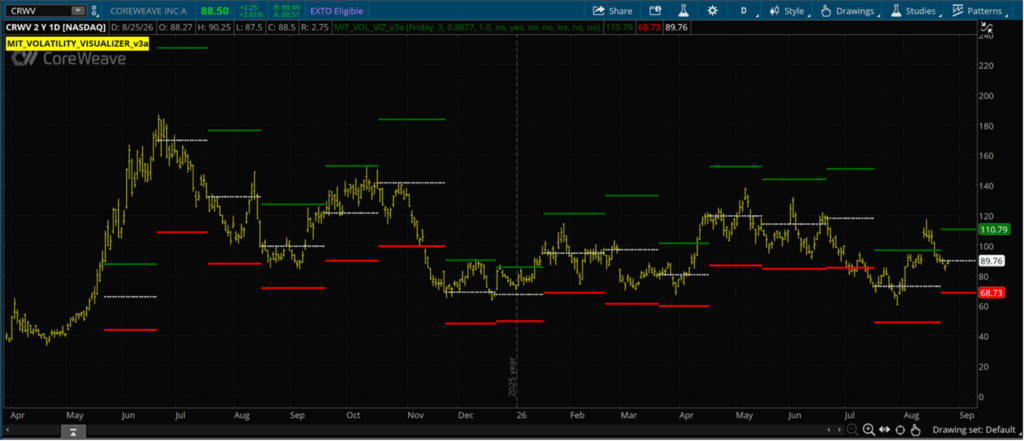
Every day I run a tool I built called the Volatility Visualizer, or the Vol Viz for short. This program plots the expected-move band the options market is pricing in for where a stock could realistically trade over a given window.

To be clear, this isn’t an arbitrary line I drew on a chart. This is hard data, pulled straight out of live options prices — the market’s own, dollar-weighted forecast of how far this thing can move.

Coreweave chart

Here’s what it’s showing on CoreWeave, with the stock around $88.50: an expected-move band running from roughly $69 on the downside to $111 on the upside — a range more than 40 points wide, better than 20% in either direction.

Sit with that. The options market is pricing a swing of more than a fifth of the company’s value, up or down, on a business worth tens of billions of dollars.

That’s an unusually wide range of expected outcomes. And it echoes the same warning coming from the credit market: investors are demanding a much bigger margin for uncertainty.

The lenders demanded a cash lockbox and 9% money because they couldn’t pin down the risk. The options market is pricing a 40-point range for the same reason.

Two completely different corners of Wall Street — credit and volatility — look at CoreWeave and reach one identical verdict: nobody knows where this settles and they’re actively worried about where it might end.

Why the Expected Move Matters More Than Any Price Target

A sell-side analyst stamps a $165 target on the stock and a headline is born — but that’s one person’s guess about direction.

The expected move is the whole market’s consensus about magnitude, and it comes with probabilities attached. Roughly speaking, the market is pricing about a two-in-three chance the stock finishes inside that ~$69–$111 band over the window.

That single fact should reframe everything you’re looking at. CRWV ripping toward $110 next month? Still “inside expected” — not a breakout, not a miracle, just the top of a range the market already told you about. A decisive break below $69 or above $111 is the only thing that would count as the market being genuinely surprised.

That is how you keep your head in a stock that moves 15% before lunch. You stop flinching at every candle and start asking one question: is this move inside the expected range, or did something just break the market makers’ models?

Because the day CoreWeave slices through the low end of that band on heavy volume is the day the credit-market alarm bells stop being silent.

Five Signals I’m Watching Next

You don’t need to track every loan. Watch these:

The 10-year Treasury. With the long end elevated, the cost of all this debt is set by the bond market. Higher-for-longer is the neocloud’s enemy.

The next neocloud financing. The tell isn’t whether it gets done — it’s the spread and the structure. Wider pricing and more lockboxes mean the squeeze is tightening. Cheaper, cleaner deals mean the fear is fading.

CoreWeave and Oracle CDS. The real-time thermometer. Staying wide is the warning; the more it compresses, the smoother sailing there is ahead.

Contract renewals. The duration mismatch is critical. The first time a big three-year contract comes up and doesn’t renew at full value, the mismatch problems stop being theoretical.

Hyperscaler insourcing. Every “Meta Compute” — every hyperscaler that builds instead of rents — is a direct hit to the neocloud customer base.

The Bottom Line

The biggest mistake investors make with AI infrastructure stocks is assuming they’re all exposed to the same risks.

Financial talking heads love to go on about the AI trade as a contest of technology — whose model is smartest, whose chips are fastest. But at this scale, it’s a contest of capital allocation and financial endurance. The question is no longer whether AI demand is real in the short-term. It’s whether that demand converts to cash fast enough, and lasts long enough, to service the mountain of debt being stacked against depreciating hardware.

The stock market already voted twice — panic in July, euphoria in August. The credit market didn’t flip-flop. It wrote the risk into a contract and left it there: wider spreads, tighter terms, a cash lockbox, and a set of covenants that tell you exactly how the smartest lenders in the room see this. The stock forgot. The loan remembers.

The first crack in the AI trade won’t show up on a chart. It will be buried in the fine print of a loan document.

Always follow the money.

Editor’s Note: Forbes calls $1 billion fund manager Louis Navellier “the king of quants.” Today, he’s stepping forward to reveal why he’s investing $358 million of his own firm’s money in the next stage of Artificial Intelligence… a technological sea-change that could erase millions of jobs, solve humanity’s biggest mysteries, and spark a wave of moneymaking opportunities — both in and outside the stock market. Click here for the details… 


I break down the day’s biggest market story every morning on Masters in Trading Live, 11 AM ET. I follow the top stories of the day and show you how the smart money is really positioned — no geometry, no chart-drawing, just evidence of where the money is moving. Join me each morning, drop a “Good Morning” in the chat, and let’s read the tape together. Jonathan Rose is a former CBOE market maker and the founder of Masters in Trading at InvestorPlace. I hosts Masters in Trading Live every weekday at 11 AM ET. Follow me on X at @JRoseTrades

The post CoreWeave Stock: The $2.6 Billion Debt Signal the AI Bubble Is Ignoring appeared first on MarketWise.

  •  

Boeing-Archer Deal: Why Give Away a $200 Million Business — on Purpose?

Companies don’t give away $200 million businesses.

Except Boeing just did. On purpose. And if you understand why, you understand where the next wave of AI money is headed.

On Monday, the Boeing-Archer deal was announced. Boeing (BA) handed three of its subsidiaries — Wisk Aero, SkyGrid, and Insitu — to Archer Aviation (ACHR). Three businesses. Two decades of investment. One of them generating over $200 million a year in defense revenue across 35 countries, with drones flown by the U.S. Navy.

The price? Zero dollars.

Boeing took stock instead. A 19.75% stake in Archer, plus options to buy more over the next four years — all laid out in a regulatory filing, not a marketing deck.

The market heard it. ACHR stock ripped 20% by mid-morning.

So why would Boeing do this? Simple. I spent 28 years on trading floors in Chicago, and I watched this exact trade a hundred times: when a market maker holds a position he can’t run properly, he doesn’t dump it at the bid — he swaps it to the guy who can run it and keeps a piece of the upside. That’s what Boeing did. CEO Kelly Ortberg has been shedding everything that isn’t commercial planes, defense, or space since he took over — he sold the Jeppesen flight-planning unit for $10.55 billion last year. But this time, instead of taking cash and walking away, Boeing kept a nearly 20% seat at the table and licensed back Wisk’s autonomy tech for its own future aircraft. Sell the headache, keep the upside. That’s not desperation. That’s a pro’s trade.

But here’s the part most investors will miss: the deal announcement gave Wall Street something more valuable than a stock pop.

It gave Wall Street new language.

“Physical AI” Just Entered the Chat

Archer didn’t call this a drone acquisition. It didn’t call it an eVTOL consolidation.

It called it an “end-to-end physical AI platform for aerospace and defense.”

Physical AI. Remember that phrase. You’re going to hear it a thousand times over the next year.

Here’s the plain-English version. The first wave of AI lived in a data center. It wrote your emails. It answered your questions. It made Nvidia the most valuable company in history.

Physical AI is what happens when that intelligence gets a body. Aircraft that fly themselves. Drones that navigate without a pilot. Air traffic systems that manage thousands of autonomous vehicles at once.

That’s what Archer just bought:

  • Wisk Aero — six generations of autonomous electric aircraft, more than 1,700 test flights
  • SkyGrid — the air traffic management software that keeps autonomous aircraft from hitting each other
  • Insitu — military drones flown worldwide, including by the U.S. Navy, with 3,500+ systems built and $200M+ in annual revenue

Feed all of it — nearly two million combined flight hours of data — into Archer’s AI foundation model, called ZEE. That’s the platform.

Whether Archer executes on that vision is a different question. But the theme just got a name, a poster child, and a Boeing endorsement. Themes with all three don’t stay quiet.

The Tape Told You Everything at 10 A.M.

I don’t care what a press release says. I care what the money does.

So here’s what the money did on Monday.

ACHR jumped 20% — fine, that’s the deal stock, it’s supposed to move. Part of that pop was mechanical anyway: nearly 15% of Archer’s float was sold short, and shorts covering into a takeover headline is rocket fuel that has nothing to do with conviction.

The real tell was everything around ACHR:

  • AeroVironment (AVAV) — up 9%
  • Kratos Defense (KTOS) — up nearly 6%
  • Red Cat Holdings (RCAT) — up 6%
  • Planet Labs (PL) — up 5%

None of those companies were in the deal. Not one.

That’s called a sympathy move, and it’s one of the most honest signals in markets. Nobody issued a press release telling AVAV to rally 9%. Real buyers showed up because the deal re-priced what an autonomous-systems business is worth. Insitu — a drone maker doing $200 million a year — just got valued inside a “physical AI” wrapper, and every fund manager holding a comparable business did the same math before lunch.

Meanwhile Boeing itself? Up less than 1%. The market shrugged at the seller and chased the theme.

That’s what the tape can’t hide, folks. The money went straight to the drone complex.

Follow the Money: 3 Ways to Play Physical AI Stocks

I’m not going to hand you a “buy this now” list. What I’ll do is show you where the money is pointing, so you can do your own work.

The pure comp: AeroVironment (AVAV). If you want to know what Insitu is, look at AVAV. Military drones, loitering munitions, U.S. defense contracts. It led Monday’s sympathy rally for a reason — it’s the closest public company to the business Boeing just handed Archer. When the theme gets a re-rating, the cleanest comp gets it first.

The autonomy arms dealer: Kratos (KTOS). Kratos builds tactical drones and the autonomy software that flies them. If “physical AI” becomes the label funds put on their defense-tech sleeve, Kratos sits in the middle of it.

The small-cap torque: Red Cat (RCAT). Higher risk, higher beta. Red Cat’s Teal drones won a U.S. Army short-range reconnaissance program, and the stock moves violently when the drone theme catches a bid. This is the name that goes up the most when the theme is hot — and down the most when it isn’t. Size accordingly.

And a word on the obvious one everybody will mention: Palantir (PLTR) is the software layer of battlefield AI, but it’s already priced like everyone knows it. The fresh money in a new theme usually flows to the names that haven’t been discovered yet.

Read the Fine Print Before Chasing the Boeing-Archer Deal

Two things to keep in your back pocket before you chase anything.

The deal isn’t done. It’s expected to close by the end of 2026, pending antitrust review. Between now and then, Archer is a story stock with a $200 million revenue business attached to a press release, not a balance sheet.

Archer paid in paper. This was an all-stock deal. Archer just issued roughly 20% of itself to Boeing. Dilution is real, and existing shareholders paid for these assets whether they realize it or not.

None of that kills the theme. It just means the theme and the ticker are two different trades. You can believe in physical AI without believing ACHR at any price.

Physical AI Stocks: The Bottom Line on the New Theme

Twenty-eight years of watching order flow taught me one thing above everything else: nothing matters until the money moves.

On Monday, the money moved. Boeing swapped $200 million of annual revenue for equity in a startup. The drone complex re-rated in hours on a deal it wasn’t even part of. And Wall Street got handed a brand-new theme with a Fortune 50 company’s signature on it.

Chatbots were the first act. Physical AI — machines that fly, see, and decide — is the sequel.

The smart money already bought its ticket. The question is whether you’re watching the screen or the popcorn line.

Editor’s Note: Every generation or so, the way money moves gets a fundamental upgrade. The people who see it coming have the chance to get extraordinarily wealthy. Everyone else watches from the sidelines. Luke Lango says that moment is here again, and Elon Musk is behind the upgrade in an amazing way. He’s revealing exactly what to buy, including one free pick, in this presentation.

The Boeing-Archer Deal FAQ

Why did Boeing sell Wisk, SkyGrid, and Insitu?

Boeing is streamlining under CEO Kelly Ortberg to focus on commercial aircraft, defense, and space. Rather than selling the three autonomy-focused units for cash, Boeing traded them for a 19.75% stake in Archer — keeping upside exposure to the technology while removing the units from its own cost structure. Boeing also retains licensed access to Wisk’s autonomous flight systems.

What is physical AI?

Physical AI refers to artificial intelligence embedded in machines that operate in the real world — autonomous aircraft, drones, robots, and the systems that manage them — rather than software that only generates text or images. The Boeing-Archer deal made it a Wall Street buzzword by branding the combined Wisk, SkyGrid, and Insitu businesses an “end-to-end physical AI platform.”

Why did Archer Aviation stock go up?

Archer (ACHR) surged roughly 20% after announcing it would acquire three Boeing subsidiaries — including profitable defense drone maker Insitu — in an all-stock deal that gives Boeing a 19.75% stake. Heavy short interest (about 15% of the float) amplified the move as short sellers covered.

What did Boeing get in the Archer deal?

Boeing received a 19.75% equity stake in Archer’s Class A shares, options to purchase additional shares over four years, and continued access to Wisk’s autonomous flight technology for its own current and future aircraft. Boeing took no cash.

What are the best physical AI stocks?

There’s no official “physical AI” index yet, but the names the market treated as beneficiaries on deal day were AeroVironment (AVAV), Kratos Defense (KTOS), Red Cat Holdings (RCAT), and Planet Labs (PL) — all up 5–9% on the news despite having no role in the transaction. Always do your own research; sympathy rallies can fade as fast as they appear.

Is the Boeing-Archer deal complete?

No. The companies signed definitive agreements on August 10, 2026, but the transaction is expected to close by the end of 2026 and remains subject to antitrust review.

Want to see how a 28-year floor trader reads moves like this in real time? Jonathan Rose goes live every weekday at 11 a.m. ET on Masters in Trading Live — breaking down the tape, unusual options activity, and trades like these as they happen. It’s free. Search “Masters in Trading Live” on YouTube and pull up a chair.

The post Boeing-Archer Deal: Why Give Away a $200 Million Business — on Purpose? appeared first on MarketWise.

  •  
❌