
 Login


The Next Lindy Payments Network

In a market obsessed with quarterly results and narratives that change by the week, today’s screen searches for the exact opposite – companies that are built to last for decades. The screen identifies the next generation of enduring businesses – before they’re widely recognized.
The Emerging Lindy Screen is about finding future Lindys: businesses that combine invention with discipline, transforming broken industries through structural innovation, vertical integration, and cultural resilience. The screen is designed to uncover the next Amazon or Apple – the types of compounding machines we aim to own long before the world catches on.
In today’s Sunday Selection, we report on a business that has quietly assembled the traits of an Emerging Lindy – the first company in 60 years to build both sides of a new payments network, where every merchant added makes it more useful to consumers, and every consumer added raises the cost of staying out for merchants. Its founder architected it from day one as a vertically integrated, software-defined, data-preserving network – a foundation built to carry product after product, from everyday financial services to advertising tools for merchants.
To see the criteria used to create The Emerging Lindy Screen, go here.
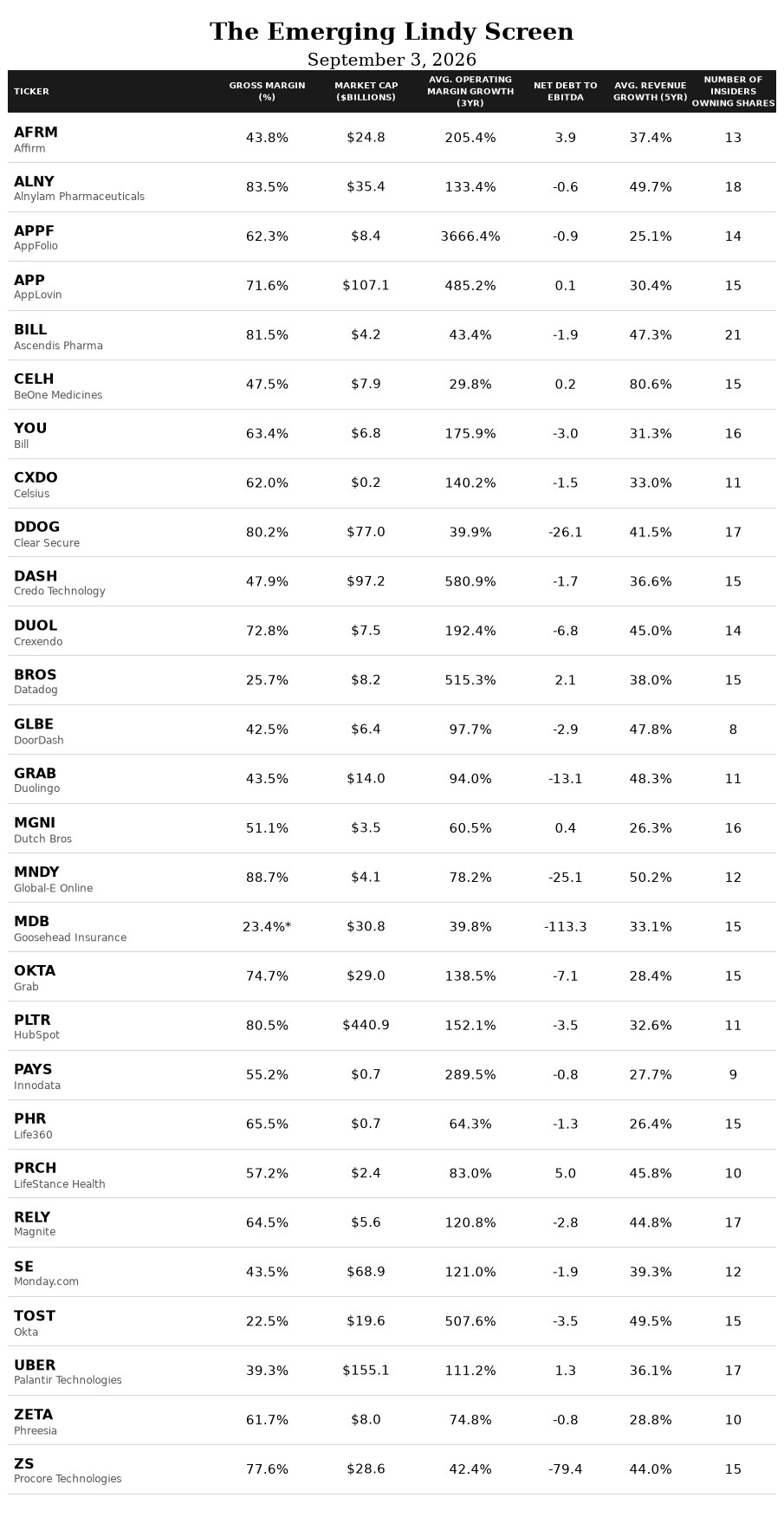
As of the close of trading on Thursday, September 3, the following 28 stocks met these criteria:
Highs And Lows
Each week, we also monitor any stocks in the market making 52-week highs. We do this because any stock on its way to generating 2x, 3x, or 10x returns will spend a lot of time making new 52-week highs along the way. Thus, the 52-week-high list provides an opportunity to flag these potential high performers before they really break out, with a particular emphasis on lower-profile, less widely-followed stocks that might have otherwise gone unnoticed.
Notable stocks making a 52-week high this week:
- JPMorgan Chase (JPM)
- Visa (V)
- Johnson & Johnson (JNJ)
- Mastercard (MA)
- AbbVie (ABBV)
- Chevron (CVX)
- Dell Technologies (DELL)
- Amgen (AMGN)
- Salesforce (CRM)
- Verizon Communications (VZ)
- Deere & Company (DE)
- ConocoPhillips (COP)
- Pfizer (PFE)
- Vertex Pharmaceuticals (VRTX)
- Bristol-Myers Squibb (BMY)
- Marathon Petroleum (MPC)
- The Bank of New York Mellon (BNY)
- Valero Energy (VLO)
- Phillips 66 (PSX)
- Regeneron Pharmaceuticals (REGN)
- MetLife (MET)
- Corteva (CTVA)
- State Street (STT)
- Ameriprise Financial (AMP)
- Atlassian (TEAM)
Presented By MyWallSt
We also monitor stocks on the 52-week-low list. In many cases, the names on this list are there for good reason – the market is often correctly pricing in weak fundamentals. However, once in a while, a great business with excellent long-term prospects finds itself on this list due to a temporary setback. This can create the rare opportunity to buy top-shelf merchandise at bargain-basement prices.
Notable stocks making a 52-week low last week:
- McDonald’s (MCD)
- TJX (TJX)
- Lowe’s (LOW)
- TransDigm (TDG)
- Nike (NKE)
- Honeywell Aerospace (HONA)
- L3Harris Technologies (LHX)
- AutoZone (AZO)
- IDEXX Laboratories (IDXX)
- Public Service Enterprise (PEG)
- Martin Marietta Materials (MLM)
- Carnival (CCL)
- Las Vegas Sands (LVS)
- Otis Worldwide (OTIS)
- Xylem (XYL)
- CMS Energy (CMS)
- Rollins (ROL)
- Constellation Brands (STZ)
- Textron (TXT)
- Wynn Resorts (WYNN)
- Builders FirstSource (BLDR)
The Making Of The Next American Express
This week’s Sunday Selection comes off today’s Emerging Lindy screen. Payment networks are some of the most Lindy businesses ever created.
The oldest payments company in America – American Express (AXP) – has been operating since 1850. The technology behind the most widely used payment rails today – Visa (V) and Mastercard (MA) – was designed in the 1950s and 1960s. Once a financial network reaches critical mass, it almost never dies – it simply compounds. Which is why it is remarkable that no company has successfully built a new payments network at the scale of these behemoths. Today Visa and Mastercard are worth a combined $1.2 trillion, and American Express another $200 billion.
The company featured in today’s Sunday Selection is a founder-led business that has quietly assembled both sides of a new payments network – tens of millions of consumers on one side and a large share of American commerce on the other. This year it crossed the threshold every young network must cross – from burning cash to generating it – and just reported the most profitable quarter in its history. Yet the stock trades almost exactly where it did one year ago.
Edit Delete (To become a Partner Pass member, contact our Customer Care team at 888-610-8895, internationally at +1 443-815-4447, or via email at support@porterandcompanyresearch.com.)
Today’s Sunday Selection is Affirm Holdings (Nasdaq: AFRM). Its founder and CEO, Max Levchin, was the original engineer behind PayPal (PYPL). In 2002, freshly minted as a multimillionaire from PayPal’s IPO, Levchin was denied a car loan – a failed college startup had wrecked his credit score a decade earlier.
The denial was a shock and an embarrassment – and it planted the question Affirm was founded to answer: why is the American credit system designed so that the lender wins when the borrower stumbles?
A credit card is an open tab – the bank grants you a limit, the balance revolves, and interest compounds on whatever you carry. Affirm’s model – an improved version of buy now, pay later (“BNPL”) – flips that: each purchase is its own small loan, with a fixed number of payments, a fixed end date, and the total dollar cost shown before you buy.
Underneath that simple product is the machinery that makes it possible. Every loan is underwritten individually, in real time, with full knowledge of what is being purchased. There are no late fees, no deferred interest, and no gimmicks. In an industry that collects roughly $15 billion per year in late fees alone, Affirm structured itself so that it only makes money when its borrowers succeed and repay their loans. That alignment is the backbone of Affirm’s moat, and the design principle the entire network is built on: underwrite every transaction, and never profit from a customer’s failure.
There was one problem. No company had built a new payments network at scale in 60 years, because networks have a cold-start problem – merchants will not join without consumers, and consumers will not join without merchants. Affirm cracked the code by entering through the merchant’s income statement. It did not sell payment acceptance – Affirm sold demand. Merchants who added Affirm’s BNPL at checkout saw conversion rates rise 28%, and roughly 70% saw larger average carts. That gave merchants a reason to join on day one, and merchants delivered consumers for free – it is why Amazon (AMZN), Walmart (WMT), and Shopify (SHOP) all partnered so deeply with Affirm. Every repayment then sharpened the underwriting models, and the models turned into the moat: Affirm’s 30-day-plus delinquencies run below 3% – 100 to 300 basis points better than large consumer lenders like Capital One and Synchrony – despite a loan book that is roughly 44% non-prime, a higher share than any of those lenders carry.
Over the past year, the business model has gained momentum. As Levchin described in the latest shareholder letter, in a well-designed network, the cost of not participating rises as the network itself scales. With roughly 28 million active consumers now expecting Affirm at checkout, the merchant without it is the one with the conversion problem – which is why Crate & Barrel, Backcountry, and Bed, Bath & Beyond’s brands all signed on just this summer.
And once merchants join, they do not leave – they process more and more transactions. Well-managed networks see very little churn at scale, and Affirm’s numbers prove that it belongs in the upper echelon of this class: merchants already offering Affirm have expanded their volume at a dollar-based net expansion rate averaging 120% over the past three years. That means even if Affirm never signed another merchant, the existing base alone would grow the network 20% per year.
Affirm processed $50.2 billion of gross merchandise volume (“GMV”) in fiscal 2026, up 37% – adding roughly $13.5 billion of incremental volume in a single year, nearly as much as the entire network processed in all of fiscal 2022.
For perspective, Visa and Mastercard grow volume 8% to 10% per year. And Affirm’s growth is not the same as that of the payments companies it gets lumped in with. Stripe processes enormous volume, but for one side only – it has no consumer relationship. PayPal owns consumers, but moves money above through Visa. The difference shows up in the economics: Affirm keeps more than 4% of every dollar that crosses its network after funding costs and credit losses – what the company calls revenue less transaction costs (“RLTC”) – versus the 2% to 3% the card ecosystem collects for simply moving money.
Affirm is the only company at scale that owns both sides of the network, underwrites every transaction in-house, and does so profitably. Meanwhile, Affirm is still live on only 75 of the top 250 U.S. e-commerce sites, and roughly 10% of e-commerce merchants overall – leaving plenty of share to grab.
Affirm’s largest operating loss came in fiscal 2023 at $1.2 billion when interest rates surged. But Affirm’s loans are short-duration assets, so the company repriced its entire book within a few quarters – producing a $1.6 billion swing to $417 million of operating profit in fiscal 2026, on the same business model the market had written off.
From fiscal 2024 to fiscal 2026, roughly 53 cents of every incremental revenue dollar fell straight to the operating bottom line. That is the signature of a network, not a lender – the ledger, the risk models, and the merchant integrations are already built and paid for, so each new dollar of volume carries very little cost beyond funding and credit.
What separates Affirm from a typical growth company is that the network keeps manufacturing new growth verticals. Each of Affirm’s businesses has followed an S-curve – slow adoption while the product finds its footing, then a steep run of growth as it catches on, then a plateau as the market matures.
The first S-curve – online checkout – is largely won. More than 60% of U.S. e-commerce already runs through merchants that offer Affirm. The second S-curve is live right now: the Affirm Card, which brings per-transaction underwriting to the physical world, where roughly six times more spending happens than online. The card works like a debit card for everyday purchases – but any transaction over $50 can be converted into an installment plan from the Affirm app within 48 hours, putting pay-over-time in the consumer’s pocket instead of at a merchant’s checkout page.
Card GMV grew 124% last quarter to an annualized run rate above $11 billion, active cardholders doubled to 5.2 million, and cardholders spend about twice as much as typical Affirm users. Yet only 19% of Affirm’s consumers carry the card – the steep, profitable part of this curve is ahead. Management’s long-term vision of 20 million cardholders spending $7,500 per year implies roughly $150 billion of GMV from the card alone.
The clearest tell that more S-curves are coming is how the founder spends his time. Levchin has always framed Affirm as a 30-year mission to do what PayPal never did – own both sides of the ecosystem, merchant and consumer alike. And with Michael Linford promoted to president to run daily operations, Levchin is freed up to chase the next S-curve full time, at the exact moment the core business has started printing the cash to fund it.
That next S-curve is already visible – and it runs through the banks themselves. Affirm spent a decade winning online checkout. It is now three years into putting a card in consumers’ wallets. And it is now encroaching on the banking system.
It’s looking at two options – becoming its own standalone chartered bank or creating a product (Affirm Edge) that embeds Affirms installment lending inside bank and credit-union apps. If the banking application succeeds, the near-term upside is modest – the bank would originate roughly half of Affirm’s loans but hold only a fraction on the balance sheet, reclaiming the fees and interest currently shared with partner banks, worth perhaps 15 to 30 basis points on that volume. The long-term math is what matters: once the bank is allowed to keep what it originates, insured deposits replace capital-markets funding at roughly 100 to 150 basis points less – every $10 billion moved on-balance-sheet is worth about $100 million of pre-tax income – and that balance sheet grows with Affirm’s own retained earnings. Nobody is modeling that yet, including Affirm. The application is pending in the friendliest charter environment in two decades, with GM and Ford both winning conditional approvals days before Affirm filed.
The end state is the only architecture that has ever produced an untouchable consumer finance franchise – a payments network attached to a deposit-funded bank.
We are not formally recommending Affirm – but it is one of our highest-conviction Emerging Lindys. The brand promise, the world-class partnerships, and the two-sided network make it the closest thing we have seen to a young American Express – a Porter classic, and an all-time Lindy. Amex has compounded for 176 years. Visa’s rails have run for nearly 70. Affirm has what took them generations to build – both sides of the network, a brand built on trust, and a founder 14 years into a 30-year mission.
Levchin remains the largest individual shareholder, and his compensation is almost entirely a multi-year award of performance options that vest only at stock price hurdles climbing as high as $372 per share. And with the network finally paying for itself, he is free to finish what he started – reorienting the entire credit ecosystem around the people who actually use it.
Porter & Co.
Stevenson, Maryland
The post The Next Lindy Payments Network appeared first on Porter & Co..
