❌

Normal view

  • ✇Market Wise
  • This ignored corner of the semiconductor market could be a huge AI winner Brian Hunt
    Today’s issue in preview: Demand for AI compute is exploding. That’s bullish for this stock This ignored corner of the semiconductor market could be a huge AI winner You don’t own enough of this bull market that has YEARS to run Learn our Top Themes to buy now This ignored corner of the semiconductor market could be a huge AI winner Credit: Ignatiev According to documents filed for its coming IPO, leading AI firm Anthropic expects to spend a colossal $518 billion over the next decade

     

This ignored corner of the semiconductor market could be a huge AI winner

7 October 2026 at 12:00

Today’s issue in preview:

  • Demand for AI compute is exploding. That’s bullish for this stock

  • This ignored corner of the semiconductor market could be a huge AI winner

  • You don’t own enough of this bull market that has YEARS to run

  • Learn our Top Themes to buy now


This ignored corner of the semiconductor market could be a huge AI winner

Image

Credit: Ignatiev

According to documents filed for its coming IPO, leading AI firm Anthropic expects to spend a colossal $518 billion over the next decade building AI infrastructure.

Anthropic also lists who it intends to give this money to. Broadcom (AVGO) accounts for about $161 billion in equipment lease obligations, followed by Alphabet (GOOG) at $111 billion and Amazon (AMZN) at $110 billion in computing services. Smaller expected deals include SpaceX (SPCX) at up to $84.5 billion, Microsoft (MSFT) at $31 billion, and AMD (AMD) at over $20 billion.

These are the latest extraordinary developments in the proliferation of AI agents, a megatrend we call the “Agent Supernova,” which is the explosion of AI agents that work for us, think for us, shop for us, invest for us, and solve hundreds of different problems for us.

In our March 31 research note, we detailed how this megatrend is bullish for the “power management” sector of the semiconductor industry.

These days, you can’t read an AI investment research report or listen to an AI-focused podcast without hearing about its insatiable demand for electric power and how it is the limiting factor in AI proliferation.

You hear about towns protesting AI data center power consumption.

You hear how limited access to power is constraining AI infrastructure growth.

You hear why limited power access is driving Elon Musk to operate data centers in space.

All this means that the pressure to improve AI’s power consumption efficiency – or its “unit of intelligence per unit of power ratio” – is enormous.

Any improvement in AI power-consumption efficiency – no matter how small – can yield significant cost savings across the industry.

And that means companies that help improve AI’s power consumption efficiency stand to generate large returns for their shareholders.

AI data centers need high-voltage, high-density power systems to keep everything running. Edge devices like robots, smart homes, and autonomous vehicles need efficient local power management to run locally without draining batteries or generating excess heat.

You could think of the potential savings and efficiency gains here by considering America’s automotive fleet of 280 million+ cars, which drive billions of miles every year. All that driving consumes so much gasoline that even tiny gains in overall fuel economy can yield significant fuel cost savings.

Now, instead of picturing car traffic and its gasoline consumption, think of AI’s data and “thinking” traffic and its electricity consumption.

Small power-efficiency gains across many AI data centers, communication networks, and Edge Computing devices can yield significant overall power-cost savings… plus greater growth opportunities for hundreds of AI applications.

The semiconductor industry is varied. It has dozens of large players that focus on different kinds of applications. One of these applications is electric power management: Ensuring AI data centers and communication networks use power efficiently. Ensuring cars, robots, factories, phones, hospitals, and office computer networks use power efficiently.

As AI moves into its mass adoption phase, demand for innovation and quality equipment from the power management semiconductor sector will soar. This will benefit several companies with specialized technology solutions, including:

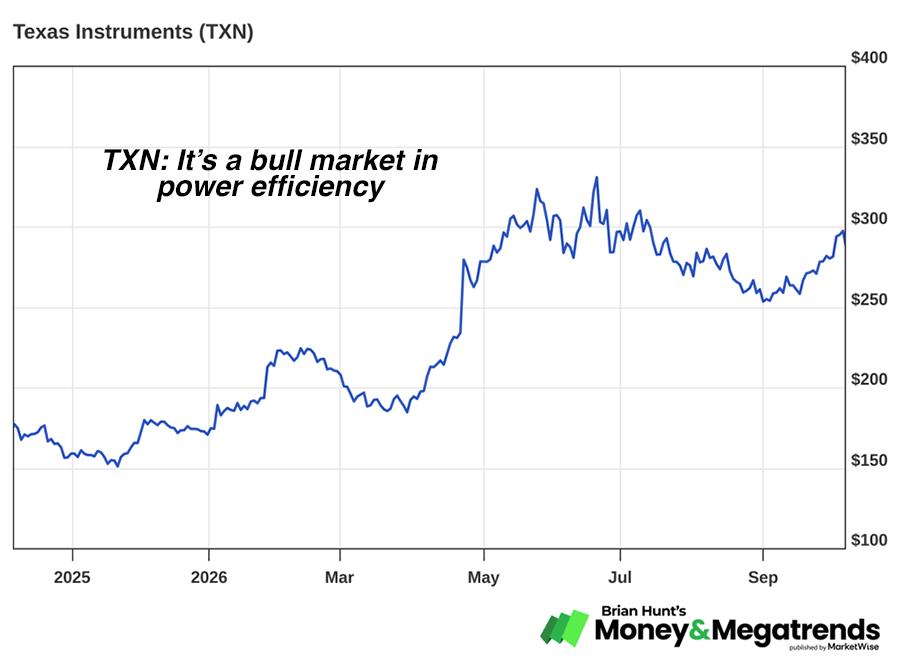
Texas Instruments (TXN) is a $286 billion semiconductor maker. It specializes in analog chips and embedded processors. Its products perform essential functions such as managing power, converting real-world signals into digital data, and controlling electronic systems. TI sells tens of thousands of products to roughly 100,000 customers, with particularly strong exposure to industrial and automotive markets.

TI chips do not need huge amounts of computing power or electricity, which makes them perfect for edge devices like sensors, motors, and smart appliances

Onsemi (formerly ON Semiconductor) (ON) is a $32 billion semiconductor maker specializing in power-management and sensing chips, with a strong focus on automotive and industrial markets. Its chips help efficiently control and convert electricity in products such as electric vehicles, EV chargers, solar systems, industrial equipment, and data centers

Navitas Semiconductor (NVTS) is a $3.3 billion company at a much earlier stage than ON and TXN. The US government recently selected it to develop next-generation 10kV silicon carbide power chips, which are power chips designed to handle 10,000 volts, or ten times more than what most chips can handle.

Electricity is converted several times between the grid and the AI chip, and each step wastes energy as heat… so chips that can handle higher voltages could eliminate steps and make the whole process more efficient. NVTS is not yet profitable, though, and the current valuation is around 45x next year’s sales, which is very rich. This makes NVTS a higher risk bet. But with revenue forecast to hit approximately $500 million by 2030, there is a large potential upside here.

We are in the early innings of the Agent Supernova. As it develops, the pressure to wring more “intelligence per unit of power” will be enormous. The companies above stand to benefit.
Image

Recommended Link:

Major Buy Alert Issued for October 31st

Ad Image

Keith Kaplan’s firm has invested $17 million into their own AI research and tools. He’s built a platform that 180,000 people worldwide use in the stock market. Now he says there’s a handful of stocks you need to buy before October 31st, to set yourself up for 1,000% potential returns in the near future. Here are the stocks you need to buy for the chance to profit.

Demand for AI compute is exploding. That’s bullish for this stock
Image

Credit: Oselote

Over the past month, we have published a special series of research notes analyzing the health of the AI infrastructure trend… a trend that is so large and so pervasive that the health of the U.S. economy now depends on it.

Thus, we’ve called the AI infrastructure “the world’s most important trend.”

The status of this critical trend has become one of the great sagas of the business and investment world… a source of intense disagreement among industry bulls and bears. It’s a trend whose outcome could have large effects on your portfolio.

Given AI’s enormous promise, large tech firms such as Alphabet (GOOG), Amazon (AMZN), and Microsoft (MSFT) have invested over $1 trillion in AI infrastructure. They are on pace to invest over $700 billion this year alone and more than $3 trillion after that.

Both the scale and the velocity of this investment boom are unprecedented. It is the largest collective investment effort in history.

Big Tech’s historic investment boom has made the entire “AI infrastructure” trend responsible for a large share of America’s GDP growth and stock market returns over the past two years. It has also drawn the skeptical scrutiny of many widely followed investment analysts who claim the trend is a bubble… one that will soon explode and cause tremendous damage to stock prices and the global economy.

If this hugely consequential trend isn’t the most important trend in the stock market, then it is certainly in the top three.

As we’ve detailed many times over the past month, the market is moving in favor of the supporters.

Key AI infrastructure stocks Nvidia (NVDA), Taiwan Semiconductor (TSM), and Lumentum (LITE) are reaching new highs. Plus, the “hyperscalers” such as Amazon (AMZN) and Microsoft (MSFT) are doing so well that the Roundhill Magnificent 7 ETF (MAGS) recently reached an all-time high.

If the market continues to favor the bull side of AI infrastructure, we once again remind you that “neocloud” stocks such as Nebius (NBIS) are almost certain to benefit.

Neocloud businesses own and operate AI data centers. Traditional cloud providers (AWS, Azure, Google Cloud) are generalist platforms built to serve every computing need. Neoclouds are purpose-built to serve AI companies with enormous computing needs.

Big customers like Meta use neocloud data centers so they can train and operate bleeding-edge AI models. Neocloud businesses handle all the logistics of securing, building, and operating AI data centers so AI model builders can focus on building models. In industry speak, neoclouds provide “compute” to big tech.

The neocloud stock group contains players such as Nebius, CoreWeave (CRWV), IREN (IREN), and Applied Digital (APLD). In this group, Nebius almost always gets the highest marks from industry analysts.

Nebius Group is a fast-growing “neocloud” firm. Its biggest customers include Microsoft and Meta. Microsoft signed a five-year agreement with Nebius worth about $17.4 billion, potentially rising to $19.4 billion

This year, Meta expanded its relationship with Nebius, committing $12 billion for compute capacity plus potentially another $15 billion of capacity – a deal worth up to $27 billion.

NVIDIA also invested $2 billion in Nebius and formed a strategic partnership supporting the deployment of more than 5 gigawatts of NVIDIA systems by 2030.

These huge commitments provide Nebius with strong visibility into future demand and help finance its data center expansion. They also help Wall Street forecast extraordinary growth into 2030, with revenue potentially rising over 10X to $23 billion in 2028.

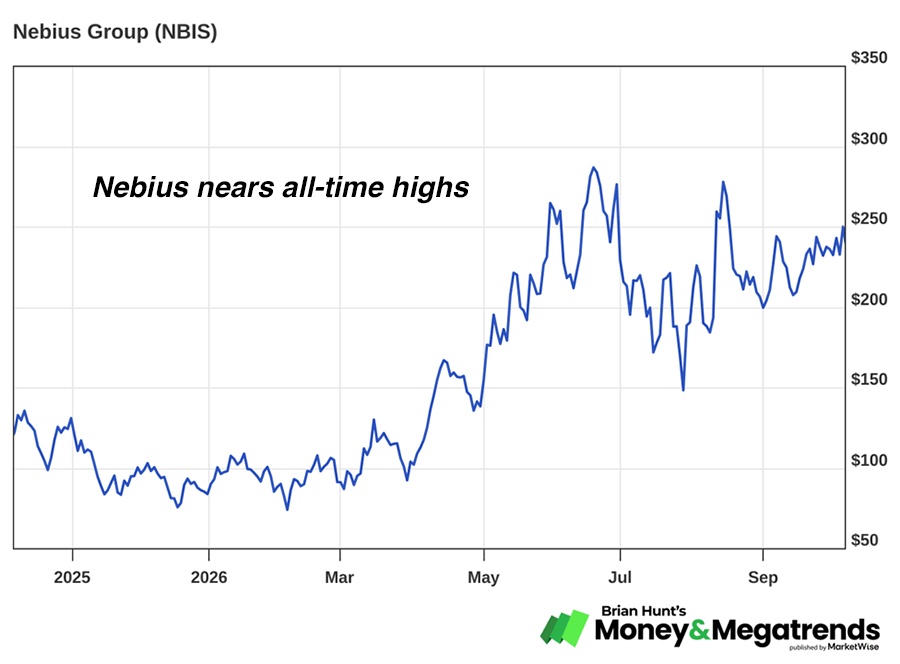
Like virtually every component of the AI infrastructure trend, Nebius enjoyed a big spring rally followed by a summer correction. As you can see in the one-year chart below, the stock has recovered from its lows and is closing in on its all-time high. The bull market in neoclouds appears set to continue.
Image


You don’t own enough of this bull market that has YEARS to run

Image

Credit: Andy

Over the past month, the investment world has been fixated on rising interest rates, the Iran War, and the AI infrastructure trade.

Given all this, it’s been easy to forget that our “Boomer healthcare” megatrend is alive and well, healthcare stocks are in a bull market, and this industry is full of investment opportunities.

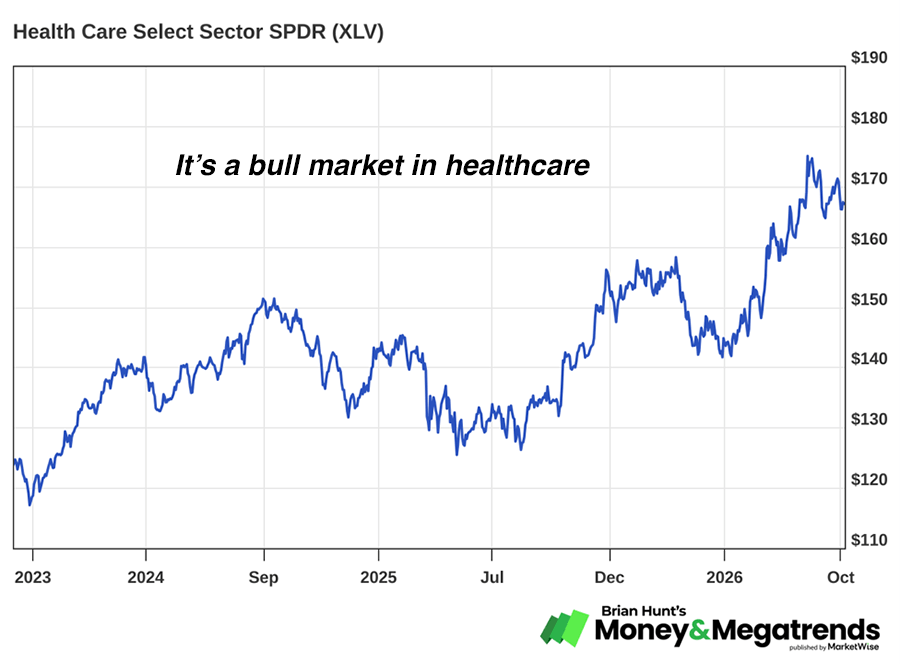
As evidence, we point to the world’s largest healthcare stock ETF – the State Street Health Care Select Sector SPDR (XLV) – which is up 38% over the past three years, 19% over the past 12 months, and trading near its all-time high.

XLV owns a “who’s who” of big-time healthcare firms. It holds a diversified basket of drugmakers (Merck, Eli Lily), healthcare tools and services firms (Thermo Fisher, Danaher), medical device firms (Intuitive Surgical, Medtronic), and other assorted components of the healthcare industry.

Constant readers of Money & Megatrends are not surprised to hear such firms are doing well and reaching new highs.

For more than three years, I’ve made “Boomer healthcare” one of my highest conviction long-term investment themes. We don’t know of another investment research publication that has written more bullishly, more often about this booming industry than we have.

Over the past year, we have published more than two dozen pieces on opportunities in drug development, biotechnology, senior living facilities, genomics, cardiology, diagnostics, and more.

Our bullish stance has produced a parade of home runs, with the healthcare industry dominating the stock market’s new highs list over the past year.

Healthcare stocks are generating extraordinary returns because they are benefiting from several megatrends simultaneously…

One is a demographic tsunami. More than 10,000 Americans reach retirement age every day. The U.S. population aged 80 and older is projected to roughly double, from 14.7 million in 2025 to 29.4 million by 2045.

This is the enormous Baby Boom generation entering the phase of life where health care and longevity spending skyrocket. For many boomers, a typical month involves going to see at least one doctor to have something looked at, removed, or treated.

This means many health care businesses are experiencing huge demand now – and will for at least the next decade.

Two is exponential technological progress. Thanks to major advances in genomic sequencing, AI-powered analytics, imaging technology, and preventive treatments, healthcare is becoming much better and more personalized. This is driving strong demand for all kinds of new tests, tools, and treatments.

After all, when a useful and important service you buy gets much better, you typically buy more of it.

This means many healthcare businesses are experiencing huge demand now – and will for at least the next decade. It means boom times ahead for many “ology” businesses, stocks, and careers. Dermatology. Cardiology. Radiology. Oncology. Anesthesiology. Ophthalmology. The list goes on.

Investing in many healthcare businesses over the next decade will be investing with a gale-force tailwind at your back. If you’re a parent and worried about your child getting a job, just point them to the booming healthcare industry.

That’s my bull case. But I care a lot more about what the market thinks of a bull case, a bear case, or any other case than what any one person thinks of it (including me).

You can read a thousand opinions and forecasts related to virtually any industry or asset class. However, there’s only one source of objective truth: Market prices.

Today’s market prices are the sum and current manifestation of all knowledge held by industry insiders, connected investors, government officials, and bankers who quietly control huge swaths of the economy. These people know 50 times as much about their industries of focus as you or I do.

Their knowledge manifests itself through action… and that action that sets market prices. Market prices are not always perfect, but most of the time, they know hell of a lot more than any economist, podcaster, X poster, or investment guru.

As you can see in the three-year chart of XLV below, the people who know… the people who see real-time, proprietary insider data related to new orders, new innovations, new customers, backlogs, returns on invested capital, and free cash flows are enthusiastically supporting the key businesses operating inside the healthcare megatrend. Still bullish!
Image


Market Notes

  • Air taxi leader Joby Aviation (JOBY) just hit a new yearly low. It’s now down 70% over the last year.

  • Our June 8th recommendation to invest in Eli Lilly (LLY) is performing well. The stock trades up 2% today in a weak broad market.

  • The Iran War and its constriction of oil and refined products continues to benefit big U.S. oil refiners. Valero Energy (VLO) and Marathon Petroleum (MPC) reached one-year highs today.

  • Data storage and infrastructure leader Hewlett Packard Enterprise (HPE) just hit a new high. It’s now up 30% over the last month.

  • The bear market in U.S. housing-related stocks continues: Pool supply giant Pool Corp (POOL) reached a new one-year low today. Home appliance giant Whirlpool (WHR) reached a new one-year low. Landscaping supply giant SiteOne (SITE) reached a new one-year low. Mortgage giant Rocket Companies (RKT) reached a one-year low.

Regards,

Brian Hunt signature

Brian Hunt signature

Brian Hunt
Editor, Money & Megatrends


An urgent message from our colleagues:

Wall Street Legend: “I’ve discovered a fatal flaw built into Elon’s AI model”

Image

60-year Wall Street legend Marc Chaikin has discovered a fatal flaw built into Elon’s AI model and every AI frontier model on earth… and says the race to fix it could send one obscure stock soaring. Right now, behind a high-security fence in rural Tennessee, the U.S. government is quickly working to solve it by building a new form of AI – what Marc calls “Sovereign AI.” He believes it could trigger a $248 trillion boom, 56x bigger than today’s AI market.

Click here for the full story and get the name and ticker of Marc’s No. 1 stock to buy now, 100% free.

The post This ignored corner of the semiconductor market could be a huge AI winner appeared first on MarketWise.

  • ✇Market Wise
  • One of our top energy recommendations keeps producing winners day after day. Are you benefiting? Brian Hunt
    Today’s issue in preview: One of our top energy recommendations keeps producing winners day after day. Are you benefiting? This business megatrend is creating dozens of big winners… and will for years to come. How to trade the stock market’s most important trend from here Learn our Top Themes to buy now One of our top energy recommendations keeps producing winners day after day. Are you benefiting? Credit: sefa ozel This week, the bull case we’ve been making for oil stocks got a lot
     

One of our top energy recommendations keeps producing winners day after day. Are you benefiting?

3 September 2026 at 12:00

Today’s issue in preview:

  • One of our top energy recommendations keeps producing winners day after day. Are you benefiting?

  • This business megatrend is creating dozens of big winners… and will for years to come.

  • How to trade the stock market’s most important trend from here

  • Learn our Top Themes to buy now


One of our top energy recommendations keeps producing winners day after day. Are you benefiting?

Image

Credit: sefa ozel

This week, the bull case we’ve been making for oil stocks got a lot stronger.

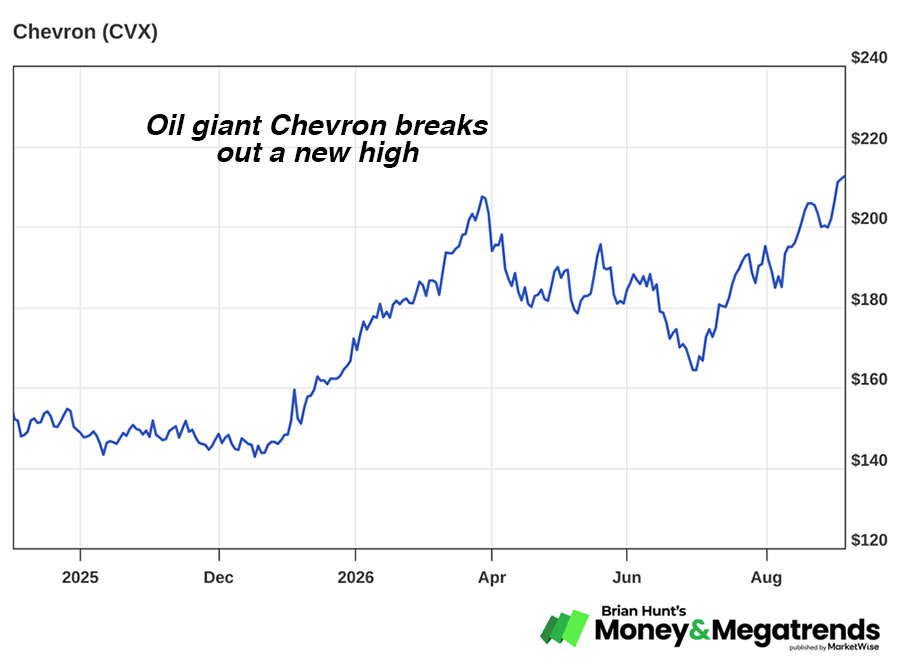
The boost came in the form of new all-time highs for oil giant Chevron (CVX), Canadian oil giant Cenovus (CVE), Canadian oil giant Canadian Natural Resources (CNQ), oilfield services firm Tidewater (TDW), oilfield services firm NOV (NOV), oil drilling firm Patterson-UTI (PTEN), U.S. oil producer SM Energy (SM), and the SPDR S&P Oil & Gas Exploration & Production ETF (XOP).

These new highs make the oil and gas sector one of the market’s leading trends.

Last September, I made the case for going long the emerging uptrend in oil and gas stocks: As the global economy grows, oil demand will remain solid. However, importantly, U.S. shale oil production growth appears to be peaking.

Flatlining supply from this region would remove a critical and reliable source of production growth that has been in place for more than a decade. Plus, oil was very cheap relative to gold and other assets, indicating good value.

With all that in mind, we’ve written frequently and bullishly about owning Canadian oil giant Suncor (SU),ExxonMobil (XOM), and oilfield service stocks like those in the SPDR S&P Oil & Gas Equipment & Services ETF (XES).

Both SU and XOM are up more than 44% since our September call. XES is up 69%.

When I recommended oil and started trading it from the long side, I did not factor in the potential bullish driver of the Iran War. That’s been a “bonus” driver of gains in oil stocks. Sometimes, the dice rolls in your favor.

Although positive news related to the Iran War could emerge at any time and trigger a short-term correction in oil and oil stocks, the long-term picture remains bullish. I see three reasons why this is the case.

One: Critical oil infrastructure in the Middle East has been damaged. Oil flows will not return to pre-war levels for possibly over a year. This supports oil prices north of $80 per barrel, which supports large cash flows for oil and gas firms.

Two: Most countries maintain substantial above-ground “buffer” supplies of oil and refined petroleum products in the event of market disruptions such as the Iran War. Over the past five months, much of these buffer supplies have been depleted to compensate for the loss of Middle Eastern flows. They must be replenished.

The coming restocking of buffer supplies will support oil prices north of $80 per barrel… which, again, supports large cash flows for oil and gas firms.

Three: Although oil stocks have enjoyed a large run since our September call, they aren’t up much over the past ten years. Adjusted for dollar debasement over the past decade, key oil and gas ETFs are down significantly. This is not an aging bull market that has attracted too many fans and too much capital. It is the opposite of that.

Avid Money & Megatrends readers know that I like to know both the bull and bear cases for any trend… but I care a lot more about what the market thinks of those cases than anything else. You can be bullish on an industry or theme all you like, but if the market is going against you, then your bullish thesis isn’t worth much.

As for the bull case for oil stocks, the market is enthusiastically supporting it. Our guidance remains: Stay long oil stocks.

Image

Recommended Link:

Small Colorado Company (Backed by Sam Altman) Could Save U.S. Power Grid

Ad Image

A small Colorado company now owns rights to a tech that could save the entire public power grid from collapse. And billionaire Sam Altman is now an investor. Click here to learn this company’s name for free.

This business megatrend is creating dozens of big winners… and will for years to come.

Image

Credit: Jezperklauzen

This week, shares of Replimune (REPL), Vir Biotechnology (VIR), Exelixis (EXEL), and RenovoRx (RNXT) all reached new one-year highs.

This means it’s a bull market in oncology stocks.

The companies above aren’t household names, but they are all significant players in the cancer treatment business. Their new highs indicate the Boomer healthcare megatrend is alive and well. It’s a megatrend generating new stock market winners virtually every week.

For more than three years, I’ve made “Boomer healthcare” one of my highest conviction long-term investment themes. This means I’ve been bullish on biotech, genomics, and healthcare in general. In more than 20 Money & Megatrends research notes over the past year, we’ve been very bullish on stocks and ETFs related to this trend.

Regular readers are familiar with the bull case here. More than 10,000 Americans reach retirement age every day. The U.S. population aged 80 and older is projected to roughly double, from 14.7 million in 2025 to 29.4 million by 2045.

This is the enormous Baby Boom generation entering the phase of life where healthcare and longevity spending skyrocket. For many boomers, a typical month involves going to see at least one doctor to have something looked at, removed, or treated.

This means many health care businesses are experiencing huge demand now – and will for at least the next decade. It means boom times ahead for many “ology” businesses, stocks, and careers. Dermatology. Cardiology. Radiology. Oncology. Anesthesiology. Ophthalmology. The list goes on.

Investing in many healthcare businesses over the next decade will be investing with a gale-force tailwind at your back. If you’re a parent and worried about your child getting a job, just point them to the booming healthcare industry.

Unfortunately, an aging Baby Boomer population means more cancer cases the U.S. healthcare system must treat each year. Just over 2 million Americans are expected to be diagnosed with cancer in 2026. In 2020, the comparable estimate was about 1.81 million new cases.

Age is the single most important risk factor for cancer overall. Cancer incidence is roughly 350 cases per 100,000 people at ages 45–49, but rises to more than 1,000 per 100,000 among people aged 60+.

The median age at cancer diagnosis is 67, which is where much of the Baby Boom generation is now concentrated.

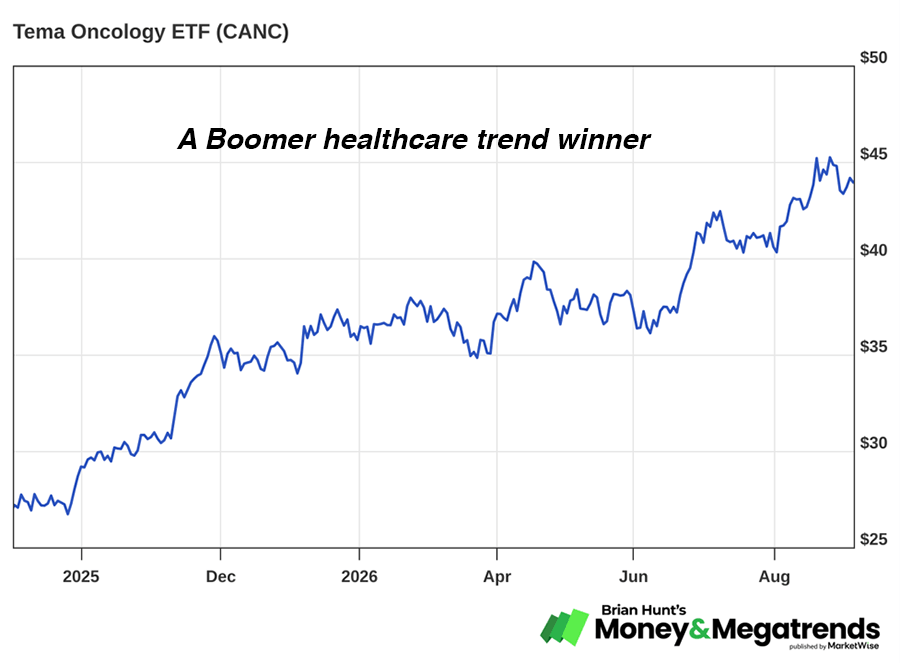
More cancer cases mean more spending on cancer diagnostics and treatments… which means strong tailwinds for the companies mentioned above and the oncology-focused Tema Oncology ETF (CANC). This unique ETF is up 61% over the past year. It’s yet another profitable facet of the Boomer healthcare megatrend.

Image


How to trade the stock market’s most important trend from here

Image

Credit: Petrovich9

Has the bull market in AI infrastructure turned into a dangerous bubble that will soon pop and wreak havoc on the economy?

Or is this bull market taking a healthy break… and poised to resume its tremendous production of stock market winners?

This is one of the biggest, most consequential issues in all of business and investment right now.

The status of this critical trend has become one of the great sagas of the business and investment world… a source of intense disagreement among industry bulls and bears. It’s a trend whose outcome could have large effects on your portfolio.

Given AI’s enormous promise, large tech firms such as Alphabet (GOOG), Amazon (AMZN), and Microsoft (MSFT) have invested over $1 trillion in AI infrastructure. They are on pace to invest over $700 billion this year alone and more than $3 trillion after that.

Both the scale and the velocity of this investment boom are unprecedented. It is the largest collective investment effort in history.

Big Tech’s historic investment boom has made the entire “AI infrastructure” trend responsible for a large share of America’s GDP growth and stock market returns over the past two years. It has also drawn the skeptical scrutiny of many widely followed investment analysts who claim the trend is a bubble… one that will soon explode and cause tremendous damage to stock prices and the global economy.

If this hugely consequential trend isn’t the most important trend in the stock market, then it is certainly in the top three.

I believe the AI infrastructure trend has years to run. I believe the world’s smartest, most connected tech CEOs who have the greatest access to information on AI advancement and return on AI infrastructure spend like Elon Musk, Jensen Huang (Nvidia), Satya Nadella (Microsoft) and Andy Jassy (Amazon) just might know more about the AI trend than the bearish armchair quarterbacks know about it.

As much press as AI gets, let’s remember that less than 1% of the global population pays for top-tier AI programs. And I estimate less than 20% of large companies believe AI has made a meaningful impact on their businesses. It’s probably closer to less than 10%.

This revolutionary technology hasn’t yet proliferated, achieved mass adoption, or had mass impact.

Regular readers know I care a lot more about what the market thinks of any stock, trend or theme than what any one person thinks of it, including me. You can be bullish or bearish on a trend all you like, but if that trend is moving strongly against you, then your idea isn’t worth a hell of a lot in my book.

Over the past six weeks, we have published a special series of research notes analyzing the semiconductor trend, which is a key part of the larger AI infrastructure investment megatrend. We’ve also analyzed the trend of computer memory giant Micron (MU).

But a thorough analysis of any trend as large and diverse as AI infrastructure is a mosaic of facts, figures, and stock price action. The trend in optical networking stocks is a key part of this mosaic.

Optical networking equipment is a critical ingredient of the AI infrastructure boom. This equipment allows data to be transferred quickly and efficiently between parts of AI computing chains. Think of optical networking as a critical part of the “AI data traffic highway system.”

As a result of Big Tech’s enormous AI infrastructure spending, optical network equipment makers Lumentum (LITE) and Coherent (COHR) have enjoyed soaring revenues, and their stocks are among the market’s biggest winners over the past two years.

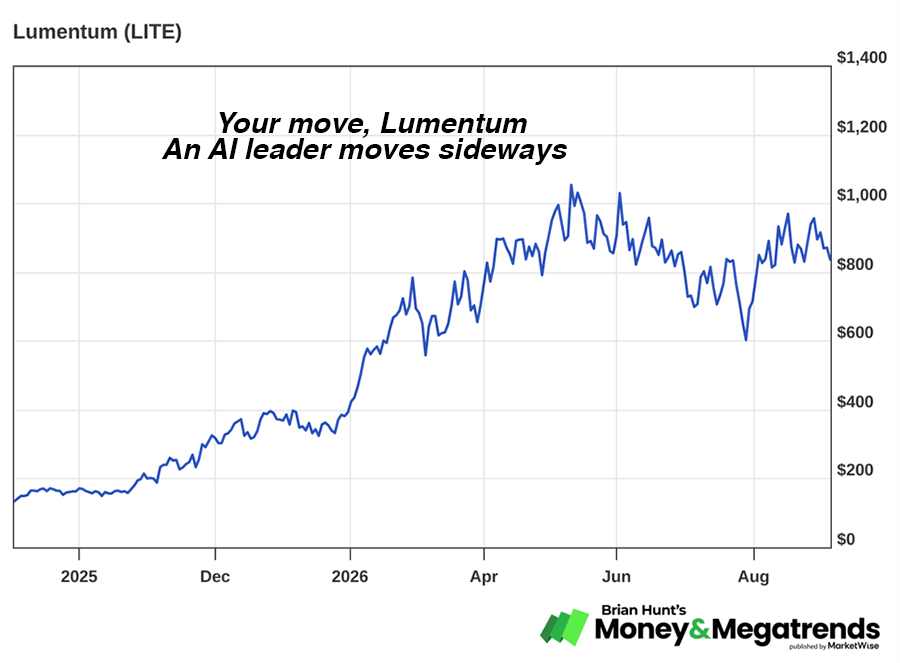
Since reaching a high in June, Lumentum’s stock has moved in line with the semiconductor sector, which we’ve been tracking closely.

As you can see in the one-year chart below, Lumentum is trading within a directionless sideways consolidation. It, like the VanEck Semiconductor ETF (SMH), is like a “becalmed” sailboat on a windless sea. The trends of other important parts of the AI infrastructure trade – electric power component makers, neoclouds, and data center cooling firms – look much the same.

This entire, hugely consequential trend continues to move sideways.

I’ll keep you updated on this world’s most important trend. It won’t be long before we get meaningful price action that provides direction for trading semis, optical networking, and other key components of AI infrastructure.

Image


Market Notes

  • Our recommendation to own farm machinery giant Deere & Co. (DE) is working well. The stock reached a new all-time high today.

  • Japanese banking giants Mitsubishi UFJ Financial Group (MUFG), Mizuho Financial Group (MFG) and Sumitomo Mitsui Financial (SMFG) hit new highs along with Spanish giant Banco Bilbao (BBVA).

  • The Boomer healthcare theme we recommended continues to do well. Pharma giant Pfizer (PFE) , along with Vertex Pharmaceuticals (VRTX), Biogen (BIIB) , and Regeneron Pharmaceuticals (REGN), reached new one-year highs today.

  • Our September 2025 recommendation to get long the oil and gas uptrend continues to pay off. The State Street Energy Select Sector SPDR ETF (XLE) hit a new high today. Individual plays ConocoPhillips (COP) and Canadian Natural Resources (CNQ) also reached new highs today.

  • Our January 28th recommendation to own the AI application layer is paying off. Zeta Global Holdings (ZETA) just hit a new yearly high, which means it’s now up 56% since our initial recommendation.

Regards,

Brian Hunt signature

Brian Hunt signature

Brian Hunt
Editor, Money & Megatrends


An urgent message from our colleagues:

Elon Musk Just Did Something He’s Never Done Before

Image

This February, Elon spent millions to send a message to 125 million Americans. Most people ignored it. But Wall Street veteran Whitney Tilson couldn’t stop thinking about it, and says what Elon was really saying explains everything about what’s unfolding in America’s economy right now.

He’s sharing his full analysis, free, here.

The post One of our top energy recommendations keeps producing winners day after day. Are you benefiting? appeared first on MarketWise.
3 ripple effects of the Iran conflict that the market is missing

1 September 2026 at 22:00

The Iran conflict is doing more than pushing oil higher. It's sending ripples through key economic drivers. Here are three under-the-radar trends already taking shape… and what they mean for investors.

The post 3 ripple effects of the Iran conflict that the market is missing appeared first on Curzio Research.

  • ✇Market Wise
  • How to trade the world’s most important trend Brian Hunt
    Today’s issue in preview: How to trade the world’s most important trend This chart shows why you should be bullish and buy stocks Why you should be bullish on Bitcoin right now Learn our Top Themes to buy now How to trade the world’s most important trend Credit: KanawatTH The world’s most important trend just got a big boost from Nvidia (NVDA). Last night, the world’s largest semiconductor firm reported extraordinary second-quarter results that came in well ahead of estimates. Nvidia
     

How to trade the world’s most important trend

27 August 2026 at 12:00

Today’s issue in preview:

  • How to trade the world’s most important trend

  • This chart shows why you should be bullish and buy stocks

  • Why you should be bullish on Bitcoin right now

  • Learn our Top Themes to buy now


How to trade the world’s most important trend

Image

Credit: KanawatTH

The world’s most important trend just got a big boost from Nvidia (NVDA).

Last night, the world’s largest semiconductor firm reported extraordinary second-quarter results that came in well ahead of estimates.

Nvidia CFO Colette Kress said that the company expects revenue growth of 70% for fiscal 2028, which goes from February 2027 to January 2028. CEO Jensen Huang said demand “is much greater than 70%,” but Nvidia is constrained on how much product it can supply.

In response to this good news, Nvidia shares climbed 7.5% during the morning trading session. It also sent the VanEck Semiconductor ETF (SMH) up 2.17%.

Over the past month, we have published a special series of research notes analyzing the semiconductor trend, a key part of “the world’s most important trade.”

The status of this critical tech sector has become one of the great sagas of the business and investment world… a source of intense disagreement among industry bulls and bears.

The semiconductor industry has always been a critical part of our high-tech economy. Semiconductors are the “tiny engines” that power our computers. However, the proliferation of AI has turbocharged the industry’s revenues, stock prices, and importance to the global economy. It has also made industry leader Nvidia a $5+ trillion colossus. The stock is up more than 1,300% since Jan. 1, 2023.

In June 2025, semiconductor stocks broke out of a sideways consolidation pattern and began a rally for the ages. During this rally, the world’s largest semiconductor ETF – SMH – gained 147% in just under a year.

Individual semiconductor leaders AMD (AMD), Marvell Technology (MRVL), and Lattice Semiconductor (LSCC) gained more than 200% during that time. Stock gains of 25% in a month became commonplace.

When a sector gains 50% in a year, that’s considered incredible. What semis returned was “triple incredible.”

Avid Money & Megatrends readers know what drove those giant returns. Given AI’s enormous promise, large tech firms such as Alphabet (GOOG), Amazon (AMZN), and Microsoft (MSFT) have invested over $1 trillion in AI infrastructure. They are on pace to invest over $700 billion this year alone and more than $3 trillion after that.

Both the scale and the velocity of this investment boom are unprecedented. It is the largest collective investment effort in history.

A lot of this money was used to purchase semiconductors. Semiconductor industry revenue totaled $793 billion in 2025, an increase of 21% year-over-year, according to Gartner, Inc.

Big Tech’s historic investment boom has made the entire “AI infrastructure” trend responsible for a large share of America’s GDP growth and stock market returns over the past two years. It has also drawn the skeptical scrutiny of many widely followed investment analysts who claim the trend is a bubble… one that will soon explode and cause tremendous damage to stock prices and the global economy.

I believe the AI infrastructure trend has years to run. I believe the world’s smartest, most connected tech CEOs who have the greatest access to information on AI advancement and return on AI infrastructure spend like Jensen Huang, Satya Nadella (Microsoft) and Andy Jassy (Amazon) just might know more about this business than the bearish armchair AI quarterbacks know.

As much press as AI gets, let’s remember that less than 1% of the global population pays for top-tier AI programs. And I estimate less than 20% of large companies believe AI has made a meaningful impact on their businesses. It’s probably closer to less than 10%.

This revolutionary technology hasn’t yet proliferated, achieved mass adoption, or had mass impact.

Regular readers know I care a lot more about what the market thinks of any stock, trend or theme than what any one person thinks of it, including me. You can be bullish or bearish on a trend all you like, but if that trend is moving strongly against you, then your idea isn’t worth a hell of a lot in my book.

With this in mind, let’s look at industry giant Nvidia’s effect on the state of semis. The semiconductor sector is our preferred way to track and analyze the hugely consequential AI infrastructure megatrend.

Given its AI drivers and big returns, it’s no wonder semis became the world’s “hottest trade” this summer. And when any theme becomes the world’s hottest trade, it becomes a leading candidate to experience a significant correction or something worse.

That’s just how the stock market works. When a bull market grows very popular and attracts a lot of speculation, it likes to “buck off” market participants with a sharp correction or worse.

That’s what has happened to the semiconductor trade this summer. After soaring from June 2025 to June 2026, SMH declined 24%. Some individual semi names declined by more than 35%.

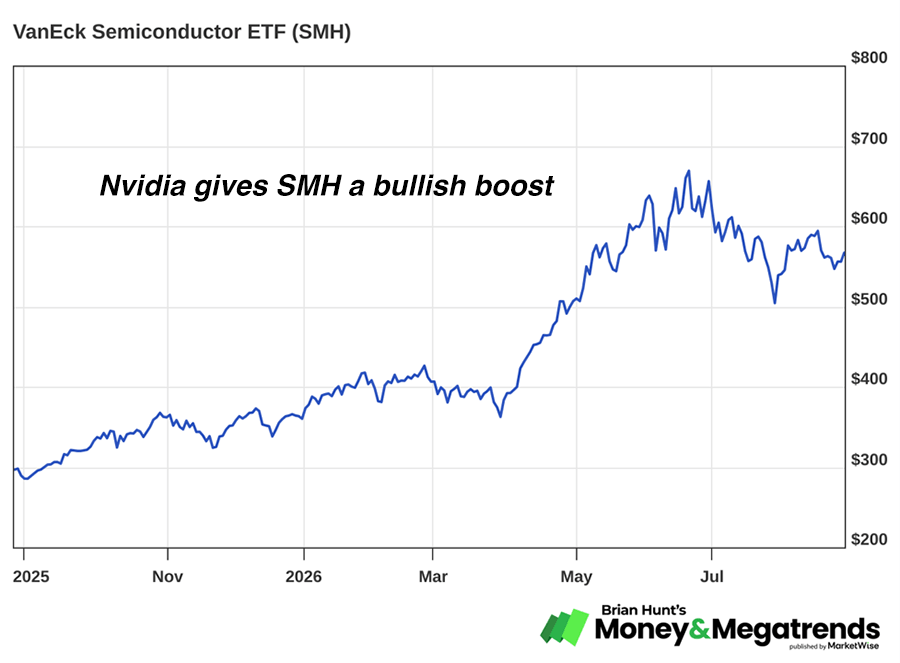
As you can see in the two-year chart below, the SMH share price declined from the mid-$600s to the mid-$500s. Since reaching a low in late July, SMH has traded up and down, failing to establish a meaningful trend. In other words, “becalmed” as described above.

In my July 20 health analysis of SMH, I stated that if long-term AI bulls are proven right by the market, SMH will likely “digest” its summer losses by trading in a sideways consolidation pattern for 3-6 months… and then recover to trade back to the mid-$600 area and beyond.

If the AI bears are right, SMH won’t see that mid-$600-per-share level for years… and we are much better off focusing on other trends.

As you can see in the chart below, SMH is getting a boost today… but it is still trading in a directionless sideways consolidation pattern. If the current rally can take SMH back to the $620 level, we can say this critical trend is enjoying restored health. We will keep you updated.

Image

Recommended Link:

Tonight, Louis Navellier Closes the Doors

Ad Image

Until midnight, you can claim a full year of Louis Navellier’s brand-new research… the project that ended his 47-year run as Chief Quant Analyst… at 60% off. It’s a totally new approach to the AI boom, built with Eric Fry and Luke Lango – one the team believes could realistically double your entire portfolio in the years ahead. Doors close at midnight. Until then, click here for the full details.

This chart shows why you should be bullish and buy stocks

Image

Credit: Art Wager

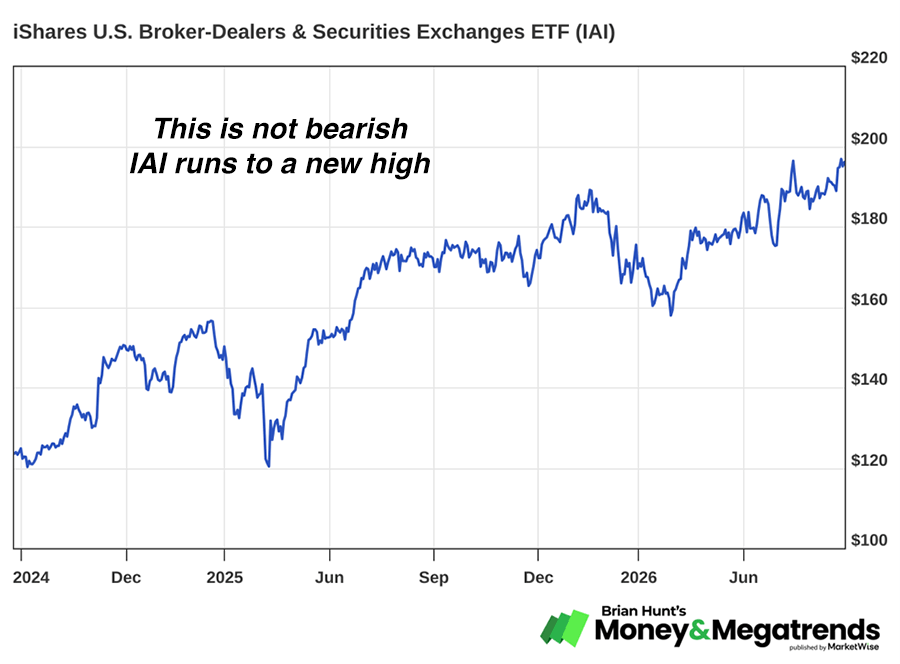
If you’re looking for reasons to be optimistic on the U.S. economy and U.S. stocks, look no further: The iShares U.S. Broker-Dealer & Securities Exchanges ETF (IAI) recently registered a new all-time high.

This is a bullish signal for America… and for your 401(k).

Since the current bull market began in 2023, a whole doom-and-gloom industry has been built on bearish stock and recession forecasts. Anyone who listened to the “prophets of the apocalypse” and avoided stocks has missed a historic wave of wealth creation. The bears have sounded clever, but they’ve been very, very wrong.

Sure, the U.S. economy has imbalances and problems. But it also has tremendous forces working in favor of prosperity. Energy independence. Food independence. The world’s most dynamic system for creating and funding new businesses. The world’s largest and most innovative technology industry. A system that rewards hard work, risk-taking, and value creation.

These “forces for good” are manifesting themselves in IAI’s all-time highs.

IAI is a unique ETF focused on companies in the business of money flows… companies that function as the business and investment world’s “circulatory system.”

The fund includes investment banks, securities exchanges, stock brokerages, financial index providers, and credit rating agencies.

Major holdings include diversified giant Goldman Sachs (GS), fellow giant Morgan Stanley (MS), brokerage firm Charles Schwab (SCHW), brokerage firm Robinhood (HOOD), credit rating agency Moody’s (MCO), and financial exchange giant CME Group (CME, formerly Chicago Mercantile Exchange).

These firms provide the grease and gears that make the world’s financial markets engine go. They eventually get a substantial “cut” from all kinds of financial activities, such as IPOs, 401(k) management, option trades, stock index administration, ETF management, stock purchases, commodity transactions, wealth management, debt issuance, and credit ratings.

Their fortunes rise and fall with the health of global financial markets. The new highs reached by their ETF are a bullish economic signal. The fund has returned a stellar 57% over the past two years.

Over the past 10 months, I’ve written over a dozen research notes analyzing the soaring share prices of highly economically sensitive industry groups, including trucking stocks, regional banks, manufacturing stocks, diesel engine makers, steelmakers, shopping mall operators, and hotel chains.

At the end of each note, I pointed to their soaring stock prices and told readers that the U.S. economy is doing much better than most people think.

This exceptional price strength in key components of America’s economic machine means the economy is doing much better than the news you hear from the mainstream media.

We can add IAI’s new highs to this long list of positive market trends. The business of money, investment, and corporate finance is booming. Manage your financial affairs accordingly!

Image


Why you should be bullish on Bitcoin right now

Image

Credit: Vertigo3d

Minute by minute… day by day… things keep getting a little better for Bitcoin bulls.

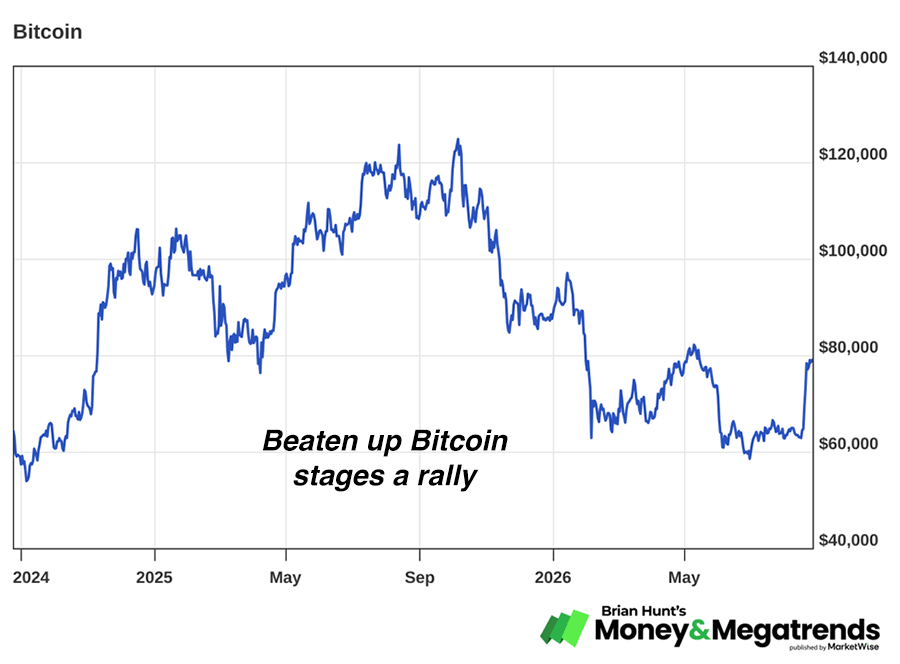
This week, the beaten-up cryptocurrency rallied to reach $80,000 – its highest price in three months. This action gives me confidence in saying that our bullish March 13 note was well-timed.

After reaching an all-time high of around $125,000 last October, Bitcoin entered a brutal bear market, declining by about 48% to the mid-$60,000 range.

Crypto specialists attributed this decline to the U.S. government withdrawing liquidity from financial markets, as well as to gold and AI trades drawing money flows that could have been directed toward Bitcoin.

Most long-term Bitcoin believers see it as a “store of value” that should maintain its purchasing power like gold and beachfront homes do. It should be a digital form of “hard money.” Sounds great.

However, from October 2025 to February 2026, Bitcoin traded more like a failing technology company than anything you’d call strong and stable.

In March, Bitcoin’s trading behavior underwent a significant change. It formed a bottom and gained 9.5% in one month, while technology stocks dropped and gold gained just 3.2%. Importantly, Bitcoin outperformed stocks and gold as Operation Epic Fury created tremendous market volatility and hammered many sectors of the stock market. It was a “port in the storm.”

Importantly, Bitcoin recently rallied above its long-term 200-day moving average. This is a good sign of an improving health trend. Remember what we say about the 200-day moving average around here: Securities below their 200-day moving average are on the wrong side of the tracks. It’s the ugly part of town. All the really bad things happen below the 200-day moving average. Bitcoin just broke about it.

So, after a year of disappointing believers, has Bitcoin regained its place as a “store of value”? Is it ready to be a “port in the storm” and a stabilizing component of serious portfolios? I hope so. The world is a better place when Bitcoin is rising, and we have not one but two forms of hard money to own. Plus, I like it when the “crypto bros” get chirpy on X and antagonize the skeptics.

Count me bullish on Bitcoin and its new rally.

Image


Market Notes

  • Our recommendation to invest in cybersecurity is paying off nicely. Okta (OKTA) just reached a new yearly high, and Palo Alto Networks (PANW) is up 10% today. PANW is now +150% since our March recommendation.

  • Our recommendation to invest in the genomics megatrend continues to pay off. Cancer genomics leader NeoGenomics (NEO) just hit a new high. It’s now up 166% in the last month. Genomics analytics giant Illumina (ILMN) reached a new one-year high.

  • Global and community banks are showing strength. Japanese investment banking giant Nomura Holdings (NMR) and community lender Private Bancorp of America (PBAM) reached new highs today.

  • Our Oct. 2, 2025, recommendation to own the natural gas theme is doing very well. The US Natural Gas Fund (UNG) just hit a new high, as individual names like Range Resources (RRC) have gained around 7.5% this month.

Regards,

Brian Hunt signature

Brian Hunt signature

Brian Hunt
Editor, Money & Megatrends


An urgent message from our colleagues:

Wall Street veteran goes ALL in on Bank of Elon

Image

A 20-year Wall Street veteran – who worked at a $10 billion hedge fund – is putting ALL his money in Elon Musk’s new bank. He says he can see the writing on the wall for traditional banks. And he’s not the only one.

See if you should join him here (not just for the 6% yield).

The post How to trade the world’s most important trend appeared first on MarketWise.

  • ✇Market Wise
  • Does Intel’s $20 Billion Stock Sale Signal a Buying Opportunity or a Warning Sign? David Engle
    Key Points Intel (INTC) raised $20 billion through an upsized stock offering to fund AI infrastructure, foundry expansion, and other growth initiatives without adding more debt. The offering will dilute existing shareholders, while Intel’s heavy capital spending and negative free cash flow raise questions about how long its AI investment strategy can continue. Intel stock could offer upside if its AI and foundry investments pay off, but the offering also highlights the enormo
     

Does Intel’s $20 Billion Stock Sale Signal a Buying Opportunity or a Warning Sign?

13 August 2026 at 06:55

Key Points

  • Intel (INTC) raised $20 billion through an upsized stock offering to fund AI infrastructure, foundry expansion, and other growth initiatives without adding more debt.
  • The offering will dilute existing shareholders, while Intel’s heavy capital spending and negative free cash flow raise questions about how long its AI investment strategy can continue.
  • Intel stock could offer upside if its AI and foundry investments pay off, but the offering also highlights the enormous costs and risks surrounding the AI infrastructure boom.

Intel (INTC) raised $20 billion from a new stock offering this week, allowing it to turbocharge the company’s AI-infrastructure investments.

Initially, Intel announced in a brief press release on Monday that it aimed to raise $15 billion from the new stock offering. Investors didn’t react very positively to that news.

Between the dilution of existing shares and companies’ uninhibited spending on AI, many investors are skeptical of and, frankly, fatigued by this type of development. Not surprisingly, Intel’s stock, which closed at $101.65 on Friday, August 7, fell during pre-market trading, opening Monday morning at $98.26.

This unexpected announcement also raised some questions.

Why the surprise public stock offering? What does it mean for Intel and its investors? And is this offering a good buying opportunity at a lower stock price, or is it an AI warning sign?

Why Intel Sold $20 Billion of Common Stock

If you guessed artificial intelligence (“AI”), you are correct! What decisions aren’t driven by AI these days? If you haven’t paid much attention to Intel in the past few years, let’s get you caught up.

As I wrote in a May 1 article about Intel’s fast-rising stock, much of Intel’s recent success can be attributed to the revival of Intel Foundry Services.

Here’s an excerpt from that article:

In 2022 and 2023, Intel Foundry Services (“IFS”) earned external foundry revenue of $895 million and $952 million, respectively.

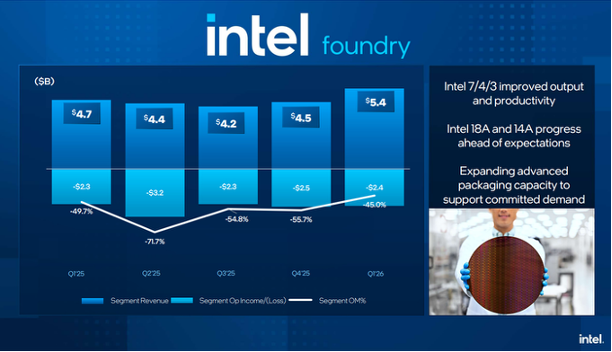
IFS revenue then exploded to $17.5 billion in 2024 and increased to $17.8 billion last year. The pattern continued into 2026’s first quarter, with Intel’s foundry business earning $5.4 billion, a nearly $1 billion jump from the previous quarter.

Intel Foundry

What sparked such a drastic revenue surge?

  • Intel began manufacturing its own products, including the Core Ultra Series 3 and Xeon 6 processors, rather than having them manufactured by Taiwan Semiconductor.
  • The AI data-center boom pushed demand for Intel’s Xeon processors to unprecedented levels.
  • Intel’s application-specific integrated circuit (“ASIC”) custom chip business increased by more than 50% thanks to demand from cloud customers…

And what might be the best

AI demand is obviously still quite strong, so Intel is doubling down on its AI investments.

In its press release, Intel stated that:

Progress in emerging areas including physical AI, purpose-built silicon, advanced packaging and external wafers represent significant growth opportunities for Intel.

Thus, Intel decided to offer the common stock for sale and put the proceeds toward capital expenditures (“capex”), working capital, and growth opportunities. In other words, Intel is looking to grow its AI-infrastructure business significantly. And this offering would greatly expand the available capital Intel needs to do so.

That capital comes without Intel increasing its debt, which is important considering, in July, Intel upped its 2026 capex projection to more than $20 billion.

Other key details of the transaction:

  • The offering’s share price came in at $95, meaning 210,526,315 new shares were made available for purchase.
  • The offering’s underwriters will have a 30-day option (called a “greenshoe”) to purchase up to a total of $2.25 billion in additional shares of common stock at the public offering price, minus underwriting discounts.
  • This would add another 31,578,947 shares of stock to the market, resulting in a total of around 242 million new shares of Intel common stock, based on the $95 share price.
  • Wall Street titans JPMorgan Securities, Goldman Sachs, Morgan Stanley, and Citigroup are serving as joint book-running managers for the offering, reflecting the magnitude of this transaction.

As I mentioned earlier, Intel stock took a hit upon the initial news of the transaction, falling more than 4% on August 10. The reason? Concerns about dilution for existing Intel shareholders… a common worry whenever a company makes this much stock available for public sale.

And it’s a legitimate concern. Issuing $20 billion in new equity will, indeed, dilute Intel’s investors. But the other side of the argument is also valid. Intel stands to gain up to $20 billion in needed capital from the stock sale, giving the company tons of liquidity as it continues to invest in future growth. And it does so without increasing its debt.

The dip in stock price on August 10 may be a blip on the radar, but it’s worth monitoring for investors – especially those who own a sizable stake in the company.

The Federal Government’s 10% Stake in Intel Faces Dilution

About a year ago, the United States government, with the backing of President Donald Trump and his administration, purchased 433.3 million shares of Intel at $20.47 per share. That gave the federal government 9.9% ownership of Intel.

Whether coincidental or not, Intel has since taken off, seeing its stock price increase by nearly five times since the federal government’s investment last August. Intel and its investors – especially the government – have made a lot of money during that span.

Now, with this $20 billion stock offering, the government’s 10% stake is about to shrink. Based on the math used earlier, and the fact that the government did not participate in this sale, that 10% became roughly 9.5%.

Also, as part of the administration’s deal with Intel, the government received a five-year warrant at $20 per share for an additional 5% of Intel common shares, which, according to Intel, is “exercisable only if Intel ceases to own at least 51% of the foundry business.”

Because the August 2025 deal locked in 240.5 million warrants at $20 per share, the growing pool of total outstanding shares automatically dilutes the ownership of those warrants. In other words, the government’s 5% of additional shares from that warrant will also dip closer to 4.64%.

Unfortunately for the government, as a passive minority shareholder, it doesn’t hold any veto or voting power. So, there’s nothing Trump or his Cabinet can do to stop the offering. Ultimately, the government stayed on the sidelines.

On Monday evening, the only official comments from the administration came from White House National Economic Council Director Kevin Hassett, who told CNBC that it’s ultimately up to President Trump when the administration sells its stake – which it does not appear ready to do just yet. So, that’s also something to watch.

What the $20 Billion Offering Means for Intel Investors

We should learn the details of Intel’s stock offering after the sale closes on August 12, as the Wall Street banks running the transaction build an order book. At that point, we should have a better idea of how much Intel’s stock will be impacted.

But you can probably count on an Intel stock slide in the immediate aftermath of the transaction.

Why’s that? Dilution, for one. Then there are discounts. Underwriters often price newly available shares at a small discount (generally 2% to 5%) below the current trading price to entice institutional investors to spend millions or billions on the new shares. Sure enough, Intel’s stock was priced at $95, a discount of 2.6% from its August 10 ​close.

Finally, simple supply and demand negatively impact the stock’s price when millions of new shares are added without an instant surge in buyer demand. But considering Intel’s sale did see a big swing in buyer demand, this shouldn’t be much of a factor.

We don’t have to look back too far for similar examples:

  • In 2020, as Tesla (TSLA) stock was soaring, Musk and company took full advantage of the high price by rolling out multiple multibillion-dollar capital raises. One example was a huge $5 billion “at-the-market” stock offering, which immediately pulled Tesla stock back, resulting in a loss of roughly 4.7% by market close that day.
  • Earlier this year, Oracle (ORCL) announced it was raising nearly $40 billion in capital through mixed debt and equity offerings to bankroll its AI-infrastructure and cloud data-center build-out. The company’s shares plunged more than 12% in after-hours trading as investors lost their collective minds over the amount of money needed to support Oracle’s AI expansion.

But what about long-term impact? This is where things get more complicated. A short-term reaction – or overreaction – is one thing, because it’s typically based on impulsive investor and analyst emotion and sentiment, whether it’s sheer panic or total exuberance.

Long-term impact is generally driven by more rational and strategic thinking. It takes time to analyze and unpack how a company has performed after certain transactions have completed – in Intel’s case, the $20 billion public stock offering.

If you’re considering investing in Intel, you’ll want to see whether this transaction leads to real revenue and profit, whether there’s significant growth and expansion of its foundry facilities to handle demand for its AI hardware, and whether Intel can establish strong cash flow.

During the second quarter of fiscal year 2026, Intel operations generated an impressive $7 billion in cash flow. However, the company’s free cash flow (“FCF”) came in at negative $8.42 billion – compared with last year’s negative $1.1 billion – because of rising capex.

Intel is projecting another year of negative FCF, which would extend its streak to five straight years… the company accumulated a negative FCF of roughly $44 billion between 2022 and 2025, fueled by constant investments in AI and foundry expansions.

Here’s the thing: Intel is probably doing the right thing by increasing its capex to fund its AI infrastructure and meet customer demand. And doing so by diluting its existing shareholders was preferable to growing its debt by the billions, from Intel’s perspective.

The problem is, AI expenditures and financing are simply out of control.

Intel is seemingly doing everything right. Just look at the highlights from its July quarterly earnings report.

  • $16.1 billion total revenue, well above the projected $14.4 billion.
  • Data-center and AI revenue of $6.3 billion, a massive 59% year-over-year gain.
  • Non-generally accepted accounting principles (“GAAP”) earnings per share (“EPS”) of $0.42, doubling expectations.
  • A 40.4% gross margin, up from 27.5% year over year.

By any standard, that’s a highly successful quarter. Until you look at the company’s second-quarter net loss of $11 billion, up from $2.9 billion the year before.

All the positives are being negated by capex that appears to be unsustainable over the long term. And it shows no signs of slowing.

Intel Chief Financial Officer David Zinsner, who had already raised 2026 capex guidance from $18 billion to more than $20 billion, noted that 2027 capex would be “significantly above” that threshold.

So the questions investors must ask themselves are, “Will all of this pay off?” And, “If so, when?”

That’s yet to be determined. In the meantime, investors can take some comfort in knowing Intel is raising capital through equity rather than taking on more debt.

Which begs the question… Does this $20 billion stock offering make Intel a buy, or is this a warning that AI expenditures are simply too overwhelming for the company?

From my view, it’s another ominous warning of the prohibitive costs of financing the AI boom. Sure, the stock offering makes some sense from a bottom-line perspective. But when successful companies – and Intel has been riding a yearlong wave of success – start looking for different avenues to help them raise money to pay their seemingly endless string of capex bills, it’s worrisome.

The Bottom Line on Intel Stock

Intel has momentum. As I mentioned earlier, its stock price has nearly quintupled over the past year, clearly a positive sign. And, if Intel manages this stock offering the right way and makes smart investments with this capital, there’s no reason to think the company won’t continue along the right path, and its stock along with it.

But there’s no escaping the daunting shadow of AI capex that hovers over everything Intel does. The company has already burned billions in cash to expand its capacity, making some investors and analysts tired of the nonstop AI-related expenses that grow more exorbitant by the day.

It’s resulting in too many reputable companies with negative FCF despite growing revenues. And there’s no sure answer as to whether these massive investments will ultimately pay off. That’s just the uncertainty of the AI economy.

Intel is truly straddling the buy/sell fence right now. It’s possible the investments made using the capital from the $20 billion stock offering push Intel into “elite global foundry” territory alongside Taiwan Semiconductor Manufacturing (TSM). That makes Intel look undervalued.

But there’s also a possibility that Intel’s AI investments don’t pay off the way it envisions and the company never even remotely approaches anything close to that status. (Let’s face it, TSM has no peer and probably never will.) That, combined with shareholder dilution, is not looked upon favorably by investors.

The AI-expenditure crisis certainly isn’t unique to Intel. It spans the entire industry. But the spotlight is on Intel now, after its public stock offering. And the investing world will be watching its every move to see where it goes from here.

Regards,

David Engle

Editor’s Note: Whitney Tilson called the rise of Apple, Amazon, and Netflix… as well as the collapse of dozens of companies that went bankrupt. Now the former $200M hedge fund firm manager is stepping forward with what he calls the most important financial warning of his 30-year career. He’s sharing two free stock recommendations  (one to buy, one to sell immediately)  along with details of a new proprietary system fueling his predictions. See it all in his free presentation. 

The post Does Intel’s $20 Billion Stock Sale Signal a Buying Opportunity or a Warning Sign? appeared first on MarketWise.
  • ✇Market Wise
  • A high probability stock trade with significant upside Brian Hunt
    Today’s issue in preview: A high probability stock trade with significant upside The best and most important economic news you’re not hearing in the mainstream press How to trade the world’s hottest market of 2026: An update in our series Learn our Top Themes to buy now A high probability stock trade with significant upside Credit: Orhan Turan Over the past two months, the iShares Biotechnology ETF (IBB) is up 17% and recently reached a new all-time high. This makes IBB one of the wo
     

A high probability stock trade with significant upside

12 August 2026 at 12:00

Today’s issue in preview:

  • A high probability stock trade with significant upside

  • The best and most important economic news you’re not hearing in the mainstream press

  • How to trade the world’s hottest market of 2026: An update in our series

  • Learn our Top Themes to buy now


A high probability stock trade with significant upside

Image

Credit: Orhan Turan

Over the past two months, the iShares Biotechnology ETF (IBB) is up 17% and recently reached a new all-time high.

This makes IBB one of the world’s top-performing ETFs of the past two months. It also makes our recommendation to invest in this theme a big winner.

On August 18, 2025, I sent a research note to colleagues outlining my bullish view of the biotech sector’s price action. Since then, I’ve written more than a dozen updates on the biotech bull market, as IBB has risen 52%, far outpacing the S&P’s 21% gain.

IBB focuses on large biotech firms such as Amgen (AMGN), Vertex Pharmaceuticals (VRTX), and Gilead Sciences (GILD). The S&P Biotech ETF (XBI), which focuses on smaller biotechs, has risen 86% compared to the S&P’s 21% gain.

The biotechnology sector comprises companies working on cures and treatments for hundreds of diseases. When investors grow interested in this industry, the returns can be incredible. During the last biotech bull market, the sector soared 300% over four years.

Biotech performed poorly from 2021 through 2025, so most investors are indifferent to it. But I see major potential here. This industry is poised to generate many stock market doubles and triples over the coming decade.

The fusion of AI plus biology will generate dozens of compelling stock narratives over the coming years. Researchers running superintelligent AI programs will be able to run millions of digital simulations of drugs and treatments. This will put medical innovation into overdrive… and create many big stock market winners.

Companies that leverage AI to “crack the code” for various diseases, treatments and drugs will enjoy 100%… 500%… even 1,000%+ stock rallies.

In many cases, these rallies will happen thanks to stories and potential… rather than a company generating revenue or earnings.

Capitalizing on many of today’s biggest stock market trends means focusing on promise over profits. The biotech sector holds the potential for both.

Biotech has another powerful factor working in its favor: Virtual anonymity.

The investment public is largely indifferent to the biotech industry right now. Investment newsletter sales related to biotech are tiny. Biotech specialists posting on X get scant attention. CNBC does not have a show devoted to biotech. Presentations on biotechnology stocks are not popular at investment conferences.

If I were to bring up biotech investing to a group of casual, amateur investors, I’d get blank stares in return. To put the situation in blunt, conversational terms, “Nobody gives a s**t” about biotech.

This “state of indifference” is very bullish for biotech stocks.

When the investment public is indifferent towards a powerful theme, it tells you valuations have not been bid up to unrealistic levels… so there’s plenty of room to grow into high valuations. Plus, it means there’s a lot of money on the sidelines that could eventually pile into the trend, sending it much higher.

In other words, “A strong industry uptrend + public indifference towards that industry” is one of the greatest moneymaking equations in all of finance.

Investors with the time to spend on picking individual biotech stocks and managing the positions can generate large returns in a biotech industry uptrend. For example, over the past year, at least 14 companies with “therapeutics” in their names have delivered returns of 300%+ or more.

If you don’t want to spend time researching and managing individual biotech stock positions, ETFs can get you exposure to this industry. XBI and IBB are worth considering.

The biotech industry has tremendous price momentum working in its favor… plus the investment public is largely indifferent to its success. This is a powerful combination that makes more new highs a high-probability bet. I remain bullish on biotech.

Image

Recommended Link:

Small Colorado Company (Backed by Sam Altman) Could Save U.S. Power Grid

Ad Image

A small Colorado company now owns rights to a tech that could save the entire public power grid from collapse. And billionaire Sam Altman is now an investor. Click here to learn this company’s name for free.

The best and most important economic news you’re not hearing in the mainstream press

Image

Credit: IURII KRASILNIKOV

It’s too bad our biology makes us fixate on alarming news, scandals, wars, fights, murders, and disasters.

If that weren’t the case, more people would know that the entire world is in a bull market.

Many people like to blame the mainstream media for fanning the flames of political divides, culture wars, social unrest and other conflicts. But don’t blame the media. The people working at Fox, CNN, ABC, NBC, and CBS have kids and mortgages and cars to pay for, like the rest of us. They are chasing high salaries, bonuses, capital gains, and dividends like the rest of us.

And they know their customers (you and me) like to click on and watch news about wars, crises, murders, political fights, and the like. This desire is seared into our DNA.

Fixating on potential dangers and sources of conflict is a useful survival instinct. A million years ago, it’s how our ancestors survived. Back then, an unusual noise coming from behind a bush could mean a tiger was about to attack.

These days, we don’t need to worry about tiger attacks, but our old survival instincts still dictate our actions. We still fixate on potential dangers. That’s why we are compelled to click on headlines that promise information about war, murder, fights, crises, natural disasters, recessions, and bear markets.

Again, you can blame the media. But it’s just responding to consumer demand.

If this weren’t the case, more people would know that literally the whole world is a bull market. Today, the Vanguard Total World Stock ETF (VT) reached a new all-time high.

VT aims to do what its name implies. It owns over 10,000 stocks to give investors exposure to dozens of countries, dozens of industries, and thousands of different stocks from around the world.

U.S. stocks. European stocks. Asian stocks. Growth stocks. Value stocks. Tech stocks. Mining stocks. Health care stocks. Emerging market stocks. You get it all with VT. For those of you scoring at home, the fund aims to track the FTSE Global All Cap Index.

Does the global economy have imbalances and big problems? Of course. It always does. But making money in stocks is never the result of a problem-free economic environment. It’s always about being in an environment where the big problems are overwhelmed by the even bigger positives.

For stocks around the world, the big positives are strong enough to send VT to all-time highs. The fund is up 23% over the past year. Trends tend to persist, so consider us bullish on stocks worldwide.

Image


How to trade the world’s hottest market of 2026: An update in our series

Image

Credit: KanawatTH

Today, bulls on the “AI infrastructure” trade received some excellent news. The VanEck Semiconductor ETF (SMH) reached its highest point since mid-June.

The status of this critical tech sector has become one of the great sagas of the business and investment world… a source of intense disagreement among industry bulls and bears.

Is this consequential industry group a buy, a sell, or something else?

Today, we update you on this industry’s “trend health” and offer guidance on how to think about and trade this sector. This is the third part of our special series on “the state of semis.”

The semiconductor industry has always been a critical part of our high-tech economy. Semiconductors are the “tiny engines” that power our computers. However, the proliferation of AI has turbocharged the industry’s revenues and stock prices. It has also made industry leader Nvidia (NVDA) a $5.4 trillion colossus. The stock is up more than 1,200 since January 1, 2023.

In June 2025, semiconductor stocks broke out of a sideways consolidation pattern and began a rally for the ages. During this rally, the world’s largest semiconductor ETF – SMH – gained 147% in just under a year.

Individual semiconductor leaders AMD (AMD), Marvell Technology (MRVL), and Lattice Semiconductor (LSCC) gained more than 200% during that time. Stock gains of 25% in a month became commonplace.

When a sector gains 50% in a year, that’s considered incredible. What semis returned was “triple incredible.”

Avid Money & Megatrends readers know what drove those giant returns. Given AI’s enormous promise, large tech firms such as Alphabet (GOOG), Amazon (AMZN), and Microsoft (MSFT) have invested over $1 trillion in AI infrastructure. They are on pace to invest over $700 billion this year alone and more than $3 trillion after that.

Both the scale and the velocity of this investment boom are unprecedented. It is the largest collective investment effort in history.

A lot of this money was used to purchase semiconductors. Semiconductor industry revenue totaled $793 billion in 2025, an increase of 21% year-over-year, according to Gartner, Inc.

Given its AI drivers and big returns, it’s no wonder semis became the world’s “hottest trade.” And when any theme becomes the world’s hottest trade, it becomes a leading candidate to experience a significant correction or something worse.

That’s just how the stock market works. When a bull market grows very popular and attracts a lot of speculation, it likes to “buck off” market participants with a sharp correction or worse.

That’s what has happened to the semiconductor trade this summer. After soaring from June 2025 to June 2026, SMH declined 24%. Some individual semi names declined by more than 35%.

So, what is next for the “world’s hottest” trade?

Let’s size up this trend and make some “trend health” conclusions.

As you can see in the two-year chart below, the SMH share price declined from the mid-$600s to the mid-$500s. But over the past two weeks, SMH has rallied back into the $580s and has recently reached its highest level since June. This rally has erased the worst of July’s selloff.

In my initial trend health analysis of SMH, I stated that if long-term AI bulls are proven right by the market, SMH will likely “digest” its summer losses by trading in a sideways consolidation pattern for 3-6 months… and then recover to trade back to the mid-$600 area and beyond.

If the AI bears are right, SMH won’t see that mid-$600-per-share level for years… and we are much better off focusing on other trends.

Since SMH began selling off in July, I’ve leaned towards thinking SMH’s decline will prove to be a short-term correction inside a long-term bull market. However, I place much more weight on what the market thinks about this trend (and every other trend) than on what anyone else thinks about it, including me.

With all this in mind, traders looking to ride clear, healthy uptrends should see the recent SMH rally as a huge step in the right direction back towards “excellent trend health.” Further gains into the $610 per share area will tell us the semi trend is officially alive and well. Our updates on this all-important trend will continue…

Image


Market Notes

  • Our recommendation to invest in the booming oil and gas pipeline industry continues to pay off bigly. Blue chip pipeline firm Energy Transfer (ET) reached a new all-time high today.

  • The strong economy continues to express itself via the bull market in Full Service Restaurants (FSR). The Cheesecake Factory (CAKE) and Brinker International (EAT, Chili’s) reached new all-time highs today.

  • Mega bank JPMorgan Chase (JPM) reached a new all-time high today. This is a significant bullish economic signal.

  • The Power Grid Upgrade theme continues to create winners. Electrical infrastructure giant Eaton (ETN) reached a new all-time high today.

  • Drug development giant Charles River Laboratories (CRL) reached a new all-time high today.

Regards,

Brian Hunt signature

Brian Hunt signature

Brian Hunt
Editor, Money & Megatrends


An urgent message from our colleagues:

Elon Now Pays 15X More Than Your Bank

Image

Elon Musk is now paying you 15X more than your bank… Thanks to a project he’s been working on for the last 27 years. All you have to do is sign up for his new bank. For years, America’s biggest banks have been telling you they have no choice but to pay you interest rates as low as 0.4% (that’s the national average). Now, suddenly… Elon is exposing many of these bankers for the sharks they really are. He’s not offering double… or triple… or even five times the interest… But 15 times the national average – at 6% per year. This is just one of the radical ways Elon’s new bank is disrupting the financial sector…

Luke Lango is revealing how it could impact your money (and how you should prepare) here.

The post A high probability stock trade with significant upside appeared first on MarketWise.
  • ✇Market Wise
  • Memory Capacity Is Sold Out Through 2027. Why Have Micron, SK Hynix, and Samsung Shares Tumbled? David Engle
    Key Points AI-driven demand has pushed memory supply to its limits, with Micron Technology, SK Hynix, and Samsung Electronics reportedly sold out of DRAM and high-bandwidth memory through 2027. Memory stocks have declined despite record demand as investors weigh valuation concerns, uncertainty around future AI spending, and profit-taking after earlier gains. Emerging technologies such as High-Bandwidth Flash and growing competition from new memory suppliers could reshape the
     

Memory Capacity Is Sold Out Through 2027. Why Have Micron, SK Hynix, and Samsung Shares Tumbled?

7 August 2026 at 12:36

Key Points

  • AI-driven demand has pushed memory supply to its limits, with Micron Technology, SK Hynix, and Samsung Electronics reportedly sold out of DRAM and high-bandwidth memory through 2027.
  • Memory stocks have declined despite record demand as investors weigh valuation concerns, uncertainty around future AI spending, and profit-taking after earlier gains.
  • Emerging technologies such as High-Bandwidth Flash and growing competition from new memory suppliers could reshape the industry while increasing long-term volatility.

Since the artificial-intelligence (“AI”) boom began, the industry has faced its share of bottlenecks. Power continues to be a major choke point, as America’s grids can no longer accommodate the immense energy needs of AI data centers. Thermal management has also been a significant issue, with data-center servers and equipment requiring proper cooling to prevent overheating.

But perhaps the biggest AI bottleneck to date has been memory. And that shortage has been building for months.

During Micron Technology’s (MU) first-quarter earnings call on December 17, CEO Sanjay Mehrotra stated:

Over the last few months, our customers’ AI data center build-out plans have driven a sharp increase in demand forecasts for memory and storage. We believe that the aggregate industry supply will remain substantially short of the demand for the foreseeable future…

Micron is working hard to support our customers’ demand during this time, and we expect to grow our [dynamic random-access memory (“DRAM”)] and NAND bit shipments approximately 20% in calendar [year] 2026. Despite significant efforts, we are disappointed to be unable to meet demand from our customers, across all market segments.

After Micron’s second-quarter earnings were released on March 18, Mehrotra told CNBC:

We are only able to supply, for our key customers in the midterm, about 50% to two-thirds of their requirements.

We’re now into August, and the supply of memory hasn’t improved. The world’s leading memory manufacturers – Micron, SK Hynix (SKHY), and Samsung Electronics (005930.KS) – have sold out their entire DRAM and high-bandwidth memory (“HBM”) not just through the rest of this year… but through all of 2027.

That should be good news for these companies, right? Sellouts mean that all of your product has been purchased, with backlogs promising millions or billions in future revenue. So, why has Micron stock sunk from its all-time closing high of $1,213.56 on June 25 to its August 3 closing price of $829.50? That’s a nearly 32% drop. In the same time frame, Samsung, which trades on the Korea Exchange, has fallen roughly 33%. And since SK Hynix went public on the Nasdaq on July 10, its price is down 15% through August 3.

What should investors make of this broad decline in the top memory stocks?

Why the 2027 Memory Sellout Matters

As bad as 2026 has been for memory shortages, 2027 will likely be much worse, at least according to SK Hynix CEO Kwak Noh-jung, who told Reuters that 2027 will likely be “the worst year in the industry’s history from the supply perspective.” He also projected that customer demand will exceed supply capacity “even beyond 2030.”

Here’s why: Memory manufacturers have been encouraging customers to sign long-term (three-to-five-year) contracts, “using an advance payment deposit model where customers essentially pre-pay for some of the memory capacity,” according to TechPowerUp.

With all of 2027’s memory allocation already being sold out, the only customers who will receive any memory supply are those who signed these agreements. Everyone else looks to be out of luck. There literally isn’t enough DRAM available. Those businesses that didn’t sign contracts with the memory manufacturers will be without the memory they need in 2027 and forced to wait until the 2028 supply is made available to order.

Even for those customers that did sign contracts, they’re still not guaranteed the memory supply in 2027. That’s because most of the memory supply will go to AI data centers, hyperscalers, and cloud-service providers. For example, Samsung has five-year agreements in place to supply the world’s five largest data-center operators with the memory they need… and that amounts to between 60% and 70% of Samsung’s memory production capacity.

It’s undoubtedly a smart business move by Samsung because it locks in steady revenue for the next five years. But who suffers the most from these deals? Everyday consumers.

With up to 70% of all memory production going everywhere but into consumer-electronics items, simple math tells us that only 30% of the memory supply remains for everyday products like phones, computers, tablets, and gaming consoles, to name a few.

And when supply is that limited, Economics 101 informs us prices rise. In fact, if you’ve shopped recently for some of these products, you’re already seeing the ripple effect.

So far, this year:

  • Steam PC prices have increased between $240 and $300.
  • Xbox and PlayStation game console prices have jumped between $100 and $150.
  • Apple (AAPL) iPads are between $150 and $200 more expensive, and MacBook prices have soared by $100 to $300.
  • Computer and server makers Dell Technologies (DELL), HP (HPQ), Acer, Asus, and Lenovo have also raised prices between 15% and 20%.

On top of the price hikes, global smartphone shipments are projected by IDC’s Worldwide Quarterly Mobile Phone Tracker to finish 2026 down nearly 14% from last year. That would represent the largest annual decline in the history of smartphones. IDC also projects a 1.1% decline in 2027.

All of this trickles down to other types of memory as well. With DRAM silicon wafers in such short supply, electronics manufacturers are turning toward alternative memory options, like NAND flash and solid-state drives (“SSDs”). And that higher demand is pushing those prices up.

With all that in mind, it’s fair to ask why memory manufacturers’ stocks continue to fall.

Why Memory Stock Prices Are Falling Despite Record Sales

There isn’t one clear answer as to why memory stocks have been sinking even as memory manufacturers have completely sold out their supply through next year. Multiple factors are contributing to the stocks’ declines.

For one, as the market looks ahead, there are serious concerns about how sustainable this nonstop AI spending is, even if most of the companies spending are flush with cash. Investors cast a wary eye on hyperscalers and other tech companies and wonder whether this head-spinning spending will slow.

Second, the valuation of stocks like Micron and SK Hynix has been bolstered by huge price surges. While those increases may have been warranted based on the seemingly endless demand for their products as well as the subsequent sold-out inventory, the massive growth may already be baked into their stock prices. That leaves Micron and SK Hynix stocks with a paper-thin margin for error if demand for memory wanes even slightly.

Finally, this is just how the market works. Before the recent memory-stock dip, Micron, for example, experienced a huge move higher. For example, investors could have bought Micron shares for $367.85 on April 1. By June 25, the stock’s price rose to $1,213.56. That’s an increase of 230%… in less than three months. After an otherworldly surge like that, Micron was bound to fall back to Earth – which it has done since, falling roughly 27% (as of August 6) since its late-June high.

That’s simply a product of investors selling high and taking their profit, which brings the stock price back down. The market also tends to correct itself when stocks get ahead of themselves (see SpaceX). This volatility is likely the new norm for memory stocks, which will probably continue to see periods of big gains followed by pullbacks. This isn’t a reflection on the products or the demand, however. That remains real.

How New High-Bandwidth Flash Memory Impacts the AI Build-Out

A brand-new technology has entered the mix. On August 3, flash memory giant Sandisk (SNDK) announced that it, along with SK Hynix, had released the High-Bandwidth Flash (“HBF”) technical specification through the Open Compute Project.

Sandisk and SK Hynix were joined in this venture by Google and AI startup Tenstorrent to create this specification, which, according to Sandisk’s press release, “provides companies and developers designing AI inference systems and accelerators with a common technical framework for incorporating HBF technology where larger, near-compute memory capacity and higher bandwidth are needed to improve power and performance metrics and help reduce total cost of ownership.”

Near-compute memory capacity is essentially HBM placed close to computing cores, which is what AI inference systems need to process today’s AI workloads. The new HBF technology accomplishes this by merging high bandwidth with high capacity.

HBF basically bridges the gap between fast HBM and slow SSDs by stacking NAND flash memory, which provides high storage capacities at speeds that rival HBM. This technology has the potential to loosen AI inference bottlenecks and reduce costs, as HBF is substantially cheaper than HBM because it removes expensive DRAM from the equation.

Plus, HBF could potentially alleviate the AI data-center power problem. Most data centers today use HBM built with DRAM, which consumes power while constantly refreshing itself. HBF, using NAND flash memory, doesn’t require those refresh cycles. That means less power is used during AI inference, which could help lower costs.

Keep in mind, however, that HBF is just in its blueprint stage. It’s not a buyable product yet. Sandisk and SK Hynix expect HBF memory samples later this year, with actual AI-inference products possibly available in early 2027. This is a development worth watching, as it could play a large role later next year if it’s deployed at a commercial scale.

What to Watch for Going Into 2027

We know that all of Micron’s, SK Hynix’s, and Samsung’s memory inventory is sold out through 2027. So, what should investors watch for in the memory industry and its stocks going into next year?

We’ve alluded to some of these already, but they all bear repeating.

  • The influx of HBM and DRAM memory alternatives: If data-center operators and consumer-electronics companies want memory, they don’t have any other choice but to look for alternatives to HBM and DRAM since there isn’t any available. Keep a close eye on different types of memory, such as NAND flash memory, high-speed graphics memory (GDDR6 / GDDR7), enterprise SSDs, and the emerging HBF memory.
  • The companies making those memory alternatives: SK Hynix is still one to watch, as it manufactures high-speed graphics memory, enterprise-grade NAND flash, and data-center SSDs, as well as the sold-out HBM and DRAM. The South Korean company, as mentioned earlier, was also instrumental in the development of HBF. Samsung also produces the same memory types as SK Hynix and is now developing its own HBF solutions. And Micron is one of the world’s leading makers of high-speed graphics memory, NAND flash wafers, and enterprise SSDs.

Besides those “Big Three,” however, there are other major memory players. The largest being Sandisk, the longtime leader in advanced flash memory that partnered with SK Hynix in the development of HBF technology. In fact, Sandisk’s stock has seen some of the biggest growth in the history of the American stock market. A year ago, Sandisk was trading for roughly $42 per share. As of August 6? $1,258.58 per share. That’s a mind-boggling 2,890% increase in one year.

And that’s actually down from its June 25 closing high of $2,335 (which means, at that point, Sandisk was up 4,841% year over year). This backs up my earlier point regarding the volatility of the memory sector. After its absolutely massive surge, the market pulled back as investors sold off.

While NAND flash memory is a strong alternative, it’s also important to keep in mind that Sandisk, Micron, and Samsung have also sold out their full-year 2026 NAND flash capacity, and SK Hynix expects its inventory to sell out by the end of this month.

  • The memory-making wild cards: You may not know much about Asian memory manufacturers Kioxia or CXMT. But they’re worth monitoring.

Kioxia, which trades on the Tokyo Stock Exchange, is actually a spinoff from Toshiba, the Japanese electronics giant that invented NAND flash memory. So, it’s no surprise that Kioxia is a global leader in the manufacturing of NAND flash memory as well as SSDs.

ChangXin Memory Technologies (“CXMT”) is a Chinese manufacturer of DRAM chips for smartphones, computers, servers, and other consumer-electronics products.

This isn’t a recommendation to invest in Kioxia or CXMT. Rather, it’s an alert to watch these Asian tech giants because they could very well eat into the profits of Micron, SK Hynix, and Samsung.

CXMT, for example, is quickly ramping up its DRAM production. In fact, it currently holds a significant 8% of the global DRAM market. And CXMT’s late-July IPO on Shanghai’s STAR Market closed around 466% above its offer price, ensuring it has plenty of financial heft (roughly $8.6 billion) behind it to keep expanding its production.

How Risky Are Memory Stocks?

The massive gains have certainly been enticing. Anyone who bought Micron or Sandisk stock at this time last year must like what they see in their portfolios right now. However, as lucrative as the memory industry has been, some risks come with investing in it.

As I mentioned, the memory industry is volatile. Since late 2022 and the start of the AI data-center boom, it has been riding a massive growth wave that hasn’t fully crashed down yet. One only needs to look at the recent stock growth of all the companies discussed in this article.

Until recently, that is. Consider this recent downturn part of the boom-and-bust cycle.

Back in May, William de Gale, a portfolio manager at BlueBox Asset Management, told CNBC that the industry typically experiences “enormous ups and downs” and that, “in the long run, it’s a pretty dreadful industry.”

While de Gale’s view is pretty grim, his point is valid. Investors in the memory industry better buckle their seat belts, because they’re in for a wild ride.

Consider the five-year betas, which measure stock volatility compared with the overall market, for Micron (2.21), SK Hynix (2.41), and  Samsung (1.56), all of which are roughly 1.5 to 2.4 times more volatile than the market.

Investing in memory stocks through 2027 may produce big gains simply because of supply and demand. But what happens in 2028, when more memory is expected to be available? Again, supply and demand come into play. As more product becomes available, prices should drop, which would result in tighter profit margins… and more than likely lead to a pullback in memory stocks.

Is that a guarantee? Of course not. Nothing investment-related ever is. And who knows what may unfold between now and 2028? But simple economics has stood the test of time for a reason. So there’s a strong chance memory stocks suffer as more capacity is manufactured.

Similarly, what happens if hyperscalers and AI companies tighten the reins on their spending? If you’re considering investing in memory stocks, pay close attention to what Amazon (AMZN), Alphabet (GOOGL), Meta Platforms (META), and Microsoft (MSFT) are spending on AI infrastructure over the next year or so. If there’s a downturn in spending, you can bet memory stocks and their investors will feel the consequences.

And don’t forget about companies like CXMT and Kioxia as they expand production and threaten to take a larger bite out of the global memory pie.

The bottom line? Memory stocks are a fascinating play. Despite this recent downturn, which we can likely attribute to simple valuation and market correction driven by selldowns, the industry is as strong as it’s ever been. And with AI’s demand for memory not expected to die down anytime soon, its stocks could bounce back soon.

Regards,

David Engle

Editor’s Note: What ever happened to the AI stock boom? Even AI darlings like Nvidia have essentially gone nowhere since summer 2025. Our friend and colleague at InvestorPlace, Louis Navellier, may have the answer. According to Louis, the AI industry is quietly “staging” ahead of the next great AI breakthrough… a new class of AI he calls “Superintelligence… but better.” How will it trigger a $100 trillion reset of the AI markets. How will the launch of this tech send some stocks to zero, and others soaring? And why does Louis say: Don’t buy or sell an AI stock in 2026 until you see what’s coming next? Go here for the full story (and Louis’ #1 pick).  

The post Memory Capacity Is Sold Out Through 2027. Why Have Micron, SK Hynix, and Samsung Shares Tumbled? appeared first on MarketWise.

  • ✇Market Wise
  • 7 Top Tech ETFs to Invest in Semiconductor, AI, Software, and Space Stocks James Royal
    Key Points Major tech sectors including semiconductors, software, AI, and space are benefiting from the investment boom, and ETFs offer one of the simplest ways to gain exposure. Leading tech ETFs have delivered annualized returns ranging from roughly 30% to more than 50% over the past three years. While investors should not expect those outsized returns to continue indefinitely, tech ETFs remain a compelling long-term way to invest in high-growth companies. Major tech
     

7 Top Tech ETFs to Invest in Semiconductor, AI, Software, and Space Stocks

7 August 2026 at 10:44

Key Points

  • Major tech sectors including semiconductors, software, AI, and space are benefiting from the investment boom, and ETFs offer one of the simplest ways to gain exposure.
  • Leading tech ETFs have delivered annualized returns ranging from roughly 30% to more than 50% over the past three years.
  • While investors should not expect those outsized returns to continue indefinitely, tech ETFs remain a compelling long-term way to invest in high-growth companies.

Major technology sectors – semiconductors, software, and artificial intelligence (“AI”) – are some of the stock market’s hottest investments right now. With major tech companies investing in AI at record levels, many related stocks have surged to all-time highs over the past year.

For investors looking to ride this investment wave, it can be challenging to pick individual tech stocks. An easier way to get diversified exposure to these companies and find winners is to invest in some of the best tech exchange-traded funds (“ETFs”), often for a low cost.

The best tech ETFs in chips, software, and AI have returned 30%, 40%, and even 50% annually over the past three years – without investors needing to analyze and trade stocks.

While tech darlings such as Nvidia (NVDA) and Broadcom (AVGO) have raced higher for years, the big winners aren’t all trillion-dollar mega-cap stocks. In fact, even smaller chip companies and lesser-known software and AI companies can offer huge returns in the investment boom.

So, the best tech ETFs offer an accessible way for investors of all skill levels to invest in a portfolio of winning stocks across the semiconductor, software, space, and AI sectors.

Top Tech ETFs to Invest in for 2026

Fund (ticker)One-year returnThree-year annualized returnExpense ratio
VanEck Semiconductor ETF (SMH)99.0%55.3%0.35%
Invesco PHLX Semiconductor ETF (SOXQ)116.7%49.0%0.19%
State Street SPDR S&P Kensho Final Frontiers ETF (ROKT)69.8%40.2%0.45%
Franklin Intelligent Machines ETF (IQM)37.1%32.0%0.50%
Procure Space ETF (UFO)54.3%35.2%0.75%
Invesco AI and Next Gen Software ETF (IGPT)83.6%39.3%0.56%
Amplify Bloomberg AI Equal Weight ETF (AIVC)      99.5%44.0%0.59%
Source: Data from Morningstar as of August 6, 2026

How MarketWise Selected These Funds

MarketWise chose its best tech funds based on the following criteria:

  • Funds with exposure to the semiconductor, software, AI industries, and others
  • Funds with at least three years of strong returns
  • A reasonable expense ratio
  • No leveraged or inverse funds

1. VanEck Semiconductor ETF (SMH)

This fund tracks the MVIS U.S. Listed Semiconductor 25 Index, which includes 25 semiconductor production and equipment companies. This fund also makes our list of best semiconductor ETFs.

This VanEck fund is the market’s largest semiconductor-focused ETF, and it charges a fair 0.35% expense ratio. Its returns were notably strong over the past year and three years, and even its five-year returns bested the largest chip-focused funds, too.

Assets under management: $70.5 billion

Top holdings: Nvidia, Taiwan Semiconductor Manufacturing (TSM), Broadcom, Micron Technology (MU), Advanced Micro Devices (AMD)

2. Invesco PHLX Semiconductor ETF (SOXQ)

This passively managed Invesco fund tracks the PHLX Semiconductor Sector Index, which includes the 30 largest semiconductor companies listed on U.S. exchanges. The fund’s low expense ratio of 0.19% means that more money stays in your pocket rather than going to the fund manager.

This chip fund recorded the best one-year returns on our list as well as the second-best annualized returns here over the past three years. It’s a testament to the fact that you don’t need a high-cost fund to achieve attractive total returns.

Assets under management: $2.9 billion

Top holdings: Nvidia, Broadcom, Micron Technology, Applied Materials (AMAT), Marvell Technology (MRVL)

3. State Street SPDR S&P Kensho Final Frontiers ETF (ROKT)

This passive fund tracks the S&P Kensho Final Frontiers Index, which includes companies driving the exploration of space and the deep seas.

The fund has had a tremendous run over the past year and three years, and yet it still charges a not-too-costly expense ratio of 0.45%, putting it among the lower half of expense ratios on the list, despite those stellar returns. This State Street fund also ranks in our list of best space ETFs.

Assets under management: $209.2 million

Top holdings: Oceaneering International (OII), Ducommun (DCO), RTX (RTX), Forum Energy Technologies (FET), Heico (HEI)

4. Franklin Intelligent Machines ETF (IQM)

This Franklin actively managed fund invests in stocks that fit the theme of intelligent machines, where AI is driving the “transformation of products, software, systems and machinery as well as product design, manufacture, logistics, distribution and maintenance….,” according to the prospectus.

Despite being an actively managed fund, it doesn’t charge a steep expense ratio, at just 0.5%. And it has delivered some outstanding annual returns over the past year and three years.

Assets under management: $108.7 million

Top holdings: Nvidia, Taiwan Semiconductor Manufacturing, Celestica (CLS), Broadcom, SanDisk (SNDK)

5. Procure Space ETF (UFO)

This passively managed fund tracks the S-Network Space Index, which includes companies with a majority of their sales coming from space-related sectors, including satellite-based telecoms, space technology and hardware, as well as rocket and satellite manufacturing, among others. The fund’s above-average expense ratio of 0.75% has been worth the extra returns you’re getting, at least so far.

This fund’s portfolio is more tightly focused on telecom names such as Viasat and Sirius XM, as well as rocket companies such as SpaceX (SPCX) and Rocket Lab (RKLB). So, the fund may be a better pick for investors with that kind of investment angle on space.

Assets under management: $609.7 million

Top holdings: Viasat (VSAT), Sirius XM (SIRI), Trimble (TRMB), Garmin (GRMN), AST SpaceMobile (ASTS)

6. Invesco AI and Next Gen Software ETF (IGPT)

This passively managed Invesco ETF tracks the STOXX World AC NexGen Software Development Index, which includes “companies with significant exposure to technologies or products that contribute to future software development through direct revenue,” per the prospectus.

The fund’s one-year performance at more than 80% is nothing short of amazing, while its three-year annualized performance approaches 40% – all for a reasonable expense ratio.

Assets under management: $1.2 billion

Top holdings: Advanced Micro Devices, Alphabet (GOOGL), Nvidia, Meta Platforms (META), Micron Technology

7. Amplify Bloomberg AI Equal Weight ETF (AIVC)

This passively managed Amplify fund tracks the Bloomberg AI Value Chain Equal Weight Total Return Index, which includes cloud computing, semiconductor, and hardware companies that form the basis of AI technologies. The fund uses an equal-weight approach, where stocks have a broadly similar position size in the portfolio.

The fund’s price has effectively doubled over the past year, while its 44% annualized returns over the past three years would have generated some significant wealth. This fund’s returns have been among the best on this list of superstars, and it charges a not-too-high expense ratio.

Assets under management: $120.9 million

Top holdings: Alibaba (BABA), Atlassian (TEAM), Hewlett Packard Enterprise (HPE), Microsoft (MSFT), Snowflake (SNOW)

Are Tech Stocks a Good Long-Term Investment?

Tech stocks have long been among the market’s most popular investments. The best stocks offer scalability – that is, their profits can grow much faster than their sales. As they grow, their profits often soar as their operating margin improves.

Semiconductor stocks have performed very strongly in the past few years, as Big Tech companies, such as Microsoft and Alphabet, have poured money into AI investments. However, much of this high return has occurred in the past year, with two funds in the list up about 100% or more.

This level of performance will be hard-pressed to continue over time, even if semiconductors do post attractive long-term returns. It’s effectively impossible for a stock or fund to put up this level of return over extended periods. So, investors should expect returns to come back to more normal levels, say 20% annually over time. Even this more manageable level will build huge wealth over time.

For investors who like the prospects of the top tech stocks, it’s important to invest cautiously, especially after the phenomenal returns over the past year and three years. Take a long-term view on the market and invest regularly over time. Doing so helps reduce your risk of buying at a relatively high point, and it still can deliver attractive long-term returns.

Regards,

James Royal, PhD

Editor’s Note: One company quietly beat Apple, Amazon, and the S&P 500 — combined. Over the long run it has returned more than 8,300%… enough to turn $10,000 into $830,000. Yet most investors have never heard of it. Former fund manager Whitney Tilson says right now it’s trading at a rare discount — and he’s revealing the name and ticker, free of charge. Click here for the details…

The post 7 Top Tech ETFs to Invest in Semiconductor, AI, Software, and Space Stocks appeared first on MarketWise.

❌