❌

Reading view

This new catalyst could send Bitcoin much higher from here

Today’s issue in preview:

  • This new catalyst could send Bitcoin much higher from here

  • An important new development for “the world’s most important trend”

  • How to invest in AI and robotics… with one great company

  • Learn our Top Themes to buy now


This new catalyst could send Bitcoin much higher from here

Image

Credit: Vertigo3d

We drew a line in the sand for Bitcoin. And it didn’t take long to cross it.

Now, the world’s leading form of “digital gold” is in a bull market by our reckoning.

Back in March, we wrote a bullish research note on how we believed Bitcoin had reached an important bottom.

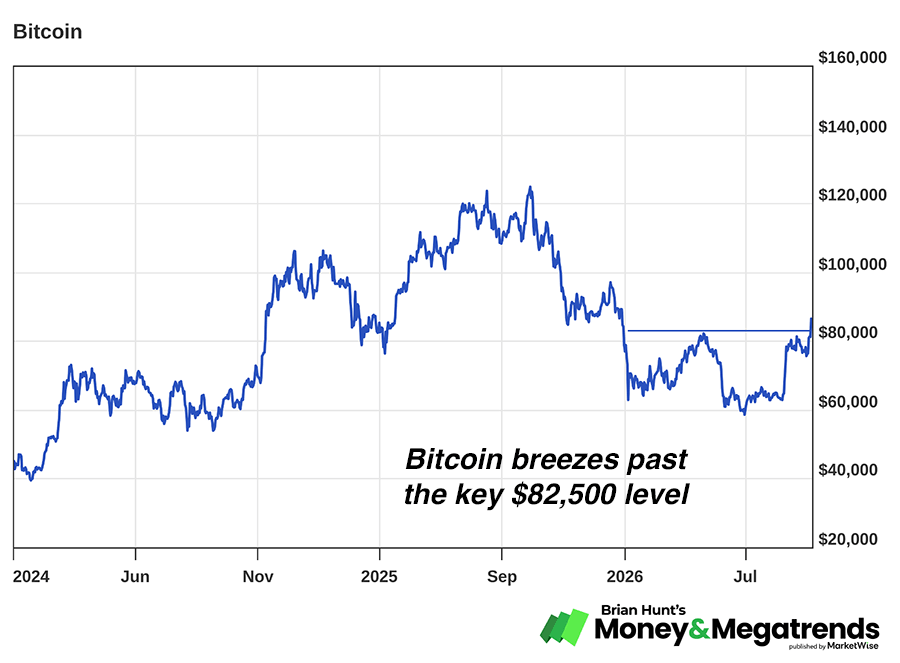
And earlier this month, we noted that if Bitcoin cleared the $82,500 level and reached a new six-month high, it would signal that Bitcoin is back in a bull market… which could attract billions in new buying and send it north of $100,000 per coin. This would, in turn, help drive adjacent bull markets in blockchain-based stablecoin and tokenization trends.

It didn’t take long for Bitcoin to challenge our key $82,500 level and leave it in the dust. On Monday, Bitcoin rallied past that level to reach $86,000, a new 10-month high. This is a huge change in market climate compared to earlier this year.

After reaching an all-time high of around $125,000 last October, Bitcoin entered a brutal bear market, declining by about 48% to the mid-$60,000 range.

Crypto specialists attributed this decline to the U.S. government withdrawing liquidity from financial markets, as well as to gold and AI trades drawing money flows that could have been directed toward Bitcoin.

Most long-term Bitcoin believers see it as a “store of value” that should maintain its purchasing power like gold and beachfront homes do. It should be a digital form of “hard money.” Sounds great.

However, from October 2025 to February 2026, Bitcoin traded more like a failing technology company than anything you’d call strong and stable.

In March, Bitcoin’s trading behavior changed significantly. It formed a bottom and gained 9.5% in one month, while technology stocks dropped and gold gained just 3.2%.

Importantly, Bitcoin outperformed stocks and gold as Operation Epic Fury created tremendous market volatility and hammered many sectors of the stock market. It was a “port in the storm.”

Importantly, Bitcoin recently rallied above its long-term 200-day moving average. This is a good sign of an improving health trend.

Remember what we say about the 200-day moving average around here: Securities below their 200-day moving average are on the wrong side of the tracks. It’s the ugly part of town. All the really bad things happen below the 200-day moving average. Bitcoin has broken above it.

Bitcoin has not only rallied over the past month but has also done so while the CLARITY Act failed to pass Congress. Many industry specialists believed a “pass” of this bill was bullish and a “fail” was bearish. Well, it failed to pass. And yet, bitcoin kept rising.

So, after a year of disappointing believers, has Bitcoin regained its place as a “store of value”?

Is it ready to be a “port in the storm” and a stabilizing component of serious portfolios?

I believe that is the case.

As you can see in the chart below, Bitcoin recently cleared the $82,5000 level and reached a new 10-month high.

As noted above, I believe this break is a signal to the market that Bitcoin is back in a bull market… which will draw in billions of dollars in new buying and send it north of $100,000 per coin. This will be bullish for the bull markets in blockchain-based stablecoins and tokenization. Let the money flow begin!
Image

Recommended Link:

Two Wall Street Legends Identify the Exact Day in October a Major Market Event Could Strike

Ad Image

Whether you lose thousands… Or potentially make more money than you have since the first days of the AI boom… Depends on whether you’re able to make ONE simple move in the final days of September. Louis Navellier and Marc Chaikin – who predicted every market crash of the past four decades – are calling for a dramatic market event with a 92% historical chance of hitting U.S. stocks before the midterms. They’ll share the exact day this event could ignite a firestorm through the market, and the ONE urgent move you need to make with your money BEFORE it arrives, during Midterm Mayhem on Tuesday, September 29. Click here to reserve your spot.

An important new development for “the world’s most important trend”

Image

Credit: KanawatTH

In yesterday’s issue, we looked at the fresh all-time highs reached by the Roundhill Magnificent Seven ETF (MAGS) and noted the move was a bullish new development for the AI infrastructure trade, which we’ve labeled “the world’s most important trend.”

MAGS is the largest ETF designed to give investors exposure to the “Magnificent 7,” a group of dominant technology firms comprised of Nvidia (NVDA), Microsoft (MSFT), Alphabet (GOOG), Tesla (TSLA), Amazon (AMZN), Apple (AAPL), and Meta (META).

Together, these firms are worth about $25 trillion and make up roughly 31% of the benchmark S&P 500. This group includes nearly all the “hyperscalers” leading the AI revolution. It plays a central role in the AI infrastructure trend. And much to the disappointment of AI bears, the group just reached a new all-time high.

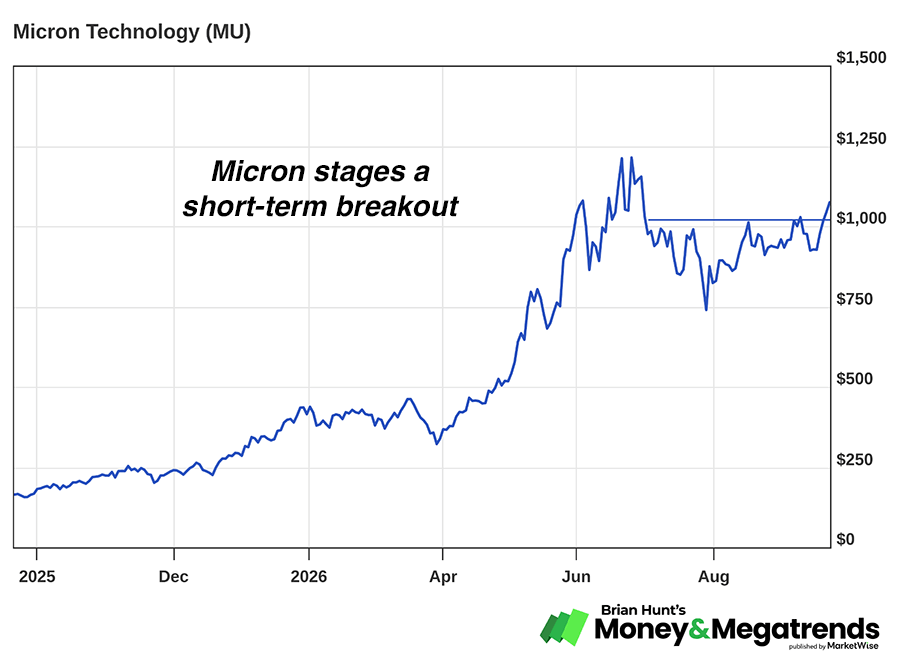
But this move wasn’t the only hugely positive development for AI infrastructure this week. On Monday, the giant of AI memory – Micron (MU) – broke out of a sideways consolidation pattern and reached its highest point since early July. This is a big deal.

Over the past two months, we’ve published a special series of research notes analyzing the AI infrastructure megatrend.

The status of this critical trend has become one of the great sagas of the business and investment world… a source of intense disagreement among industry bulls and bears. It’s a trend whose outcome could have large effects on your portfolio.

Given AI’s enormous promise, the firms above have invested over $1 trillion in AI infrastructure. They are on pace to invest over $700 billion this year alone and more than $4 trillion after that.

Both the scale and the velocity of this investment boom are unprecedented. It is the largest collective investment effort in history.

Big Tech’s historic investment boom has made the entire “AI infrastructure” trend responsible for a large share of America’s GDP growth and stock market returns over the past two years. It has also drawn the skeptical scrutiny of many widely followed investment analysts who claim the trend is a bubble… one that will soon explode and cause tremendous damage to stock prices and the global economy.

If this hugely consequential trend isn’t the most important trend in the stock market, then it is certainly in the top three.

I believe the AI infrastructure trend has years to run. I believe the world’s smartest, most connected tech insiders who know the true state of bleeding-edge AI development and have real-time stats on AI investment ROI, such as Elon Musk, Jensen Huang (Nvidia), Satya Nadella (Microsoft) and Andy Jassy (Amazon), could possibly… perhaps maybe… just might… know far more about AI and their businesses than outsiders know about it.

As much press as AI gets, let’s remember that less than 1% of the global population pays for top-tier AI programs. And I estimate less than 10% of large companies believe AI has made a meaningful impact on their businesses.

This revolutionary technology hasn’t yet proliferated, achieved mass adoption, or had mass impact.

Over the past few months, we have analyzed price action in critical areas of the AI infrastructure trade – including the VanEck Semiconductor ETF (SMH) and optical networking stocks such as Lumentum (LITE) – to guide our trading. The trend in computer memory stocks such as Micron is another key aspect of AI infrastructure we must analyze.

Memory chips are a critical part of AI data centers because AI systems constantly require large amounts of data to perform their tasks. Think of memory as the information sitting within easy reach of an AI chip. The faster the memory, the faster powerful AI chips can get the data they need. As AI models get bigger and smarter, they need more and faster memory to keep up.

Micron is America’s largest memory chip maker. Along with South Korea’s Samsung and SK Hynix, it is one of the “big three” global memory chip makers. The state of Micron is essentially the state of the memory business.

The massive AI infrastructure buildout has been a boon to Micron’s business. Micron revenue grew 49% in fiscal 2025, and the stock soared over 950% from June 1, 2025, to June 1, 2026.

Since reaching a high in June, Micron’s stock has moved in line with the semiconductor sector, which we’ve been tracking closely.

As you can see in the one-year chart below, Micron declined from its June high and entered a directionless sideways consolidation. On Monday, the stock surged 2.77% and broke out of this sideways pattern to reach its highest point since June. Importantly, another AI infrastructure giant – Marvell Technology (MRVL) – did the same.

These new short-term highs by themselves are not “all clear, full speed ahead” signals for the world’s most important trend. But when you pair them with new all-time highs for MAGS, you see the weight of the evidence is tilting bullish for the AI infrastructure trade.
Image


How to invest in AI and robotics… with one great company

Image

Credit: OGULCAN AKSOY

If you look under the hood of the Magnificent 7’s rally to new all-time highs (detailed above), you see a large portion of it is attributable to a large upside move in Meta (META). The stock has gained 22% over the past two weeks, a phenomenal move for a megacap stock.

This move makes our bullish July 31 call on the stock a big winner. In that research note, we detailed how Meta was badly oversold, represented growth at a reasonable price, and would draw large amounts of buying from institutional money managers.

It didn’t take long for this thesis to deliver value. Meta stock is up 39% in less than two months, which is a tremendous 268% annualized pace.

“Great Hunt, but that’s in the past. What’s the next good big tech trade?”

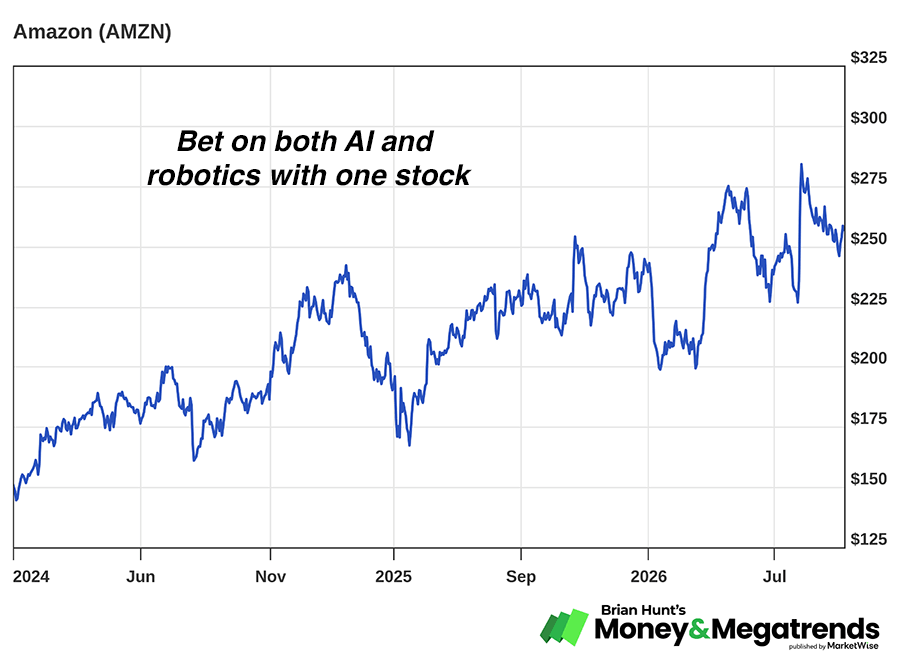
I believe the answer to that question is a stock I’ve called “the best way to invest in AI and robotics at the same time” – Amazon (AMZN).

Avid Money & Megatrends readers know that we believe AI and robotics are two of the biggest business and investment trends of the 21st century. They will revolutionize the way we live as much as electricity or the automobile did…. while creating huge stock market winners along the way.

Tech giant Amazon is uniquely positioned to benefit from both technologies.

Although everyone knows about Amazon, the online retailer, and almost everyone is a customer, most people don’t know about Amazon, the giant employer of robots.

Last June, Amazon announced it had deployed its 1 millionth robot across its business. It describes itself as the world’s largest manufacturer and operator of mobile robotics.

Amazon operates more than 1,000 warehouses in the U.S. It ships millions of packages across millions of miles every month. This blizzard of activity can become more efficient and profitable with AI-enhanced logistics and robots that don’t complain, don’t take coffee breaks, and don’t ask for raises.

In other words, Amazon is uniquely well-suited to benefit from a megatrend in which robots will become cheaper, faster, more dexterous, more durable, and smarter soon.

Amazon is also heavily involved in AI. It owns equity stakes in AI leaders OpenAI and Anthropic. Plus, its huge AWS cloud computing division is benefiting from skyrocketing demand for AI compute. In Q2 2026, AWS generated $42 billion in quarterly revenue and 37% year-over-year growth.

AWS profit growth is also incredible. AWS’s operating income rose 64% YoY to $16.6 billion, with its operating margin reaching 39.4%, versus 32.9% a year earlier. AWS is now running at roughly a $169 billion annualized revenue rate

Add these robotics and AI assets to the world’s largest online retail business, and you get a pretty good bet on the future of technology in one stock.

Plus, a “back of the envelope” valuation analysis says you get all the growth and potential detailed above for a reasonable price.

Our conservative estimate of AWS value is around $1.5 trillion. Bank of America analysts recently estimated its value at roughly $1.9 trillion. From what we can decipher from Goldman Sach’s research, it has a roughly similar estimate of AWS value.

Now here’s where it gets interesting. Let’s break down Amazon’s E-commerce and Amazon’s Digital Ads business separately:

E-Commerce: Amazon’s annual revenue run rate in retail is currently $547 billion. Comparable retail businesses often trade at 1x–1.8x sales, which implies an approximate valuation of around $800 billion.

Digital Advertising: FY26 revenue is north of $80 billion, with operating margins likely above 50%, resulting in an operating income of $40 billion. At a conservative 20x EBIT multiple, we have an $800 billion business there alone.

Between AWS, E-Commerce, and Digital Advertising, you get to $3.1 trillion in value… which is more than Amazon’s current market cap of $2.7 trillion.

Also consider that Amazon’s combined stake in OpenAI and Anthropic is worth around $240 billion right now. Then there’s…

  • Amazon Prime Video

  • Zoox: Amazon’s autonomous vehicle bet.

  • Project Kuiper: Amazon’s satellite internet initiative taking on Starlink.

  • One Medical: Amazon’s primary care business

  • And then add on the fact that Amazon is “still in the early stages of how we’ll leverage robotics” as per CEO Andy Jassy.

With approximately 800,000 warehouse and delivery employees, even a modest improvement in operating efficiency from automation can produce billions of dollars of extra free cash flow at Amazon’s scale.

In other words, there’s a lot to like about Amazon’s growth prospects. And as we’ve detailed above, the current valuation is not excessive. It leaves plenty of upside should Amazon build on its momentum and execute on its plans. History shows that’s a bet worth making.
Image


Market Notes

  • Our recommendation to invest in the genomics megatrend continues to pay off. Sector leaders Twist Bioscience (TWST), Natera (NTRA), and 10X Genomics (TXG) reached new all-time highs today. Twist is up 415% since our bullish note. 10X is up 578%. Natera is up 123%.

  • The tech-focused Nasdaq 100 ETF (QQQ) advanced to a new three-month high today.

  • The widely followed and aggressive technology ARK Innovation ETF (ARKK) reached a new 10-month high today.

  • Tech supergiant Apple (AAPL) reached a new all-time high today.

Regards,

Brian Hunt signature

Brian Hunt signature

Brian Hunt
Editor, Money & Megatrends


An urgent message from our colleagues:

Buy this off-the-radar AI stock Sept. 29th

Image

You won’t hear about this from CNBC, Forbes or the Wall Street Journal. But Donald Trump has committed $1 billion in support for an obscure AI stock… A company helping to unleash a whole new category of Artificial Intelligence. Louis Navellier and his team have spent months researching this opportunity. He even traveled to Mar-a-Lago several times, personally. And he anticipates a potential announcement from this company on or before Sept. 29th. That’s why he’s encouraging his readers to buy the stock now – before that date.

Watch his brand-new presentation detailing everything you need to know, including the name and ticker of the company behind the coming revolution.

The post This new catalyst could send Bitcoin much higher from here appeared first on MarketWise.

  •  

Six ways to invest in the revolution in money and banking

Today’s issue in preview:

  • Six ways to invest in the revolution in money and banking

  • Own these stocks to profit from the coming mass adoption of AI

  • New highs for the Magnificent 7 are sending you a clear signal. Are you listening?

  • Learn our Top Themes to buy now


Six ways to invest in the revolution in money and banking

Image

Credit: ISerg

It looks like the revolution is here.

And it’s starting to move the markets.

Over the past week, the token representing the leading blockchain network Ethereum broke out to its highest price in eight months. Its fellow leading network/token, Solana, did the same. And leading cryptocurrency brokerage/infrastructure provider Coinbase (COIN) surged 5.4% this morning, reaching its highest level since June.

In other words, the market is beginning to agree with the bullish thesis we laid out in a special series of research notes we published this year… in which we asserted that a revolution in money and banking is at hand.

In our series, we detailed how two megatrends could converge to drive many blockchain-centric stocks and network tokens much higher.

Those two megatrends are:

Agentic payments and money transfers: The number of AI agents at work in the economy is growing rapidly and will continue to do so for years. We will have many millions of agents transferring money and making payments in the economy. These agents will avail themselves of blockchain technology. Often.

Blockchain is a digital record-keeping system that stores transactions across a network of computers rather than in one central location. Once information is recorded, it is extremely difficult to change or erase. This allows people and businesses to securely exchange money or information without relying on a central authority to verify every transaction.

This can make banking systems much faster, much more efficient, and much cheaper.

Money will eventually have more machine use than human use. And once you understand that AI agents can’t use bank accounts as we know them… the only logical use case will be blockchain-enabled stablecoins… aka “dollars that computers use without having bank accounts.”

You can think of dollar-backed stablecoins like dollars you spend online, only faster and more flexible. Stablecoins are digital dollars that can move on open blockchain networks, while conventional dollars in your bank account generally move through closed banking systems.

An AI agent cannot go to a bank, show an ID, sign forms, or open an account. That’s why the traditional banking system as we know it today isn’t agent-friendly.

But an agent can manage a digital wallet protected by a key or code. Stablecoins are simply dollars that live inside these keyed, or coded, wallets that can move dollars instantly, anytime, anywhere. This makes them a natural fit for how agents spend and receive money.

Stablecoin transaction volume more than tripled year over year, rising 229% to $22.4 trillion in Q1 2026.

Visa’s stablecoin settlement volume has risen more than 15X year over year, recently exceeding a $20 billion annualized run rate.

Tokenization: Tokenization is simple. Take any real-world asset – a US treasury bond, a share in a private equity fund, a piece of commercial real estate, a share of Apple (AAPL), a corporate bond – and represent fractional ownership of it as a digital token on a blockchain.

Think of a blockchain as a record book that anyone can verify, but no single bank or government controls. It’s the ledger that makes digital ownership trustworthy without needing the middleman.

Instead of paper certificates of ownership, settlement agents taking a fee, and a multi-day clearing cycle, ownership becomes digital, with no human middleman, and practically instant.

A token of ownership can be transferred in seconds, fractionalized to a percentage of its original size, and plugged directly into a liquid market.

The market for tokenized real-world assets on public blockchains is already nearly $30 billion in 2026. But that number is purely a proof of concept. Forecasts from the likes of Boston Consulting Group and McKinsey assert this market is headed towards the $16-$30 trillion range in the next 5-8 years.

And for even more proof, Larry Fink – the CEO of BlackRock and one of the most powerful figures in finance, with more than $11.5 trillion in assets under management – has consistently advocated for tokenization.

In his 2025 annual letter to investors, he described tokenization as “the next generation for markets.”

“If we could digitize every asset, we could have a more seamless way of going from a digital wallet to ownership of real assets.”

He’s not alone in this view, and some major institutions are already on board. Kinexys, J.P. Morgan’s enterprise blockchain and digital asset business unit, has now processed over $1.5 trillion in tokenized transactions.

A bullish cherry on top of the cake is political power.

For better or worse, the Trump family is heavily invested in blockchain-centric businesses and therefore heavily incentivized to drive friendly regulation. I expect to soon see President Trump speaking and posting about the trends outlined above.

Plus, U.S. Treasury Secretary Scott Bessent has spoken favorably of stablecoins and how they could drive demand for U.S. bonds, which could help the U.S. manage its large debt burden.

In our research on these trends, we’ve highlighted Bitcoin, Ethereum, Solana, Coinbase (COIN), Robinhood (HOOD), and Securitize (SECZ) as compelling investment options.

The market is starting to agree with the bull case for the stocks and tokens listed above.

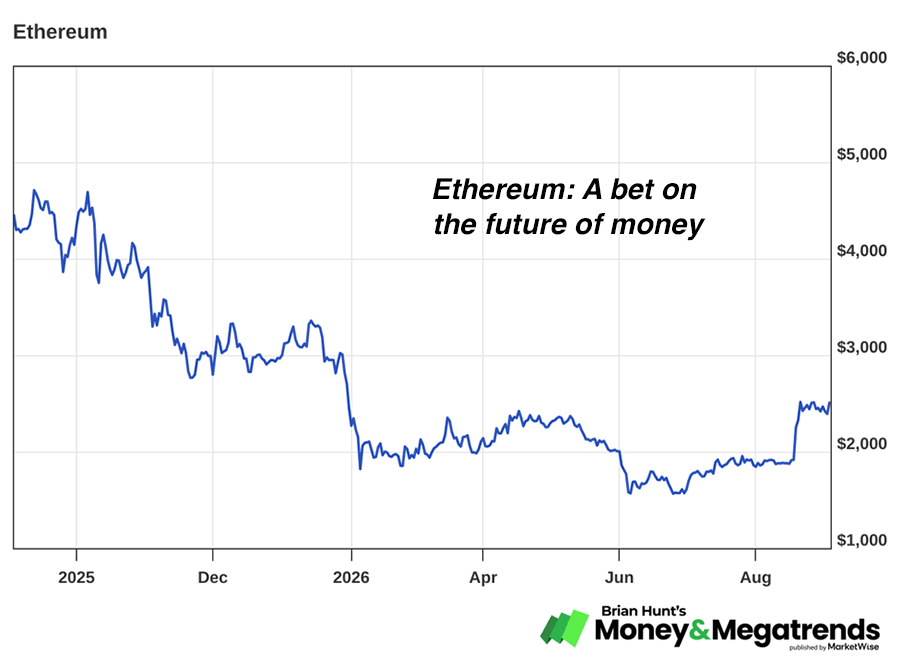
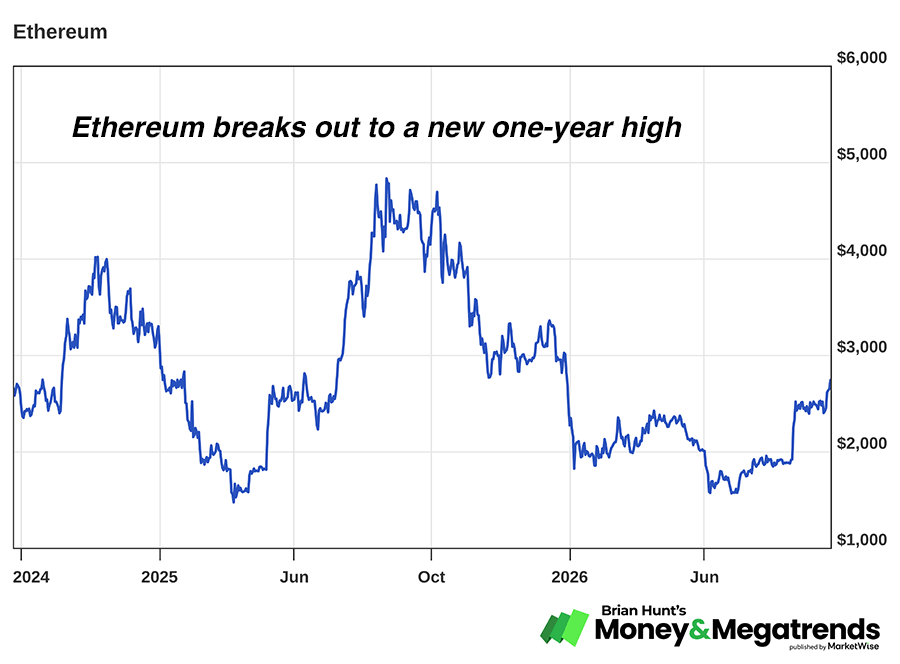
Below is a one-year chart of Ethereum, one of the world’s most widely used blockchain networks for the commercial activities described above.

As you can see, Ethereum suffered greatly along with the rest of the cryptocurrency world from late 2025 to mid 2026. Since that suffering, it has carved out a bottom and recently reached its highest point in eight months.

This is a bullish development in favor of the coming revolution in money and banking.

Image

Recommended Link:

Tomorrow, “Super AI” Opens New Way of Trading

Ad Image

Beginning at 10 am ET tomorrow, a new form of AI could quadruple your portfolio by foreseeing the future prices of 2,334 stocks, to the penny, with 85% backtested accuracy. It’s opened the most lucrative investment vehicle in our firm’s 21-year history, which has officially crushed the 2026 market by 218%, as of August. You can even chat with it! Try it now, free of charge.

Own these stocks to profit from the coming mass adoption of AI

Image

Credit: imaginima

As we expected, it’s a bull market in securing the world’s AI, computers, and data centers.

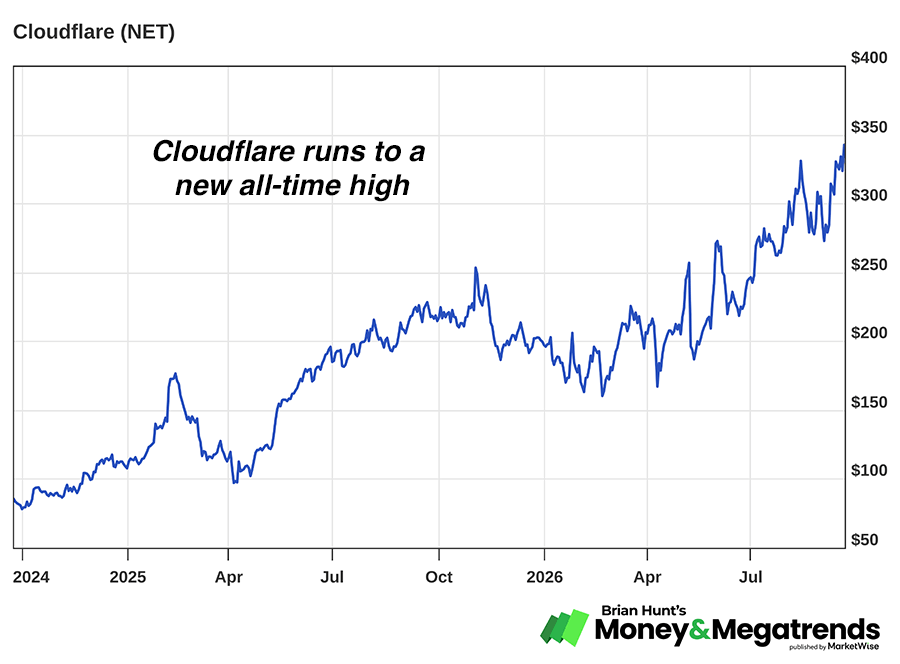
As evidence, I present today’s new all-time high for Cloudflare (NET), the new all-time high for the Global X Cybersecurity ETF (BUG), and the new six-month highs for cybersecurity leaders Zscaler (ZS) and Rubrik (RBRK).

In our March 16 issue, we introduced our Agent Supernova thesis… and how companies such as Cloudflare are positioned to benefit from the trend.

After years of development, AI is now advanced enough to perform many everyday tasks people do … and the list is only getting longer. Over the next 12–24 months, AI “agents” will help manage factories, perform financial analysis, manage inventories, write software, design websites, create legal documents… and thousands of other tasks.

The Agent Supernova is poised to reorder how the world works. It will break and reform many businesses, industries, and societal norms.

Soon, a restaurant could have five different agents working in it. One agent to manage the cooking schedules of meals. One agent to manage accounting. One agent to manage the staff. One agent to manage the ordering and tracking of supplies. One general-purpose agent to manage the specialized agents and interact with the restaurant owner.

At home, another set of agents can perform tasks to help the heroic American mom. A “mom helper” agent could schedule dentist appointments for the kids, pay bills, renew the car insurance, write and send thank-you cards, order groceries, and remind the kids to do their homework.

Meanwhile, another set of agents will transform American factories. They will have agents managing logistics, accounting, production schedules, component part ordering, hiring and firing workers, and other critical functions.

Now, take those three examples and extrapolate that activity across the economy. We are on the cusp of an explosion of agents working 24/7/365 for individuals, businesses, and governments.

In addition to restaurant manager agents, mom agents, and factory management agents, our lives will soon feature legal agents, government agents, tax agents, teacher agents, negotiator agents, airport agents, hospital agents, writing agents, marketing agents, and the list goes on for days.

Within the next two years, the number of AI agents operating in the American economy isn’t poised to increase by 10X… or 50X… or even by 1,000X. Try at least 10,000X.

Of course, the business and investment implications here are huge. The Agent Supernova will transform many businesses and industries. It will end many businesses as we know them… while creating new ones at the same time. The economic deck is about to get reshuffled.

Of all the stocks we’ve covered to profit from the Agent Supernova, few have powered higher than Cloudflare.

Cloudflare is one of the world’s leading Content Delivery Network (CDN) firms. A CDN is a network of physical servers deployed across the country that speeds up the delivery of website content. It reduces latency and bandwidth costs by bringing data and content closer to users.

In addition to this business, Cloudflare provides in-demand cybersecurity services, AI agent management services, and AI agent transaction services. This is a huge component of the business, since nobody will want to use AI if they think it will be used to steal their identity.

This diversified suite of hardware and agent management services makes Cloudflare something of an AI agent “conglomerate,” and uniquely positioned to benefit from the coming agent boom.

Cloudflare’s unique position is driving strong growth. In 2024, its revenue grew 29%. In 2025, it grew 30%. Growth has accelerated in 2026, with second-quarter revenue surging 36%. Wall Street now expects Cloudflare’s revenue to reach approximately $2.87 billion in 2026, up 32%, and climb another 28% to roughly $3.7 billion in 2027.

We first profiled Cloudflare on May 5. Since then, the stock is up 53% and reached a new all-time high today.

Cloudflare is now trading at a very rich 40X expected 2026 revenue, so we’d avoid buying the stock at these levels. However, the stock’s new high sends a loud message. It is yet more confirmation that the Agent Supernova and its security implications are a massive trend we should be following.

Image


New highs for the Magnificent 7 are sending you a clear signal. Are you listening?

Image

Credit: pingingz

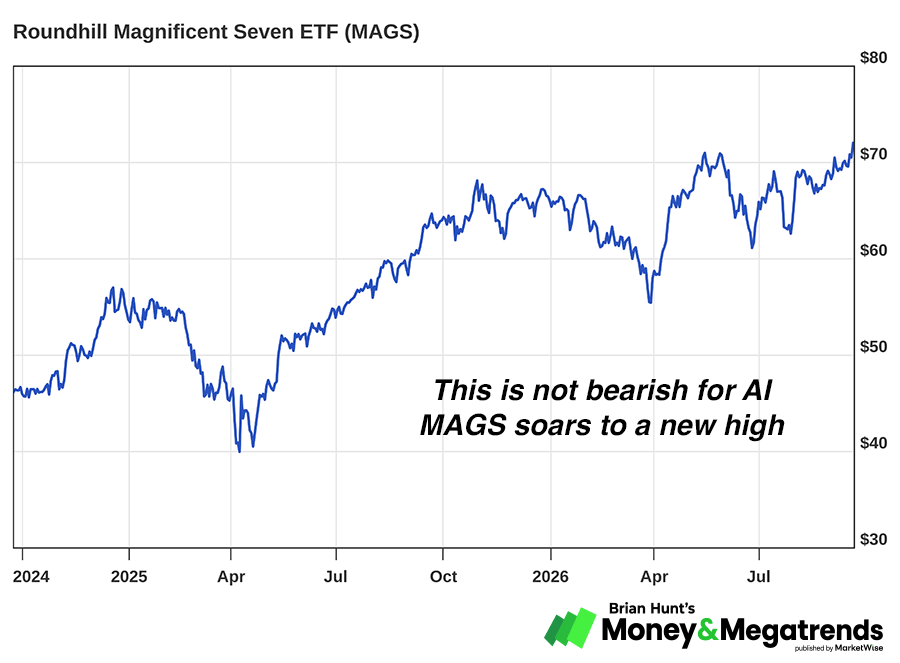
Last week, we looked at the Roundhill Magnificent Seven ETF (MAGS) and noted the positive signals it was flashing for the technology sector.

At the time, MAGS had reached a new three-month high and was pennies away from an all-time high.

Today, MAGS is no longer pennies away from that high. It is beyond it.

That’s bullish for technology… bullish for the AI trade… and bullish for America in general.

MAGS is the largest ETF specifically designed to give investors exposure to the “Magnificent 7,” a group of dominant technology firms comprised of Nvidia (NVDA), Microsoft (MSFT), Alphabet (GOOG), Tesla (TSLA), Amazon (AMZN), Apple (AAPL), and Meta (META).

Together, these firms are worth about $24 trillion and make up roughly 31% of the benchmark S&P 500. No group of companies in history has wielded this group’s awesome combination of power, technological expertise, and vast financial resources. This group includes nearly all of the “hyperscalers” leading the AI revolution.

And the ETF that tracks this group reached an all-time high today.

This is an important development for “the world’s most important trend.”

Over the past two months, we’ve published a special series of research notes analyzing the AI infrastructure megatrend.

The status of this critical trend has become one of the great sagas of the business and investment world… a source of intense disagreement among industry bulls and bears. It’s a trend whose outcome could have large effects on your portfolio.

Given AI’s enormous promise, the firms above have invested over $1 trillion in AI infrastructure. They are on pace to invest over $700 billion this year alone and more than $4 trillion after that.

Both the scale and the velocity of this investment boom are unprecedented. It is the largest collective investment effort in history.

Big Tech’s historic investment boom has made the entire “AI infrastructure” trend responsible for a large share of America’s GDP growth and stock market returns over the past two years. It has also drawn the skeptical scrutiny of many widely followed investment analysts who claim the trend is a bubble… one that will soon explode and cause tremendous damage to stock prices and the global economy.

If this hugely consequential trend isn’t the most important trend in the stock market, then it is certainly in the top three.

I believe the AI infrastructure trend has years to run. I believe the world’s smartest, most connected tech insiders who know the true state of bleeding-edge AI development and have real-time stats on AI investment ROI, such as Elon Musk, Jensen Huang (Nvidia), Satya Nadella (Microsoft) and Andy Jassy (Amazon), could possibly… perhaps maybe… just might… know far more about AI and their businesses than outsiders know about it.

As much press as AI gets, let’s remember that less than 1% of the global population pays for top-tier AI programs. And I estimate less than 10% of large companies believe AI has made a meaningful impact on their businesses.

This revolutionary technology hasn’t yet proliferated, achieved mass adoption, or had mass impact.

Regular readers know I care a lot more about what the market thinks of any stock, trend, or theme than what any one person thinks of it, including me. You can be bullish or bearish on a trend all you like, but if that trend is moving strongly against you, then your idea isn’t worth much in my book.

Over the past few months, we have analyzed price action in critical areas of the AI infrastructure trade – including the VanEck Semiconductor ETF (SMH), computer memory giant Micron (MU), and optical networking stocks – to guide our trading.

Since the Mag 7 plays a central role in AI infrastructure, it is central to our analysis. Several of these firms have been singled out by bears for issuing debt to invest in AI data center construction.

However, right now, the market is saying debt issuance and ROI on AI infrastructure spend aren’t much of a worry… and that things are going quite well for the Mag 7.

As you can see in the two-year chart below, MAGS is in a clear uptrend and just broke out to an all-time high. This is bullish for the AI infrastructure trade, bullish for the tech sector in general, and bullish for America.

Image


Market Notes

  • Good signs for the AI infrastructure trade: AI infrastructure leader Semtech Corp (SMTC) just hit a new yearly high. Semiconductor leader Advanced Micro Devices (AMD) also hit an all-time high.

  • Our recommendation to invest in the genomics megatrend continues to pay off. Genomic analysis firm 10X Genomics (TXG) reached a new all-time high today. The stock is up 553% since our bullish October 2025 note.

  • Food and beverage giant Pepsico (PEP) reached a new one-year low today.

  • Fast food giant McDonald’s (MCD) reached a new one-year low today.

  • Alcoholic drink giant Constellation Brands (STZ) reached a new one-year low today.

Regards,

Brian Hunt signature

Brian Hunt signature

Brian Hunt
Editor, Money & Megatrends


An urgent message from our colleagues:

Chaikin: This “White Swan” Could Eat Every Data Center in America starting 9/29/26

Image

Every major AI firm now relies on massive data centers. But these monstrosities suck up our electricity. They drain our water supplies. They steal precious land. Yet AI companies are requesting 700 gigawatts of new electricity – enough to power every home in America! Until now, AI investors have piled trillions into the data-center boom. But according to investing legend Marc Chaikin, a new technology’s coming… called AI “micro clusters.” And they’ll render all current data centers obsolete. The company he believes is behind this $248 trillion “White Swan” event could soar starting Sept. 29th.

Marc reveals his full prediction – and the stock ticker – free, here.


The post Six ways to invest in the revolution in money and banking appeared first on MarketWise.

  •  

A unique inflation hedge you’ve probably never considered

Today’s issue in preview:

  • A unique inflation hedge you’ve probably never considered

  • This Bitcoin catalyst could trigger soon and send it past $100,000

  • Learn our Top Themes to buy now


A unique inflation hedge you’ve probably never considered

Image

Credit: f9photos

For anyone looking to protect themselves against inflation, it’s worth knowing that it’s not just timberland on sale right now. World-class collections of gravel pits are also on sale.

Over the past six months, I’ve written a special series of research notes on publicly traded assets such as timberland giant Weyerhaeuser (WY) and construction aggregates firm Vulcan Materials (VMC) that can add a robust “inflation defense” component to your financial life.

You probably know why being vigilant against inflation is important: governments in most Western nations have promised far too many things to far too many people. They are spending far more on taxpayer benefits and wars than they collect in tax revenues.

The related debts and obligations governments have taken on cannot possibly be paid back with sound money. They can only be paid back with debased, devalued money… much of which is created out of thin air. This is driving inflation and significant currency debasement.

Prices are going up because the value of our money is going down.

Measured against a basket of widely used raw materials like crude oil, corn, copper, natural gas, sugar, and soybeans, the U.S. dollar has lost 53% of its value over the past eight years.

When I provide guidance on inflation defense, I urge people to keep my number one rule in mind: own in-demand, useful assets that cannot be easily replaced or replicated.

That is inflation defense in a nutshell. You want to own businesses and properties that produce in-demand, scarce resources, products, experiences, and services.

This group of assets includes quality farmland, beachfront real estate, timberland, mountain-view properties, great businesses, and oil and gas pipelines.

When a very difficult or impossible-to-replicate business or property produces in-demand, scarce resources, products, experiences, or services, it tends to hold its value no matter what the dollar is doing.

Its price will constantly “recalibrate” to accommodate an increase in currency units. It’s like the difference between slicing a pizza into 6 or 8 pieces. The number of slices changed, but the amount of pizza is the same.

In Monday’s issue, we detailed how timberland giant Weyerhaeuser was trading near one-year lows thanks to the rising interest rates and their depressive effects on the housing market.

Rising rates are also driving weakness in blue-chip construction aggregate producers Vulcan Materials and Martin Marietta Materials (MLM).

Together, Vulcan and Martin Marietta own and operate hundreds of mines across America that produce gravel, sand, and crushed stone – aka “construction aggregates.”

These raw materials are literally the foundation of highways, bridges, airports, offices, apartments, homes, and factories. You are virtually guaranteed to have driven on a road made possible by the construction aggregates produced by Vulcan or Martin Marietta. They are the giants of the industry.

Importantly, many of Vulcan and Martin Marietta’s mines are in coveted locations near America’s major metropolitan areas. This is key because construction aggregates are very heavy and therefore costly to transport over long distances. Transporting $5 million worth of gold and transporting $5 million worth of gravel are two very different things.

Given how difficult, expensive, and time-consuming it can be to permit and develop a large gravel mine, we can say both VMC and MLM own irreplaceable collections of scarce, in-demand resources. Again, these attributes are key to playing inflation defense. They’ve allowed the market values of VMC and MLM to rise and outpace dollar debasement over the past seven years.

VMC and MLM are also enjoying the U.S. factory and data center building boom we’ve been investing in with great success. As America grows, VMC and MLM grow with it.

We believe the attributes above are why master “quality” investor Chris Hohn is accumulating stakes in both firms.

Owning a collection of gravel pits and sand mines isn’t as exciting as owning SpaceX or AI stocks. However, if you want to play inflation defense by owning irreplaceable collections of scarce, in-demand assets whose prices can rise along with the rate of money creation, consider VMC and MLM.

Image

Recommended Link:

America’s New Money – Explained

Ad Image

Porter Stansberry reveals how Executive Order 14241 may have unleashed the first U.S. Dollar reset in 52 years. If you own property, stocks or have savings in the bank – discover what it could mean for your personal wealth. Go here to watch now.
  

This Bitcoin catalyst could trigger soon and send it past $100,000

Image

Credit: Vertigo3d

Bitcoin owners and watchers take note: The world’s leading digital asset is poised to clear a critical price level… which could serve as a catalyst to send it past $100,000 per coin.

Back in March, we wrote a bullish research note on how we believed Bitcoin had reached an important bottom.

After reaching an all-time high of around $125,000 last October, Bitcoin entered a brutal bear market, declining by about 48% to the mid-$60,000 range.

Crypto specialists attributed this decline to the U.S. government withdrawing liquidity from financial markets, as well as to gold and AI trades drawing money flows that could have been directed toward Bitcoin.

Most long-term Bitcoin believers see it as a “store of value” that should maintain its purchasing power like gold and beachfront homes do. It should be a digital form of “hard money.” Sounds great.

However, from October 2025 to February 2026, Bitcoin traded more like a failing technology company than anything you’d call strong and stable.

In March, Bitcoin’s trading behavior underwent a significant change. It formed a bottom and gained 9.5% in one month, while technology stocks dropped and gold gained just 3.2%.

Importantly, Bitcoin outperformed stocks and gold as Operation Epic Fury created tremendous market volatility and hammered many sectors of the stock market. It was a “port in the storm.”

Importantly, Bitcoin recently rallied above its long-term 200-day moving average. This is a good sign of an improving health trend.

Remember what we say about the 200-day moving average around here: Securities below their 200-day moving average are on the wrong side of the tracks. It’s the ugly part of town. All the really bad things happen below the 200-day moving average. Bitcoin has broken above it.

So, after a year of disappointing believers, has Bitcoin regained its place as a “store of value”? Is it ready to be a “port in the storm” and a stabilizing component of serious portfolios?

I hope so.

The world is a better place when Bitcoin is rising, and we have not one but two forms of hard money to own.

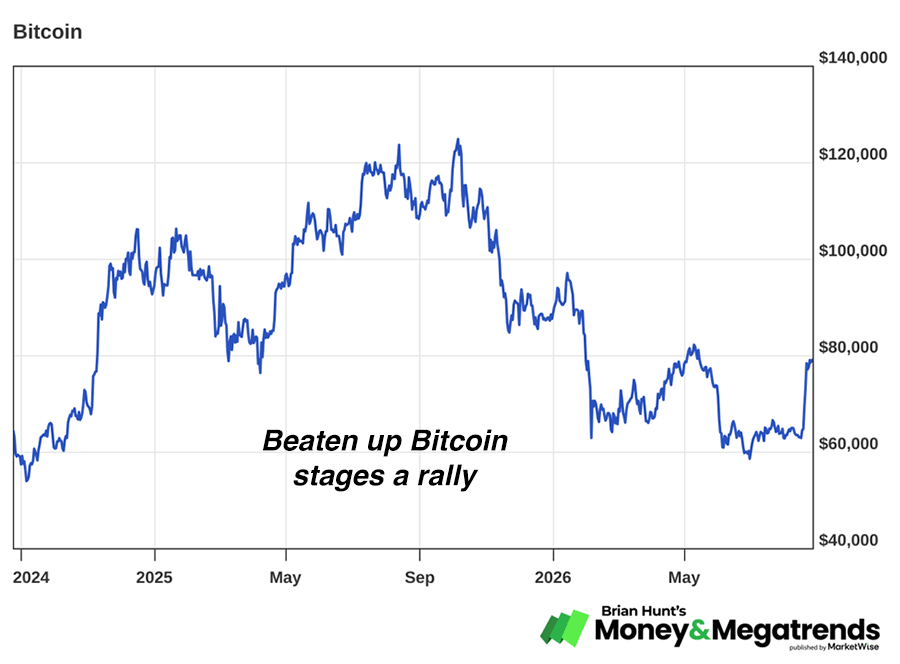
Bitcoin is currently trading for around $79,000. You can see in the chart below that a break above $82,500 would mark Bitcoin’s highest level in over six months.

This break could signal to the market that Bitcoin is back in a bull market… which could attract billions in new buying and send it north of $100,000 per coin. This would, in turn, drive adjacent bull markets in blockchain-based stablecoin and tokenization trends.

We’re bullish… and we’ll keep you updated on this potential catalyst.

Image


Market Notes

  • The tokenization trend we’ve been writing about picked up momentum today. Ethereum reached a six-month high.

  • The VanEck Oil Refiners ETF (CRAK) hit a new high today. Individual refining giants Valero Energy (VLO) and Marathon Petroleum (MPC) reached highs, too.

  • Japanese banking giant Mizuho Financial Group (MFG) hit new highs along with Bancolombia (CIB), Colombia’s largest bank. International banks continue their momentum.

  • Our November 17 recommendation to own biotech is doing well. 10X Genomics (TXG) hit new highs today, which puts it up 191% since our recommendation.

  • Our February 3rd recommendation to own space bottleneck play Frequency Electronics (FEIM) just surged 35% post stellar earnings. It’s now up 54% since our February recommendation.

  • Our March 20th recommendation to invest into scandium with Sunrise Energy Metals (SREMF) has performed extremely well. The stock is now up 22% in the last month and 211% since our March recommendation.

Regards,

Brian Hunt signature

Brian Hunt signature

Brian Hunt
Editor, Money & Megatrends


An urgent message from our colleagues:

AI Breakthrough Could Soon Reorder Stock Market Winners and Losers

Image

For years, we’ve been led to believe the tech firm operating at 500 Howard Street in Silicon Valley is “one of the good guys.” But will the advanced form of AI that just emerged from this location change the way we live, work and invest forever? Marc Chaikin reveals the time-sensitive details of this discovery and offers you a FREE 3-part playbook to protect your future.

Click here for the details.

The post A unique inflation hedge you’ve probably never considered appeared first on MarketWise.

  •  

You Probably Don’t Own Bitcoin And That’s A HUGE Mistake

Issue#153, Volume#3

Most Investors Still Don’t Understand Bitcoin – Here’s What They’re Missing


Editor’s note: The Porter & Co. editorial and Customer Care teams will be off on Monday because of Labor Day. We will all be back on Tuesday.


Nobody invented money.

It was not designed, chartered, decreed, or granted. It was discovered, slowly, in trade. A man takes salt in exchange for his labor because he knows he can exchange it for other goods. Cattle, hides, shells, iron bars, bricks of tea, cakes of salt, strings of beads: each of these served as money at different times in history.

Carl Menger, one of the founders of the Austrian School of economics, first theorized how money evolved through trade. Men were led, he wrote,

each by his own economic interests, without convention, without legal compulsion, nay, even without any regard to the common interest, to exchange goods destined for exchange (their ‘wares’) for other goods equally destined for exchange, but more saleable.

The most important takeaway is that money predates all government. Governments don’t create money – in fact, as you’ll see, governments constantly corrupt money.

The second most important takeaway is that the market – through the choices of millions of individuals each pursuing their own economic interests – will always trend toward the best and most reliable form of money. That’s why, over time, more people favored metals, particularly gold and silver. And it’s why more and more people are choosing Bitcoin (BTC), today.

And what did governments add to money? Fraud, of course.

The denarius, the benchmark coin of the Roman Empire, was 90% silver (3.9 grams) under Julius Caesar. By AD 200, the coin was less than 60% pure, and by AD 300, it contained 5% silver. The Empire disintegrated alongside its money – something Americans would be wise to remember.

The same thing has happened to every empire.

Between 1544 and 1551, in a program historians call the Great Debasement, England’s silver coinage went from the old sterling standard of 92.5% fine to 75%, then 50%, then 33.33%, and finally to 25% in April 1551. Measured in metal, a pound sterling fell from 153.4 grams of pure silver to 25.9. Roughly 83% of the silver content was removed in only eight years.

It happens, over and over again. As sure as the sun rises in the East, every government, if it gains enough power, will attempt to control money by creating a currency. And they will devalue that currency to steal. That’s exactly what’s been happening in America since 2010. It’s why people under the age of 40 can’t afford to buy a house, get married, or have a family. It is what’s driving the collapse of our culture and our society. It’s what’s leading more and more people into lives of desperation: gambling, prostitution, and substance abuse. It’s leading people to become politically radicalized. And, if it continues, it will lead America to socialism, a financial collapse, and even a civil war.

But this doesn’t have to happen to you. You are still free to choose what you save. And you should save money, not the government’s currency. What is money? Money is what people voluntarily save. It is discovered, in markets, over long periods, by people making their own self-interested choices. Currency is what a government issues and debases and requires you to use as legal tender for debts and taxes. Money doesn’t require any coercion. It’s chosen freely, in the market.

Unless you understand this background, Bitcoin will never make sense to you.

Beyond this basic distinction between money and currency, the other misunderstanding that’s common even among people like financial commentators Peter Schiff and Jim Grant, who have an Austrian orientation, is that because Bitcoin is inert – it’s just code – it doesn’t have any intrinsic value.

As the Austrians proved, value is relative. And, in the modern world, code can have enormous value. Look at Microsoft (MSFT). What is it, other than code?

Every technology that Bitcoin has combined into its code has tremendous real-world value. Public-key cryptography verifies bank wires, military traffic, software distribution, and every other encrypted commercial transaction. Cryptographic hash functions compress huge files into a short fingerprint, which is how password databases and software integrity have been protected for decades. Distributed consensus protocols (blockchains) keep databases organized for mission-critical infrastructure around the world.

Saying that these things have no value because they are only code is profoundly ignorant.

Bitcoin combined these technologies to create something extraordinary: a way to send a fixed amount of value (a proof of work) to anyone around the world using only the public internet. Bitcoin allows two strangers, who do not trust each other, to exchange a form of money, with final settlement, without asking a bank, a clearinghouse, a corporation, or a government for permission. It also allows individuals to save an unlimited amount of money using only their minds: a seed phrase.

Gold’s weakness is its physical presence. It requires custody. To use gold, people ultimately must hand it to someone: a bank, a treasury, a depository institution. Or else… they risk having it seized (see 1933) or stolen. Bitcoin removes this risk. And that is a revolutionary monetary characteristic. Over time, I believe this will transform the relationship between people and governments. It creates a defense against debasement and coercion.

How To Value Bitcoin

Like gold, Bitcoin is inert. It has no earnings. It pays no coupons. And, like gold, its supply only grows slowly, and the costs to mine Bitcoin continue to increase. To value Bitcoin, you must understand the other side of the scale: the currency you’re measuring it against. Bitcoin’s price, like gold’s, is driven by monetary aggregates.

The Porter & Co. Bitcoin Liquidity Model uses least squares regression analysis, which is a statistical method for understanding the historical relationship between global currencies and Bitcoin, using about 500 weekly observations beginning in January 2015.

The monetary aggregates we use include:

  • Federal Reserve net liquidity, which is the Fed’s balance sheet minus the Treasury’s cash account minus money parked in the reverse repo facility. It is what the Fed is actually leaving in the banking system.
  • Global M2 in dollars. M2 is broad money: currency, checking accounts, savings deposits and close equivalents. We sum the United States, the euro area, Japan, China and the United Kingdom, converted to dollars.
  • Total circulating supply of the two large dollar stablecoins, USDT (Tether) and USDC (Circle Internet).

Statistics show our model explains 89% of the variation in Bitcoin’s price. Most Bitcoin enthusiasts claim Bitcoin’s price is driven by its halving cycle. But it isn’t. Once global liquidity is measured properly, the four-year halving cycle adds nothing to Bitcoin’s price. Bitcoin’s code was designed to keep the price of Bitcoin stable against the growth in compute. It’s working. What’s driving its price higher is debasement by governments.

On May 21, I posted this on X.com (@porterstansb):

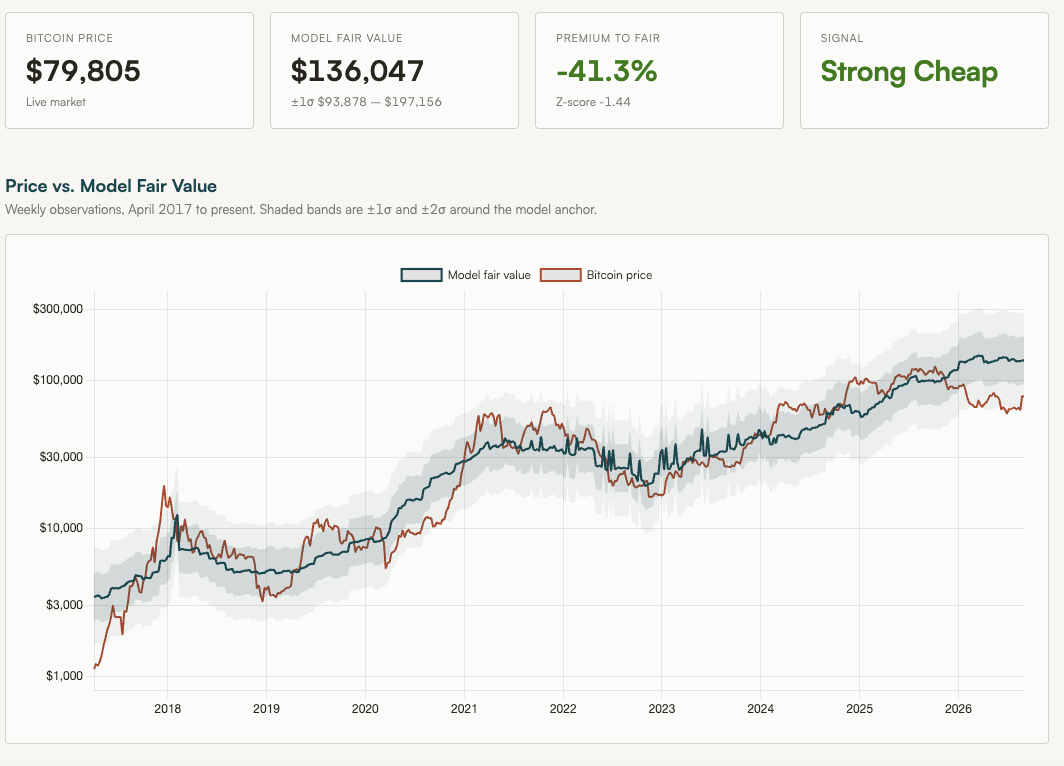
I expect Bitcoin will continue to be highly correlated with liquidity in the global financial system. My model says each 1% rise in Global M2 YOY adds ~4.5% to fair-value BTC. Model fair value is $136,050.

On May 26, on Anthony Pompliano’s podcast, I said,

The mispricing today in Bitcoin is as large as I’ve ever seen before in the model.” And I explained why: “I think that’s because the tech stocks have been so strong that all of the risk capital has fled into tech stocks, and it had to come out of somewhere.

My conclusion:

I think we’re seeing a great opportunity today in Bitcoin, certainly the best opportunity I’ve seen in Bitcoin in a decade.

On June 20, we published an entire issue of my newsletter, Complete Investor, about Bitcoin:

In this issue, we’re re-recommending Bitcoin (BTC). And we believe buying it now, before the next halving, will prove to be the single best financial decision of the next decade.

By June 30, Bitcoin had fallen to $58,524. It recovered through August, and today is trading above $79,000. But… despite the rebound… Bitcoin is still trading below the lower 1-sigma band of around $94,000 of our pricing model.

Nero shaved the denarius. And every empire since then has destroyed itself and most of its people through debasement. But nobody can shave a Bitcoin.

If you use their money, you’ll be their slave. Free yourself with Bitcoin.

Tell me what you think of today’s Daily Journal: porterstansberrydirect@gmail.com

Good investing,

F. Porter Stansberry
Stevenson, Maryland


Presented By: TradeSmith

cbttninethtradingfour.png

What Happens on the 9th Trading Day?

Coming up on the 9th trading day of this month, you buy five specific blue-chip stocks. Then you could potentially watch your money grow like clockwork — all without using leverage or options. Click here to see why just five stocks, and why this one day each month is the only day that really matters.

Editor’s Note: Keep in mind, we only accept advertising from publishers we know to offer well-researched ideas vetted by a legal team, excellent customer service, and reasonable refund policies. TradeSmith is one such partner. We do not, however, under any circumstances make any representations about their investment ideas or strategies, nor will we warrant them as equal to our own. We do recognize that the markets are tempestuous and, at times, ideas that we may not endorse prove valuable.


3 Things To Know Before We Go…

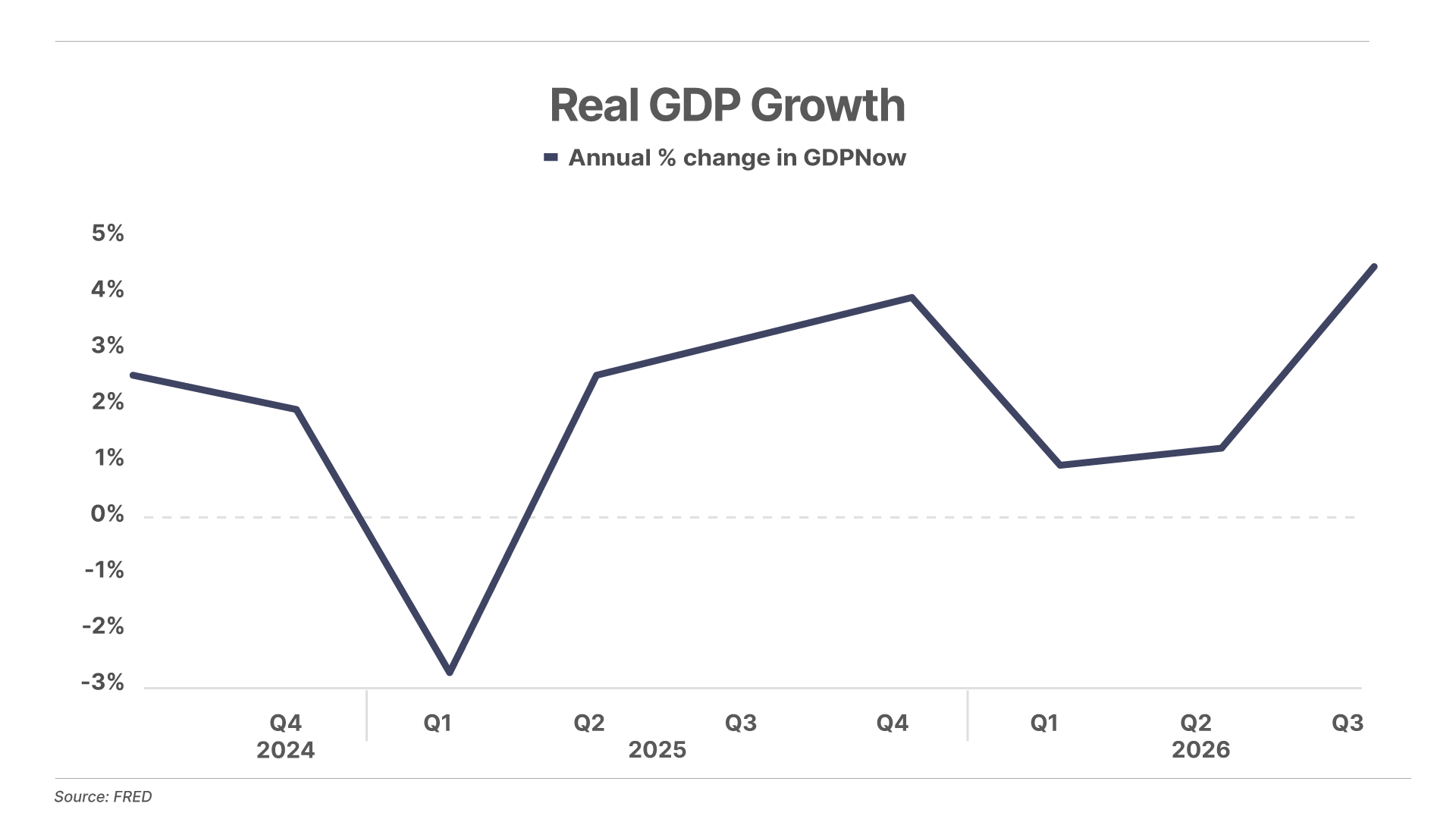
1. The Atlanta Fed says the economy is growing at a 4.7% annual rate this quarter. That September 3 reading from GDPNow is a “real” figure, meaning it has already subtracted inflation. Add prices back, and nominal growth is running near 8%. The gap with Wall Street is wide: when GDPNow touched 6.2% in early August, economists’ consensus was just 2.2%. At this pace, the October 29 GDP release could show real growth of 6.5% to 7%, five days before the midterms.

2. August hiring puts a September rate hike back in play. U.S. employers added 162,000 workers to payrolls, roughly three times the 53,000 economists had forecast, and the Labor Department revised June and July up by a combined 55,000, turning a reported July job loss into a gain. Unemployment held at 4.1%. With inflation still above the Fed’s 2% target, Chair Kevin Warsh might push to raise rates. Futures pricing for a quarter-point hike on September 16 moved to 59% from 52% before the release. The two-year Treasury yield, the maturity most sensitive to Fed policy, hit its highest level since January 2025.

3. Diesel shortage sends prices to new high. The U.S. national average price of diesel fuel has reached a record $5.62 per gallon, surpassing the prior high of June 2022. The market is grappling with an unprecedented shortage driven by the supply-chain disruptions from the war with Iran, with inventories at the lowest seasonal levels on record. Given diesel’s role as a critical transportation fuel, this will likely push prices higher throughout the economy, leading to sticky inflation in the months ahead.


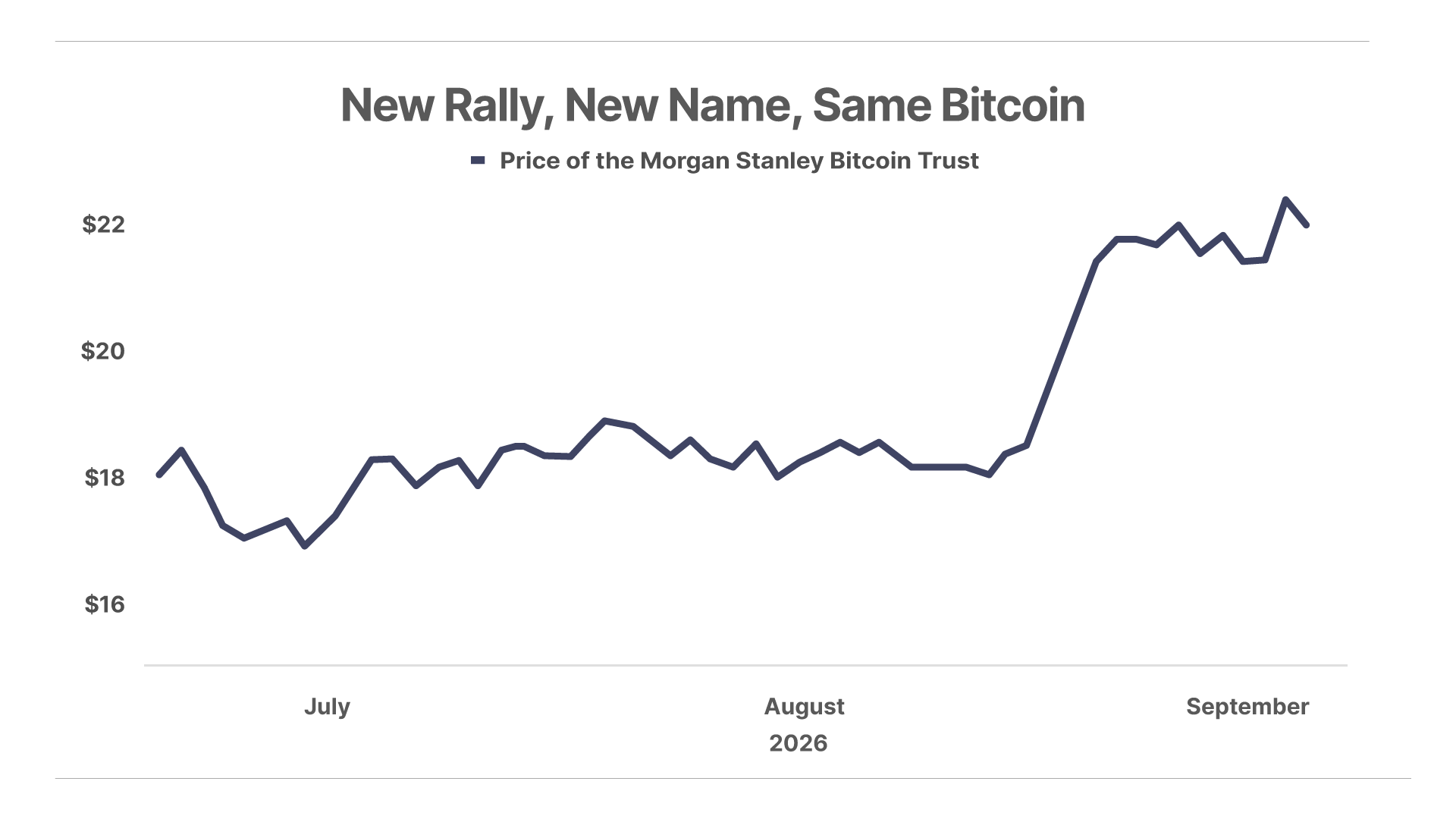
Chart Of The Day… Morgan Stanley Bitcoin Trust (MSBT)

The Morgan Stanley Bitcoin Trust (MSBT) has rallied nearly 27% since we re-recommended Bitcoin in the June 20 issue of Complete Investor.


Mailbag

“Impossible To Lose Money”

Bill C. writes:

Reading through your original product description of Porter’s Permanent Portfolio, it states: “The portfolio is structured in a way that makes it difficult – essentially impossible – to lose money, no matter what happens to the economy, or to individual stocks.

Well, apparently I have achieved the impossible! My portfolio is DOWN 2.4% YTD. The one-year at 3.8% is positive but lower than target. When I first built the portfolio in late December 2024 I followed the recommendations exactly as well as investment % of each asset.

Earlier this year, I followed your recommendation and sold all of the P&C assets. That 25% now is a cash from 12.5% recommended to 4%. And moved most of that into FNV and GLD. Gold and Bitcoin are 22% of the portfolio.

I would appreciate any comment you have as the portfolio is clearly not meeting any of it’s performance expectations.

Porter Comment: I appreciate you reaching out.

But I’ve got bad news for you: you’re not following Porter’s Permanent Portfolio.

It did not sell property-and-casualty (P&C) stock. As I made very clear, the recommended allocation for the Permanent Portfolio would not change until the 10-year yield went to 5% or higher. It has not yet reached that level, and I have not changed any of the allocations on the recommended portfolio.

Please see the website for the actual current allocations.

Now, what you’re going to say is, yeah, but you said, x,y, and z.

And yes, I did. I said if you couldn’t tolerate a drawdown, then you could go to a bigger cash allocation and reduce your volatility.

If you did that, you’re doing fine.

But I said, repeatedly, that Porter’s Permanent Portfolio is a “permanent” allocation strategy. It only rebalances once a year. And that strategy hasn’t – and won’t – change unless there is a dramatic change to the market’s fundamentals, like the 10-year moving over 5% yield.

Here’s the good news: there’s now an ETF that invests exactly in Porter’s Permanent Portfolio – called the Porter & Company Porter Portfolio Index (PCPP).

Regards,
Porter


“Numbers R Us”

William C. writes:

Years ago, when we were on the way to do something on Saturday (Daddy day), my youngest (probably eight or nine) exclaimed, “Daddy, look, Toys R Us.”

I said, “Daddy is Numbers R Us.”

She is now 31, but her daddy still pays attention to numbers.

I bought Complete Investor a few years ago, and just watched and kept track of your recommendations for most of a year. I groan every time I see the growth of BWX Technologies (BWXT), which I thought might be good, but it was still early in my watching stage.

I’ve taken positions in monthly Best Buys.

Although many won’t put money into investments outside the U.S., when your team presents a case for investing outside our borders, I’ll give it strong consideration. Simply because you and your team provide strong cases with detailed analysis (with lots of numbers) of every recommendation.

And, they work. I took the leap to become a Partner and have made enough to pay for that in the past year.

So whether the recommendation is in Arizona, Hell, or thousands or miles outside our border, making money is always good.

Sincerely

Porter Comment: Brilliant note – thank you!


Porter & Co. Market Snapshot

Price Yesterday’s Return Year-to-Date Return
S&P 500 Index $7,747.71 1.07% 14%
Gold per ounce $4,472.92 2.08% 1.3%
Bitcoin $81,271.74 5.27% -9.2%
Oil (West Texas Intermediate) per barrel $91.30 0.66% 57.1%
Berkshire Hathaway (BRK) $763,022.00 0.60% 1.1%
Porter’s Permanent Portfolio – 1.66% 5.3%
The Better Than Berkshire Index – 0.73% 8.6%
Total Return Annual Return
Porter & Co’s Top Ranked* 36.8% 16.8%
Yield Yesterday’s Change Change
Year-to-Date
U.S Treasury 30-Year Yield 5.25% -1 bps 40 bps
Prices as of 4:00 pm ET September 3, 2026 | bps = basis points (or 0.01%)
*A Complete Investor risk rating of 1 is defined as a “low risk, high allocation” security, while positions rated closer to a 5 are higher risk. Porter & Co.’s top-ranked positions include those rated either 1 or 2 in Complete Investor portfolio.


Porter & Co. Top Positions

Publication Ticker Description Total Return
Biotechnology QURE uniQure 237%
Biotechnology SGMT Sagimet Biosciences 203%
Complete Investor BTC/USD Bitcoin 201%
Complete Investor BWXT BWX Technologies 182%
Biotechnology NUVB Nuvation Bio 167%
Biotechnology TGTX TG Therapeutics 159%
Biotechnology ROIV Roivant Sciences 152%
Complete Investor SKWD Skyward Specialty Insurance 136%
Complete Investor PM Philip Morris 132%
Biotechnology QURE uniQure 131%
Prices as of 4:00 pm ET September 3, 2026

Please note: The investments in our “Porter & Co. Top Positions” should not be considered current recommendations. These positions are the best performers across our publications – and the securities listed may (or may not) be above the current buy-up-to price. To learn more, visit the current recommendations page of the relevant service, here| New Window. To gain access or to learn more about our current recommendations, call our Customer Care team at 888-610-8895 or internationally at +1 443-815-4447.

The post You Probably Don’t Own Bitcoin And That’s A HUGE Mistake appeared first on Porter & Co..

  •  

AI is about to revolutionize money and banking. Here’s how to profit

Today’s issue in preview:

  • AI is about to revolutionize money and banking. Here’s how to profit

  • This giant trend is creating more stock market winners than any other

  • One of the world’s most important infrastructure firms just reached an all-time high. That’s good for you.

  • Learn our Top Themes to buy now


AI is about to revolutionize money and banking. Here’s how to profit

Image

Credit: jroballo

Over the past two weeks, we have written a special series of research notes on the coming revolution in money, finance, and investing.

In short, the confluence of AI and blockchain technology is about to revolutionize how we save, spend, transfer, and invest our money. This revolution is poised to generate enormous gains in the stock market and cryptocurrency markets.

For example, we’ve singled out cryptocurrency exchange and infrastructure firm Coinbase (COIN) and stablecoin firm Circle Internet Group (CRCL) as companies poised to benefit from the coming revolution.

But as you review the investment landscape here, don’t forget about the foundation much of it runs on: Ethereum.

Ethereum is the foundation on which stablecoins run. It’s where most tokenized assets are held. It’s the global infrastructure layer for this revolution in money.

Ethereum is not a company or a stock. Instead, it is a blockchain network that enables developers to build applications and execute smart contracts – programs that automatically execute transactions when certain conditions are met. Its native cryptocurrency, Ether (ETH), is used to pay transaction fees.

Think of Ethereum as a computer that everyone can use… one with powerful financial utility.

Right now, when you send money or buy a stock, there are middlemen: banks, brokers, clearing houses, agents, etc. They’re the recordkeepers, and they maintain the ledger that says who owns what.

Ethereum replaces those middlemen with something called a blockchain. This is a shared, tamper-proof record book maintained by thousands of computers simultaneously around the world. No single bank or government can control it.

But Ethereum didn’t stop at just being the recordkeeper. Its founders built it to be programmable, so developers can run code on top of it. This means that:

  • Money can be sent when certain conditions are met

  • Issuance of digital versions of stock can be given

  • A loan can be created that manages itself

This programmability and adaptability make Ethereum the key blockchain above all other blockchains.

And this is why the majority of stablecoins – the “dollars that computers use” as we’ve described them – run on Ethereum.

USDC, the stablecoin issued by Circle, settles on Ethereum. Most of the stablecoin volume processed by Visa runs through Ethereum.

In fact, Ethereum currently holds a 53% share of all decentralized finance activity globally.

Here’s a key part to understand: ETH is not a stock in a company. There is no corporate balance sheet, no earnings calls, and no claims on anyone’s profits.

It is the asset that makes this shared computer run – the fuel for every stablecoin transfer, every tokenized share, and every self-executing loan built on top of it. You are not buying equity in Ethereum.

You can purchase ETH directly through crypto exchanges such as Coinbase, but it does not sit inside a standard brokerage account the way a stock does.

For many investors, particularly those who prefer to stay within their existing brokerage and don’t want to manage crypto wallets… buying ETH can be outside their comfort zone.

This is where Bitmine Immersion Technologies (BMNR) can come in handy.

BMNR is a publicly traded company on the NYSE that gives you a leveraged bet on the Ethereum trade. The company has adopted an aggressive Ethereum treasury strategy. Rather than holding cash or bonds, BMNR has accumulated ETH at an incredible scale. It holds approximately 5.9 million ETH tokens. It is the largest corporate owner of ETH in the world.

It’s a similar strategy to what Michael Saylor has employed at Strategy (MSTR) (formerly MicroStrategy), raising capital to accumulate Bitcoin. Bitmine is pursuing the same playbook to buy more ETH.

BMNR has performed poorly during this crypto pullback, but over the last month, it has risen 37%, reaching fresh three-month highs. This makes it a stock to watch for a continued breakout.

Ethereum isn’t just part of the AI-native finance revolution we have been detailing in Money & Megatrends. In many respects, it is the revolution.

Image

Recommended Link:

Elon Musk, Peter Thiel, Sam Altman Back New Potential $367 Trillion “Medical AI”

Ad Image

The three most successful tech billionaires in history are now backing a new use for AI that could dwarf anything we’ve seen before. And Nature says this tech is so revolutionary, it could add $367 trillion to the economy – the equivalent of $1 million per American. Click here to see the stocks that could soar as “Medical AI” goes online nationwide.

This giant trend is creating more stock market winners than any other

Image

Credit: Pixelbizz

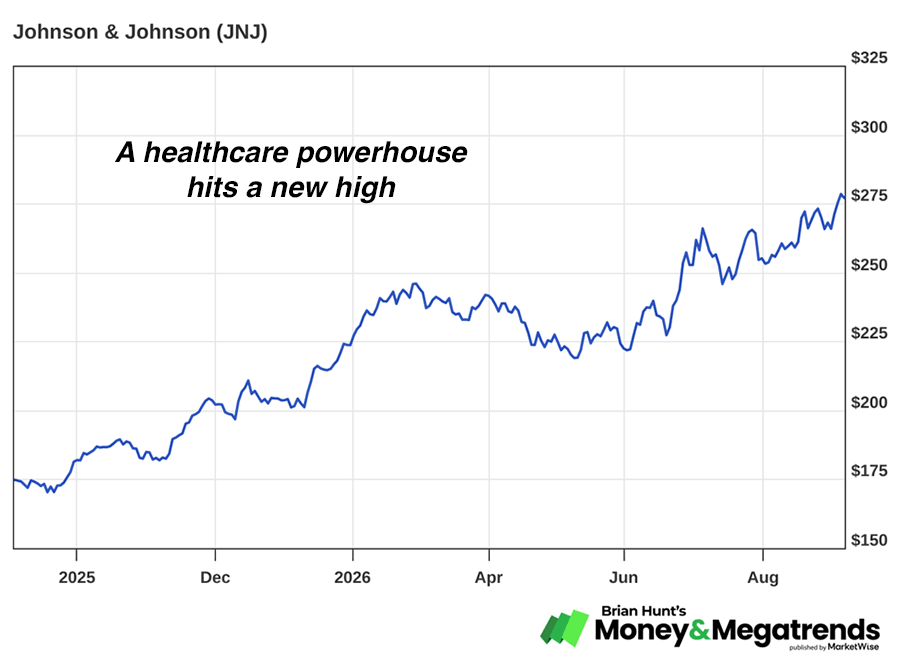
The bull market in “Boomer healthcare” we’ve been writing so much about got even stronger yesterday.

Pharmaceutical giants Johnson & Johnson (JNJ) and Bristol Myers Squibb (BMY) reached new all-time highs.

J&J is one of the world’s largest healthcare companies. It focuses on prescription drugs and medical devices, such as orthopedic implants and cardiovascular devices. The company’s blood cancer treatment, Darzalex, is one of the top-selling drugs in the world, with annual sales over $14 billion.

For years, J&J had a large consumer product division that sold Tylenol, Band-Aids, and Listerine, but that business was spun off in 2023 into a company called Kenvue (KVUE).

Bristol Myers Squibb is a major pharmaceutical company concentrated in oncology, hematology, cardiovascular disease and immunology. Its biggest products include Eliquis (blood thinner), Opdivo (cancer immunotherapy) and Revlimid (multiple myeloma).

For more than three years, I’ve made “Boomer health care” one of my highest conviction long-term investment themes. This means I’ve been bullish on biotech, genomics, and healthcare in general. In more than 20 Money & Megatrends research notes over the past year, we’ve been very bullish on stocks and ETFs related to this trend.

Regular readers are familiar with the bull case here. More than 10,000 Americans reach retirement age every day. The U.S. population aged 80 and older is projected to roughly double, from 14.7 million in 2025 to 29.4 million by 2045.

This is the enormous Baby Boom generation entering the phase of life where health care and longevity spending skyrocket. For many boomers, a typical month involves going to see at least one doctor to have something looked at, removed, or treated.

This means many health care businesses are experiencing huge demand now – and will for at least the next decade. It means boom times ahead for many “ology” businesses, stocks, and careers. Dermatology. Cardiology. Radiology. Oncology. Anesthesiology. Ophthalmology. The list goes on.

Investing in many healthcare businesses over the next decade will be investing with a gale-force tailwind at your back. If you’re a parent and worried about your child getting a job, just point them to the booming healthcare industry. The new highs generated by two of the largest leaders show this bull market is alive and well.

The strong demographic tailwinds described above are driving powerful revenue and profit growth for companies like Johnson & Johnson and Bristol Myers Squibb. Given the very long-term nature of this trend, we expect to see many more new highs in the healthcare sector.

Image


One of the world’s most important infrastructure firms just reached an all-time high. That’s good for you.

Image

Credit: Maudib

If you’re looking for a reason to feel optimistic about the global economy over the weekend, look no further:

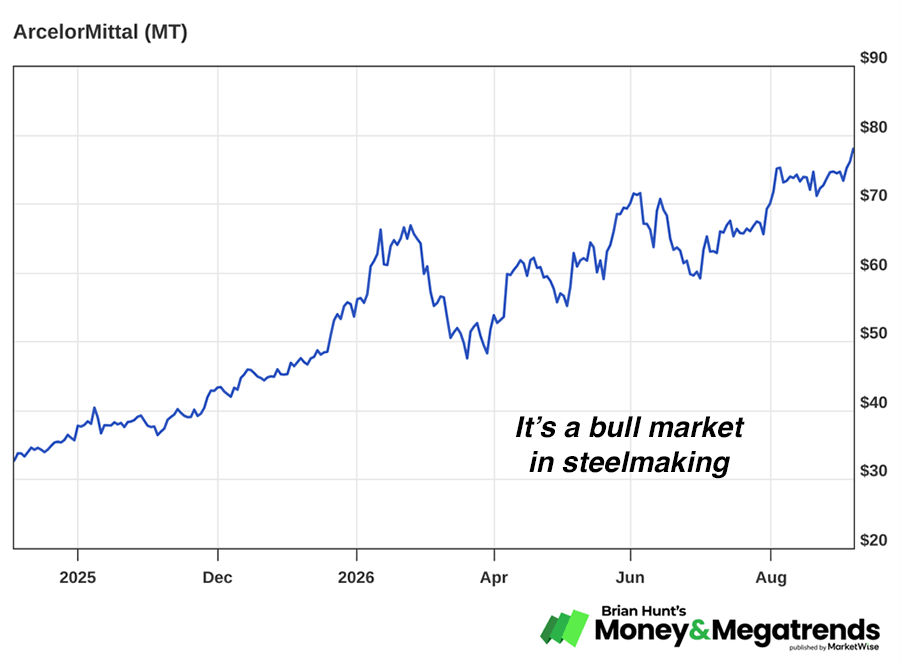
The world’s largest public steelmaker by production – ArcelorMittal (MT) – just reached an all-time high.

That’s a bullish economic signal. And it’s a great signal for your 401(k).

ArcelorMittal is one of the most important companies that most people have never heard of. MT was created in 2006 through the merger of European steel giant Arcelor and Indian steel giant Mittal Steel.

Headquartered in Luxembourg, ArcelorMittal produces roughly 55-60 million metric tons of steel annually, with major operations across Europe, North America, South America, and Africa. Its steel is used in automobiles, construction, infrastructure, machinery, appliances, and energy projects.

Unlike many steelmakers, ArcelorMittal is also vertically integrated, owning substantial iron ore and coal mining operations that supply raw materials to its mills. The company produces everything from automotive-grade sheet steel to heavy plate and structural products.

In today’s high-tech world of iPhones, ChatGPT, video streaming, and Instagram, it’s easy to forget our world is built on a low-tech foundation of steel, concrete, and lumber.

Steel is a major component of bridges, cars, trucks, electric grids, ships, pipes, factories, construction equipment, and skyscrapers. This makes the steel industry highly sensitive to the economy’s ups and downs. When the economy booms, the steel industry booms with it. When the economy busts, so does the steel business.

Over the past eight months, I’ve written over a dozen research notes analyzing the soaring share prices of similar highly economically sensitive industry groups, including trucking stocks, railroad stocks, regional banks, manufacturing stocks, shopping mall operators, and hotel chains.

At the end of each note, I pointed to their soaring stock prices and told readers that the U.S. economy is doing much better than most people think.

These economically sensitive firms are important “real world” indicators. They almost always do a better job of telling us what is happening in the economy than any media outlet or economist. And their uptrends are moving in a bullish upward direction for the global economy as a whole.

Driven by strong demand, MT’s latest earnings report detailed 5% annual revenue growth and 11% EBITDA growth. MT’s stock is up 138% over the past year and reached a new all-time high today.

Does the global economy have imbalances and big problems? Of course. It always does. But making money in stocks is never the result of a problem-free economic environment. It’s always about being in an environment where the big problems are overwhelmed by the even bigger positives.

Right now, these bigger positives are sending MT to new all-time highs. The world’s largest steelmaker does not do this when the economy is weak.

Image


Market Notes

  • The bull market in agriculture we’ve been detailing just drove farm equipment giant CNH Industrial (CNH) to a new one-year high.

  • Apparel giant Lululemon (LULU) dropped 17% this morning to reach a new one-year low after reporting weak earnings and guidance.

  • The WisdomTree Emerging Markets High Dividend Fund (DEM) reached a new all-time high today.

  • The iShares Singapore ETF (EWS) reached a new all-time high today.

  • Oil shipping giant Frontline (FRO) reached a new one-year high today.

Regards,

Brian Hunt signature

Brian Hunt signature

Brian Hunt
Editor, Money & Megatrends


An urgent message from our colleagues:

Landmark Executive Order 14241 Unleashes Trump’s New Dollar

Image

Republican or Democrat – whether you support or oppose Trump’s New Dollar – every American could soon be forced to use it.

Discover three critical moves to help you prepare, before it’s too late.

The post AI is about to revolutionize money and banking. Here’s how to profit appeared first on MarketWise.

  •  

How to trade the world’s most important trend

Today’s issue in preview:

  • How to trade the world’s most important trend

  • This chart shows why you should be bullish and buy stocks

  • Why you should be bullish on Bitcoin right now

  • Learn our Top Themes to buy now


How to trade the world’s most important trend

Image

Credit: KanawatTH

The world’s most important trend just got a big boost from Nvidia (NVDA).

Last night, the world’s largest semiconductor firm reported extraordinary second-quarter results that came in well ahead of estimates.

Nvidia CFO Colette Kress said that the company expects revenue growth of 70% for fiscal 2028, which goes from February 2027 to January 2028. CEO Jensen Huang said demand “is much greater than 70%,” but Nvidia is constrained on how much product it can supply.

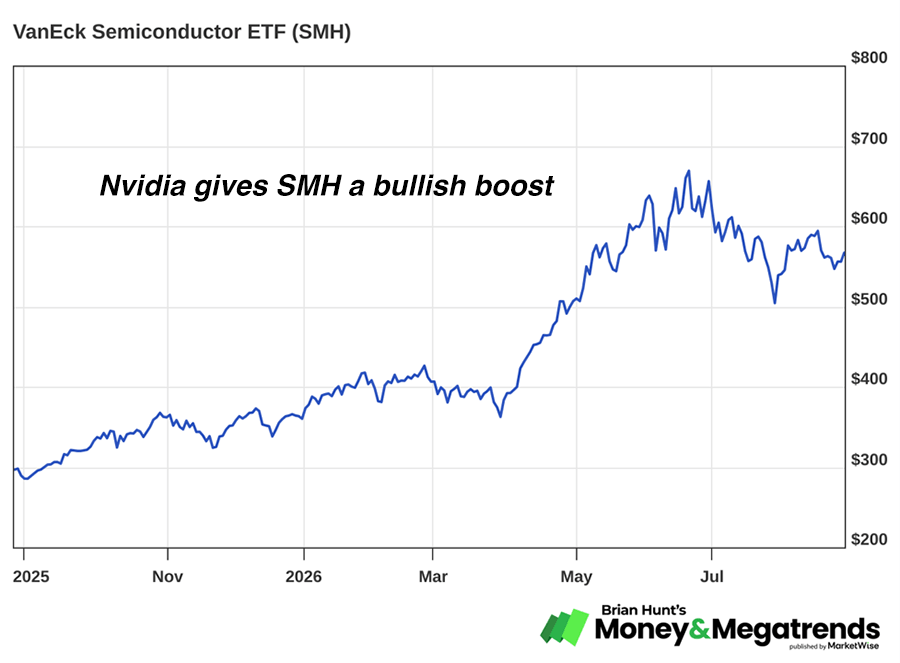
In response to this good news, Nvidia shares climbed 7.5% during the morning trading session. It also sent the VanEck Semiconductor ETF (SMH) up 2.17%.

Over the past month, we have published a special series of research notes analyzing the semiconductor trend, a key part of “the world’s most important trade.”

The status of this critical tech sector has become one of the great sagas of the business and investment world… a source of intense disagreement among industry bulls and bears.

The semiconductor industry has always been a critical part of our high-tech economy. Semiconductors are the “tiny engines” that power our computers. However, the proliferation of AI has turbocharged the industry’s revenues, stock prices, and importance to the global economy. It has also made industry leader Nvidia a $5+ trillion colossus. The stock is up more than 1,300% since Jan. 1, 2023.

In June 2025, semiconductor stocks broke out of a sideways consolidation pattern and began a rally for the ages. During this rally, the world’s largest semiconductor ETF – SMH – gained 147% in just under a year.

Individual semiconductor leaders AMD (AMD), Marvell Technology (MRVL), and Lattice Semiconductor (LSCC) gained more than 200% during that time. Stock gains of 25% in a month became commonplace.

When a sector gains 50% in a year, that’s considered incredible. What semis returned was “triple incredible.”

Avid Money & Megatrends readers know what drove those giant returns. Given AI’s enormous promise, large tech firms such as Alphabet (GOOG), Amazon (AMZN), and Microsoft (MSFT) have invested over $1 trillion in AI infrastructure. They are on pace to invest over $700 billion this year alone and more than $3 trillion after that.

Both the scale and the velocity of this investment boom are unprecedented. It is the largest collective investment effort in history.

A lot of this money was used to purchase semiconductors. Semiconductor industry revenue totaled $793 billion in 2025, an increase of 21% year-over-year, according to Gartner, Inc.

Big Tech’s historic investment boom has made the entire “AI infrastructure” trend responsible for a large share of America’s GDP growth and stock market returns over the past two years. It has also drawn the skeptical scrutiny of many widely followed investment analysts who claim the trend is a bubble… one that will soon explode and cause tremendous damage to stock prices and the global economy.

I believe the AI infrastructure trend has years to run. I believe the world’s smartest, most connected tech CEOs who have the greatest access to information on AI advancement and return on AI infrastructure spend like Jensen Huang, Satya Nadella (Microsoft) and Andy Jassy (Amazon) just might know more about this business than the bearish armchair AI quarterbacks know.

As much press as AI gets, let’s remember that less than 1% of the global population pays for top-tier AI programs. And I estimate less than 20% of large companies believe AI has made a meaningful impact on their businesses. It’s probably closer to less than 10%.

This revolutionary technology hasn’t yet proliferated, achieved mass adoption, or had mass impact.

Regular readers know I care a lot more about what the market thinks of any stock, trend or theme than what any one person thinks of it, including me. You can be bullish or bearish on a trend all you like, but if that trend is moving strongly against you, then your idea isn’t worth a hell of a lot in my book.

With this in mind, let’s look at industry giant Nvidia’s effect on the state of semis. The semiconductor sector is our preferred way to track and analyze the hugely consequential AI infrastructure megatrend.

Given its AI drivers and big returns, it’s no wonder semis became the world’s “hottest trade” this summer. And when any theme becomes the world’s hottest trade, it becomes a leading candidate to experience a significant correction or something worse.

That’s just how the stock market works. When a bull market grows very popular and attracts a lot of speculation, it likes to “buck off” market participants with a sharp correction or worse.

That’s what has happened to the semiconductor trade this summer. After soaring from June 2025 to June 2026, SMH declined 24%. Some individual semi names declined by more than 35%.

As you can see in the two-year chart below, the SMH share price declined from the mid-$600s to the mid-$500s. Since reaching a low in late July, SMH has traded up and down, failing to establish a meaningful trend. In other words, “becalmed” as described above.

In my July 20 health analysis of SMH, I stated that if long-term AI bulls are proven right by the market, SMH will likely “digest” its summer losses by trading in a sideways consolidation pattern for 3-6 months… and then recover to trade back to the mid-$600 area and beyond.

If the AI bears are right, SMH won’t see that mid-$600-per-share level for years… and we are much better off focusing on other trends.

As you can see in the chart below, SMH is getting a boost today… but it is still trading in a directionless sideways consolidation pattern. If the current rally can take SMH back to the $620 level, we can say this critical trend is enjoying restored health. We will keep you updated.

Image

Recommended Link:

Tonight, Louis Navellier Closes the Doors

Ad Image

Until midnight, you can claim a full year of Louis Navellier’s brand-new research… the project that ended his 47-year run as Chief Quant Analyst… at 60% off. It’s a totally new approach to the AI boom, built with Eric Fry and Luke Lango – one the team believes could realistically double your entire portfolio in the years ahead. Doors close at midnight. Until then, click here for the full details.

This chart shows why you should be bullish and buy stocks

Image

Credit: Art Wager

If you’re looking for reasons to be optimistic on the U.S. economy and U.S. stocks, look no further: The iShares U.S. Broker-Dealer & Securities Exchanges ETF (IAI) recently registered a new all-time high.

This is a bullish signal for America… and for your 401(k).

Since the current bull market began in 2023, a whole doom-and-gloom industry has been built on bearish stock and recession forecasts. Anyone who listened to the “prophets of the apocalypse” and avoided stocks has missed a historic wave of wealth creation. The bears have sounded clever, but they’ve been very, very wrong.

Sure, the U.S. economy has imbalances and problems. But it also has tremendous forces working in favor of prosperity. Energy independence. Food independence. The world’s most dynamic system for creating and funding new businesses. The world’s largest and most innovative technology industry. A system that rewards hard work, risk-taking, and value creation.

These “forces for good” are manifesting themselves in IAI’s all-time highs.

IAI is a unique ETF focused on companies in the business of money flows… companies that function as the business and investment world’s “circulatory system.”

The fund includes investment banks, securities exchanges, stock brokerages, financial index providers, and credit rating agencies.

Major holdings include diversified giant Goldman Sachs (GS), fellow giant Morgan Stanley (MS), brokerage firm Charles Schwab (SCHW), brokerage firm Robinhood (HOOD), credit rating agency Moody’s (MCO), and financial exchange giant CME Group (CME, formerly Chicago Mercantile Exchange).

These firms provide the grease and gears that make the world’s financial markets engine go. They eventually get a substantial “cut” from all kinds of financial activities, such as IPOs, 401(k) management, option trades, stock index administration, ETF management, stock purchases, commodity transactions, wealth management, debt issuance, and credit ratings.

Their fortunes rise and fall with the health of global financial markets. The new highs reached by their ETF are a bullish economic signal. The fund has returned a stellar 57% over the past two years.

Over the past 10 months, I’ve written over a dozen research notes analyzing the soaring share prices of highly economically sensitive industry groups, including trucking stocks, regional banks, manufacturing stocks, diesel engine makers, steelmakers, shopping mall operators, and hotel chains.

At the end of each note, I pointed to their soaring stock prices and told readers that the U.S. economy is doing much better than most people think.

This exceptional price strength in key components of America’s economic machine means the economy is doing much better than the news you hear from the mainstream media.

We can add IAI’s new highs to this long list of positive market trends. The business of money, investment, and corporate finance is booming. Manage your financial affairs accordingly!

Image


Why you should be bullish on Bitcoin right now

Image

Credit: Vertigo3d

Minute by minute… day by day… things keep getting a little better for Bitcoin bulls.

This week, the beaten-up cryptocurrency rallied to reach $80,000 – its highest price in three months. This action gives me confidence in saying that our bullish March 13 note was well-timed.

After reaching an all-time high of around $125,000 last October, Bitcoin entered a brutal bear market, declining by about 48% to the mid-$60,000 range.

Crypto specialists attributed this decline to the U.S. government withdrawing liquidity from financial markets, as well as to gold and AI trades drawing money flows that could have been directed toward Bitcoin.

Most long-term Bitcoin believers see it as a “store of value” that should maintain its purchasing power like gold and beachfront homes do. It should be a digital form of “hard money.” Sounds great.

However, from October 2025 to February 2026, Bitcoin traded more like a failing technology company than anything you’d call strong and stable.

In March, Bitcoin’s trading behavior underwent a significant change. It formed a bottom and gained 9.5% in one month, while technology stocks dropped and gold gained just 3.2%. Importantly, Bitcoin outperformed stocks and gold as Operation Epic Fury created tremendous market volatility and hammered many sectors of the stock market. It was a “port in the storm.”

Importantly, Bitcoin recently rallied above its long-term 200-day moving average. This is a good sign of an improving health trend. Remember what we say about the 200-day moving average around here: Securities below their 200-day moving average are on the wrong side of the tracks. It’s the ugly part of town. All the really bad things happen below the 200-day moving average. Bitcoin just broke about it.

So, after a year of disappointing believers, has Bitcoin regained its place as a “store of value”? Is it ready to be a “port in the storm” and a stabilizing component of serious portfolios? I hope so. The world is a better place when Bitcoin is rising, and we have not one but two forms of hard money to own. Plus, I like it when the “crypto bros” get chirpy on X and antagonize the skeptics.

Count me bullish on Bitcoin and its new rally.

Image


Market Notes

  • Our recommendation to invest in cybersecurity is paying off nicely. Okta (OKTA) just reached a new yearly high, and Palo Alto Networks (PANW) is up 10% today. PANW is now +150% since our March recommendation.

  • Our recommendation to invest in the genomics megatrend continues to pay off. Cancer genomics leader NeoGenomics (NEO) just hit a new high. It’s now up 166% in the last month. Genomics analytics giant Illumina (ILMN) reached a new one-year high.

  • Global and community banks are showing strength. Japanese investment banking giant Nomura Holdings (NMR) and community lender Private Bancorp of America (PBAM) reached new highs today.

  • Our Oct. 2, 2025, recommendation to own the natural gas theme is doing very well. The US Natural Gas Fund (UNG) just hit a new high, as individual names like Range Resources (RRC) have gained around 7.5% this month.

Regards,

Brian Hunt signature

Brian Hunt signature

Brian Hunt
Editor, Money & Megatrends


An urgent message from our colleagues:

Wall Street veteran goes ALL in on Bank of Elon

Image

A 20-year Wall Street veteran – who worked at a $10 billion hedge fund – is putting ALL his money in Elon Musk’s new bank. He says he can see the writing on the wall for traditional banks. And he’s not the only one.

See if you should join him here (not just for the 6% yield).

The post How to trade the world’s most important trend appeared first on MarketWise.

  •  

Six elite stocks to play the bull market in gold

Today’s issue in preview:

  • Six elite stocks to play the bull market in gold

  • AI will drive a revolution in money and banking. Three stocks for the coming shift.

  • Learn our Top Themes to buy now


Six elite stocks to play the bull market in gold

Image

Credit: Backyard Production

Last week, the U.S. government announced that total U.S. debt topped $40 trillion for the first time.

The government’s debt has more than doubled in less than a decade, from $19.95 trillion when President Donald Trump was sworn in for the first time in January 2017.

Net interest payments on the debt are projected to total more than $1 trillion in fiscal 2026. Interest payments now exceed defense spending and Medicare spending. Servicing debt is now the second-largest item in the federal budget, behind only Social Security. It is expected to cost more than $16.2 trillion over the next decade.

Given all this, it is no wonder gold recently rallied from $4,000 per ounce to $4,600 and resumed its long-term uptrend.

In 2003, I placed over half of my net worth into physical gold. Since making that bet, gold has risen about 1,170%, far outperforming stocks. I haven’t sold one ounce along the way. Over the years, I’ve held huge positions in gold stocks.

And now, all these years later, the best reason I can find to be bullish on gold is the same reason why I bought gold in the first place…

The U.S. government is spending far more money than it takes in and then makes up the difference by borrowing and printing money by the trainload. Every freshly printed unit of currency debases an existing one. This raises the nominal price of real money (gold). Gold has spent the past 23 years constantly revaluing itself to accommodate the huge increase in new currency units.

Here in mid 2026, the problem is worse than ever. In America, millions of people are net tax recipients – meaning they receive more in benefits than they pay in taxes.

No politician can win a major election by promising reduced spending. Too many people are now riding the gravy train. Democrat or Republican, it doesn’t matter. Campaigning on sensible spending is a sure loser.

This makes it a good time to know “who’s who” in the gold royalty business.

In our recent analysis of the unique ETF, Horizon Kinetics Inflation Beneficiaries ETF (INFL), I covered its business model.

Gold royalty firms are a unique type of company. They do not engage in the business of operating gold mines. Instead, they are essentially resource banking/investment firms. They raise investor capital and then invest it in prospective or existing resource projects.

They partner with mine and oilfield operators… buying upfront stakes in projects in exchange for a share of future production. In doing this, the best royalty firms own diversified resource portfolios and enjoy high-margin businesses without doing the day-to-day work of operating mines or oilfields.

This “high margin, asset-lite” business model allows the best royalty firms to generate strong profit margins, consistent cash flow and leverage to rising gold prices. This in turn makes royalty firms the preferred vehicles for many sophisticated investors to invest in gold for the long term.

Compelling gold royalty firms include:

Royal Gold (RGLD): RGLD is one of the largest precious metals companies. Royal Gold has major interests in several large, long-lived mines, including Mount Milligan in Canada, Pueblo Viejo in the Dominican Republic, Cortez in Nevada, Andacollo in Chile and Kansanshi in Zambia. Mount Milligan and Pueblo Viejo are particularly important cash generators. The portfolio is primarily gold-focused but provides meaningful exposure to copper. Market cap: $22.6 billion.

Franco-Nevada (FNV): Franco-Nevada owns one of the industry’s largest and most diversified portfolios, spanning hundreds of mining and energy assets across numerous countries. Major contributors have included Candelaria, Antapaccay, Antamina and various Nevada gold operations. Gold accounts for most of its value, supplemented by silver, platinum-group metals, copper and energy. Market cap $52 billion.

Triple Flag Precious Metals (TFPM): Triple Flag’s important assets include Northparkes and Ravenswood in Australia, Cerro Lindo in Peru, Impala Bafokeng in South Africa, Buriticá in Colombia and Fosterville in Australia. Its portfolio is heavily weighted toward gold and silver and geographically concentrated in the Americas and Australia. Market cap $7.2 billion.

OR Royalties (OR): Formerly Osisko Gold Royalties, OR’s flagship asset is its valuable interest in Agnico Eagle’s Canadian Malartic complex in Quebec, one of Canada’s largest gold operations. OR also has exposure to other producing and development projects, including several Canadian assets. Market cap $7.3 billion.

Gold Royalty Corp. (GROY): Gold Royalty has assembled a large portfolio of interests across the Americas, with particularly significant exposure to gold projects in Canada and the United States. Unlike the industry’s giants, much of GROY’s potential value comes from mines and projects that are still being developed, expanded or explored. That creates potentially substantial production growth over time but also makes future cash flows less certain. Market cap: $815 million.

Versamet Royalties (VMET): Versamet is an emerging player whose portfolio provides exposure to precious and base metals across producing, development and exploration-stage properties. The company’s attraction is largely its growth potential: because it remains relatively small, successful mine developments, expansions and additional acquisitions can materially increase its cash flow and asset value. Market cap $1.2 billion.

Recent government spending and taxation data tell us the government is going “full speed ahead” with spending, borrowing, and printing. This means owning quality “inflation defense” assets is as important as ever. Gold royalty firms are worthy members of this club. If gold continues its bull market, as I think it will, these stocks will be large winners. As you can see in the chart below, our Precious Metals Royalty Index is poised to reach new highs:

Image

Recommended Link:

“Do NOT buy high flying tech stocks like Nvidia, SpaceX”

Ad Image

One of America’s leading AI pioneers is stepping forward today with this urgent warning… and to reveal exactly where to move your money for a chance at 1,000%+ returns before August 31st. Get the full details here.

AI is poised to drive a revolution in money and banking. Three stocks for the coming shift.

Image

Credit: jroballo

In May, Microsoft said the number of active AI agents in its business software suite (the Microsoft 365 ecosystem) increased 15-fold from March 2025 to March 2026.

This significant increase in agent usage marks the start of a massive AI trend… one that will create many large opportunities for investors. It’s also proof that the Agent Supernova we forecasted is here.

On March 16, we urged readers to prepare for the “Agent Supernova” our nickname for the coming explosion in AI agent usage.

Years of development have made AI advanced enough to perform many everyday tasks people do now… and the list of tasks is only getting bigger.

In the next 12–24 months, AI agents will assist with managing factories… performing financial analysis… managing business inventories… writing software… designing websites… creating legal documents… and thousands of other things.

Within the next two years, the number of AI agents operating in the American economy isn’t poised to increase by 10X… or 50X… or even by 1,000X. Try at least 10,000X.

This is the coming Agent Supernova. Agents working with people. Agents working with other agents. Agents running businesses. Agents negotiating and haggling with other agents.

The Agent Supernova is about to introduce billions of “AI workers” into our economy to perform all kinds of roles… with very little day-to-day human oversight.

The business and investment implications are huge. The Agent Supernova will transform many businesses and industries, and end many as we know them… while creating new ones. The economic deck is about to get reshuffled.

The bigger the impact a megatrend can have on our world, the bigger the capital gains it can generate in your portfolio. This is why the Agent Supernova is such a big opportunity. It’s why we will be writing about and investing in this trend for years.

One compelling facet of this megatrend is how AI will revolutionize money, payments, and banking.

Very soon, there may be more AI agents than humans transferring money and making payments in our economy.

That’s not our claim. That’s what the CEO of Coinbase, Brian Armstrong, said on March 9:

“Very soon, there are going to be more AI agents than humans making transactions. They can’t open a bank account, but they can own a crypto wallet. Think about it.”

Money is about to have far more machine use than human use. And once you understand that machines and AI agents can’t use bank accounts as we know them… the only logical use case will be stablecoins… aka “dollars that computers use without having bank accounts.”

Why do more AI agents mean more stablecoins?

Currently, AI agents can do the following:

  • Talk to other APIs (services)

  • Rent computer power

  • Buy and sell data and

  • Send lots of small payments every day.

That is all programmed in advance and easy for an agent to do.

However, an agent cannot go to a bank, show an ID, sign forms, or open an account. That’s why the traditional banking system as we know it today isn’t agent-friendly.

But an agent can manage a digital wallet protected by a key or code. Stablecoins are simply dollars that live inside these keyed, or coded, wallets that can move dollars instantly, anytime, anywhere. This makes them a natural fit for how agents spend and receive money.

Compelling investment candidates related to this trend include:

Circle (CRCL): CRCL is a $23 billion company that is the issuer of USDC, the #1 stablecoin in transaction volume globally. Unlike Tether (another key stablecoin), which operates predominantly outside the more regulated US industry, CRCL is a fully regulated entity that has created a stablecoin that banks, institutions, and asset managers are regularly using.

The business model is simple. It issues USDC, holds the corresponding dollar reserves in T-bills (for yield), and earns yield on those reserves. This means it’s a simple play on the adoption of stablecoins that CRCL CEO Jeremy Allaire has recently compared to where the internet was in 2002.

Coinbase (COIN): COIN is a $50 billion company that can be best described as the “everything crypto company,” which includes stablecoins.

COIN doesn’t issue stablecoins the way Circle (CRCL) does, but it has a revenue-sharing partnership, agreed upon until 2029, that allows it to profit from USDC. COIN is now at a level where over 90% of all agentic stablecoin transactions settle through Base, COIN’s own blockchain, which has processed over $32 trillion in stablecoin transfer volume over the last 12 months.

Visa (V): V is a $720 billion payments giant that is quietly also becoming one of the most important plays in the stablecoin infrastructure world. V has been settling transactions in USDC on chain since 2021. This quarter, it launched the Visa Stablecoin Platform, which allows it to issue, move, and manage stablecoins.

V’s CEO Ryan McInerey has been explicit in the recent earnings call that the company is not picking one stablecoin winner. It is connecting clients to the entire ecosystem, meaning V will win as long as the stablecoin market continues to win.

For investors, V can offer a safer exposure to the stablecoin market because the stablecoin segment is wrapped inside one of the most durable, cash-generative business models on earth.

If Brian Armstrong and his fellow bulls on stablecoins are even half right, the next big user of money won’t be humans. It’ll be agents. If that’s true, stablecoins become the default money for machines, and COIN, CRCL, V will enjoy huge tailwinds.

Image


Market Notes

  • The American consumer continues to spend. Credit card giant and emerging stablecoin giant Visa (V) reached a new all-time high this week.

  • U.S. manufacturing giant Nordson (NDSN) reached a new all-time high this week.

  • Steelmaking giant ArcelorMittal (MT) reached a new all-time high today. This is a bullish economic signal.

  • Our recommendation to invest in the genomics megatrend continues to pay off. Genomic testing/analytics giant Illumina (ILMN) reached a new one-year high today.

  • Our recommendation to get long the copper mining megatrend continues to pay off. Ero Copper Corp. (ERO) reached a new all-time high today. The Global X Copper Miners ETF (COPX) reached a new all-time high today.

  • It’s a bull market in Poland. The iShares MSCI Poland ETF (EPOL) reached a new all-time high today.

Regards,

Brian Hunt signature

Brian Hunt signature

Brian Hunt
Editor, Money & Megatrends


An urgent message from our colleagues:

These 3 Stocks Could Soar as Sam Altman Announces New Venture After OpenAI

Image

Elon Musk calls it “the most disruptive force in history.” The test staff are sworn to keep it secret – by law. And 3 little-known stocks are poised to take off, as Sam Altman releases what could be the biggest venture of his life – 500 times bigger than ChatGPT.

Click here to learn about the stocks tied to Sam Altman’s NEXT big move after OpenAI.

The post Six elite stocks to play the bull market in gold appeared first on MarketWise.

  •  

A major bear case against AI is falling apart

A huge AI worry has been eliminated. Plus, these stocks could rally after Nvidia (NVDA) reports earnings… Druckenmiller's AI op-ed… 2 assets that will benefit from Bessent's bond intervention… And trading ideas from the latest 13Fs.

The post A major bear case against AI is falling apart appeared first on Curzio Research.

  •  
❌