❌

Reading view

How to trade AI stocks from here

Today’s issue in preview:

  • How to get paid again and again by owning the world’s best businesses

  • How to trade AI stocks from here

  • This bull market in energy is generating huge winners. Here are four good ways to invest.

  • Learn our Top Themes to buy now


How to trade AI stocks from here

Image

Credit: KanawatTH

The giant AI infrastructure boom has its believers and its doubters. And they can disagree on many things.

But they can all agree that no matter if this trend is going to move higher or lower from here, it’s going to do so quickly… and with plenty of volatility.

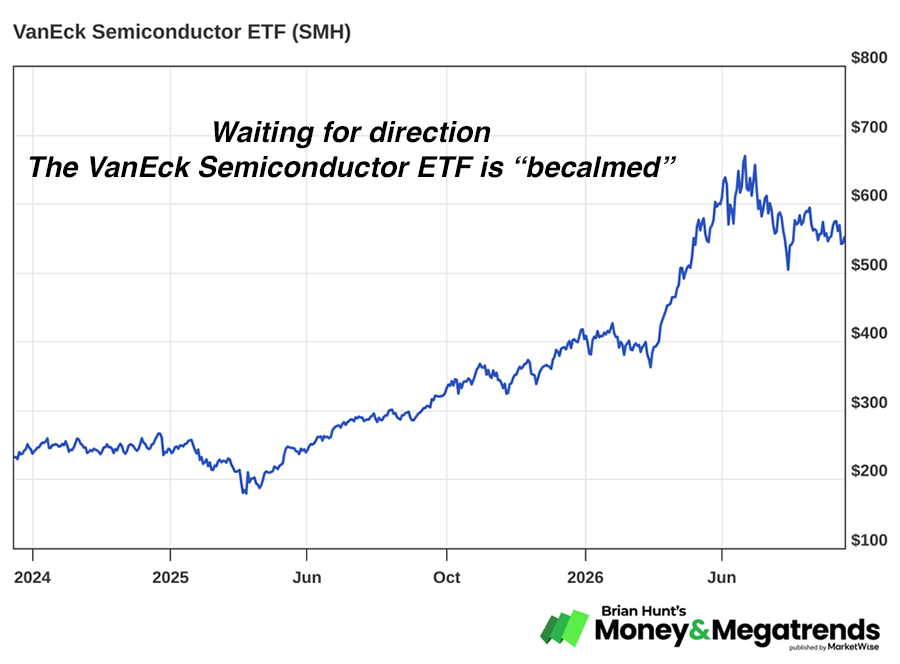
Case in point: After ripping higher in September, most of this megatrend’s key stocks and ETFs have suffered steep declines over the past week. This rapid series of up-and-down moves has left the larger trend back to trading in a directionless, sideways market… or “becalmed,” like a sailboat on a windless sea.

In other words, the “world’s most important trend” is back in a holding pattern. Here’s what it means for your portfolio…

Over the past three months, we’ve published a special series of research notes analyzing the AI infrastructure trend.

The status of this critical trend has become one of the great sagas of the business and investment world… a source of intense disagreement among industry bulls and bears. It’s a trend whose outcome could have large effects on your portfolio.

Given AI’s enormous promise, large tech firms such as Alphabet (GOOG), Amazon (AMZN), and Microsoft (MSFT) have invested over $1 trillion in AI infrastructure. They are on pace to invest over $700 billion this year alone and more than $3 trillion after that.

Both the scale and the velocity of this investment boom are unprecedented. It is the largest collective investment effort in history.

Big Tech’s historic investment boom has made the entire “AI infrastructure” trend responsible for a large share of America’s GDP growth and stock market returns over the past two years. It has also drawn the skeptical scrutiny of many widely followed investment analysts who claim the trend is a bubble… one that will soon explode and cause tremendous damage to stock prices and the global economy.

If this hugely consequential trend isn’t the most important trend in the stock market, then it is certainly in the top three.

I believe the AI infrastructure trend has years to run. I believe the world’s smartest, most connected tech insiders who know the true state of bleeding-edge AI development and have real-time stats on AI investment ROI, such as Elon Musk, Jensen Huang (Nvidia), Satya Nadella (Microsoft) and Andy Jassy (Amazon), perhaps maybe… just might… know far more about AI and their businesses than outsiders know about it.

As much press as AI gets, let’s remember that less than 1% of the global population pays for top-tier AI programs. And I estimate less than 10% of large companies believe AI has made a meaningful impact on their businesses.

This revolutionary technology hasn’t yet proliferated, achieved mass adoption, or had mass impact. However, the Agent Supernova is coming.

Regular readers know I care a lot more about what the market thinks of any stock, trend or theme than what any one person thinks of it, including me. You can be bullish or bearish on a trend all you like, but if that trend is moving strongly against you, then your idea isn’t worth much in my book.

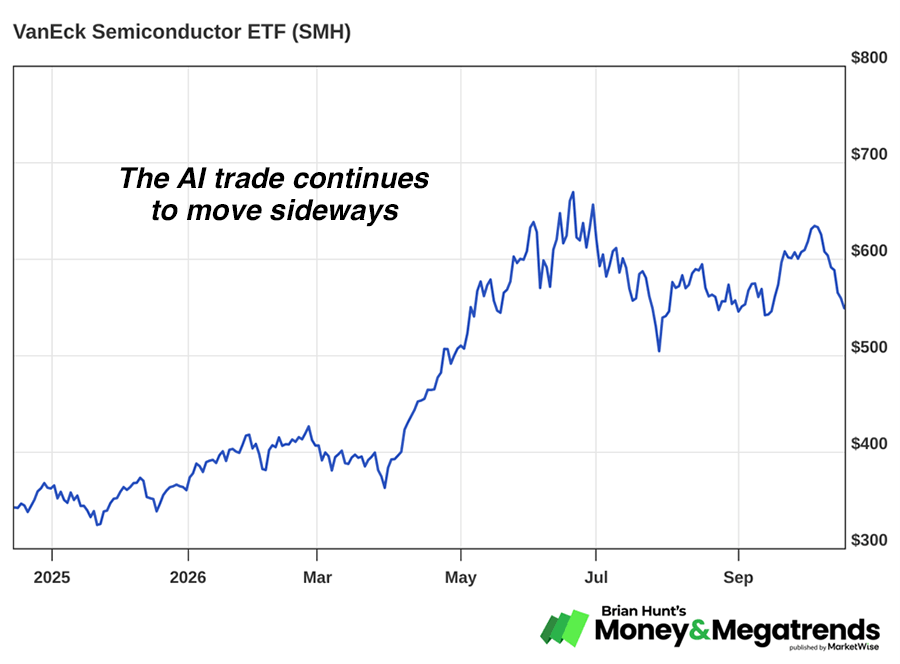
One of the best ways to gauge what the market thinks of AI infrastructure is analyzing the VanEck Semiconductor ETF (SMH).

This fund is full of key semiconductor firms whose fortunes rise and fall with AI infrastructure spending trends. Major holdings include Nvidia (NVDA), Taiwan Semiconductor (TSM), AMD (AMD), Texas Instruments (TXN), ASML Holdings (ASML) and Micron (MU).

As you can see in the two-year chart below, SMH enjoyed a gigantic run from June 2025 to June 2026. The fund gained 176%. Since June 2026, however, the fund has corrected and moved in a volatile, sideways pattern. The fund attempted a breakout in late Sept/early Oct, but huge selling pressure over the past week has sent it back into its sideways base. Back to a trendless state.

I’ll keep you updated on the world’s most important trend. It won’t be long before we get meaningful price action that provides more direction for trading the semis and AI as a megatrend.
Image

Recommended Link:

The #1 Stock Picker Who Called AMD Is Going Public With His Next Big Idea

Ad Image

TipRanks once named Luke Lango the #1 stock picker out of 15,000. He recommended AMD back when Wall Street dismissed it as a gaming company – before it soared as much as 26,797%. Now Luke’s found what he believes could be the most lucrative move of Elon Musk’s career – along with the $15 stock at the center of it all. Click here for the full story.

How to get paid again and again by owning the world’s best businesses

Image

Credit: Liudmila Chernetska

This week, the stock market sent us a subtle but important message…

It says that if you don’t want to deal with the complexity and volatility of investing in rapidly evolving technologies like AI, consider focusing on the simplicity of just getting paid.

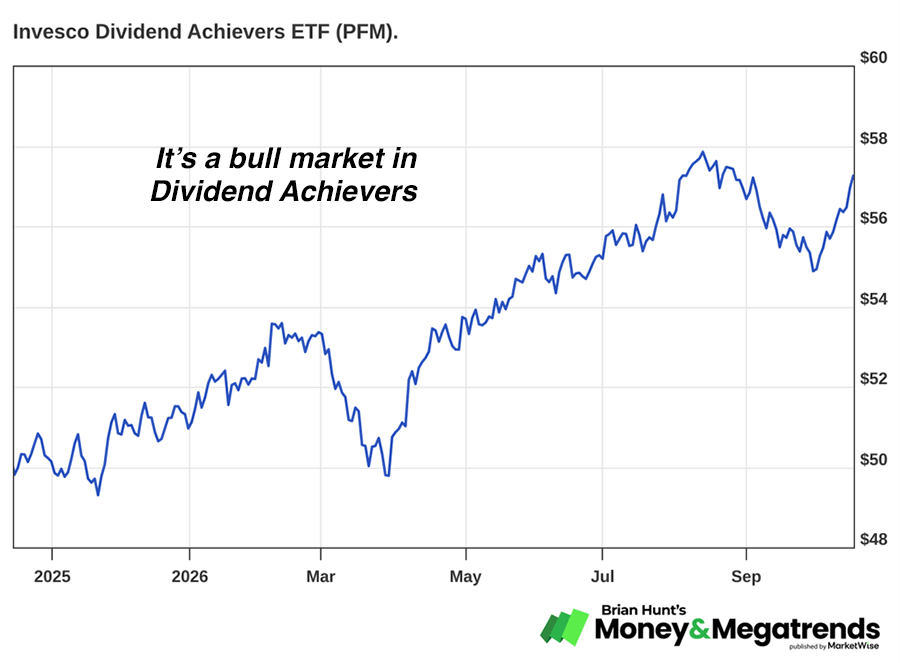
Focus on the strategy employed by investment funds like the Invesco Dividend Achievers ETF (PFM).

PFM is a unique fund that invests exclusively in high-quality dividend-paying stocks. A dividend is a payment a company makes to its shareholders, typically distributed from its profits. Dividends are typically paid by companies on the larger, more stable side of the stock market spectrum.

In the world of dividend payers, there is an elite class of firms that have raised their dividends for 10 consecutive years. These elite, high-quality firms are called Dividend Achievers. Only the strongest, most durable companies can qualify for membership in this club.

Some legendarily great businesses that are members of the exclusive Dividend Achievers club include Johnson & Johnson (JNJ), PepsiCo (PEP), 3M (MMM), Wal-Mart (WMT), Visa (V), Procter & Gamble (PG), Coca-Cola (KO), Chevron (CVX), and ExxonMobil (XOM).

Some of these firms have increased their dividends not for “just” 10 years in a row, but 30, 40, and even 50+ years in a row (and are called “Dividend Aristocrats”).

These businesses have paid and increased their dividends through recessions, bear markets, and a global pandemic. In terms of consistency, these firms rank just behind the rising sun. PFM is a fund designed specifically to own such firms.

Over the past week, many high-profile technology stocks, such as Lumentum (LITE), Dell Technologies (DELL), and Applied Materials (AMAT), have suffered large short-term sell-offs. Each firm is down more than 15% over the past five trading sessions.

Meanwhile, PFM has climbed by 2% over the same period. It’s something of a “port in the storm.” As you can see in the one-year chart below, the fund is enjoying a strong uptrend and is near its all-time high.

We are wildly bullish on the power of technology to create greater prosperity, longer lifespans, and large investment returns. However, we understand that “going big” into technology investments isn’t for everyone. And of course, it’s smart to have a diversified portfolio.

If you’re of the same mind, it’s good to know that investing in stable compounders and insisting on “getting paid” is still working well.
Image


This bull market in energy is generating huge winners. Here are four good ways to invest.

Image

Credit: Stock87

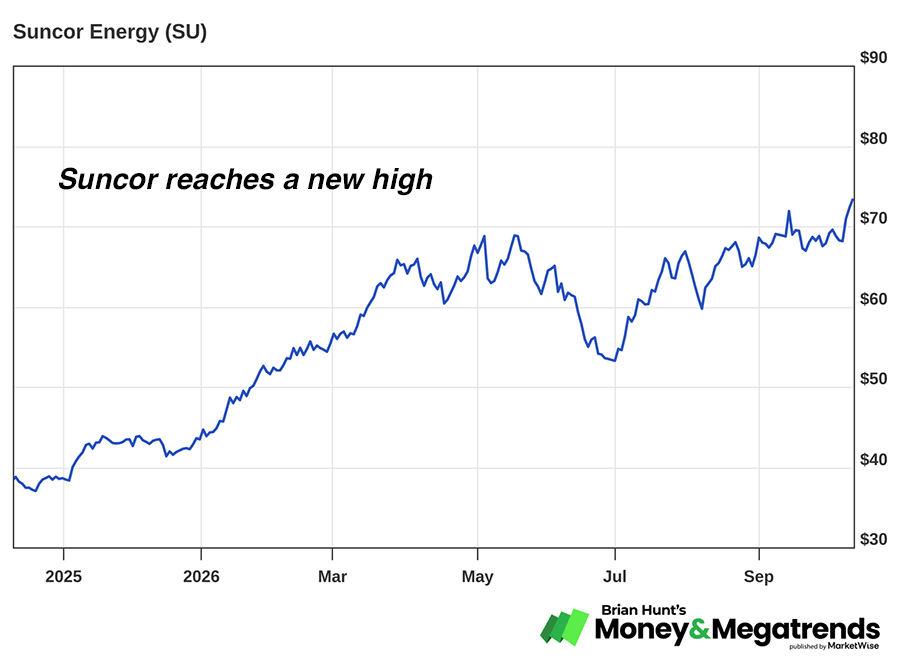
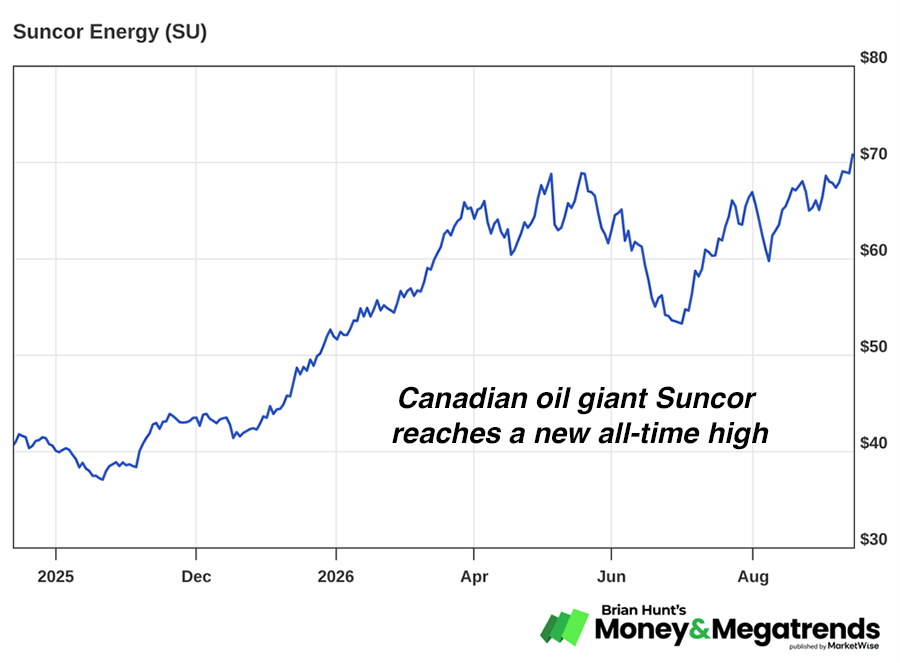
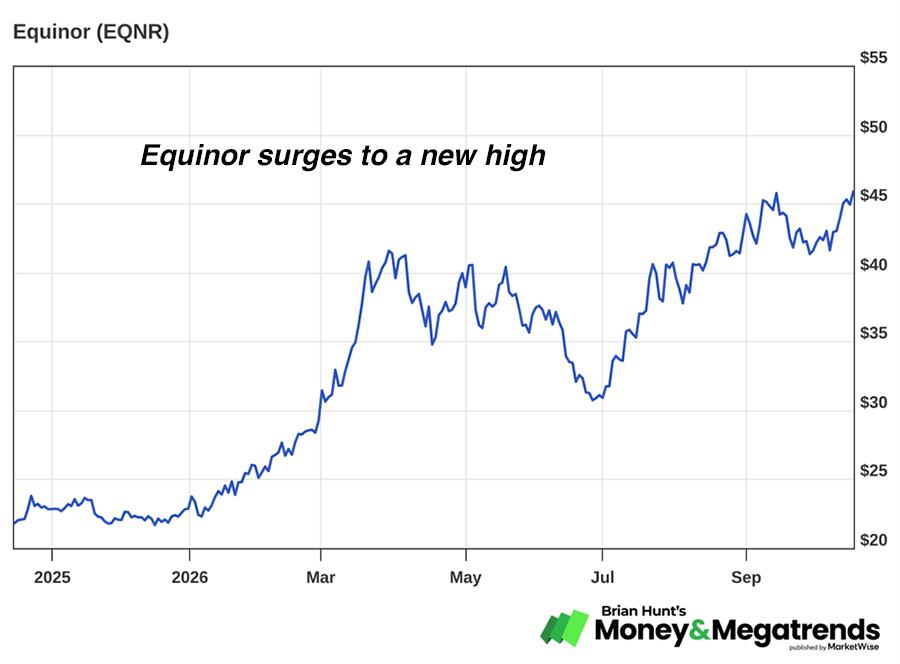
This morning, the stock prices of Canadian oil giants Suncor Energy (SU) and Canadian Natural Resources (CNQ) reached new all-time highs. Shares of Norwegian oil and gas giant Equinor (EQNR) did the same.

This price action tells us that it’s still a bull market in “non-Middle Eastern” oil supplies… and that our September 2025 recommendation to get long oil stocks was very well timed.

Last September, I made the case for going long the emerging uptrend in oil and gas stocks: As the global economy grows, oil demand will remain solid. However, importantly, U.S. shale oil production growth appears to be peaking.

Flatlining supply from this region would remove a critical and reliable source of production growth that has been in place for more than a decade. Plus, oil was very cheap relative to gold and other assets, indicating good value.

With all that in mind, we’ve written frequently and bullishly about owning Suncor, ExxonMobil (XOM), the diversified State Street Energy Select Sector SPDR Fund (XLE), and oilfield service stocks like those in the SPDR S&P Oil & Gas Equipment & Services ETF (XES). The oil sector has been one of the true market leaders over the past year. Both XOM and XLE recently reached new all-time highs.

When I recommended oil and started trading it from the long side, I did not factor in the potential bullish driver of the Iran War. That’s been a “bonus” driver of gains in oil stocks. Sometimes, the dice rolls in your favor.

Although positive news related to the Iran War could emerge at any time and trigger a short-term correction in oil and oil stocks, the long-term picture remains bullish. I see three reasons why this is the case.

One: Critical oil infrastructure in the Middle East has been damaged. Oil flows will not return to pre-war levels for possibly over a year. This supports oil prices north of $80 per barrel, which in turn supports strong cash flows for oil and gas firms.

Two: Most countries maintain substantial above-ground “buffer” supplies of oil and refined petroleum products in the event of market disruptions such as the Iran War. Over the past six months, much of these buffer supplies have been depleted to compensate for the loss of Middle Eastern flows. They must be replenished.

The coming restocking of buffer supplies will support oil prices north of $80 per barrel… which, again, supports large cash flows for oil and gas firms.

Three: Although oil stocks have enjoyed a large run since our September call, they aren’t up much over the past ten years. Adjusted for dollar debasement over the past decade, key oil and gas ETFs are down significantly. This is not an aging bull market that has attracted too many fans and too much capital. It is the opposite of that.

I’ve been especially bullish on companies with all or most of their assets in safe, reliable “not Middle Eastern” asset bases such as Canada, Brazil, and Norway (where Equinor is a major player).

As I’ve covered over the past five months, for many countries and businesses, the Iran War is a powerful reminder: If your survival or smooth operation depends on uninterrupted resource flows from the Middle East, you are in a dangerous, vulnerable position.

No politician, CEO, or major shareholder wants their business to be in that position. No citizen wants their country to be in that position. Many powerful and influential people are realizing this is a big risk that must be mitigated if humanly possible. Executives and politicians will get fired for not addressing it effectively.

This means building and buying as many forms of “not Middle Eastern” and “non-Russian” resource supply chains as possible economically… like those from safe, resource-rich Canada, Norway, and Brazil. With today’s new highs for Suncor, Canadian Natural Resources, and Equinor in mind, I repeat my big picture takeaway: It’s a bull market in safe, reliable oil supplies… so stay long Canada and Norway.
Image


Market Notes

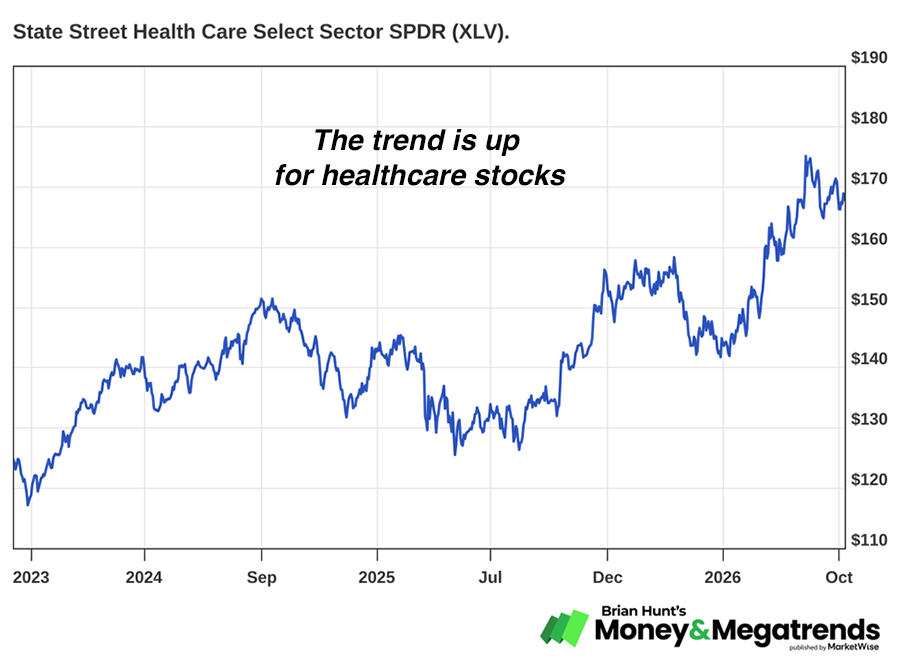
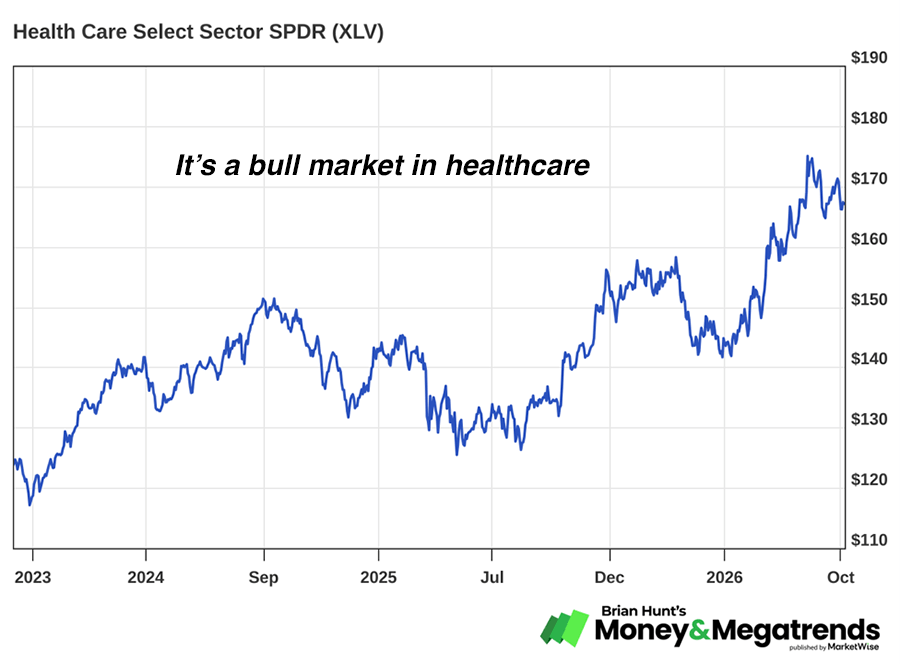
  • Our recommendation to own healthcare stocks continues to pay off. The Health Care Select Sector Fund (XLV) reached a new one-year high today.

  • Software leaders Atlassian (TEAM), Veeva Systems (VEEV), DocuSign (DOCU), Freshworks (FRSH) and Paylocity (PCTY) hit new one-year highs today.

  • Our January 28th recommendation to own the AI application layer is paying off. Zeta Global Holdings (ZETA) just hit a new yearly high. It is up 88% since our initial recommendation.

  • Payment giants Visa (V) and Mastercard (MA) hit new one-year highs today. These are positive economic signals.

  • E-commerce giant eBay (EBAY) hit a new one-year high today.

Regards,

Brian Hunt signature

Brian Hunt signature

Brian Hunt
Editor, Money & Megatrends


An urgent message from our colleagues:

FCC Rule Change Could Fast-Track New Elon Device

Image

New FCC Rule Change Could Make It Easier to Launch Elon’s Next Big Project. See why this new FCC rule change could be the most important evidence for Elon’s newest tech.

Click here.


The post How to trade AI stocks from here appeared first on MarketWise.

  •  

Three ways to invest in Elon Musk’s next big move

Today’s issue in preview:

  • Three ways to invest in Elon Musk’s next big move

  • The longevity gold rush has a clear winner. How to invest.

  • These stocks are quietly crushing the rest of the market. Are you profiting?

  • Learn Our Top Themes to Buy Now


These stocks are quietly crushing the rest of the market. Are you profiting?

Image

Credit: Ridofranz

To help us track and trade the world’s strongest business and technology trends, our Global Trend Tracker monitors over 170 industry groups, over 30 proprietary thematic indexes, over 70 ETFs, and over 3,500 public stocks.

This trend-tracking system serves as our “all-seeing eye” – an early-detection system that continuously monitors money flows and shifts in the market climate.

It is designed to identify powerful trends very early in their lifespans, giving us the opportunity to capitalize on them before they become popular investment themes. A business, product, or technology trend can barely twitch without being picked up by our Global Trend Tracker.

This week, our tracker emphatically states that in a market where many important sectors are trading weakly – including defense stocks, small caps, homebuilders, and banking stocks – the healthcare sector is displaying terrific “relative strength.”

For example, while many sectors are down significantly over the past month, the Invesco S&P 500 Equal Weight Health Care ETF (RSPH) just reached a new one-year high.

This fund is an equal-weighted, diversified basket of large health care firms such as Illumina (ILMN, genomic sequencing), Revvity (RVTY, life sciences), Intuitive Surgical (ISRG, surgical robotics), Biogen (BIIB, biotech), ResMed (RMD, sleep devices), and Pfizer (PFE, pharma). The fund is up 29% over the past year and is one of the few equity ETFs outside of the oil and gas complex to reach a new one-year high this week.

Avid Money & Megatrends readers know that “Boomer healthcare” is one of our highest-conviction long-term investment megatrends. We don’t know of another investment research publication that has written more bullishly, more often about this booming industry than we have.

Over the past year, we have published more than two dozen pieces on opportunities in drug development, biotechnology, senior living facilities, genomics, cardiology, diagnostics, and more.

Our bullish stance has produced a parade of home runs, with the healthcare industry dominating the stock market’s list of new highs over the past year.

Healthcare stocks are generating extraordinary returns because they are benefiting from several megatrends simultaneously…

One is demographics. More than 10,000 Americans reach retirement age every day. The U.S. population aged 80 and older is projected to roughly double, from 14.7 million in 2025 to 29.4 million by 2045.

This is the enormous Baby Boom generation entering the phase of life where health care and longevity spending skyrocket. For many boomers, a typical month involves going to see at least one doctor to have something looked at, removed, or treated.

This means many health care businesses are experiencing huge demand now – and will for at least the next decade.

Two is exponential technological progress. Thanks to major advancements in genomic sequencing, AI-powered analytics, imaging technology, and preventative treatment, healthcare is becoming much better and more personalized. This is driving strong demand for all kinds of new tests, tools, and treatments.

After all, when a useful and important service you buy gets much better, you typically buy more of it

Investing in many healthcare businesses over the next decade will be investing with a gale-force tailwind at your back. If you’re a parent and worried about your child getting a job, just point them to the booming healthcare industry.

The new high in RSPH serves as a reminder: The giant business, tech, and demographic trends that shape our world tend to play out in five or more years, not five months. This means the stock market trends they manifest play out over the same time periods. With this trend truism in mind, I once again remind you that if you like money, keep it invested in healthcare.

Image

Recommended Link:

My Nearly $20 Million ‘Bar Tab’ With Stansberry Research

Ad Image

I’m an ordinary guy – a financial newsletter reader like you. But a few years ago, I landed in an extraordinary position: unmasking a priceless secret from inside Stansberry Research, unfiltered, on camera. In the years since, my ongoing efforts have COST Stansberry nearly $20 million and counting – money that has stayed in readers’ bank accounts instead. Today, I’m speaking out one FINAL time.

The longevity gold rush has a clear winner. How to invest.

Image

Credit: svetikd

As with any large part of our economy, the booming healthcare sector (see above) comprises many smaller “sub-industries” that often perform much better or much worse than the broader sector.

Currently, one prominent member of the “doing better” category is the business of selling GLP-1 drugs.

As evidence, we cite the surging revenues and strong stock trend of one of our top healthcare “picks to click,” Eli Lilly (LLY).

Back in June, I detailed how drug giant Eli Lilly is uniquely positioned to benefit from soaring health care and longevity spending.

Data from the Federal Reserve shows that between 15 million and 20 million baby boomers are millionaires. More than 1 million boomers are worth more than $10 million. As mentioned above, the U.S. population aged 80 and older is projected to roughly double, from 14.7 million in 2025 to 29.4 million by 2045.

This is the largest group of wealthy people in history. It includes many motivated, older, wealthy people who can spend big on longevity.

One of the leaders of this investment trend – you could even call it the poster child – is drug giant Eli Lilly.

Lilly is the world’s largest seller of glucagon-like peptide-1 (GLP-1) medications. GLP-1 drugs mimic a natural gut hormone. They control blood sugar by stimulating insulin release, thereby slowing digestion and reducing appetite.

Over the past 5 years, this class of medications has exploded in popularity. A representative of healthcare giant IQVIA says GLP-1 therapies for weight loss generated $55 billion in sales over the past 12 months, which is up from $2 billion in 2022.

Many people who take GLP-1 drugs see drastic weight loss in less than six months… which should extend their lives.

Studies indicate that GLP-1 drugs may also lower cholesterol, slow cancer growth, and reduce the risk of cardiac disease. They are also prescribed to treat sleep apnea, which is a pervasive problem whose effective treatment should extend many lives.

In other words, GLP-1s are believed to be the closest thing to “miracle longevity drugs” that we currently have.

As a result, Eli Lilly’s sales are skyrocketing. The company recently reported quarterly sales growth of 48%. The results were driven by a 91% jump in demand for Lilly’s weight-loss drug, Mounjaro.

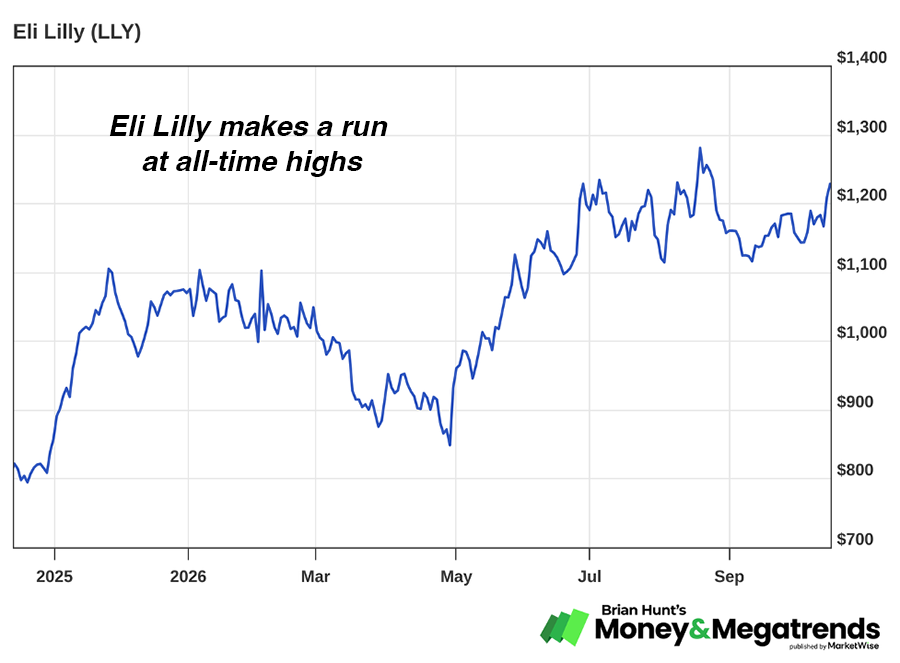
Soaring GLP-1 revenues are driving strong returns for Lilly shareholders. The stock has returned 49.7% over the past year… and is currently making a run to eclipse its all-time high reached in August. The Boomer health care theme continues.

Image


Three ways to invest in Elon Musk’s next big move

Image

Credit: Walter Cicchetti

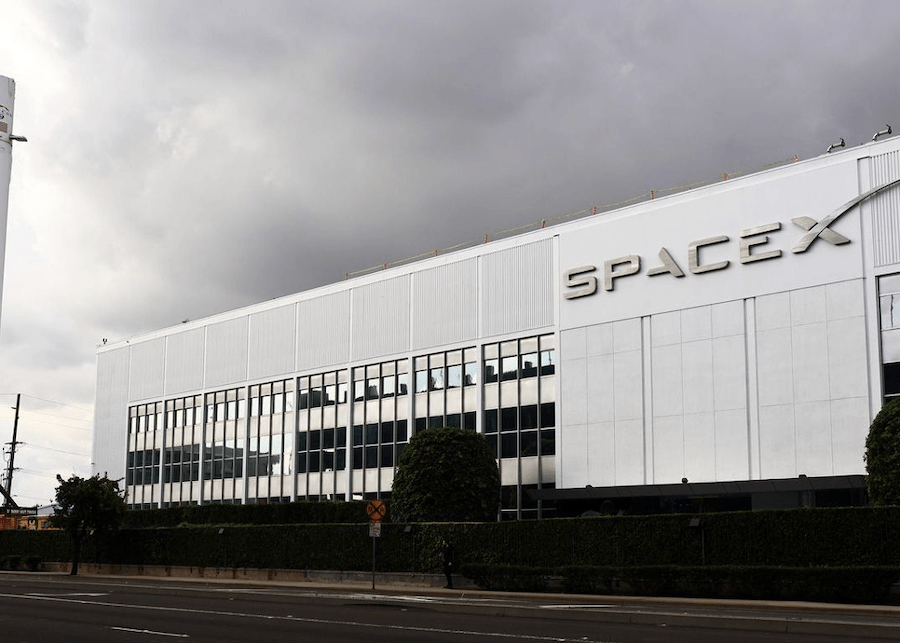
Last week, shares of America’s three biggest telecommunication firms took one of their worst beatings in decades, thanks to Elon Musk’s SpaceX (SPCX).

Verizon (VZ), AT&T (T), and T-Mobile (TMUS) all dropped between 9% and 13%, wiping roughly $45 billion off their collective market value.

The trigger?

SPCX announced it was acquiring a nationwide spectrum license to become a major mobile carrier in the U.S. It’s paying about $8 billion for up to 14 megahertz of low-band airwaves. In other words, it is buying the legal rights to transmit wireless signals over specific radio frequencies.

Musk called it a “very big deal.” It potentially puts SpaceX on a collision course with Verizon, AT&T, and T-Mobile.

For years, Starlink has been considered a backup phone service… one that kicked in when you lost signal on a hiking trail or a rural highway. Not anymore. Investors now see a fourth national carrier coming to take customers from the incumbents.

And SPCX isn’t starting from zero. An estimated 13.5 million people already pay for Starlink internet, including about 4.1 million in the U.S. Those are likely easier wins: customers who already trust the brand and pay a monthly bill. Bundling a phone plan for those customers is the next logical step.

Obviously, there’s a long way to go to disrupt incumbents like Verizon, which has about 147 million wireless connections. But in a market estimated at $600 billion annually, even a few percentage points of customers switching to Starlink each year would be worth a lot.

In any case, the threat of SPCX disruption is likely still years away. The spectrum deal still needs approval from the Federal Communications Commission. SPCX’s next-generation direct-to-phone satellites won’t start launching until the second half of 2027. And it takes years for people to upgrade their phones and decide to switch away from their current provider.

But in the background, while all of this plays out, the demand for hardware to build this network will arrive long before the first customers sign up.

As a result, the “picks and shovels” suppliers behind Starlink are already seeing orders.

When a company with SPCX’s scale and speed decides to build, its suppliers feel it first. That’s where you want to be positioned as an investor.

Compelling investment candidates inside this long-term trend include:

Filtronic (FTC.L) is a roughly $800 million UK-listed company that builds the powerful amplifiers Starlink uses to transmit enormous amounts of data between satellites and ground stations. SpaceX is its largest customer, accounting for 68% of annual revenue, and holds warrants to acquire up to 15% of Filtronic’s shares. On Oct. 1, Filtronic announced its largest-ever SpaceX order: $68.1 million for advanced amplifiers, with deliveries expected primarily in fiscal 2028.

As SpaceX launches thousands of additional satellites and pursues millions of mobile phone customers, its network will need to handle vastly more data traffic. That should drive growing demand for Filtronic’s specialized amplifiers, making this sub-$1 billion company an intriguing way to invest in the satellite communications boom.

STMicroelectronics (STM) is a roughly $42 billion semiconductor giant that has spent a decade co-designing custom chips with SpaceX. Its advanced BiCMOS technology is a critical component of Starlink’s satellite dishes, and the company has reached a remarkable delivery rate of more than 5 million chips per day.

STM also supplies chips used aboard Starlink satellites and in ground infrastructure. Now SpaceX plans to expand into traditional mobile phone service, potentially installing small cellular base stations alongside its existing Starlink dishes. This could create another enormous market for advanced communications chips. STM expects to generate more than $3 billion in cumulative space-related revenue between 2026 and 2028, making it one of the clearest publicly traded beneficiaries of the satellite communications boom.

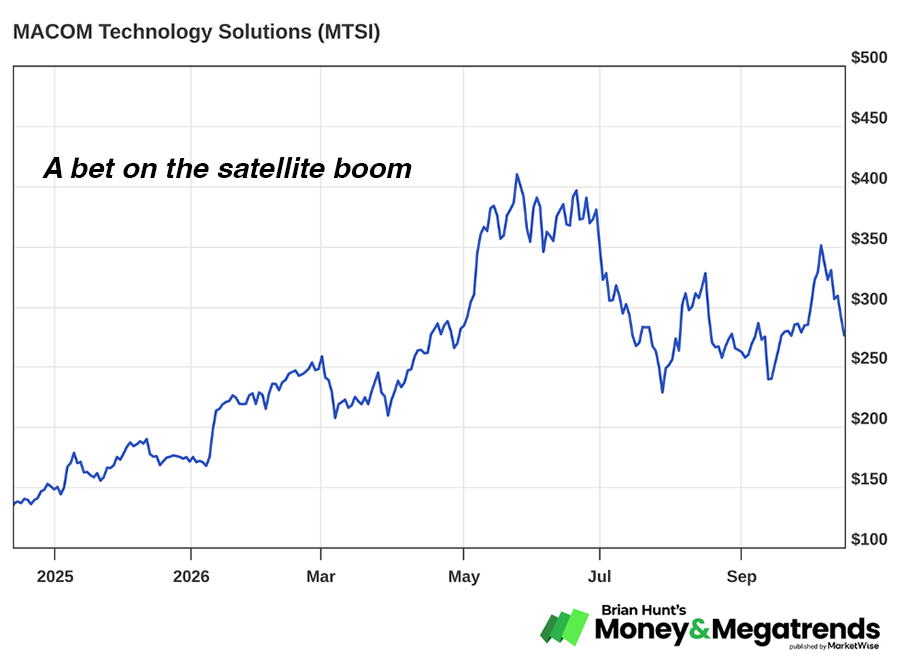
MACOM Technology Solutions (MTSI) is a $22 billion semiconductor company that makes the powerful radio-frequency chips satellite communications networks depend on.

Its specialty includes amplifiers that boost weak radio signals, allowing enormous amounts of data to travel between space and the ground. These chips are critical components of phased-array antennas, which use hundreds or thousands of tiny antenna elements working together to electronically steer signals.

In June, MACOM introduced new amplifier technology specifically designed for satellites that communicate directly with ordinary smartphones. That’s important because SpaceX plans to deploy up to 15,000 next-generation direct-to-phone satellites, each of which requires sophisticated communications hardware.

MACOM hasn’t been confirmed as a direct SpaceX supplier, but its technology positions it to benefit from the enormous satellite communications boom SpaceX is helping create.

Whether Starlink Mobile becomes America’s fourth major carrier in three years or ten, the hardware must be built first. STM, MTSI, and FTC all stand to benefit from the boom in satellite-based communications that SpaceX is leading.

Image


Market Notes

  • The Boomer health care megatrend continues to generate winners: Pharma giant Pfizer (PFE) reached a new one-year high today.

  • Worries over mid-term elections and potential changes in defense spending helped send military firms Aerovironment (AVAV) and Kratos Defense (KTOS) to new one-year lows today.

  • Quantum computing stocks Rigetti Computing (RGTI) and D-Wave Quantum (QBTS) reached new one-year lows today.

  • Uranium miners Denison Mines (DNN) and Uranium Energy Corp (UEC) reached a new one-year low today.

  • Air taxi firms Joby Aviation (JOBY) and Archer Aviation (ACHR) reached new one-year lows today.

  • Nuclear energy technology firms Oklo (OKLO) and NuScale Power (SMR) reached new one-year lows today.

Regards,

Brian Hunt signature

Brian Hunt signature

Brian Hunt
Editor, Money & Megatrends


An urgent message from our colleagues:

Free AI Demo – 10X Your Money

Image

Keith Kaplan, one of America’s top AI experts, leads a firm that spent $17 million building some of the most advanced AI models around. Today, he’s agreed to publicly demo a brand-new breakthrough, which he says could help you make more than 10X your money.

Join Keith here for the demo.

The post Three ways to invest in Elon Musk’s next big move appeared first on MarketWise.

  •  

How to invest with Donald Trump massively on your side

Today’s issue in preview:

  • How to invest with Donald Trump massively on your side

  • Visa and Mastercard just trampled the stock market bears. That’s important for your 401(k)

  • Should you be selling stocks because of “weak breadth?” This chart has the answer

  • Learn our Top Themes to buy now


Visa and Mastercard just trampled the stock market bears. That’s important for your 401(k)

Image

Credit: VioletaStoimenova

This week, shares of credit card giants Visa (V) and Mastercard (MA) reached new all-time highs.

We can take several insights away from their strength, but the most important one is this:

If two of America’s most important consumer spending companies are enjoying strong growth and soaring stock prices, then the economy isn’t struggling as many bearish investment professionals claim… it’s actually “humming along nicely.”

Visa and MasterCard are the world’s largest credit card companies. Their payment networks connect billions of consumers, merchants, and banks.

Rather than lending money, they earn fees by facilitating credit and debit card transactions. The two firms are effectively a duopoly in U.S. credit card payments. Together, they account for roughly 85% of U.S. general-purpose credit card purchase volume, with American Express and Discover accounting for most of the remainder.

Visa and Mastercard have leveraged their entrenched positions and massive networks to generate market-leading long-term growth and large profit margins. Business quality aficionados consider their financial metrics a thing of beauty.

Visa and Mastercard’s positions also make them good “real world” economic indicators.

Many investors fixate on government data such as unemployment figures, job hirings, and the Consumer Price Index. I like to know that data as everyone else does.

However, when I want a read on what’s really happening in the economy, I place far greater focus on what’s happening in the real world. I look at stock prices. In doing this, I listen to the judge, jury, and executioner of any thesis, any trend, and any claim: The market.

Visa and Mastercard are sensitive to the health of the American consumer. Last quarter, both firms reported double-digit revenue growth, healthy transaction volumes, and resilient consumer spending. That business strength – plus expectations of more in the future – has propelled both stocks to new all-time highs.

Does the U.S. economy have imbalances, distortions, and risks? Absolutely. It always does. But making money in stocks is never the result of a problem-free economic environment. It’s always about being in an environment where the big problems are overwhelmed by the even bigger positives.

Right now, the market is telling us that the positives are currently much stronger than the negatives. Manage your financial affairs accordingly!

Image


Recommended Link:

Up 26% in a Month — And Navellier Says It’s Just Getting Started

Ad Image

This AI stock just posted record orders. Some of its biggest customers are signing multi-year deals without even knowing the final price. Louis Navellier — who’s recommended over 675 stocks that went on to gain 100% or more — says its biggest move is still ahead. Don’t wait. Get the name and ticker now.

How to invest with Donald Trump massively on your side

Image

Credit: halbergman

Want to know if America’s manufacturing renaissance is real?

Don’t listen to the mainstream news or politicians.

Instead, listen to the market.

It’s far smarter and far more honest than the sources above. And it’s saying the “Made in America” megatrend is gathering steam.

As evidence, we cite the bull market in industrial supply distributors Fastenal (FAST), W.W. Grainger (GWW), and MSC Industrial Direct (MSM).

Fastenal, Grainger, and MSC Industrial Direct are three of America’s leading industrial supply distributors. They provide manufacturers, construction companies, and industrial facilities with essential products such as fasteners, cutting tools, safety equipment, replacement parts, and maintenance supplies.

Fastenal specializes in fasteners and on-site inventory management. Grainger offers a vast catalog of industrial and maintenance products. MSC focuses heavily on metalworking and manufacturing supplies. All three benefit from increased U.S. manufacturing activity and industrial investment.

This means their stock price trends tell us a lot about the Made in America megatrend.

Back in January, I made the case for going long the Made in America megatrend… for investing in companies that supply critical equipment and services for building and operating today’s high-tech factories.

The bull case here is simple…

President Donald Trump – along with many business and military leaders – believes that the U.S. has outsourced far too much of its industrial capacity to China over the past 25 years.

We outsourced significant portions of our semiconductor, appliance, medicine, weapons, and machinery production. We outsourced the capacity to produce and process critical resources, such as rare earth elements.

The COVID-19 pandemic showed that depending on other countries for critical economic inputs makes the U.S. economy less safe and secure. To put it bluntly, it is very stupid to not make products critical to national security like AI semiconductors within our own borders.

Trump has staked his legacy and reputation on expanding our industrial base… and he’s working with business leaders to invest trillions to pursue this goal. Apple (AAPL), for example, has committed to invest $600 billion in U.S.-based manufacturing over the next four years. Nvidia (NVDA) says it will invest $500 billion in U.S.-based manufacturing over the next four years.

Drug giant Eli Lilly (LLY) said it has committed more than $50 billion in domestic manufacturing commitments since 2020, including four additional U.S. plants announced in 2025. Lilly says it will be the largest domestic drug manufacturing investment in U.S. history.

In Money & Megatrends, we’ve capitalized on this “Made in America” megatrend with strong returns in robotics, factory automation, and machine component makers such as Cognex (CGNX), Ouster (OUST), and RBC Bearings (RBC).

The stock price trends of FAST, GWW, and MSM suggest the Made in America megatrend is gaining momentum. Over the past 12 months, their shares have surged 21.5%, 41.6%, and 54%, respectively. This week, MSM reached a new all-time high. All three companies are reporting year-over-year quarterly revenue growth exceeding 7.5%.

These impressive business results and stock market performances send a powerful message: American manufacturers and industrial companies are spending heavily on the equipment, supplies, and materials they need to expand and maintain their operations. We recommend staying long the Made in America megatrend.

Image


Should you be selling stocks because of “weak breadth?” This chart has the answer

Image

Credit: roman_slavik

No matter how strong corporate earnings are… or how strong broad market averages like the S&P 500 are, two or three “Big Worries” are always circulating around the investment community.

There are always potential risks and concerns held by investment professionals that keep them light on stocks or out of them completely.

This fall, one of the Big Worries is “weak market breadth.”

“Breadth” is Wall Street’s preferred term for how widely a stock market’s gains or losses are spread across individual stocks.

Rather than focusing solely on the movement of a major index like the S&P 500, breadth reveals how many stocks are participating in the trend. The general idea is that if you’re bullish, you want to see strong breadth, which shows many stocks are in uptrends.

Common breadth indicators include the percentage of stocks above their 50- or 200-day moving averages, the percentage of advancing versus declining stocks, and the percentage of new highs versus new lows.

Strong breadth suggests widespread participation, while weak breadth indicates that relatively few stocks are driving the market.

Over the past two months, stock market breadth has grown weak. Rising interest rates and several smaller market forces have hammered many key market sectors, including real estate, utilities, defense, financials, and consumer spending-related stocks.

Meanwhile, the strength in technology stocks we’ve been covering has supported the broad market averages. The S&P 500 is less than 2% off its all-time high.

Many investment professionals look at select weak breadth indicator readings and say it’s bearish. They say it means “time to sell.”

But before you do that, have a look at the Invesco S&P 500 Equal Weight ETF (RSP).

The popular S&P 500 Index is a “market-cap weighted” index. This means the biggest companies, such as Nvidia (NVDA) and Apple (AAPL), have a greater impact on the index’s value than smaller companies. A big rally in a $5 trillion giant like Apple can overwhelm losses in 30 smaller companies.

An “equal weight” index nullifies market-value-related impacts – assigning equal weight to each stock in the index regardless of company size. With an equal-weight index, a massive 100% annual gain in a giant like Nvidia cannot mask or overwhelm weakness in hundreds of smaller stocks.

An equal-weight index does a much better job of showing how the market is doing broadly than how the 10 largest companies are doing.

RSP is by far the largest ETF that tracks the S&P 500 Equal Weight Index. As you can see in the one-year chart below, this fund is comfortably within the confines of an uptrend. And while it isn’t trading near its all-time high, it’s not far from it (less than 5%).

RSP’s uptrend shows that all the hype and hoopla over “weak market breadth” and the supposed horrible market conditions it reflects is ignorant and misplaced. This is not a market with a small handful of leaders and a collapsing interior.

Having said this, keep an eye on RSP’s September low of $209 per share. If we hold above this line, I’m not worried at all about weak breadth. But a break below $209 is cause for concern. We will keep you updated on this Big Worry that is getting so much attention.

Image


Market Notes

  • Our recommendation to get long oil and gas stocks continues to pay off. Oil giants Chevron (CVX), Shell (SHEL), Canadian Natural Resources (CNQ), EOG Resources (EOG), Suncor Energy (SU), and Petroleo Brasileiro (PBR) hit new one-year highs today.

  • The Iran War and its constriction of oil and refined products continue to benefit U.S. refiners. Refining giants Valero Energy (VLO), Phillips 66 (PSX), HF Sinclair (DINO), and Marathon Petroleum (MPC) reached new one-year highs today.

  • The Iran War and its constriction of oil and refined product supplies continue to work in favor of oil shipping firms. Industry leaders International Seaways (INSW) and Tsakos Navigation (TEN) reached new one-year highs this week.

  • Leading financial technology company SoFi Technologies (SOFI) reached a new one-year low today.

  • Space economy leader AST SpaceMobile (ASTS) reached a new one-year low today.

  • Large homebuilders DR Horton (DHI), KB Home (KBH), PulteGroup (PHM), and Lennar (LEN) reached new one-year lows today.

  • Leading air taxi firm Joby Aviation (JOBY) reached a new one-year low today.

Regards,

Brian Hunt signature

Brian Hunt signature

Brian Hunt
Editor, Money & Megatrends


An urgent message from our colleagues:

“Do NOT buy high flying tech stocks like Nvidia, SpaceX”

Image

One of America’s leading AI pioneers is stepping forward today with this urgent warning… and to reveal exactly where to move your money for a chance at 1,000%+ returns before October 31st.

Get the full details here.

The post How to invest with Donald Trump massively on your side appeared first on MarketWise.

  •  

A new kind of AI trade is emerging. Here are the stocks to play it.

Today’s issue in preview:

  • A new kind of AI trade is emerging. Here are the stocks to play it.

  • Why Apple could be one of the biggest winners of the AI agent boom

  • A new development for the world’s most important trend… and what it means for your portfolio

  • Learn our Top Themes to buy now


A new kind of AI trade is emerging. Here are the stocks to play it.

Image

Credit: valentinrussanov

After we’ve invested more than a trillion dollars in AI infrastructure, new, leading AI models such as OpenAI’s ChatGPT-6 Astra and Anthropic’s Claude Fable 5.1 have become far more than just great search engines compared to the models of 18 months ago.

These models have extraordinary capabilities. They can analyze complex information, solve difficult problems, make decisions, and automate a wide range of tasks and business functions. They can generate useful “agents” that do lots of work for us.

So how in the heck do we leverage this new, awesome power inside our business?

That’s the question thousands of executives, corporate boards, and entrepreneurs are asking themselves today. It’s one of the hottest topics in the business world… one that will create huge opportunities for you as an investor.

After all, a company that successfully uses AI to increase efficiency, reduce costs, and generate more revenue could gain an enormous advantage over its competitors.

And a company that fails to embrace and master AI could find itself falling hopelessly behind.

That’s why many business leaders – especially those in knowledge industries such as law, software, consulting, research, marketing, and media – justifiably view mastering AI as one of their defining challenges of 2026 and beyond. Failure to do so poses an existential risk.

And when something is an existential risk that could result in a business leader getting fired, losing a big executive salary, and seeing her stock grants lose 75% of their value, that business leader is going to go to great lengths to prevent that potential risk from becoming real.

This means spending lots of money on enterprise software and data analytics firms that help companies integrate and leverage AI.

Enterprise software refers to applications and technology platforms that help businesses manage operations, organize and analyze data, automate tasks, and improve productivity. These systems support functions such as finance, sales, R&D, human resources, and supply chain management. Increasingly, enterprise software incorporates AI to help companies make better decisions and operate more efficiently.

In fact, to capitalize on the “mad dash” of businesses trying to incorporate AI, a smart enterprise software company will sell itself as an “enterprise AI” company.

Consulting giant Gartner expects AI software spending to rise from approximately $283 billion in 2025 to $453 billion in 2026.

Enterprise software has such strong AI-related growth prospects because taking old, legacy databases and software platforms and transforming them into lean, mean, AI-centric systems is a messy, complicated business.

This cannot be done by purchasing a ChatGPT subscription and having two run-of-the-mill employees work on it. Transitioning a large company’s disparate tech systems into a safe, reliable package of AI-powered systems is a huge task whose bill can run into the many millions of dollars.

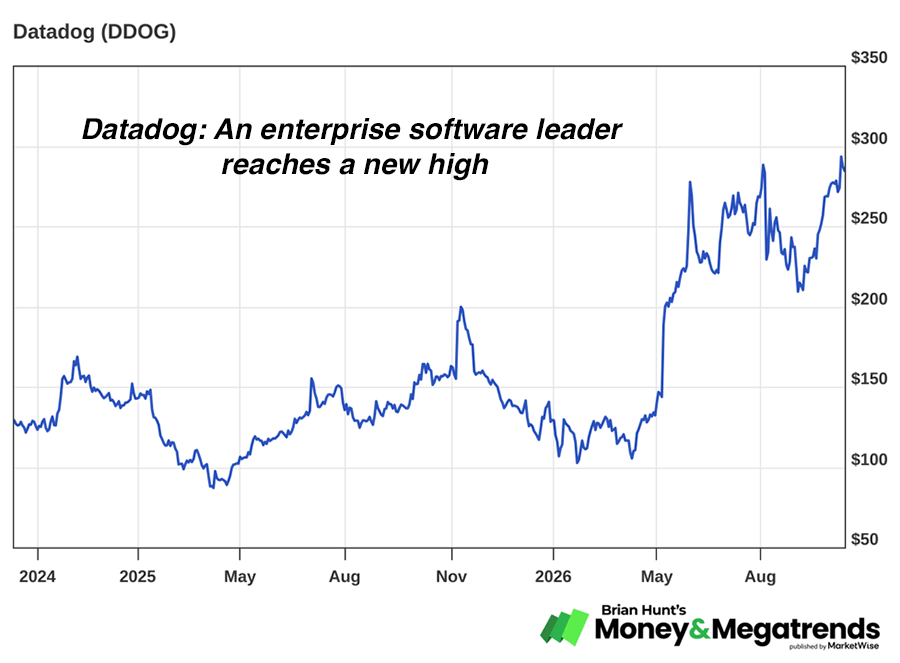
This situation is proving to be bullish for enterprise software firms such as Palantir (PLTR), Datadog (DDOG), Dynatrace (DT), Snowflake (SNOW), ServiceNow (NOW), MongoDB (MDB) and UiPath (PATH).

This under-the-radar tech trend is one of the strongest themes in the market right now. Palantir, Datadog, Snowflake, and Dynatrace recently reached new one-year highs. Many such firms are enjoying 15%+ annual revenue growth.

The AI boom is entering a powerful new phase. After spending more than a trillion dollars building AI infrastructure, the business world is now racing to put that technology to work. For large corporations, integrating AI into existing systems is a complex, expensive, and increasingly urgent undertaking.

That creates an enormous opportunity for enterprise software and data analytics companies. As businesses scramble to harness AI’s capabilities, or risk falling behind, the companies helping them make that transition could generate big stock returns.

Image

Recommended Link:

Debunking the SpaceX Phone Rumors

Ad Image

“I spent years as a Bloomberg tech reporter… and as an analyst for one of Wall Street’s most ruthless hedge fund billionaires. Here’s what I think about Elon building an AI phone…” Click here.

Why Apple could be one of the biggest winners of the AI agent boom

Image

Credit: valentinrussanov

In yesterday’s issue, we detailed how the “AI Applications Layer” is a business and investment area with extraordinary potential over the next three years.

We expect to see dozens of businesses follow in the footsteps of legendary winners such as Amazon, YouTube, Facebook, and Netflix.

These winners didn’t build the physical network of fiber optic lines, routers, servers, and switches that made up the internet. Instead, they built the wonderful businesses on top of that revolutionary infrastructure.

They were the “applications” layer of the internet.

It’s important to understand the applications layer concept because we’re on the cusp of a historic boom in companies that don’t build critical AI “hard infrastructure” such as data centers and semiconductors…but instead build wonderful businesses on top of that infrastructure… just like Apple, Amazon, and Google did with the internet.

I’m talking about AI-centric businesses that revolutionize how we invest, how we develop medicines, how we educate, how we entertain ourselves, how we manufacture, how we shop, how we transfer money, and much more.

The internet changed every industry and created many new ones. AI will do the same.

Investors who follow the Internet applications layer playbook into big AI applications layer winners stand to make giant returns.

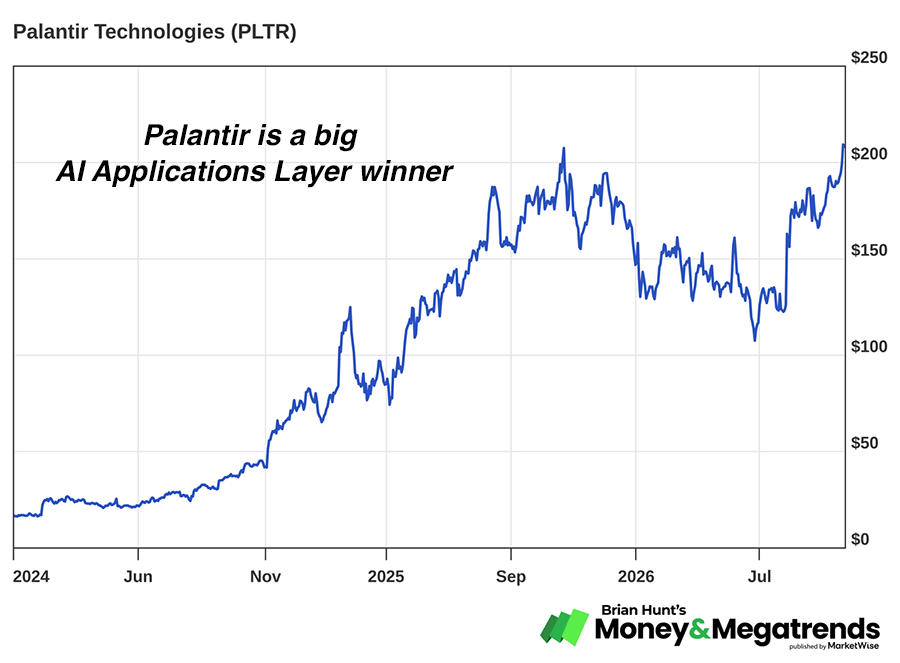
In yesterday’s issue, we highlighted how AI-centric data analytics firm Palantir (PLTR) is a powerful example of this strategy. The business is booming and its stock is up more than 1,100% since Jan. 1, 2024.

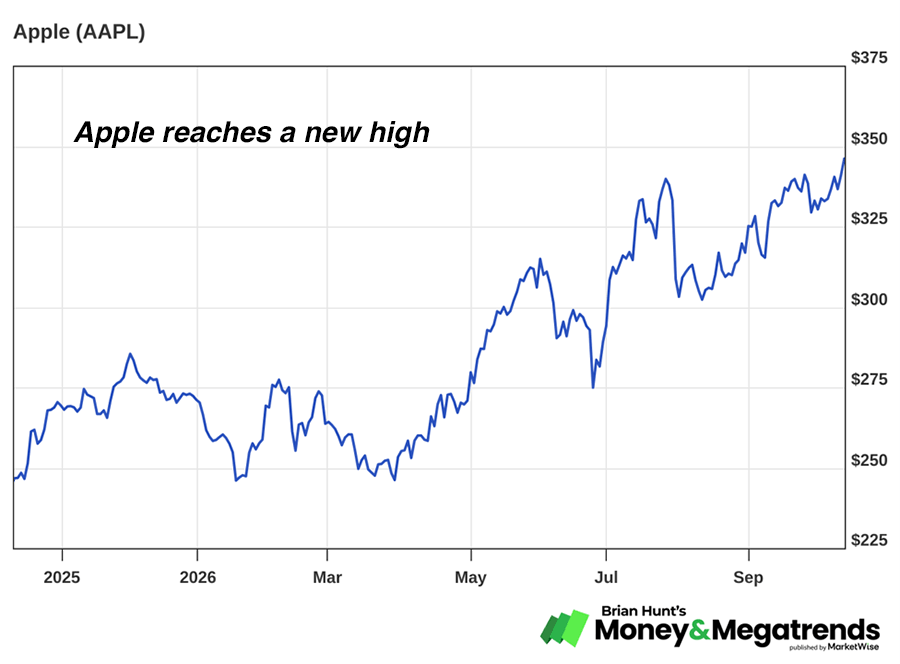
Today, the market is sending us a message that Apple (AAPL) is emerging as a winner in this trend.

Apple is the largest smartphone seller in the U.S. It also generates substantial revenue by selling iPads, Mac computers, and Apple Watches.

For more than 145 million Americans and more than 1 billion people globally, Apple devices are the primary gateway to the internet and, increasingly, to AI applications. In other words, Apple owns one of the most powerful and valuable digital product distribution networks in all recorded history.

As AI agents become more powerful and useful, consumers will increasingly spend money on agentic apps and services that perform complex tasks, solve problems, and manage their daily lives.

And for more than a billion people, Apple products will be the primary gateway to this new world. Their iPhones, iPads, and Macs will serve as the interfaces through which they interact with AI agents, issue instructions, and receive results. Apple doesn’t have to develop the world’s smartest AI models to become a big beneficiary of the agentic AI revolution. It already owns one of the world’s most valuable digital distribution networks.

Don’t take our word for it, however. Take the market’s word. This week, Apple reached a new all-time high. The stock has returned 40% over the past 12 months. It looks like, in Apple’s case, AI is going to help the big get bigger, and the rich get richer. And if the company could make Siri “not terrible,” then the sky is the limit!

Image


A new development for the world’s most important trend… and what it means for your portfolio

Image

Credit: BlackJack3D

Apple’s new high (see above) isn’t good news just for Apple shareholders.

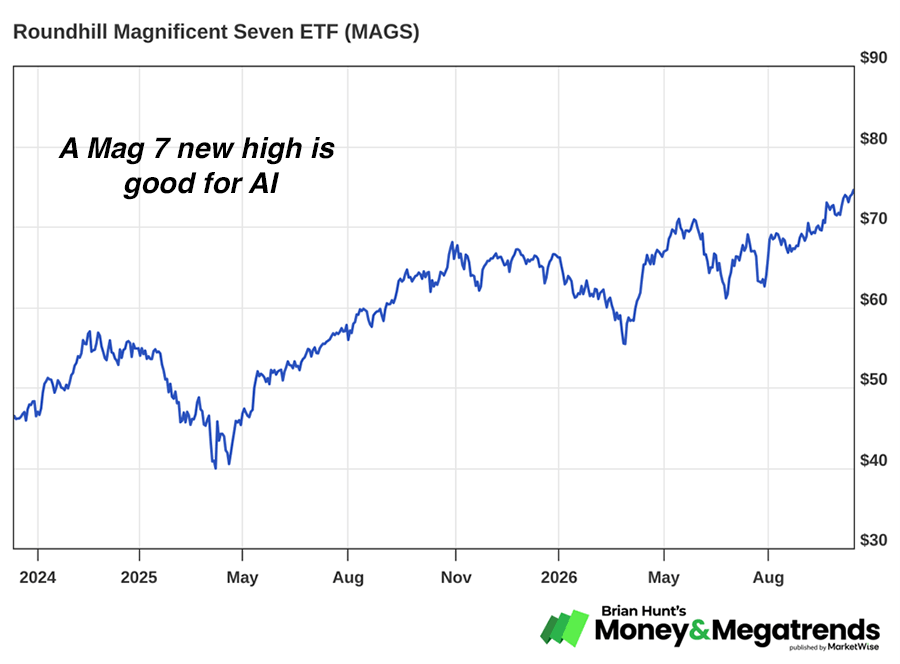
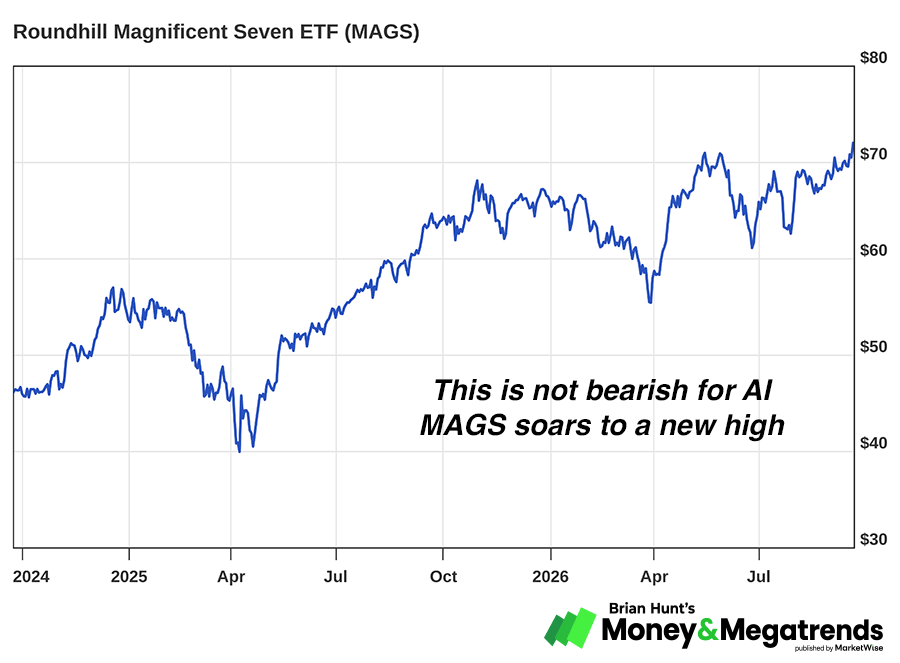
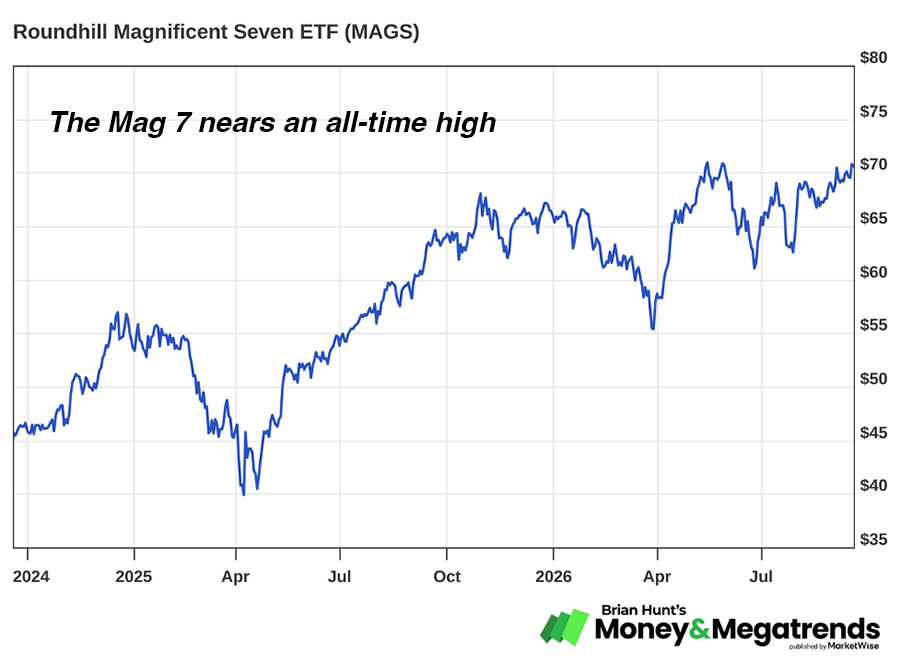
Strength in the stock helped power the Roundhill Magnificent Seven ETF (MAGS) to a new all-time high today.

That’s a great signal for the technology sector in general and the AI infrastructure trade specifically. It tells us the “world’s most important trend” is alive and well… and continuing to confound the very vocal group of AI bears that claim the trend is in a bubble.

MAGS is the largest ETF specifically designed to give investors exposure to the “Magnificent 7,” a group of dominant technology firms comprised of Nvidia (NVDA), Microsoft (MSFT), Alphabet (GOOG), Tesla (TSLA), Amazon (AMZN), Apple (AAPL), and Meta (META).

Together, these firms are worth about $25 trillion and make up roughly 31% of the benchmark S&P 500. No group of companies in history has wielded this group’s awesome combination of power, technological expertise, and vast financial resources. This group includes nearly all the “hyperscalers” leading the AI revolution.

And the ETF that tracks this group reached an all-time high today.

This is a huge development for “the world’s most important trend.”

Over the past two months, we’ve published a special series of research notes analyzing the AI infrastructure megatrend.

The status of this critical trend has become one of the great sagas of the business and investment world… a source of intense disagreement among industry bulls and bears. It’s a trend whose outcome could have large effects on your portfolio.

Given AI’s enormous promise, the firms above have invested over $1 trillion in AI infrastructure. They are on pace to invest over $700 billion this year alone and more than $4 trillion after that.

Both the scale and the velocity of this investment boom are unprecedented. It is the largest collective investment effort in history.

Big Tech’s historic investment boom has made the entire “AI infrastructure” trend responsible for a large share of America’s GDP growth and stock market returns over the past two years. It has also drawn the skeptical scrutiny of many widely followed investment analysts who claim the trend is a bubble… one that will soon explode and cause tremendous damage to stock prices and the global economy.

If this hugely consequential trend isn’t the most important trend in the stock market, then it is certainly in the top three.

I believe the AI infrastructure trend has years to run. I believe the world’s smartest, most connected tech insiders who know the true state of bleeding-edge AI development and have real-time stats on AI investment ROI, such as Elon Musk, Jensen Huang (Nvidia), Satya Nadella (Microsoft) and Andy Jassy (Amazon), could possibly… perhaps maybe… just might… know far more about AI and their businesses than outsiders know about it.

As much press as AI gets, let’s remember that less than 1% of the global population pays for top-tier AI programs. And I estimate less than 10% of large companies believe AI has made a meaningful impact on their businesses.

This revolutionary technology hasn’t yet proliferated, achieved mass adoption, or had mass impact. Plus, as I’ve recently pointed out, anyone who says AI is a “bubble” should have their brain checked for defects.

Regular readers know I care a lot more about what the market thinks of any stock, trend, or theme than what any one person thinks of it, including me. You can be bullish or bearish on a trend all you like, but if that trend is moving strongly against you, then your idea isn’t worth much in my book.

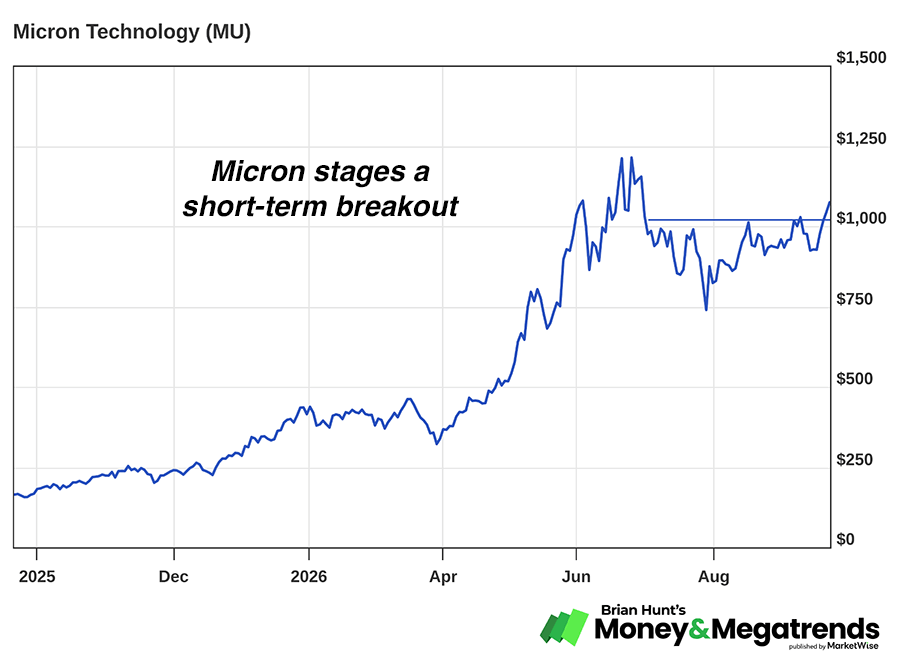
Over the past few months, we have analyzed price action in critical areas of the AI infrastructure trade – including the VanEck Semiconductor ETF (SMH), computer memory giant Micron (MU), and optical networking stocks – to guide our trading.

Since the Mag 7 plays a central role in AI infrastructure, it is central to our analysis. Several of these firms have been singled out by bears for issuing debt to invest in AI data center construction.

However, right now, the market is saying debt issuance and ROI on AI infrastructure spend aren’t much of a worry… and that things are going quite well for the Mag 7.

As you can see in the two-year chart below, MAGS is in a clear uptrend and just broke out to an all-time high. This is bullish for the AI infrastructure trade, bullish for the tech sector in general, and bullish for America.

Image


Market Notes

  • Payment giants Visa (V) and Mastercard (MA) just hit yearly highs. This is a positive sign for the economy.

  • The Iran War and its constriction of oil and refined products continue to benefit U.S. refiners. Refining giants Phillips 66 (PSX) and Marathon Petroleum (MPC) reached new one-year highs today.

  • Our September 2025 recommendation to invest in oil and gas stocks continues to pay off. Oil and gas giants Shell (SHEL), BP (BP), Suncor Energy (SU) and Petrobras (PBR) reached new one-year highs today.

  • Last October’s recommendation to own the Boomer healthcare trend is paying off. AbbVie (ABBV) just hit new yearly highs. It’s now up 12% over the last month alone. Other healthcare-related names Oscar Health (OSCR), Haemonetics (HAE), and Hinge Health (HNGE) also reached new highs today.

  • Space economy leader AST SpaceMobile (ASTS) reached a new one-year low today.

Regards,

Brian Hunt signature

Brian Hunt signature

Brian Hunt
Editor, Money & Megatrends


An urgent message from our colleagues:

“The Prophet’s” #1 Retirement Stock Right Now — Free

Image

Whitney Tilson — the man CNBC calls “The Prophet,” twice featured on 60 Minutes — is revealing the name and ticker of what he calls America’s Greatest Retirement Stock. Completely free. It’s already outperformed Apple, Amazon, and the S&P 500 combined… A billionaire put 60% of his $9 billion fund into it… And Google’s former CEO just partnered with it directly. Right now it’s trading at a rare discount.

No email required. Get the name free.

The post A new kind of AI trade is emerging. Here are the stocks to play it. appeared first on MarketWise.

  •  

A new AI investment strategy that could generate 1,100%+ returns

Today’s issue in preview:

  • A new AI investment strategy that could generate 1,100%+ returns

  • This energy trend is producing winners day after day. Are you benefiting?

  • Learn our Top Themes to buy now


This energy trend is producing winners day after day. Are you benefiting?

Image

Credit: sefa ozel

As it turns out, being bullish on oil stocks was a good idea.

Last week, one of our top energy recommendations – Canadian oil giant Suncor Energy (SU) – climbed 3.8% to reach a new all-time high. The stock has returned 73.5% since our original bullish oil call back in September 2025.

Last September, I made the case for going long the emerging uptrend in oil and gas stocks: As the global economy grows, oil demand will remain solid. However, importantly, U.S. shale oil production growth appears to be peaking.

Flatlining supply from this region would remove a critical and reliable source of production growth that has been in place for more than a decade. Plus, oil was very cheap relative to gold and other assets, indicating good value.

With all that in mind, we’ve written frequently and bullishly about owning Suncor, ExxonMobil (XOM), the diversified State Street Energy Select Sector SPDR Fund (XLE), and oilfield service stocks like those in the SPDR S&P Oil & Gas Equipment & Services ETF (XES). The oil sector has been one of the true market leaders over the past year. Both XOM and XLE recently reached new all-time highs.

When I recommended oil and started trading it from the long side, I did not factor in the potential bullish driver of the Iran War. That’s been a “bonus” driver of gains in oil stocks. Sometimes, the dice rolls in your favor.

Although positive news related to the Iran War could emerge at any time and trigger a short-term correction in oil and oil stocks, the long-term picture remains bullish. I see three reasons why this is the case.

One: Critical oil infrastructure in the Middle East has been damaged. Oil flows will not return to pre-war levels for possibly over a year. This supports oil prices north of $80 per barrel, which in turn supports strong cash flows for oil and gas firms.

Two: Most countries maintain substantial above-ground “buffer” supplies of oil and refined petroleum products in the event of market disruptions such as the Iran War. Over the past six months, much of these buffer supplies have been depleted to compensate for the loss of Middle Eastern flows. They must be replenished.

The coming restocking of buffer supplies will support oil prices north of $80 per barrel… which, again, supports large cash flows for oil and gas firms.

Three: Although oil stocks have enjoyed a large run since our September call, they aren’t up much over the past ten years. Adjusted for dollar debasement over the past decade, key oil and gas ETFs are down significantly. This is not an aging bull market that has attracted too many fans and too much capital. It is the opposite of that.

Avid Money & Megatrends readers know that I like to know both the bull and bear cases for any trend… but I care a lot more about what the market thinks of those cases than anything else. You can be bullish on an industry or theme all you like, but if the market is going against you, then your bullish thesis isn’t worth much.

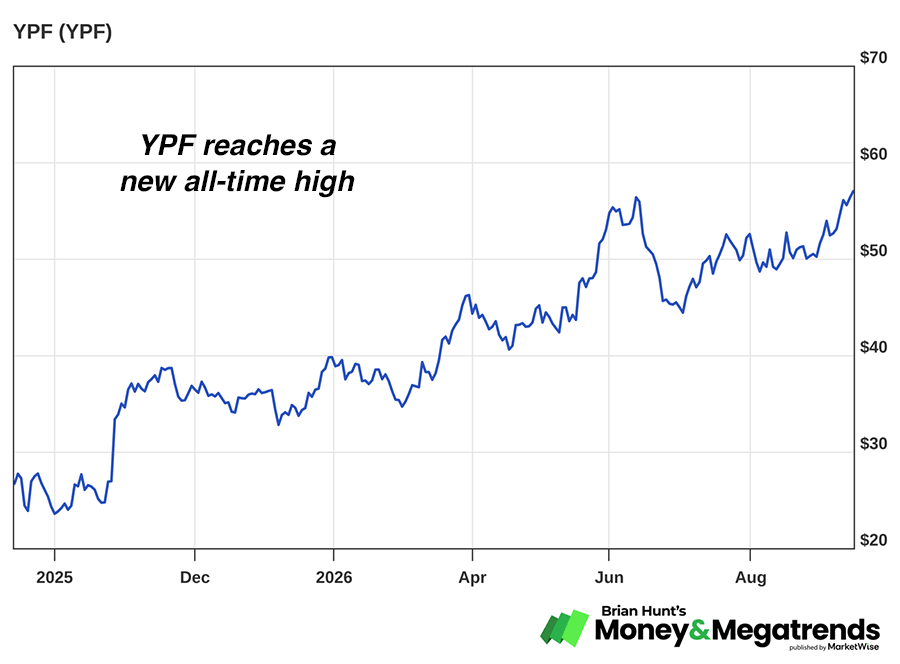
As for the bull case for oil stocks, the market is enthusiastically supporting it… especially for companies with safe, reliable “not Middle Eastern” asset bases like key Canadian oil sand firms Suncor, Canadian Natural Resources (CNQ), Cenovus Energy (CVE), plus Argentine oil firm YPF (YPF). Our guidance remains: Stay long oil stocks.

Image

Recommended Link:

“AI Bank” pays 6% APY

Ad Image

Your bank has been ripping you off for years with low interest rates, high fees, bad customer service. Well now you have an alternative – an “AI Bank” that pays 6% interest and gives you full control of your money. See the details here… and why this is striking fear into Wall Street bankers.

A new AI investment strategy that could generate 1,100%+ returns

Image

Credit: imaginima

Since Jan. 1, 2024, the market value of AI-centric defense giant Palantir (PLTR) is up 1,117%. Last Friday, the stock reached a new all-time high.

This giant gain makes Palantir one of the top-performing stocks of the 2020s.

It’s also a demonstration of how powerful the strategy of owning “AI Applications Layer” winners can be.

This strategy – which we most recently detailed in our July 15 issue – is so powerful that it can change your life. Like an “add a zero to your net worth” kind of change.

For a refresher of this strategy, think about Apple, Amazon, Google, Facebook, Netflix, and YouTube for a moment.

These are among the largest and most successful businesses in history.

Their early investors made 10X returns and, in some cases, 100X+ returns.

And they all have one thing in common: They didn’t build the physical network of fiber optic lines, routers, servers, and switches that made up the internet.

Instead, they built the wonderful businesses on top of that revolutionary infrastructure.

They were the “applications” layer of the internet.

It’s important to understand the applications layer concept because we’re on the cusp of a historic boom in companies that don’t build critical AI “hard infrastructure” such as data centers and semiconductors…but instead build wonderful businesses on top of that infrastructure… just like Apple, Amazon, and Google did with the internet.

The revolutionary AI program ChatGPT was released to the public in late 2022. Since then, big tech firms have invested over $1 trillion in semiconductors, networking equipment, computer memory, physical data centers, and other components of AI infrastructure.

This infrastructure powers extraordinary AI models that become more capable and faster by the month.

Now that so much infrastructure has been installed, thousands of businesses can be built upon it… much like how Amazon, YouTube, and Netflix were built upon the internet.

I’m talking about AI-centric businesses that revolutionize how we develop medicines, how we educate, how we entertain ourselves, how we manufacture, how we shop, how we transfer and invest money, and much more.

The internet changed every industry and created many new ones. AI will do the same.

Investors who follow the Internet applications layer playbook into big AI applications layer winners stand to make giant returns. In fact, I’d say this theme is one of the best places to find 10X+ winners over the next decade.

Palantir is a very early leader in this field.

Palantir is a leading software company that helps its customers use AI to organize, analyze, and act on huge amounts of complex data.

Palantir’s major products include Gotham, used extensively by defense and intelligence agencies; Foundry, designed for commercial enterprises; and Artificial Intelligence Platform (AIP), which integrates advanced AI models into business workflows.

Palantir’s largest customer is the U.S. government. Palantir provides military and intelligence agencies with advanced software that integrates battlefield intelligence, satellite imagery, sensor data, and operational information. Its AI-powered platforms help commanders identify threats, track adversaries, plan missions, coordinate forces, and make decisions.

If you want to conduct war in an ultra-high-tech fashion, you work with Palantir.

To be clear, Palantir did not build any AI data centers. Nor did it develop one of the leading frontier AI models. Instead, it has built software that harnesses the power of models from companies such as OpenAI and runs on computing infrastructure provided by others.

In effect, Palantir has positioned itself as a critical bridge between the extraordinary capabilities of AI and the organizations that can put those capabilities to work.

Palantir’s early mastery of AI and data analytics has helped it generate extraordinary revenue growth over the past six years. In 2020, annual revenue came in at $1.09 billion. In 2025, revenue came in at $4.48 billion. Palantir expects 2026 revenue to grow by an incredible 82% this year to about $8.15 billion.

Given this blazing growth, it’s no wonder Palantir is up more than 10X since early 2024. This is the AI Applications Layer phenomenon at work.

The AI infrastructure buildout is far from over. But enough advanced models have been developed, and enough infrastructure is in place, to fuel an extraordinary next phase of the AI boom.

Innovative companies in the “AI Applications Layer” can now harness this technology to build great businesses with extraordinary growth potential. Palantir is just the beginning.

Image


Market Notes

  • Our 8th recommendation to own the Boomer healthcare trend is paying off. Biogen (BIIB) and AbbVie (ABBV) just hit new yearly highs.

  • Our March 27th recommendation to own cybersecurity stocks is paying off well. Fortinet (FTNT), Okta (OKTA), Qualys (QLYS) and Dynatrace (DT) all hit new highs. OKTA is now up 160% in the last year alone.

  • The Iran War and its constriction of oil and refined product supplies continues to work in favor of oil shipping firms. Industry leaders Frontline (FRO), Torm (TRMD) and Hafnia (HAFN) reached new one-year highs this week.

  • Small Modular Reactor players Oklo (OKLO) and NuScale Power (SMR) both hit new yearly lows last week.

Regards,

Brian Hunt signature

Brian Hunt signature

Brian Hunt
Editor, Money & Megatrends


An urgent message from our colleagues:

Elon just declared war on your phone

Image

Elon Musk just dropped another bombshell… He’s going after your cell phone provider. For months, Elon kept these plans under wraps. But late last week, he finally showed his hand. I’ve tracked this story for months, and it’s playing out exactly as I predicted. Next, I believe Elon could launch a new device that kills the iPhone… and hands early investors his biggest payday yet. Potentially 50 times their money. Here’s everything you need to do BEFORE he makes his move. Just act quickly because this story is moving fast.

Click here.

The post A new AI investment strategy that could generate 1,100%+ returns appeared first on MarketWise.

  •  

Seven stocks that could explode as AI goes mainstream

Today’s issue in preview:

  • Seven stocks that could explode as AI goes mainstream

  • AI’s hidden income opportunity: How to earn large income streams from the boom

  • Why the U.S. dollar is plummeting in value… and how to protect yourself

  • Learn our Top Themes to buy now


Seven stocks that could explode as AI goes mainstream

Image

Credit: Petrovich9

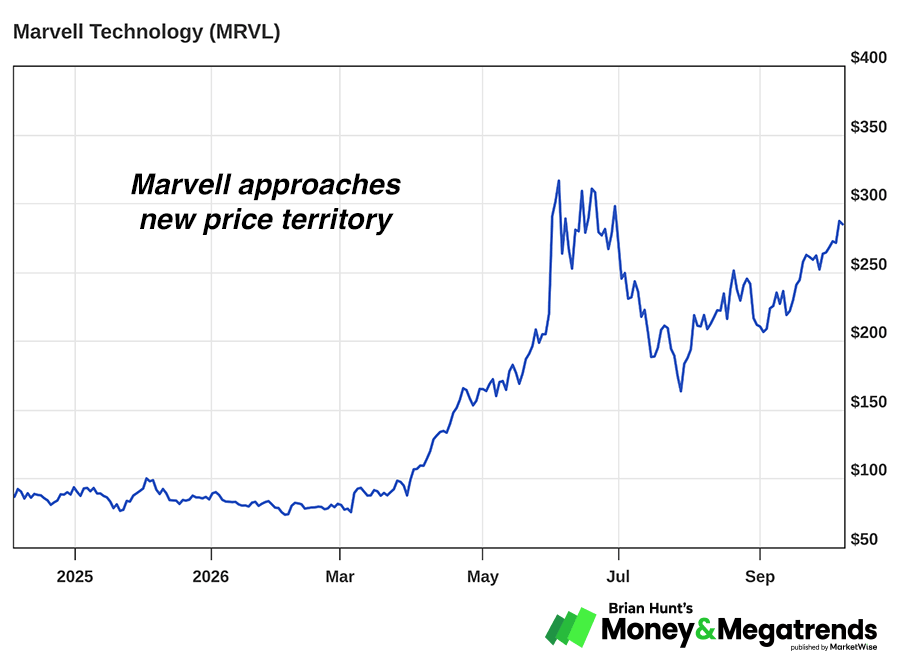
In June, Nvidia (NVDA) CEO Jensen Huang stood on stage next to Marvell Technology (MRVL) CEO Matt Murphy and predicted Marvell would be the “next trillion-dollar company.”

As a result, MRVL shares jumped 32% in a single day, which was the largest one-day gain in the company’s history. Plus, Marvell became one of the most widely followed companies in the tech world.

Why is Jensen – the “Michael Jordan of AI” – so bullish on Marvell?

Marvell is one of the world’s leading suppliers of optical networking semiconductors, particularly the chips that enable high-speed data transmission inside AI data centers. Market cap is $241 billion.

Jensen believes Marvell could become the next trillion-dollar company because it solves one of AI’s biggest challenges: moving enormous amounts of data between chips.

As AI data centers grow to include hundreds of thousands of processors, connecting those chips quickly and efficiently becomes critical. Marvell specializes in high-speed networking chips, optical connections, and custom processors that enable this.

Jensen sees these technologies becoming increasingly valuable as AI infrastructure spending explodes. Nvidia is so bullish on Marvell’s future that it invested $2 billion in the company and formed a strategic partnership to develop next-generation AI infrastructure.

Over the past two months, we’ve published a special series of research notes analyzing the AI infrastructure trend.

The status of this critical trend has become one of the great sagas of the business and investment world… a source of intense disagreement among industry bulls and bears. It’s a trend whose outcome could have large effects on your portfolio.

Given AI’s enormous promise, large tech firms such as Alphabet (GOOG), and Microsoft (MSFT) have invested over $1 trillion in AI infrastructure. They are on pace to invest over $700 billion this year alone and more than $3 trillion after that.

Both the scale and the velocity of this investment boom are unprecedented. It is the largest collective investment effort in history.

Big Tech’s historic investment boom has made the entire “AI infrastructure” trend responsible for a large share of America’s GDP growth and stock market returns over the past two years. It has also drawn the skeptical scrutiny of many widely followed investment analysts who claim the trend is a bubble… one that will soon explode and cause tremendous damage to stock prices and the global economy.

If this hugely consequential trend isn’t the most important trend in the stock market, then it is certainly in the top three.

Recently, we’ve detailed how new highs for Nvidia, AI chip leader Nvidia (NVDA), semiconductor manufacturer Taiwan Semiconductor (TSM) and the Roundhill Magnificent 7 ETF (MAGS) indicate the market is enthusiastically endorsing a continuation of the AI infrastructure megatrend.

This of course, is also bullish for Marvell.

Although bleeding edge semiconductors from the likes of Nvidia get most of the headlines, those chips are only as good as the connections between them.

As AI data centers grow more complex and more powerful, the number of chips connected inside them increases. A modern AI cluster, for example, ties together hundreds of thousands of chips that all must act together. If that data between chips moves too slowly, these expensive processors just sit there idle.

Traditionally, these data connections have been made from copper. But at the speeds required today, copper can’t keep up. It loses signal and burns power too quickly.

The fix is to slowly replace electrical signals traveling over copper with light signals traveling over fiber-optic cables. That’s what optical networking does. And it’s what Marvell is a world leader in.

Recently, Marvell put a huge spotlight on this technology at its investor day, held on October 6.

Until MRVL’s investor day, we knew optical networking gear had at least two years of solid demand ahead. But we never saw forecasts through to 2030 and beyond.

Marvell’s investor day just changed that.

Here’s is big news:

  • Management estimates its total market opportunity will expand to approximately $400 billion, growing around 45% annually from 2025.

  • Management forecasts annual revenue to climb from $8.2 billion in fiscal year 2026 to $80 billion in fiscal year 2031.

In other words, Marvell has made one of the most aggressive industry forecasts in the technology world… and one of the most aggressive company growth forecasts.

This forecast – plus the word of Jensen Huang – makes optical networking stocks like Marvell and fellow industry players Coherent (COHR), Lumentum (LITE), Ciena (CIEN), Credo Technology (CRDO) and Applied Optoelectronics (AAOI) one of the most compelling technology trends to monitor and consider as an investment candidate.

It is one of the highest leverage ways to invest in the mass adoption of AI.

Like most components of the AI infrastructure trade, Marvell enjoyed a big spring rally this year and a significant summer correction. It has since digested this correction, rallied, and is closing in on an all-time high. A break above that high would be a very bullish signal for the optical networking theme. We will keep you apprised of the situation.

Image

Recommended Link:

10 Doubles in 12 Months, or He Works for Free

Ad Image

On October 14, Master Trader Jonathan Rose is putting his reputation on the line by promising at least TEN 100% recommendations over the next 12 months. He’ll reveal the specifics during his $10k to $100k Challenge. Details here.

AI’s hidden income opportunity: How to earn large income streams from the boom

Image

Credit: stanley45

In yesterday’s issue, we highlighted how both large tech firms such as Google (GOOG) and the U.S. government are making huge investments in nuclear energy.

As more individuals and businesses leverage the power of “super intelligence,” more demands are placed on AI infrastructure… which means more demands on our national electric power system.

Since that overloaded system is already straining, AI has a “power problem.” We don’t have enough electric power plants. We don’t have enough connections to existing power plants. We don’t have enough high-voltage transmission lines.

A big part of the solution to this problem is nuclear energy. According to a 2026 analysis by energy consulting firm KeyLogic, annual U.S. nuclear power investment could reach $80 billion to $94 billion by 2035 under an ambitious expansion scenario designed to quadruple the nation’s nuclear generating capacity by 2050.

However, nuclear is only part of the solution to AI’s power problem.

Natural gas – and America’s natural gas transportation network – is a huge part of the solution as well.

Although building large amounts of nuclear power generation capacity is a compelling long-term solution to AI’s power problem, it is not a short-term solution.

Getting permits and project financing for a nuclear power plant typically takes years. And with permits in hand and financing secured, the industry expects build times of 7-10 years.

A nuclear plant is a gigantic, extraordinarily complex construction project. It requires huge reactor vessels, steam generators, coolant pumps, heat exchangers, and miles of specialized piping. Many of these components are frequently custom-built or produced in tiny quantities. There is nothing resembling the mass-production supply chain for conventional industrial equipment.

Once these often enormous, often highly specialized components are built, they must be installed in a precise sequence, inspected, tested, and integrated into a single safety-critical system.

Because the safety stakes are so high, nuclear power plant components are subject to rigorous testing. A problem with one component can hold up several downstream construction activities.

You typically cannot throw more workers at a nuclear power plant project to speed it up. You often cannot even throw more money at it to make it go faster. And so, it takes 7-10 years to build a new nuclear plant.

All this has made my recommendation of energy pipelines a big winner… and should keep it winning for years.

In early 2024, I began to see the oil and gas pipeline industry as the best way to generate substantial passive income from the AI boom.

The U.S. has enormous reserves of clean-burning natural gas. Plus, it has over 2,000 natural gas-fired power plants. An additional natural gas power plant can be built in less than a third of the time it takes to build a new nuclear plant.

However, all the natural gas reserves in the world aren’t worth much if you can’t get the gas from the wellhead to the plants.

This is where America’s vast natural gas transportation, processing, and storage industry comes in.

An extensive network of pipes crisscrosses America that allows energy companies to transport natural gas from prolific fields in Texas, Pennsylvania, New Mexico, West Virginia, and Louisiana to the nation’s power plants.

A boom in AI-related electricity demand by default means a boom in demand for natural gas transportation services.

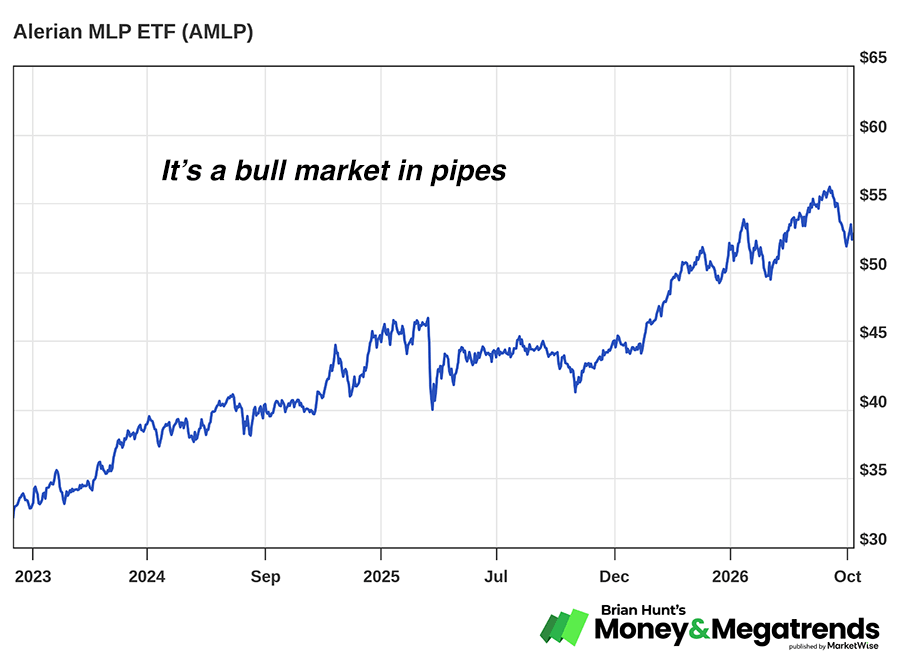
Since 2024, the market has enthusiastically supported our bull case for energy pipelines. Blue chip pipeline operator Enterprise Products (EPD) has returned 67%. Fellow blue chip operators Energy Transfer (ET) and Kinder Morgan (KMI) have returned 92% and 129%, respectively. Each of these firms is enjoying terrific growth in volumes and revenue.

These individual stock gains have powered the energy pipeline-focused Alerian MLP ETF (AMLP) to a 64% total return since 2024. Despite AMLP’s big run and shares being near all-time highs, it still yields around 7.75%.

The typical pipeline operator is not your conventional “high-risk, high-reward” AI play. Instead, it’s a boring, predictable business that generates steady cash flows and shareholder distributions.

But the AI megatrend is giving natural gas a boost that will last for years. Plus, the Iran War and its constriction of Middle Eastern energy flows have made U.S. natural gas exports increasingly more valuable to customers in Europe and Asia. The Russia/Ukraine war is doing the same with its constriction of Russian natural gas exports.

Generating stable cash flows by transporting oil and gas isn’t as exciting as some high-tech industries, but business is booming… and will most likely do so for years. It’s a bull market in pipes!

Image


Why the U.S. dollar is plummeting in value… and how to protect yourself

Image

Credit: Backyard Production

Every day across America, people complain about high prices.

The price of gasoline is high.

The price of groceries is high.

Young people can’t afford homes because their prices are high.

We all know the prices of many things we buy a lot of are way up over the past seven years.

But do we all know why?

I’ll answer that for you: No.

Most people have a vague, nagging feeling that soaring prices may have something to do with runaway government spending, the U.S. deficit, and inflation. They know something isn’t quite right… But they don’t fully understand what is happening.

Here is what is happening in simple terms anyone can understand…

Over the past 50 years, the U.S. and state governments have made many promises to many people. Social security payments. Medicare. Medicaid. Pensions. Defense contracts. Veterans’ benefits. Government employment contracts. Unemployment benefits. Food stamps. Federal education programs. Plus, you have the day-to-day costs of things like roads, bridges, police, and regulatory enforcement.

And over those same 50 years, a dangerous trend has taken root. More and more people have grown very comfortable voting themselves benefits paid by their fellow taxpayers. This trend has become so strong that our government has promised far too many things to far too many people. They are spending far more on social programs, pensions, and wars than they collect in tax revenues.

The related debts and obligations governments have taken on cannot be paid back with sound money. They can only be paid back with debased, devalued money… much of which is created out of thin air. Every freshly printed unit of currency debases an existing one.

This is driving inflation and significant currency debasement. Prices are going up because the value of our money is going down.

Measured against a basket of widely used raw materials like crude oil, corn, silver, sugar, and soybeans, the U.S. dollar has lost 48% of its value over the past eight years.

Here in mid 2026, the problem is worse than ever. In America, millions of people are net tax recipients – meaning they receive more in benefits than they pay in taxes. Plus, according to the U.S. Bureau of Labor Statistics, about 15% of all jobs in America are government jobs (federal, state, local). These folks aren’t voting for fewer benefits or fewer jobs.

No politician can win a major election by promising reduced spending.

Too many people are now riding the gravy train.

Democrat or Republican, it doesn’t matter.

Campaigning on sensible spending is a sure loser.

So, what stops the insanity?

How can we get spending under control?

Sorry – bad news. Too many voters either work for the government directly or indirectly or are net tax recipients. They will flat-out not vote for someone who promises to cut benefits, handouts, and spending. This crazy spending is a runaway train.

We will only “get religion” after a financial market crisis forces us to get it.

It’s like how most alcoholics won’t make a change until they’ve almost killed themselves in a car crash or something… or how someone that doesn’t exercise and has a horrible diet won’t change their ways unless a health crisis forces them to.

It’s just human nature. We tend not to change unless we get hit with a metaphorical 2×4 to the head.

So, keep all this in mind next time you see high prices or think about inflation. Sure, you can think of it as prices going up. Or, you can think of it as the value of the money is going down.

This phenomenon shapes all kinds of things and distorts many concepts people hold. For example…

*People like to make a big deal about the massive market values of giants like Nvidia (NVDA) and Apple (AAPL). But keep in mind that since the value of the dollar has declined by about 50% over the past eight years, today’s $5 trillion is worth about $2.5 trillion in 2018 dollars.

*People like to point out that oil prices are very high, but today’s $90 barrel of oil is worth about $45 in 2018 dollars.

*People who recently sold a house for a lot more than they paid for it 10 years ago aren’t actually any wealthier. The value of the money plummeted, so the home’s price went way up. They essentially treaded water, minus all the insurance costs, maintenance costs, and taxes. Their “profits” are largely an illusion: The money they pocketed doesn’t buy any more food, gas, or housing than it did 10 years ago.

*If a company generated $1 million in profits in 2018 and generated $2 million in profits in 2025, it didn’t grow in real terms.

*A $250,000 salary in 2018 is worth roughly a salary of $125,000 in 2026.

You get the picture.

It’s easy to get tripped up or mistaken by the great “money illusion”

The government wants you to see rising wages, rising home prices, and rising stock prices and then feel richer and happier.

That would mean you’re more likely to support the status quo and less likely to agitate for change.

But it’s an illusion.

We’re all “earning” more money… and we’re all “making” money in the housing and stock markets…

… But those gains are a mirage.

The money we’ve been making at our jobs, in our homes, and in our stocks aren’t buying us any extra food, fuel, or free time.

We aren’t increasing our level of real wealth because the price of everything is going up.

The value of our money is going down.

You can think of prices for everything in America – homes, cars, gasoline, food, insurance, medical care – as boats on a lake.

And our money supply is the water level in the lake.

As the water level rises and rises, all the boats go up. But your real wealth doesn’t increase a bit. Every vessel on the water goes up with the water level.

And remember…

More water has been pumped into America’s “money supply” lake in the past five years than was pumped over the previous 100 years.

Sure, the price of your home is rising, but the price of everything you buy is rising.

You can think about “cashing in” and banking some profits produced by the rising price of your home, but remember that if you sell your existing house, you must buy a different house at a greatly elevated price!

You can think of the price going up, but you should also know the value of our money is going down.

This is all why it’s more important than ever to be vigilant against inflation and own many of the “inflation defense” assets we’ve covered, such as oil and gas pipelines, gold, timberland, copper mines, gravel pits, and solid, growing businesses.


Market Notes

  • Medical device giant Boston Scientific (BSX) reached a new one-year low this week.

  • Casino giant Las Vegas Sands (LVS) reached a new one-year low this week.

  • The Iran War and its constriction of oil and refined product supplies continues to work in favor of oil shipping firms. Industry leaders Frontline (FRO), International Seaways (INSW), and Hafina (HAFN) reached new one-year highs this week.

  • Software leader Atlassian (TEAM) reached a new one-year high this week.

Regards,

Brian Hunt signature

Brian Hunt signature

Brian Hunt
Editor, Money & Megatrends


An urgent message from our colleagues:

Blue Origin… DOOMED

Image

Jeff Bezos should be terrified. He will be down on his knees, begging Elon for mercy. Because Elon is set to: Cut Amazon out of the AI race ENTIRELY…Completely DESTROY Blue Origin…And take control of the potential $25 TRILLION DOLLAR PER YEAR AI INDUSTRY. And in his wake, potentially create 1,806,000 NEW millionaires over the coming years… Starting December 8. And this is your chance to be one of them. Legendary tech investor, James Altucher, shows why a single FCC filing proves it.

Click here to see why.

The post Seven stocks that could explode as AI goes mainstream appeared first on MarketWise.

  •  

Four stocks to invest in an industry with exploding demand

Today’s issue in preview:

  • Four stocks to invest in an industry with exploding demand

  • How to trade the AI infrastructure boom from here

  • Eight stocks to invest in soaring AI electric power consumption

  • Learn our Top Themes to buy now


How to trade the AI infrastructure boom from here

Image

Credit: pingingz

This week, the bull case for “the world’s most important trend” got a little stronger. And it’s increasingly looking like the “AI bulls” are right.

As evidence, we cite the new all-time highs reached yesterday by Everpure (P), Arista Networks (ANET), NetApp (NTAP), and Hewlett Packard Enterprise (HPE).

Each of these tech firms has heavy exposure to the AI infrastructure buildout.

  • Arista makes high-speed networking switches connecting GPUs and servers in AI data centers.

  • Hewlett Packard Enterprise supplies AI servers, networking equipment, storage systems, and advanced data center cooling.

  • Everpure provides high-performance flash storage enabling rapid data access for AI workloads.

  • NetApp makes enterprise data storage and management systems that support AI training and inference.

This round of new highs for companies heavily leveraged to the AI infrastructure boom is yet another positive signal that indicates a healthy megatrend.

Over the past month, we’ve published a special series of research notes analyzing the AI infrastructure trend.

The status of this critical trend has become one of the great sagas of the business and investment world… a source of intense disagreement among industry bulls and bears. It’s a trend whose outcome could have large effects on your portfolio.

Given AI’s enormous promise, large tech firms such as Alphabet (GOOG), and Microsoft (MSFT) have invested over $1 trillion in AI infrastructure. They are on pace to invest over $700 billion this year alone and more than $3 trillion after that.

Both the scale and the velocity of this investment boom are unprecedented. It is the largest collective investment effort in history.

Big Tech’s historic investment boom has made the entire “AI infrastructure” trend responsible for a large share of America’s GDP growth and stock market returns over the past two years. It has also drawn the skeptical scrutiny of many widely followed investment analysts who claim the trend is a bubble… one that will soon explode and cause tremendous damage to stock prices and the global economy.

If this hugely consequential trend isn’t the most important trend in the stock market, then it is certainly in the top three.

I believe the AI infrastructure trend has years to run. I believe the world’s smartest, most connected tech insiders who know the true state of bleeding-edge AI development and have real-time stats on AI investment ROI, such as Elon Musk, Jensen Huang (Nvidia), Satya Nadella (Microsoft) and Andy Jassy (Amazon), perhaps maybe… just might… know far more about AI and their businesses than outsiders know about it.

As much press as AI gets, let’s remember that less than 1% of the global population pays for top-tier AI programs. And I estimate less than 10% of large companies believe AI has made a meaningful impact on their businesses.

This revolutionary technology hasn’t yet proliferated, achieved mass adoption, or had mass impact.

Regular readers know I care a lot more about what the market thinks of any stock, trend or theme than what any one person thinks of it, including me. You can be bullish or bearish on a trend all you like, but if that trend is moving strongly against you, then your idea isn’t worth much in my book.

In the case of AI infrastructure, the market is favoring the bullish case.

Not only are the companies above reaching new highs, but we’re seeing tremendous strength in AI chip leader Nvidia (NVDA), semiconductor manufacturers Taiwan Semiconductor (TSM) and the Roundhill Magnificent 7 ETF (MAGS), which owns the “hyperscalers” that are spending big on AI data center construction.

On the stock market’s “scales of justice,” the weight of the evidence continues to heavily favor the bulls.

Image

Recommended Link:

Can $10,000 Become $100,000 in the Next 12 Months?

Ad Image

On Wednesday, October 14 at 8 pm ET, legendary trader Jonathon Rose will reveal how you could turn every $10,000 into $100,000 or more by using the same strategy that produced 959% in one month from Albemarle Corp. Click here to reserve your spot.

Four stocks to invest in an industry with exploding demand

Image

Credit: yacobchuk

In yesterday’s issue, we detailed how strong fundamentals are powering a big bull market in the world’s largest healthcare stock ETF – the State Street Health Care Select Sector SPDR ETF (XLV).

This key investment fund is up 35.4% over the past three years, 17.8% over the past 12 months, and is trading near its all-time high.

XLV owns a “who’s who” of big-time healthcare firms. It holds a diversified basket of drugmakers (Merck, Eli Lily), healthcare tools and services firms (Thermo Fisher, Danaher), medical device firms (Intuitive Surgical, Medtronic), and other assorted components of the healthcare industry.

These high-profile firms are benefitting from a “superboom” in health care spending… which is driven by the enormous Baby Boom generation entering the period of life where spending on healthcare skyrockets.

However, a large and varied ecosystem of smaller but critical health care businesses is worth knowing about and owning. They comprise a huge – yet usually unseen – infrastructure layer of equipment and service providers that enable doctors, nurses, clinicians, and executives to do their jobs.

This is the world of CT scanners, hospital software, surgical tools, stents, catheters, wearable medical devices, endoscopes, artificial hips, X-ray machines, MRI machines, lab service providers, syringes, and the list goes on.

The U.S. spends more than $5 trillion on health care annually, or about 18% of GDP. This means the world of Healthcare Equipment & Services is large, varied, and full of opportunity.

Compelling “off the radar” healthcare stocks that are positioned to benefit from the trends detailed above include:

Dexcom (DXCM) is a $33 billion company that makes continuous glucose monitors (CGMs). These are wearable sensors that have replaced the traditional fingerstick testing for millions of diabetics.

DXCM has historically only competed in the type 1 diabetes market, but it is expanding into type 2 diabetes to compete with the likes of Abbott (ABT). Management has noted that about 500 million people have diabetes worldwide, and only 2% of them are on a CGM, which frames the massive addressable market ahead for DXCM.

Edwards Lifesciences (EW) is a $50 billion company that is the leader in transcatheter heart valves. This is the product needed in minimally invasive replacement procedures that have made open heart surgery unnecessary for hundreds of thousands of patients. The company benefits from aging populations, rising diagnosis rates, and the growing adoption of less invasive cardiac procedures.

West Pharmaceutical Services (WST) is a $26 billion manufacturer of specialized packaging and drug-delivery components used by drug companies. Its products include rubber stoppers, seals, syringe components, and systems for safely storing and administering injectable drugs.

West is a key player in biologics, vaccines, and GLP-1 weight-loss medications. Its products must meet strict regulatory and quality standards, creating high switching costs and durable customer relationships. Once a component is approved for use with a drug, manufacturers are reluctant to change suppliers. Over the past 12 months, revenue has grown by 12.4%.

TransMedics Group (TMDX) is a $2.8 billion medical technology company specializing in organ transplantation. Its flagship Organ Care System (OCS) keeps donated hearts, lungs, and livers functioning outside the body by circulating warm, oxygenated blood through them, unlike traditional cold-storage methods.

This technology can extend organ preservation time, improve organ assessment, and increase the number of viable organs available for transplantation. TransMedics also operates its National OCS Program, providing organ retrieval, transportation, and logistical services, including its own aircraft fleet.

The enormous Baby Boom generation has long moved through the economy like a pig through a python, creating massive surges in demand for products and services at each stage of life. Now, the generation is fueling what could be the biggest and most profitable boom yet: healthcare. We recommend staying long.

Image


Eight stocks to invest in soaring AI electric power consumption

Image

Credit: RelaxFoto.de

Alphabet’s (GOOG) latest AI investment isn’t a new kind of semiconductor chip or a data center. It’s nuclear power.

This week, Google and nuclear power giant Constellation Energy (CEG) agreed to a massive 20-year power deal that will boost output at 11 existing nuclear reactors.

The agreement calls for at least $4 billion in upgrades to Constellation’s plants, ultimately adding roughly the same amount of electricity-generating capacity as an entirely new nuclear reactor.

Shares in Constellation jumped 12.2% after the news was released. Shares of fellow nuclear power generator Talen Energy (TLN) rose 12.4%.

The Google/Constellation deal isn’t the only big news in nuclear power. On Monday, the U.S. Department of Energy (DOE) said it has conditionally committed up to $4.2 billion in financing to upgrade and expand nuclear power firm Vistra’s (VST) nuclear fleet.

Most of the money would go toward the Beaver Valley plant in Pennsylvania and the Perry and Davis-Besse plants in Ohio. Vistra shares climbed 11% on Tuesday.

These new deals serve as a reminder: It’s going to take an enormous amount of electric power to keep the AI boom running.

Over the past year, we have written more than a dozen research notes on AI’s soaring power needs and its “ripple effects” on stocks of electric grid builders, uranium miners, and power producers such as Constellation and Vistra.

As detailed above, large tech firms are investing trillions of dollars to build the best AI applications and infrastructure. They are on pace to invest over $700 billion this year alone and more than $4 trillion after that. A huge portion of that money will go into data centers.

All those data centers are consuming increasingly large amounts of electric power. Goldman Sachs estimates that data-center electricity demand will rise 170% between 2025 and 2030. Goldman says the incremental electricity required by AI alone by 2030 will be roughly equivalent to adding the entire electricity consumption of Japan to the global power system.

Given this outlook, AI companies and their power providers are spending heavily to expand nuclear power capacity. The deals detailed above are the latest examples of this trend at work. Nuclear provides “always on” carbon-free baseload power. Bloomberg reports that surging nuclear demand will drive $350 billion in U.S. spending by 2050.

You can get long on this theme in several ways. In the past, I’ve mentioned nuclear power equipment and service companies such as BWX Technologies (BWXT, specialized manufacturing), Mirion Technologies (MIR, nuclear facility monitoring), Centrus (LEU, uranium enrichment), and Solstice Advanced Materials (SOLS, uranium processing).

I’ve also mentioned Independent Power Producers such as Constellation and Vistra. These two are not traditional, heavily regulated utility firms. Read here for more on their unique positions in the market.

You can also take the “one-click, and you’re done” route with a uranium miner fund such as the Global X Uranium ETF (URA) or the Sprott Uranium ETF (URNM). Both funds own diversified baskets of uranium miners and hold large positions in the blue-chip uranium miner Cameco (CCJ).

As you can see in the three-year chart of Constellation below, the nuclear power uptrend is alive and well. Given AI’s growing power demands and nuclear energy’s bullish demand outlook, I’m confident this uptrend will continue.

Image


Market Notes

  • Our September 2025 recommendation to invest in oil and gas stocks continues to pay off. Oil and gas giants Shell (SHEL) and Petrobras (PBR) reached new one-year highs today.

  • The Iran War and its constriction of oil and refined products continues to benefit U.S. refiners. Refining giants Valero Energy (VLO) and Marathon Petroleum (MPC) reached new one-year highs today.

  • AI-centric defense giant Palantir (PLTR) reached a new six-month high today.

  • Oil shipping giant Frontline (FRO) reached a new one-year high today.

Regards,

Brian Hunt signature

Brian Hunt signature

Brian Hunt
Editor, Money & Megatrends


An urgent message from our colleagues:

Elon + Trump… BACK TOGETHER!?

Image

James Altucher believes Elon Musk just filed a plan with the FCC to take over the AI industry… from outer space. Around the same time, Trump signed an order gutting the red tape around commercial space launches… and signed the second order pushing NASA to hand its work to private companies (aka SpaceX). It’s clear Washington is clearing the runway for Elon’s biggest project to date… And James Altucher predicts it could create 1,806,000 NEW millionaires over the next decade starting December 8. This FREE millionaire maker masterclass describes why you should get positioned in the $100 company at the center of it all.

It’s critical that you view it NOW.

The post Four stocks to invest in an industry with exploding demand appeared first on MarketWise.

  •  

This ignored corner of the semiconductor market could be a huge AI winner

Today’s issue in preview:

  • Demand for AI compute is exploding. That’s bullish for this stock

  • This ignored corner of the semiconductor market could be a huge AI winner

  • You don’t own enough of this bull market that has YEARS to run

  • Learn our Top Themes to buy now


This ignored corner of the semiconductor market could be a huge AI winner

Image

Credit: Ignatiev

According to documents filed for its coming IPO, leading AI firm Anthropic expects to spend a colossal $518 billion over the next decade building AI infrastructure.

Anthropic also lists who it intends to give this money to. Broadcom (AVGO) accounts for about $161 billion in equipment lease obligations, followed by Alphabet (GOOG) at $111 billion and Amazon (AMZN) at $110 billion in computing services. Smaller expected deals include SpaceX (SPCX) at up to $84.5 billion, Microsoft (MSFT) at $31 billion, and AMD (AMD) at over $20 billion.

These are the latest extraordinary developments in the proliferation of AI agents, a megatrend we call the “Agent Supernova,” which is the explosion of AI agents that work for us, think for us, shop for us, invest for us, and solve hundreds of different problems for us.

In our March 31 research note, we detailed how this megatrend is bullish for the “power management” sector of the semiconductor industry.

These days, you can’t read an AI investment research report or listen to an AI-focused podcast without hearing about its insatiable demand for electric power and how it is the limiting factor in AI proliferation.

You hear about towns protesting AI data center power consumption.

You hear how limited access to power is constraining AI infrastructure growth.

You hear why limited power access is driving Elon Musk to operate data centers in space.

All this means that the pressure to improve AI’s power consumption efficiency – or its “unit of intelligence per unit of power ratio” – is enormous.

Any improvement in AI power-consumption efficiency – no matter how small – can yield significant cost savings across the industry.

And that means companies that help improve AI’s power consumption efficiency stand to generate large returns for their shareholders.

AI data centers need high-voltage, high-density power systems to keep everything running. Edge devices like robots, smart homes, and autonomous vehicles need efficient local power management to run locally without draining batteries or generating excess heat.

You could think of the potential savings and efficiency gains here by considering America’s automotive fleet of 280 million+ cars, which drive billions of miles every year. All that driving consumes so much gasoline that even tiny gains in overall fuel economy can yield significant fuel cost savings.

Now, instead of picturing car traffic and its gasoline consumption, think of AI’s data and “thinking” traffic and its electricity consumption.

Small power-efficiency gains across many AI data centers, communication networks, and Edge Computing devices can yield significant overall power-cost savings… plus greater growth opportunities for hundreds of AI applications.

The semiconductor industry is varied. It has dozens of large players that focus on different kinds of applications. One of these applications is electric power management: Ensuring AI data centers and communication networks use power efficiently. Ensuring cars, robots, factories, phones, hospitals, and office computer networks use power efficiently.

As AI moves into its mass adoption phase, demand for innovation and quality equipment from the power management semiconductor sector will soar. This will benefit several companies with specialized technology solutions, including:

Texas Instruments (TXN) is a $286 billion semiconductor maker. It specializes in analog chips and embedded processors. Its products perform essential functions such as managing power, converting real-world signals into digital data, and controlling electronic systems. TI sells tens of thousands of products to roughly 100,000 customers, with particularly strong exposure to industrial and automotive markets.

TI chips do not need huge amounts of computing power or electricity, which makes them perfect for edge devices like sensors, motors, and smart appliances

Onsemi (formerly ON Semiconductor) (ON) is a $32 billion semiconductor maker specializing in power-management and sensing chips, with a strong focus on automotive and industrial markets. Its chips help efficiently control and convert electricity in products such as electric vehicles, EV chargers, solar systems, industrial equipment, and data centers

Navitas Semiconductor (NVTS) is a $3.3 billion company at a much earlier stage than ON and TXN. The US government recently selected it to develop next-generation 10kV silicon carbide power chips, which are power chips designed to handle 10,000 volts, or ten times more than what most chips can handle.

Electricity is converted several times between the grid and the AI chip, and each step wastes energy as heat… so chips that can handle higher voltages could eliminate steps and make the whole process more efficient. NVTS is not yet profitable, though, and the current valuation is around 45x next year’s sales, which is very rich. This makes NVTS a higher risk bet. But with revenue forecast to hit approximately $500 million by 2030, there is a large potential upside here.

We are in the early innings of the Agent Supernova. As it develops, the pressure to wring more “intelligence per unit of power” will be enormous. The companies above stand to benefit.

Image

Recommended Link:

Major Buy Alert Issued for October 31st

Ad Image

Keith Kaplan’s firm has invested $17 million into their own AI research and tools. He’s built a platform that 180,000 people worldwide use in the stock market. Now he says there’s a handful of stocks you need to buy before October 31st, to set yourself up for 1,000% potential returns in the near future. Here are the stocks you need to buy for the chance to profit.

Demand for AI compute is exploding. That’s bullish for this stock

Image

Credit: Oselote

Over the past month, we have published a special series of research notes analyzing the health of the AI infrastructure trend… a trend that is so large and so pervasive that the health of the U.S. economy now depends on it.

Thus, we’ve called the AI infrastructure “the world’s most important trend.”

The status of this critical trend has become one of the great sagas of the business and investment world… a source of intense disagreement among industry bulls and bears. It’s a trend whose outcome could have large effects on your portfolio.

Given AI’s enormous promise, large tech firms such as Alphabet (GOOG), Amazon (AMZN), and Microsoft (MSFT) have invested over $1 trillion in AI infrastructure. They are on pace to invest over $700 billion this year alone and more than $3 trillion after that.

Both the scale and the velocity of this investment boom are unprecedented. It is the largest collective investment effort in history.

Big Tech’s historic investment boom has made the entire “AI infrastructure” trend responsible for a large share of America’s GDP growth and stock market returns over the past two years. It has also drawn the skeptical scrutiny of many widely followed investment analysts who claim the trend is a bubble… one that will soon explode and cause tremendous damage to stock prices and the global economy.

If this hugely consequential trend isn’t the most important trend in the stock market, then it is certainly in the top three.

As we’ve detailed many times over the past month, the market is moving in favor of the supporters.

Key AI infrastructure stocks Nvidia (NVDA), Taiwan Semiconductor (TSM), and Lumentum (LITE) are reaching new highs. Plus, the “hyperscalers” such as Amazon (AMZN) and Microsoft (MSFT) are doing so well that the Roundhill Magnificent 7 ETF (MAGS) recently reached an all-time high.

If the market continues to favor the bull side of AI infrastructure, we once again remind you that “neocloud” stocks such as Nebius (NBIS) are almost certain to benefit.

Neocloud businesses own and operate AI data centers. Traditional cloud providers (AWS, Azure, Google Cloud) are generalist platforms built to serve every computing need. Neoclouds are purpose-built to serve AI companies with enormous computing needs.

Big customers like Meta use neocloud data centers so they can train and operate bleeding-edge AI models. Neocloud businesses handle all the logistics of securing, building, and operating AI data centers so AI model builders can focus on building models. In industry speak, neoclouds provide “compute” to big tech.

The neocloud stock group contains players such as Nebius, CoreWeave (CRWV), IREN (IREN), and Applied Digital (APLD). In this group, Nebius almost always gets the highest marks from industry analysts.

Nebius Group is a fast-growing “neocloud” firm. Its biggest customers include Microsoft and Meta. Microsoft signed a five-year agreement with Nebius worth about $17.4 billion, potentially rising to $19.4 billion

This year, Meta expanded its relationship with Nebius, committing $12 billion for compute capacity plus potentially another $15 billion of capacity – a deal worth up to $27 billion.

NVIDIA also invested $2 billion in Nebius and formed a strategic partnership supporting the deployment of more than 5 gigawatts of NVIDIA systems by 2030.

These huge commitments provide Nebius with strong visibility into future demand and help finance its data center expansion. They also help Wall Street forecast extraordinary growth into 2030, with revenue potentially rising over 10X to $23 billion in 2028.

Like virtually every component of the AI infrastructure trend, Nebius enjoyed a big spring rally followed by a summer correction. As you can see in the one-year chart below, the stock has recovered from its lows and is closing in on its all-time high. The bull market in neoclouds appears set to continue.

Image


You don’t own enough of this bull market that has YEARS to run

Image

Credit: Andy

Over the past month, the investment world has been fixated on rising interest rates, the Iran War, and the AI infrastructure trade.

Given all this, it’s been easy to forget that our “Boomer healthcare” megatrend is alive and well, healthcare stocks are in a bull market, and this industry is full of investment opportunities.

As evidence, we point to the world’s largest healthcare stock ETF – the State Street Health Care Select Sector SPDR (XLV) – which is up 38% over the past three years, 19% over the past 12 months, and trading near its all-time high.

XLV owns a “who’s who” of big-time healthcare firms. It holds a diversified basket of drugmakers (Merck, Eli Lily), healthcare tools and services firms (Thermo Fisher, Danaher), medical device firms (Intuitive Surgical, Medtronic), and other assorted components of the healthcare industry.

Constant readers of Money & Megatrends are not surprised to hear such firms are doing well and reaching new highs.

For more than three years, I’ve made “Boomer healthcare” one of my highest conviction long-term investment themes. We don’t know of another investment research publication that has written more bullishly, more often about this booming industry than we have.

Over the past year, we have published more than two dozen pieces on opportunities in drug development, biotechnology, senior living facilities, genomics, cardiology, diagnostics, and more.

Our bullish stance has produced a parade of home runs, with the healthcare industry dominating the stock market’s new highs list over the past year.

Healthcare stocks are generating extraordinary returns because they are benefiting from several megatrends simultaneously…

One is a demographic tsunami. More than 10,000 Americans reach retirement age every day. The U.S. population aged 80 and older is projected to roughly double, from 14.7 million in 2025 to 29.4 million by 2045.

This is the enormous Baby Boom generation entering the phase of life where health care and longevity spending skyrocket. For many boomers, a typical month involves going to see at least one doctor to have something looked at, removed, or treated.

This means many health care businesses are experiencing huge demand now – and will for at least the next decade.

Two is exponential technological progress. Thanks to major advances in genomic sequencing, AI-powered analytics, imaging technology, and preventive treatments, healthcare is becoming much better and more personalized. This is driving strong demand for all kinds of new tests, tools, and treatments.

After all, when a useful and important service you buy gets much better, you typically buy more of it.

This means many healthcare businesses are experiencing huge demand now – and will for at least the next decade. It means boom times ahead for many “ology” businesses, stocks, and careers. Dermatology. Cardiology. Radiology. Oncology. Anesthesiology. Ophthalmology. The list goes on.

Investing in many healthcare businesses over the next decade will be investing with a gale-force tailwind at your back. If you’re a parent and worried about your child getting a job, just point them to the booming healthcare industry.

That’s my bull case. But I care a lot more about what the market thinks of a bull case, a bear case, or any other case than what any one person thinks of it (including me).

You can read a thousand opinions and forecasts related to virtually any industry or asset class. However, there’s only one source of objective truth: Market prices.

Today’s market prices are the sum and current manifestation of all knowledge held by industry insiders, connected investors, government officials, and bankers who quietly control huge swaths of the economy. These people know 50 times as much about their industries of focus as you or I do.

Their knowledge manifests itself through action… and that action that sets market prices. Market prices are not always perfect, but most of the time, they know hell of a lot more than any economist, podcaster, X poster, or investment guru.

As you can see in the three-year chart of XLV below, the people who know… the people who see real-time, proprietary insider data related to new orders, new innovations, new customers, backlogs, returns on invested capital, and free cash flows are enthusiastically supporting the key businesses operating inside the healthcare megatrend. Still bullish!

Image


Market Notes

  • Air taxi leader Joby Aviation (JOBY) just hit a new yearly low. It’s now down 70% over the last year.

  • Our June 8th recommendation to invest in Eli Lilly (LLY) is performing well. The stock trades up 2% today in a weak broad market.

  • The Iran War and its constriction of oil and refined products continues to benefit big U.S. oil refiners. Valero Energy (VLO) and Marathon Petroleum (MPC) reached one-year highs today.

  • Data storage and infrastructure leader Hewlett Packard Enterprise (HPE) just hit a new high. It’s now up 30% over the last month.

  • The bear market in U.S. housing-related stocks continues: Pool supply giant Pool Corp (POOL) reached a new one-year low today. Home appliance giant Whirlpool (WHR) reached a new one-year low. Landscaping supply giant SiteOne (SITE) reached a new one-year low. Mortgage giant Rocket Companies (RKT) reached a one-year low.

Regards,

Brian Hunt signature

Brian Hunt signature

Brian Hunt
Editor, Money & Megatrends


An urgent message from our colleagues:

Wall Street Legend: “I’ve discovered a fatal flaw built into Elon’s AI model”

Image

60-year Wall Street legend Marc Chaikin has discovered a fatal flaw built into Elon’s AI model and every AI frontier model on earth… and says the race to fix it could send one obscure stock soaring. Right now, behind a high-security fence in rural Tennessee, the U.S. government is quickly working to solve it by building a new form of AI – what Marc calls “Sovereign AI.” He believes it could trigger a $248 trillion boom, 56x bigger than today’s AI market.

Click here for the full story and get the name and ticker of Marc’s No. 1 stock to buy now, 100% free.

The post This ignored corner of the semiconductor market could be a huge AI winner appeared first on MarketWise.

  •  

Stocks for investing in a massive new AI trend

Today’s issue in preview:

  • Stocks for investing in a massive new AI trend

  • This AI trade has turned into a moneymaking juggernaut

  • This industry has massive upside potential. How to trade it from here

  • Learn our Top Themes to buy now


Stocks for investing in a massive new AI trend

Image

Credit: BlackJack3D

To track and trade the world’s strongest business and technology trends, our Global Trend Tracker monitors over 170 industry groups, over 30 proprietary thematic indexes, over 70 ETFs, and over 3,500 public stocks.

This trend-tracking system serves as our “all-seeing eye” – an early-detection system that tracks money flows and shifts in the market climate.

It is designed to identify powerful trends early in their lifespans, giving us the opportunity to capitalize on them before they become widely recognized. A business, product, or technology trend can barely twitch without being picked up by our Global Trend Tracker.

Today, one of the powerful messages our trend tracker is sending is that the genomics theme is booming… and our longstanding recommendation to be long this megatrend is paying off massively.

This week, genomics-related companies and ETFs reaching important new highs include:

  • Illumina (ILMN) is a leader in DNA sequencing systems and genomic analysis tools used in research, diagnostics, and precision medicine.

  • Guardant Health (GH), which develops blood-based cancer tests for early detection, treatment selection, recurrence monitoring, and precision oncology.

  • Twist Bioscience (TWST) is a manufacturer of synthetic DNA products used in drug discovery, diagnostics, genetic research, and next-generation sequencing.

  • 10x Genomics (TXG) is a maker of advanced genomic research tools for analyzing individual cells, tissues, and spatial patterns of gene activity.

  • Adaptive Biotechnologies (ADPT), which analyzes immune-system genetics to develop tests and research tools for cancer, autoimmune, and infectious diseases.

  • GRAIL (GRAL) is a leading developer of blood-based screening tests designed to detect dozens of different cancers at their earliest stages.

  • The ARK Genomic Revolution ETF (ARKG) is one of the world’s most “bleeding-edge genomics-centric” ETFs.

Money & Megatrends readers in good standing are not surprised to see the genomics theme surge to new highs. On Oct. 9, 2025, we detailed the sector’s large upside potential and recommended getting long.

Over the past year, we’ve written over 20 research notes about the extraordinary upside potential of biotech and genomics. I don’t know of any other research publication that has been so early to this trend and written so frequently and emphatically about it.

Since our original note, many of the most important genomics companies have skyrocketed.

Genomics is the science of analyzing human DNA – the “software code of life” – to create tests, medicines, and treatments.

Years of innovation in this field are allowing healthcare firms to create customized treatments based on an individual’s DNA… and even “edit” genes to cure disease. This field is in the early innings of being transformed and turbocharged by AI. Super-intelligent computer programs can analyze massive datasets to enable early detection and personalized treatments. They are starting to design entirely new drugs.

The fusion of AI and genomics is generating massive winners in the stock market. We believe this trend is in its early stages. Researchers running superintelligent AI programs will be able to create useful new diagnostics and run millions of digital simulations of drugs and treatments. This will put medical innovation into overdrive… and create many big stock market winners.

This AI-driven, personalized, and preventative approach has us in the early innings of a historic revolution in healthcare. Ten years from now, medicine will be transformed… and a lot of money will be made along the way.

I’ve frequently mentioned how the ARKG is a good way to track and trade the genomics theme. It owns a basket of bleeding-edge genomic companies.

One of its largest holdings, Tempus AI (TEM), is often cited as a premier way to play “AI in health care.” It holds 10x Genomics and Twist Bioscience. It also holds significant positions in Guardant and Illumina… plus positions in promising “gene editing” companies CRISPR Therapeutics (CRSP) and Intellia Therapeutics (NTLA).

Getting into the genomics theme has proven to be one of our top-performing recommendations of the past two years. This sector was relatively small when we recommended getting into it. This means even modest new inflows of money can have enormous effects on stock prices.

Since our October 2025 recommendation, GH is up 181%. ILMN is up 204%. TWST is up 533%. TXG is up an extraordinary 681%.

These big individual moves have powered ARKG to a 74% since our 2025 recommendation, making it one of the world’s top-performing ETFs over that time.

After going on such a big run in such a short time, it is reasonable to expect the genomics theme to correct and digest its gains. But given how early we are in the process of “AI + genomics-based” diagnostics, analytics, and drug development, any such correction will likely be followed by another leg up for this high-growth industry.

Image

Recommended Link:

Elon’s $480 Trillion Currency Masterplan

Ad Image

He’s waited 27 years for this moment. Elon Musk just launched his biggest disruption ever, which could totally reset how millions of people access their money and even pay tax. Here’s exactly what to buy to profit.


This AI trade has turned into a moneymaking juggernaut

Image

Credit: ismagilov

Genomics isn’t the only well-timed Money & Megatrends theme on the stock market leaderboard. The cybersecurity sector is leading the market… and making our March 27 recommendation to get long the sector a large winner.

This week, cybersecurity stocks reaching important new highs include Palo Alto Networks (PANW), CrowdStrike (CRWD), Fortinet (FTNT), Okta (OKTA), Rubrik (RBRK, and SentinelOne (S).

These strong individual performers have helped make the Global X Cybersecurity ETF (BUG) a large winner, up 88% over the past six months. The fund reached an all-time high this morning.

Back in March, we detailed how cybersecurity stocks were a compelling way to invest in our forecasted Agent Supernova, which is the explosion of AI agents that work for us, think for us, shop for us, invest for us, and solve hundreds of different problems for us.

In that issue, we detailed how this Agent Supernova was poised to explode, creating a huge number of new cybersecurity threats across banking, transportation, social media, energy production, healthcare, manufacturing, and many other industries.

If we’re going to have millions of AI agents performing billions of daily tasks in health care, education, energy, transportation, manufacturing, and technology, then we’re going to have billions of points of cybercrime vulnerability. And remember, crooks get to use AI too.

If agents can roam the web, communicate for you, log in to your apps, move money, and modify data at machine speed, then a compromised agent can do the same damage just as fast – now with far less human oversight to catch mistakes or intrusions. We stated this is why well-positioned cybersecurity companies are poised to enjoy years of booming business.

Concerns over AI safety have surged over the past two months, thanks to current and former Anthropic employees airing concerns that AI “could kill us all.”

They have shared precious few details on exactly how AI would do that, but presumably, they have some movie scenarios in mind, such as a “bad” AI taking over nuclear missile launches, developing a killer virus, or taking over transportation systems and causing catastrophic accidents.

Whatever the vector is, the public is now sufficiently spooked over AI. Political leaders are spooked over AI. And business leaders are spooked over AI.

This is all bullish for the cybersecurity business. After all, few things drive large increases in corporate cybersecurity budgets like a global AI panic.

We can see the future very clearly: Your average Fortune 500 CEO will be encouraged by his board to increase the cybersecurity budget. He will be encouraged by his executive team and workforce to increase the cybersecurity budget. Even his wife and kids will encourage him to increase the cybersecurity budget.

After all, the guy on the news said that “AI could kill us all”!

At the time of our March note, cybersecurity stocks – a special type of software stock – had suffered a sharp decline due to investor concerns that AI would disrupt software.

Soon after our note, cybersecurity stocks staged a huge rebound as investors began to believe AI wouldn’t disrupt the business as much as they had thought. CrowdStrike has returned 186%. Palo Alta has returned 169%. The Global X Cybersecurity ETF has returned 93%.

AI is the most exciting and potentially transformational technology of our time. The high-profile concerns aired by AI insiders over the past few months indicate that it’s probably also the most dangerous. That’s bullish for the cybersecurity industry.

Image


This industry has massive upside potential. How to trade it from here

Image

Credit: 3DSculptor

Are the beatings over for space stocks?

Can morale improve and create a new and rewarding bull market here?

We are starting to get indications that this could be the case…

Money & Megatrends readers in good standing will recall our belief that space-related industries will enjoy tremendous growth and generate many large stock market winners over the next five years.

On Sept. 22, 2025, I wrote a bullish piece on space stocks and said it’s a sector that the “public could go wild for.” I stated the bull case like this:

When people think of investing in space, they often go towards the business of launching rockets and Elon Musk’s SpaceX. But many of the most promising “space stocks” are in the business of space-based communication platforms and equipment. Think government surveillance, military communication, GPS, internet service, and cell service.

The best big picture fundamental case for space stocks right now is that the Trump administration believes America is in a hugely important competition with China and other countries for “space dominance.” This means regulatory and financial support for the U.S. space industry.

… Top performing individual space names worth checking out include Rocket Lab (RKLB), BlackSky (BKSY), Planet Labs PBC (PL), and AST SpaceMobile (ASTS).

Soon after our note, many space stocks soared 50%-100%, powered in part by anticipation of SpaceX’s (SPCX) gigantic IPO in June.

After that runup, however, space stocks experienced a large correction. I viewed this correction as natural, given its huge preceding run-up. No sector runs higher week after week in a straight line. The space trade needed to “work off” a lot of froth and enthusiasm.

As you can see in the one-year chart below for RKLB, the correction appears to be ending… and health is being restored to this high-potential trend.

After supergiant Space X, Rocket Lab is America’s largest “space economy” stock.  This makes it one of the most widely followed and widely traded stocks in the industry. Its stock price trend gives us a good “real-time” read on the health of the space trade.

Rocket Lab makes rockets, satellites, and critical spacecraft components. Its Electron rocket launches small satellites into orbit, while its larger, reusable Neutron rocket is under development for heavier payloads.

Rocket Lab also manufactures satellite platforms, solar cells, navigation systems, and other space hardware used by commercial and government customers. Increasingly, the company can design, manufacture, launch, and operate entire satellite systems, making it one of the most vertically integrated competitors to SpaceX. Revenue has soared from $244 million in 2023 to $601 million in 2025.

As you can see in the 18-month chart below, RKLB enjoyed a spring rally and corrected in the summer, along with the rest of the space economy sector. The stock has found a bottom in the $60-$65 per share range, rebounded off it, and reached a one-month high this morning.

By itself, this new constructive price action for one of the leading space stocks does not mean “all clear, back up the truck and buy” for the space trade. However, it’s a step in the right direction. This high-potential trade is now near the top of our watch list.

Image


Market Notes

  • Our recommendation to ignore the AI bears and stay long the AI infrastructure trade continues to pay off. AI leaders Nvidia (NVDA), Advanced Micro Devices (AMD), and Everpure (P) all hit new highs today.

  • Our February 20th recommendation to get long Brazil is doing well. Itau Unibanco (ITUB) and Banco Bradesco (BBD) just hit new highs.

  • Leading diagnostics firm GRAIL (GRAL) continues to lead the market. The stock reached a new one-year high today. It is up 165% since our bullish June 12 note.

  • The Made in America megatrend we’ve been forecasting continues to generate stock winners. ProtoLabs (PRLB) is off to a good start as the stock just hit a new yearly high. Our pick-to-click Xometry (XMTR) also reached a one-year high.

Regards,

Brian Hunt signature

Brian Hunt signature

Brian Hunt
Editor, Money & Megatrends


An urgent message from our colleagues:

Elon’s Big Lie

Image

Elon Called This “Utterly False”… But the Evidence Says Otherwise. WSJ and Reuters both published this rumor. Elon denied it twice.

Here’s what he’s hiding.

The post Stocks for investing in a massive new AI trend appeared first on MarketWise.

  •  

The massive bull market nobody is talking about

Today’s issue in preview:

  • The massive bull market nobody is talking about

  • Are you an AI moron? Take our quiz!

  • Learn our Top Themes to buy now


The massive bull market nobody is talking about

Image

Credit: Martin Philip

The hits keep coming for the Healthcare Diagnostics and Genomics themes.

And the healthcare gold rush continues to generate winner after winner

This week, Adaptive Biotechnologies (ADPT) advanced to a new all-time high. The stock is up 14% over the past month and up 124% over the past year.

Adaptive is a $4.7 billion market cap specialized diagnostics firm whose tests are used to detect and monitor minimal residual disease (MRD) in blood cancers such as multiple myeloma and certain leukemias. Adaptive also performs advanced genetic sequencing analysis to study how the immune system responds to disease and treatments.

Its fellow diagnostics firm, Biodesix (BDSX), recently reached a new high as well. The stock is up 262% over the past year. Biodesix is a $304 million lung-cancer diagnostics firm. It uses blood-based tests that help evaluate suspicious lung nodules and guide treatment.

Two familiar names to Money & Megatrends – genetic testing giants Natera (NTRA) and Illumina (ILMN) – also reached new one-year highs. The stocks are up 152% and 198%, respectively, in 2026.

Adaptive, Biodesix, Natera, and Illumina are unique firms where our Healthcare Diagnostics theme overlaps with our Genomics theme. As we’ve covered many times this year, both themes are high-growth segments of the larger Boomer health care megatrend.

Thanks to huge advances in next-generation genomic sequencing, all kinds of new screens and tests are being developed, moving the healthcare system from “reactive, one-size-fits-all treatment” to much better “preventative and personalized treatment.”

An ounce of prevention is worth a pound of cure. And advanced genetic testing – that analyzes both the patient and the disorder at a fundamental genetic level – is the current ultimate expression of this axiom.

Natera may be the best large-company example of how this technology is translating into sales. The company’s revenue increased 35.9% in 2025 to $2.31 billion, while tests processed increased about 15% to 3.53 million.

Cancer testing giant Guardant Health (GH) provides another strong example. Revenue increased 33% to $982 million in 2025. Oncology test volume increased 34% to approximately 276,000 tests, while oncology revenue rose 26%.

I worry some readers may tire of reading about these booming healthcare trends. We’ve devoted so much attention to them because they’ve been paying off so well for us. This is where the money is. It’s like the stock market version of what the famed bank robber Willie Sutton said. When asked why he robs banks, Sutton said, “Because that’s where the money is.”

We publish a lot on healthcare because that’s where the money has been for the past year. It’s a trend that is paying us. Given the very large and long-term nature of the Boomer healthcare megatrend, we expect it to continue. Stay bullish on Genomics and Healthcare Diagnostics.

Image

Recommended Link:

I paid $5,000 to hear Elon say this

Ad Image

I recently paid $5,000 to be in a room with Elon Musk in Los Angeles. What he’s launching right now could be his biggest move yet (and make you more money than anything he’s done so far). If you buy just one stock in 2026, I urge you to make it the one I’m giving away for free: Get the ticker & full details here.

Are you an AI moron? Take our quiz!

Image

Credit: da-kuk

Are you an AI moron?

Or, do you understand what stock market bubbles look and feel like?

Today, you can take our test and find out if you are an “AI moron” or not.

Don’t worry. It’s the easiest test you’ll ever take.

It’s just one question. And it’s a yes-or-no answer.

But the answer to this test could help you make a lot of money in stocks.

And if you end up getting the answer wrong and find yourself in the “AI moron” category, don’t worry. We can help you get out of it quickly and easily.

Before you take the test, let’s provide some context…

If you’ve been reading Money & Megatrends for the past few weeks, you know we’ve been running a special research series on what we call “the world’s most important trend,” which is the trend of the enormous AI infrastructure boom.

The status of this critical trend has become one of the great sagas of the business and investment world… a source of intense disagreement among industry bulls and bears. It’s a trend whose outcome could have large effects on your portfolio.

Given AI’s enormous promise, large technology firms such as Amazon (AMZN), Meta (META), and Microsoft (MSFT) have invested over $1 trillion in AI infrastructure. They are on pace to invest over $700 billion this year alone and more than $4 trillion after that.

Both the scale and the velocity of this investment boom are unprecedented. It is the largest collective investment effort in history.

Big Tech’s historic investment boom has made the entire “AI infrastructure” trend responsible for a large share of America’s GDP growth and stock market returns over the past two years.

It has also drawn the skeptical scrutiny of many widely followed investment professionals who claim the trend is a bubble… one that will soon explode, and cause tremendous damage to stock prices and the global economy. (Most of these guys have been saying the same thing for two years and missing massive opportunities.)

You probably know where I sit in this debate. I believe the AI infrastructure trend has years to run. I believe the world’s smartest, most connected tech insiders who know the true state of bleeding-edge AI development and have real-time stats on AI investment ROI, such as Elon Musk, Jensen Huang (Nvidia), Satya Nadella (Microsoft) and Andy Jassy (Amazon), could possibly… perhaps maybe… just might… know far more about AI and their businesses than outsiders know about it.

As much press as AI gets, let’s remember that less than 1% of the global population pays for top-tier AI programs. And I estimate less than 10% of large companies believe AI has made a meaningful impact on their businesses.

This revolutionary technology hasn’t yet proliferated, achieved mass adoption, or had mass impact. Yet, as we’ve detailed in past issues, the Total Addressable Market (TAM) for super intelligence across all industries and countries over the next decade is north of $100 trillion.

The true leader of the AI revolution is Nvidia (NVDA).

Nvidia is the world’s largest company and the most consequential AI company.

Nvidia founder and CEO Jensen Huang saw the AI revolution coming before virtually anyone… and positioned his company to benefit. The company’s annual revenue has climbed from $27 billion in fiscal 2023 to $215 billion in fiscal 2026 (which was almost entirely the 2025 calendar year) and is forecasted to grow to around $410 billion in fiscal 2027 (which is almost entirely the 2026 calendar year) and to roughly $675 billion in fiscal 2028 (which is almost entirely the 2027 calendar year).

Nvidia designs a large portion of the world’s most advanced AI semiconductors. It has also used its enormous cash flows to become a key investor in many AI firms… and to become essentially a “central bank of AI,” capable of financing many very large AI companies and initiatives.

Nvidia is not an 800-pound gorilla of AI… but perhaps an 800,000-pound gorilla of AI. Few companies in history have wielded Nvidia’s awesome combination of power, influence, technological expertise, and vast financial resources. If you wanted to argue that zero companies have, I wouldn’t protest.

AI is Nvidia. Nvidia is AI.

Now, as bright as Nvidia’s future is, the stock trades for only about 24 times this year’s estimated earnings and less than 15 times 2027 expected earnings. That’s a relatively low current P/E and forward P/E for any company that is rapidly growing earnings like Nvidia.

The entire market has looked at the AI boom, evaluated its future prospects, and collectively awarded Nvidia … a multiple often placed on middling fast-food chains. Too many people running large investment funds believe the AI boom will slow down, so they refuse to “pay up” for this leader. Too many people believe Nvidia’s earnings will decline substantially soon.

This brings us to our one question test:

Do you think AI is in a bubble?

Think about it for a few seconds.

Okay, if you answered YES, then you are an AI moron.

Or, you are at least terribly misinformed about what the word “bubble” means when used in an economic or stock market context.

As mentioned above, many high-profile investment professionals proclaim “AI is a bubble” every time they get within five feet of a microphone, keyboard, or video camera.

They see the historic amounts of infrastructure spending, the borrowing by big tech firms to fund some of it, the big AI claims, and the enormous stock returns produced by AI companies and say, “AI is a bubble.”

Hmm.

I’ve lived and traded through a bubble. I’ve studied history. And I can tell you this is not a bubble. It does not feel like one. It does not look like one. It is not one.

A financial bubble occurs when widespread speculative fever grips a large portion of society, and the price of an asset, such as stocks, rises far beyond its economic utility and far beyond feasible growth forecasts.

Bubbles are typically fueled by unbridled optimism and a nearly nationwide speculative fever. In a bubble, virtually every time the bubble asset is featured on TV, newspapers, or magazines, it is highly favorable coverage that asks NOT IF it’s going to go up, only “HOW MUCH” it is going to go up. In a bubble, extraordinary expectations are taken for granted.

One of the “must have” attributes a market must have to be accurately labeled as a bubble is widespread “fever-like” bullishness among people who normally don’t invest or play the stock market.

The legendary Joe Kennedy famously provided the salient example of this. According to Wall Street legend, Kennedy knew speculation had reached dangerous levels before the 1929 crash when his shoeshine boy began giving him stock tips. In modern times, it’s when taxi drivers, Uber drivers, and bartenders give you tips and trade stocks or crypto on their phones as they work. Again, a nationwide fever. Extreme froth.

Sure, there are skeptics of the bubble, but most people talking about it are bullish.

Another “must have” hallmark of a bubble is that speculative fever drives companies in the industry to insane valuations. For example, both Cisco and Qualcomm traded for over 100 times forecasted earnings in 2000. At the height of the Japanese stock bubble of the 1980s, the entire index traded for around 60 times earnings.

Okay. With the defining features of a bubble in mind, I ask you, How in the hell can AI be in a bubble when AI’s “poster child” – the #1 most consequential AI stock – is trading for less than 15 times next year’s expected earnings?

Has the AI bubble crowd read a single financial history book?

Do they have AI Derangement Syndrome?

Did they hit their heads on something and forget what “bubble” means?

Did they mean to say “AI will double” instead of “AI bubble”?

Instead of nationwide fever, unbridled optimism, and absurdly expensive market leaders, we see a lot of the opposite right now.

Right now, we see:

  • Massive opposition to AI data centers

  • Massive distrust of AI leaders such as Dario Amodei of Anthropic.

  • Massive skepticism of AI infrastructure investment ROI.

  • Massive worry over “AI will kill us all.”

  • Massive worry over AI taking jobs.

  • The most consequential, highest profile “poster child” AI stock trading for about 15 times next year’s estimated earnings.

These are not the characteristics of a bubble. So, when you say AI is in a bubble, you sound like a moron. I’m sorry.

The talking head that says AI is a bubble may reply to my assertion by saying the AI infrastructure boom is a bubble, not necessarily the AI stocks. Or they will say there’s a bubble in a handful of overvalued companies, such as OpenAI or the compute provider CoreWeave.

If that’s how you feel, then make that distinction. Because when you make the blanket statement that “AI is in a bubble,” you sound like a moron. You sound like someone who doesn’t know what “bubble” even means when applied to stocks.

You cannot be in a bubble when the most consequential stock in the industry is trading for 15 times next year’s expected earnings. An industry cannot be in a bubble (aka “mania”) when a giant portion of the population is not only avoiding investing in it but openly detests it!

The taxi driver and the bartender are not passing along AI stock tips.

They hate AI!

They think AI is going to kill us all.

To be clear, AI infrastructure stocks do not need to be in a bubble to trade sideways or drop 30%. I’m not saying AI stocks can’t or won’t go down from here. They can. But being vulnerable to a decline is not remotely the same as being in a bubble.

Will the AI trade ever form a bubble?

I hope so. The ride up will be full of opportunity. Plus, bubbles create enormous market distortions, extremes, and opportunities. Plus, they are entertaining. I like to see people do insane things as long as I’m watching from a distance or on a big-screen TV.

However, we are not in bubble territory right now. Sure, there are pockets of high valuation. Sure, there are some aggressive and leveraged companies that will fail. Of course. That happens in every garden-variety boom.

But there is no nationwide speculative fever.

There is no mania driving taxi drivers and shoeshine boys to issue stock tips.

When Nvidia starts trading for 80 times forecasted earnings, give me a call, and we’ll talk bubbles. I will agree with you. But for now, if you’re saying, “AI is a bubble,” stop being a moron.

Image


Market Notes

  • A good sign for the AI infrastructure trade: Semiconductor leader Advanced Micro Devices (AMD) hit an all-time high and is now a $1 trillion company.

  • Clothing and footwear giant Nike (NKE) reached a new one-year low today.

  • Food and beverage giant Pepsico (PEP) reached a new one-year low today.

  • Elevator giant Otis Worldwide (OTIS) reached a new one-year low today.

  • Alcoholic beverage giant Constellation Brands (STZ) reached a new one-year low today.

  • Grocery store giant Sprouts Farmers Market (SFM) reached a new one-year low today.

  • Home improvement and building materials giant Lowes (LOW) reached a new one-year low today.

Regards,

Brian Hunt signature

Brian Hunt signature

Brian Hunt
Editor, Money & Megatrends


An urgent message from our colleagues:

Wall Street Legend: “I’ve discovered a fatal flaw built into Elon’s AI model”

Image

60-year Wall Street legend Marc Chaikin has discovered a fatal flaw built into Elon’s AI model and every AI frontier model on earth… and says the race to fix it could send one obscure stock soaring. Right now, behind a high-security fence in rural Tennessee, the U.S. government is quickly working to solve it by building a new form of AI – what Marc calls “Sovereign AI.” He believes it could trigger a $248 trillion boom, 56x bigger than today’s AI market.

Click here for the full story and get the name and ticker of Marc’s No. 1 stock to buy now, 100% free.

The post The massive bull market nobody is talking about appeared first on MarketWise.

  •  

We’re revealing our top AI trade of the month…

Today’s issue in preview:

  • We’re revealing our top AI trade of the month…

  • This stock sector is starting to boom. We bet it has years to run. Are you on board

  • One of our top thematic recommendations generates another huge winner

  • Learn our Top Themes to buy now


We’re revealing our top AI trade of the month…

Image

Credit: Ron and Patty Thomas

Short-term traders take note: The utilities sector is oversold and due for a rebound.

Back in April 2024, I sent a note to colleagues highlighting the emerging uptrend in utility stocks and the AI data center boom’s potential to increase electricity demand.

Utility stocks are shares of companies that generate, transmit, and distribute electricity. Most operate as regulated monopolies in specific regions, earning government-approved returns on their investments. They’re generally known for stable revenues and reliable dividends.

The bull case for these stocks going forward is simple: Given AI’s enormous promise, big tech firms Meta (META), Alphabet (GOOG), and Microsoft (MSFT) are racing to build the world’s best AI models and infrastructure. They’ve already spent more than a trillion dollars. This year, they are on pace to spend over $700 billion on AI infrastructure, with more than $4 trillion expected to follow.

All that AI infrastructure is poised to consume huge amounts of electricity. Goldman Sachs forecasts global power demand from data centers will climb 50% by 2027 and as much as 165% by the end of the decade. This demand is driving a big bull market in virtually every form of electric power production.

One of my recommended ways to invest in this megatrend is via electric power producers… aka “electric utilities.” When you invest in utilities, you are not risking your money by trying to pick the company that creates the best AI model or the best AI-powered fintech application.

Instead, you’re making the safe bet that every company and every individual using AI ends up buying some electricity to power it. It’s the old “selling picks and shovels to Gold Rush miners” strategy applied to AI.

From early 2024 to mid 2026, utility stocks – as represented by the State Street Utilities Select Sector SPDR ETF (XLU) – enjoyed a strong bull market. However, the sector has been hammered over the past two months by rising interest rates. XLU has dropped 13% over the past two months, a huge move for the utility sector.

Traditionally, utility stocks decline when interest rates rise because income-seeking investors may view rising bond yields as making bonds more attractive relative to dividend-paying utilities.

This big decline has made XLU deeply oversold and due for a rebound. To gauge the “oversold-ness,” of XLU, we can consult its Relative Strength Index (RSI).

RSI is an indicator that measures a stock’s short-term price momentum. It is represented on a 0 – 100 scale. Typically, an RSI reading below 30 indicates that a stock or ETF has suffered a deep sell-off and may be due for a rebound.

I like to think of the RSI as showing how a market swings like a pendulum. The market swings back and forth, back and forth, back and forth… with some swings anomalously large and extreme.

RSI is no infallible indicator. However, it can be a useful tool to spot good trade setups.

In the case of XLU’s trade setup, the sector’s fundamental drivers are strong. And the price is badly stretched to the downside. RSI has reached an extreme level that in the past has flashed near local bottoms. A rebound starting soon is likely.

Image

Recommended Link:

Trump to build “biggest data center on the planet”

Ad Image

America’s about to get its first national data center… Completely funded by taxpayer dollars. When it comes online just days from now… This device could change the history of Artificial Intelligence… And even human civilization. (It could also make early investors in this company very happy.) Louis Navellier believes it will secure America’s dominance over China in the AI arms race… While completely sidestepping the dangers of Artificial Superintelligence. Donald Trump committed $1 billion to support the stock behind the coming breakthrough right now… Ahead of a potential announcement from the company that could hit on or before Sept. 29th. Get all the details – down to the company name and ticker – here, in Louis’ brand-new presentation.

This stock sector is starting to boom. We bet it has years to run. Are you on board?

Image

Credit: gorodenkoff

This morning, the benchmark S&P 500 declined 0.40% to trade back to its level in early August.

And one look at our Global Trend Tracker database shows most major U.S. sectors and themes are down on the day. Many are trading in sideways, directionless trends… much like “becalmed” sailboats on a windless sea.

This pervasive lack of bullish momentum makes today’s continued strength and new highs in Healthcare Equipment & Services stocks such as Repligen (RGEN), Agilent (A), Thermo Fisher Scientific (TMO), Mettler Toledo (MTD), and Waters (WAT) more impressive.

We covered this industry yesterday because that’s where the money was flowing. It’s where the meaningful trend was. And we’re covering it again today because both of those conditions are in full force again.

This group of winners has many of the “who’s who” of the healthcare industry niche that sells laboratory equipment, drug manufacturing and testing equipment, and related services. They comprise a critical infrastructure layer that enables large drug firms such as Pfizer (PFE), Amgen (AMGN), Merck (MRK), and Eli Lilly (LLY) to test, develop, and manufacture drugs.

Avid Money & Megatrends readers know that “Boomer health care” is one of our highest-conviction long-term investment megatrends. We don’t know of another investment research publication that has written more bullishly, more often about this booming industry than we have.

Over the past year, we have published more than two dozen pieces on opportunities in drug development, biotechnology, senior living facilities, genomics, cardiology, diagnostics, and more.

Our bullish stance has produced a parade of home runs, with the healthcare industry dominating the stock market’s new highs list over the past year.

Healthcare stocks are generating extraordinary returns because they are benefiting from several megatrends simultaneously…

One is demographics. More than 10,000 Americans reach retirement age every day. The U.S. population aged 80 and older is projected to roughly double, from 14.7 million in 2025 to 29.4 million by 2045.

This is the enormous Baby Boom generation entering the phase of life where health care and longevity spending skyrocket. For many boomers, a typical month involves going to see at least one doctor to have something looked at, removed, or treated.

This means many health care businesses are experiencing huge demand now – and will for at least the next decade.

Two is exponential technological progress. Thanks to major advances in genomic sequencing, AI-powered analytics, imaging technology, and preventive treatments, healthcare is becoming much better and more personalized. This is driving strong demand for all kinds of new tests, tools, and treatments.

After all, when a useful and important service you buy gets much better, you typically buy more of it.

The fortunes of the equipment and services firms above are closely tied to the R&D and capital spending cycles of big drug firms like those listed above.

When drugmakers expand laboratory research, genomic analysis, testing programs, and manufacturing capacity, they require more analytical instruments, consumables and bioprocessing equipment – the “picks and shovels” supplied by companies like Agilent, Waters, and Thermo Fisher.

We believe the new highs reached by these firms are harbingers of a healthcare megatrend that will generate large returns over the coming years: That thanks to advanced genomic sequencing, AI-powered data analytics, and other bleeding edge innovations, the healthcare industry will move away from blunt “one size fits all” treatments and move to more “personalized” treatments that are tailored to an individual’s genetic makeup.

The Boomers are willing to spend trillions of dollars per year on such things.

This megatrend will drive strong drugmaker R&D spending and strong revenue growth for well-positioned “picks and shovels” firms above.

Also, consider that U.S. healthcare leaders and the U.S. government are very keen on increasing domestic drug manufacturing to reduce our reliance on foreign manufacturing.

The FDA says more than half of pharmaceuticals distributed in the U.S. are manufactured overseas, and only about 11% of active pharmaceutical ingredient manufacturers are U.S.-based.

Since 2025, pharmaceutical companies have announced hundreds of billions of dollars of U.S. manufacturing and R&D investment. CBRE tracked approximately $350 billion in announcements, although it estimates that roughly half of these were projects that had already been planned or begun – an important caveat when interpreting the headline.

Add these two trends – the personalized treatment revolution and the domestic drug manufacturing boom – and you get serious fundamental tailwinds that will continue driving the bull market in many areas of healthcare, especially the “picks and shovels” providers of drug development and manufacturing. We remain bullish on drug development and manufacturing infrastructure.

Image


One of our top thematic recommendations generates another huge winner

Image

Credit: gorodenkoff

It turns out, being bullish on the Healthcare Diagnostics theme was a heck of an idea.

The latest data point that makes this case?

GRAIL (GRAL) – one of the world’s leading cancer diagnostics firms – just received a critical endorsement from an FDA advisory committee for its bleeding-edge Galleri cancer screening technology. The news has sent GRAL stock up 57% in the past eight trading sessions. Shares are up a massive 97% since our original bullish note on Healthcare Diagnostics, which featured GRAIL.

In the Healthcare Equipment & Services note above, we detailed why Boomer health care is one of our highest conviction long-term investment themes. Our bullishness has yielded many large winners over the past year.

In July, we narrowed our focus to the Healthcare Diagnostics theme.

Over the past 20 years, preventive healthcare diagnostics have improved dramatically due to advances in genomics, imaging technology, and data analytics. Genetic testing has become faster and less expensive, allowing earlier identification of disease risks. High-resolution imaging and improved laboratory testing can detect conditions such as cancer, heart disease, and diabetes at much earlier stages.

Wearable devices and remote monitoring tools continuously track vital signs and health trends, enabling early intervention. Electronic health records and artificial intelligence help clinicians identify risk patterns and personalize screening recommendations.

Together, these innovations are shifting healthcare from reactive illness care to predictive, preventive, and proactive disease management before serious symptoms develop. The shift from reactive treatment to early detection is still early, but the numbers already reflect its momentum.

The U.S. health care diagnostics market was valued at $35.7 billion in 2024 and is projected to reach nearly $60 billion by 2030, growing at an annual rate of over 9%. Globally, clinical diagnostics is on track to hit $170 billion by the end of the decade. North America commands nearly half of that market.

But those figures don’t fully account for how AI is about to revolutionize health care diagnostics, such as:

  • AI-powered imaging that detects inflammation in the coronary arteries before a heart attack.

  • Liquid biopsies that identify cancer DNA in a blood draw years before a tumor becomes visible.

  • Genetic testing that recommends food and supplement changes to treat illness before it even takes root.

The diagnostics market isn’t just growing. It’s being rebuilt from the ground up around a new clinical philosophy powered by blazing technological progress: detect early, intervene early, prevent the crisis entirely. This industry’s potential to drive growth, deliver societal benefits, and produce big stock market winners is massive.

In our June note, we detailed how GRAL’s flagship product, Galleri, is a multi-cancer early detection test that analyzes DNA fragments in a blood sample to identify cancer signals and predict where the cancer originated, potentially detecting more than 50 types of cancer, many of which lack routine screening methods. And as of today, this test’s potential has driven GRAL up 95% since our note.

We look at this major shift and confidently restate our original summary of Healthcare Diagnostics: Healthcare is undergoing a historic revolution. For generations, the system was built to treat the sick. It is now being rebuilt to detect and treat disease before it makes people sick.

The companies above are building the tools and equipment at the center of what may be the most durable growth theme in healthcare investing over the next decade. We recommend staying bullish on it and the stocks we have covered.

Image


Market Notes

  • Our recommendation to invest in the genomics megatrend continues to pay off. Sector leaders Natera (NTRA) and Illumina (ILMN) reached new all-time highs today.

  • Our July 31 call to buy Meta (META) remains a huge winner. The stock is up 42% since our note, thanks to the company’s successful new AI assistant Muse.

  • Nuclear power industry manufacturer BWXT Technologies (BWXT) just hit a new one-year low.

  • Cruise line giant Carnival Corp (CCL) reached a new one-year low today.

  • Casino giants Wynn Resorts (WYNN), Boyd Gaming (BYD), and Las Vegas Sands (LVS) reached new one-year lows today.

Regards,

Brian Hunt signature

Brian Hunt signature

Brian Hunt
Editor, Money & Megatrends


An urgent message from our colleagues:

Two Wall Street Veterans Warn: “Just days from now, the U.S. stock market will be rocked by a shocking October Surprise”

Image

In mere days, investors could wake up a market transformed by an extraordinary October Surprise. Both Louis Navellier and Marc Chaikin have independently come to the same conclusion: a midterm-election market event is about to strike, backed by a 92% historical precedent stretching back more than a century. On September 29, they’re holding an urgent market update to share the EXACT day they believe this event could begin shocking the market… the No. 1 move investors need to make beforehand… And FOUR free stock recommendations you can act on immediately.

Reserve your spot now.

The post We’re revealing our top AI trade of the month… appeared first on MarketWise.

  •  

The strongest, most profitable bull market you’re probably missing

Today’s issue in preview:

  • The strongest, most profitable bull market you’re probably missing

  • This stealth AI trade is generating extraordinary winners. Are you in on it?

  • Learn our Top Themes to buy now


The strongest, most profitable bull market you’re probably missing

Image

Credit: gorodenkoff

The modern-day gold rush in the healthcare business continues.

This week, shares of Agilent Technologies (A) reached a new all-time high.

Agilent is one of the largest and most important companies that most people have never heard of. It is a $45 billion giant of the Healthcare Equipment and Services industry.

Agilent is a leading provider of laboratory instruments, software, consumables, and services for analyzing chemical and biological materials. Its equipment – including chromatography, mass spectrometry, spectroscopy, and cell-analysis systems – is widely used by drug makers and biotech firms. Agilent also sells consumable supplies and maintenance services for its installed instruments.

Avid Money & Megatrends readers know that “Boomer health care” is one of our highest-conviction long-term investment megatrends. We don’t know of another investment research publication that has written more bullishly, more often about this booming industry than we have.

Over the past year, we have published more than two dozen pieces on opportunities in drug development, biotechnology, senior living facilities, genomics, cardiology, diagnostics, and more.

Our bullish stance has produced a parade of home runs, with the healthcare industry dominating the stock market’s new highs list over the past year.

Healthcare stocks are generating extraordinary returns because they are benefiting from several megatrends simultaneously…

One is demographics. More than 10,000 Americans reach retirement age every day. The U.S. population aged 80 and older is projected to roughly double, from 14.7 million in 2025 to 29.4 million by 2045.

This is the enormous Baby Boom generation entering the phase of life where health care and longevity spending skyrocket. For many boomers, a typical month involves going to see at least one doctor to have something looked at, removed, or treated.

This means many health care businesses are experiencing huge demand now – and will for at least the next decade.

Two is exponential technological progress. Thanks to major advancements in genomic sequencing, AI-powered analytics, imaging technology, and preventative treatment, healthcare is becoming much better and more personalized. This is driving strong demand for all kinds of new tests, tools, and treatments.

After all, when a useful and important service you buy gets much better, you typically buy more of it.

In the health care industry, giant drug firms like Eli Lilly (LLY) and Pfizer (PFE), as well as hospitals, get the lion’s share of media coverage and public awareness.

However, a large and varied ecosystem of smaller but critical health care businesses that are worth knowing about and owning. They comprise a huge – yet usually unseen – infrastructure layer of equipment and service providers that enable doctors, nurses, clinicians, and executives to do their jobs.

This is the world of CT scanners, hospital software, surgical tools, stents, catheters, endoscopes, artificial hips, X-ray machines, MRI machines, lab service providers, and syringes.

The U.S. spends more than $5 trillion on health care annually, or about 18% of GDP. This means the world of Healthcare Equipment & Services is large, varied, and full of opportunity.

Back to Agilent…

You generally won’t see Agilent equipment in patient rooms, operating rooms, or imaging departments. Agilent instruments are more likely to be found behind the scenes in laboratories.

For example, its pathology products can be used for tissue staining and cancer diagnostics, while its chromatography and mass-spectrometry systems can be used in research labs. Driven by strong revenue in the healthcare industry, Agilent expects 2026 sales to increase by about 8%.

Agilent is not the only Healthcare Equipment & Services stock on the market leaderboard.

  • This week, Agilent’s contemporary Danaher (DHR) reached a new six-month high.

  • Another Agilent contemporary, Mettler Toledo (MTD), reached a new one-year high.

  • Biological drug equipment leader Repligen (RGEN) just reached a new one-year high.

  • Lab instrument giant Waters (WAT) just reached a new one-year high.

  • Drug development services giant IQVIA (IQV) recently reached a new one-year high.

  • And as we covered last week, industry “super giant” Thermo Fisher Scientific (TMO) recently reached a new one-year high and is poised to break out of a huge multi-year consolidation pattern.

The fortunes of the firms above are closely tied to the R&D and capital spending cycles of drug firms such as Pfizer, Eli Lilly, Biogen, Amgen, Gilead, Merck, and Novartis.

When drugmakers expand laboratory research, genomic analysis, testing programs, and manufacturing capacity, they require more analytical instruments, consumables and bioprocessing equipment – the “picks and shovels” supplied by companies like Danaher and Agilent.

We believe the new highs reached by the likes of Danaher and Agilent are harbingers of a healthcare megatrend that will generate large returns over the coming years: That thanks to advanced genomic sequencing, AI-powered data analytics, and other bleeding edge innovations, the healthcare industry will move away from blunt “one size fits all” treatments and move to more “personalized” treatments that are tailored to an individual’s genetic makeup.

This megatrend will drive strong drugmaker R&D spending and strong revenue growth for well-positioned “picks and shovels” firms above.

Also, consider that U.S. healthcare leaders and the U.S. government are very keen on increasing domestic drug manufacturing to reduce our reliance on foreign manufacturing.

The FDA says more than half of pharmaceuticals distributed in the U.S. are manufactured overseas, and only about 11% of active pharmaceutical ingredient (API) manufacturers are U.S.-based.

Since 2025, pharmaceutical companies have announced hundreds of billions of dollars of U.S. manufacturing and R&D investment. CBRE tracked approximately $350 billion in announcements, although it estimates that roughly half of these were projects that had already been planned or begun – an important caveat when interpreting the headline.

Add these two trends – the personalized treatment revolution and the domestic drug manufacturing boom – and you get serious fundamental tailwinds that will continue driving the bull market in many areas of healthcare, especially the “picks and shovels” providers of drug development and manufacturing.

This new stock trend has much further to run.

Image

Recommended Link:

For the First Time Ever, Marc Chaikin and Louis Navellier Agree

Ad Image

Everything is about to CHANGE about the U.S. stock market. Marc Chaikin and Louis Navellier – using entirely different systems and strategies – have independently confirmed an event with a 92% chance of sending shockwaves through the market before the midterm elections. They’ve even tracked its arrival down to the EXACT day in October, thanks to a 100-year precedent. On Tuesday, September 29, they’ll join forces for the first time ever to tell you the EXACT day they see it’s coming – and give away FOUR urgent moves to make with your money now. Learn more and reserve your spot.

This stealth AI trade is generating extraordinary winners. Are you in on it?

Image

Credit: piyaset

The modern-day gold rush isn’t just making lab equipment shareholders wealthier. As we expected, genomic stock owners are getting richer as well.

The latest example of this phenomenon is the new all-time high reached today by genomics testing and analytics giant Illumina (ILMN). The stock rose 1.3% this morning, reaching a new all-time high.

Illumina’s strength has helped propel the ARK Genomic Revolution ETF (ARKG) to a new all-time high this week.

Illumina is one of the world’s largest DNA sequencing and analysis firms. Its sequencing machines, consumables, and software allow drug companies to read and analyze genetic information. Illumina’s technology is widely used in cancer research, rare-disease diagnosis, and reproductive health.

Its business benefits from growing adoption of genomics, with recurring revenue generated from sequencing consumables used on its installed base of instruments. The stock is up 158% since our original Oct. 9, 2025, bullish note on genomics.

Constant Money & Megatrends readers won’t be surprised to hear that the likes of Illumina are producing big returns.

Over the past year, we’ve written more than a dozen research notes about the extraordinary upside potential of biotech and genomics. We’ve written specific bullish notes on all the names listed above.

Genomics is the science of analyzing human DNA – often referred to as the “software code of life” – to create tests, medicines, and treatments.

Years of innovation in this field have us on the brink of creating customized, personalized treatments based on an individual’s DNA… and even “editing” genes to cure disease.

Industry bulls believe it will get a big “AI boost,” because super-intelligent computer programs can analyze genes and treatment effects so well… and have the potential to create drugs on their own.

The fusion of AI and genomics should generate dozens of compelling stock narratives over the coming years. Researchers running superintelligent AI programs will be able to create useful new diagnostics and run millions of digital simulations of drugs and treatments. This will put medical innovation into overdrive… and create many big stock market winners.

The personalized approach to medicine that genomics offers has us on the cusp of a historic revolution in healthcare. Ten years from now, medicine will be transformed… and a lot of money will be made along the way.

I’ve frequently mentioned how ARKG is one way to track and trade the genomics theme. It owns a basket of bleeding-edge genomic companies. It is up 63% since our original note.

One of its largest holdings, Tempus AI, is often cited as a premier way to play “AI in health care.” It holds genomics tools and services firm 10x Genomics (TXG) and synthetic DNA firm Twist Bioscience (TWST). TWST is up 396% since our original bullish note. TXG is up a 568%.

ARKG also holds significant positions in promising “gene editing” companies CRISPR Therapeutics (CRSP) and Intellia Therapeutics (NTLA).

It’s increasingly looking like genomics, and some drug development firms are being painted with the “AI brush,” a development that can turbocharge any trend or stock here in 2026. We recommend staying long.

Image


Market Notes

  • Our March 27th recommendation to own cybersecurity stocks is paying off. CrowdStrike (CRWD), Fortinet (FTNT), Cloudflare (NET), Okta (OKTA) and Dynatrace (DT) all hit new highs.

  • Our October 8th recommendation to own the Boomer healthcare trend is paying off. Thermo Fisher Scientific (TMO), Biogen (BIIB), Genmab (GMAB), and AbbVie (ABBV) just hit new highs.

  • Our recommendation to own farm machinery giant Deere & Co. (DE) is working well. The stock reached a new all-time high today.

  • More good signs for the AI infrastructure trade: Semiconductor leader Advanced Micro Devices (AMD) hit an all-time high and is now a $1 trillion company.

Regards,

Brian Hunt signature

Brian Hunt signature

Brian Hunt
Editor, Money & Megatrends


An urgent message from our colleagues:

This AI System identified the stocks positioned to surge

Image

While everyone rushes into Nvidia and SpaceX, one AI insider says the real money will be made elsewhere. Keith Kaplan’s AI system has identified a small group of stocks positioned to surge as the big-name AI trade breaks down.

Watch his free briefing now before September 30th.


The post The strongest, most profitable bull market you’re probably missing appeared first on MarketWise.

  •  

This new catalyst could send Bitcoin much higher from here

Today’s issue in preview:

  • This new catalyst could send Bitcoin much higher from here

  • An important new development for “the world’s most important trend”

  • How to invest in AI and robotics… with one great company

  • Learn our Top Themes to buy now


This new catalyst could send Bitcoin much higher from here

Image

Credit: Vertigo3d

We drew a line in the sand for Bitcoin. And it didn’t take long to cross it.

Now, the world’s leading form of “digital gold” is in a bull market by our reckoning.

Back in March, we wrote a bullish research note on how we believed Bitcoin had reached an important bottom.

And earlier this month, we noted that if Bitcoin cleared the $82,500 level and reached a new six-month high, it would signal that Bitcoin is back in a bull market… which could attract billions in new buying and send it north of $100,000 per coin. This would, in turn, help drive adjacent bull markets in blockchain-based stablecoin and tokenization trends.

It didn’t take long for Bitcoin to challenge our key $82,500 level and leave it in the dust. On Monday, Bitcoin rallied past that level to reach $86,000, a new 10-month high. This is a huge change in market climate compared to earlier this year.

After reaching an all-time high of around $125,000 last October, Bitcoin entered a brutal bear market, declining by about 48% to the mid-$60,000 range.

Crypto specialists attributed this decline to the U.S. government withdrawing liquidity from financial markets, as well as to gold and AI trades drawing money flows that could have been directed toward Bitcoin.

Most long-term Bitcoin believers see it as a “store of value” that should maintain its purchasing power like gold and beachfront homes do. It should be a digital form of “hard money.” Sounds great.

However, from October 2025 to February 2026, Bitcoin traded more like a failing technology company than anything you’d call strong and stable.

In March, Bitcoin’s trading behavior changed significantly. It formed a bottom and gained 9.5% in one month, while technology stocks dropped and gold gained just 3.2%.

Importantly, Bitcoin outperformed stocks and gold as Operation Epic Fury created tremendous market volatility and hammered many sectors of the stock market. It was a “port in the storm.”

Importantly, Bitcoin recently rallied above its long-term 200-day moving average. This is a good sign of an improving health trend.

Remember what we say about the 200-day moving average around here: Securities below their 200-day moving average are on the wrong side of the tracks. It’s the ugly part of town. All the really bad things happen below the 200-day moving average. Bitcoin has broken above it.

Bitcoin has not only rallied over the past month but has also done so while the CLARITY Act failed to pass Congress. Many industry specialists believed a “pass” of this bill was bullish and a “fail” was bearish. Well, it failed to pass. And yet, bitcoin kept rising.

So, after a year of disappointing believers, has Bitcoin regained its place as a “store of value”?

Is it ready to be a “port in the storm” and a stabilizing component of serious portfolios?

I believe that is the case.

As you can see in the chart below, Bitcoin recently cleared the $82,5000 level and reached a new 10-month high.

As noted above, I believe this break is a signal to the market that Bitcoin is back in a bull market… which will draw in billions of dollars in new buying and send it north of $100,000 per coin. This will be bullish for the bull markets in blockchain-based stablecoins and tokenization. Let the money flow begin!

Image

Recommended Link:

Two Wall Street Legends Identify the Exact Day in October a Major Market Event Could Strike

Ad Image

Whether you lose thousands… Or potentially make more money than you have since the first days of the AI boom… Depends on whether you’re able to make ONE simple move in the final days of September. Louis Navellier and Marc Chaikin – who predicted every market crash of the past four decades – are calling for a dramatic market event with a 92% historical chance of hitting U.S. stocks before the midterms. They’ll share the exact day this event could ignite a firestorm through the market, and the ONE urgent move you need to make with your money BEFORE it arrives, during Midterm Mayhem on Tuesday, September 29. Click here to reserve your spot.

An important new development for “the world’s most important trend”

Image

Credit: KanawatTH

In yesterday’s issue, we looked at the fresh all-time highs reached by the Roundhill Magnificent Seven ETF (MAGS) and noted the move was a bullish new development for the AI infrastructure trade, which we’ve labeled “the world’s most important trend.”

MAGS is the largest ETF designed to give investors exposure to the “Magnificent 7,” a group of dominant technology firms comprised of Nvidia (NVDA), Microsoft (MSFT), Alphabet (GOOG), Tesla (TSLA), Amazon (AMZN), Apple (AAPL), and Meta (META).

Together, these firms are worth about $25 trillion and make up roughly 31% of the benchmark S&P 500. This group includes nearly all the “hyperscalers” leading the AI revolution. It plays a central role in the AI infrastructure trend. And much to the disappointment of AI bears, the group just reached a new all-time high.

But this move wasn’t the only hugely positive development for AI infrastructure this week. On Monday, the giant of AI memory – Micron (MU) – broke out of a sideways consolidation pattern and reached its highest point since early July. This is a big deal.

Over the past two months, we’ve published a special series of research notes analyzing the AI infrastructure megatrend.

The status of this critical trend has become one of the great sagas of the business and investment world… a source of intense disagreement among industry bulls and bears. It’s a trend whose outcome could have large effects on your portfolio.

Given AI’s enormous promise, the firms above have invested over $1 trillion in AI infrastructure. They are on pace to invest over $700 billion this year alone and more than $4 trillion after that.

Both the scale and the velocity of this investment boom are unprecedented. It is the largest collective investment effort in history.

Big Tech’s historic investment boom has made the entire “AI infrastructure” trend responsible for a large share of America’s GDP growth and stock market returns over the past two years. It has also drawn the skeptical scrutiny of many widely followed investment analysts who claim the trend is a bubble… one that will soon explode and cause tremendous damage to stock prices and the global economy.

If this hugely consequential trend isn’t the most important trend in the stock market, then it is certainly in the top three.

I believe the AI infrastructure trend has years to run. I believe the world’s smartest, most connected tech insiders who know the true state of bleeding-edge AI development and have real-time stats on AI investment ROI, such as Elon Musk, Jensen Huang (Nvidia), Satya Nadella (Microsoft) and Andy Jassy (Amazon), could possibly… perhaps maybe… just might… know far more about AI and their businesses than outsiders know about it.

As much press as AI gets, let’s remember that less than 1% of the global population pays for top-tier AI programs. And I estimate less than 10% of large companies believe AI has made a meaningful impact on their businesses.

This revolutionary technology hasn’t yet proliferated, achieved mass adoption, or had mass impact.

Over the past few months, we have analyzed price action in critical areas of the AI infrastructure trade – including the VanEck Semiconductor ETF (SMH) and optical networking stocks such as Lumentum (LITE) – to guide our trading. The trend in computer memory stocks such as Micron is another key aspect of AI infrastructure we must analyze.

Memory chips are a critical part of AI data centers because AI systems constantly require large amounts of data to perform their tasks. Think of memory as the information sitting within easy reach of an AI chip. The faster the memory, the faster powerful AI chips can get the data they need. As AI models get bigger and smarter, they need more and faster memory to keep up.

Micron is America’s largest memory chip maker. Along with South Korea’s Samsung and SK Hynix, it is one of the “big three” global memory chip makers. The state of Micron is essentially the state of the memory business.

The massive AI infrastructure buildout has been a boon to Micron’s business. Micron revenue grew 49% in fiscal 2025, and the stock soared over 950% from June 1, 2025, to June 1, 2026.

Since reaching a high in June, Micron’s stock has moved in line with the semiconductor sector, which we’ve been tracking closely.

As you can see in the one-year chart below, Micron declined from its June high and entered a directionless sideways consolidation. On Monday, the stock surged 2.77% and broke out of this sideways pattern to reach its highest point since June. Importantly, another AI infrastructure giant – Marvell Technology (MRVL) – did the same.

These new short-term highs by themselves are not “all clear, full speed ahead” signals for the world’s most important trend. But when you pair them with new all-time highs for MAGS, you see the weight of the evidence is tilting bullish for the AI infrastructure trade.

Image


How to invest in AI and robotics… with one great company

Image

Credit: OGULCAN AKSOY

If you look under the hood of the Magnificent 7’s rally to new all-time highs (detailed above), you see a large portion of it is attributable to a large upside move in Meta (META). The stock has gained 22% over the past two weeks, a phenomenal move for a megacap stock.

This move makes our bullish July 31 call on the stock a big winner. In that research note, we detailed how Meta was badly oversold, represented growth at a reasonable price, and would draw large amounts of buying from institutional money managers.

It didn’t take long for this thesis to deliver value. Meta stock is up 39% in less than two months, which is a tremendous 268% annualized pace.

“Great Hunt, but that’s in the past. What’s the next good big tech trade?”

I believe the answer to that question is a stock I’ve called “the best way to invest in AI and robotics at the same time” – Amazon (AMZN).

Avid Money & Megatrends readers know that we believe AI and robotics are two of the biggest business and investment trends of the 21st century. They will revolutionize the way we live as much as electricity or the automobile did…. while creating huge stock market winners along the way.

Tech giant Amazon is uniquely positioned to benefit from both technologies.

Although everyone knows about Amazon, the online retailer, and almost everyone is a customer, most people don’t know about Amazon, the giant employer of robots.

Last June, Amazon announced it had deployed its 1 millionth robot across its business. It describes itself as the world’s largest manufacturer and operator of mobile robotics.

Amazon operates more than 1,000 warehouses in the U.S. It ships millions of packages across millions of miles every month. This blizzard of activity can become more efficient and profitable with AI-enhanced logistics and robots that don’t complain, don’t take coffee breaks, and don’t ask for raises.

In other words, Amazon is uniquely well-suited to benefit from a megatrend in which robots will become cheaper, faster, more dexterous, more durable, and smarter soon.

Amazon is also heavily involved in AI. It owns equity stakes in AI leaders OpenAI and Anthropic. Plus, its huge AWS cloud computing division is benefiting from skyrocketing demand for AI compute. In Q2 2026, AWS generated $42 billion in quarterly revenue and 37% year-over-year growth.

AWS profit growth is also incredible. AWS’s operating income rose 64% YoY to $16.6 billion, with its operating margin reaching 39.4%, versus 32.9% a year earlier. AWS is now running at roughly a $169 billion annualized revenue rate

Add these robotics and AI assets to the world’s largest online retail business, and you get a pretty good bet on the future of technology in one stock.

Plus, a “back of the envelope” valuation analysis says you get all the growth and potential detailed above for a reasonable price.

Our conservative estimate of AWS value is around $1.5 trillion. Bank of America analysts recently estimated its value at roughly $1.9 trillion. From what we can decipher from Goldman Sach’s research, it has a roughly similar estimate of AWS value.

Now here’s where it gets interesting. Let’s break down Amazon’s E-commerce and Amazon’s Digital Ads business separately:

E-Commerce: Amazon’s annual revenue run rate in retail is currently $547 billion. Comparable retail businesses often trade at 1x–1.8x sales, which implies an approximate valuation of around $800 billion.

Digital Advertising: FY26 revenue is north of $80 billion, with operating margins likely above 50%, resulting in an operating income of $40 billion. At a conservative 20x EBIT multiple, we have an $800 billion business there alone.

Between AWS, E-Commerce, and Digital Advertising, you get to $3.1 trillion in value… which is more than Amazon’s current market cap of $2.7 trillion.

Also consider that Amazon’s combined stake in OpenAI and Anthropic is worth around $240 billion right now. Then there’s…

  • Amazon Prime Video

  • Zoox: Amazon’s autonomous vehicle bet.

  • Project Kuiper: Amazon’s satellite internet initiative taking on Starlink.

  • One Medical: Amazon’s primary care business

  • And then add on the fact that Amazon is “still in the early stages of how we’ll leverage robotics” as per CEO Andy Jassy.

With approximately 800,000 warehouse and delivery employees, even a modest improvement in operating efficiency from automation can produce billions of dollars of extra free cash flow at Amazon’s scale.

In other words, there’s a lot to like about Amazon’s growth prospects. And as we’ve detailed above, the current valuation is not excessive. It leaves plenty of upside should Amazon build on its momentum and execute on its plans. History shows that’s a bet worth making.

Image


Market Notes

  • Our recommendation to invest in the genomics megatrend continues to pay off. Sector leaders Twist Bioscience (TWST), Natera (NTRA), and 10X Genomics (TXG) reached new all-time highs today. Twist is up 415% since our bullish note. 10X is up 578%. Natera is up 123%.

  • The tech-focused Nasdaq 100 ETF (QQQ) advanced to a new three-month high today.

  • The widely followed and aggressive technology ARK Innovation ETF (ARKK) reached a new 10-month high today.

  • Tech supergiant Apple (AAPL) reached a new all-time high today.

Regards,

Brian Hunt signature

Brian Hunt signature

Brian Hunt
Editor, Money & Megatrends


An urgent message from our colleagues:

Buy this off-the-radar AI stock Sept. 29th

Image

You won’t hear about this from CNBC, Forbes or the Wall Street Journal. But Donald Trump has committed $1 billion in support for an obscure AI stock… A company helping to unleash a whole new category of Artificial Intelligence. Louis Navellier and his team have spent months researching this opportunity. He even traveled to Mar-a-Lago several times, personally. And he anticipates a potential announcement from this company on or before Sept. 29th. That’s why he’s encouraging his readers to buy the stock now – before that date.

Watch his brand-new presentation detailing everything you need to know, including the name and ticker of the company behind the coming revolution.

The post This new catalyst could send Bitcoin much higher from here appeared first on MarketWise.
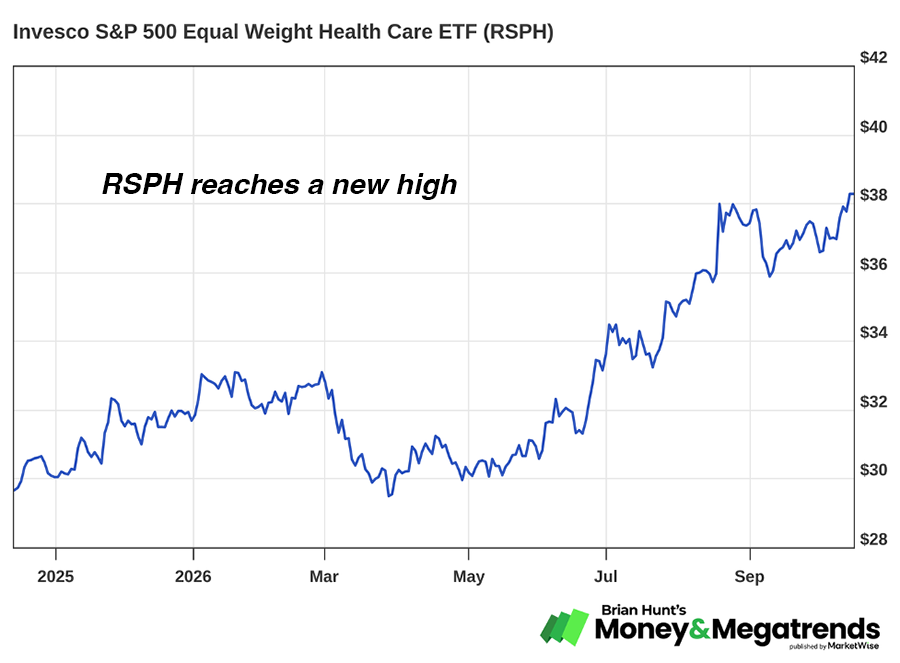
  •  

Six ways to invest in the revolution in money and banking

Today’s issue in preview:

  • Six ways to invest in the revolution in money and banking

  • Own these stocks to profit from the coming mass adoption of AI

  • New highs for the Magnificent 7 are sending you a clear signal. Are you listening?

  • Learn our Top Themes to buy now


Six ways to invest in the revolution in money and banking

Image

Credit: ISerg

It looks like the revolution is here.

And it’s starting to move the markets.

Over the past week, the token representing the leading blockchain network Ethereum broke out to its highest price in eight months. Its fellow leading network/token, Solana, did the same. And leading cryptocurrency brokerage/infrastructure provider Coinbase (COIN) surged 5.4% this morning, reaching its highest level since June.

In other words, the market is beginning to agree with the bullish thesis we laid out in a special series of research notes we published this year… in which we asserted that a revolution in money and banking is at hand.

In our series, we detailed how two megatrends could converge to drive many blockchain-centric stocks and network tokens much higher.

Those two megatrends are:

Agentic payments and money transfers: The number of AI agents at work in the economy is growing rapidly and will continue to do so for years. We will have many millions of agents transferring money and making payments in the economy. These agents will avail themselves of blockchain technology. Often.

Blockchain is a digital record-keeping system that stores transactions across a network of computers rather than in one central location. Once information is recorded, it is extremely difficult to change or erase. This allows people and businesses to securely exchange money or information without relying on a central authority to verify every transaction.

This can make banking systems much faster, much more efficient, and much cheaper.

Money will eventually have more machine use than human use. And once you understand that AI agents can’t use bank accounts as we know them… the only logical use case will be blockchain-enabled stablecoins… aka “dollars that computers use without having bank accounts.”

You can think of dollar-backed stablecoins like dollars you spend online, only faster and more flexible. Stablecoins are digital dollars that can move on open blockchain networks, while conventional dollars in your bank account generally move through closed banking systems.

An AI agent cannot go to a bank, show an ID, sign forms, or open an account. That’s why the traditional banking system as we know it today isn’t agent-friendly.

But an agent can manage a digital wallet protected by a key or code. Stablecoins are simply dollars that live inside these keyed, or coded, wallets that can move dollars instantly, anytime, anywhere. This makes them a natural fit for how agents spend and receive money.

Stablecoin transaction volume more than tripled year over year, rising 229% to $22.4 trillion in Q1 2026.

Visa’s stablecoin settlement volume has risen more than 15X year over year, recently exceeding a $20 billion annualized run rate.

Tokenization: Tokenization is simple. Take any real-world asset – a US treasury bond, a share in a private equity fund, a piece of commercial real estate, a share of Apple (AAPL), a corporate bond – and represent fractional ownership of it as a digital token on a blockchain.

Think of a blockchain as a record book that anyone can verify, but no single bank or government controls. It’s the ledger that makes digital ownership trustworthy without needing the middleman.

Instead of paper certificates of ownership, settlement agents taking a fee, and a multi-day clearing cycle, ownership becomes digital, with no human middleman, and practically instant.

A token of ownership can be transferred in seconds, fractionalized to a percentage of its original size, and plugged directly into a liquid market.

The market for tokenized real-world assets on public blockchains is already nearly $30 billion in 2026. But that number is purely a proof of concept. Forecasts from the likes of Boston Consulting Group and McKinsey assert this market is headed towards the $16-$30 trillion range in the next 5-8 years.

And for even more proof, Larry Fink – the CEO of BlackRock and one of the most powerful figures in finance, with more than $11.5 trillion in assets under management – has consistently advocated for tokenization.

In his 2025 annual letter to investors, he described tokenization as “the next generation for markets.”

“If we could digitize every asset, we could have a more seamless way of going from a digital wallet to ownership of real assets.”

He’s not alone in this view, and some major institutions are already on board. Kinexys, J.P. Morgan’s enterprise blockchain and digital asset business unit, has now processed over $1.5 trillion in tokenized transactions.

A bullish cherry on top of the cake is political power.

For better or worse, the Trump family is heavily invested in blockchain-centric businesses and therefore heavily incentivized to drive friendly regulation. I expect to soon see President Trump speaking and posting about the trends outlined above.

Plus, U.S. Treasury Secretary Scott Bessent has spoken favorably of stablecoins and how they could drive demand for U.S. bonds, which could help the U.S. manage its large debt burden.

In our research on these trends, we’ve highlighted Bitcoin, Ethereum, Solana, Coinbase (COIN), Robinhood (HOOD), and Securitize (SECZ) as compelling investment options.

The market is starting to agree with the bull case for the stocks and tokens listed above.

Below is a one-year chart of Ethereum, one of the world’s most widely used blockchain networks for the commercial activities described above.

As you can see, Ethereum suffered greatly along with the rest of the cryptocurrency world from late 2025 to mid 2026. Since that suffering, it has carved out a bottom and recently reached its highest point in eight months.

This is a bullish development in favor of the coming revolution in money and banking.

Image

Recommended Link:

Tomorrow, “Super AI” Opens New Way of Trading

Ad Image

Beginning at 10 am ET tomorrow, a new form of AI could quadruple your portfolio by foreseeing the future prices of 2,334 stocks, to the penny, with 85% backtested accuracy. It’s opened the most lucrative investment vehicle in our firm’s 21-year history, which has officially crushed the 2026 market by 218%, as of August. You can even chat with it! Try it now, free of charge.

Own these stocks to profit from the coming mass adoption of AI

Image

Credit: imaginima

As we expected, it’s a bull market in securing the world’s AI, computers, and data centers.

As evidence, I present today’s new all-time high for Cloudflare (NET), the new all-time high for the Global X Cybersecurity ETF (BUG), and the new six-month highs for cybersecurity leaders Zscaler (ZS) and Rubrik (RBRK).

In our March 16 issue, we introduced our Agent Supernova thesis… and how companies such as Cloudflare are positioned to benefit from the trend.

After years of development, AI is now advanced enough to perform many everyday tasks people do … and the list is only getting longer. Over the next 12–24 months, AI “agents” will help manage factories, perform financial analysis, manage inventories, write software, design websites, create legal documents… and thousands of other tasks.

The Agent Supernova is poised to reorder how the world works. It will break and reform many businesses, industries, and societal norms.

Soon, a restaurant could have five different agents working in it. One agent to manage the cooking schedules of meals. One agent to manage accounting. One agent to manage the staff. One agent to manage the ordering and tracking of supplies. One general-purpose agent to manage the specialized agents and interact with the restaurant owner.

At home, another set of agents can perform tasks to help the heroic American mom. A “mom helper” agent could schedule dentist appointments for the kids, pay bills, renew the car insurance, write and send thank-you cards, order groceries, and remind the kids to do their homework.

Meanwhile, another set of agents will transform American factories. They will have agents managing logistics, accounting, production schedules, component part ordering, hiring and firing workers, and other critical functions.

Now, take those three examples and extrapolate that activity across the economy. We are on the cusp of an explosion of agents working 24/7/365 for individuals, businesses, and governments.

In addition to restaurant manager agents, mom agents, and factory management agents, our lives will soon feature legal agents, government agents, tax agents, teacher agents, negotiator agents, airport agents, hospital agents, writing agents, marketing agents, and the list goes on for days.

Within the next two years, the number of AI agents operating in the American economy isn’t poised to increase by 10X… or 50X… or even by 1,000X. Try at least 10,000X.

Of course, the business and investment implications here are huge. The Agent Supernova will transform many businesses and industries. It will end many businesses as we know them… while creating new ones at the same time. The economic deck is about to get reshuffled.

Of all the stocks we’ve covered to profit from the Agent Supernova, few have powered higher than Cloudflare.

Cloudflare is one of the world’s leading Content Delivery Network (CDN) firms. A CDN is a network of physical servers deployed across the country that speeds up the delivery of website content. It reduces latency and bandwidth costs by bringing data and content closer to users.

In addition to this business, Cloudflare provides in-demand cybersecurity services, AI agent management services, and AI agent transaction services. This is a huge component of the business, since nobody will want to use AI if they think it will be used to steal their identity.

This diversified suite of hardware and agent management services makes Cloudflare something of an AI agent “conglomerate,” and uniquely positioned to benefit from the coming agent boom.

Cloudflare’s unique position is driving strong growth. In 2024, its revenue grew 29%. In 2025, it grew 30%. Growth has accelerated in 2026, with second-quarter revenue surging 36%. Wall Street now expects Cloudflare’s revenue to reach approximately $2.87 billion in 2026, up 32%, and climb another 28% to roughly $3.7 billion in 2027.

We first profiled Cloudflare on May 5. Since then, the stock is up 53% and reached a new all-time high today.

Cloudflare is now trading at a very rich 40X expected 2026 revenue, so we’d avoid buying the stock at these levels. However, the stock’s new high sends a loud message. It is yet more confirmation that the Agent Supernova and its security implications are a massive trend we should be following.

Image


New highs for the Magnificent 7 are sending you a clear signal. Are you listening?

Image

Credit: pingingz

Last week, we looked at the Roundhill Magnificent Seven ETF (MAGS) and noted the positive signals it was flashing for the technology sector.

At the time, MAGS had reached a new three-month high and was pennies away from an all-time high.

Today, MAGS is no longer pennies away from that high. It is beyond it.

That’s bullish for technology… bullish for the AI trade… and bullish for America in general.

MAGS is the largest ETF specifically designed to give investors exposure to the “Magnificent 7,” a group of dominant technology firms comprised of Nvidia (NVDA), Microsoft (MSFT), Alphabet (GOOG), Tesla (TSLA), Amazon (AMZN), Apple (AAPL), and Meta (META).

Together, these firms are worth about $24 trillion and make up roughly 31% of the benchmark S&P 500. No group of companies in history has wielded this group’s awesome combination of power, technological expertise, and vast financial resources. This group includes nearly all of the “hyperscalers” leading the AI revolution.

And the ETF that tracks this group reached an all-time high today.

This is an important development for “the world’s most important trend.”

Over the past two months, we’ve published a special series of research notes analyzing the AI infrastructure megatrend.

The status of this critical trend has become one of the great sagas of the business and investment world… a source of intense disagreement among industry bulls and bears. It’s a trend whose outcome could have large effects on your portfolio.

Given AI’s enormous promise, the firms above have invested over $1 trillion in AI infrastructure. They are on pace to invest over $700 billion this year alone and more than $4 trillion after that.

Both the scale and the velocity of this investment boom are unprecedented. It is the largest collective investment effort in history.

Big Tech’s historic investment boom has made the entire “AI infrastructure” trend responsible for a large share of America’s GDP growth and stock market returns over the past two years. It has also drawn the skeptical scrutiny of many widely followed investment analysts who claim the trend is a bubble… one that will soon explode and cause tremendous damage to stock prices and the global economy.

If this hugely consequential trend isn’t the most important trend in the stock market, then it is certainly in the top three.

I believe the AI infrastructure trend has years to run. I believe the world’s smartest, most connected tech insiders who know the true state of bleeding-edge AI development and have real-time stats on AI investment ROI, such as Elon Musk, Jensen Huang (Nvidia), Satya Nadella (Microsoft) and Andy Jassy (Amazon), could possibly… perhaps maybe… just might… know far more about AI and their businesses than outsiders know about it.

As much press as AI gets, let’s remember that less than 1% of the global population pays for top-tier AI programs. And I estimate less than 10% of large companies believe AI has made a meaningful impact on their businesses.

This revolutionary technology hasn’t yet proliferated, achieved mass adoption, or had mass impact.

Regular readers know I care a lot more about what the market thinks of any stock, trend, or theme than what any one person thinks of it, including me. You can be bullish or bearish on a trend all you like, but if that trend is moving strongly against you, then your idea isn’t worth much in my book.

Over the past few months, we have analyzed price action in critical areas of the AI infrastructure trade – including the VanEck Semiconductor ETF (SMH), computer memory giant Micron (MU), and optical networking stocks – to guide our trading.

Since the Mag 7 plays a central role in AI infrastructure, it is central to our analysis. Several of these firms have been singled out by bears for issuing debt to invest in AI data center construction.

However, right now, the market is saying debt issuance and ROI on AI infrastructure spend aren’t much of a worry… and that things are going quite well for the Mag 7.

As you can see in the two-year chart below, MAGS is in a clear uptrend and just broke out to an all-time high. This is bullish for the AI infrastructure trade, bullish for the tech sector in general, and bullish for America.

Image


Market Notes

  • Good signs for the AI infrastructure trade: AI infrastructure leader Semtech Corp (SMTC) just hit a new yearly high. Semiconductor leader Advanced Micro Devices (AMD) also hit an all-time high.

  • Our recommendation to invest in the genomics megatrend continues to pay off. Genomic analysis firm 10X Genomics (TXG) reached a new all-time high today. The stock is up 553% since our bullish October 2025 note.

  • Food and beverage giant Pepsico (PEP) reached a new one-year low today.

  • Fast food giant McDonald’s (MCD) reached a new one-year low today.

  • Alcoholic drink giant Constellation Brands (STZ) reached a new one-year low today.

Regards,

Brian Hunt signature

Brian Hunt signature

Brian Hunt
Editor, Money & Megatrends


An urgent message from our colleagues:

Chaikin: This “White Swan” Could Eat Every Data Center in America starting 9/29/26

Image

Every major AI firm now relies on massive data centers. But these monstrosities suck up our electricity. They drain our water supplies. They steal precious land. Yet AI companies are requesting 700 gigawatts of new electricity – enough to power every home in America! Until now, AI investors have piled trillions into the data-center boom. But according to investing legend Marc Chaikin, a new technology’s coming… called AI “micro clusters.” And they’ll render all current data centers obsolete. The company he believes is behind this $248 trillion “White Swan” event could soar starting Sept. 29th.

Marc reveals his full prediction – and the stock ticker – free, here.


The post Six ways to invest in the revolution in money and banking appeared first on MarketWise.

  •  

This Trump-backed stock trade could generate triple-digit returns

Today’s issue in preview:

  • This Trump-backed stock trade could generate triple-digit returns

  • An important new development in “the world’s most important trend”

  • Learn our Top Themes to buy now


This Trump-backed stock trade could generate triple-digit returns

Image

Credit: William_Potter

After decades of being indifferent or outright hostile towards mining, the U.S. government is now one of the industry’s best friends.

Over the past 18 months I’ve frequently cited how this unique situation is producing large financial opportunities. As evidence, we present the recent new highs reached by Sunrise Energy Metals (SREMF). The stock is up 150% since we first profiled it on March 20.

The megatrend thesis goes like this: President Donald Trump – along with many business and military leaders – believes that the U.S. has outsourced far too much of its industrial capacity to China over the past 25 years.

We outsourced significant portions of our semiconductor, appliance, medicine, weapons, and machinery production. We outsourced the capacity to produce and process critical resources, such as rare earth elements.

The COVID-19 pandemic showed that depending on other countries for critical economic inputs makes the U.S. economy less safe and secure. To put it bluntly, it is very stupid to not make products critical to national security like AI semiconductors within our own borders.

Trump has staked his legacy and reputation on expanding our industrial base… and he’s working with business leaders to invest trillions to pursue this goal.

Apple (AAPL), for example, has committed to invest $600 billion in U.S.-based manufacturing over the next four years. Nvidia (NVDA) says it will invest $500 billion in U.S.-based manufacturing over the next four years. The government is investing heavily in high-tech weapon systems manufacturing as well.

However, any plan to increase domestic manufacturing capacity must overcome a big problem: We don’t have sufficient supplies of critical resources needed to build the required infrastructure.

We don’t have the copper, iron ore, rare earths, lithium, antimony, nickel, and other vital building blocks required to build all those data centers… all those factories… all those robots… all those electric grids… all those power plants… and so on.

To make matters worse, we also lack the refining, smelting, and processing facilities needed to turn the raw forms of those resources into ready-to-use end products. We rely on China for a lot of that.

It’s as if we very much want to build a big house… but we don’t have all the lumber, screws, or nails we need to get the job done.

Solving the big “critical resources problem” is possible… and it is an enormous financial opportunity.

To ensure we have the critical resources to build trillions of dollars in infrastructure, the U.S. government will change any law, kill any regulation, and write any check that will increase production and processing capacity.

This means that after more than 30 years of the U.S. government being hostile to domestic mines and mineral processing facilities and indifferent towards supporting production in friendly nations, it is now supportive of the industry. Trump can’t have his big manufacturing dream without them.

And no matter who is president, the U.S. economy needs a diversified critical resources mining and processing base to lessen its dependency on China. Having that would make the U.S. economy much safer and more robust.

With all this in mind, the U.S. government has struck many important deals to support domestic and friendly country critical resource production over the past 12 months. They include:

-A $450 million preferred-equity investment in The Elmet Group (ELMT) to expand domestic tungsten mining, refining and manufacturing.

-A $725 million conditional loan commitment to Energy Fuels (UUUU) to expand U.S. rare-earth processing capacity.

-A $36.5 million direct equity investment in copper mining firm Trilogy Metals (TMQ), which is developing resources in Alaska.

-A $400 million conditional loan made to Sunrise Energy Metals to develop its enormous Syerston scandium project in Australia.

The U.S. government’s support of Sunrise has made our March 20 recommendation of the stock a big winner. Back then, we noted how scandium is one of the most critical metals you never hear about.

Scandium is a lightweight, rare metal valued mainly for strengthening aluminum. Small amounts added to aluminum create alloys that are stronger, lighter, more corrosion-resistant, and easier to weld – useful in aerospace, defense, and high-performance vehicles.

This is why securing critical minerals like scandium has become a national security imperative. Without scandium, the U.S. doesn’t have the most advanced missiles and drones. As the U.S. rebuilds missile stockpiles depleted by the Iran War, scandium demand will rise.

Scandium also has an “AI demand kicker” that should act as a long-term tailwind. The massive fuel cell maker Bloom Energy (BE) uses a lot of scandium to produce its products, which are in high demand for AI data center power infrastructure.

Sunrise’s Syerston project is one of the largest scandium resources in the world. Its development is seen as a key part of the U.S.A.’s scandium supply chain. Sunrise has signed a five-year scandium option with Lockheed Martin (LMT), giving the defense giant the right to purchase up to 25% of Sunrise’s scandium. The company is backed by mining powerhouse Robert Friedland… and is now backed by the U.S. government.

The Sunrise story demonstrates how the enormous geopolitical and economic forces working to secure critical resources right now can end up producing very large capital gains for investors.

Companies that could benefit greatly from this trend include U.S. firms Idaho Strategic Resources (IDR), Perpetua Resources (PPTA), Energy Fuels (UUUU), and MP Materials (MP). ETFs worth investigating include the Sprott Rare Earths Ex-China ETF (REXC) and the Sprott Critical Materials ETF (SETM).

Our stance on this situation now is the same as it was one year ago. We sum it up like this: Partnering with the U.S. government to increase domestic and friendly-country supplies of critical resources will prove to be one of the most lucrative financial activities of this decade.

Image

Recommended Link:

Log into Our New $5,000 “Super AI” Right Now

Ad Image

It foresees the future prices of 2,334 stocks, to the penny, with 85% backtested accuracy. This year, you could’ve already crushed the stock market by 218%, as of August. Including gains of 46.8% in 5 days on (RVMD)… 36.8% in 29 days on (ALB)… 32.4% in 2 days on (BE), and dozens more. Until Tuesday, get free access here (no purchase required).

An important new development in “the world’s most important trend”

Image

Credit: Black_Kira

Chalk one up in favor of technology stocks this week.

On Thursday, the Roundhill Magnificent Seven ETF (MAGS) reached a three-month high… and is just pennies from reaching a new all-time high.

MAGS is the largest ETF specifically designed to give investors exposure to the “Magnificent 7,” a group of dominant technology firms comprised of Nvidia (NVDA), Microsoft (MSFT), Alphabet (GOOG), Tesla (TSLA), Amazon (AMZN), Apple (AAPL), and Meta (META).

Together, these firms are worth about $24 trillion and make up roughly 31% of the benchmark S&P 500. No group of companies in history has wielded this group’s awesome combination of power, technological expertise, and vast financial resources. This group includes nearly all of the “hyperscalers” leading the AI revolution.

And the ETF that tracks this group is within pennies of its all-time high.

This is an important development for “the world’s most important trend.”

Over the past month, we’ve published a special series of research notes analyzing the AI infrastructure megatrend.

The status of this critical trend has become one of the great sagas of the business and investment world… a source of intense disagreement among industry bulls and bears. It’s a trend whose outcome could have large effects on your portfolio.

Given AI’s enormous promise, the firms above have invested over $1 trillion in AI infrastructure. They are on pace to invest over $700 billion this year alone and more than $4 trillion after that.

Both the scale and the velocity of this investment boom are unprecedented. It is the largest collective investment effort in history.

Big Tech’s historic investment boom has made the entire “AI infrastructure” trend responsible for a large share of America’s GDP growth and stock market returns over the past two years. It has also drawn the skeptical scrutiny of many widely followed investment analysts who claim the trend is a bubble… one that will soon explode and cause tremendous damage to stock prices and the global economy.

If this hugely consequential trend isn’t the most important trend in the stock market, then it is certainly in the top three.

I believe the AI infrastructure trend has years to run. I believe the world’s smartest, most connected tech insiders who know the true state of bleeding-edge AI development and have real-time stats on AI investment ROI, such as Elon Musk, Jensen Huang (Nvidia), Satya Nadella (Microsoft) and Andy Jassy (Amazon) could possibly… perhaps maybe… just might… know far more about AI and their businesses than outsiders know about it.

As much press as AI gets, let’s remember that less than 1% of the global population pays for top-tier AI programs. And I estimate less than 10% of large companies believe AI has made a meaningful impact on their businesses.

This revolutionary technology hasn’t yet proliferated, achieved mass adoption, or had mass impact.

Regular readers know I care a lot more about what the market thinks of any stock, trend or theme than what any one person thinks of it, including me. You can be bullish or bearish on a trend all you like, but if that trend is moving strongly against you, then your idea isn’t worth much in my book.

Over the past few months, we have analyzed price action in critical areas of the AI infrastructure trade – including the VanEck Semiconductor ETF (SMH), computer memory giant Micron (MU), and optical networking stocks – to guide our trading.

Since the Mag 7 plays a central role in AI infrastructure, it plays a central role in our analysis of it. Several of these firms have been singled out by bears for issuing debt to invest in AI data center construction.

However, right now, the market is saying debt issuance and ROI on AI infrastructure spend aren’t much of a worry… and that things are going quite well for the Mag 7. As you can see in the two-year chart below, MAGS is in a clear uptrend and is close to reaching an all-time high. A break above it would be bullish for the AI infrastructure trade, bullish for the tech sector in general, and bullish for America.

Image


Market Notes

  • The Iran War and its constriction of critical resources continue to work in favor of U.S. refiners. Valero Energy (VLO) reached a new all-time high today.

  • Food and beverage giant PepsiCo (PEP) reached a new one-year low today.

  • Fast food giant McDonald’s (MCD) reached a new one-year low today.

  • Home improvement giant Lowe’s (LOW) reached a new one-year low today.

  • Casino giant Las Vegas Sands (LVS) reached a new one-year low today.

Regards,

Brian Hunt signature

Brian Hunt signature

Brian Hunt
Editor, Money & Megatrends


An urgent message from our colleagues:

Emmy-winning analyst releases his next big story

Image

Whitney Tilson shocked the nation on 60 Minutes when he accused a major company of poisoning its customers. The investigation won an Emmy and the stock fell nearly 80%. (He also called the housing crisis and the collapse of Bear Stearns and Lehman Brothers). Now, he’s releasing his next big story. He says a dangerous pattern is forming, and most Americans have no idea how exposed they really are.

For the full presentation, go here.

The post This Trump-backed stock trade could generate triple-digit returns appeared first on MarketWise.

  •  

There’s a modern day gold rush happening here. How to invest

Today’s issue in preview:

  • There’s a modern day gold rush happening here. How to invest

  • Stocks for investing in “the next big AI trade”

  • Stocks for profiting from the panic over AI safety

  • Learn our Top Themes to buy now


There’s a modern day gold rush happening here. How to invest

Image

Credit: gorodenkoff

In yesterday’s issue, we detailed how stocks in the Healthcare Diagnostics field are surging to new highs. This theme’s strength is made more impressive when you consider that most themes, industries, and major stock indices are currently moving in sideways consolidation patterns or declining.

Healthcare Diagnostics firms such as Guardant Health (GH), Natera (NTRA), and Illumina (ILMN) are lighting up the stock market leaderboard because they are benefiting from several megatrends at the same time.

One is demographics. More than 10,000 Americans reach retirement age every day. The U.S. population aged 80 and older is projected to roughly double, from 14.7 million in 2025 to 29.4 million by 2045.

This is the enormous Baby Boom generation entering the phase of life where health care and longevity spending skyrockets. For many boomers, a typical month involves going to see at least one doctor to have something looked at, removed, or treated.

This means many health care businesses are experiencing huge demand now – and will for at least the next decade.

Two is exponential technological progress. Thanks to major advancements in genomic sequencing, AI-powered analytics, imaging technology, and preventative treatment, healthcare is becoming much better and more personalized. This is driving huge demand for all kinds of new tests, tools, and treatments.

As you think about these megatrends and how to benefit from them, don’t forget about the world of Healthcare Tools & Services.

This is a varied investment theme that comprises companies that provide drug testing equipment, research services, specialized microscopes, drug manufacturing services, and other critical – yet underappreciated – parts of America’s giant healthcare industry.

We believe this series of industries offers significant opportunities.

As revenue surges for large drug makers, medical device makers, and health care clinics, more money can be invested into infrastructure, research & development, and future growth.

Most importantly, the market is agreeing with this outlook. One of America’s largest players in Healthcare Tools & Services – Thermo Fisher Scientific (TMO) – just reached a new one-year high.

TMO is one of the world’s largest healthcare tools & services companies.

It’s a diversified giant that provides drug manufacturing services, clinical research trial services, precision drug testing equipment, DNA sequencing, and many other critical services. Its customers include large drug makers, small drug makers, and any entity performing healthcare-related research & development.

In its most recent earnings report, TMO reported strong 10% top-line growth and 13% earnings-per-share growth. This business performance has driven TMO stock to a 38% gain over the past year and a new one-year high. The stock is poised to break out of a large five-year consolidation pattern.

TMO is not the only Healthcare Tools & Services provider leading the market.

This week, leading drug development equipment and services firms Avantor (AVTR), Waters (WAT) and Revvity (RVTY) reached one-year highs as well. These new highs show that this is a larger industry trend, not simply TMO doing well.

The giant business, tech, and demographic trends that shape our world tend to play out in five or more years, not five months. This means the stock market trends they manifest play out over the same time periods.

With this trend truism in mind, I once again remind you that if you like money, keep it invested in healthcare. The new highs in the stocks detailed above confirm our thesis that a modern-day gold rush is on.

Image

Recommended Link:

“Biggest Breakthrough in the History of Stock Trading”

Ad Image

A Maryland computer whiz recently created a new form of “Super AI” that can foresee the future prices of any of 2,334 stocks – to the day and even the penny – with 85% backtested accuracy. It’s led to a huge anomaly that turned every $100,000 into $692,000 in 2025 in studies. Until Tuesday, claim free access here (no purchase required).

Stocks for investing in “the next big AI trade”

Image

Credit: piyaset

It turns out, being bullish on genomics was a very good idea.

This morning, shares of the ARK Genomic Revolution ETF (ARKG) soared 8.5% to reach a new all-time high. The move was driven by strength in bleeding-edge genomic testing firms Natera (NTRA) and Illumina (ILMN), plus a 14% surge in AI-centric healthcare analytics firm Tempus AI (TEM).

Constant Money & Megatrends readers are not surprised to see the genomics theme surge to new highs.

Over the past year, we’ve written over half a dozen research notes about the extraordinary upside potential of biotech and genomics. We’ve written specific bullish notes on all the names listed above.

Genomics is the science of analyzing human DNA – often referred to as the “software code of life” – to create tests, medicines, and treatments.

Years of innovation in this field have us on the brink of creating many customized treatments based on an individual’s DNA… and even “editing” genes to cure disease.

Bulls on the industry believe it will get a giant “AI boost,” because super-intelligent computer programs can analyze genes and treatment effects so well… and have the potential to create drugs on their own.

The fusion of AI and genomics should generate dozens of compelling stock narratives over the coming years. Researchers running superintelligent AI programs will be able to create useful new diagnostics and run millions of digital simulations of drugs and treatments. This will put medical innovation into overdrive… and create many big stock market winners.

The personalized approach to medicine that genomics offers has us on the cusp of a historic revolution in healthcare. Ten years from now, medicine will be transformed… and a lot of money will be made along the way.

I’ve frequently mentioned how the ARK Genomic Revolution ETF (ARKG) is one way to track and trade the genomics theme. It owns a basket of bleeding-edge genomic companies.

One of its largest holdings, Tempus AI, is often cited as a premier way to play “AI in health care.” It holds genomics tools and services firm 10x Genomics (TXG) and synthetic DNA firm Twist Bioscience (TWST).

ARKG also holds significant positions in Natera and Illumina… plus positions in promising “gene editing” companies CRISPR Therapeutics (CRSP) and Intellia Therapeutics (NTLA).

ARKG is up 61% since our October 2025 recommendation. NTRA is up 107%. ILMN is up 146%. TWST is up 394%. TXG is up a whopping 555%.

It’s increasingly looking like genomics is being painted with the “AI brush,” a development that can turbocharge any trend or stock here in 2026. ARKG and many of its constituents hit new all-time highs today. More are likely to follow.

Image


Stocks for profiting from the panic over AI safety

Image

Credit: ismagilov

Few things are better for business than a global panic over AI killing us all.

At least, that’s the case if you’re in the cybersecurity industry.

That’s why industry leaders CrowdStrike (CRWD), Fortinet (FTNT), SentinelOne (S), Okta (OKTA) and F5 (FFIV) are reaching new one-year highs today, in addition to the Global X Cybersecurity ETF (BUG) reaching new highs.

In Monday’s issue, we analyzed the global panic over AI safety and how we should react to it.

Part of the current fuss over AI development stems from recent and former Anthropic employees airing concerns that AI “could kill us all.”

They have shared precious few details on exactly how AI would do that, but presumably, they have some movie scenarios in mind, such as a “bad” AI taking over nuclear missile launches, developing a killer virus, or taking over transportation systems and causing catastrophic accidents.

Whatever the vector is, the public is now sufficiently spooked over AI. Political leaders are spooked over AI. And business leaders are spooked over AI.

This is all bullish for the cybersecurity business. After all, few things drive large increases in corporate cybersecurity budgets like a global AI panic.

We can see the future very clearly: Your average Fortune 500 CEO will be encouraged by his board to increase the cybersecurity budget. He will be encouraged by his executive team and workforce to increase the cybersecurity budget. Even his wife and kids will encourage him to increase the cybersecurity budget.

After all, the guy on the news said that “AI could kill us all”!

And this panic should continue to make our AI cybersecurity call a winner.

Back in March, we detailed how the “Agent Supernova” was set to create huge amounts of new cybersecurity threats across banking, transportation, healthcare, manufacturing, and corporate secrets.

Agent Supernova is our name for the megatrend of AI-powered “agents” working throughout the global economy.

Years of development have made AI advanced enough to perform many everyday tasks people do now… and the list keeps growing. Over the next 12–24 months, AI agents will help manage factories, perform financial analysis, manage inventories, write software, design websites, create legal documents… and thousands of other tasks.

Within two years, the number of AI agents operating in the American economy isn’t poised to increase by 10X… or 50X… or even 1,000X. Try at least 10,000X.

This is the coming Agent Supernova: agents working with people, agents working with other agents, agents running businesses, and negotiating with other agents.

The Agent Supernova is about to introduce billions of “AI workers” into our economy with very little day‑to‑day human oversight. The business and investment implications are huge. It will transform many businesses and industries, end many as we know them, and create entirely new ones.

In our original research note, we detailed how this megatrend would also create huge amounts of new cybersecurity risks. If we’re going to have millions of AI agents performing billions of daily tasks in health care, education, energy, transportation, manufacturing, and technology, then we’re going to have billions of points of cybercrime vulnerability. And remember, crooks get to use AI too.

If agents can roam the web, communicate for you, log in to your apps, move money, and modify data at machine speed, then a compromised agent can do the same damage just as fast – now with far less human oversight to catch mistakes or intrusions. We stated this is why well-positioned cybersecurity companies are poised to enjoy years of booming business.

At the time of our note, cybersecurity stocks – a special type of software stock – had suffered a sharp decline due to investor concerns that AI would disrupt software.

Soon after our note, cybersecurity stocks staged a huge rebound as investors began to believe AI wouldn’t disrupt the business as much as they had thought. This rally has sent leaders CrowdStrike and Palo Alto Networks (PANW) up more than 100% from their bottoms. This sector’s big drop and subsequent huge rise have given rollercoasters a run for their money.

AI is the most exciting and potentially transformational technology of our time. The high-profile concerns aired by AI insiders over the past week are an indication that it’s also probably the most dangerous. That’s bullish for the cybersecurity industry.

Image


Market Notes

  • Our May 7 recommendation to consider Dell Technologies (DELL) was well timed. The stock is up 239% since our write-up and just reached a new all-time high.

  • Our April 15th recommendation to own Nebius (NBIS) is still doing well. NBIS is up 6% today after news it is raising on-demand GPU prices by 20%.

  • Our October 8th recommendation to own the Boomer healthcare trend is paying off. Thermo Fisher Scientific (TMO) and Takeda Pharmaceutical (TAK) both hit new highs today.

  • Tech giants Advanced Micro Devices (AMD), Qualcomm (QCOM), and International Business Machines (IBM) all hit new one-month highs today.

  • Our September 1st recommendation to own Securitize (SECZ) as part of the tokenization trend is already paying off well. SECZ is now up 19% today.

Regards,

Brian Hunt signature

Brian Hunt signature

Brian Hunt
Editor, Money & Megatrends


An urgent message from our colleagues:

A “bloodbath” Is Coming

Image

Silicon Valley billionaires are hoarding guns, gold, and even military grade gas masks… or fleeing the country altogether. What do they know that you don’t? This AI insider is stepping forward with this time-critical message: Move your money before September 30th, ahead of the dangerous next phase of the AI market.

Here’s the one urgent move you need to make with your money immediately.

The post There’s a modern day gold rush happening here. How to invest appeared first on MarketWise.

  •  

This “super theme” is quietly generating large stock market winners. Here’s how to profit

Today’s issue in preview:

  • This “super theme” is quietly generating large stock market winners. Here’s how to profit

  • How to trade “The world’s most important trend” from here

  • These six risky stocks have enormous upside

  • Learn our Top Themes to buy now


This “super theme” is quietly generating large stock market winners. Here’s how to profit

Image

Credit: gorodenkoff

“We’ll run a test on it.”

If you’ve been following our work for the past year, you know doctors say these words many times each day in America… and what’s driving their use can make you a lot of money in stocks.

As evidence, I give you the new highs reached this week by leading stocks in the Healthcare Diagnostics theme:

  • Natera (NTRA), a genetic testing company specializing in prenatal, cancer, and transplant diagnostics.

  • NeoGenomics (NEO), a cancer diagnostics company providing oncology testing and pathology services.

  • Guardant Health (GH), a liquid-biopsy company using blood tests to detect and monitor cancer.

  • Quest Diagnostics (DGX), a major diagnostic laboratory providing blood tests and other clinical testing.

  • Illumina (ILMN), a diversified genomic sequencing services giant.

Avid Money & Megatrends readers know the bull case behind this theme and the larger Boomer health care megatrend. More than 10,000 Americans reach retirement age every day. The U.S. population aged 80 and older is projected to roughly double, from 14.7 million in 2025 to 29.4 million by 2045.

This is the enormous Baby Boom generation entering the phase of life where health care and longevity spending skyrockets. For many boomers, a typical month involves going to see at least one doctor to have something looked at, removed, or treated.

This means many health care businesses are experiencing huge demand now – and will for at least the next decade. It means boom times ahead for many “ology” businesses, stocks, and careers. Dermatology. Cardiology. Radiology. Oncology. Anesthesiology. Ophthalmology. The list goes on. Investing in many health care businesses over the next decade will be investing with a gale-force tailwind at your back.

A growing force inside this trend is bleeding-edge preventative diagnostics. We devoted a bullish research note to it on June 12.

Over the past 20 years, preventive healthcare diagnostics have improved dramatically due to advances in genomics, imaging technology, and data analytics. Genetic testing has become faster and less expensive, allowing earlier identification of disease risks. High-resolution imaging and improved laboratory testing can detect conditions such as cancer, heart disease, and diabetes at much earlier stages.

Wearable devices and remote monitoring tools continuously track vital signs and health trends, enabling early intervention. Electronic health records and artificial intelligence help clinicians identify risk patterns and personalize screening recommendations.

Together, these innovations are shifting healthcare from reactive illness care to predictive, preventive, and proactive disease management before serious symptoms develop. The shift from reactive treatment to early detection is still early, but the numbers already reflect its momentum.

The U.S. health care diagnostics market was valued at $35.7 billion in 2024 and is projected to reach nearly $60 billion by 2030, growing at an annual rate of over 9%. Globally, clinical diagnostics is on track to hit $170 billion by the end of the decade. North America commands nearly half of that market.

We expected to see the firms listed above generate new highs this year. But they are even more impressive considering that many themes, industries, and major stock indices are moving in sideways consolidation patterns right now. Healthcare Diagnostics is an area of strength where there are few such areas to be found.

We are in the early innings of a historic revolution in health care. Technological advances in DNA sequencing, AI analytics, imaging, wearables, and testing are moving this area of our lives from the reactive, “one size fits all” shotgun approach to the much better proactive, preventative, customized-for-the-individual approach. This will change the world and create huge amounts of wealth along the way. You can expect to see more new highs in the future from this compelling theme.

Image

Recommended Link:

“Super AI” Opens New Way of Trading on Sept. 22

Ad Image

New form of AI could quadruple your portfolio by foreseeing the future prices of 2,334 stocks, to the penny, with 85% backtested accuracy. It’s opened the most lucrative investment vehicle in our firm’s 21-year history, which has officially crushed the 2026 stock market by 218%, as of August. You can even chat with it! Click here to try it now, free of charge.

How to trade “The world’s most important trend” from here

Image

Credit: KanawatTH

In Monday’s issue, we covered the global AI freakout related to claims that “frontier labs” such as Anthropic and OpenAI need to slow down their AI development.

We made our take on the situation clear: All the current fuss is misplaced. Anthropic and OpenAI are free to slow down their development and ask for more regulation of their kind, but neither they nor the U.S. government can slow down AI development in China, Russia, India, or dozens of other countries. They cannot effectively regulate open-source AI all over the world.

Heavily regulating U.S. firms OpenAI and Anthropic would be like slowing down traffic in one lane of a six-lane highway. Everybody is still getting to their destinations. The prize of advanced AI is so large that it will be pursued, no matter what.

Plus, consider the U.S. government’s position. It rightly sees itself in a massive geopolitical and economic “great power” competition with China. AI supremacy is hugely valuable in this competition. It would be lunacy to slow AI development to the point that we essentially hand China a big victory. Governments are among the dumbest entities on the planet, but they aren’t that dumb.

Given all this, we believe the current fuss over AI development reeks of performative theatrics and will prove to be a tiny speed bump on the long road of breakneck AI advancement and proliferation.

But more importantly, what is the stock market saying about this debate? How is this debate affecting what we call the “world’s most important trend,” which is the historic AI infrastructure investment boom?

Over the past month, we’ve published a special series of research notes analyzing the AI infrastructure megatrend.

The status of this critical trend has become one of the great sagas of the business and investment world… a source of intense disagreement among industry bulls and bears. It’s a trend whose outcome could have large effects on your portfolio.

Given AI’s enormous promise, large tech firms such as Alphabet (GOOG), Amazon (AMZN), and Microsoft (MSFT) have invested over $1 trillion in AI infrastructure. They are on pace to invest over $700 billion this year alone and more than $4 trillion after that.

Both the scale and the velocity of this investment boom are unprecedented. It is the largest collective investment effort in history.

Big Tech’s historic investment boom has made the entire “AI infrastructure” trend responsible for a large share of America’s GDP growth and stock market returns over the past two years. It has also drawn the skeptical scrutiny of many widely followed investment analysts who claim the trend is a bubble… one that will soon explode and cause tremendous damage to stock prices and the global economy.

If this hugely consequential trend isn’t the most important trend in the stock market, then it is certainly in the top three.

I believe the AI infrastructure trend has years to run. I believe the world’s smartest, most connected tech insiders who know the true state of bleeding-edge AI development and have real-time stats on AI investment ROI, such as Elon Musk, Jensen Huang (Nvidia), Satya Nadella (Microsoft) and Andy Jassy (Amazon) could possibly… perhaps maybe… just might… know far more about AI and their businesses than outsiders know about it.

As much press as AI gets, let’s remember that less than 1% of the global population pays for top-tier AI programs. And I estimate less than 10% of large companies believe AI has made a meaningful impact on their businesses.

This revolutionary technology hasn’t yet proliferated, achieved mass adoption, or had mass impact.

Regular readers know I care a lot more about what the market thinks of any stock, trend or theme than what any one person thinks of it, including me. You can be bullish or bearish on a trend all you like, but if that trend is moving strongly against you, then your idea isn’t worth a hell of a lot in my book.

Over the past few months, we have analyzed price action in critical areas of the AI infrastructure trade – including the VanEck Semiconductor ETF (SMH), computer memory giant Micron (MU), and optical networking stocks – to guide our trading.

Today, we continue our special series by looking at the current price action in the world’s largest semiconductor ETF, the VanEck Semiconductor ETF.

In June 2025, semiconductor stocks broke out of a sideways consolidation pattern and began a rally for the ages. During this rally, SMH gained 147% in just under a year.

When a sector gains 50% in a year, that’s considered incredible. What semis returned was “triple incredible.”

Given its AI drivers and big returns, it’s no wonder semis became the world’s “hottest trade” this summer. And when any theme becomes the world’s hottest trade, it becomes a leading candidate to experience a significant correction or something worse.

That’s just how the stock market works. When a bull market grows very popular and attracts a lot of speculation, it likes to “buck off” market participants with a sharp correction or worse.

That’s what has happened to the semiconductor trade this summer. After soaring from June 2025 to June 2026, SMH declined 24%. Some individual semi names declined by more than 35%.

As you can see in the two-year chart below, the SMH share price declined from the mid-$600s to the mid-$500s. Since reaching a low in late July, SMH has traded up and down, failing to establish a meaningful trend.

It is like a “becalmed” sailboat on a windless sea. The trends of other important parts of the AI infrastructure trade – electric power component makers, computer memory makers, neoclouds, and data center cooling firms – look much the same.

In my July 20 health analysis of SMH, I stated that if long-term AI bulls are proven right by the market, SMH will likely “digest” its summer losses by trading in a sideways consolidation pattern for 3-6 months… and then recover to trade back to the mid-$600 area and beyond.

If the AI bears are right, SMH won’t see that mid-$600-per-share level for years… and we are much better off focusing on other trends.

With all this in mind, short-term traders should see semiconductors as a directionless trade right now, good for monitoring but not for trading. Long-term bulls, of course, can ignore these short-term moves and stay long.

I’ll keep you updated on this world’s most important trend. It won’t be long before we get meaningful price action that provides direction for trading semis, optical networking, and other key components of AI infrastructure.

Image


These six risky stocks have enormous upside

Image

Credit: mustafaU

The moonshot. The grand slam home run. The 1,000%+ winner.

In yesterday’s issue, we introduced our special series on new technologies, new business models, and individual stocks that could generate huge “moonshot” returns over the next five years. There is hardly anything more American than shooting for the stars in pursuit of enormous wins.

I like a moonshot bet as much as anyone. However, at this stage in my life, I’m not investing to get rich. I’m investing to stay rich. That’s why most of my savings is invested in stable stock, bond, and real estate holdings.

Still, I believe taking a small amount of money and investing it in the pursuit of grand slams adds color and interest to our financial lives. It can also net you large returns over time if you pick even just a few big winners.

With all this in mind, we looked at autonomous vehicle leader Aurora Innovation (AUR) yesterday and detailed the opportunity it has to revolutionize the trucking industry and generate great wealth by doing so.

Today, we look at the gene editing industry and its potential to generate enormous returns…

Avid Money & Megatrends readers know we are very long-term bullish on bleeding edge genomics and its potential to treat disease and disorders.

Genomics is the science of analyzing human DNA – often referred to as the “software code of life” – to create tests, medicines, and treatments.

Years of innovation in this field have us on the brink of creating many customized treatments based on an individual’s DNA… and even “editing” genes to cure disease. Bulls on the industry believe it will get a giant “AI boost,” since super-intelligent computer programs can analyze genes and treatment effects so well… and have the potential to create drugs on their own.

The fusion of AI plus genomics should generate dozens of compelling stock narratives over the coming years. Researchers running superintelligent AI programs will be able to run millions of digital simulations of drugs and treatments. This will put medical innovation into overdrive… and create many big stock market winners.

The personalized approach to medicine that genomics offers has us on the cusp of a historic revolution in healthcare. Ten years from now, medicine will be transformed… and a lot of money will be made along the way.

Now that the genomics trend is underway, it’s a good time to understand the potential of the “gene editing” industry group.

Gene editing is a group of technologies that allow scientists to precisely change a person’s DNA. By acting like precision “molecular scissors”, these tools cut the DNA at a specific spot to remove, add, or alter genetic material.

Bulls on the technology believe it will usher in an incredible new era of treating and eradicating many diseases and disorders. The pioneers of this technology won a Nobel Prize in 2020.

In April 2026, Intellia Therapeutics (NTLA) achieved a milestone in the field by publishing the world’s first successful Phase 3 clinical data for an in vivo CRISPR (a gene editing technology) therapy. The landmark trial evaluated lonvoguran ziclumeran (lonvo-z), a groundbreaking treatment injected directly into the bloodstream to cure hereditary angioedema—a debilitating, life-threatening genetic disorder characterized by severe swelling attacks.

A single, one-time intravenous infusion reduced monthly swelling attacks by 87% compared to a placebo over a six-month period. Even more impressive, 62% of patients became completely attack-free during the study, showcasing the therapy’s potential to eliminate the disease.

There are fewer than a dozen “pure play” gene editing firms.

They include Intellia, CRISPR Therapeutics (CRSP), Beam Therapeutics (BEAM), Prime Medicine (PRME), and Editas Medicine (EDIT).

These firms don’t generate much revenue right now. Owning them is a bet on future breakthroughs. They are more like high-tech science projects than they are profitable operating businesses… and their stocks are extremely volatile. Investing here is like being a venture capitalist in the stock market. Widows and orphans and those with weak stomachs should pass on this group.

Those of us who are comfortable investing relatively small amounts of money in pursuit of “asymmetric” payoffs of 10 to 1, 20 to 1, or even 30 to 1, however, can consider the gene editing group. It’s one of our top “swing for the fences” technology bets for the next five years. Batter up.

Image


Market Notes

  • Our May 7 recommendation to consider Dell Technologies (DELL) was well timed. The stock is up 230% since our write-up and just reached a new all-time high.

  • Our May 28th recommendation to go long genomics has played out well. Natera (NTRA) just hit new highs today and is now up 103% over the last year.

  • The SonicShares Global Shipping ETF (BOAT) reached a new all-time high today.

  • Fast-food giant McDonald’s (MCD)reached a new one-year low today.

  • Chinese tech giant Baidu (BIDU) reached a new one-year low this week.

  • Casino giant Las Vegas Sands (LVS) reached a new one-year low this week.

Regards,

Brian Hunt signature

Brian Hunt signature

Brian Hunt
Editor, Money & Megatrends


An urgent message from our colleagues:

60-Year Wall Street Legend: “Get out by Sept. 29th”

Image

According to McKinsey, the current AI market is worth $4 trillion. But a new form of AI – “Sovereign AI” – is about to overturn the entire industry, unleashing a $248 trillion disruption. How? By making data centers owned by SpaceX, Google, OpenAI and Anthropic obsolete (especially when it comes to major scientific breakthroughs). America’s first “Sovereign AI factory” is set to open before the end of the year. One company is poised to profit.

Go here for the full story and Marc’s top “Sovereign AI” stock pick now.

The post This “super theme” is quietly generating large stock market winners. Here’s how to profit appeared first on MarketWise.
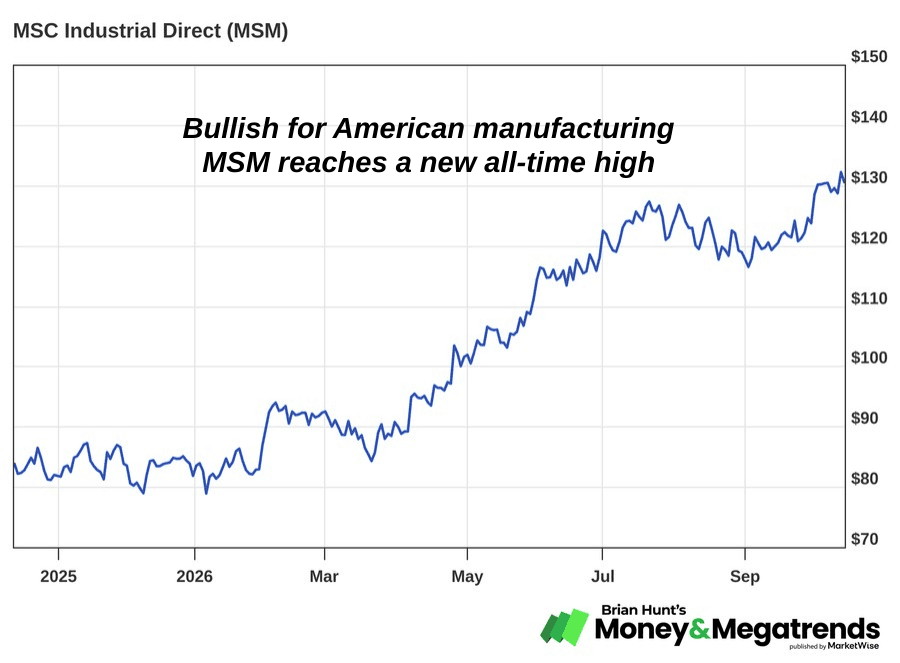
  •  

This self-driving vehicle stock has 1,000%+ upside. (It’s not Tesla)

Today’s issue in preview:

  • This self-driving vehicle stock has 1,000%+ upside. (It’s not Tesla)

  • This industry is enjoying a full-blown Gold Rush. Are you profiting?

  • This unique stock is poised to soar as the world scrambles for “not Middle Eastern” energy supplies

  • Learn our Top Themes to buy now


This industry is enjoying a full-blown Gold Rush. Are you profiting?

Image

Credit: Ridofranz

The gold rush in American healthcare stocks continues. This week, the State Street SPDR S&P Health Care Services ETF (XHS) broke out of a multi-month consolidation to reach a new all-time high.

XHS is an ETF that tracks the S&P Health Care Services Select Industry Index. This index tracks a wide variety of health care companies, including cancer diagnostics firms, mental health firms, senior living, private nursing services, physical therapy, telemedicine, and diagnostic imaging.

It’s an equal-weighted ETF, so a handful of giant firms do not dominate its ups and downs. It provides investors with a diverse “cross section” of U.S. health care stocks. The fund has returned a big 40.8% over the past 12 months.

Constant readers of Money & Megatrends are not surprised to hear that healthcare stocks are reaching new highs.

For more than three years, I’ve made “Boomer healthcare” one of my highest conviction long-term investment themes. More than 10,000 Americans reach retirement age every day. The U.S. population aged 80 and older is projected to roughly double, from 14.7 million in 2025 to 29.4 million by 2045.

This is the enormous Baby Boom generation entering the phase of life where health care and longevity spending skyrocket. For many boomers, a typical month involves going to see at least one doctor to have something looked at, removed, or treated.

This means many healthcare businesses are experiencing huge demand now – and will for at least the next decade. It means boom times ahead for many “ology” businesses, stocks, and careers. Dermatology. Cardiology. Radiology. Oncology. Anesthesiology. Ophthalmology. The list goes on.

Investing in many healthcare businesses over the next decade will be investing with a gale-force tailwind at your back. If you’re a parent and worried about your child getting a job, just point them to the booming healthcare industry.

Being bullish on health care has been a profitable call so far. XHS is up 40.8% over the past 12 months. The S&P Biotech ETF (XBI) is up 68% over the past year. Our in-house Senior Living Index is up 45% over the past year.

It’s fair to say there’s a gold rush happening in the health care industry right now.

The giant business, tech, and demographic trends that shape our world tend to play out in five or more years, not five months. This means the stock market trends they manifest play out over the same time periods. With this trend truism in mind, I once again remind you that if you like money, keep it invested in healthcare.

Image

Recommended Link:

Millionaire warns: “Move your money now.”

Ad Image

Larry Benedict generated $274 million in profits for his clients by knowing where money flows when the Federal Reserve shifts. He says Trump’s Fed Takeover is triggering the most significant shift in U.S. markets in nearly 20 years. He’s already identified the one ticker he expects billions to flood into… and he’s giving away the name for free. Click here to get the full details before the window closes.

This self-driving vehicle stock has 1,000%+ upside. (It’s not Tesla)

Image

Credit: Kinwun

Ever since its founding in 1776, America has been the home of the moonshot.

The grand slam home run.

The big dream that came true… and created fortunes for founders and investors… returns often greater than 100X the upfront investment.

There’s Andrew Carnegie and his moonshot steel company. Rockefeller and his moonshot oil company. Edison and his moonshot electricity company.

There’s grand slam home runs in Apple, Starbucks, Google, Tesla, McDonald’s, Amazon, Costco, and the list goes on.

America’s free-market enterprise system creates a level playing field for business creators… and they step up to take big swings in pursuit of big wins.

Of course, our love for the moonshot drives a lot of action in the stock market.

The allure of putting up a small amount of money in pursuit of a giant winner is something few investors can resist.

Starting a business that grows large is the single best way to grow wealthy in America. But let’s face it – some folks don’t want stress, long hours, and the risk that comes with starting and operating a business.

That’s why it’s good to know about the second best way to grow wealthy in America… by being an early financial backer in energetic, innovative, and ambitious people aiming to build the next Google… the next Starbucks… the next Tesla.

I like a moonshot bet as much as anyone. However, at this stage in my life, I’m not investing to get rich. I’m investing to stay rich. That’s why most of my savings is invested in stable stock, bond, and real estate holdings.

However, I believe taking a small amount of money and investing it in the pursuit of grand slams and moonshots adds color and interest to our financial lives. It can also net you large returns over time if you pick even just a few big winners.

This is why over the next few months, we will be running a special series of research notes on relatively small companies that grow many times larger than their current sizes.

We start today with a look at Aurora Innovation (AUR).

Aurora is a $13 billion, Pittsburgh-based company built entirely around self-driving semi-trucks.

Its CEO, Chris Urmson, helped build Google’s self-driving-car project, which ultimately became Waymo.

Aurora is the only autonomous trucking company running real freight, on real routes, with real paying customers. Heavy-duty truck manufacturers Volvo Trucks and PACCAR, which together represent roughly 50% of the US truck market, are already committed to Aurora, so its competitive moat is wide.

Aurora made history in May 2025 by launching what it called the first driverless commercial trucking operations on U.S. public roads. Its business model is “Driver as a Service” – meaning fleet operators and trucking companies subscribe to Aurora’s technology and pay per mile.

Autonomous vehicle technology is getting a lot of press lately, thanks to Tesla’s recent rollout of its self-driving Cybercabs in Austin, Texas. It’s been a huge milestone for the world of transportation

Reviews have been excellent so far. Morgan Stanley just forecast that Tesla’s robotaxi revenue will reach $320B by 2035, with the wider robotaxi market worth over $1 trillion globally by 2040.

While the world fixates on Tesla and its robotaxis, it is overlooking a significant opportunity in self-driving trucks.

The U.S. trucking market (not global) is worth $1 trillion today, with trucks hauling about 77% of the entire freight market. And that’s before any autonomy has been properly introduced to the market.

Here’s what makes this $1 trillion number so important. The global autonomous trucking market is currently worth only $50 billion. This should give you a sense of the runway ahead. Autonomy currently represents just a sliver of the market it’s about to disrupt. And that comparison doesn’t even account for a growing market projected to reach around $1.5 trillion over the next 8-10 years.

And this market needs self-driving trucks. The American Trucking Association currently estimates that the US is short 60,000 to 80,000 drivers and projects this gap to increase to 160,000 by 2031. The average age of a truck driver is 47 years old… one of the oldest average ages of any major profession in the country. This is a structural hole in the trucking labor market that autonomy is positioned to fill.

AUR is targeting 200 fully driverless trucks on the road by the end of 2026 with Driver-as-a-Service prices expected to run at $0.85 per mile which is far below the $1.18 per mile that Aurora cites for human driver wages and benefits. Plus, these trucks are free from hours-of-service limits. This tech could massively boost trucking company margins.

Robotaxis are chasing rides in cities that already have Uber, taxis, and subways. Autonomous trucks are filling seats that nobody can hire for. That’s a fundamentally different tailwind.

AUR is a classic early-stage tech firm in that it has potentially revolutionary technology but is losing money because revenue is low and R&D costs are high. There’s plenty of execution risk here. The smart investor takes small position sizes in such speculative and risky stocks.

However, if AUR executes on its potential, the upside is that it’s a company with a valuation north of $150 billion… which is more than 10X higher than the current one. If you’re looking to hit a grand slam home run in the stock market, consider a stake in AUR.

Image


This unique stock is poised to soar as the world scrambles for “not Middle Eastern” energy supplies

Image

Credit:Angelo D’Amico

In yesterday’s issue, we detailed how three of Canada’s “national champion” oil and gas companies are enjoying soaring profits and stock prices, in part due to the Iran War and its upward effect on oil prices.

The market values of giant Canadian firms Suncor Energy (SU), Cenovus Energy (CVE), and Canadian Natural Resources (CNQ) all hit new all-time highs this week… and have made our recommendation to get long Canada a big winner.

The Iran War and its effects are making our bullish stance on Argentine oil and gas giant YPF (YPF) a winner as well. Today, the stock reached a new all-time high.

YPF is the largest oil and gas company in Argentina. It is the dominant operator in Argentina’s enormous Vaca Muerta (“dead cow”) shale basin. The Vaca Muerta is one of the world’s most promising oil fields. Its potential for big discoveries and increased production is enormous.

However, since Argentina has spent most of the past 50 years as an economic basket case, many investors avoid investing there.

Making a bet on Argentina getting “less bad” looks like a good idea, however. In 2023, the country elected Javier Milei as president – an advocate of sensible, small government. He’s scored a string of successes that could make Argentina a good place to do business… and to discover large new oil reserves. This makes the Vaca Muerta one of the world’s most-watched oil fields among industry experts.

Like Canada, Argentina’s huge oil and gas endowment also makes it a beneficiary of the war in Iran and its consequences.

As I’ve covered many times this year, for many countries and businesses, the Iran War is a powerful reminder: If your survival or smooth operation depends on uninterrupted resource flows from the often-unstable Middle East, you are in a dangerous, vulnerable position.

No politician, CEO, or major shareholder wants their business to be in that position. No citizen wants their country to be in that position. Many powerful and influential people are realizing this is a big risk that must be mitigated if humanly possible. Executives and politicians will get fired for not addressing it effectively.

This means building and buying as many forms of “not Middle Eastern” resource supply chains as possible economically… like those from resource-rich Canada, Argentina, and Brazil.

YPF isn’t the only vehicle an investor can use to bet on a potentially big win via Argentina’s oil and gas development. Another operator in the Vaca Muerta is Vista Energy (VIST), with a market cap of around $8 billion. Vista is another company that could enjoy a large increase in market value if it has exploration success and an improving business climate.

The world’s most powerful governments and businesses are very keen on discovering, developing, and securing safe supplies of critical resources like oil and gas. Argentina has them. This situation could deliver big returns for the likes of YPF and VIST. So far, the market is enthusiastically agreeing with the idea.

Image


Market Notes

  • Our recommendation to get long oil and gas stocks continues to pay off. Oil giants SM Energy (SM), Crescent Energy (CRGY), and Shell (SHEL) hit new highs today.

  • Our May 28th recommendation to go long genomics has played out well. Natera (NTRA) and 10X Genomics (TXG) both just hit new highs today. TXG is now up 460% in the last year.

  • Energy shipping leaders are hitting new highs. Frontline (FRO), International Seaways (INSW), and Nordic American Tankers (NAT) just hit new highs.

  • Clothing and footwear giant Nike (NKE) reached a new one-year low today.

Regards,

Brian Hunt signature

Brian Hunt signature

Brian Hunt
Editor, Money & Megatrends


An urgent message from our colleagues:

Chaikin: This “White Swan” Could Eat Every Data Center in America starting 9/29/26

Image

Every major AI firm now relies on massive data centers. But these monstrosities suck up our electricity. They drain our water supplies. They steal precious land. Yet AI companies are requesting 700 gigawatts of new electricity – enough to power every home in America! Until now, AI investors have piled trillions into the data-center boom. But according to investing legend Marc Chaikin, a new technology’s coming… called AI “micro clusters.” And they’ll render all current data centers obsolete. The company he believes is behind this $248 trillion “White Swan” event could soar starting Sept. 29th.

Marc reveals his full prediction – and the stock ticker – free, here.

The post This self-driving vehicle stock has 1,000%+ upside. (It’s not Tesla) appeared first on MarketWise.

  •  

You’re crazy if you think AI development will slow down. Stay bullish.

Today’s issue in preview:

  • You’re crazy if you think AI development will slow down. Stay bullish.

  • How to profit from the surge in “AI is dangerous” concerns

  • Donald Trump turned these stocks into money machines

  • Learn our Top Themes to buy now


You’re crazy if you think AI development will slow down. Stay bullish

Image

Credit: Just_Super

To slow down or not to slow down?

Over the past week, this has become the biggest unanswered question in the entire investment world. The answer could have large effects on your portfolio.

Many AI insiders are seeing the blistering pace of AI advancement and saying it should be slowed. They say a slower rate of progress would give technologists more time to build safeguards such as restricting what AI agents can do, limiting what data they can access, and thorough testing to gauge their capabilities. Over the past week, this subject has exploded across mainstream media and social media alike.

However, some “AI maximalists” say slowing down development would cede America’s AI lead to China. They also say some AI leaders, such as Anthropic’s Dario Amodei, are not 100% sincere in their calls for oversight.

Dario’s critics say he is advocating regulation not out of altruism, but to kneecap competitors through new rules and laws. They say Anthropic has reached a rarified level of AI capability and wants to “pull up the ladder” to prevent other firms from reaching its level.

Sincere or not, the “deceleration” calls from Dario and other AI insiders are producing losses in many AI-related stocks today. Investors are worried that slowing the pace of AI development will ultimately depress the revenues and profits of companies that manufacture critical AI data center hardware, such as semiconductors, data networking equipment, and cooling systems.

We believe all this fuss is overblown relative to both current and future reality.

The development of a revolutionary technology like AI, which is extraordinarily valuable from both commercial and geopolitical standpoints, is a relentless force that works 24 hours a day, 365 days a year. It does not take holidays. It does not sleep. It can be temporarily slowed a little but not stopped. And development of this revolutionary technology is global.

American tech executives and politicians can regulate domestic AI development, but they cannot regulate its development in China, Russia, India, or dozens of other countries. They cannot effectively regulate open-source AI all over the world.

Heavily regulating U.S. firms OpenAI and Anthropic (called “Frontier Labs”) would be like slowing down traffic in one lane of a six-lane highway. Everybody is still getting to their destinations. The prize of advanced AI is so large that it will be pursued, no matter what.

Plus, consider the U.S. government’s position. It rightly sees itself in a massive geopolitical and economic “great power” competition with China. AI supremacy is hugely value in this competition. It would be lunacy to slow AI development to the point that we essentially hand China a big victory. Governments are among the dumbest entities on the planet, but they aren’t that dumb.

Given all this, we believe the current fuss over AI development will prove to be a tiny speed bump on the long road of breakneck AI advancement and proliferation.

During times like this, it is important to keep the big-picture view in mind. Keep AI’s potential TAM – or Total Addressable Market – in mind.

And let’s ask ourselves, “How big is the market for super intelligence?”

How much demand is there globally for instant access to super genius doctors, super genius lawyers, super genius software developers, super genius financial advisors, super genius engineers, super genius marketers, super genius accountants, and so on?

When entrepreneurs and business executives try to generate interest in their companies, they often cite the size of their TAM.

When it comes to TAM, bigger is better. A typical investor gets more excited about investing in a company with a $200 billion TAM than one with a $5 billion TAM.

You’re going to serve the $250+ billion U.S. beverage market? Great. Big TAM.

You’re going to serve the Asian grocery market in Burlington, Vermont? Not so great. Small TAM.

So, what is the TAM for super intelligence, aka AI?

Since a large portion of the $126 trillion annual global GDP consists of paying lots of money to elite lawyers, consultants, executives, project managers, doctors, software engineers, financial advisors, accountants, and business analysts, I’m comfortable saying the TAM for super intelligence over the next decade is north of $100 trillion.

We are talking about a colossal TAM.

We’re talking about a technology that will yield many of the largest financial “jackpots” in the history of capitalism… while bestowing some governments with awesome geopolitical power.

For practical purposes, we can say the demand for superintelligence is so vast that it is essentially infinite.

This is what the world’s smartest, most informed, and wealthiest technologists know… which is why they are in a great race to build the world’s most useful AI infrastructure and programs. It’s why they are conducting the largest collective investment effort in history.

When you boil away all the fluff, bluster, and extraneous details from the AI discussion, what we are left with is the core, foundational issue…

A world of advanced AI is a world of abundant, ubiquitous superintelligence. Since applied intelligence is the engine of innovation and human progress, the demand – the TAM – for superintelligence across all industries and countries is essentially infinite.

Ownership of the world’s most useful, most valuable AI programs and applications will be among the greatest financial prizes in all recorded history. They will be among the greatest prizes of government in all recorded history.

The current fuss over the speed of AI development will not prevent people all over the world from reaching for these prizes. The historic level of AI infrastructure spending will continue… and will generate significant financial opportunities along the way.

Recommended Link:

Move your money OUT of SpaceX (and into this stock) by Sept. 29th

Ad Image

Elon Musk has gone “all in” on Texas, home of SpaceX. But Texas just froze ALL new AI data center buildouts. The reason? Data center demand in Texas has soared from 48 gigawatts to 474 gigawatts… since 2023, according to Reuters. But according to 60-year Wall Street legend Marc Chaikin, one company has the solution. Its “micro cluster” technology will consume an estimated 99% less electricity and water. And it’ll come online as soon as Sept. 29th. When it does, it’ll make current data centers obsolete when it comes to major AI breakthroughs – including Elon’s Grok. Go here for the company name and ticker – and Marc’s full prediction – free.

How to profit from the surge in “AI is dangerous” concerns

Image

Credit: imaginima

Part of the current fuss over AI development (detailed above) stems from recent and former Anthropic employees airing concerns that AI “could kill us all.”

They have shared precious few details on exactly how AI would do that, but presumably, they have some movie scenarios in mind, such as a “bad” AI taking over nuclear missile launches, developing a killer virus, or taking over transportation systems and causing catastrophic accidents.

Whatever the vector is, the public is now sufficiently spooked over AI. Political leaders are spooked over AI. And business leaders are spooked over AI.

This is all bullish for the cybersecurity business.

And it should continue to make our AI cybersecurity call a winner.

Back in March, we detailed how the “Agent Supernova” was set to create huge amounts of new cybersecurity threats across banking, transportation, healthcare, manufacturing, and corporate secrets.

Agent Supernova is our name for the megatrend of AI-powered “agents” working throughout the global economy.

Years of development have made AI advanced enough to perform many everyday tasks people do now… and the list keeps growing. Over the next 12–24 months, AI agents will help manage factories, perform financial analysis, manage inventories, write software, design websites, create legal documents… and thousands of other tasks.

Within two years, the number of AI agents operating in the American economy isn’t poised to increase by 10X… or 50X… or even 1,000X. Try at least 10,000X.

This is the coming Agent Supernova: agents working with people, agents working with other agents, agents running businesses, and negotiating with other agents.

The Agent Supernova is about to introduce billions of “AI workers” into our economy with very little day‑to‑day human oversight. The business and investment implications are huge. It will transform many businesses and industries, end many as we know them, and create entirely new ones.

In our original research note, we detailed how this megatrend would also create huge amounts of new cybersecurity risks. If we’re going to have millions of AI agents performing billions of daily tasks in health care, education, energy, transportation, manufacturing, and technology, then we’re going to have billions of points of cybercrime vulnerability. And remember, crooks get to use AI too.

If agents can roam the web, communicate for you, log in to your apps, move money, and modify data at machine speed, then a compromised agent can do the same damage just as fast – now with far less human oversight to catch mistakes or intrusions. We stated this is why well-positioned cybersecurity companies are poised to enjoy years of booming business.

At the time, we highlighted CrowdStrike (CRWD), Palo Alto Networks (PANW), Zscaler (ZS), SailPoint (SAIL), and Radware (RDWR) as “picks to click” in this trend. This basket is up an average of 58% in six months.

At the time of our note, cybersecurity stocks – a special type of software stock – had suffered a sharp decline due to investor concerns that AI would disrupt software.

Soon after our note, cybersecurity stocks staged a huge rebound as investors began to believe AI wouldn’t disrupt the business as much as they had thought. This rally has sent leaders CrowdStrike and Palo Alto up more than 100% from their bottoms. This sector’s big drop and subsequent huge rise have given rollercoasters a run for their money.

AI is the most exciting and potentially transformational technology of our time. The high-profile concerns aired by AI insiders over the past week are an indication that it’s also probably the most dangerous. That is driving a bull market in cybersecurity stocks. Given the fuss of the past week, it’s no coincidence cybersecurity leader CrowdStrike jumped 12% this morning to reach a new all-time high.

Image


Donald Trump turned these stocks into money machines

Image

Credit: dan_prat

Over the past 12 months, the mainstream media has had a heyday reporting on conflicts between President Donald Trump and Canadian Prime Minister Mark Carney.

Unfortunately, Canadians have been subjected to Trump’s frequent taunting and trade war tariffs. More than a few Canadians have recently used four-letter words to refer to Trump.

However, shareholders of Canada’s “national champion” oil and gas firms should consider sending Trump a nice thank you gift. His war in Iran is generating extraordinary returns for companies such as Suncor Energy (SU), Cenovus Energy (CVE), and Canadian Natural Resources (CNQ).

All three firms are benefitting from soaring oil prices. All three are enjoying booming revenues and profits. All three recently registered all-time highs. The Iran War is a substantial driver of it all.

Money & Megatrends readers in good standing are familiar with our bullish stance on Canada. It’s been one of our highest-conviction themes over the past year. We’ve published over a dozen research notes on the idea.

Over the past 12 months, I’ve made the case that we are in a favorable environment for critical resources… one in which many individual resource sectors will generate strong returns.

Critical resources are the building blocks of the economy. Think raw materials like crude oil, natural gas, iron ore, copper, uranium, corn, and cotton.

Even today’s high-tech world of AI, apps, email, and Zoom calls is built on a “low-tech” foundation of steel, concrete, copper, lumber, and aluminum. Every day, our cars, trucks, and airplanes consume millions of barrels of fuel. Our lights turn on because we burn coal and natural gas.

Mining, extracting, planting, harvesting, processing, refining, and transporting critical resources is a multi-trillion-dollar business that affects every area of your life.

During this time, I’ve frequently highlighted Canada as an excellent place for investment capital. Canada is the second-largest country in the world by total area, after Russia.

This means there’s plenty of area to hold big oil and natural gas deposits… huge tracts of timberland… giant mineral deposits… and enormous farms. Canada is a major player in oil and natural gas production, ranking in the world’s top five producers for both. It’s also a world leader in the production of fertilizer, uranium, aluminum, wheat, gold, lumber, and platinum.

Canada’s massive resource endowment also makes it a beneficiary of the war in Iran and its consequences.

As I’ve covered this year, for many countries and businesses, the Iran War is a powerful reminder: If your survival or smooth operation depends on uninterrupted resource flows from the often-unstable Middle East, you are in a dangerous, vulnerable position.

No politician, CEO, or major shareholder wants their business to be in that position. No citizen wants their country to be in that position. Many powerful and influential people are realizing this is a big risk that must be mitigated if humanly possible. Executives and politicians will get fired for not addressing it effectively.

This means building and buying as many forms of “not Middle Eastern” resource supply chains as possible economically… like those from safe, resource-rich Canada. I can state with confidence that no caribou will ever strap on an explosive vest and attack a local oil refinery… and no grizzly bear will send a kamikaze drone flying into a natural gas pipeline.

But don’t take my word on this trend. Take the market’s word.

It enthusiastically supports owning high-quality Canadian resource assets.

Canadian Natural Resources, Cenovus Energy, and Suncor Energy are essentially “national champions” of Canada. Together, they produce a huge portion of the country’s oil and gas. Much of this production comes from the country’s vast oil sands deposits. And together, their market values are soaring. Their stocks have gained 73%, 108%, and 75%, respectively, over the past 12 months. A large portion of these gains are attributable to the Iran War and its uplifting of global oil prices.

Canadian stocks had strong tailwinds before the Iran War. They will have even stronger tailwinds after it. We are still bullish on Canada.

Image


Market Notes

  • Our recommendation to get long oil and gas stocks continues to pay off. Oil giants Chevron (CVX), ConocoPhillips (COP), Permian Resources (PR) and Shell (SHEL) hit new highs today.

  • LNG shipping leaders are hitting new highs. Frontline (FRO), Teekay Tankers (TNK), Dorian LPG (LPG) and Nordic American Tankers (NAT) just hit a new highs.

  • Cruise line giants Norwegian Cruise Line Holdings (NCLH) and Carnival Corp (CCL) reached new one-year lows today.

  • The high-profile eVOTL firm Joby Aviation (JOBY) reached a one-year low today.

Regards,

Brian Hunt signature

Brian Hunt signature

Brian Hunt
Editor, Money & Megatrends


An urgent message from our colleagues:

I paid $5,000 to hear Elon say this

Image

I recently paid $5,000 to be in a room with Elon Musk in Los Angeles. What he’s launching right now could be his biggest move yet (and make you more money than anything he’s done so far). If you buy just one stock in 2026, I urge you to make it the one I’m giving away for free:

Get the ticker & full details here.

The post You’re crazy if you think AI development will slow down. Stay bullish. appeared first on MarketWise.
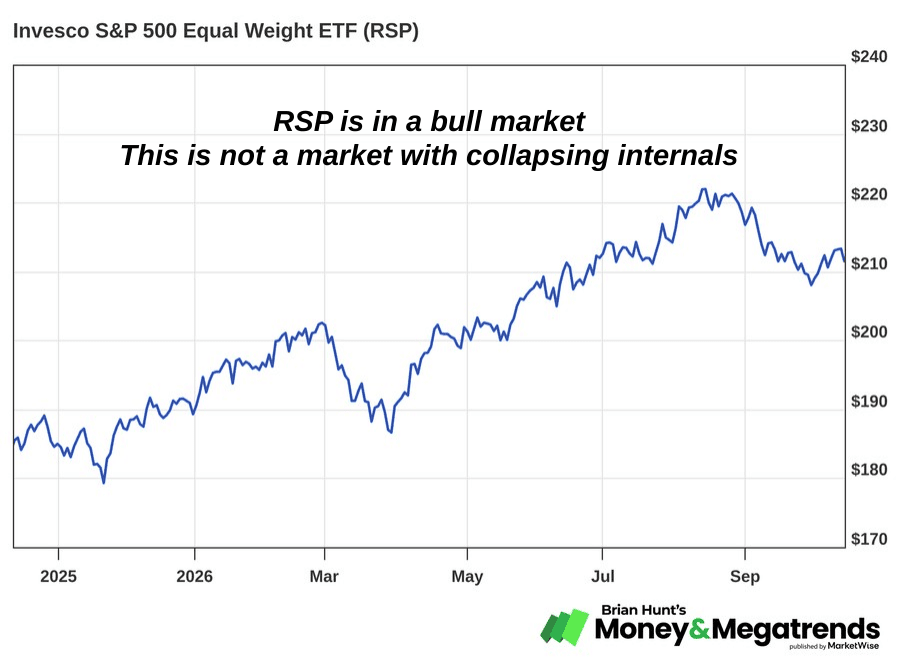
  •  

A unique inflation hedge you’ve probably never considered

Today’s issue in preview:

  • A unique inflation hedge you’ve probably never considered

  • This Bitcoin catalyst could trigger soon and send it past $100,000

  • Learn our Top Themes to buy now


A unique inflation hedge you’ve probably never considered

Image

Credit: f9photos

For anyone looking to protect themselves against inflation, it’s worth knowing that it’s not just timberland on sale right now. World-class collections of gravel pits are also on sale.

Over the past six months, I’ve written a special series of research notes on publicly traded assets such as timberland giant Weyerhaeuser (WY) and construction aggregates firm Vulcan Materials (VMC) that can add a robust “inflation defense” component to your financial life.

You probably know why being vigilant against inflation is important: governments in most Western nations have promised far too many things to far too many people. They are spending far more on taxpayer benefits and wars than they collect in tax revenues.

The related debts and obligations governments have taken on cannot possibly be paid back with sound money. They can only be paid back with debased, devalued money… much of which is created out of thin air. This is driving inflation and significant currency debasement.

Prices are going up because the value of our money is going down.

Measured against a basket of widely used raw materials like crude oil, corn, copper, natural gas, sugar, and soybeans, the U.S. dollar has lost 53% of its value over the past eight years.

When I provide guidance on inflation defense, I urge people to keep my number one rule in mind: own in-demand, useful assets that cannot be easily replaced or replicated.

That is inflation defense in a nutshell. You want to own businesses and properties that produce in-demand, scarce resources, products, experiences, and services.

This group of assets includes quality farmland, beachfront real estate, timberland, mountain-view properties, great businesses, and oil and gas pipelines.

When a very difficult or impossible-to-replicate business or property produces in-demand, scarce resources, products, experiences, or services, it tends to hold its value no matter what the dollar is doing.

Its price will constantly “recalibrate” to accommodate an increase in currency units. It’s like the difference between slicing a pizza into 6 or 8 pieces. The number of slices changed, but the amount of pizza is the same.

In Monday’s issue, we detailed how timberland giant Weyerhaeuser was trading near one-year lows thanks to the rising interest rates and their depressive effects on the housing market.

Rising rates are also driving weakness in blue-chip construction aggregate producers Vulcan Materials and Martin Marietta Materials (MLM).

Together, Vulcan and Martin Marietta own and operate hundreds of mines across America that produce gravel, sand, and crushed stone – aka “construction aggregates.”

These raw materials are literally the foundation of highways, bridges, airports, offices, apartments, homes, and factories. You are virtually guaranteed to have driven on a road made possible by the construction aggregates produced by Vulcan or Martin Marietta. They are the giants of the industry.

Importantly, many of Vulcan and Martin Marietta’s mines are in coveted locations near America’s major metropolitan areas. This is key because construction aggregates are very heavy and therefore costly to transport over long distances. Transporting $5 million worth of gold and transporting $5 million worth of gravel are two very different things.

Given how difficult, expensive, and time-consuming it can be to permit and develop a large gravel mine, we can say both VMC and MLM own irreplaceable collections of scarce, in-demand resources. Again, these attributes are key to playing inflation defense. They’ve allowed the market values of VMC and MLM to rise and outpace dollar debasement over the past seven years.

VMC and MLM are also enjoying the U.S. factory and data center building boom we’ve been investing in with great success. As America grows, VMC and MLM grow with it.

We believe the attributes above are why master “quality” investor Chris Hohn is accumulating stakes in both firms.

Owning a collection of gravel pits and sand mines isn’t as exciting as owning SpaceX or AI stocks. However, if you want to play inflation defense by owning irreplaceable collections of scarce, in-demand assets whose prices can rise along with the rate of money creation, consider VMC and MLM.

Image

Recommended Link:

America’s New Money – Explained

Ad Image

Porter Stansberry reveals how Executive Order 14241 may have unleashed the first U.S. Dollar reset in 52 years. If you own property, stocks or have savings in the bank – discover what it could mean for your personal wealth. Go here to watch now.
  

This Bitcoin catalyst could trigger soon and send it past $100,000

Image

Credit: Vertigo3d

Bitcoin owners and watchers take note: The world’s leading digital asset is poised to clear a critical price level… which could serve as a catalyst to send it past $100,000 per coin.

Back in March, we wrote a bullish research note on how we believed Bitcoin had reached an important bottom.

After reaching an all-time high of around $125,000 last October, Bitcoin entered a brutal bear market, declining by about 48% to the mid-$60,000 range.

Crypto specialists attributed this decline to the U.S. government withdrawing liquidity from financial markets, as well as to gold and AI trades drawing money flows that could have been directed toward Bitcoin.

Most long-term Bitcoin believers see it as a “store of value” that should maintain its purchasing power like gold and beachfront homes do. It should be a digital form of “hard money.” Sounds great.

However, from October 2025 to February 2026, Bitcoin traded more like a failing technology company than anything you’d call strong and stable.

In March, Bitcoin’s trading behavior underwent a significant change. It formed a bottom and gained 9.5% in one month, while technology stocks dropped and gold gained just 3.2%.

Importantly, Bitcoin outperformed stocks and gold as Operation Epic Fury created tremendous market volatility and hammered many sectors of the stock market. It was a “port in the storm.”

Importantly, Bitcoin recently rallied above its long-term 200-day moving average. This is a good sign of an improving health trend.

Remember what we say about the 200-day moving average around here: Securities below their 200-day moving average are on the wrong side of the tracks. It’s the ugly part of town. All the really bad things happen below the 200-day moving average. Bitcoin has broken above it.

So, after a year of disappointing believers, has Bitcoin regained its place as a “store of value”? Is it ready to be a “port in the storm” and a stabilizing component of serious portfolios?

I hope so.

The world is a better place when Bitcoin is rising, and we have not one but two forms of hard money to own.

Bitcoin is currently trading for around $79,000. You can see in the chart below that a break above $82,500 would mark Bitcoin’s highest level in over six months.

This break could signal to the market that Bitcoin is back in a bull market… which could attract billions in new buying and send it north of $100,000 per coin. This would, in turn, drive adjacent bull markets in blockchain-based stablecoin and tokenization trends.

We’re bullish… and we’ll keep you updated on this potential catalyst.

Image


Market Notes

  • The tokenization trend we’ve been writing about picked up momentum today. Ethereum reached a six-month high.

  • The VanEck Oil Refiners ETF (CRAK) hit a new high today. Individual refining giants Valero Energy (VLO) and Marathon Petroleum (MPC) reached highs, too.

  • Japanese banking giant Mizuho Financial Group (MFG) hit new highs along with Bancolombia (CIB), Colombia’s largest bank. International banks continue their momentum.

  • Our November 17 recommendation to own biotech is doing well. 10X Genomics (TXG) hit new highs today, which puts it up 191% since our recommendation.

  • Our February 3rd recommendation to own space bottleneck play Frequency Electronics (FEIM) just surged 35% post stellar earnings. It’s now up 54% since our February recommendation.

  • Our March 20th recommendation to invest into scandium with Sunrise Energy Metals (SREMF) has performed extremely well. The stock is now up 22% in the last month and 211% since our March recommendation.

Regards,

Brian Hunt signature

Brian Hunt signature

Brian Hunt
Editor, Money & Megatrends


An urgent message from our colleagues:

AI Breakthrough Could Soon Reorder Stock Market Winners and Losers

Image

For years, we’ve been led to believe the tech firm operating at 500 Howard Street in Silicon Valley is “one of the good guys.” But will the advanced form of AI that just emerged from this location change the way we live, work and invest forever? Marc Chaikin reveals the time-sensitive details of this discovery and offers you a FREE 3-part playbook to protect your future.

Click here for the details.

The post A unique inflation hedge you’ve probably never considered appeared first on MarketWise.

  •  
❌