❌

Normal view

  • ✇Porter & Co
  • Weekly Partner Monitor Porter &#38 · Co.
    Welcome to the Partner Monitor… one full week in one short email Recommended stocks, bonds, and funds: NAVI, QQQ… Porter & Co. Distressed Investing: Marty Fridson recommended both the stock and the bond for education loan company Navient (NAVI)… The issue also included a market analysis of distressed debt and a review of current recommendations. We sent this Porter & Co. Distressed Investing report on Saturday, September 12. See a summary below or… Read it here now.The Trading Club: In
     

Weekly Partner Monitor

14 September 2026 at 05:00

Welcome to the Partner Monitor… one full week in one short email

Recommended stocks, bonds, and funds: NAVI, QQQ…

Porter & Co. Distressed Investing: Marty Fridson recommended both the stock and the bond for education loan company Navient (NAVI)… The issue also included a market analysis of distressed debt and a review of current recommendations. We sent this Porter & Co. Distressed Investing report on Saturday, September 12. See a summary below or… Read it here now.

The Trading Club: In response to some macroeconomic risks, Ross Hendricks recommended a new hedging trade: buying to open an Invesco QQQ Trust (QQQ) $680 put, expiring October 16, 2026. Ross alerted members to this trade on Friday, September 11. See a summary below or… Read it here now.

Sunday Screener: This week we dialed in Porter’s 3X Screen and produced a list of 29 companies, plus shared the 52-week highs and 52-week lows in the Sunday Screener. We emailed this Sunday Screener on September 13. See a summary below or… Read it here now.

Daily Journal: Porter kicked off the short week with an analysis of Big Pharma company Novartis (NVS) – both a Biotechnology and High Conviction recommendation that had disappointing results from an FDA Phase III trial. On Wednesday, he detailed the dire shortage in the global fuel supply, namely diesel. On Thursday, Marty Fridson shared his thoughts on prediction markets, gambling, and the stock market. And Porter ended the week on Friday extolling the virtues of AI in particular and tech in general… Read the Daily Journal here now.

Digging Deeper


Porter & Co. Distressed Investing

Porter & Co. Distressed Investing released its recommendation of Navient (Nasdaq: NAVI) – a financial-services company currently pivoting from its legacy of government-guaranteed student loans toward a high-growth private lending business. Its history is rooted in the 1965 Higher Education Act, which established a system of federally guaranteed student aid. Following the 2014 split from Sallie Mae, Navient inherited a large portfolio of these government-backed loans.

Navient’s recent trajectory was significantly impacted by a 2017 CFPB civil complaint regarding servicing practices, which was settled in 2024. As part of this resolution, Navient is permanently barred from originating new federally guaranteed loans, though it continues to manage its existing portfolio.

In response, Navient has shifted its focus to private lending, largely through its acquisition of Earnest. This segment targets high-credit-score, high-income graduates, and growth is being accelerated by the 2026 elimination of the federal “GradPLUS” program. With a combined portfolio of approximately $43 billion, Navient manages both its legacy government-backed loans and its expanding private lending business.

We recommended a “package” of Navient’s 11.5% bonds (maturing March 2031) and its common stock – 25 shares for each bond purchased. The bonds offer a significant yield in a market where similarly rated assets pay less, while the stock trades at a large discount to its net asset value. Despite regulatory history and a declining legacy portfolio, Navient projects strong long-term cash flows, supported by disciplined expense management and the growth of its private loan segment, making it a compelling candidate for income-focused investors… Click here to read the full report from Saturday, September 12.


The Sunday Screener

On Sunday, we revisited a popular stock-filtering tool we call “Porter’s 3x Stock Screen.” Over the last 25 years, buying an equally-weighted basket of stocks generated from the 3x screen has tripled the return over the overall stock market (the S&P 500). In the issue, released Sunday, September 13, we also show the names of significant stocks hitting 52-week highs and 52-week lows – a helpful list that we use to guide our analysis.

The 3x Screen was inspired by Porter himself, who challenged the Complete Investor analyst team to create a filtering tool to find companies with high capital efficiency, steady revenue growth, and that trade at reasonable valuations… and to backtest the results to ensure the screening criteria selected stocks that generated market-beating gains over time… To see the issue, click here.


The Trading Club

On Friday, Ross Hendricks provided an update and trade alert for The Trading Club. Ross emphasized a shift toward a more defensive strategy in the trading service amid escalating market risks. He highlighted a concerning surge in bond yields – with 10-year Treasury yields nearing 5% – and an intensifying energy crisis driven by Middle East conflicts. With U.S. crude prices rising and global refining capacity at historical lows, these energy shocks are increasingly likely to stifle consumer purchasing power, potentially foreshadowing a broader market downturn.

In response to these risks, The Trading Club recommended a new hedging trade: buying to open an Invesco QQQ Trust (QQQ) $680 put, expiring October 16, 2026. The portfolio, which has returned 7% year-to-date, currently lags the S&P 500’s 12% gain, largely because the team has avoided the AI-driven tech rally while maintaining hedges against it. Despite this performance gap, the team reaffirmed their three-part strategy: identifying high-quality stocks, selling options for income, and hedging downside risks. No fundamental changes to this process are planned.

Operationally, due to the upcoming Porter & Co Annual Conference (September 23–24), the next quarterly trade series is delayed until late October. An interim series of trades expiring October 16 will be published on September 21 to bridge this gap. Finally, the update addressed subscriber questions regarding portfolio performance and specific holdings, while hinting at emerging opportunities in the fertilizer supply chain as the team explores new ways to hedge supply risk… To see the full report, click here.


The Week In Porter’s Daily Journal…

On Tuesday, Porter kicked off the short week with an analysis of Big Pharma company Novartis (NVS), which had disappointing results from an FDA Phase III trial for its heart and cholesterol drug pelacarsen… See it here now.

On Wednesday, he detailed the dire shortage resulting from the ongoing war in Iran in the global fuel supply, namely diesel – making the comparison to cotton shortages that emerged during the U.S. Civil War… See it here now.

On Thursday, Marty Fridson shared his thoughts on prediction markets, gambling, and the stock market… See it here now.

On Friday, Porter returned to the Journal to extol the productivity and other great benefits of artificial intelligence to business and society… See it here now.

… Read the Daily Journal here now.


What’s Up Next Week…

The Complete Investor team will be releasing a new stock recommendation on Saturday, September 19.


The post Weekly Partner Monitor appeared first on Porter & Co..

  • ✇Porter & Co
  • New Partner Benefit: Weekly Partner Monitor Porter &#38 · Co.
    Welcome to the Partner Monitor… one full week in one short email.  Recommended stocks, bonds, and funds: LLY, HALO, MSBT, ETH, BSOL, BHYP, COIN, GLXY, CRCL, FIGR, ASST, SBET, FWDI, PURR, SGOV… Porter & Co. Biotechnology: Porter recommended Big Pharma company Eli Lilly (LLY), which he calls the Nvidia of biotech… He also touts pharmaceutical royalty collector Halozyme Therapeutics (HALO). We sent this Porter & Co. Biotechnology report on Saturday, September 5. See a summary below or… R
     

New Partner Benefit: Weekly Partner Monitor

7 September 2026 at 05:00


Welcome to the Partner Monitor… one full week in one short email. 

Recommended stocks, bonds, and funds: LLY, HALO, MSBT, ETH, BSOL, BHYP, COIN, GLXY, CRCL, FIGR, ASST, SBET, FWDI, PURR, SGOV…

Porter & Co. Biotechnology: Porter recommended Big Pharma company Eli Lilly (LLY), which he calls the Nvidia of biotech… He also touts pharmaceutical royalty collector Halozyme Therapeutics (HALO). We sent this Porter & Co. Biotechnology report on Saturday, September 5. See a summary below or… Read it here now.

    Porter & Co. Systematic Crypto: Analyst Justin Brill unveiled this new service for Partners on Saturday, August 29, with a first buy alert on Tuesday, September 1. See a summary below or… Read it here now.

    The Trading Club: Ross Hendricks recommended covered-call trades on six positions of The Trading Club. He’s making new trades designed to generate income from several of our existing long positions to bring in upfront cash into the portfolio. Ross alerted members to this trade on Friday, September 4. See a summary below or… Read it here now.

    Sunday Selection: Sunday Selection focused on the high-growth loan and payment platform Affirm (AFRM). Our weekly Sunday Screener includes a biweekly “For Partners Only” Sunday Selection on a company we are watching. We emailed this Sunday Screener on September 6. See a summary below or… Read it here now.

          Daily Journal: Porter had two guest Journal writers this week in between his own fresh essays: the first of Porter’s was a critique of CoreWeave’s (CRWV) business model and the next explored the high cost in the shipping business. His guests this week included Tuttle Management CEO Matt Tuttle, writing about his ETF based on Porter’s Permanent Portfolio, and Marin Katusa sharing the latest news on gold. See a summary below or… Read the Daily Journal here now.

          Digging Deeper


          Porter & Co. Biotechnology

          Porter & Co. Biotechnology recommended Eli Lilly (LLY) and Halozyme Therapeutics (HALO). Porter made the following comparison: In 2010, the oil business turned from exploration to engineering – when drillers found new ways to dig. Output per rig in the Permian Basin went from 130 barrels a day in 2014 to 800 barrels a day by 2019… Nobody found more oil. They engineered more oil.

          Drug discovery is making that same turn right now. Artificial intelligence (“AI”) will play a growing role in testing new drug targets. AI will dramatically reduce the cost of discovery – figuring out more efficient, more effective, and cheaper ways of hitting the best targets.

          Our portfolio will be built around who owns the best engineering.

          Eli Lilly (LLY) is the best in the world at finding the best pharmaceutical companies to buy that have the leading drugs and delivery methods and it is also the best at building the best therapeutics itself.

          There’s no question, Porter writes, that Eli Lilly will be a leader in fields like gene silencing. And even though shares trade for more than $1,000 and the company’s enterprise value is more than $1 trillion, Porter says shares are cheap compared to what the company will earn over the next decade. On top of its smart acquisitions, Lilly is also a leader in innovation – and what it does with its weight-loss pill over the coming years could transform the entire industry.

          Action to Take: Buy Eli Lilly (NYSE: LLY) below $1,500 per share
          Porter recommends using an 80/20 allocation on this position, where you invest 80% of your capital into the equity and 20% of your capital into a long-dated call option with a strike price that is between 5% and 10% “out of the money.”

          He also recommended Halozyme Therapeutics (HALO). Most antibody drugs have to be dripped into a vein, which means the patient sits in an infusion chair for hours and the hospital bills for a nurse, a chair, and a bag. Halozyme owns an enzyme called rHuPH20 that temporarily loosens the mesh of tissue under the skin, so the same drug can be pushed in with a syringe in minutes. It licenses that enzyme to drug companies under the name ENHANZE and collects a royalty.

          Halozyme runs no trials, treats no patients, and files for no approvals. Roche Holding (SIX: ROG), Johnson & Johnson (JNJ), Takeda Pharmaceutical (TAK), Argenx (ARGX), and Bristol- Myers Squibb (BMY) do all of that. Halozyme cashes checks.

          In June royalty revenue rose 50% to $307.7 million, of which $152.2 million came from DARZALEX, the subcutaneous myeloma drug Johnson & Johnson sells.

          Management raised full-year guidance for the second time this year, to $1.84 billion to $1.91 billion of revenue and non-GAAP earnings of $8.65 to $9.00 a share, up from $7.75 to $8.25. And it bought 4.8 million of its own shares in the quarter for $332.8 million, at an average price of $69.30, under a $1 billion authorization that runs through 2028.

          Action to Take: Buy Halozyme Therapeutics (Nasdaq: HALO) up to $110 per share

          To read the full report, click here.


          Porter & Co. Systematic Crypto

          Porter & Co. Systematic Crypto analyst Justin Brill unveiled this new service for Partners on Saturday, August 29, with a first buy alert on Tuesday, September 1.

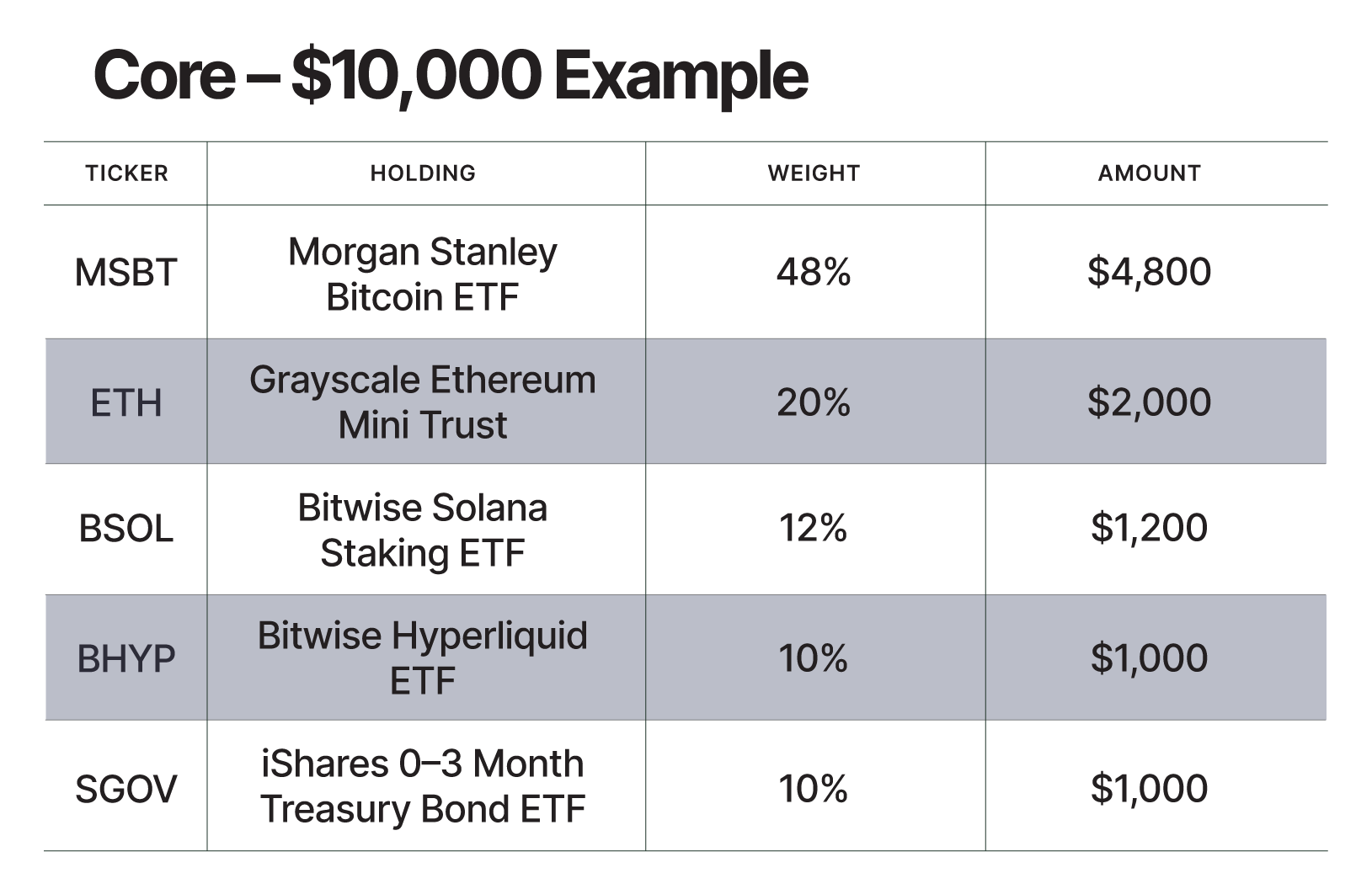
          Systematic Crypto offers two rules-based crypto portfolio strategies – Core and Frontier – built to beat Bitcoin where it matters: after taxes and across a full market cycle. As a Partner Pass member, you receive this service as part of your membership.

          We are launching Systematic Crypto sooner than we planned. Both strategies follow a single long-term trend measure on Bitcoin, evaluated at each month-end. Bitcoin, which traded near $62,000 in early August, is now over $77,000, and we realized that this measure was on pace to turn positive at Monday’s month-end close (August 31) – which would be the first new buy signal these rules have generated since the 2023 bull market began.

          Then on Tuesday, September 1, we confirmed its first real-time buy signal following the August 31 month-end close. What we explained is that the system is trend-following, not predictive; it identifies confirmations rather than attempting to call market bottoms. Historical backtesting suggests this type of signal, which follows months of bearish price action, often marks the beginning of an extended crypto rally.

          When we sent the alert on Tuesday, September 1, we advised subscribers to choose between two strategies:

          • Core: The flagship strategy, designed for the best risk-adjusted performance. It holds four crypto ETFs and a Treasury-bill reserve (five positions total).
          • Frontier: Builds on the Core foundation but adds exposure to emerging areas, such as businesses built on crypto and companies with tokenized balance sheets (13 positions total). It targets higher absolute returns while accepting greater volatility.

          The firm recommends allocating approximately 5% to 10% of investable assets to these strategies. Investors should use a U.S. brokerage account supporting commission-free trading and fractional shares to execute the target weights.

          Once positions are purchased, the system requires no daily monitoring. The rules operate in the background, with triggers for monthly trend checks, weekly circuit breakers, and quarterly rebalances. While these strategies may underperform the broad crypto market during certain periods to mitigate massive drawdowns, they are designed to outperform over a full market cycle. Here are the suggested investment allocations for each of the two strategies.

          To read the full report, click here.


          The Trading Club

          The Trading Club recommends covered calls on a number of existing positions

          In The Trading Club this week, Ross Hendricks shared new trades designed to generate income from several of existing long positions. These trades will bring in upfront cash into the portfolio while still leaving upside of 6% to 14% in additional capital gains over the next six weeks. Those trades include covered calls on Booz Allen Hamilton (BAH), Hims & Hers Health (HIMS), Figma (FIG), Novo Nordisk (NVO), Triple Flag Precious Metals (TFPM), and Turning Point Brands (TPB).

          The covered-call trades we recommended today are not about expressing a changing view on any of the underlying stocks. Instead, the goal is to reduce overall portfolio risk, but to do so in a way that still leaves significant upside on the table.

          As a reminder, when selling covered calls, we’re making the conscious choice to surrender the upside on the underlying stock at prices above the option strike price. By foregoing that upside to the call-option buyers, we generate a guaranteed return via the immediate cash proceeds collected upon the option sale, regardless of where the stock trades from here. So we’re locking in guaranteed income, while still retaining upside potential – in this case, between 6% and 14% across the various call strikes and the underlying stock prices for these trades. Over the relatively brief six-week time period until expiration, this upside potential works out to an average annualized return in the triple digits – which, of course, is very impressive.

          The value of The Trading Club tracking portfolio settled at $131,698 as of Thursday, September 3 – up 31.7% since the May 30, 2025, inception date. We made no trades this week.

          To read the full issue, click here.


          Sunday Selection

          The Sunday Selection on September 6 reported on loan and payment platform Affirm (AFRM) – a true “Emerging Lindy,” a young company possessing the traits of durable, long-lasting businesses like Visa or American Express. Founded in 2012 by Max Levchin (a co-founder of PayPal), Affirm was built to fix a credit system it views as predatory, replacing revolving debt and hidden fees with transparent, fixed-payment “buy now, pay later” (BNPL) loans.

          Affirm’s business model succeeds by underwriting transactions in real-time, aligning profit with consumer repayment rather than failure. The company overcame the “cold-start” problem of building a new payments network by proving it could increase merchant demand – driving conversion rates and larger carts – which attracted major partners like Amazon and Shopify.

          With the core e-commerce business reaching profitability, Affirm is currently pursuing three strategic “S-curves” for growth:

          • E-commerce: Already largely established with over 60% of U.S. e-commerce running through Affirm-enabled merchants
          • Affirm Card: Extending the BNPL model into the physical world, capturing everyday spending with significant growth potential
          • Banking Integration: Leveraging “Affirm Edge” to embed lending within bank apps and seeking a bank charter (“Affirm Bank”) to fund loans with insured deposits rather than capital markets.

          Ultimately, Affirm aims to build a modern, untouchable consumer finance franchise: a two-sided payments network attached to a deposit-funded bank. With Levchin free to focus on long-term innovation and the business now generating its own cash, we see Affirm as a high-conviction candidate to eventually join the ranks of iconic, multi-generational financial institutions.

          While we are not recommending Affirm yet, we are keeping a close eye on it for a future Complete Investor issue.

          To read the full issue, click here.


          This Week In The Daily Journal…

          In Monday’s Daily Journal, Porter explored the capital-intensive business model of data-center builder CoreWeave (CRWV)… and says “it’s a zero.” Read the Journal here.

          In Tuesday’s Daily Journal, Tuttle Capital’s Matt Tuttle explained the architecture of the Porter & Company Porter Portfolio Index ETF… Read the Journal here.

          On Wednesday, Porter reported on the shipping tanker market, gushing more cash than ever before – and what you can do about it. To see that Journal, click here.

          Porter turned Thursday’s Daily Journal over to his friend Marin Katusa, who shared the latest news and opportunities in the world of gold and precious metals. Read Marin’s Journal essay here.

          In Friday’s Daily Journal, Porter revisits the Journal essay about his Bitcoin pricing model following the news that the leading cryptocurrency rose sharply this week. Read the Journal here.


          What’s Up Next Week…

          Marty Fridson will be releasing a new stock/bond combo recommendation this Saturday, September 12, at 10 am. We will send that full report to your inbox and include a summary in next week’s Weekly Monitor.


          Sponsored by Paradigm Press

          Rickards: “I didn’t think the government would go this far”

          In the last few weeks, the White House has done something I’ve haven’t seen in 50 years of working alongside government institutions.

          This is BIGGER than opening federal land… or eliminating mining regulations.

          This is the “final trigger” to unleash America’s 50X mining boom.

          Three small companies are now at the epicenter of a resource boom that could create more wealth than the San Francisco Gold Rush… and the Texas Oil Boom… COMBINED.

          My research shows they could dominate a $100 billion market within 12 months.

          I want to give you a shot to get in before this accelerates further.

          Watch my urgent briefing here.

          Editor’s Note: Keep in mind, we only accept advertising from publishers we know to offer well-researched ideas vetted by a legal team, excellent customer service, and reasonable refund policies. Paradigm Press is one such partner. We do not, however, under any circumstances make any representations about their investment ideas or strategies, nor will we warrant them as equal to our own. We do recognize that the markets are tempestuous and, at times, ideas that we may not endorse prove valuable.

          The post New Partner Benefit: Weekly Partner Monitor appeared first on Porter & Co..

          • ✇Porter & Co
          • The Long-Legged Leader Of Biotech Porter &#38 · Co.
            This Is Why We Love Big Pharma Porter & Co. High Conviction does not follow a regular schedule. We only publish it when we believe the recommendation is so certain to be a long-term winner that we’d be prepared to invest 100% of our capital into it. To be clear, a high-conviction opportunity isn’t necessarily about how much a share price might appreciate – but rather, the probability that a share price will rise steadily over time. Sometimes, these situations may only result in a modest aver
             

          The Long-Legged Leader Of Biotech

          2 September 2026 at 07:03

          This Is Why We Love Big Pharma

          Porter & Co. High Conviction does not follow a regular schedule. We only publish it when we believe the recommendation is so certain to be a long-term winner that we’d be prepared to invest 100% of our capital into it.

          To be clear, a high-conviction opportunity isn’t necessarily about how much a share price might appreciate – but rather, the probability that a share price will rise steadily over time. Sometimes, these situations may only result in a modest average annual gain… but it comes with far less risk than your average investment.

          That’s the opportunity we’re presenting in this issue, with one of the pharmaceutical world’s most well-known and established brands. The company was founded in 1758. But over the last few years, the company has emerged as a Big Pharma leader while at the same time becoming an exciting growth story in the biotech world.


          Talk about a Lindy business – which Porter describes as a company with excellent economics and long track records in the marketplace, of at least 20 years… This biotech firm has been at it for 268 years. And it continues to crush it.

          Novartis (NYSE: NVS) traces its roots to a Basel, Switzerland, dye-works founded in 1758. The $300 billion market-cap company now sells medicines in around 80 countries, earned a 41.2% operating margin on $14.4 billion of sales in the most recent quarter, and converted $5.6 billion of that quarter’s revenue into cash. It paid shareholders a remarkable $7.8 billion in dividends last year.

          Novartis has produced a first-in-class medicine in nearly every modern modality.

          • Approved in 2001, Gleevec was the first drug designed to jam the single enzyme that drives chronic myeloid leukemia
          • Approved in 2017, Kymriah was the first approved therapy that reprograms a patient’s own immune cells to hunt cancer
          • Approved in 2017, Zolgensma delivers a working gene inside a virus to infants born without it
          • Approved in 2018, Lutathera (and later Pluvicto) attach radiation to molecules that seek out tumors
          • Approved in 2026, Fabhalta slows kidney function decline in IgA nephropathy, blocks part of the immune system’s complement cascade with a twice-daily capsule

          The management still guides to 5% to 6% sales growth a year through 2030 because innovation in the pharma industry continues to produce new, higher-quality, patent-protected medicines. Novartis has re-stocked its patent portfolio with gene-silencing drugs. It is currently ramping sales of Leqvio – developed by Alnylam Pharmaceuticals (ALNY) – a twice-yearly cholesterol injection, which sold $1.2 billion in 2025 and $480 million in the June quarter alone, both up 59% year-over-year.

          Plus – and this is the big one – we believe Novartis is going to win the race to the first Lipoprotein(a) target. Lp(a) is a cholesterol-carrying particle set almost entirely by the genes a person is born with. Diet does not move it. Exercise does not move it. Statins barely touch it. It causes heart attacks, strokes, and a narrowing of the aortic valve, and no approved drug lowers it.

          Novartis enrolled 8,323 patients with established heart disease in Lp(a)HORIZON, the first trial ever run to prove that lowering Lp(a) prevents cardiovascular events rather than merely moving a laboratory number. Results arrive in the second half of this year. Novartis intends to file with the Food And Drug Administration (“FDA”) this year.

          Novartis licensed its Lp(a) gene-silencing drug, called pelacarsen, from Ionis Pharmaceuticals (IONS) in February 2019, took worldwide responsibility for developing, manufacturing, and selling it, and has funded the 8,323-patient trial since.

          An estimated 18.7 million American adults have established cardiovascular disease, and roughly 21% of them carry Lp(a) above the level Novartis used to enroll its trial – 3.9 million people in the U.S. alone. Only 2% of American cardiovascular patients have ever been tested for it.

          In March 2026, the American College of Cardiology and the American Heart Association began recommending that every adult have Lp(a) measured at least once, and that the relatives of anyone with a high reading be tested too.

          The three lead Lp(a) drugs are estimated to generate $5.6 billion combined by 2032. One estimate models pelacarsen above $3 billion at its peak. Our own model, built from the diagnosed population upward, produces $4 billion in 2032 annually and $13 billion annually by 2036.

          Why Novartis Is High Conviction

          If pelacarsen sells on the low side, $3 billion a year, Novartis collects about $2.4 billion of it. Ionis gets roughly $450 million. Royalty Pharma (RPRX) takes the remaining $150 million. Novartis keeps $4 out of every $5. The company that discovered this molecule, that spent three decades learning how to build it, will keep about 15 cents of every dollar it earns. That’s the power of Big Pharma.

          And it gets better… Novartis trades at 18x trailing earnings and pays a 3% dividend. The huge opportunity in Lp(a) isn’t priced into the stock.

          That’s why Porter will continue to recommend Big Pharma in our Porter & Co Biotechnology portfolio – and that’s why we are making Novartis part of High Conviction now. Novartis is likely to be one of the single biggest growth companies in the world over the next 20 years, despite its current (large) size.

          Action to Take: Buy Novartis (NYSE: NVS) up to $165 per share

          Porter & Co. Stevenson, Maryland

          The post The Long-Legged Leader Of Biotech appeared first on Porter & Co..

          ❌